


1 Introduction
Birth registration exists in the legal systems of different countries not only as an administrative obligation but also as a linguistic act through which relations of kinship are created. In Ukraine, for example, the law requires birth certificates to unequivocally assign a father’s identity, even in cases where paternity has neither biological nor legal existence. This constitutes an instance in which a legal fiction becomes embedded within state documentation practices. The operation assumes that completeness in documentation provides for the psychological welfare of the child. However, its impact goes much deeper than mere administrative neatness, affecting issues of personal identity and legal recognition as well as psychological welfare.
The primary aim of this article is to examine Article 135(1) of the Family Code of Ukraine (FCU) from legal, historical, linguistic and socio-legal perspectives, scrutinising the phenomenon of mandatory paternal attribution for children born to unmarried single mothers. To achieve this, the study maps the historical genesis of this norm, tracks its systemic application in contemporary Ukraine and evaluates its compliance with international human rights standards, specifically the UN Convention on the Rights of the Child (UNCRC) and the European Convention on Human Rights (ECHR).
The objective of this research is to advocate for a fundamental legislative reform of the Ukrainian civil registration framework. By critically evaluating Western European approaches alongside post-socialist and global models, this study demonstrates that transitioning from institutionalised legal fictions to the principle of legal realism (where unestablished paternity is recorded transparently as ‘unknown’ or left vacant) eliminates administrative friction. Ultimately, the goal is to provide policy-makers with a robust, harmonised framework that conceptually aligns Ukrainian family law with European standards, thereby removing obsolete bureaucratic barriers that harm single mothers and children in international and cross-border contexts.
The central argument of this article is that the mandatory entry of a fictitious father on birth certificates is an obsolete ideological relic of the Soviet regime that actively harms, rather than protects, the modern subject. The state’s original paternalistic justification, which held that a complete document provides social and psychological comfort to the child, functions as a mechanism of institutional concealment. Instead of addressing structural discrimination or supporting vulnerable mothers, the law uses a paper fiction to reinforce an idealised patriarchal model of family organisation.
Furthermore, we argue that while this fiction attempts to hide parental absence, it may interfere with the child’s access to information concerning their biological origins and devalues the individual, who should be recognised by the state as inherently valuable regardless of paternal status. In the context of the ongoing war and the resulting refugee crisis, this overextended legal fiction has generated systemic administrative difficulties. Specifically, it forces single displaced mothers into costly, prolonged and degrading bureaucratic cycles in foreign jurisdictions just to prove to international authorities that a fictitious father does not exist and holds no custody rights. Therefore, true harmonisation with European values requires abandoning this paternalistic legal fiction in favour of documentary truth and the unconditional recognition of the child’s autonomous worth.
To ensure terminological clarity, this article uses the term ‘administrative legal fiction of fatherhood’ to denote entries in civil registration documents that construct a paternal identity purely for administrative completeness when there are no legal grounds to record the biological father on the child’s birth certificate, and when no other legally recognised form of fatherhood involving a real individual, such as an adoptive father, is available. Unlike the classical legal fiction of paternity, which attributes fatherhood to an identifiable man under the presumption of marriage or legitimacy, the Ukrainian administrative fiction creates a paternal identity that refers to no real person and functions as a placeholder generated to satisfy formal bureaucratic requirements. An illustrative Ukrainian case, discussed in section 4, concerns a single mother who, following the outbreak of the full-scale war, was unable to obtain the Canada-Ukraine Authorization for Emergency Travel (CUAET) because her child’s birth certificate had an administratively created, non-existent father in the ‘Father’ field. Immigration authorities treated this fictitious entry as evidence of an actual parental relationship and therefore required a signed paternal consent. This disjunction between documentary form and social reality produced a tangible barrier to the family’s safety and mobility.
2 Theoretical views on legal fiction
2.1 Classical ideas about legal fiction
The conceptual framework of legal fiction occupies a foundational yet highly contested position in jurisprudence. Legal fiction is defined broadly as a device where the law assumes something to be true that is known to be false in order to achieve a specific legal outcome, and the utility and ethics of fictions have divided legal theorists for centuries. To understand their operation in modern administrative and family law, it is essential to trace this phenomenon from its historical roots to contemporary critical legal studies, mapping the shift from functional necessity to systemic pathology.
The philosophical underpinnings of legal fictions find their most systematic articulation in Hans Vaihinger’s Philosophy of ‘As If’ (Die Philosophie des Als Ob). Vaihinger posited that human cognition naturally relies on deliberate, scientifically or practically useful fabrications – conceptual constructs that are known to diverge from reality but are maintained because they facilitate operational efficiency. In the realm of law, this ‘as if’ thinking allows complex, multilayered social dynamics to be translated into rigid, manageable statutory categories (Vaihinger Reference Vaihinger2021). Sir John Salmond operationalised this within common-law jurisprudence, famously observing that the law, to remain an efficient and workable system, ‘must needs be blind to many things’ and that, partly by deliberate design, ‘legal theory and the truth of things are far from complete coincidence’ (Salmond Reference Salmond1902, pp. 22–23). For Salmond, and subsequent functionalist theorists, fictions are benign, creative instruments of institutional adaptation, enabling legal systems to fill statutory gaps, extend remedies or maintain doctrinal consistency without requiring clumsy legislative overhauls. This functionalism is historically illustrated by the presumptions of legitimacy or the ancient doctrine of nasciturus pro iam nato habetur.
However, this utilitarian celebration of legal fictions has faced severe resistance from analytical and critical legal traditions. Jeremy Bentham famously launched a scathing critique against judicial and statutory fabrications, branding legal fiction as ‘falsehood’ and comparing it to a systemic infection – the ‘syphilis of the law’ – that corrupts institutional integrity. Bentham argued that fictions obscure accountability, mystify power dynamics and force citizens to operate within a state-manufactured illusion (Bentham Reference Bentham1821, pp. 61–62). In the twentieth century, Lon L. Fuller synthesised these opposing views in his seminal work Legal Fictions. Fuller acknowledged that fictions are pervasive across disciplines, famously noting their structural presence ‘in two subjects that seem in other respects at opposite poles from one another: physics and jurisprudence’ (Fuller Reference Fuller1967, p. ix). When a fiction is viciously isolated from its context or taken literally by the bureaucracy, it hardens into a rigid dogma and a dynamic of alternation of reality. As Fuller warned, such a process results in ‘mystifying and perplexing the mind’ (Fuller Reference Fuller1967, pp. 114–15, 120), misleading institutional actors and degenerating into an instrument of systemic unfairness.
In recent decades, contemporary scholars have shifted the focus of this debate towards the administrative state. Del Mar and Twining, in their comprehensive volume Legal Fictions in Theory and Practice, emphasise that modern bureaucracies increasingly deploy digital and documentary fictions not to achieve equity, but to enforce mechanical symmetry and procedural standardisation (Del Mar and Twining Reference Del Marand and Twining2015). Modern critical legal theory argues that when an administrative apparatus forces a counter-factual premise on foundational identity documents, the fiction ceases to be an intellectual tool for judicial reasoning; instead, it transforms into an institutionally imposed narrative that overrides individual autonomy.
In this context, Shmilovits provides a critical missing link by arguing that fictions in modern governance frequently survive because they are exceptionally economical in terms of cognitive and procedural costs (Shmilovits Reference Shmilovits2022). Within private and administrative law, it is inherently more efficient for the state apparatus to pretend that Situation A (a single-parent family) is structurally identical to Situation B (a traditional nuclear family) than to formulate an entirely new protective doctrine, gather fresh evidence or rewrite an existing administrative algorithm. Consequently, the persistence of a legal fiction is driven not by ethical considerations or human welfare, but by institutional inertia and the pragmatic desire to minimise bureaucratic expenditure.
By engaging with this substantial academic literature, this article establishes a diagnostic matrix is established for examining modern birth registration practices in order to unpack the systemic dysfunction of mandatory paternity attribution in Ukraine. First, alignment with Bentham’s critical tradition is employed to expose how the mandatory fabrication of a father’s identity functions as an institutional falsehood that corrupts the integrity of civil records. In the context of birth registration, this fiction operates as a form of obfuscation that mystifies power dynamics, enabling the state to avoid substantive legislative and financial responsibility for supporting single mothers by masking the social problem behind a mandatory fictitious paternal entry.
Second, Fuller’s framework of legal fictions is utilised to identify the point at which an administrative tool degenerates into systemic pathology. As Fuller warned, a fiction remains functional only insofar as its counter-factual nature is consciously recognised by institutional actors. In the Ukrainian case, amid the ongoing war crisis, mass forced displacement and the emergence of millions of Ukrainian refugees in foreign jurisdictions, this localised legal fiction is increasingly treated as fact by foreign authorities. When international bureaucracies recognise the ‘fictitious father’ as a factual legal entity, thе critical degree of the fiction is reached, transforming a domestic administrative placeholder into a source of tangible administrative, financial and psychological harm for both child and mother.
Third, insights from Del Mar, Twining and Shmilovits are synthesised to reveal the underlying logic of state rigidity. The persistence of this fiction does not function as child protection, but rather as an enforcement of administrative symmetry, standardisation and institutional economy of resources. Ultimately, this integrated theoretical framework provides diagnostic criteria for subsequent analysis demonstrating that what initially appears as a paternalistic mechanism for protecting children from social stigma has evolved into an institutional illusion that undermines individual autonomy and compromises the child’s right to legal and biological truth.
2.2 Discursive and performative dimensions of legal fictions
Legal texts and official state documents do not merely record pre-existing biological facts or issue passive administrative commands; from a critical discourse perspective, they actively participate in shaping cognitive models of identity, belonging and relational structures. The linguistic choices embedded within foundational documents, such as birth certificates, exert a profound, long-term influence on an individual’s sense of self and social orientation (Fairclough Reference Fairclough2010).
Because these legal documents operate performatively, they linguistically constitute legal identities by asserting specific relationships, statuses and entitlements. When a state mandate requires the attribution of a fictional ‘father’ in the complete absence of biological or legal reality, it forcefully places the child into a preconstructed, counter-factual cognitive frame. This process embeds an imaginary, state-manufactured relational map directly into the developing cognitive structures of an individual’s identity. As critical psychological and socio-legal studies have increasingly demonstrated, seemingly neutral legal phrases and administrative fields carry deep, hidden existential and psychological consequences, particularly when public documentation creates false realities that individuals are later forced to reconcile with their personal, lived truths (Tobin Reference Tobin2019). Therefore, the mandatory entry of a paternal identity represents a formative, intrusive linguistic and institutional intervention into an individual’s lifelong construction of self.
To fully grasp the mechanism through which administrative language alters social reality, this framework draws upon John Langshaw Austin’s theory of speech acts, which posits that language does not merely describe circumstances but actively enacts them. Performative utterances bring into concrete existence the very states of affairs they declare, effectively changing the legal and social status of subjects (Austin Reference Austin1962). Judith Butler extended this performative framework to the domain of institutional regulations and identity construction, arguing that the language of state apparatuses, official certificates and public records does not just describe a population, but actively produces, enforces and regulates subjectivities (Butler Reference Butler1997). Within these conceptual parameters, the entry of a fictional name into a birth certificate functions as a precise institutional speech act. While institutional performatives are traditionally designed to stabilise populations and streamline state management, they generate severe destabilising effects on both psychological and social fronts when the fictions they enforce inevitably collapse under administrative, legal or personal scrutiny.
Complementing the theories of performativity and critical discourse are the insights of cognitive linguistics, particularly the conceptual metaphor theory developed by George Lakoff and Mark Johnson. Legal frameworks and bureaucratic protocols are heavily intertwined with underlying conceptual metaphors that unconsciously dictate how institutions interpret and discipline social reality. A dominant metaphor governing family law is ‘Family is a Symmetrical Structure’. This structural metaphor heavily influences state practices, creating an institutional impulse to impose a complete, idealised and perfectly symmetrical version of the family unit on official documentation (Lakoff and Johnson Reference Lakoff and Johnson1980). Under the influence of this metaphor, the bureaucratic compulsion to fill the ‘Father’ field reflects a cognitive mapping where a child is conceptualised as an ‘inhabitant of a completed structure’. Consequently, leaving a paternal field blank is systematically resisted by the state apparatus because an empty space metaphorically signals that the family structure is inherently broken, incomplete or defective. Alongside this operates the metaphor ‘Law is a Builder of Reality’, which positions legal frameworks as active architects of social existence. When legal systems deploy fictions to aggressively enforce document symmetry, the law metaphorically ‘builds walls’ designed to conceal parental absence or social fragmentation.
In synthesis, the convergence of classical jurisprudential critiques and contemporary discursive and cognitive-linguistic theories establishes an integrative diagnostic matrix for evaluating contemporary birth registration frameworks. By operationalising these complementary lenses, this study transcends a purely formalistic assessment of family law, positioning the mandatory attribution of unverified paternity at the intersection of institutional utility and discursive violence. Where the historical evolution of legal fictions – from Fuller’s warnings on overextended dogmas to Shmilovits’s resource economy – illuminates the state’s pragmatic incentives for maintaining structural symmetry, the frameworks of performativity and conceptual metaphors expose the hidden human costs of these bureaucratic choices. The ‘fictitious father’ entry ceases to be analysed as a benign administrative placeholder; instead, through the synthesis of Bentham’s warning against systemic obfuscation and Butler’s account of state-enforced subjectivities, it is revealed as an overextended fiction that codifies a counter-factual reality. Consequently, this integrated theoretical scaffolding provides the necessary analytical parameters in the subsequent sections to scrutinise the systemic pathologisation of Ukrainian civil documentation, demonstrating how a rigid paternalistic mandate, designed for domestic ideological containment, degenerates into a material obstacle that violates individual autonomy and generates severe cross-border vulnerabilities for single mothers and children in foreign jurisdictions.
3 Legal and linguistic framework in Ukraine
3.1 Linguistic and legal dilemmas
In Ukraine, the legal foundation for including a father’s name on birth certificates comes from Article 135 of the FCU. This article states that if paternity is not established through mutual agreement or a court decision, the birth certificate still needs to be filled in: the father’s surname is taken from the mother, and his first name and patronymic are recorded based on her instructions.
The current wording of Part One of Article 135 of the FCU (Law of Ukraine dated 10 January 2002, No 2947-III) is a direct legacy of Soviet family law policy. Prior to 1917–19 (the period of the Russian Empire), the registration of births was conducted exclusively through church parish registers (metric books). Children born out of wedlock were openly recorded as illegitimate, with information provided only regarding the mother and witnesses.
The Code of Laws on Acts of Civil Status, Marriage, Family and Guardianship Law of the Ukrainian Soviet Socialist Republic (UkrSSR) of 1919 (Articles 133, 140) (which was not effectively brought into force by the Soviet authorities due to the events of the Civil War) represented the first attempt to codify Soviet family law in Ukraine. For the first time in history, children born out of wedlock were granted equal rights to those born within a legal marriage. In practice, when resolving disputes, the courts and authorities of the UkrSSR relied on separate decrees (e.g. the 1919 Decree on Civil Marriage and Divorce) and the subsequent 1926 Code of Laws on Marriage, Family and Guardianship.
The Decree established the baseline for the protection of women who gave birth to children outside of a registered marriage: the terms ‘out-of-wedlock’ and ‘illegitimate’ child were officially abolished; an unmarried mother was granted the legal right to sue any man to establish his paternity over the child; if the court recognised the man as the father, he was obliged to cover the costs of child maintenance and medical assistance for the mother in proportion to his income.
The 1926 Code further developed these ideas, rendering the procedure for holding fathers liable even more radical and simpler for women: a pregnant unmarried woman had the right to file an application with the civil registry office three months prior to giving birth, specifying the name of the putative father; if the man did not contest the application in court within one month, he was automatically recorded as the father, bearing all corresponding child support obligations; if the woman had sexual relations with multiple men during the period of conception, the court could order all these men to pay child support in respective shares for a single child; if the father could not be located, the corresponding field remained blank, or a fictitious name was permitted with the annotation ‘as stated by the mother’. The 1926 Code equated unregistered cohabitation with official marriage. During this period, the Soviet authorities sought to protect the single mother not through direct state benefits (which the devastated country practically lacked), but through the compulsory search for the biological father and the maximum simplification of the procedure for recovering funds from him.
However, the Decree of the Presidium of the Supreme Soviet of the USSR dated 8 July 1944, ‘On increasing state assistance to pregnant women, mothers of large families, and single mothers…’ – enacted towards the end of World War II under conditions of catastrophic demographic losses to stimulate the birth rate – rigidly bifurcated the ‘legal’ and ‘out-of-wedlock’ family. A single mother was categorically prohibited from applying to the courts with lawsuits for the establishment of paternity and the recovery of child support. A dash was placed in the ‘Father’ field, the child was automatically assigned the mother’s surname and the patronymic was recorded according to her instruction. For the first time, the state assumed the obligation to pay a monthly financial allowance to single mothers for the maintenance of a child until they reached the age of twelve, while unregistered cohabitation completely lost its legal status. This Decree aimed to stimulate the birth rate by relieving men of any financial or legal burden arising from out-of-wedlock relationships; in a country facing a deficit of the male population, the state sought to shield men (especially military personnel) from lawsuits and financial liabilities resulting from casual encounters during the war. The Decree categorically prohibited both the voluntary acknowledgement of paternity out of wedlock and its judicial establishment. The paradox of Stalinist legislation was also manifest in the fact that a man could adopt someone else’s orphaned child through a decision of the executive committee, but was forbidden from adopting his own biological child unless he entered into an official marriage with the child’s mother. The state began to officially refer to the woman as a ‘single mother’ and paid her a meagre allowance. In society, such children faced severe stigmatisation (referred to as bezbatchenky – ‘the fatherless children’). This rigid system involving ‘dashes’ and the prohibition on searching for fathers persisted for nearly a quarter of a century, until the family law reform of 1968.
The Code on Marriage and the Family of the UkrSSR of 1969 (Article 55, Part 3) established for the first time that upon the birth of a child to an unmarried mother, in the absence of a joint application or a court decision, the record concerning the father is made using the mother’s surname, while the first name and patronymic are recorded according to her instruction. Article 55 of the Code established a legal mechanism to ensure that a father was legally recorded in the birth certificate of every child, in order to (fictitiously) equalise the rights of children born within and outside of marriage, and to formulate a patronymic for the child in accordance with Soviet traditions (the clerical tripartite formula: first name, patronymic, surname). Furthermore, this form of registration obscured the true scale of single-parent families in state statistics and maintained the ideological image of the complete Soviet family. Consequently, the 1969 Code did not reinstate the model of establishing paternity characteristic of the 1926 legislation, but rather performed a compensatory fictionalisation of the consequences of the 1944 Decree by replacing open legal fatherlessness with a symbolic construction of a paternal record. This norm was transferred into independent Ukraine virtually unchanged. The Family Code of Ukraine of 10 January 2002, No 2947-III (Article 135, Part 1), drafted under the leadership of Prof. Zoryslava Romovska, preserved this Soviet mechanism out of the very same considerations regarding the equalisation of the rights of children born within and outside of wedlock.
Pursuant to Part 3 of Article 123 of the FCU and Order of the Ministry of Health No 787, a single woman has the full right to give birth to a child via artificial insemination using the material of an anonymous donor. In this case, the legal status of the donor is clearly defined: he possesses no parental rights or obligations regarding the future child, and his anonymity is protected by law. However, upon the registration of such a child, a legal anachronism arises: instead of reflecting the legal reality (such as leaving the field blank or simply removing it), the state system once again compels the mother to apply Article 135 – that is, to invent a first name and patronymic of a non-existent man. The law forces the woman into myth-making in a scenario where the origin of the child is an absolutely legitimate and conscious choice based on modern technologies.
Conversely, in accordance with paragraph 15 of the ‘Procedure for Registering Civil Status Acts in the Ukrainian SSR’, approved on 12 December 1970, the surname, first name and patronymic of a found child (a foundling) are recorded according to the data specified in the decision of the guardianship and trusteeship authority, with an entry in the ‘For Notes’ field stating: ‘The child was found, the parents are unknown, information about them has been entered in accordance with the decision of the guardianship and trusteeship authority.’ The fields ‘Mother’ and ‘Father’ remain blank. The state system operates from the position that the absence of information regarding both parents in the documents of a foundling does not inflict critical psychological trauma upon the child and is a normal reflection of their legal status, which paves the way for subsequent adoption. On the other hand, in the case of a child who has an actual mother, the state deems a blank paternity field to be an impermissible traumatising factor. An analysis of the adjacent legislation of Ukraine reveals a normative inconsistency and the application of double standards regarding the psychological protection of children.
Furthermore, the argument regarding the necessity of forming a patronymic also loses its cogency. It is fundamentally based on the premise that in order to record a patronymic in the documents, it is necessary to preliminarily create a legal image of a father, even where paternity has not been established. However, such logic is inconsistent with current regulation, given that the Law of Ukraine No 942-IX of 3 November 2020, enacted on the basis of Draft Bill No 2450, introduced amendments to Article 295 of the Civil Code of Ukraine and Article 149 of the FCU. Effective from 1 January 2021, these amendments provided an individual (starting at fourteen years old) with the right to change their patronymic, specifically to a matronymic (derived from the mother’s name). Consequently, if the law already permits the use of a matronymic as a legally valid element of a person’s full name, but prohibits its application at the stage of primary state registration of birth under Article 135 of the FCU, an obvious logical and legal contradiction arises. The actual burden and full responsibility for the child from the first days of life are borne solely by the mother; why, then, in addition to the surname, can she not legitimise a matronymic instead of a patronymic-construct from the very moment of birth? A prudent and progressive step within the context of ensuring gender equality and protecting the interests of single mothers would be the abolition of this obsolete norm, which fulfils neither the function of protecting children from discrimination nor the function of a necessary basis for the formation of a child’s full name.
However, the practice of administrative legal fiction of fatherhood raises some important linguistic and legal dilemmas. When we fill in the ‘Father’ field with a fictional name, are we preserving social truth or distorting it? Does adding a made-up name genuinely help the child’s mental health, or could it lead to cognitive dissonance and distress in the future? In Ukrainian legal discussions, the main argument for keeping a filled-in record is psychological: it is thought that having all parental information helps the child avoid feeling incomplete. Yet, research on how children form their identities is increasingly questioning this belief (Clapton Reference Clapton2014), indicating that honesty, rather than fiction, is what truly supports healthy psychological growth.
3.2 Prevalence and scope of the issue in Ukraine
In order to estimate the population of children who remained minors as of 2025 and were potentially subject to the ramifications of the legal status associated with birth registration under Article 135 of the FCU (together with their mothers, who acquired the status of single mothers), a timeframe spanning 2008–25 was selected for this study. This approach enables the determination of the current scale of this vulnerable socio-legal category in Ukraine.
The baseline premise for the calculation is the correlation established in demographic studies between the total out-of-wedlock birth rate and births registered pursuant to Article 135 of the FCU. Specifically, according to data from the M.V. Ptukha Institute for Demography and Social Studies of the National Academy of Sciences of Ukraine, in 1994, nearly half (47.8 per cent) of children born to unmarried women were registered on the basis of a joint application by the father and mother, whereas the remaining 52.2 per cent were registered solely on the basis of the mother’s application (Sliusar Reference Sliusar2018, p. 32). This coefficient remains the only officially verified academic benchmark in Ukrainian scholarship, since, beginning in 1995, government authorities stopped publishing separate statistics on the number of child registrations carried out under Article 135 of the FCU. Thereafter, this figure was no longer reported independently and became part of the broader indicator ‘the number of live births to mothers who were not in a registered marriage’.
Based on data published by the State Statistics Service of Ukraine (the number of live births to mothers not in a registered marriage, and their percentage relative to the total number of live births) and the Ministry of Justice of Ukraine (birth statistics in Ukraine) for the pre-war period of 2008–21 (State Statistics Service of Ukraine 2020, p. 49; 2022, p. 44; 2023, p. 32), and applying the method of proportional recalculationFootnote 1 to estimate unpublished corresponding data for 2022–25 (the period of the ongoing full-scale war in Ukraine), we obtain the figures presented in Table 1.
Estimated number of children born in single-mother households (Article 135 of the FCU) in Ukraine within 2008–2025

Table 1 Long description
The table presents data on the estimated number of children born in single-mother households in Ukraine from 2008 to 2025. It includes columns for the year, total births, out-of-wedlock births, births in single-mother households, and data status. The table has 18 rows and 5 columns. Row 1: AQ13, 510600, 110800, 57838, Official Database of State Statistics Service of Ukraine and Ministry of Justice. Row 2: 2009, 512525, 111730, 58323, Official Database of State Statistics Service of Ukraine and Ministry of Justice. Row 3: 2010, 497700, 108785, 56786, Official Database of State Statistics Service of Ukraine and Ministry of Justice. Row 4: 2011, 502600, 103980, 54278, Official Database of State Statistics Service of Ukraine and Ministry of Justice. Row 5: 2012, 520700, 99175, 51769, Official Database of State Statistics Service of Ukraine and Ministry of Justice. Row 6: 2013, 503700, 94370, 49261, Official Database of State Statistics Service of Ukraine and Ministry of Justice. Row 7: 2014, 465900, 89566, 46753, Official Database of State Statistics Service of Ukraine and Ministry of Justice. Row 8: 2015, 411800, 84761, 44246, Official Database of State Statistics Service of Ukraine and Ministry of Justice. Row 9: 2016, 397000, 79982, 41751, Official Database of State Statistics Service of Ukraine and Ministry of Justice. Row 10: 2017, 364000, 74779, 39035, Official Database of State Statistics Service of Ukraine and Ministry of Justice. Row 11: 2018, 335900, 68809, 35918, Official Database of State Statistics Service of Ukraine and Ministry of Justice. Row 12: 2019, 308800, 63371, 33079, Official Database of State Statistics Service of Ukraine and Ministry of Justice. Row 13: 2020, 299100, 60186, 31417, Official Database of State Statistics Service of Ukraine and Ministry of Justice. Row 14: 2021, 273772, 55781, 29118, Official Database of State Statistics Service of Ukraine and Ministry of Justice. Row 15: 2022, 206032, -, 21914, Proportional recalculation. Row 16: 2023, 187387, -, 19926, Proportional recalculation. Row 17: 2024, 176679, -, 18793, Proportional recalculation. Row 18: 2025, 168800, -, 17953, Proportional recalculation. Total: 6642995, -, 708158, -.
The figure of 708,158 children calculated on the basis of the core coefficient (approximately 10.66 per cent of all births during the relevant period) should be viewed as a conservative lower bound of the estimate. There are compelling sociodemographic and legal grounds to assert that the actual proportion of children whose births were registered under Article 135 of the FCU exhibited a steady upward trend throughout the study period. Although the absence of comprehensive continuous statistical records precludes an empirical verification of the precise percentage shift, the cumulative effect of a complex array of modern factors suggests that the actual population of this category may substantially exceed the conservative estimate of 708,158 individuals and approach 1 million (approximately 14.8 per cent of all births during the corresponding period).
The primary determinants driving this transformation include several interrelated factors. First, reproductive-technological modernisation, characterised by the development and widespread implementation of assisted reproductive technologies (ART) in Ukraine – specifically in vitro fertilisation (IVF) programmes utilising donor material – has shaped an entirely new model of conscious motherhood. Given that current legislation permits the use of ART by single women, the legal institution of paternity is absent a priori in such cases. Each child born to a single woman within this medical-social model is automatically registered exclusively under Article 135 of the FCU. The increasing accessibility of these programmes (notably through state funding and medical grant projects) acts as a persistent driver expanding the share of sole-parent registrations among women of mature age. Second, ideological and sociocultural transformations (the emancipation of motherhood) characterise the contemporary stage of development in Ukrainian society, which is marked by the diffusion of feminist discourse, financial autonomy of women and the destigmatisation of the ‘single mother’ phenomenon. Economically independent women of mature age increasingly make a deliberate choice to bear a child outside of marital or consensual unions. Third, wartime-psychological and military factors must be considered, because the experience of the Anti-Terrorist Operation (ATO) and the full-scale war has actualised sociodemographic anomalies analogous to those of the World War II period. The specific environment of martial law entails transient, non-formalised relations between civilian women and military personnel in both rear and front-line regions. Frequently, such relationships are perceived by men as mechanisms of psychological compensation and emotional release under extreme stress, without implying the subsequent creation of a family. In the event of pregnancy, combined with the relocation of the military unit, or the death/disappearance of the partner in action, a joint application to establish paternity becomes physically and legally impossible. Fourth, the geographical and infrastructural contraction of access to medical services must be considered, since the factor of front-line, occupied or de-occupied territories severely restricts women’s options regarding family planning and the termination of unwanted pregnancies. The destruction of medical infrastructure, logistical collapse, shortages of specialised health-care professionals and acute psychological shock frequently preclude timely access to medical or surgical abortions during the first trimester. Consequently, women who find themselves in a vulnerable position without a partner’s support are compelled to carry pregnancies to term, which potentially increases the number of newborn registrations under Article 135 of the FCU.
Taken together, these factors shape a stable trend towards the expansion of this population category, highlighting its structural character within the modern demographic dynamics of Ukraine.
Further empirical confirmation of the intensification of these processes is found in the dynamics of judicial cases regarding the establishment of paternity. An analysis of official judicial statistics indicates that during the pre-war period (2018–21), the number of such cases remained relatively stable, fluctuating between 1,700 and 2,000 proceedings annually. Conversely, the period of full-scale war saw a significant surge in corresponding applications: from 1,606 cases in 2022 to 2,644 in 2023, and reaching 3,089 in 2024, representing a 66.2 per cent increase relative to the 2021 baseline. Since petitioning the court for the judicial establishment of paternity under Articles 128–130 of the FCU occurs precisely in instances of primary birth registration according to the rules of Article 135 of the FCU, this dynamic indirectly mirrors the amplification of legal risks and the growing practical need to resolve paternity issues judicially to realise the property, social and other rights of the child.
4 Case study: challenges faced by single mothers in Ukraine
4.1 Empirical framework and data selection
To examine the lived experiences and systemic vulnerabilities of single mothers navigating the administrative legal fiction of fatherhood, this study employs a mixed qualitative methodological framework combining netnography (Kozinets Reference Kozinets2019) and autoethnography (Ellis et al. Reference Ellis, Adams and Bochner2011). This dual approach is selected because netnography captures the collective institutional barriers documented in digital discourse, while autoethnography contextually bridges these public patterns with the researcher’s reflexive, insider experience. The empirical dataset comprises public digital discourse across thematic online support groups and social media platforms (such as Telegram, Instagram, Facebook and Threads) spanning the period from 2014 to 2025. This timeframe captures the dual historical waves of forced displacement in Ukraine: the regional conflicts following 2014 and the subsequent full-scale invasion in 2022.
Over 4,500 textual units (including original posts, comments and personal narratives) were analysed. The primary criterion for inclusion was a mother’s documented experience of registering a child under Article 135 of the FCU without paternal acknowledgement. To interpret these dense digital narratives, the primary researcher utilised an autoethnographic approach. As a displaced person and a single mother of a neurodiverse child, the researcher engaged in a reflexive analysis, integrating personal lived experience with the broader socio-legal patterns observed in the digital landscape.
To bridge the gap between large-scale narrative patterns and institutional realities, the study utilises a typical case sampling strategy. Out of the thousands of analysed accounts, one illustrative case was selected for detailed examination. This specific case was chosen because it epitomises the structural convergence of international migration barriers, administrative invisibility and acute psychosocial distress common to the wider sample, while highlighting the unique precarity of managing these hurdles alongside a child’s neurodiversity.
In terms of research ethics, all empirical data harvested from social networks and gathered via autoethnographic observation were strictly anonymised by removing or altering participants’ names, titles of digital communities and specific biographical details. Because this study analyses generalised, non-identifiable narrative models from public or semi-public sources, it does not constitute formal human subjects research requiring institutional ethical review, consistent with established standards for Internet research ethics.
4.2 Narrative analysis: the illusion of the completed structure
The geopolitical turbulence caused by the escalation of the Russian–Ukrainian war in 2022 led to mass international displacement, primarily affecting women and children seeking asylum in foreign jurisdictions. This mass migration suddenly revealed a significant incompatibility between the Ukrainian administrative-legal fiction of paternity and the legal realism governing Western bureaucratic systems. An acute manifestation of this regulatory mismatch is documented in the story of a single mother who attempted to obtain a humanitarian visa for her minor child under the Canada-Ukraine Authorization for Emergency Travel (CUAET) programme in 2023. The child’s sociodemographic reality was characterised by the complete absence of a father, although the physical birth certificate contained an entry under a fictional father’s name, generated in accordance with Article 135(1) of the FCU. Despite meeting all the basic eligibility criteria, the application was abruptly rejected by the Canadian immigration authorities (Immigration, Refugees and Citizenship Canada, IRCC) due to the lack of a signed parental consent form or conclusive proof of sole custody. This institutional impasse highlights a critical legal-administrative paradox in transnational legal relations. While Ukrainian case law addresses the fictitious nature of such records by issuing an Extract from the State Registry of Civil Status Acts confirming registration of birth pursuant to Article 135(1) of the FCU, foreign immigration systems consistently demonstrate an inability to interpret or verify this textual mechanism. Western bureaucratic regimes operate under a paradigm of strict literalism, wherein the physical birth certificate functions as the primary, absolute ontic authority. Thus, foreign officials treated the administratively created paternal entry inscribed in the certificate as an empirically existing person whose human rights – specifically, parental consent regarding the international movement of the child – required protection.
The described case demonstrates that the administrative legal fiction of fatherhood results in substantial administrative obstacles under conditions of global mobility. The textual verification provided by the Ukrainian registry failed to eliminate the authority of the primary document, thereby creating serious geopolitical barriers, prolonged psychological distress and a temporary suspension of family security.
The empirical narrative of the mother illustrates the deep existential and psychological dimensions of this bureaucratic entrapment, wherein the subject is forced to adopt a state-imposed fiction, only to be subsequently penalised for it by international authorities:
‘I am the only parent my child has. I carried, birthed, raised, and protected her. And yet, because of a line filled with made-up data on a piece of paper, I was told I had no full authority over my own child. It was devastating.’ (Source: Anonymous narrative accounts (Facebook, April 2024))
This narrative underscores not only the psychological destabilisation of the mother but also the direct exposure of the minor child to systemic vulnerability, manifested through procedural delays, legal uncertainty and the forced prolongation of their stay in a high-risk conflict zone.
This scenario brings to light two significant consequences of legally required fictions: 1) administrative invisibility and legal impossibility: when legal documents portray a non-existent person as a legitimate legal entity, it creates unmanageable administrative challenges, particularly in international settings where systems expect a match between names and actual individuals; and 2) psychosocial erosion of trust: for single mothers, being compelled to recognise a fictional co-parent undermines their authority and their bond with their child. For the child, eventually learning about the made-up nature of recorded information can lead to feelings of betrayal and confusion about their origins (Clapton Reference Clapton2014).
Thus, while Ukraine’s legislative approach was originally driven by the paternalistic intention to protect the child from potential social stigma and to formally equalise the rights of children born out of wedlock, its empirical application in the context of war, forced displacement and transnational migration reveals profound structural flaws, transforming a protective legal mechanism into a source of systemic exclusion.
5 Comparative international practices
Expanding beyond the national legal context and incorporating the world’s leading legal families into the analysis allows for positioning the domestic norm within global juridical trends. For this comparative analysis, key legal macrosystems (Romanic, Germanic, common law and East Asian) have been selected, as they shaped authentic, conceptually distinct approaches to the registration of out-of-wedlock births, while secondary colonial jurisdictions have been omitted because they underwent direct reception and absorbed direct reception and absorbed the experience of their metropolises.
An analysis of the post-Soviet legal space demonstrates a unique phenomenon: following the dissolution of the USSR, the majority of countries preserved the Soviet matrix of birth registration (including Ukraine, Belarus, Kazakhstan, Kyrgyzstan, Uzbekistan and Russia). The artificial construction of a ‘fictitious father’ at the mother’s instruction remains firmly entrenched there due to administrative inertia as well as a deep anchoring in the patronymic system of naming. However, in Russia and Belarus, upon the mother’s request, information about the child’s father may be omitted from the birth record, though she remains required to invent a patronymic for the child.
Within the countries of the post-socialist bloc, this legal fiction serves as a marker of direct Soviet legal influence, which divided the post-socialist countries into two groups: states of direct Soviet reception in family law (Bulgaria, Poland) and countries of autonomous socialist development (the countries of the former Yugoslavia, Czechia, Slovakia). Specifically, under Polish legislation (Art. 61, Para. 2 of the Law Prawo o aktach stanu cywilnego of 2014, which transformed the former Art. 42 of the 1986 Law), in the absence of acknowledged paternity, the Head of the Civil Registry Office (Kierownik Urzędu Stanu Cywilnego) fills the mandatory fields of the registry using obscured data (dane przesłonięte): the father’s surname automatically duplicates the mother’s surname, and the first name is entered according to her instructions or chosen by the official. This practice first appeared in the Polish Kodeks rodzinny i opiekuńczy of 1964. In Romania, a similar practice existed during the Ceaușescu era, when the state pursued an aggressive demographic policy and surveilled every pregnancy, but the country has now transitioned to European standards. In Serbia, Croatia, Czechia and Slovakia, if the father is not established, the field ‘Data on the Father’ (such as Подаци о оцу/Matica rođenih/Matrika) in the birth registry remains blank, or a dash or the entry ‘father unknown’ is made. The civil law of Hungary has preserved a strong influence of the Austro-Hungarian legal tradition. In a Hungarian birth certificate, a blank space was traditionally left in the absence of a father. However, the system utilised another specific mechanism: if the mother wished, she could submit an application to have a ‘fictitious father’ (képzelt apa) inscribed for the child by a decision of the guardianship council to protect against social condemnation; however, this was a voluntary choice by the woman rather than a mandatory, automatic requirement of the state.
The modern Western European civil law model for the registration of children born out of wedlock emerged through the convergence of two autonomous legal traditions – the Romanic (based on the French Code Napoléon of 1804) and the Germanic (based on the German Bürgerliches Gesetzbuch (BGB) of 1900). Despite ideological and doctrinal differences in their origins, both systems demonstrated patriarchal rigidity: while French law protected the capital of legitimate families through an absolute prohibition on searching for the father (la recherche de la paternité est interdite), the German BGB established the fiction of a complete absence of legal kinship between a father and his out-of-wedlock child (paragraph 1589 BGB in its original wording). However, in the technical aspect of document management, both parallel systems were always guided by the principle of documentary clarity and the recording of a legal fact, due to which, in the absence of official recognition, exclusively a physical dash or the status of ‘father unknown’ (père inconnu/vader onbekend in the Romanic branch; Vater unbekannt in the Germanic branch) was entered into the civil status registers.
From the second half of the twentieth century, spanning from the reforms of the 1970s–80s to the final legislative changes in Italy in 2012, these two Western legal branches synchronised completely in both their philosophical and institutional dimensions. The modern unified Western European model radically altered the legal nature of the blank field: women obtained an unconditional right to prove actual biological paternity through the courts and DNA testing, as well as to recover child support, while children were granted absolute equality in property and inheritance rights. The technical dash in these documents was preserved; however, following the expansion of children’s rights and access to paternity determination procedures, it ceased to function as a marker of stigma and became part of a registration model that respected the child’s right to know their origins.
A distinct civilisational vector is represented by the common law legal family, which encompasses the United Kingdom, the United States of America, Canada and Australia. Historically arising from the strict doctrine of filius nullius (‘the son of no one’), which entirely isolated an out-of-wedlock child from the paternal lineage, the common law registration system traditionally applied a method of absolute legal realism – the entry of a physical dash in birth registries (such as those maintained by the General Register Office). In the second half of the twentieth century (specifically Family Law Reform Act 1987, applicable to England and Wales), the registration practice based on a dash or blank paternal field gradually lost its discriminatory significance.
To ensure the completeness of this inter-civilisational analysis, it is appropriate to incorporate the broader East Asian (Confucian) legal sphere, represented by the civil registration systems of Japan (Koseki), China (Hukou) and the former patriarchal system of South Korea (Hoju). In contrast to Western European ‘legal realism’ and the Soviet–Polish model of ‘bureaucratic fiction’, the East Asian civilisational doctrine historically views the state register as a sacred document of genealogical purity and clan continuity. Within this legal culture, the entry of any knowingly false information or artificial ‘cover data’ is traditionally qualified as a grave criminal offence against the state and social order. In the absence of established paternity, East Asian systems categorically reject the creation of fictitious fathers, leaving the father’s field physically blank. However, for a long time, the blank field in the Confucian space functioned as an instrument of repressive social segregation, which triggered large-scale civilisational crises: from the phenomenon of mukoseki (the unregistered population) in Japan and the compulsory dismantling of the patriarchal Hoju institution in Korea, to the emergence of heihu (‘ghost children’) in China, where the impossibility of entering fictitious data combined with out-of-wedlock status effectively expels the child from the legal framework of the state.
Conversely, religious-legal systems, particularly Islamic law (Sharia), which prevails in the Middle East and parts of Asia, demonstrate a conceptual denial of out-of-wedlock paternity as such. Since lineage (nasab) is recognised exclusively within the bounds of a lawful marriage, recording a fictitious father is a religious and legal offence, and the presence of a blank field historically served as direct evidence of a transgression. Crucially, the civil law of Latin America, Africa and most of Southeast Asia (specifically Indonesia) is predominantly a product of colonial expansion and the direct reception of European models.
Thus, the global legal landscape records a fundamental watershed: while Western civilisation (continental Europe and the common law world) preserved the possibility of leaving paternal information unrecorded while simultaneously expanding the substantive rights of children born outside of marriage, and the East Asian and religious-legal spheres chose the path of repressive inviolability of lineage, the post-socialist space continued to rely on the administrative legal fiction of fatherhood as a mechanism of institutional concealment. The choice made by the legal system of Ukraine to adapt to social prejudices through the creation of fictitious paternal entries creates a stark contrast with the experience of states where the legislator utilised the law as an instrument for the transformation of prevailing social norms. Highly indicative in this regard are the examples of Turkey (within the framework of the reception of the Swiss Civil Code (Zivilgesetzbuch, ZGB in 1926) and Ireland (the Status of Children Act 1987). In both cases – despite resistance from ultra-conservative religious society (Muslim and Catholic, respectively) – the states categorically rejected the practice of institutional masking and maintained the practice of leaving paternal information unrecorded in civil status registers. Instead, these reforms were directed towards a purely legal plane: the absolute substantive and procedural equalisation of rights for all children regardless of origin, and providing single mothers with effective tools for the compulsory judicial establishment of actual paternity. This international experience proves that the protection of the child’s best interests is achieved not through the bureaucratic construction of knowingly false data in documents, but through the destigmatisation of the very fact of the father’s absence, which serves as an important benchmark for the modernisation of domestic family legislation.
6 Psycholinguistic analysis and the destabilising effects of administrative paternity attribution
6.1 The performative act of paternal nomination and the conceptual metaphors of ‘structural symmetry’
Within the framework of classical family law, the nature of a birth certificate is conventionally examined through a biological-legal matrix. Accordingly, this document is designed to establish the biological fact of a human being’s birth from a specific man and woman. Consequently, in this context, adoption and the recording of adoptive parents as parents in a child’s birth certificate constitute a classical legal fiction.
However, an analysis of the family legislation of Ukraine, specifically Articles 122, 123 and 136 of the FCU, demonstrates that the categories of ‘mother’ and ‘father’ are not identical to their biological (genetic) components. The Ukrainian legislator treats parenthood as a socio-legal status based on the voluntary expression of will and the assumption of obligations. A vivid confirmation of this is the impossibility of contesting paternity by a person who was aware of the absence of their biological connection to the child at the time of registration and consciously assumed responsibility for the child’s upbringing (Art. 136, para. 5 of the FCU). This norm operates as a presumption of the conscious acceptance of paternity, which cannot be contested post factum even by the biological father. The state protects the social role of the father if it is filled with the real substance of upbringing, vesting the corresponding legal status in the actual caregiver with all subsequent legal consequences.
Conversely, the mechanism of Article 135 of the FCU represents a specific legal fiction wherein, beneath the linguistic construction of the father’s name, there is neither a biological nor a social bearer of the respective status. Unlike adoption or voluntarily acknowledged paternity, such a construction does not personify any subject of family legal relations and is maintained only until a real bearer of parental status emerges.
Furthermore, contemporary family law in many jurisdictions demonstrates a gradual departure from an exclusively biological understanding of parenthood in favour of a sociofunctional concept based on intent, the expression of will and the assumption of responsibility for the child. Examples include Canada and certain states in the United States, which utilise gender-neutral terms (such as ‘Parent 1’, ‘Parent 2’, etc.), as well as the Netherlands, Belgium and France, which employ specialised or adaptive form structures tailored to specific situations (e.g. Moeder and Meemoeder/Duomoeder in the Netherlands; Mère and Reconnaissance conjointe, or Père and Père in France).
From the perspective of speech act theory (Austin Reference Austin1962; Butler Reference Butler1997), an official state document does not merely record a pre-existing biosocial reality; rather, it functions as a powerful institutional performative that actively constructs legal and social ontology. The compulsory filling of the ‘Father’ field in a child’s birth certificate under Article 135 of the FCU represents a foundational linguistic act of the state. This act places the child and the single mother into an artificial, counter-factual cognitive frame.
When discussing performative acts, it is generally assumed that they are designed to stabilise social and administrative identities. However, in certain instances, such acts produce the opposite effect – engendering legal, social and psychological instability, particularly when the legal fiction they maintain conflicts with factual circumstances. In the context of Article 135 of the FCU, this manifests as difficulties in verifying the child’s lineage, the subsequent necessity for the judicial establishment of paternity, obstacles in the realisation of inheritance and social rights and an additional psychological burden on both the mother and the child. The initial normative logic behind this construction, which was ostensibly aimed at mitigating social stigmatisation, in practice transforms into a source of secondary vulnerability due to the constant requirement to prove one’s legal status across various administrative procedures.
These processes become particularly acute under martial law, wherein the issue of the documentary verification of family status directly impacts the feasibility of evacuation, border crossings, access to social benefits and registration for temporary protection. Supplementary bureaucratic procedures – including obtaining certificates and clarifications from consular offices regarding the substance of the relevant provisions of Ukrainian family legislation for foreign authorities – create critical time delays and financial burdens, which are especially exhausting for single mothers holding the status of forced migrants or refugees.
6.2 Long-term psychological implications of fictive paternity
The administrative attribution of simulated paternal identities on birth certificates, initially conceptualised as a bureaucratic mechanism to ensure structural ‘completeness’, triggers profound long-term psychological repercussions. These effects unfold across distinct stages of personality development, structurally altering identity synthesis, attachment dynamics and emotional regulation capacities within the family dyad.
According to Erik Erikson’s theory of psychosocial development, adolescence represents a critical juncture for identity integration versus role confusion (Erikson Reference Erikson1950). A foundational prerequisite for a coherent self-narrative is the integration of biographical truth, including genealogical lineage and historical continuity. When individuals raised by single mothers discover that their primary identity document contains an administratively imposed fictitious paternal identity, they experience a destabilisation of ego identity. The revelation that a core component of their legal persona is grounded in administrative fiction rather than historical reality induces acute existential uncertainty. Empirical literature confirms that disruptions or forced mystifications within family narratives correlate with elevated risks of clinical depression, generalised anxiety and prolonged identity crises (Fonagy et al. Reference Fonagy, Gergely, Jurist and Hepworth2002).
From the perspective of attachment theory (Bowlby Reference Bowlby1969), the quality of early emotional bonds between an infant and their primary caregiver constructs internal working models – cognitive-affective frameworks that permanently shape subsequent interpersonal relationships, emotional regulation and self-worth. Crucial to the stabilisation of a secure attachment style are relational predictability, transparency and structural authenticity within the caregiving dyad (Dozier and Rutter Reference Dozier and Rutter2016). When a legal matrix systematically compels a mother to operate within an administrative fiction of paternity, it introduces a latent stressor into this relational core. Although the act of inventing a paternal name may appear to be a benign statutory formality, the subsequent developmental discovery of this fabrication threatens to destabilise the foundational trust bond between mother and child. Contemporary attachment research emphasises that early maternal secrecy or the containment of identity-deforming myths often compromises the child’s relational security, precipitating defensive splitting mechanisms and elevating the risk of insecure-avoidant or disorganised attachment trajectories in later developmental stages (Fonagy and Target Reference Fonagy and Target2007).
While the disruptive impact of compromised attachment is historically documented in early childhood, the psychological repercussions of identity disclosure during adolescence or emergent adulthood generate unique, systemic pathologies. When an individual discovers during formative periods of identity synthesis that a core component of their legal registration is based on an institutionalised fabrication, the experience functions as a significant identity-related stressor. Empirical literature concerning non-disclosed adoptions and donor-conceived individuals demonstrates that late-stage revelations of biographical falsehoods frequently trigger acute crises of ontological security, characterised by pervasive feelings of existential betrayal, a loss of systemic trust and a distressing sense of uncertainty regarding family origins (Blake et al. Reference Blake, Casey, Jadva and Golombok2014; Turner and Coyle Reference Turner and Coyle2000). This disruption does not merely damage the historical, early attachment bond; rather, it ruptures the individual’s contemporary internal working pattern of relationships, inducing a secondary crisis of trust that severely destabilises adult identity integration and biographical continuity.
This relational vulnerability becomes critically acute when intersected with neurodivergence, as exemplified by the case of the child diagnosed with autism spectrum disorder (ASD) discussed in section 4.1. For neurodiverse individuals, socio-relational understanding and the processing of conceptual metadata develop along highly specialised, atypical trajectories (McKenzie and Dallos Reference McKenzie and Dallos2017). Children with ASD frequently struggle to navigate the blurred boundaries between factual social configurations and state-enforced administrative legal fictions, particularly when public educational curricula and cultural narratives aggressively reinforce an idealised, perfectly symmetrical model of the nuclear family. When the law utilises a legal fiction to project a fictitious paternal identity on a child’s birth certificate, it creates an unarticulated, profound cognitive dissonance that severely compromises the individual’s executive functioning and semiotic trust in institutional language.
The child may perceive a discrepancy between the mandatory societal ideals encoded in their documents and their lived, everyday reality, responding to this unresolvable friction with internal distress, chronic confusion or profound social withdrawal. Furthermore, predicting the optimal developmental window for introducing biographical truth to a neurodivergent child remains highly uncertain, heavily dependent on idiosyncratic neurocognitive profiles and individual maternal strategies (cf. Falkmer et al. Reference Falkmer, Anderson, Falkmer and Horlin2013; Smith Reference Smith2018). Consequently, for single mothers navigating the exhausting intersection of neurodivergent care and forced displacement, this state-enforced administrative fiction ceases to be an abstract legal technicality; it operates as an active psychological stressor that structurally undermines both maternal agency and the child’s emotional stabilisation.
Furthermore, this institutionalised obfuscation severely impairs the capacity for mentalisation – the ability to conceptualise mental states in oneself and others, as introduced by Peter Fonagy and colleagues. Reflective functioning and robust mentalisation require consistent, authentic relational feedback (Fonagy et al. Reference Fonagy, Gergely, Jurist and Hepworth2002). In environments where core biographical truths are systematically replaced by administrative simulations, children experience an erosion of epistemic trust. This structural invalidation compromises their capacity to formulate coherent autobiographical memories, inducing chronic emotional dysregulation and pervasive self-doubt.
Crucially, the psychological weight of this legal fiction affects the maternal figure with equal intensity. Single mothers consistently endure severe manifestations of internal guilt, anticipatory grief and chronic anxiety regarding the inevitable disclosure of the administrative fiction to the child. This intrapsychic turmoil frequently manifests as emotional withdrawal, defensive overcompensation or inconsistent parenting behaviours, further complicating the child’s attachment pathology (Bowlby Reference Bowlby1980). Entrapped between conservative societal expectations of structural symmetry and the lived reality of sole parenting, these mothers face profound systemic isolation – an isolation artificially exacerbated by state mechanisms that structurally impose a counterfeit narrative of familyhood.
In summary, the psycholinguistic and psychological critique of Article 135 of the FCU suggests that the state’s current administrative practice produces a systemic inconsistency. While intended as a benign legal fiction to shield single-parent families from social marginalisation, the compulsory assignment of a fictitious paternal identity operates instead as an instrument of significant identity-related and communicative harm. By forcing a counter-factual ‘structural symmetry’ upon the birth certificate, the state deprives the single mother of her administrative visibility and subjects the child to long-term risks of epistemic trauma, identity fragmentation and attachment disruptions – risks that accelerate exponentially when navigating neurodivergence or wartime displacement. This severe divergence between institutional performatives and factual sociofunctional reality exposes the critical exhaustion of the post-Soviet administrative paradigm. Consequently, mitigating these multilayered psychological vulnerabilities requires a paradigm shift towards legal realism and the structural destigmatisation of sole-parent registration. To realign domestic family legislation with contemporary international standards of human rights, children’s rights and gender equity, the legal system must transition from enforcing artificial nuclear models to acknowledging and validating diverse, sociofunctional configurations of parenthood. This imperative forms the foundation for the comprehensive legislative and structural reforms proposed in section 7.
7 Prospects for reform and harmonisation of national legislation
The interpretation and application of Article 135 of the FCU must be critically evaluated through the lens of international human rights law, which increasingly demands that state civil registration practices reflect biological and social realities rather than administrative assumptions. While the current Ukrainian mechanism was historically introduced to counter social stigma and ensure formal equality, it fundamentally conflicts with the evolving standards established by the United Nations Convention on the Rights of the Child (UNCRC) and the ECHR.
The doctrinal core of this conflict lies in the definition of the child’s right to identity. Article 7 of the UNCRC stipulates that every child has the right to be registered immediately after birth and, ‘as far as possible, to know and be cared for by his or her parents’. This is reinforced by Article 8 of the UNCRC, which places an explicit obligation on States Parties to ‘respect the right of the child to preserve his or her identity, including nationality, name and family relations as recognized by law without unlawful interference’.
When the state mandates the insertion of a fictitious paternal identity into a birth certificate solely to achieve bureaucratic completeness or to satisfy a traditional three-part patronymic personal naming structure, it actively obscures the child’s authentic family ties. By forcing single mothers into involuntary myth-making, the state constructs a legal fiction that completely lacks a biological or social foundation. In the context of international human rights standards, birth registration is recognised as a constitutive act protecting legal personality, which implies that a certificate must serve as a truthful record of origin. Forcing an administrative fiction by default undermines the substantive right to a truthful identity, transforming an administrative tool into an instrument of structural misinformation.
Furthermore, the Ukrainian legal position is increasingly out of step with the jurisprudence of the European Court of Human Rights (ECtHR) regarding Article 8 of the ECHR (the right to respect for private and family life). The ECtHR has consistently established that Article 8 encompasses a vital interest in obtaining information necessary to discover the truth concerning important aspects of one’s personal identity, including parental identity (see, e.g. Mikulić v. Croatia, no. 53176/99, judgment of 7 February 2002, final on 4 September 2002; Odièvre v. France [GC], no. 42326/98, judgment of 13 February 2003). The Court’s jurisprudence highlights that an individual’s identity is constructed through the right to know the truth of their origins. While European standards allow states to balance competing interests, such as the anonymity of gamete donors or the protection of adoptive families, they firmly reject arbitrary administrative fictions that serve no functional parental purpose. In the case of Ukraine, the fictitious entry does not establish a social or legal father with enforceable obligations; instead, it creates a dead-end record that complicates future searches for biological truth.
This procedural mechanism also manifests a discriminatory undertone that contradicts Article 14 of the ECHR and Article 24(1) of the International Covenant on Civil and Political Rights (ICCPR), which prohibit discrimination based on ‘birth’ or ‘social origin’. Children of single mothers are subjected to a regime of artificial documentation that is fundamentally different from that of children with confirmed paternal status or even abandoned children (foundlings). As noted in Ukrainian administrative practice, the birth record of a foundling leaves parental fields blank without assuming that a blank field causes unacceptable psychological harm. Imposing a mandatory fictitious father on a single mother’s child constitutes a clear normative inconsistency and an institutional double standard.
To reconcile Ukrainian family law with international human rights norms, structural legislative and procedural reforms are urgently required: 1) first, the FCU should be amended to allow the registration of a birth without the mandatory inclusion of a father’s name when paternity is neither legally nor factually determined. The civil registry must record reality, such as leaving the field blank or using a standardised ‘paternity unestablished’ marker, rather than maintaining an administrative legal fiction; 2) second, aligning with the recent legislative advancements of Law No 942-IX (which permits individuals to change their patronymic to a matronymic), the state should allow single mothers to legally establish a matronymic for the child at the time of primary birth registration, bypassing the need to invent a paternal name to form a middle name; 3) third, reforming the registry software, internal guidelines and civil servant training is crucial to ensure that a blank or adaptive paternal field does not trigger administrative delays, secondary vulnerability or diplomatic barriers, especially for displaced mothers navigating international jurisdictions.
By dismantling this outdated Soviet-era administrative relic, Ukraine would transition from a paradigm of bureaucratic expediency to a framework of authentic human rights protection, securing every child’s right to an identity rooted in truth.
The findings of this study suggest that the mandatory attribution of a fictitious paternal identity raises significant legal, psychological and linguistic concerns. These findings support the need for legislative and administrative reforms aimed at aligning birth registration practices with contemporary standards of children’s rights, identity protection and documentary accuracy.
8 Conclusion
The findings demonstrate that the mandatory entry of a fictitious father’s name in accordance with Article 135 of the FCU is not just an administrative procedure, but an outdated ideological relic of the Soviet era. The Soviet paternalistic approach, which was intended to conceal the true extent of single-parent families and to impose a patriarchal model of the ‘symmetrical family’, has evolved into a source of significant administrative and psychosocial difficulties. Instead of providing real socio-economic support to vulnerable groups, the regulation relies on symbolic documentary solutions rather than substantive support mechanisms. Crucially, our demographic calculations challenge the notion that this issue is marginal or isolated. A conservative estimate of 708,158 children (representing approximately 10.66 per cent of all births between 2008 and 2025), adjusted for contemporary factors such as the expansion of assisted reproductive technologies (ART) for single women, the emancipation of motherhood and the specific dynamics of wartime, suggests that the actual figure is likely close to one million. This underscores the systemic nature of the problem, which affects a huge segment of Ukrainian society.
Furthermore, in the context of full-scale war and mass forced migration, this localised legal fiction has become a cross-border administrative challenge. Foreign migration authorities (as shown in the CUAET case study) misinterpret the fictitious father as a real legal parent. As a result, they require notarised consents to travel from single mothers, driving them into administrative, judicial or corruption obstacles during emergency evacuation. Thus, a document created under the guise of ‘child protection’ directly jeopardises the child’s safety and right to life.
When mapping Ukraine within a comparative analysis of global legal macrosystems clearly positions Ukraine on the world legal map. While Western legal systems (continental Europe and common-law jurisdictions) have largely eliminated such discrimination through a commitment to legal realism, Ukraine, like many other post-socialist states, continues to rely on administrative legal fictions. The experience of countries such as Ireland and Turkey proves that the best interests of the child are protected not by creating fictitious documentary entries, but by socially destigmatising fatherlessness.
This discrepancy is further compounded by the existence of a forced construction of a patronymic, in contrast to the legally recognised right to a matronymic (from the age of fourteen), which is a direct manifestation of gender inequality and a logical-legal paradox. A woman who bears full responsibility for a child from conception is denied the right to legitimise her own name in the primary identification of her child at birth.
Ultimately, subsequent research in this area should be guided by the principles of pragmatic legal realism. Accordingly, a key avenue for future scholarship is the development of a theoretical foundation for legislative reform, particularly the abolition of mandatory paternal attribution under Article 135 of the FCU and the recognition of a primary right to a matronymic. Only after such regulatory changes have been implemented will subsequent empirical research become both relevant and methodologically justified, including assessments of legal reform outcomes, analyses of social reception and studies of cross-border administrative integration.
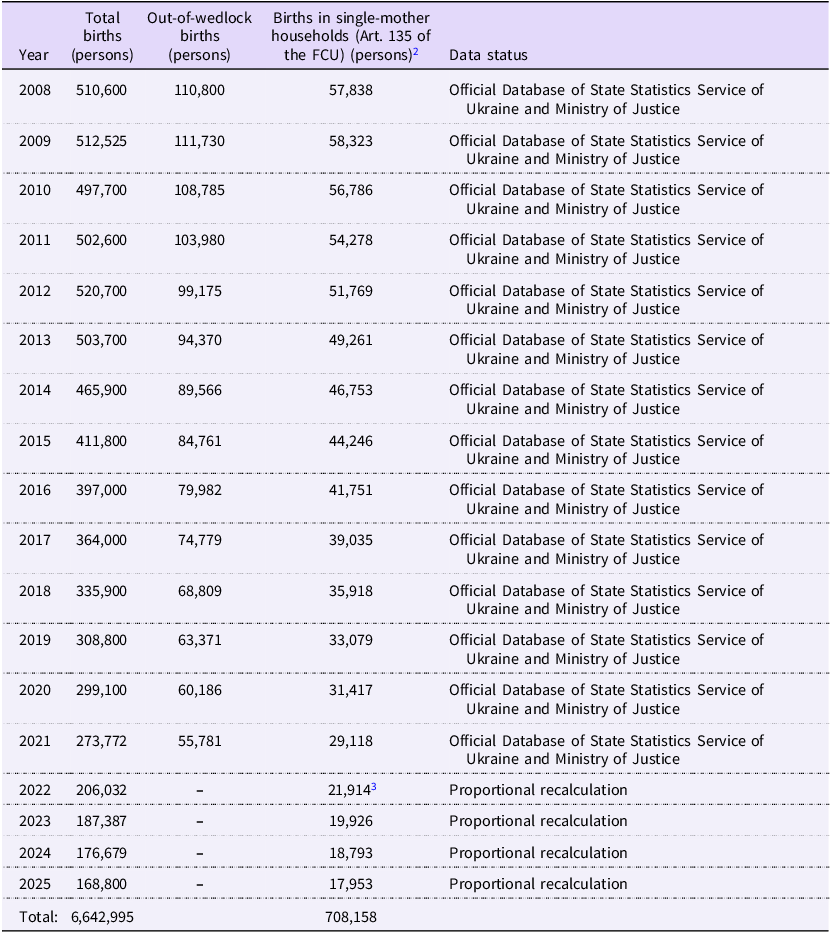

 Open access

