In November of 1772, at the height of London's Georgian ascendancy, a party of six boarded a Thames wherry at Westminster and traveled downriver toward the heart of the city. An Englishman from an aristocratic Nottinghamshire family who had turned his life to exploration and entrepreneurship, George Cartwright was the mastermind of this small voyage. The other five members of the party were foreigners, newcomers to the city and to Britain. They were Inuit, from a place the English called Labrador, and included the shaman Atajuq (Connected);Footnote 1 his youngest wife, Ikkannguq (Becoming Shallow); their toddler daughter, Ikiunaq (Spark); and Atajuq's youngest brother, Tuglavingaaq (the Big Beautiful Braid), and his wife, Qavvik (Badger).Footnote 2 Cartwright was showing his five Inuit companions many of the same sights a present-day tour guide might show a group of tourists from America or Japan or the Continent, with a special emphasis on engineering prowess and intensely symbolic, monumental architecture. But this particular tour was much more complicated for everyone involved. “I was exceedingly disappointed,” Cartwright later complained in his journal, “to see them pass through London Bridge without taking much notice of it. I soon discovered that they took it for a natural rock which extended across the river. They laughed at me when I told them it was the work of men; nor could I make them believe it.” Alighting at Blackfriars, Cartwright had more luck with the bridge there, using his fairly passable Inuktitut to encourage the five visitors “to examine with more attention [and] shewing them the joints, and pointing out the marks of the chizzels upon the stones. They no sooner comprehended by what means such a structure could be erected, than they expressed their wonder with astonishing significancy of countenance.”Footnote 3
The group then traveled, likely by carriage, into Blackfriars Street, up Ludgate Hill, and on to Christopher Wren's iconic church. Cartwright noted that the group “had often passed St. Paul's without betraying any great astonishment,” something that mystified him, until he learned that they had taken it for Ikkigockeatuie, a mountainous headland and important landmark in their home territory.Footnote 4 This time, he tried something different: he took them to the church's Stone Gallery, the highest spot in the city and one that offered panoramic views across it. There, he “convinced them that it was built by the hands of men,” with the result that they were “quite lost in amazement. The people, they compared to mice; and insisted, that it must at least be as high as Cape Charles, which is a mountain of considerable altitude.” If Cartwright's journal is to be believed, the five Inuit were taken aback by the experience. “Upon my asking them how they should describe it to their countrymen on their return,” he wrote, “they replied, with a look of the utmost expression, they should neither mention it, nor many other things which they had seen, lest they should be called liars, from the seeming impossibility of such astonishing facts.”Footnote 5
This Inuit experience of urban spectacle is one of many moments in the history of colonialism that are as freighted with baggage as an overloaded Thames wherry. As an encounter between the “civilized” and the “primitive,” the urban and the Indigenous, and between the “center” and the “periphery,” it is anchored—some would say mired—in overdetermined narratives. The shock experienced by the five Inuit at the top of St. Paul's no doubt seemed a great success to Cartwright. The novelist John Steffler, amplifying sentiments expressed throughout Cartwright's journal, imagined what the moment meant to the explorer and entrepreneur:
He felt himself grin at the prospect of showing off England to the Inuit, watching their faces as they rode in a coach through London's streets. As they entered St. Paul's. He liked their capacity for awe, and the thought of the tales they'd take back to their people in Labrador. They looked on the English as landless wanderers. He wanted to show them the true proportion of things, amaze them, make them willing subjects of his rule, to both their advantages. He needed to keep them working for him, bringing him whalebone and furs; he wanted them to see that they needed his knowledge and goods in exchange.Footnote 6
As we shall see, both Cartwright's observations and Steffler's exegesis of them are part of a much longer narrative of Inuit, and Indigenous, wonderment at the beautiful and terrifying panoply of the imperial capital. Popular commentators, scholars, and even Indigenous people themselves have been participants in the construction of this narrative describing the meeting of two very different worlds, with one, sublime and implacable, necessarily awing the other into submission. It is an urban corollary of the narrative of Indigenous people perceiving European newcomers as gods, a citified version of, for example, Captain James Cook's alleged apotheosis among the Kanaka Maoli at Kealakekua during the same decade. Here, however, the great canvas sails that brought to mind the tapa cloth of the gold Lono and the magical weapons of metal and thunder are replaced by Portland limestone and workmen's chisels, even if the end result is a very similar, and all too familiar, story of unequal encounter and Indigenous intellectual or technological inadequacy. However, in recent years such just-so stories of encounter have come under intense scrutiny as scholars and Indigenous communities have sought a different “true proportion of things.” Reimaginings of what happened to and because of Cook at Kealakekua, for example, inspired one of the most fractious debates in the recent history of anthropology, with some arguing that Indigenous Hawaiians might have in fact understood Cook as a manifestation or echo of Lono, and others countering that such a position is a descendant of the imperial, racist thinking that informed the project of empire in which Cook himself had been engaged.Footnote 7 Scholarly sparring aside, the reframing of Hawaiian-British encounter and other similar moments has opened rich veins of inquiry; brought an attentiveness to Indigenous epistemologies, sources, and logic; and attempted to challenge persistent narratives of “civilization” and “savagery.” It is a part of a much broader transformation of historical and ethnohistorical practice that has challenged static notions of culture, the supremacy of European peoples and their sources, and our understanding of the relationship between imperial “centers” such as London and colonial “peripheries.”
London, like the empire that it administered, has been one of the key beneficiaries of this transformation, which has its roots in several different literatures and approaches. First, the rise of Atlanticist scholarship has convincingly identified an oceanic world in which European, African, and Indigenous American peoples encountered and influenced each other in complex ways, ranging from the role of local knowledges in the production of metropolitan natural history to the cross-cultural and transatlantic migration of images and styles of performance and public ritual. In this scholarship, medical knowledge seemingly centered in London in fact has its origins in the traditional practices of enslaved Africans, while carnivals in New Orleans and mob rituals in London borrowed images from each other and elsewhere.Footnote 8 A second and more recent body of literature arises out of postcolonial studies, reading critical race theory, notions of the subaltern, and other key contributions of the field back into the British imperial past, and in doing so, decentering London as the normative, or even most important, node within a dynamic, unstable global system. Although often vast in scope, such studies typically also ground themselves in the social and cultural histories of the city as well, oscillating between urban and colonial spaces.Footnote 9 Third, and finally, an increasing number of scholars have begun to write about non-British people who traveled to London from within and outside its growing empire, from Chinese immigrants to Japanese travelers and Hindu reformers.Footnote 10 Some studies, drawing from these and other scholarly genealogies, have begun to imagine and make the case for such things as a “black London” or an “Asian London.”Footnote 11
However, relationships between London and Indigenous peoples whose territories were claimed by the British Empire have yet to receive similar sustained, critical attention. Certainly, a rich body of literature exists on the role of Indigenous peoples—particularly those of parts of North America—in the British imaginary, including at least some emphasis on the display of Indigenous travelers in London's great exhibitions, its theaters, and its “freak shows,” particularly in the nineteenth century.Footnote 12 Historians and others have also documented in great detail the journeys of a handful of Indigenous visitors to Britain and London, who ranged from political emissaries and sailors to translators and even missionaries, and who came from places as diverse as colonial Virginia, a newly “discovered” Tahiti, or the outpost that became Sydney. These Indigenous visitors were often the subject of widespread attention and commentary, and they were in some cases celebrities, with the result that rich, if usually one-sided, archives exist related to their time in London.Footnote 13
Still, these accounts, while making great strides in moving beyond metaphorical “Indians” and attributing agency to Indigenous visitors, tell us relatively little about the city itself; they may be excellent examples of Indigenous history, but they are rarely urban histories. The nature of London as an imperial space, and indeed, the meaning of urbanity itself, remains largely unexamined. This is mostly due to the fact that the teleologies and overarching narratives that have emerged out of Europe's encounter with the Americas and other “new worlds”—in particular, the notion that Indigenous peoples represent the past and the local, while cities represent the future and the global—continue to shape historical practice, with the result that urban and Indigenous histories are all too often estranged, or even treated as though they are mutually exclusive. The reality was, and is, that Indigenous and urban histories are in fact mutually constitutive and profoundly entangled.Footnote 14
The account that follows makes a case for this entanglement, suggesting that something far more complicated than mere Inuit incredulity was taking place at St. Paul's that day in 1772. It begins with the deeper history of Inuit presence in London, which was often based in violence, and then examines exactly how Atajuq and his family came to be in London with Cartwright that winter and what they experienced there. Drawing on Inuit cultural practices and knowledge systems, the article then tries to imagine how the five visitors might have understood their experience—focusing in particular on the Inuit concept of isuma—and then sets Inuit responses to the city alongside other observers of late eighteenth-century London, Indigenous and otherwise. The investigation turns at that point to the city itself, arguing that it is not “the Inuit mind” that is the anomaly that requires “figuring out”; instead, it is London that is the anomaly. The article then continues by showing the ways in which London and Inuit territories became entangled in British popular culture, especially over the course of the nineteenth century, and the ways in which British people struggled to make sense of arctic places just as Atajuq and his kin struggled with the city. The discussion ends with a caution about overstating such entanglements and equivalencies, drawing our attention to the unequal power relations of empire by following the story of the five Inuit visitors to its end back in Labrador. The story of Cartwright, Atajuq, and the others becomes one of equally human peoples embodied in local landscapes and united in the wonder and trauma of encounter. It is a story about how power and place worked in a world that Inuit and English contemporaries were creating together, however unequally, and the ways in which urban and Indigenous histories, while seemingly so separate, are inextricably linked.
■■■
Just as Atajuq and his family were not the first Indigenous people to visit London, they were also far from the first Inuit to do so. In fact, it is likely that the first documented Indigenous North Americans in the city were Inuit. Some two hundred and seventy years before Cartwright took his five guests to see St. Paul's, in either 1501 or 1502, three strangers appeared among the dense crowds at Westminster Palace, and eight decades later, in an anonymous source collected within a 1580 chronicle of London's history:
This yere also were browgth unto the kyng iij men takyn In the Newe ffound Ile land, that beffore I spak of In wylliam purchas tyme beyng mayer, These were clothid In bestys skynnys and ete Rawe fflesh and spak such speech that noo man cowde undyrstand theym, and In theyr demeanure lyke to bruyt bestis whom the kyng kept a tyme afftyr, Of the whych upon (ij) yeris passis (afftir) I sawe ij of theym apparaylyd afftyr Inglysh men In westmynstyr paleys, which at that tyme I cowde not discern ffrom Inglysh men tyll I was lernyd what men they were, But as ffor spech I hard noon of them uttyr oon word.Footnote 15
Based on the descriptions of their diet and their manner of dress, it is likely that these were Inuit people. However, it is unclear how they got there: none of the recorded English voyages into Inuit territories, such as those of Giovanni Caboto, make mention of captives being taken. It is more likely that the men were brought to England aboard ships that left no paper trail. Regardless of their origin, however, these three men and the single, fragmentary reference to them mark the beginning of Indigenous London.
As England became more actively engaged in the business of exploration and empire over the course of the sixteenth century, more Inuit people found themselves crossing the Atlantic. In 1576, Martin Frobisher entered the territory of the Inuit, seeking not only the fabled passage to Cathay but also wealth from the northern lands themselves. While the “gold” would turn out to be pyrite, and England's arctic colony ultimately a failed venture, these earlier voyages left distinct impressions upon the Inuit and their descendants. An island that had once been known mostly for walrus hunting, sealing, and the gathering of duck eggs was renamed Kodlunarn (“white men's island”), while future generations of Inuit people would teach their children never to show glimmering rocks to the qallunaat (the term for Europeans) because it “steals their minds.”Footnote 16
Other more traumatic sorts of thefts took place as well. From the beginning, English voyagers to the Americas were tasked with not only finding new lands and riches but also collecting human specimens as proof of discovery, as scientific curiosities, and as potential translators. Indeed, Frobisher's instructions included the admonishment that “we do not think it good you should bring hither above the number of iii or iiii or eight or ten at the most of the people of that country.” The first such captive, taken in 1576 and unnamed in all the sources, was one of a pair of men lured near Frobisher's ship with a small bell. English crew members wrenched this “new pray,” as sailor George Best described him, aboard while his companion fled, howling like a wolf. As soon as the Inuk realized he was a captive, he “bit his tong in twayne within his mouth.”Footnote 17 In London later that year, the man served as a “sufficiente witnesse” of Frobisher's accomplishments, despite the fact that he was bedridden from his injury and an illness almost the entire time. He soon died, and was buried in the churchyard of St. Olave's Hart Street.
The next year, Frobisher was happy to report, “I have aboord . . . a Man, a Woman, and a Childe, which am contented to deliver for you.” This group—the man and woman unrelated, the child her son—were being held ransom for five Englishmen Frobisher believed to have been captured by the Inuit; the man had been subdued by a brutal “Cornish tricke” wrestling move during a sham trade encounter. Their names have come down to us as Kalicho, Arnaq, and Nutaaq—arnaq, however, simply means woman, and nutaaq, child. When the group arrived in Bristol, it was to much acclaim: Kalicho displayed his qajaq and duck-hunting skills in the Avon River for huge audiences, and the three posed for portraits. Kalicho, however, was rapidly declining, and soon died. The autopsy concluded that he had died of a brain injury, a collapsed and infected lung (both likely caused by the “Cornishe tricke”), and something called “Anglophobia.” Almost immediately after, “Arnaq” broke out in spots, most likely measles, and died four days later. There was then a mad dash to get the infant “Nutaaq” to London, likely for a private audience with the queen. But the baby died soon after arriving at London's Three Swans Inn and, like the anonymous adult Inuk of the year before, was interred at St. Olave's.Footnote 18 Despite the outcomes of these first two abductions, George Best prophesied a positive future for Inuit-English relations: “They wondred muche at all our things . . . and beganne to growe more civill, familiar, pleasaunt, and docible amongst us in a verye shorte time.”Footnote 19 But where Best saw docility and civility, something else entirely was going on. Perhaps the most powerful legacy of these earliest encounters is that Inuit often came to interact with the foreigners out of an emotion called ilira in Inuktitut: the fear and vulnerability felt toward beings (abusive fathers, unreasonable people, or ghosts) who had things a person needed but whose minds and actions were unpredictable. In the twentieth century, one Inuit elder described these early encounters and the complicated welter of feelings they produced: “During the first meeting,” Inookie Adamie recalled in the late twentieth century, “the Inuit were just in awe. The qallunaat came with their huge ship. . . . They had never seen such a big ship and the people were strange, just different. Right away there were some grudges. The qallunaat fire two warning shots in the air. . . . So, when they met there was a lot of uncertainty. . . . It's very cold; their clothes are not fit for this kind of weather. . . . They were ghostly.”Footnote 20 The shock of the new, the potential for violence, and the possibility of spiritual power: these had always been part of Inuit people's experiences throughout their history, and the fraught novelty of these particularly strange newcomers into their territory must have been a matter of degree, not of kind, even if they are also remembered today as critical junctures in Inuit history.Footnote 21
In the decades and centuries after the deaths of Frobisher's captives, the English presence continued to be felt along the coast of Labrador in the shape of whaling crews and fishing boats, and by the middle of the eighteenth century, trade relations between the Inuit and qallunaat had become more intimate—and more violent—in the territory that Atajuq and his family called home.Footnote 22 In 1767, Inuit warriors killed three European crewmen; in a retaliatory assault, twenty Inuit men were killed, and three women and six children were captured. Of the latter, one woman, Mikkuq (Small Feather), her son Tutuak, and another young boy named Karpik would be taken to England, after Mikkuq had been forced to teach her captors her language. Of the three, only Mikkuq would return home alive, a foreshadowing of what would happen several years later to Atajuq and his kinfolk.Footnote 23
It was into this emergent English-Inuit world that the former military officer George Cartwright arrived. Primarily concerned with establishing sealing stations and salmon fisheries on the coast, Cartwright understood that relations with the local population would be key to his success. Over time, he became deeply involved in the everyday workings of at least some Inuit families, delivering their children (including those fathered by European men), employing some in his own household, and according to at least one account, fathering a son by a local woman.Footnote 24 Cartwright later wrote, “[T]hey are a most amiable, ingenious, tractable and well-disposed race of mortals, and would greatly and rapidly improve by proper management and cultivation.”Footnote 25 Part of that cultivation, as was common practice throughout the British Empire, was to bring people from the uncultivated margins to the center of proper management: London. And so, on 29 October 1772, Cartwright chose the five individuals who would accompany him back to England.
Even before arriving in England, Cartwright recorded two events that foreshadow the kinds of encounters and misunderstandings that we are concerned with here. Just before leaving, Cartwright discovered Ikkannguq lying on the floor with her husband, Atajuq, kneeling beside her, her head suspended from a heavy stick with a loose strap. Atajuq was singing in a low voice, raising and lowering his spouse's head, and explained to Cartwright that she had a headache. “I got out of the room as fast as possible,” recalled Cartwright, “that I might indulge myself in a hearty laugh.” Then, while nearing the coast of Ireland, the Inuit became anxious that the ship would never see land again. Cartwright showed them his charts, “but they gave very little credit to what I said.”Footnote 26 Such moments highlighted the seeming incommensurability of Inuit and English societies, and between Inuit and English minds. We shall return to this imagined gulf between the “savage” and the “civilized.”
■■■
London. From the moment they arrived, the Inuit family was both subjected to the spectacle of Georgian London and cast as one of that spectacle's attractions. “On landing at Westminster Bridge,” wrote Cartwright, “we were immediately surrounded by a great concourse of people; attracted . . . by the uncommon appearance of the Indians who were in their seal-skin dresses.” Bundling them into coaches, Cartwright had the Inuit driven to their lodgings in Leicester Street. Soon, however, crowds angling to see the strangers “made my lodgings very inconvenient to my landlord as well as to myself,” forcing Cartwright to find a more private situation in Little Castle Street near Oxford Market. Again, the clamor made it almost impossible for him to sleep or conduct business. Finally, he set Tuesdays and Fridays aside for public viewings: “[O]n those days, not only my house was filled . . . but the street was so much crowded with carriages and people, that my residence was a great nuisance to the neighbourhood.”Footnote 27 His sister, Catherine Cartwright, described similar crowds when the five spent time at the family estate in Nottinghamshire: “The curiosity that raged in the environs of Marnham is not to be imagin'd,” she wrote, “for above a month we never stirred without a Mob; and all our acquaintance far & near came to see them.” She also noted how the Inuit disliked being the subject of commoners' gazes, even as they seemed happy to entertain and be entertained by the Nottinghamshire elite.Footnote 28
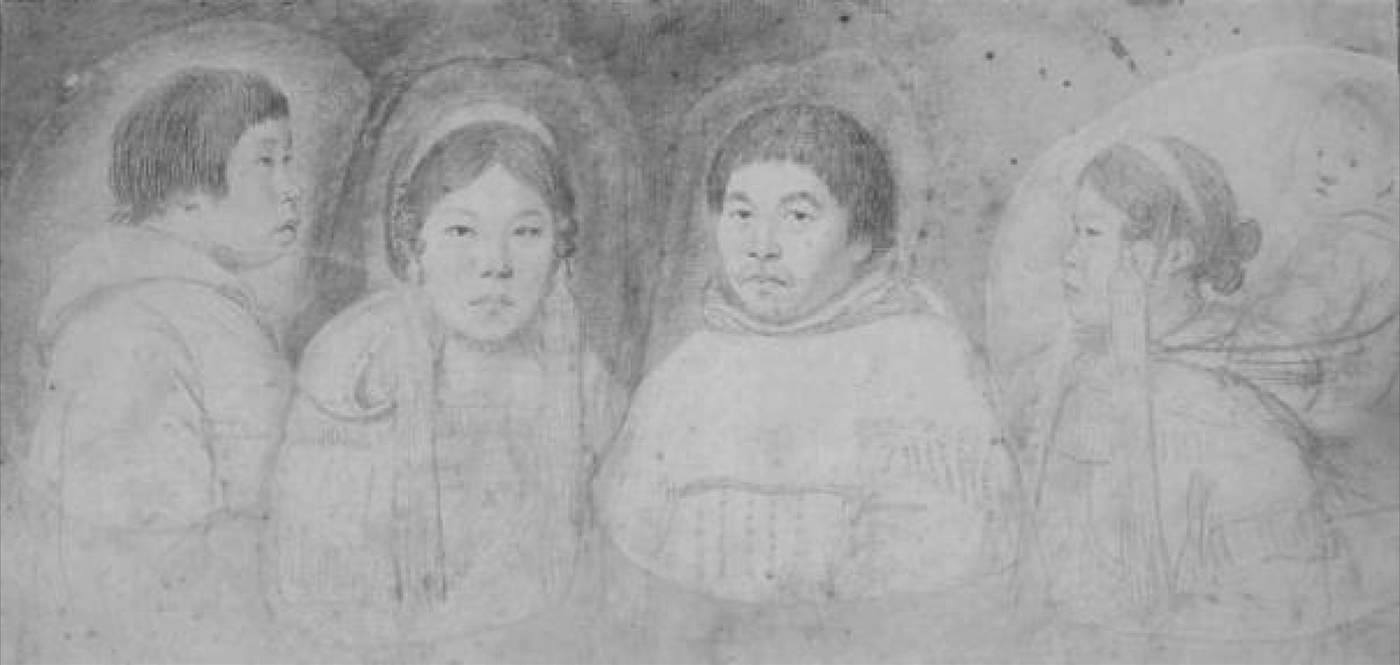
While most Indigenous visitors were treated as actors on an ethnographic stage, their keepers also usually felt they should experience the stages of London as spectators too. Cartwright was no different, taking his guests to see a performance of Shakespeare's Cymbeline at the Covent Garden Theatre and seating them in the royal box, noting, “their pride was mostly highly gratified, at being received with a thundering applause by the audience.” The young Ikiunaq, for her part, paid “unremitting attention to the whole representation” and “set up a most feeling scream” at the first swordfight.Footnote 29 On another occasion, Cartwright escorted Tuglavingaaq and Atajuq to Piccadilly Circus—no doubt to countless gaping stares—and took them into a menagerie where, among the parrots and snakes, they were horrified to see what appeared to be a tiny Inuit. Cartwright, agreeing that there did seem to be “considerable resemblance,” explained the monkey's true nature to them, at which they were both “greatly diverted” and “not well pleased.”Footnote 30 Then, while dining at the home of the surgeon John Hunter—whose anatomical and other collections, among which are found images of Atajuq and his family (figure 1), became the origins of the Royal College of Surgeon's Hunterian Museum—Atajuq stepped into the next room only to return with “evident marks of terror.” “He hastily led me to . . . a glass case containing many human bones,” Cartwright wrote. “‘Look there,’ says he. . . . ‘[A]re those the bones of Esquimaux whom Mr. Hunter has killed and eaten? Are we to be killed? Will he eat us, and put our bones there?’” The entire company of diners had by this time joined them; when Cartwright explained the situation, the Britons exploded into laughter, while Cartwright spent the rest of the evening assuring the Inuit that the bones were those of a criminal and would help in healing the living. While the others seemed to relax, Atajuq only felt safe once back in Little Castle Street.Footnote 31
Tuglavingaaq, Qavvik, Atajuq, Ikkannguq, and Ikiunaq. With the permission of the Hunterian Museum, Royal College of Surgeons, London.

Stories like these of primitive rubes lost amid London's splendor and sophistication fill the accounts of Indigenous visitors to the city and reflect English expectations about their inferiority. In his comments on the day the Inuit men met their first monkey, for example, Cartwright tells us exactly what he expects of the encounter between the Inuit and the metropolis: “The uninformed mind of the savage, who never had the least hint given him, that certain things are in existence; consequently, they break upon him as unexpectedly, and forcibly, as the sun would do upon a man who was born deaf and blind, in case he should suddenly be brought to sight on a clear day.”Footnote 32 This Georgian shock of the new had very practical imperial applications. After taking the five Inuit to court and to the homes of several noble and fashionable people, Cartwright wrote of using the city itself as a tool of submission: “I omitted nothing . . . to make their stay in England agreeable, or to impress them with ideas of our riches and strength. The latter I thought highly necessary, as they had often . . . spoken of our numbers with great contempt, and told me they were so numerous, that they could cut off all the English with great ease, if they thought proper to collect themselves together. . . . But they had not been long in London before they confessed to me, that the Esquimaux were but as one, compared to that of the English.”Footnote 33 This hospitable domination permeates the bulk of the sources relating to Indigenous visitors, telling us little of what people like Atajuq actually thought and felt. How, then, might we reconstruct something resembling an Inuit account of these moments without replicating or reifying European interpretations of the encounters? Certainly, Cartwright's five visitors had their own intentions and motivations for the actions in England; when the four adults were given English clothes to wear—the girl Ikiunaq continued to wear animal skins—Ikkunngaq and Qavvik quickly ornamented the garments with colored beads in keeping with Inuit aesthetics, thus asserting their own identities in this foreign land.Footnote 34 But beyond such clear expressions of selfhood, how might we understand their experience?
One option is to approach them structurally and ethnographically, looking to Inuit cultural practices across time and space, or as some have rather awkwardly put it, the “Inuit mind.” For example, the experiences of Tuglavingaaq and the others in 1772 and 1773 might be framed through the concept of isuma, an Inuit form of logic expressed in emotional restraint and dispassionate detachment. Isuma is, in many ways, a response to ilira: it is a counterweight to vulnerability and fear, and a rational and reasonable response to the unfamiliar or disorienting. More than just the guardedness that arises out of the shock of the new, however, it is also a cool circumspection and an observant detachment. The seemingly mute unresponsiveness to certain London spectacles such at St. Paul's was almost certainly isuma, a studied withholding of affect that allowed for clear-headed apprehension.Footnote 35 Thinking about isuma, or in other words, about Indigenous thinking, also allows us to reframe Inuit experience of the journey to London. It dislodges racist notions of docility and primitiveness and replaces them with a specifically Inuit rationality. Even if London did not make sense to the Inuit, Inuit understanding of the journey to London made sense, and the experiences chronicled by Cartwright can be reinterpreted through isuma, ilira, and other Inuit ways of knowing and being. The head-raising ceremony just before departure for England? Not quackery, but an engagement with spiritual forces and an accounting of personal failings that could cause illness.Footnote 36 The fears regarding crossing the Atlantic? Throughout the circumpolar north, the Inuit tell of epic journeys to places with staggering tides, horrifying sights, and seas that never freeze; such stories are filled with careful detailing of rituals of hospitality, way-finding, and purification. The anxiety expressed near the coast of Ireland was surely informed by such stories, and thus reflected not just primitive terror but a very logical concern with distance, danger, and perhaps the lack of ritual protocols.Footnote 37 As for the monkey in the Piccadilly menagerie, the Inuit had throughout their history told stories of encounters with miniature and dangerous humanlike beings called inugarulligaarjuit, and they had developed strategies for protecting themselves in such situations. Their reaction on seeing one so far “out of place” spoke not so much of Inuit confusion but of Inuit order: Inuit logics and ontologies transposed into the heart of the metropolis.Footnote 38
At the same time, we should be wary of “the Inuit mind.” After George Cartwright's journal, the most detailed sources relating to Atajuq and his family come from George's sister, Catherine Cartwright, whose letters offer a sense of the five as real individuals with their own personalities and ways of seeing the world. According to Catherine, Atajuq was “serious & noble & uncommonly sensible & expressive” and “easy, obliging, & perfectly the gentleman.” His wife, Ikkannguq, was “shrewd, lively, and sensible,” but also “selfish,” with “no grace in any of actions,” but a very good mother nonetheless. Their daughter, Ikiunaq, was “an exceeding pretty, fine child, the very image of its Father.” Atajuq's brother, Tuglavingaaq, meanwhile, was “vastly quick” with “great spirit” and “a native honesty, integrity, generosity, & disinteredness.” Qavvik was clearly Catherine's favorite; besides her beauty, in her face and actions Cartwright saw “a happy manner that engages you at once in her favour . . . sprightliness, softness, humour . . . conscious innocence, modesty, youthful vivacity, & native worth.”Footnote 39 Each of these descriptions suggests that despite the centrality of concepts such as ilira and isuma to the Inuit experience of the city, it is also unlikely that there was one “Inuit experience” at all. Five individuals as diverse as Tuglavingaaq, Qavvik, Ikiunaq, Ikkannguq, and Atajuq would have no doubt had quite different reactions to the city, even if that level of texture is largely invisible in the documentary record.
Asserting both the affective sophistication of concepts such as isuma and the elusive individuality of Indigenous actors within the fragmentary colonial archive opens up a space for Indigenous agency and intelligence at the center of empire. There are moments from the winter of 1772–73 that suggest that the Inuit had ways of not only making sense of the city but also fitting it into their own geographies and even critiquing it. For example, Cartwright noted that they found it difficult to understand how many people actually lived in London and how those people were fed. Cartwright chalked this up to their limited intelligence and a counting system that he claimed only went to twenty-one, but he also let slip that “nothing surprized them more, than to meet with a man who assured them he could not shoot, had never killed an animal, nor seen the sea in his life.”Footnote 40 The Inuit were, in fact, onto something: in the era of land clearances and other forms of subsistence dispossession, failed agricultural experiments, and burgeoning urban slums where food provision was a constant worry, a small group of hunter-gatherers seemed aware of one of Britain's most pressing problems and the strange lack of self-sufficiency in the English.
Still, London could wear on its visitors. After a long day on the Thames, at Westminster, and at Hyde Park Corner, Atajuq returned home exhausted and despairing according to Cartwright. “Oh! I am tired; here are too many houses; too much smoke; too many people. . . . I wish I was back again.”Footnote 41 Here, a savage seems to cede defeat at the hands of civilization, but of course, his concession is ventriloquized by a man with his own agendas. And yet it resonates with other Indigenous visitors' experiences. In 1736, for example, a delegation from the Yamacraw people, who had allowed colonists to found the colony of Georgia in their midst the year before, traveled to London to deepen their diplomatic relations with the Crown. In his diary, John Perceval, Earl of Egmont and a close associate of Georgia colonist James Oglethorpe, described how the Yamacraw mico or headman, Tomochichi, had lost his way among the endless rooms of St. James's Palace. “They carried him through a great many houses (he meant rooms) to make him believe the King's Palace consisted of many,” Perceval wrote, “but he was much surprised to find he returned by the same stairs he went up, by which he found it was still one house. He added that he found we know a great many more things than they, but he doubted if we were happier, since we are worse livers than they, and more innocent.”Footnote 42 While his diary entry betrays the earl's ideas about British superiority, they also speak to what might have been real reactions to a palatial maze and to the excesses and miseries of London more generally. A diary written by a Mohegan minister who visited London in 1766—the first firsthand account of the city by an Indigenous North American—offers similar sentiments without the intrusion of Egmont's aristocratic condescension or Cartwright's self-interest. Only six years before Atajuq and his family disembarked at Westminster, Samson Occom penned a passage that echoes in content and in tone the Inuit shaman's exhausted soliloquy: “Such Confusion as I never dreamt of—there was Some at Churches, Singing & Preaching, in the Streets some Cursing Swaring & Damning one another, others was hollowing, Whestling, talking gigling, & Laughing, & Coaches and footmen passing and repassing, Crossing and Cross-Crossing, and the poor Begars Praying, Crying, and Beging upon their knees.”Footnote 43 The Indigenous visitor overwhelmed by and even critical of London comes through in all of these passages, regardless of the author of record. Cartwright's ventriloquism, then, seems less of a problem in the light of a Yamacraw headman's architectural confusion or a Mohegan minister's struggle with urban spectacle.
It is in fact not the “primitive mind” that is the “problem” in these moments of urban Indigenous encounter. Rather, the problem is the city. Over the course of the eighteenth century and beyond, many foreign visitors, including fully “civilized” Europeans, reacted in a way not unlike Atajuq, Tomochichi, or Samson Occom. Venetian traveler Giacomo Casanova called London “a town which is sometimes described as a chaos, especially for a stranger.”Footnote 44 Arriving ten years after the Inuit, in 1782, German schoolmaster Karl Moritz was particularly impressed, even awed, by the activity of London's river. “On the Thames itself are countless swarms of little boats passing and repassing,” he wrote, “[and] there is hardly less stir and bustle on this river, than there is in some of its . . . crowded streets.”Footnote 45 In this, he echoed closely the responses of Cartwright's female guests, Qavvik and Ikkannguq, who “were greatly astonished at the number of shipping which they saw in the river; for they did not suppose that there were so many in the whole world.”Footnote 46
Even the English—including Londoners themselves—struggled to find meaning in their city, and they often quailed in the face of it. Atajuq's “too many houses” complaint, for example, echoed one made half a century earlier by Daniel Defoe, who complained of London's “most straggling, confus'd Manner, out of all Shape, uncompact, and unequal; neither long or broad, round or square.”Footnote 47 In 1771, novelist Tobias Smollett described London as “an overgrown monster; which, like a dropsical head, will in time leave the body and extremities without nourishment and support,” resonating with the Inuit questions about London's food system.Footnote 48 Poet William Cowper penned in 1785 that “London is, by taste and wealth proclaim'd / The fairest capital of all the world, by riot and incontinence the worst.”Footnote 49 Such critiques were part of broader debates about the nature of English society, often prefiguring Romantic jeremiads against industrial modernity. But they also provide critical context for interpreting Indigenous responses to the city; instead of the facile tautology of the primitive unable to understand London, it would appear that almost no one was able to apprehend the city. For many observers, London eluded reason and comprehension, and moved into the uncanny, irrational, and even otherworldly. On seeing Ranelagh Gardens, for example—a place the five Inuit visited—Karl Moritz wrote, “I felt pretty near the same sensations, that I remember to have felt, when . . . I first read the Fairy Tales.”Footnote 50 In these accounts, it is the allegedly rational center of empire, not the “Indigenous mind,” then, that is the anomaly: sublime, disordered, decentered, provincialized, and rendered Other.
With London no longer serving as the normative anchor of this story, we might then oscillate back into Inuit territories along networks of empire and knowledge making, where strange parallels existed. The moment in which the Inuit saw in St. Paul's a mountain, for example, mirrored explorers' narratives of the arctic, which consistently deployed a particular kind of language to describe the land-, sea-, and icescapes of the high latitudes both north and south: architecture. Frobisher's companion Christopher Hall, for example, portrayed the coastal glaciers of Greenland as “rising like pinnacles of steeples.” Charles Darwin described icebergs “as tall as cathedrals”; others wrote of “castles with towers of crystal, surmounted by turrets and minarets”; icebergs in Labrador seemed to some like “a Gothic cathedral,” a “Coliseum,” or the “ruins of a marble city.”Footnote 51 This descriptive, and I would suggest cognitive or ontological, tradition parallels the Inuit reading of St. Paul's Cathedral in 1772, as Cartwright himself noted, writing that while at St. Paul's, the Inuit had experienced “at least not so much [astonishment] as all Europeans do at the first sight of one of those stupendous islands of ice, which are daily to be seen near the east coast of their own country.”Footnote 52 Sites of such “confusion,” then, existed not only among the Inuit but also among the English; not just in London, but on the coasts of Labrador and Greenland and other arctic places—in the shared transatlantic spaces in which the natural and the architectural were enmeshed in hybrid landscapes of encounter.
Such hybrid landscapes also existed in London, where simulacra of Inuit territories—and Inuit people themselves—contributed to the city's urban lexicon. In 1818, fashionable types thrilled at paintings of the exotic shores of Greenland, illustrating the first meetings between the British and the Inuit, painted by an Inuk who carried the English name John Sackhouse. However, these paintings were not made in some sod house or iglu in the arctic; they had been created aboard the Isabella, at anchor in Deptford's massive Greenland Dock. There, Sackhouse also gave qajaq demonstrations for up to ten thousand spectators, met privately with lords and bishops, and fended off offers of thousands of pounds to become a performer at Sadler's Wells, before dying of an illness.Footnote 53 Two years later, the comic pantomime The North West Passage; or, Harlequin Esquimeaux featured an elaborate stage of frozen sea, icebergs, and ships of discovery, and provided “a lively picture of those grand but desolate regions.”Footnote 54 Soon after that, Londoners marveled at the Sadler's Wells performances of two Inuit named Niakungitok and Coonahink, which included “Evolutions of the Lake of Real Water, the Stage forming a panoramic view of the Icy Seas.”Footnote 55 By the 1830s and 1840s, as Russell Potter has noted, arctic spectacles, most notably the displays at Vauxhall Gardens, were among the most celebrated, technologically advanced, and well-attended entertainments in the city, and many involved Inuit people, both real and sham.Footnote 56 Leaving for a tour of Germany in 1850, the Anishinaabe visitor and performer Gaagigegaabaw (George Copway) described London's traffic using a decidedly arctic simile: “Here I am with my trunk and carriage blockaded by any number of drays, ‘busses’ and so forth, et cetera, completely pent in, as a ship by icebergs,” he complained.Footnote 57 The fervent interest in Inuit territories reached its peak after the loss of the Franklin expedition during the middle of the century, even if the tone changed from escapist to elegiac. For decades to come, arctic landscapes and Inuit knowledge would be at the center of a nation's attempts to understand this disaster of empire and reason. In 1851, the first Franklin relics were brought home to London, along with a nineteen-year-old Inuit man renamed Erasmus York, whose presence lent the relics their veracity.Footnote 58 Similarly, in 1854 two Inuit named Tookoolitoo and Ebierbing visited England, providing information about explorers going back to Frobisher, meeting with the queen at Windsor, and appearing in grand exhibitions on the Strand.Footnote 59 In doing so, they showed how London's (and Britain's) history had become enmeshed in Inuit history, and vice versa.Footnote 60
These movements of knowledge and imagery between London and Inuit territories, while tenuous, nonetheless linked together center and periphery, and created new, hybrid spaces. The cutting-edge special effects of frozen seas within the proscenium of Sadler's Wells, the massive paintings of ice hung in fashionable galleries, and the lurid midnight-sun chiaroscuros filling entire pages of The Times were neither urban nor arctic, Londoner nor Inuit: they were both, and so were the English histories recounted by Inuit visitors. Such moments presented not opposites, but entanglements. And this new language could slip free of ships and stages, and move out into the city itself. When author and addict Thomas de Quincey set out on yet another expedition in early nineteenth-century London in search of the perfect whore or the purest opium, he called the object of his desire “the North.” As London novelist and historian Iain Sinclair has noted, de Quincey's quest was simply an obsessive's grafting of a long-standing imperial ambition, the Northwest Passage and the extremities of human endeavor, onto the seedy streetscapes of the urban flâneur. But sometimes, it was even simpler than that: during an apocalyptic snowstorm in 1885, one observer noted, in a strange echo of a certain moment in 1772, that “the dome of St. Paul's was alone visible, rising up like the roof of a huge Esquimoux hut.”Footnote 61
■■■
There is an Inuit word tautcuunnguatitsiniq, which describes the conveyance of images to another person's consciousness. This is what I suggest is going on here, on a transatlantic and cross-cultural, if also ephemeral and anecdotal, scale. That said, there is another Inuit word, angiarivaa, which means “he hides it within words,” and it is often applied to the qallunaat tendency to talk too much.Footnote 62 (Similarly, many Inuit stories say white people are descended from a woman who married a dog; thus, qallunaat are always “chewing things over.”)Footnote 63 It is all too easy to allow academic reinterpretations and the methods drawn from the linguistic turn to hide within words the realities of colonialism and encounter. It is all too easy to minimize the specific forms of racism and coercion that many Indigenous travelers to London faced.
For example, during the same year that Ikkannguq, Tuglavingaaq, and the others achieved such notoriety—and, it must be acknowledged, quite lavish hospitality, despite the inherent racism and coercion that surrounded them—other Inuit people were having quite a different experience altogether. Catherine Cartwright described in one of her letters the predicament of I-mich-toke, apparently a brother to Tuglavingaaq, and his wife, Ang-nu-toke, who had been brought to England by an unnamed Bristol merchant (they had initially wanted to accompany George Cartwright). The pair found themselves forced to live, in Catherine's words, in “one dirty miserable room” where “they sat alone from weeks end to weeks end without seeing any one but the servant that carried them victuals,” which were little more than plates of scraps. Despite this level of isolation, Ang-nu-toke and I-mich-toke were still put on display; Catherine Cartwright fretted about how they were “made up in an absurd style, being neither in their taste, nor ours but between both,” and wrote that Atajuq and the others were outraged at their kinfolk's treatment. But for all the shows at Covent Garden and country pastimes in Nottinghamshire, the broader context of Inuit travels to England—the conquest of Inuit territories—remained very real.Footnote 64
In May 1773, Cartwright's Inuit guests returned home. Cartwright wrote that all were “well pleased in the expectation of soon seeing their native country, their relations and friends again; and I very happy in the prospect of carrying them back, apparently in perfect health.” But as they left the estuary of the Thames on 13 May, Qavvik became violently ill. Stopping for supplies at Lymington, Cartwright had a surgeon confirm that it was smallpox. This “had nearly the same effect on me, as if he had pronounced my sentence of death. As it was in vain to expect that the rest should escape the infection, medicines were immediately given to prepare them for it.” On 22 May, Qavvik seemed to improve, but Ikkannguq now fell ill, and soon after, Tuglavingaaq. On 29 May, Cartwright described a climate of horror and desperation on board:
At ten o'clock, so dreadful a stench pervaded the whole vessel, all the Indians being now ill, that three of ship's crew now were seized with a fever, and we had reason to expect, that a pestilential disorder would soon attack us all. I therefore ordered captain Monday to carry the vessel into Plymouth, although I foresaw that measure would prove an immense loss to me, by the ruin of my voyage. . . . I went on shore immediately, and made a personal application to Earl Cornwallis, Admiral Spry, and the Mayor of Plymouth, for an [sic] house to put the Indians in, but could not succeed.
On 1 June, Ikiunaq died, Qavvik again had a violent fever, and the other three adults were gravely ill. Cartwright anchored the ship, found a house on shore, and moved them into it, but Ikkannguq died that night. The next day, Cartwright left on a desperate run for London to get additional help, but by the time he returned three days later, both Atajuq and his brother, Tuglavingaaq, had perished in quarantine tents set up outside the house.Footnote 65 The three adults were cremated, and then their ashes were buried in sand dunes outside Plymouth alongside the unburned body of Ikiunaq. By all accounts, George Cartwright was devastated by the deaths, as was his sister, who mourned “little Ikky” above all, and many others who had met the Inuit visitors.Footnote 66
But it was Qavvik who suffered most of all. From the moment she first showed signs of illness, she was quarantined from her relatives, meaning she never saw them again. While she did ultimately recover, she had been “reduced to a skeleton and troubled with a great many large boils.” After the burial of Qavvik's family, Cartwright's crew once again set sail, and George spent much of the crossing trying to convince Qavvik to let him shave off her pus-matted, stinking, and likely infectious hair. She finally relented (losing some of her scalp in the process), but she refused to let Cartwright throw it overboard, instead locking it in a trunk and “flying into a violent passion of anger and grief whenever I mentioned the subject, which I did almost every day.”Footnote 67
On 27 August 1773, they returned to what the Labrador Inuit today call Nunatsiavut, “our beautiful land.” Cartwright's ship, with the miserable Qavvik aboard, sailed into Charles Harbor, past the cape that the Inuit had thought St. Paul's Cathedral so resembled. What happened next is remarkable:
About noon almost the whole of the three southernmost tribes of Esquimaux, amounting to five hundred souls or thereabouts, arrived. . . . I placed myself upon a rock near the water-side, and Caubvick sat down a few paces behind me. We waited for the landing of the Indians with feelings very different from their's; who were hurrying along with the tumultuous joy at the thoughts of immediately meeting their relations and friends again. . . . On drawing near the shore, and perceiving only Caubvick and myself, their joy abated, and their countenances assumed a different aspect. Being landed, they fixed their eyes on Caubvick and me, in profound, gloomy silence. At length, with great perturbation in faltering accents, they enquired, separately, what was become of the rest; and were no sooner given to understand, by a silent, sorrowful shake of my head, that they were no more, than they instantly set up such a yell, as I had never before heard. Many of them, but particularly the women, snatched up stones, and beat themselves on the head and face. . . . [O]ne pretty young girl (a sister to the two men) gave herself so severe a blow upon the cheek-bone, that she bruised and cut the flesh shockingly, and almost beat an eye out. In short, the violent, frantic expressions of grief were such, as far exceeded my imagination; and I could not help participating with them so far, as to shed tears most plentifully. They no sooner observed my emotion, that . . . they instantly seemed to forget their own feelings, to relieve those of mine. They pressed round me, clasped my hands, and said and did all in their power to convince me, that they did not entertain any suspicion of my conduct towards their departed friends. . . . I related the melancholy tale . . . and pointed to Caubvick, who bore very strong, as well as recent, marks of it. They often looked very attentively at her, but, during the whole time, they never spoke one word to her, nor she to them. . . . They assured me of their belief of every particular, and renewed their declarations of friendship. . . . [T]he rest of the afternoon and the whole of the night was spent in horrid yellings, which were considerably augmented by the variety of echoes, produced from the multiplicity of hills surrounding the harbour, till the whole rung again with sounds that almost petrified the blood.Footnote 68
A community that had expected to celebrate now suddenly and shockingly entered naasivik, the period of mourning and public grieving meant to prevent outrages against the spirits of the dead.Footnote 69 It also must have involved attempts to make sense of this new kind of death, so distant and abstract: whether the spirits of the two men, woman, and young girl would find happiness with ancestors and game animals in the lower world or be trapped in the upper world of cold and hunger, or whether the tarneq (name-soul) of any of them would appear in an atsiaq, a reincarnation of the person in the form of a child. Of course, we cannot know what answers they found, if any.Footnote 70
But we do know many things about what happened after. George Cartwright got on with his work, buying a fourteen-year-old slave girl named Tuigaq (who promptly ran away) and continuing with his business enterprises up and down the coast. He did see Qavvik at least once more, finding it strange that she had returned to Inuit life so quickly after the “comfort and luxury” of London. Then, as though he had forgotten the awful voyage from England, he began to look for new recruits to take back to London. In the spring of 1774, he bought a young boy named Nujaliaq, but he intended to avoid his past mistakes. His first task upon arriving in the city was to go to a doctor in Knightsbridge and have Nujaliaq inoculated. The boy died three days later. Cartwright lamented the loss of an interpreter, servant, and public relations asset who would have enhanced his business dealings in both London and Labrador.Footnote 71
Soon after her arrival, Qavvik appears to have opened her trunk, Pandora-like. Cartwright wrote in the winter of 1773, “[T]he three southernmost tribes were compleatly swept away . . . by the small-pox, communicated to them by a woman whom I had brought to England. . . . [T]he infection is retained and communicated in a most wonderful manner.”Footnote 72 Not long before, Governor Hugh Palliser had outlawed Inuit presence in southern Inuit territories, both to avoid violence and to free up fishing and sealing sites for commercial exploitation. To the north, Moravian missionaries were establishing outposts that drew in dislocated, starving, and ill Inuit. By the beginning of the nineteenth century, the region had been transformed, with every river's mouth blocked by a fishing station, entire areas left only to the dead, and converts learning Psalms and Revelation.Footnote 73 The policy of bringing Inuit in off the land in order to “civilize” them—called resettlement and a corollary, really, of bringing Indigenous people to London to “cultivate” them—would be the law of the land throughout all the Inuit territories I have discussed until the late twentieth century.Footnote 74 For all the cultural analysis we might do of these hybrid encounters in and of London—all the hiding within words—we cannot lose sight of the larger picture. Entanglements and hybridities do not erase ecological imperialism, cultural genocide, or economic, legal, and political marginalization. The blurred spaces between an iceberg and a cathedral do not mean colonialism did not hurt.
■■■
A coda, in four parts:
Part One: In the 1850s, anthropologist and explorer C. F. Hall developed a standardized survey with thirty-six questions that he gave to Inuit he encountered during his journeys. Question eight read, “Did some ships a great many years ago, come into Tu-nuk-jok-ping-oo-sy-ong and carry away some Innuits?” The response, he found, was always this: “Never heard of it.” Even though some respondents had been abroad themselves, none of them seemed to know—or want to talk about—the Inuit who were taken away. And perhaps those who would have remembered were lost in the waves of epidemics that followed European contact.Footnote 75 This silence speaks to the nature of Indigenous London: it involves turning quite profound lacunae and absences into “voices” and presences. The sources that do exist are fragmentary, ambiguous, and few in number; in Inuktitut, they might be called utirnigiit, hunter's language for the faintest traces of coming and going, like the gossamer but provocative genealogies of image and language that linked an iceberg and a cathedral.Footnote 76
Part Two: In the arctic today, where the Inuit still seek to implement the rights they have only recently earned as members of Canadian society, Christian churches and government buildings still seem alien, if tolerable, to most Inuit people. There is a word for the big, ridge-roofed buildings that so dominate the landscape, a word that seems part of the genealogy of icebergs, mountains, and cathedrals discussed previously. These are the places for learning English, praying to Jesus, placing orders for food flown in from the South, or making arrangements to go to Ottawa to lobby Parliament. Despite their strangeness, each is called by a word right out of the Inuit experience of territoriality. Each is nuvulik: “a peak.”Footnote 77
Part Three: At the beginning of the twenty-first century, Atanarjuat: The Fast Runner, the first feature-length film in Inuktitut and the first made by Inuit people, took the international cinematic world by storm, its story of love, deceit, and violence capturing the Golden Camera at Cannes and becoming Canada's most successful film of 2001. Over the years that followed, Atanarjuat's creators would produce other films based on Inuit history, which would continue to garner acclaim around the world. Of the 2006 feature The Journals of Knud Rasmussen, Isuma's founders write: “In this film Native people think, a cultural identity rarely depicted in popular media. Seeing Inuit undeniably as sentient beings, The Journals sets in motion a non-violent opportunity for recognition and healing between two different audiences surprised or even unsettled at finding common ground.” The production company's name? Isuma.Footnote 78
Part Four: And then London, where there is a very strong tradition of psychogeographical writing, influenced by the Situationists of the 1960s and deeply interested in the hidden and arcane within the urban landscape. These are the writers, often acting as historians if rarely formally trained in the discipline, who look for ley lines connecting the city's sacred sites, who imagine the lost rivers of the city, who seek out the echoes of the fugitive and the immigrant and the insane, who trace the taboo and forgotten and derelict. In a recent issue of one of their journals, one of these urban imaginers documented a recurrent haunting in Ranelagh Gardens, now part of the Royal Hospital Chelsea. The ghost is understood to be that of Ikiunaq, the youngest of the Inuit who came in 1772, clearly where she is not meant to be—or, if one believes in such a thing as an Inuit London, perhaps exactly where she belongs.Footnote 79