INTRODUCTION
Patients with Parkinson’s disease (PD) exhibit impaired frontal lobe functions such as the executive function (Green et al., Reference Green, McDonald, Vitek, Evatt, Freeman, Haber, Bakay, Triche, Sirockman and DeLong2002; Lees & Smith, Reference Lees and Smith1983; Lewis et al., Reference Lewis, Cools, Robbins, Dove, Barker and Owen2003; McKinlay, Grace, Dalrymple-Alford, & Roger, Reference McKinlay, Grace, Dalrymple-Alford and Roger2010; Morris et al., Reference Morris, Downes, Sahakian, Evenden, Heald and Robbins1988; Muslimovic, Post, Speelman, & Schmand, Reference Muslimovic, Post, Speelman and Schmand2005; Owen et al., Reference Owen, James, Leigh, Summers, Marsden, Quinn, Lange and Robbins1992). Previous studies have reported that patients with PD show a significant decline in both semantic (Beatty, Monson, & Goodkin, Reference Beatty, Monson and Goodkin1989; Henry & Crawford, Reference Henry and Crawford2004; Koerts et al., Reference Koerts, Meijer, Colman, Tucha, Lange and Tucha2013; Zec et al., Reference Zec, Landreth, Fritz, Grames, Hasara, Fraizer, Belman, Wainman, McCool, O’Connell, Harris, Robbs, Elble and Manyam1999) and socioemotional processes (Ibarretxe-Bilbao et al., Reference Ibarretxe-Bilbao, Junque, Tolosa, Marti, Valldeoriola, Bargallo and Zarei2009; Kobayakawa, Koyama, Mimura, & Kawamura, Reference Kobayakawa, Koyama, Mimura and Kawamura2008; Mimura, Oeda, & Kawamura, Reference Mimura, Oeda and Kawamura2006), and these cognitive declines in PD are potentially caused by dysfunction in the fronto-striatal circuits (Zgaljardic, Borod, Foldi, & Mattis, Reference Zgaljardic, Borod, Foldi and Mattis2003). However, little is known about how impairments in semantic and socioemotional processes during encoding affect the later retrieval of episodic memories in PD. To investigate this issue, the present study compared the effects of semantic and socioemotional elaborations on face memories between patients with PD and age-matched healthy controls (HC).
One of the cognitive declines caused by fronto-striatal dysfunctions in PD is semantic impairment. Previous neuropsychological studies have demonstrated that the performance of patients with PD is impaired in the semantic fluency test, whereas their performance in the phonemic fluency test is relatively preserved (Henry & Crawford, Reference Henry and Crawford2004; Koerts et al., Reference Koerts, Meijer, Colman, Tucha, Lange and Tucha2013; Raskin, Sliwinski, & Borod, Reference Raskin, Sliwinski and Borod1992; Zec et al., Reference Zec, Landreth, Fritz, Grames, Hasara, Fraizer, Belman, Wainman, McCool, O’Connell, Harris, Robbs, Elble and Manyam1999), and that the degree of this disturbance correlates with the gray matter density in the inferior and middle frontal gyri and several regions of the temporal lobe (Pereira et al., Reference Pereira, Junque, Marti, Ramirez-Ruiz, Bartres-Faz and Tolosa2009). The enhancing effect of semantic elaborations on long-term memory is known as the levels-of-processing effect, in which memories encoded with semantic or deep processes are significantly enhanced compared to memories encoded with perceptual or shallow processes (Craik & Lockhart, Reference Craik and Lockhart1972). This effect has been consistently reported in previous studies investigating face memories (Bower & Karlin, Reference Bower and Karlin1974; Marzi & Viggiano, Reference Marzi and Viggiano2010). For example, memories of faces encoded by judging the face-based impression of a personality trait, such as honesty, were remembered more accurately than those encoded by judging the sex of each face (Bower & Karlin, Reference Bower and Karlin1974). In another study, memories of faces encoded by judging whether a job associated with each face was categorized into actors or politicians were significantly enhanced compared to those memories encoded by judging whether each face was oriented in an upright or inverted manner (Marzi & Viggiano, Reference Marzi and Viggiano2010). One fMRI study of healthy young adults demonstrated that the levels-of-processing effect for verbal materials was significant in recollection-related processes, but not in familiarity-related processes, and recollection-related enhancement by the levels-of-processing effect was involved in a mechanism of interaction between the left inferior frontal gyrus and the hippocampus during encoding (Otten, Henson, & Rugg, Reference Otten, Henson and Rugg2001). Thus, memory enhancement due to semantic elaborations during encoding would decrease in patients with PD whose semantic process is impaired, and the decline of this effect in PD would be associated with dysfunctions in the left inferior frontal regions as a part of the fronto-striatal circuit (Zgaljardic et al., Reference Zgaljardic, Borod, Foldi and Mattis2003).
Another cognitive decline associated with fronto-striatal dysfunctions in PD is the impairment of socioemotional processes. Previous neuropsychological studies have reported that patients with PD are impaired in the processing of monetary rewards (Ibarretxe-Bilbao et al., Reference Ibarretxe-Bilbao, Junque, Tolosa, Marti, Valldeoriola, Bargallo and Zarei2009; Kobayakawa et al., Reference Kobayakawa, Koyama, Mimura and Kawamura2008; Mimura et al., Reference Mimura, Oeda and Kawamura2006). For example, compared to healthy participants, patients with PD received small amounts of money in the Iowa Gambling Task (IGT) because of their biased responses toward risky choices, and did not exhibit significant skin conductance responses when choosing disadvantageous decks, while these responses were significantly observed in healthy individuals (Kobayakawa et al., Reference Kobayakawa, Koyama, Mimura and Kawamura2008). In addition, there is neuroanatomical evidence that individual IGT scores of patients with PD correlate significantly with gray matter volumes in the left orbitofrontal cortex as a reward-related region (Ibarretxe-Bilbao et al., Reference Ibarretxe-Bilbao, Junque, Tolosa, Marti, Valldeoriola, Bargallo and Zarei2009). Functional neuroimaging studies of healthy individuals have demonstrated that the impact of monetary rewards on enhancing memory is significant only in recollection-related processes but not in familiarity-related processes, and reward-related enhancement in recollection is involved in an interaction between the reward-related region that includes the nucleus accumbens and the ventral tegmental area and the memory-related region that includes the hippocampus (Adcock, Thangavel, Whitfield-Gabrieli, Knutson, & Gabrieli, Reference Adcock, Thangavel, Whitfield-Gabrieli, Knutson and Gabrieli2006; Shigemune, Tsukiura, Kambara, & Kawashima, Reference Shigemune, Tsukiura, Kambara and Kawashima2014; Wittmann et al., Reference Wittmann, Schott, Guderian, Frey, Heinze and Duzel2005). Reward-related enhancement in memory was also evident in the context of social rewards conveyed from faces, in which the interaction between the reward-related orbitofrontal cortex and the memory-related hippocampus was critical (Tsukiura & Cabeza, Reference Tsukiura and Cabeza2011a). Thus, memory enhancement of faces that occurs with face-based social rewards such as facial attractiveness would be reduced in patients with PD because of the impaired processing of socioemotional information, and this reduction in memory enhancement in PD would also be caused by dysfunctions in the mesolimbic system as a part of the fronto-striatal circuit.
In the present study, we investigated the effects of encoding operations by semantic and socioemotional processes on face memories in PD and HC groups. Given that the levels-of-processing effect has been observed in retrieval enhancement by encoding operations rather than storage/consolidation operations (Craik & Lockhart, Reference Craik and Lockhart1972), we prepared three encoding conditions including two conditions reflecting the deep encoding of semantic and socioemotional processes and one control condition reflecting shallow encoding, and retrieval enhancement by deep encoding processes was compared between PD and HC groups. On the basis of previous findings, we made two predictions. First, patients with PD would show a significantly lower enhancement of face memories encoded by semantic processes than HC, and this reduced enhancement would be evident in recollection-related processes. Second, the beneficial effects on face memories by encoding strategy of socioemotional processes would be significantly lower in PD group than in HC group. Likewise, this reduction in the beneficial effects on face memories would be evident in recollection-related processes. Furthermore, individual differences of recollecting faces in each condition would be explained by neuropsychological measures of frontal lobe function and long-term memories involved in the fronto-striatal regions.
METHODS
Participants
Twenty-four patients with PD (15 males, 9 females) who were native Japanese speakers participated in the present study. They were recruited from the Department of Neurology, Kyoto University Hospital, and were diagnosed with PD by clinical neurologists based on the UK Parkinson’s Disease Brain Bank criteria. All patients with PD were categorized into stages 1–3 (stage 1, 7 patients; stage 2, 11 patients; and stage 3, 6 patients) by the Hoehn and Yahr stages as an index of PD severity. Thus, PD patients in the present study were regarded as at early stages of PD. Twenty-one patients with PD were treated with daily dopaminergic medications at the time of the experiment. In addition, we recruited 30 HC participants from Kyoto City Silver Human Resource Center. We asked it to recruit native Japanese speakers who had no history of neurological or psychiatric diseases by self-assessment and who were independently taking part in basic daily activities without clear evidence of severe health problems. However, data from three HC participants were excluded from all analyses due to their clinical history of cerebral infarction. In addition, data of three participants were excluded from the study: two participants were excluded due to the malfunction of an experimental device, and one participant withdrew from the study. Thus, data from 24 HC participants (14 males, 10 males) were compared with data from 24 participants with PD.
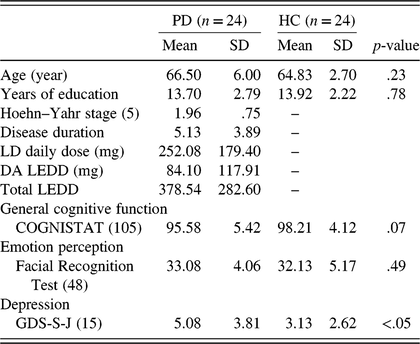
Ages and education years were compared between PD and HC groups by two-sample t-tests, and no significant difference in age [t(46) = 1.21; p = .23; r = .18] or education years [t(46) = 0.28; p = .78; r = .04] was found between these groups. In addition, no significant difference in scores between the two groups was identified in general cognitive functions assessed by COGNISTAT (Kiernan, Mueller, Langston, & Van Dyke, Reference Kiernan, Mueller, Langston and Van Dyke1987; Matsuda and Nakatani Reference Matsuda and Nakatani2004) [t(46) = 1.85; p = .07; r = .26] and in face recognition assessed by Facial Recognition Test (Matsumoto and Ekman Reference Matsumoto and Ekman1988; Sato et al., Reference Sato, Kubota, Okada, Murai, Yoshikawa and Sengoku2002) [t(46) = 0.70; p = .49; r = .10]. However, the depressive status assessed by the Japanese version of Geriatric Depression Scale (Short Version) (GDS-S-J) (Sugishita & Asada, Reference Sugishita and Asada2009; Yesavage & Sheikh, Reference Yesavage and Sheikh1986) was significantly higher in PD group than HC group [t(46) = 2.03; p < .05; r = .29].
All participants in both groups gave informed consent to participate in the protocol approved by the Institutional Review Board of Graduate School of Medicine, Kyoto University (E1493), and Graduate School of Human and Environmental Studies, Kyoto University (23-H-36). Detailed profiles of both PD and HC groups are summarized in Table 1.
Demographic and general neuropsychological profiles in PD and HC

Note. PD = Parkinson’s disease; HC = healthy control; GDS-S-J = Geriatric Depression Scale-Short Version-Japanese; LD = levodopa; DA = dopamine agonist; LEDD = levodopa-equivalent daily dose. Maximum score on a scale shown in parentheses.
Experimental Tasks
Stimuli
As an experimental stimulus, 128 faces with a neutral expression, including 64 male and 64 female faces, were selected from an in-house face database. The in-house database was created from a voluntary participation of pedestrians in their 30s and 40s in the downtown area of the Kyoto city and included Japanese and Korean faces. All stimuli were converted into grayscale images with dimensions of 256 × 296 pixels on a white background using an image-processing software (Adobe Photoshop CS 5.1). These 128 faces were divided into four lists of 32 faces (16 males, 16 females). Three of the lists were applied to three conditions during encoding, and the other list was used for distracter stimuli during retrieval. These lists were counterbalanced across participants.
Procedures
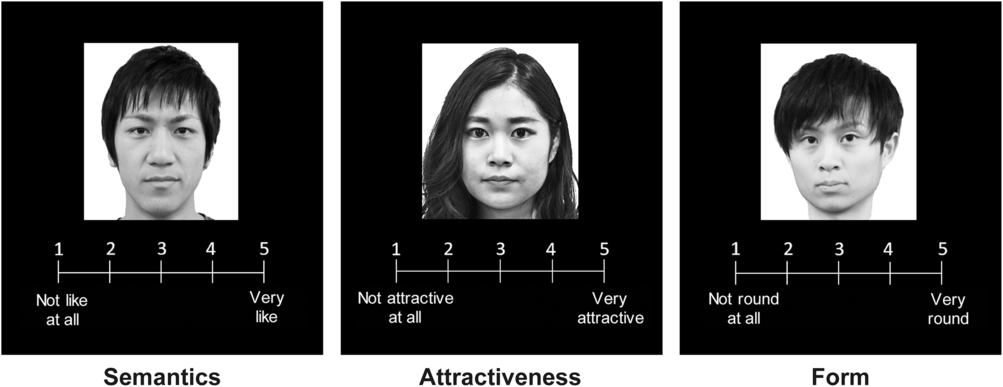
The presentation of experimental stimuli and the recoding of behavioral responses for each participant were controlled by Superlab 4.5 (http://www.cedrus.com/) on Windows PC. The behavioral responses of each participant were recorded on a Windows PC by pressing a key from the keyboard. All participants in PD and HC groups performed the encoding task, followed by the retrieval task. An example of stimuli in the encoding task is illustrated in Figure 1. During encoding, participants were presented with unfamiliar faces in three encoding conditions one by one and were required to rate each face under an instruction given in each encoding condition. Three encoding conditions were conducted in separate runs respectively, and stimuli from different lists were employed in each encoding condition. No reference was made to a subsequent memory test, and hence the encoding operation was incidental.
Examples of experimental stimuli during encoding. During encoding, participants performed three encoding conditions, namely, semantic judgment (Semantics), attractiveness judgment (Attractiveness), and form judgment (Form). No reference was made to a subsequent memory test during encoding (incidental encoding). All instructions were presented in Japanese; English labels are used here for illustration purposes only.

The first condition was the semantic judgment (Semantics) condition, in which target faces were encoded by providing a semantic judgment for each face. In a run of Semantics, participants were presented with 32 unfamiliar faces one by one in random order and were required to rate subjectively the degree to which each of these faces looked like an office worker using a five-point scale (1 = not like at all to 5 = very like). Given that the job information was regarded as one of the person-related semantics (Tsukiura et al., Reference Tsukiura, Fujii, Fukatsu, Otsuki, Okuda, Umetsu, Suzuki, Tabuchi, Yanagawa, Nagasaka, Kawashima, Fukuda, Takahashi and Yamadori2002; Tsukiura, Mochizuki-Kawai, & Fujii, Reference Tsukiura, Mochizuki-Kawai and Fujii2006; Tsukiura, Suzuki, Shigemune, & Mochizuki-Kawai, Reference Tsukiura, Suzuki, Shigemune and Mochizuki-Kawai2008), the rating in Semantics was considered as semantic processes for facial stimuli. The second condition was the attractiveness judgment (Attractiveness) condition, in which target faces were encoded by making attractiveness judgment of each face. In a run of Attractiveness, participants were presented with 32 unfamiliar faces one by one in random order and were required to rate subjectively how attractive each of these faces was using a five-point scale (1 = not attractive at all to 5 = very attractive). Given that facial attractiveness was regarded as one of the face-based social signals (Tsukiura & Cabeza, Reference Tsukiura and Cabeza2011a), the rating in Attractiveness was considered to process the socioemotional information conveyed from faces. The third condition was the form judgment (Form) condition, in which target faces were encoded by making a shape judgment of each face. In a run of Form, participants were presented with 32 unfamiliar faces one by one in random order and were required to rate subjectively the roundness of each face using a five-point scale (1 = not round at all to 5 = very round). This condition served as a control for Semantics and Attractiveness. In each run of the three encoding conditions, an instruction explaining each rating strategy of faces was first presented on the PC display, and then the experimental program was started when participants pressed a “start” key. The order of three encoding conditions was counterbalanced across participants. Each target face was presented until the participant pressed a response key for their rating.
Immediately after the encoding task, participants performed the retrieval task for target faces. During retrieval, participants were presented with 96 target and 32 distracter faces one by one in random order and were required to judge whether or not each face had been previously seen in either of the three encoding conditions. Participants were also given a choice of two levels of confidence with which to categorize their responses. Four response options were prepared – definitely old, probably old, probably new, and definitely new – and their responses were recorded in a Windows PC by pressing one of four keys. Each face was presented until participants pressed a response key with their judgment.
Data Analysis
The “definitely old” response for target faces was defined as hits with high confidence (HH), the “probably old” response for target faces as hits with low confidence (HL), and the “probably new” and “definitely new” responses for target faces as misses (Miss). The proportion of HH and HL of all the responses to target faces was calculated for each encoding condition. In addition, for distracter faces, the “definitely old” response was categorized into false alarms with high confidence (FAH), the “probably old” response into false alarms with low confidence (FAL), and the “probably new” and “definitely new” responses into correct rejections (CR). The proportion of FAH and FAL of all the responses to distracter faces was computed. To investigate the effects of group and encoding conditions on retrieval accuracies of target faces, we conducted two-way mixed analyses of variance (ANOVAs) for HH and HL rates with factors of groups (PD and HC) and encoding conditions (Semantics, Attractiveness, and Form). Each of the HH and HL responses was assumed to have a recollection and familiarity component (Daselaar, Fleck, Dobbins, Madden, & Cabeza, Reference Daselaar, Fleck, Dobbins, Madden and Cabeza2006). In addition, the enhancement scores of HH responses by semantic and socioemotional processes were calculated by comparing the HH rates in Semantics and Attractiveness with those in Form, and the enhancement scores in Semantics and Attractiveness were analyzed by two-tailed two-sample t-tests between PD and HC. Each of the FAH and FAL rates was also compared between PD and HC groups by two-sample t-tests.
To examine how the recollection-related retrieval of target faces encoded in each encoding condition was explained by individual variances of neuropsychological tests, we performed hypothesis-driven simple correlation analyses (Pearson) for all participants in each encoding condition. In these analyses, we analyzed the correlation coefficients between HH rates and total scores of Frontal Assessment Battery (FAB) (Dubois, Slachevsky, Litvan, & Pillon, Reference Dubois, Slachevsky, Litvan and Pillon2000; Uchida & Kawashima, Reference Uchida and Kawashima2008), between HH rates and scores of 30-min delayed recall in Rey Auditory Verbal Learning Test (RAVLT) (Lezak, Reference Lezak1983; Tanaka, Reference Tanaka1998), and between HH rates and scores of 5-min delayed recall in Rey–Osterrieth Complex Figure Test (ROCFT) (Lezak, Reference Lezak1995). In addition, multiple regression analyses using the forced entry method were performed for all participants in each encoding condition. In these analyses, the model included HH rates in each encoding condition as a dependent variable, and total scores of FAB, scores of 30-min delayed recall in RAVLT, and scores of 5-min delayed recall in ROCFT as independent variables. Results of forced entry multiple regression analyses were followed by stepwise multiple regression analyses, in which we employed the same dependent and independent variables.
RESULTS
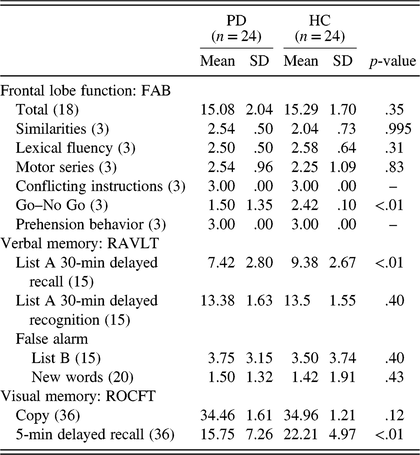
First, cognitive declines reflecting frontal lobe functions and long-term memories in PD group were evaluated with FAB, RAVLT and ROCFT. One-tailed two-sample t-tests driven by our hypotheses were used to identify the decreasing scores in PD group compared to HC group. In these analyses, we found that the PD group showed significantly lower scores than the HC group in frontal lobe functions as evaluated by the Go–No Go component of FAB [t(46) = 2.62; p < .01; r = .36], and in both verbal and visual memories as evaluated by RAVLT [delayed recall: t(46) = 2.43; p < .01; r = .34] and ROCFT [delayed recall: t(46) = 3.52; p < .01; r = .46]. Detailed results of FAB, RAVLT, and ROCFT are shown in Table 2.
Frontal lobe function and long-term memory in PD and HC

Note. PD = Parkinson’s disease; HC = healthy control; FAB = Frontal Assessment Battery; RAVLT = Rey Auditory Verbal Learning Test; ROCFT = Rey–Osterrieth Complex Figure Test. Maximum score on a scale shown in parentheses.
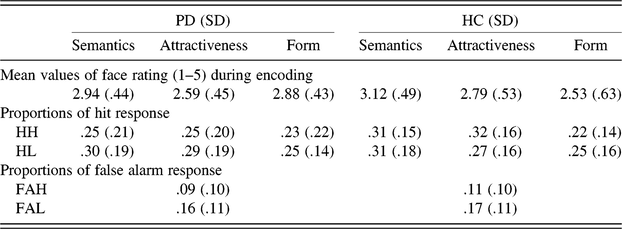
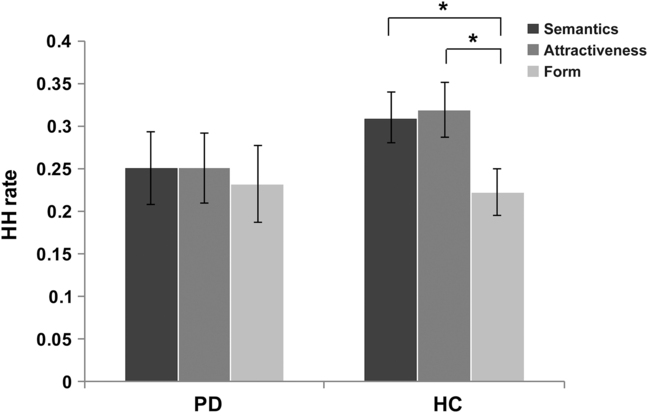
Second, the retrieval performance in each encoding condition was compared between PD and HC groups. Table 3 summarizes the proportion of HH and HL in each encoding condition, and of FAH and FAL. A two-way mixed ANOVA for recollection-related HH rates with the factors of groups (PD and HC) and encoding conditions (Semantics, Attractiveness, and Form) showed a significant main effect of encoding condition [F(2,92) = 10.48; p < .01; η p2 = .19] and a significant interaction between these factors [F(2,92) = 4.45; p < .05; η p2 = .09]. A simple main effect of encoding condition in the HC group was significant [F(2,92) = 14.28; p < .01; η 2 = .24] but not in the PD group [F(2,92) = 0.64; p = .53; η 2 = .01]. As shown in Figure 2, in post hoc tests for the HC group based on the Ryan’s method, HH rates in Semantics and Attractiveness were significantly higher than those in Form [Semantics: t(92) = 4.38; p < .01; r = .42; Attractiveness: t(92) = 4.84; p < .01; r = .45]. A main effect of group was not significant [F(1,46) = 0.58; p = .45; η p2 = .01]. In addition, to compare the memory enhancement of HH rates by semantic and socioemotional processes between the two groups, differences of HH rates in Semantics and Attractiveness from those in Form were analyzed by two-sample t-tests between PD and HC. Two-sample t-tests demonstrated that the enhancing effect of HH rates in both conditions was significantly larger in HC than PD [Semantics: t(46) = 2.33; p < .05; r = .33; Attractiveness: t(46) = 2.86; p < .01; r = .39].
Results of rating and memory in each encoding condition

Note. PD = Parkinson’s disease; HC = healthy control; Semantics = semantic judgment; Attractiveness = attractiveness judgment; Form = form judgment; HH = hits with high confidence; HL = hits with low confidence; FAH = false alarms with high confidence; FAL = false alarms with low confidence.
Results of HH rates in PD and HC groups. PD = Parkinson’s disease; HC = healthy control; HH = hits with high confidence; error bar = standard error; *p < .05.

In a two-way mixed ANOVA for familiarity-related HL rates with the factors of groups and encoding conditions, we found a significant main effect of encoding condition [F(2,92) = 5.14; p < .01; η p2 = .10], in which post hoc tests by the Ryan’s method showed a significant difference between Semantics and Form [t(92) = 3.20; p < .01; r = .32]. However, a main effect of group [F(2,92) = 0.00; p = .99; η p2 = .00] and interaction between groups and encoding conditions [F(2,92) = 0.36; p = .70; η p2 = .01] were not significant. FAH and FAL rates were analyzed by two-sample t-tests between both groups. However, we did not find a significant difference between PD and HC groups in either FAH [t(46) = 0.72; p = .48; r = .11] or FAL [t(46) = 0.27; p = .78; r = .04].
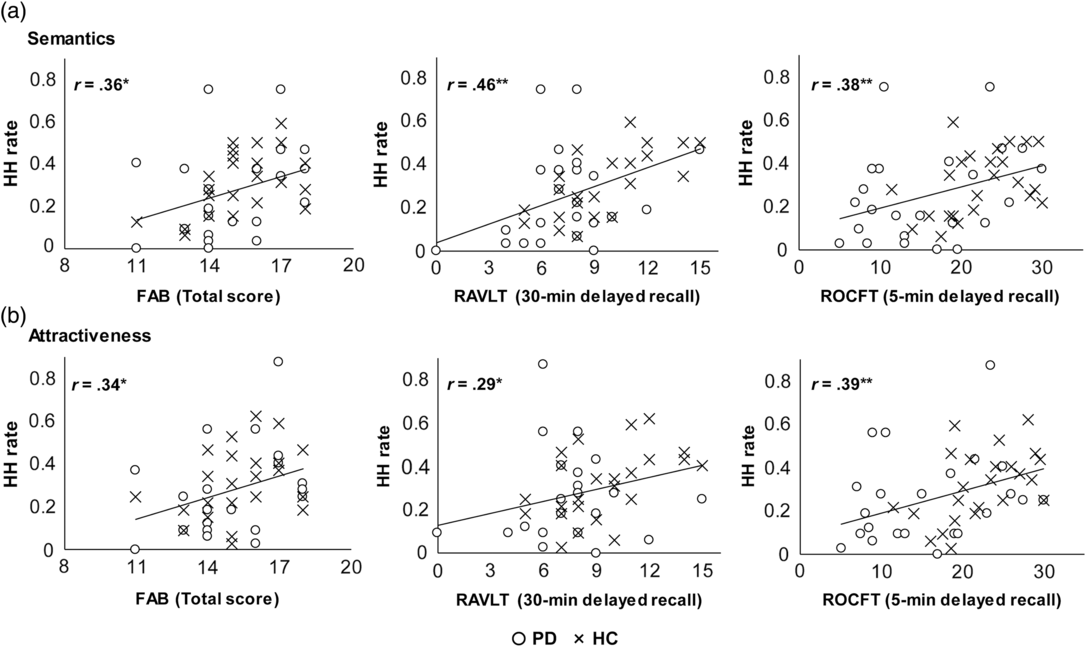
Third, we investigated how the recollection-related retrieval of faces encoded in the three encoding conditions was explained by individual variances in cognitive functions. In this analysis, we conducted simple correlation (Pearson) analyses and multiple regression analyses using the forced entry method and stepwise method. In Pearson correlation analyses, HH rates in Semantics significantly correlated with individual scores of FAB (r = .36; p < .05), RAVLT (r = .46; p < .01), and ROCFT (r = .38; p < .01). The similar patterns of correlation were identified in the HH rates of Attractiveness (FAB: r = .34; p < .05; RAVLT: r = .29; p < .05; ROCFT: r = .39; p < .01). In the correlation analyses of Form, however, no significant correlation was found in any scores (FAB: r = .28; p = .06; RAVLT: r = .27; p = .07; ROCFT: r = .18; p = .23). Results of simple correlation analyses are summarized in Figure 3.
Scatter plots in correlation analyses. (a) Correlations in Semantics. (b) Correlations in Attractiveness. PD = Parkinson’s disease; HC = healthy control; HH = hits with high confidence; FAB = Frontal Assessment Battery; RAVLT = Rey Auditory Verbal Learning Test; ROCFT = Rey–Osterrieth Complex Figure Test; **p < .01; *p < .05.

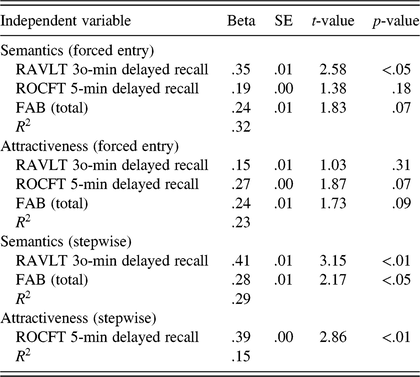
In multiple regression analyses using the forced entry method, we assigned HH rates in each encoding condition to a dependent variable, and the scores of RAVLT (30-min delayed recall), ROCFT (5-min delayed recall), and FAB (total) to independent variables. Results of these analyses demonstrated that the HH rates for Semantics were significantly predicted in the model including these independent variables [R 2 = .32; F(3,44) = 6.73; p < .01; η 2 = .31], in which a variable of the scores of RAVLT was significant (p < .05) and a variable of the total score of FAB approached significance (p = .07). For Attractiveness, these independent variables significantly predicted HH rates [R 2 = .23; F(3,44) = 4.36; p < .01; η 2 = .23], for which the effects of ROCFT (p = .07) and FAB (p = .09) were marginally significant. For Form, a significant model to predict HH rates was not identified [R 2 = .13; F(3,44) = 2.09; p = .12; η 2 = .12]. In addition, to reconfirm the results in forced entry multiple regression analyses, we performed stepwise multiple regression analyses for HH rates as a dependent variable and the scores of three neuropsychological tests as independent variables. In the analyses, a model that included the scores of 30-min delayed recall in RAVLT and the total scores of FAB as independent variables significantly predicted the HH rates for faces encoded in the Semantics condition [R 2 = .29; F(2,45) = 8.97; p < .01; η 2 = .29]. For the Attractiveness condition, a model that included the scores of 5-min delayed recall in ROCFT as an independent variable significantly predicted HH rates [R 2 = .15; F(1,46) = 8.16; p < .01; η 2 = .15]. However, no significant independent variable was identified for a model that explained the HH rates for faces encoded in the Form condition. Thus, the results in forced entry multiple regression analyses were reconfirmed by stepwise multiple regression analyses. Detailed results of multiple regression analyses are summarized in Table 4.
Results of multiple regression analyses in all participants

Note. Semantics = semantic judgment; Attractiveness = attractiveness judgment; RAVLT = Rey Auditory Verbal Learning Test; FAB = Frontal Assessment Battery; ROCFT = Rey–Osterrieth Complex Figure Test.
Finally, using the Pearson correlation analyses, we investigated the potential effects of medication status, depressive status, and disease duration on individual scores of memory retrieval. The correlations between total LEDD (Levodopa-equivalent daily dose) of medication and memory retrieval (HH rates in each encoding condition) were analyzed in 21 PD patients who were medicated. In these analyses, no significant correlation was found in any encoding conditions (Semantics: r = −.11; p = .64; Attractiveness: r = −.13; p = .59; Form: r = .01; p = .97). In the correlation analyses between scores of GDS-S-J and memory retrieval for all participants, we did not find significant correlation coefficients in any encoding conditions (Semantics: r = −.16; p = .28; Attractiveness: r = −.13; p = .37; Form: r = −.08; p = .59). In addition, significant correlation between disease duration and memory retrieval in patients with PD was not identified in any encoding conditions (Semantics: r = −.24; p = .26; Attractiveness: r = −.32; p = .13; Form: r = −.25; p = .24).
DISCUSSION
Two major findings emerged from the present study. First, the HC group demonstrated a significant enhancement in the recollection of faces encoded by semantic judgment, whereas the recollection of face memories was not enhanced by semantic elaborations in the PD group. Recollection-related enhancement in Semantics compared to Form was significantly larger in HC than PD. In addition, simple correlation analyses demonstrated that the scores of cognitive functions, including frontal lobe function and long-term memory, in both verbal and visual domains significantly correlated with individual abilities in the recollection of faces encoded by semantic judgment, whereas in multiple regression analyses, frontal lobe function and verbal long-term memory as independent variables predicted the recollection scores of face memories as a dependent variable. Second, the recollection of faces encoded by the judgment of facial attractiveness was significantly enhanced in the HC group, whereas the recollection of face memories was not enhanced by socioemotional elaborations in the PD group. The HC group showed significantly larger enhancement of recollecting face memories encoded in Attractiveness than those in Form. In simple correlation analyses, we found that the recollection of faces encoded by the judgment of facial attractiveness significantly correlated with individual scores of frontal lobe function and long-term memory in both verbal and visual domains. In multiple regression analyses, however, we identified that individual differences in visual memory as an independent variable explained the recollection of face memories as a dependent variable. These findings suggest that patients with PD could have impaired processing of semantic and socioemotional signals conveyed from faces, and these impairments could disturb the enhancement of face memories that occurs with semantic and socioemotional processes. The disturbed enhancement of face memory by encoding operations in patients with PD could be associated with general neuropsychological abilities including frontal lobe function and long-term memory, whereas the roles of frontal lobe function and long-term memory in the disturbed enhancement of face memories could be dissociable between semantic and socioemotional elaboration during encoding in PD patients. These findings are discussed in separate sections below.
Face Memories Encoded by Semantic Judgment
The first main finding of the present study was that the HC group showed significantly higher HH rates of face memories encoded in Semantics than those in Form, whereas the PD group did not show memory enhancement from semantic elaboration during encoding. In HL rates, however, such a pattern of memory enhancement by semantic elaboration was identified in both PD and HC groups. These findings suggest that the encoding operation of face memories by semantic elaboration could not be sufficiently functioned in PD and that recollection-related enhancement of face memories by semantic elaboration during encoding could be disturbed in this group.
The present finding that memory enhancement by semantic elaboration during encoding was not significant in patients with PD is consistent with previous results demonstrating that processing of semantic information is impaired in patients with PD (Grossman et al., Reference Grossman, Carvell, Gollomp, Stern, Vernon and Hurtig1991; Koerts et al., Reference Koerts, Meijer, Colman, Tucha, Lange and Tucha2013; Raskin et al., Reference Raskin, Sliwinski and Borod1992). For example, compared to HC, patients with PD was impaired in the semantic fluency task that required participants to generate names belonging in the animal or job title category, whereas performance in the phonemic verbal fluency task that required participants to generate names from cued letters was relatively preserved in PD (Koerts et al., Reference Koerts, Meijer, Colman, Tucha, Lange and Tucha2013). Another study reported that patients with PD performed significantly worse than HC in the semantic fluency task when the semantic strategy was employed, whereas the performance of this task in PD was preserved when the phonemic strategy was employed (Raskin et al., Reference Raskin, Sliwinski and Borod1992). There is neuropsychological evidence showing that a decline in the semantic process in PD was identified in the sentence comprehension task (Grossman et al., Reference Grossman, Carvell, Gollomp, Stern, Vernon and Hurtig1991). In addition, a psychological study of healthy participants demonstrated that faces encoded by judging the job titles of each face were recognized more accurately than those encoded by judging the orientation of faces (Marzi & Viggiano, Reference Marzi and Viggiano2010). Given that the levels-of-processing effect reflecting semantic elaborations during encoding was significant in recollection but not in familiarity (Gallo, Meadow, Johnson, & Foster, Reference Gallo, Meadow, Johnson and Foster2008), the present finding of dissociable effects on face memories between PD and HC groups suggests that the beneficial effects of semantic elaborations during encoding on later recollection could not be expressed due to the disturbance in semantic elaborations in PD.
In simple correlation, we found that HH rates in Semantics significantly correlated with individual scores of FAB, RAVLT, and ROCFT. However, multiple regression analyses showed that HH rates in Semantics were explained by individual scores of FAB and RAVLT. These findings suggest that the enhancing effects of semantic elaboration during encoding on later recollection could be modulated by individual variances of frontal lobe function and long-term memory in both verbal and visual domains, but the contribution of frontal lobe function and verbal long-term memory could be more critical than that of visual long-term memory. A functional neuroimaging study of patients with PD revealed that several regions of the brain, such as the medial and lateral temporal lobe and the frontal lobe, showed significant activation during the processing of semantic information (Pereira et al., Reference Pereira, Junque, Marti, Ramirez-Ruiz, Bartres-Faz and Tolosa2009). In addition, fMRI studies of healthy participants demonstrated that significant activation in the medial and lateral temporal lobe, lateral parietal lobe, and lateral frontal lobe was identified in the delayed recall of RAVLT (Dupont, Samson, Le Bihan, & Baulac, Reference Dupont, Samson, Le Bihan and Baulac2002). The inferior frontal gyrus also showed significant activation in tasks associated with semantic generation, classification, and comparison of words (Thompson-Schill, D’Esposito, Aguirre, & Farah, Reference Thompson-Schill, D’Esposito, Aguirre and Farah1997). This activation pattern was followed by a neuropsychological study in which patients with inferior frontal lesions were impaired in these tasks (Thompson-Schill et al., Reference Thompson-Schill, Swick, Farah, D’Esposito, Kan and Knight1998). In another neuropsychological study for patients with PD, damage to the fronto-striatal circuit in PD by dopamine depletion in the substantia nigra was associated with a significant decline in frontal lobe functions in these patients (Zgaljardic et al., Reference Zgaljardic, Borod, Foldi and Mattis2003). Taken together, the present findings suggest that the processing of semantic information could be impaired in patients with PD due to disturbances in frontal lobe functions, and that the disturbed processes of semantic information in patients with PD could lead to difficulties with verbal long-term memory involved in the temporal lobe region.
Face Memories Encoded by Attractiveness Judgment
The second main finding of the present study was that the HC group demonstrated significantly higher HH rates in the retrieval of faces encoded in Attractiveness than those in Form, whereas memory enhancement was not significant in the PD group. However, this dissociable pattern of face memories between PD and HC groups was not evident in HL rates. These findings suggest that socioemotional elaborations of facial stimuli during encoding could be disturbed in patients with PD, and that the disturbance of socioemotional elaborations of face memories in PD could reduce the enhancing effects on recollecting face memories encoded by judging facial attractiveness.
The present finding that recollection-related enhancement for face memories encoded by judging attractiveness of target faces was not significant in patients with PD is associated with previous findings of functional neuroimaging studies (Haber & Knutson, Reference Haber and Knutson2010; Hahn & Perrett, Reference Hahn and Perrett2014; Schultz, Reference Schultz2000). For example, several fMRI studies have reported that reward-related regions such as the orbitofrontal cortex (Ishai, Reference Ishai2007; O’Doherty et al., Reference O’Doherty, Winston, Critchley, Perrett, Burt and Dolan2003; Tsukiura & Cabeza, Reference Tsukiura and Cabeza2011b) and striatum (Kampe, Frith, Dolan, & Frith, Reference Kampe, Frith, Dolan and Frith2001) contribute to the processing of facial attractiveness. There is fMRI evidence that memory enhancement for attractive faces was identified in hit responses with high confidence related to the recollection process, and the interacting mechanisms between the reward-related orbitofrontal cortex and the memory-related hippocampus played an important role in the enhancement of recollecting attractive faces (Tsukiura & Cabeza, Reference Tsukiura and Cabeza2011a). In addition, neuropsychological studies have consistently reported that patients with PD are impaired in the monetary reward task (Ibarretxe-Bilbao et al., Reference Ibarretxe-Bilbao, Junque, Tolosa, Marti, Valldeoriola, Bargallo and Zarei2009; Kobayakawa et al., Reference Kobayakawa, Koyama, Mimura and Kawamura2008; Mimura et al., Reference Mimura, Oeda and Kawamura2006). In an fMRI study, the recollection-related process was enhanced by the motivation of receiving monetary rewards, and reward-related enhancement of memories was involved in interactions between the reward-related regions such as the nucleus accumbens and ventral tegmental area and recollection-related hippocampus (Shigemune et al., Reference Shigemune, Tsukiura, Kambara and Kawashima2014). Thus, the processing of facial attractiveness as a social reward could be disturbed in patients with PD, and this disturbance could suppress the enhancement of recollection-based face memories by face-based social signals.
Although simple correlation analyses showed significant correlation coefficients between HH rates and scores in FAB, RAVLT, and ROCFT, multiple regression analyses revealed that individual variances in ROCFT scores predicted HH rates in Attractiveness. These findings suggest that the retrieval of face memories encoded by socioemotional elaboration could be associated with individual variances of frontal lobe function and long-term memory in both verbal and visual domains, but the processing of visual forms and visual memories involved in the temporal lobe regions could be more important than that of verbal memories in the enhancement of face memories by the processing of socioemotional signals from faces. A previous fMRI study identified significant activation in the left hippocampus related to the subsequent recollection and activation in the right fusiform gyrus related to the processing of face images during the encoding of faces by the attractiveness judgment (Tsukiura & Cabeza, Reference Tsukiura and Cabeza2011a). In another fMRI study, significant activation during the judgment of facial attractiveness was identified in the reward-related orbitofrontal cortex and the right inferior temporal region associated with the processing of face-related visual forms (Winston, O’Doherty, Kilner, Perrett, & Dolan, Reference Winston, O’Doherty, Kilner, Perrett and Dolan2007). Taken together, the processing of face-based visual forms and face memories could be enhanced by socioemotional signals conveyed from faces, and the absence of an enhancing effect on face memories by judging facial attractiveness in patients with PD could reflect a disturbance in elaborations for visual forms of faces due to dysfunctions in the mesolimbic dopaminergic system (Kehagia, Barker, & Robbins, Reference Kehagia, Barker and Robbins2010).
Limitations
There are several potential limitations to be discussed in the present study. The first possible limitation is related to recollection–familiarity dissociation. In the present study, the HC group showed a significant enhancement of recollecting face memories encoded by semantic and socioemotional elaborations, and recollection-related enhancement was not identified in the PD group. In familiarity-based recognition related to HL rates, however, both PD and HC groups showed significantly higher HL rates for face memories encoded in Semantics than those in Form, and familiarity-based enhancement was not different between PD and HC groups. The different patterns of memory enhancement between recollection and familiarity suggest that the enhancing effect of memories by semantic and socioemotional elaborations during encoding could be active commonly between PD and HC groups at least in familiarity-based recognition. Several previous studies have reported that patients with PD are impaired in recollection-based recognition and preserved in familiarity-based recognition (Algarabel et al., Reference Algarabel, Rodriguez, Escudero, Fuentes, Peset, Pitarque, Cómbita and Mazon2010; Pitarque et al., Reference Pitarque, Melendez, Sales, Satorres, Escudero and Algarabel2017), whereas other studies have reported preserved recollection and impaired familiarity in patients with PD (Davidson, Anaki, Saint-Cyr, Chow, & Moscovitch, Reference Davidson, Anaki, Saint-Cyr, Chow and Moscovitch2006; Weiermann, Stephan, Kaelin-Lang, & Meier, Reference Weiermann, Stephan, Kaelin-Lang and Meier2010). To explain the inconsistency among previous findings, another study demonstrated that non-demented PD patients were impaired in recollection and preserved in familiarity when memories encoded by a deep strategy were recognized, whereas the reverse pattern of deficits was found in recognizing memories encoded by a shallow strategy (Cohn, Moscovitch, & Davidson, Reference Cohn, Moscovitch and Davidson2010). Taken together with the present findings, recognition memories in patients with PD could be impaired in recollection and preserved in familiarity, when memories are encoded by deep strategies such as semantic or socioemotional elaborations. Further investigations would be required to find the recollection–familiarity dissociation in patients with PD.
The second possible limitation is about the memory performance affected by biased responses for target faces. In the present experiment, we employed 96 target faces (32 in each encoding condition) and 32 distracter faces, by which we aimed to decrease the difficulty of memory task and to investigate the effects of encoding operations on retrieval performance of target faces in both PD and HC groups. A similar procedure was employed in a previous study, in which 20 target faces were encoded by several types of facial expression and then memories of target faces were tested with eight distracter faces (Shimamura, Ross, & Bennett, Reference Shimamura, Ross and Bennett2006). Biased responses for target faces might be generated in the experimental design with larger number of target faces in a memory test, and response bias might affect the different patterns of face memories between PD and HC groups. As mentioned in the Results section, however, we did not find significant differences of false alarm rates in both high and low levels of confidence between PD and HC groups. In addition, no significant difference of recollection-related HH and familiarity-related HL rates in the Form condition as a control was found between the two groups. Thus, the potential effect of response biases for target faces induced by the present experimental design could be small in the different patterns of memory enhancement between PD and HC groups.
The third possible limitation is about the storage/consolidation issues. One neuropsychological study reported that no significant difference of memory consolidation scores was found between cognitively intact and impaired PD patients assessed by the Clinical Dementia Rating (CDR) (Karrasch, Laatu, Martikainen, & Marttila, Reference Karrasch, Laatu, Martikainen and Marttila2013). In another study, PD patients treated with dopaminergic medications during learning/early consolidation were impaired in both 30-min and 24-h delayed recall, whereas patients with dopaminergic mediations during late consolidation after learning (8–24 h after learning) showed significantly better scores of memory recall in 24-h delayed recall than those without medications (Grogan, Bogacz, Tsivos, Whone, & Coulthard, Reference Grogan, Bogacz, Tsivos, Whone and Coulthard2015). These findings imply that memory consolidation could be possibly preserved in PD patients with dopaminergic medications. In the present study, however, all participants in PD and HC groups were evaluated only in the immediate recognition of faces but not in delayed recognition after the consolidation of face memories. Thus, further investigations would be required to find the effects of consolidation on face memories encoded by semantic and socioemotional elaborations in patients with PD.
The final possible limitation is that multiple regression analysis using the stepwise method might cause Type I error in the decision of regression variables included in the final model. As noted in a previous study, model selection in stepwise multiple regression is conducted by inferring whether parameters are significantly different from zero, which could cause potential biases in parameters, over-fitting, and incorrect significance tests (Whittingham, Stephens, Bradbury, & Freckleton, Reference Whittingham, Stephens, Bradbury and Freckleton2006). The potential artifacts raised by stepwise multiple regression analysis might affect the results and interpretations of the present study. However, we found similar trends of results in inferring significant independent variables between forced entry and stepwise multiple regression analyses. Thus, the present findings in multiple regression analysis suggest that the possible Type I error by stepwise multiple regression analysis could be limited in the present study.
CONCLUSIONS
In the present study, we investigated the effects of semantic and socioemotional elaborations on face memories in patients with PD and in HC. Recollection-based memory enhancement tended to be greater when using semantic and socioemotional encoding strategies than the perceptual encoding strategy in the HC group. This benefit in using semantic and socioemotional encoding strategies was not demonstrated in the PD group. In addition, while individual variances in frontal lobe function and verbal long-term memory predicted the retrieval performance of memories encoded by semantic elaborations during encoding, the retrieval of memories encoded by socioemotional elaborations was predicted with individual variances in visual long-term memory. These findings suggest that the processing of semantic and socioemotional signals conveyed from faces could be impaired in patients with PD, and that these impairments could decrease the enhancing effect of semantic and socioemotional elaborations on face memories.
A recent review article has proposed that facial emotion recognition is impaired in patients with PD, and that understanding the deficits of facial emotion recognition in PD contributes to the improvement of social behaviors and quality of life (QOL) in PD patients (Argaud, Verin, Sauleau, & Grandjean, Reference Argaud, Verin, Sauleau and Grandjean2018). Given that our research tackled to clarify how PD patients recognize semantic and socioemotional signals from faces in more complex situations than the simple emotion recognition of faces, the progress of future research about facial recognition and face memory in PD could be helpful to improve social communication between patients with PD and caregivers in real-life situations, and could have a beneficial effect on QOL in them.
ACKNOWLEDGEMENTS
We thank Dr. Naho Saito for the technical support and the recruitment of patients with PD to the study. This work was supported by grants from the JSPS NEXT Program (LZ001) initiated by the Council for Science and Technology Policy, JSPS KAKENHI grant numbers JP17H05947, JP18H04193, and the Naito Foundation.
CONFLICTS OF INTEREST
The authors have no conflicts of interest to declare.