Our mobile society has become accustomed to obtaining many services and products through a car window. The environmental and public health verdicts on our drive-through culture are resoundingly negative, but the business goals of drive-through service remain the same: speed, efficiency, and volume. To this end, it is not a surprise that public health and health care providers began to use drive-through clinics to help reach the goal of universal seasonal influenza vaccination coverage.
Drive-through clinics can also provide valuable experience for health care and public health providers in the mass distribution of health care services, such as would occur during a disaster or public health emergency. Drive-through clinics are often used to simulate provision of antibiotics, antiviral agents, or other pharmaceuticals during disaster conditions by using the physical layout and procedures for an emergency point of dispensing site.Reference Rega, Bork, Chen, Woodson, Hogue and Batten1, Reference Zerwekh, McKnight, Hupert, Wattson, Hendrickson and Lane2
The recommendations of the National Vaccine Advisory Committee include conducting program evaluation to determine the characteristics of participants and the impact on underserved and at-risk populations.3 The committee defines people at high risk of developing flu-related complications as children younger than age 5 years, adults aged 65 years and older, people with chronic medical conditions, pregnant women, and Native American and Alaskan natives.4 In spite of numerous reports describing drive-through clinics, very little published information describes the patrons of these clinics. Health insurance coverage has been reported as a significant driver of influenza immunization in general,Reference Takayama, Wetmore and Mokdad5 but the impact of no-cost clinics is unknown. Nontraditional clinics such as those in the work place and at retail locations have been shown to underserve minority, rural, and low-income populations, but the study did not include drive-through clinics.Reference Lee, Mehrotra, Burns and Harris6 In 2 studies of language barriers, influenza vaccination rates in general were shown to be lower in those who preferred to communicate in Spanish.Reference Pearson, Zhao and Ford7, Reference Haviland, Elliott, Hambarsoomian and Lurie8 The goal of this study was to determine important characteristics of the participants in a drive-through seasonal influenza vaccination clinic.
Methods
In October 2011, we conducted a survey during a no-cost drive-through influenza vaccination clinic conducted by the University of New Mexico (UNM) Health Sciences Center in Albuquerque. Advertisement for the drive-through clinic included e-mail messages to university personnel and students and standard news releases. The clinic provided injectable influenza vaccine for 1858 adults and children 9 years of age or older. Vaccinations were administered by UNM Health Sciences Center staff, and nursing students under the supervision of instructors.
Vaccinations were accompanied by standard consent forms submitted to the New Mexico Department of Health. Safety services, traffic control, and logistical support were provided by UNM personnel and 2 local Medical Reserve Corps units. The study was submitted for approval to the UNM Human Research Protection Office and was deemed to be exempt from the requirement of the human research regulations stated in 45 CFR 46.101(b).
The survey was a single page that was printed in English on one side and Spanish on the other. Surveys were administered by volunteers who handed the numbered survey and a pen to the driver of each car who was waiting in line; collection of the form occurred at the time of vaccination. Questions that were answered only once on behalf of all the occupants of the vehicle included (1) prior use of the drive-through clinic, (2) other options available for vaccination (6 choices), and (3) how they learned about the clinic (6 choices). The age group, gender, and zip code of those receiving a vaccine was collected for up to 3 people per vehicle. Although some vehicles had as many as 8 people to be vaccinated, a large majority (94%) had only 1, 2, or 3 people.Reference Banks, Crandall and Esquibel9
We used the R statistical package for exploratory and graphical analyses (R Foundation for Statistical Computing). The confirmatory data analysis for this report was generated using SAS/STAT& software, version 9.3 of the SAS System for Windows 7. The map was created in ArcGIS Desktop 10.
Results
Clinic Usage
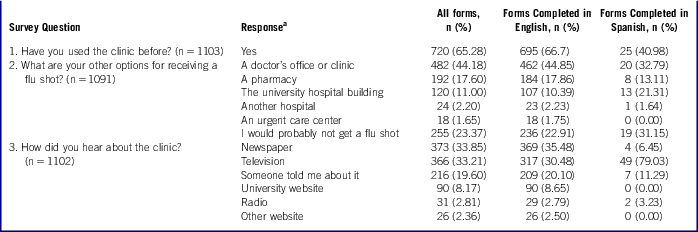
A total of 1114 surveys were collected. The surveys varied slightly in the number of responses to the 3 clinic usage questions (1103, 1091, and 1102 responses, respectively). The majority of the responses to question 1 (65.28%) indicated prior usage of the annual clinic. The responses to question 2 indicated that other options for vaccination in the absence of a drive- through clinic included primarily a physician's office (44.18%) or a pharmacy (17.60%). A fairly large percentage of participants (23.37%) chose the answer “I would probably not get a flu shot.” The responses to question 3 indicated that the participants learned about the clinic primarily through the newspaper (33.85%%) and television (33.21%). Table 1 shows the distribution of responses for all of the forms, the forms printed in English, and the forms printed in Spanish. The proportion of answers to all 3 clinic usage questions differed between the English forms and the Spanish forms (P < .0001, P = .0389, P < .0001, respectively). Most interestingly, the percentage of responses on the forms printed in Spanish that indicated “I would probably not get a flu shot” was 31.15%, as compared to 22.91% on the forms printed in English (P = .0389).
Responses to Clinic Usage Questions from a 2011 Drive-Through Influenza Vaccination Survey

aThe proportion of answers to all 3 questions differed significantly between the English forms and the Spanish forms (χ2-distribution, P < .0001, P = .0389, P < .0001, respectively).
Demographic Characteristics
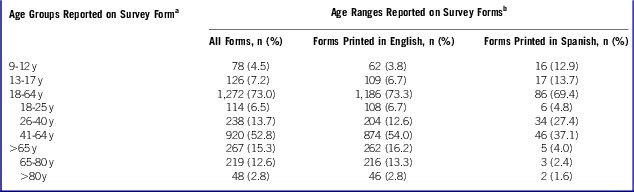
The survey produced a total of 1840 individuals for whom either age, zip code, or gender was reported. The gender was reported as female for 57% of the vaccine recipients; no significant difference was observed in the gender proportion between the forms completed in English versus Spanish (χ2-distribution, P = .90). Table 2 shows the age groups reported on forms completed in English, Spanish, and overall. The table summarizes the age groups of 1743 responses using the categories commonly used by the Centers for Disease Control and Prevention (CDC) (except for the youngest group), and more detailed information for age ranges within certain groups. A significantly different proportion of age groups was reported between the forms printed in English versus those printed in Spanish. Respondents of the English forms trended older than the respondents of the Spanish forms (P < .0001).
Age of Participants in a 2011 Drive-Through Influenza Vaccination Clinic (n = 1743)
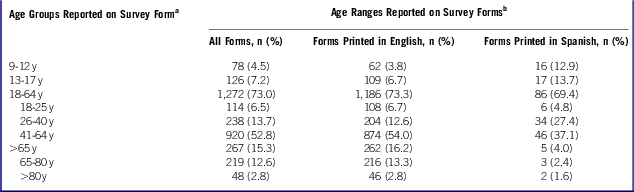
aThe age of 1743 individuals were reported; 1619 were on forms printed in English, 124 were on forms printed in Spanish.
bStatistically significant difference in age group distribution between forms printed in English and those printed in Spanish: χ2-distribution, P < .0001.
Geographic Distribution
The total number of zip code responses was 1706 (representing 92% of the total vaccines given), and the number of responses per zip code ranged from 1 to 163. The distribution included 38 New Mexico non-PO box zip codes, representing 9 of 33 counties; 1 each from Colorado, Texas, and Nevada; and 2 from California.
Discussion
The analysis of demographic characteristics of clinic participants is an important step in evaluating the impact of a clinic, and determining a community's progress toward immunization goals. The findings of such studies can be used to modify outreach methods to target at-risk populations or drive decisions on the use of alternative methods for vaccination. The drive-through clinic we studied has been successful in providing services to a varied population from many age groups and from many locations in the northwest region of New Mexico. It appears that the clinic has provided some vaccinations that might not otherwise have been received. These data alone, however, cannot determine what makes these annual drive-through clinics popular: the fact that they are convenient or the fact that they are free. In addition, intrusive questions such as pregnancy and chronic health conditions also are not included because one individual is completing the survey on behalf of other occupants in the vehicle.
The sample in the study was not intended to be a representative sample of the population of the community or the state, but only a characterization of the participants who were drawn to the clinic by various outreach methods and because of various motivations. The drive-through clinic did, however, appear to serve a different distribution of vaccine recipients than that estimated for New Mexico as a whole by the CDC using FluVaxView.10 The CDC report, which uses data from several national surveys, estimates the vaccination rates for the 2011to 2012 season for New Mexico at 67.1% for children aged 5 to 12 years, 42.5% for children aged 13 to 17 years, 34.2% for adults aged 18 to 64 years, and 62.0% for adults aged 65 years or older. For the Spanish language participants, as compared to the English language participants, the clinic appeared to be slightly more popular for providing services for younger people and less popular for providing services for older adults. The reason for this finding is unknown, but could be related to a differential uptake of media messages or word of mouth, or a difference in the use of a vehicle for transportation, between the 2 language groups. The impact of language barriers may have played a role in the differences noted in the clinic usage questions. Consistent with the studies on language preference and vaccination rates, a higher percentage of participants responding in Spanish reported not having an alternative for vaccination.
Zip code responses indicated wide usage of the clinic in the city of Albuquerque and the surrounding, mostly rural, communities. Zip codes indicated usage of the clinic by persons residing in New Mexico from as far away as 175 miles, as well as from other states. This finding is likely because the city of Albuquerque serves as a hub of retail, transportation, and services for the region, with individuals likely participating in the clinic during a visit to the city for some other purpose. The media outlets in Albuquerque used for advertising the clinic also have a wide regional reach that may have contributed to the usage of the clinic by nonresidents.
Limitations
A limitation of the study was the inconsistent completion of all survey questions. This aspect was partially mitigated by the large percentage of completed individual questions relative to the total numbers of vaccines given. The study was also necessarily brief to allow for quick completion; it therefore left out several important questions, as mentioned. In addition, no local comparison data are currently available for traditional influenza vaccination clinics. Future surveys should include questions regarding insurance coverage, high-risk conditions, and other variables that are likely to contribute to participation. Additional surveys are needed for speakers of other languages. Similar studies should be conducted during future clinics to determine the consistency of findings seen here, in this community, as well as in others.
Conclusions
It is likely that drive-through clinics have been permanently incorporated into national influenza prevention efforts. Drive-through techniques are also likely to be used in many communities during the response to a public health emergency. The operators of vaccine clinics can use these findings to improve outreach to populations of concern and encourage multiple venues, both traditional and nontraditional, to maximize immunization in their communities.
Acknowledgement
Roxanne Jarrard compiled the data for this report.