Introduction
Carbon is a “go-to” material for applications in the fields of molecular separations via adsorption, as electrode materials in batteries, and for strong composite materials. From a fundamental point of view, carbon can form different types of hybridized bonds (sp, sp2, and sp3), which underpin the formation of a wide variety of allotropes, including diamond, graphite, fullerenes, and nanotubes. Graphene, an individual carbon layer of monoatomic thickness, has also been isolated and its properties evaluated.
While wide-ranging experimental and theoretical work has been undertaken on the electronic, electrochemical, and mechanical properties of carbon allotropes, understanding and exploiting the molecular- and fluid-transport properties within the confines of the nanoscale afforded by the one-dimensional (1D) structure of carbon nanotubes (CNTs) and the two-dimensional (2D) planar structure of graphene is a new frontier. Carbon is special from the fluidic perspective, and the discovery of new nanofluidic behavior associated with graphitic materials has triggered explosive growth in this field. Much, however, remains to be discovered and understood. There is potential in these discoveries to lead to disruptive new technologies for water purification, desalination, and energy generation and storage. In this article, we focus primarily on experimental studies of carbon nanostructures. Other articles in this issue review the theoretical studies undertaken in this field.
One-dimensional carbon channels
Molecular simulations have played a key role in the development of this field. In 2001, Hummer et al. investigated the water-conduction properties of single-walled CNTs and reported extraordinary water speeds in CNTs of around 90 cm s–1 under moderate pressure drops, comparable to aquaporin protein channels, an extremely performing biological water filter. Reference Hummer, Rasaiah and Noworyta1 Around the same time, Johnson et al., using molecular dynamics (MD) simulations, reported orders of magnitude larger transport diffusivities of gases inside the smooth interiors of CNTs, compared to what was expected by classical hydrodynamics. Reference Skoulidas, Ackerman, Johnson and Sholl2 It was interesting to observe that two different states of matter—liquids and gases—with different molecular densities, showed similar behavior during flow through CNTs.
Several years later, experimental studies were undertaken when methods were developed to fabricate membranes composed of a large ensemble of vertically aligned CNTs. Carbon nanotubes were grown in a vertical array and the space between these tubes were filled with a polymer Reference Hinds, Chopra, Rantell, Andrews, Gavalas and Bachas3 or ceramic. Reference Holt, Park, Wang, Stadermann, Artyukhin, Grigoropoulos and Bakajin4 This consolidated film was released from the substrate to yield freestanding membranes. These studies demonstrated the ultrahigh permeability of CNT membranes, four to five orders of magnitude larger than standard continuum predictions for liquids and gases. Reference Holt, Park, Wang, Stadermann, Artyukhin, Grigoropoulos and Bakajin4–Reference Majumder, Chopra and Hinds6 However, there was some debate surrounding the origin of the superfast flows as well as the magnitude of the enhancements, because these measurements were averaged over a large number of nanotubes. Reference Joseph and Aluru7
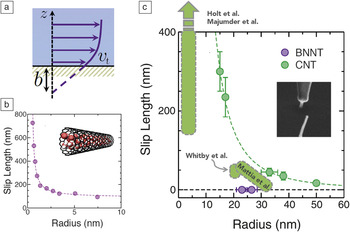
Theoretical efforts for understanding the origins of enhanced flow in nanotubes confirmed a low wall-fluid friction coefficient at the water–nanotube surface as compared to other surfaces. Even more striking was that surface friction decreased with the radius of the CNT—smaller tubes lead to faster flows. Reference Thomas and McGaughey8,Reference Falk, Sedlmeier, Joly, Netz and Bocquet9 As shown in Figure 1 , surface friction of liquids is usually quantified in terms of a slip length, b, which accounts for the breakdown of the no-slip boundary condition at the CNT surface (a large slip length being associated with small friction). Reference Bocquet and Charlaix10 In the presence of surface slippage, the nanotube permeability, k NT, defined in terms of the ratio between the averaged water velocity, v w, and applied pressure drop, ΔP, is accordingly enhanced as:
 $${v_{\rm{w}}} = {{{k_{{\rm{NT}}}}} \over \eta } \times \left( { - {{\Delta P} \over L}} \right);$$
 $${k_{{\rm{NT}}}} = {{{R^2}} \over 8}\left( {1 + {{4b} \over R}} \right),$$
where R is the channel radius, L is the channel length, and η is the water viscosity.
(a) Definition of the slip length, b, at a surface; v t is the fluid velocity transversal to the liquid–solid interface. (b) Molecular dynamics results for the slip length in carbon nanotubes (CNTs) versus the tube radius; Reference Falk, Sedlmeier, Joly, Netz and Bocquet9 qualitatively similar results were found by Thomas and McGaughey. Reference Thomas and McGaughey8 (c) Experimental results for the slip length measured in individual carbon (green-CNT) and boron nitride (blue-BNNT) nanotubes. Typical results for the slip length reported in the literature (labeled Mattia et al. and Whitby et al.) with large-scale membranes are provided for comparison. Reprinted with permission from Reference Reference Secchi, Marbach, Niguès, Stein, Siria and Bocquet17. © 2016 Macmillan Publishers Ltd.

Simulations report large slip in the hundreds of nanometers range, which increases when the CNT radius decreases. Reference Thomas and McGaughey8,Reference Falk, Sedlmeier, Joly, Netz and Bocquet9 Values of slippage observed in CNTs are remarkable and exceed almost two orders of magnitude of that observed in any other material. Reference Bocquet and Charlaix10 This nanoscale behavior can be theoretically rationalized in terms of an increasing incommensurability of water with a crystalline CNT surface for smaller tubes. Reference Falk, Sedlmeier, Joly, Netz and Bocquet9
It has slowly and steadily emerged from the theoretical studies that CNTs are special for water conduction. To resolve this scientific question of enhanced fluid flow, increased experimental activity for single-pore measurements in CNTs has been reported. This has raised challenges in instrumentation, both in building well-defined individual nanofluidic channels amenable for a systematic fundamental understanding of their properties, as well as in measurements of minute ionic currents and water flows traversing these nanoscale pipes.
A number of groups have developed methods to isolate and embed single nanotubes into microscale chambers. Reference Lee, Choi, Han and Strano11–Reference Liu, He, Tang, Liu, Pang, Cao, Krstic, Lindsay and Nuckolls13 Another approach consists of embedding CNTs directly into lipid bilayers and cell membranes, allowing the systematic study of ion and DNA translocation through such “CNT porins.” Reference Liu, Yang, Zhao, Li and Wu14,Reference Geng, Kim, Zhang, Escalada, Tunuguntla, Comolli, Allen, Shnyrova, Cho, Munoz, Wang, Grigoropoulos, Ajo-Franklin, Frolov and Noy15 Siria et al. used nano-manipulation tools to insert a single nanotube into a pierced membrane, leading to a transmembrane geometry that allows the exploration of ionic transport not only under electric fields, but also pressure drops and osmotic gradients. Reference Siria, Poncharal, Biance, Fulcrand, Blase, Purcell and Bocquet16–Reference Secchi, Niguès, Jubin, Siria and Bocquet18 In most of these experiments, transport has been driven by electric fields, and the measured quantity is the ionic current traversing the individual channels, typically in the range of nanoamperes to picoamperes.
These studies demonstrate that ionic transport in CNTs is peculiar; for example, conductance scales sublinearly as a function of salt concentration. Reference Secchi, Niguès, Jubin, Siria and Bocquet18,Reference Guo, Buchsbaum, Meshot, Davenport, Siwy and Fornasiero19 This can be rationalized in terms of ion adsorption at the carbon surface. Reference Secchi, Niguès, Jubin, Siria and Bocquet18 Siria et al. Reference Siria, Poncharal, Biance, Fulcrand, Blase, Purcell and Bocquet16 also demonstrated giant, osmotically induced ionic currents in boron nitride nanotubes (BNNTs), the crystallographic cousin of CNTs. This property has been further confirmed in an alternative MoS2 single-layer system; Reference Feng, Graf, Liu, Ovchinnikov, Dumcenco, Heiranian, Nandigana, Aluru, Kis and Radenovic20 it is now the object of technological transfer for the development of new membranes for the conversion of the energy coming from the mixing of solutions with different salinity, the so-called blue energy. We should also note that some of these experiments in CNTs have yielded results that are difficult to explain using standard theories of ionic transport, like the observation of blocking currents in single nanotubes. Reference Lee, Choi, Han and Strano11
Going from ionic to mass flow measurements is a further challenge in individual nanotubes. Secchi et al. were recently able to quantify the water flow across a single nanotube by harvesting the hydrodynamic peculiarity of nanojet flows. Reference Secchi, Marbach, Niguès, Stein, Siria and Bocquet17 These experiments, the first to measure flow in single nanotubes, have shown that considerable flow slippage occurs in CNTs and that the effect is enhanced in smaller diameter nanotubes (see Figure 1). Interestingly, these measurements raise new mysteries, as the slip increase is much larger than predicted by theory. The BNNTs exhibited no slip at all. It is worth noting that these two materials, which have the same crystallographic characteristics, but different electronic properties—boron nitride being strongly insulating in contrast to semimetallic carbon—exhibit different hydrodynamic behaviors. Recent explorations using ab initio simulation tools have shown that electronic degrees of freedom can strongly affect the physical chemistry and lead to considerable difference in transport properties. Reference Tocci, Joly and Michaelides21,Reference Grosjean, Pean, Siria, Bocquet, Vuilleumier and Bocquet22
To a large extent, the prediction of enhanced flow in nanotubes by simulations and experiments in both large-scale ensembles of CNTs and single-tube flow measurements should alleviate any doubt about the occurrence of superfast flows in CNTs. Despite this scientific assurance, vertically oriented CNT membranes are difficult to scale up, and after a decade of research, no product is currently available. It also remains to be seen if the fast fluid flow properties will lead to lower energy requirements for desalination, given that fast fluid flow would mean that the concentration polarization layers that would oppose the applied pressure would also increase rapidly. Reference Werber, Deshmukh and Elimelech23 Still, nanotubes remain a fascinating fundamental object, full of surprises.
Two-dimensional carbon channels
In terms of fluidics, driving forces scale with the inverse of the membrane thickness, so that molecularly thin membranes are associated with minimal flow resistance and maximal transport. Several research groups have used thin graphene layers grown by chemical vapor deposition, transferred it over a porous substrate, and utilized nanofabrication tools such as focused ion beam or focused ion beam-assisted chemical etching to develop permeable pores. This allows fabrication of porosities with tunable subnanometric pores sizes and large pore densities, up to 1012 cm–2, Reference O’Hern, Boutilier, Idrobo, Song, Kong, Laoui, Atieh and Karnik24 making such membranes good candidates for molecular sieving applications (e.g., for desalination). Reference Surwade, Smirnov, Vlassiouk, Unocic, Veith, Dai and Mahurin25 If no defects or holes are pierced, atomically thin 2D membranes made of graphene have been proven to be impermeable to all atoms and molecules at ambient pressure, making them the perfect support for developing new fluidics membranes. Interestingly, only protons seem to be able to permeate through defect-free graphene, with a slightly different result on h-BN. Reference Hu, Lozada-Hidalgo, Wang, Mishchenko, Schedin, Nair, Hill, Boukhvalov, Katsnelson, Dryfe, Grigorieva, Wu and Geim26
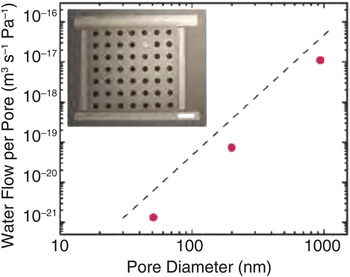
As expected from their molecular thickness, such pierced membranes also demonstrated fast transport properties. Park et al. Reference Celebi, Buchheim, Wyss, Droudian, Gasser, Shorubalko, Kye, Lee and Park27 verified that flow resistance is, however, limited by the hydrodynamic entrance effect—the lateral size of the nanopore, a, acts as a cutoff and the permeability in this case obeys the so-called Sampson Law, relating flux, Q, to the pressure drop ΔP ( Figure 2 ):
 $$Q = {{{a^3}} \over {3\eta }} \times ( - \Delta P).$$
Experimental water permeability of nanoporous graphene sheets (red dots) and comparison with the Sampson prediction (dashed line). Scale bar in inset image is 10 μm. Reprinted with permission from Reference Reference Celebi, Buchheim, Wyss, Droudian, Gasser, Shorubalko, Kye, Lee and Park27. © 2014 AAAS.

Geim and co-workers recently fabricated nanofluidic devices consisting of a few graphene layers as spacers between two graphite surfaces and measured evaporation flows of water induced by capillarity across these channels. Reference Radha, Esfandiar, Wang, Rooney, Gopinadhan, Keerthi, Mishchenko, Janardanan, Blake, Fumagalli, Lozada-Hidalgo, Garaj, Haigh, Grigorieva, Wu and Geim28 They discovered the possibility of stacking graphene with controlled subnanometer confinement—this is the domain where “exotic” (nonclassical) transport (and breakdown of bulk hydrodynamics) is expected. Geim et al. highlight the role of molecular disjoining pressure effects on transport leading to counterintuitive consequences, such as a higher flux for smaller confinements. In this regime, the Laplace expression for the capillary pressure breaks down and it depends on the number of water layers confined in the channels. Reference Gravelle, Ybert, Bocquet and Joly29 The ability to fabricate such nanofluidic systems allows for a new domain of fluid transport with the possibility of systematic fundamental exploration of their properties.
Molecular confinement can also be reached in larger-scale membranes, such as graphene oxide membranes composed of stacked carbon membranes, as in a layered French pastry called a “millefeuille” (see Figure 3 ). Graphite oxide (GO) shows rich colloidal behavior, including phase transitions from isotropic to liquid crystalline phases. Reference Raidongia and Huang30–Reference Tkacz, Oldenbourg, Mehta, Miansari, Verma and Majumder32 Majumder and co-workers have recently developed methods to manufacture GO membranes in large scales compatible with roll-to-roll processing utilizing the liquid crystalline phases of GO. Reference Akbari, Sheath, Martin, Shinde, Shaibani, Chakraborty-Banerjee, Tkacz, Bhattacharyya and Majumder33
(a) Scanning electron microscope micrograph of graphene oxide sheets assembled in a membrane. Reprinted with permission from References Reference Joshi, Carbone, Wang, Kravets, Su, Grigorieva, Wu, Geim and Nair35 and Reference Nair, Wu, Jayaram, Grigorieva and Geim37. © 2014 and 2012 AAAS, respectively. (b) Molecular dynamics (MD) prediction of water permeability,
 hyd, across such a labyrinthine structure as a function of the number of layers, N, and comparison to the theoretical model.
Reference Yoshida and Bocquet40

The transport properties of such membranes composed of stacked layers of graphene oxide have been explored in various studies. Reference Xia, Ni, Zhu, Zhao and Li34–Reference Hu and Mi38 In terms of flow, the characterization of the transport properties of these membranes has yielded contrasting results, with permeability results spanning orders of magnitude, so it is rather difficult to conclusively interpret the flow-enhancement mechanisms. There is a thus a need to develop consistent materials characterization and measurement protocols. Reference Amadei and Vecitis39 However, due to its labyrinthine architecture, the hydrodynamic resistance of this structure is expected to be much larger than that of molecularly thin graphene, and mainly controlled by (again) entrance effects between the various layers. This mechanism was rationalized theoretically in a recent report (Figure 3), and yielded good agreement with experimental results for liquid flows (provided experiments did not involve capillary meniscii). Reference Yoshida and Bocquet40
In terms of ionic transport, these stacked systems have demonstrated esoteric phenomena, such as ion-current rectification behavior depending on the shape of the membrane. Reference Martin, Neild and Majumder41 Interpreting such results remains to be understood on the theoretical side, but they have potential in the construction of components of iontronic circuits, the ionic counterpart of electronic circuits. Reference Martin, Akbari, Chakraborty Banerjee, Neild and Majumder42
Beyond these aspects, such stacked membranes may be advantageous for separations. Recent simulations have shown that GO membranes may exhibit a subtle “self-semipermeability” to water in the presence of ethanol, thereby opening the possibility of separating water from ethanol by a reverse osmosis-like process, which consumes considerably less energy than distillation processes. Reference Gravelle, Yoshida, Joly, Ybert and Bocquet43 GO membranes have been utilized for pervaporation, typically allowing water vapor to permeate through the membrane while retaining the organic components. Reference Huang, Liu, Lou, Dong, Shen and Jin44 They have also demonstrated CO2/N2 selectivity depending upon the degree of interlocking of the GO sheets. Reference Kim, Yoon, Yoon, Yoo, Ahn, Cho, Shin, Yang, Paik, Kwon, Choi and Park36 Importantly, both of these examples highlight molecular-scale separations.
Another practical example is the use of GO membranes as a protective and permselective membrane on the sulfur cathode of Li-S batteries, enabling the transport of Li ions, but limiting the transport of the physically larger polysulfide species. The addition of the membrane in the battery architecture is found to dramatically increase the cyclability and transport kinetics in Li-S battery cells. Reference Shaibani, Akbari, Sheath, Easton, Chakraborty Banerjee, Konstas, Fakhfouri, Barghamadi, Musameh, Best, Rüther, Mahon, Hill, Hollenkamp and Majumder45 These membranes have also been reported to have better flux and selectivity performance than typical commercial nanofiltration polymeric membranes. Reference Akbari, Sheath, Martin, Shinde, Shaibani, Chakraborty-Banerjee, Tkacz, Bhattacharyya and Majumder33 Their specific architecture, which is intrinsically molecular, combined with their ease of fabrication, offer great opportunities for membrane applications and a complex structure to model transport (see Figure 3b). Reference Yoshida and Bocquet40
Future challenges to be addressed and conclusions
After more than a decade of intense investigations, both on the experimental and theoretical sides, the unique flow properties of carbon materials, which are far beyond expectations, have been confirmed. This period has seen the considerable development of carbon nanofluidics, which now offers the possibility of conducting single nanotube and single molecular channel experiments. This is a milestone, and opens new opportunities for the systematic exploration of transport properties of these systems.
These experiments have raised further mysteries, such as the strong contrast of flow properties inside semimetallic carbon structures versus the insulating boron nitride. This suggests that the interaction of water with the confining materials to a large extent remains to be understood, and a proper model is still needed to account for such effects. It is interesting to note that hydrodynamic properties depend so strongly on the electronic degrees of freedom. This suggests that carbon nanofluidics is an exciting fundamental playground where classical physics meets quantum physics, a research avenue that should be further explored.
Beyond fundamental questions, the specific properties of carbon materials still raise considerable hope for more applications. On the one hand, the fabrication challenges of large-scale CNT membranes has somewhat crushed the hope to use these 1D materials for separations and desalination applications at large scale. On the other hand, the development of 2D graphene materials and their stacked forms as graphene oxides now raises great hopes, because these materials retain many of the key advantages of carbon with a less prohibitive technical cost in terms of fabrication. In the end, the property to exploit may not be flow enhancement, but exploring their potential in a broader perspective for water transport and novel functionalities is definitely needed.
These new architectures have revived the hopes of harvesting carbon materials for industrial applications. This opens up new possibilities in membrane science. Industries need to invest and commercialize some of these novel fluidic platforms, which is only possible if high-value, high-volume applications are demonstrated and commercial potential unearthed.
In summary, the nascent field of carbon nanofluidics is at a crucial juncture of impact and growth because all the parts are accessible. The materials are readily available, the problems are laid out, and the experimental and theoretical tools have been developed.

Mainak Majumder is an associate professor of mechanical engineering and an adjunct associate professor of chemical engineering at Monash University, Australia. He is on the board of directors of Ionic Industries, and is the founding deputy director of the Australian Research Council’s Research Hub for Graphene Enabled Industry Transformation. His research interests focus on 2D materials, including their synthesis and upscaled production, their colloidal phase and flow behavior, and the development of innovative and scalable processing approaches for applications in energy storage, chemical separations, and lab-on-chip devices. Majumder can be reached by phone at +61 3 990 56255 or by email at mainak.majumder@monash.edu.

Alessandro Siria is a Centre National de la Recherche Scientifique research associate at the Laboratoire de Physique Statistique de l’Ecole Normale Supérieure, France. He is a co-founder of Sweetch Energy. He received a European Research Council Starting Grant from 2015 to 2020. His research interests focus on the interface between various domains: solid-state physics, nanoscience, and soft-condensed matter. Siria can be reached by email at alessandro.siria@lps.ens.fr.

Lydéric Bocquet is Director of Research at the Centre National de la Recherche Scientifique (CNRS) and a professor of physics at the École Normale Supérieure, France. His research interests focus on the interface between soft condensed matter, fluid dynamics, and nanoscience, with applications in the fields of materials science, micro- and nanofluidics, energy harvesting, and desalination. He has received several awards, including the 2017 CNRS Silver Medal, and an Advanced Grant from the European Research Council in 2010. Bocquet can be reached by email at lyderic.bocquet@ens.fr.