1. Introduction
The regulation of international investment is in flux. Unlike international trade, a multilateral and centralized institution that regulates foreign direct investment (FDI) does not exist. Though repeated efforts have been made over the years to construct a multilateral investment regime, success has been elusive due to seemingly irreconcilable rights of foreign investors and host countries (Simmons, Reference Simmons2014). Instead, cross-border capital flows are tackled by more than 3,000 international investment agreements (IIAs), many of which are bilateral investment treaties (BITs) that were signed in the 1990s. In addition, and largely based on these treaties, more than one-thousand investment disputes were (or are) adjudicated by international arbitrators in a decentralized system known as investor–state dispute settlement (ISDS). Taken together, these two features form the so-called global ‘IIA Regime.’
The primary objective of this regime is to provide foreign investors with protection of their assets and protection against political risk in the host country. Most IIAs include provisions that guarantee standards of treatment (e.g. most favored nation (MFN) and fair and equitable treatment (FET)), protection against and adequate compensation in case of expropriation, and the freedom to transfer capital). Many of them also allow foreign investors to turn to international arbitration if they believe that the host government has violated the agreement. Given that much FDI flowed from economically developed to developing countries, and given that the latter were associated with heightened political risk, developed countries utilized IIAs to protect their own investors abroad.Footnote 1 Thus, the vast majority of IIAs in the early days of the IIA Regime were North–South agreements.Footnote 2 Consequently, the IIA Regime has been traditionally understood in the context of the North–South divide, invariably pitting host states from the developing world against investors supported by home governments from economically developed countries.
The IIA Regime may now be at a turning point, due to the ‘rise of the rest’ (Amsden, Reference Amsden2001; Zakaria, Reference Zakaria2008); that is, the increasing prominence of high-growth emerging market economies or ‘late-industrializing countries’ from the developing world. These include not only the countries of the well-known BRICS (Brazil, Russia, India, China, and South Africa) group but also other economies comprising the G-20 that are the leading economies of their respective regions (Kim, Reference Kim and Kim2020). Emerging market economies and other high-income developing countries (HIDCs) are in a unique and unprecedented position in the IIA Regime.Footnote 3 They are part of the global South and historically have represented their interests as recipients of FDI in international negotiations over global investment governance. More recently, however, their strong economic performance in the global economy, due in large part to their integration into the global economy, has transformed some of these countries into senders of investment as well. Indeed, according to UNCTAD (2018), eight out of the top twenty capital exporting countries in 2017 were developing and transition economies.Footnote 4
Some, but not all, HIDC governments have observed an increasing international exposure of their own multinational corporations (MNCs), which suggests their preferences on investment governance may look similar to those of the economically developed North in pushing for investor rights. How have HIDC governments navigated the crosscutting pressures of asserting host country rights as traditional recipients of FDI, on the one hand, and pursuing investor rights as capital-exporting countries, on the other? We argue that HIDC governments whose own domestic firms and citizens have become significant investors abroad are more willing to give up domestic regulatory space in their IIAs, compared to HIDCs that remain mostly recipients of FDI. Thus, as an HIDC's FDI outflows as a share of their economies increase, so does its preference for international rules that reflect stronger investor protection.
We test this theoretical expectation empirically by, first, comparing sixty-four HIDCs on the manner in which they balance investor protection and national autonomy in their IIAs. We do so with the concept of state regulatory space (SRS), higher levels of which reflect greater flexibility for the host country and which commonly result in weaker commitments to protect foreign investors through international rules and arbitration.Footnote 5 Taking into account the number of IIAs concluded by these countries, the SRS in each of these agreements, and the economic size of partner countries, we generate a novel measure of a HIDC's ‘exposure’ to the IIA Regime. This state level measure reflects the degree to which a country cedes autonomy in regulating investment, in favor of greater delegation to an international agreement. With this measure in hand, we demonstrate that HIDCs vary a great deal in their exposure to the IIA Regime. Second, we test for the effect of FDI outflows on a country's exposure to this regime. Controlling for several confounding factors and accounting for temporal dynamics, we find strong support for our theoretical expectations: higher FDI outflows as a proportion of the national economy result in greater exposure to the IIA Regime.
We should note at the outset that our monadic approach departs from much of the conventional scholarship, which tends to rely on a dyadic setup. While the latter approach offers many insights into the factors affecting states’ propensity to sign IIAs with specific partners and design them in particular ways, we believe it misses a country's more general position vis-à-vis global investment rules, as expressed through its IIA program as a whole. Focusing attention on the monadic level does just that: it provides new insights into the nature of investment governance objectives that HIDCs have aimed to advance as host and now increasingly as home countries within the IIA Regime. Shaped by both domestic and international factors, we see a country's exposure to this regime as emanating largely from broader national priorities or attitudes rather than directed at particular partners. The research design thus embraces the state-year as the unit of analysis. It examines how exposure to the IIA Regime varies across HIDCs, and perhaps, more importantly, how it fluctuates over time as these countries’ governments face pressure to protect the interests of their home investors abroad. To be sure, we view the dyadic and monadic levels of analyses as complementary rather than competing.
This study contributes to the growing body of research on developing countries and their new role as both host of and home to foreign investment. First, it problematizes the crude distinction between North and South and acknowledges the growing diversity of so-called developing economies, especially over the last two decades. While the importance of HIDCs has been long acknowledged, especially with reference to the BRICS, scholarly research is yet to offer clear theoretical expectations about the interests and actions of these countries in the international arena. With our focus on variation in their FDI outflows, we provide such a framework, which also underscores important differences within this group of states.
Second, it adds to our understanding of the evolution of the IIA Regime more broadly. As several studies have shown, many developing countries rushed to sign IIAs in the 1990s, hoping to attract much needed foreign capital (Elkins et al., Reference Elkins, Guzman and Simmons2006; Jandhyala et al., Reference Jandhyala, Henisz and Mansfield2011), often with limited understanding of the legal consequences of these agreements (Poulsen, Reference Poulsen2015). A growing number of ISDS cases in the 2000s, many of which were very costly to respondent states, gave rise to criticism and reevaluation of these agreements. Indeed, some countries have begun to look for ways to ‘rebalance’ investors’ rights and host states’ flexibility, thus reducing their exposure to the IIA Regime (Poulsen and Aisbett, Reference Poulsen and Aisbett2013; Simmons, Reference Simmons2014; Peinhardt and Wellhausen, Reference Peinhardt and Wellhausen2016; Manger and Peinhardt, Reference Manger and Peinhardt2017; Haftel and Thompson, Reference Haftel and Thompson2018; Thompson et al., Reference Thompson, Broude and Haftel2019; Alschner et al., Reference Alschner, Elsig and Polanco2021). This study is the first to examine these developments with respect to HIDCs and the first to develop a comparative monadic measure of exposure to the Regime, based on IIA content.
This article proceeds as follows. The next section fleshes out the link between an HIDC's FDI outflows and its attitude towards the IIA Regime. The third section elaborates on our measure of exposure to the IIA Regime, which serves as the dependent variable, and highlights the variation in our sample of sixty-four HIDCs. It also discusses the operationalization of independent and control variables as well as our estimation strategy. The fourth section reports the results of the statistical analysis. The final section concludes.
2. Theoretical Framework
As already mentioned, HIDCs have been members of the global South and, until recently, mostly recipients of foreign capital. Their IIA policies largely reflected this reality. Like other developing countries, they signed such agreements in order to persuade foreign, mostly Western, investors that their countries are safe and hospitable to their assets and ventures. As Bonnitcha et al. (Reference Bonnitcha, Poulsen and Waibel2017, 207) explain, ‘the first and most important reason why developing countries entered into investment treaties was the belief that it would help them attract foreign investment’. That many governments probably exaggerated the potential benefits and underestimated the risks of IIAs (Poulsen, Reference Poulsen2014, Reference Poulsen2015) or had additional motivations (Poulsen and Aisbett, Reference Poulsen and Aisbett2016) does not detract from this basic axiom.
While boosting FDI inflows remains an important motivation to many HIDCs to this day, over the past two decades or so, investors from these countries have become much more prominent. A number of HIDCs, most notably China, have shown a rapid growth of outwards FDI. Since the early 2000s, China's FDI outflow has climbed sharply and quickly, moving from under five billion US dollars a year to over one-hundred billion US dollars a year in less than a decade. In 2019, China was the fourth largest exporter of FDI, trailing behind only the United States, Japan, and the Netherlands. Several other HIDCs exhibit similar tendencies. Russia's FDI outflows increased from three billion US dollars in the early 2000s to over sixty billion US dollars by 2014, and Singapore, South Korea, Chile, and the United Arab Emirates (UAE), have also become significant sources of outward FDI. The amount of their capital export is especially notable relative to their economic size. Such countries thus shifted from largely host countries, who receive substantial FDI inflows, to both host and home countries, whose own local firms and citizens engage in considerable investment activities abroad.
There is significant variation among HIDCs in growth of outward FDI, however. In contrast to the emergent group of HIDCs above, India's FDI outflows climbed to twenty billion US dollars annually in the early 2000s, but plateaued thereafter. While its position as a home country is evident in the global profile of several Indian MNCs in the information technology (IT) and automotive sectors (Collins, Reference Collins2013, 79–82), it lags well behind countries such as China, Russia, and Singapore. Other HIDCs such as the Czech Republic, Indonesia, and Jordan (to name a few), remain largely FDI recipients as well.
We argue that the differences in HIDCs’ engagement in outwards FDI goes a long way to account for their IIA policies. Those countries whose home investors have become especially active in commercial ventures abroad felt the need to protect them against various types of political risk and provide them with access to ISDS should such a need arise. While direct evidence of lobbying is difficult to pin down, it is safe to assume that large and globally competitive corporations and their industry associations were concerned about political risk in their host countries and had their government's ears. As a result, many IIAs signed by HIDCs with other developing countries (known as ‘South–South IIAs’) were no longer symbolic, and were intended to protect the former's investors (and their assets) in host countries that were perceived as risky (Bonnitcha et al., Reference Bonnitcha, Poulsen and Waibel2017, 229). Thus, several capital-exporting HIDCs concluded numerous South–South IIAs with relatively low SRS from the middle 1990s to the middle 2000s, and in turn increased their exposure to the IIA Regime.
Some countries that fit this pattern are Singapore, South Korea, and Turkey. In Latin America, countries such as Chile and Mexico signed several FTAs with investment chapters in order to support their globally oriented firms. Studies have noted both the overlap in investment commitments across FTAs and BITs (Kim and Lee, Reference Kim, Lee, Elsig, Hahn and Spilker2019) and how FTAs encourage multinational firms to locate affiliates in partner countries (Kim, Reference Kim2021). Another interesting, even if atypical, case is Brazil. This country signed fourteen BITs in the 1990s, mostly with European developed economies, but never ratified them. As Brazilian firms have internationalized in the 2000s and 2010s and have faced greater investment risk abroad, the pressure to conclude IIAs with host countries, especially in Latin America and Africa, has increased. Indeed, in the early 2010s, in light of several incidents of expropriation of Brazilian MNCs’ assets abroad, the Brazilian Chamber of Commerce initiated a process to develop a new investment treaty designed to protect Brazilian investors in host countries. This led to a new model agreement, labelled the Cooperation and Facilitation Investment Agreement (CFIA), developed jointly by the government and the private sector (Gabriel, Reference Gabriel2016; Carvalho, Reference Carvalho2018). Brazil signed about fifteen CFIAs with Latin American, African, and Asian partners in the second half of the 2010s, and some of them were also ratified and entered into force. In short, as Brazil's position has changed from mostly a recipient of FDI to both a recipient and a sender of FDI, it embarked on a program that increased its exposure to the IIA Regime.
As important, and in contrast with more traditional capital-exporting countries, in some HIDCs state-owned enterprises (SOEs) play a significant role both in the economy, in general, and as pivotal multinational corporations, in particular. Given that governments have direct stakes in the operations and profits of these firms, they have a strong incentive to protect them, thereby necessitating the need for political pressure on the investors’ part. Thus, as SOEs expanded their activities across the globe, HIDCs felt the need to protect them and level the playing field vis-à-vis MNCs from other countries with IIAs. China exemplifies this logic best. As Bonnitcha, Poulsen, and Waibel (Reference Bonnitcha, Poulsen and Waibel2017, 229, emphasis ours) note: ‘China is not only a capital importer with defensive interests but also a capital exporter attempting to ensure protections for Chinese outwards investors who are perceived to be subject to unfair restrictions in developed countries – not least when the investors in question are government owned or controlled.’Footnote 6 This explains China's rush to sign dozens of BITs with African and Asian countries in the 2000s. As Chinese firms began to invest heavily in developed countries as well, China concluded IIAs with such countries as Canada, Australia, and the European Union.
China is not alone. Other HIDCs where global SOEs are prevalent include Russia, Saudi Arabia, and the UAE. In line with our expectations, the UAE, Qatar, and Saudi Arabia, whose SOEs are heavily invested in numerous host countries, continue to sign IIAs in order to protect them (Bonnitcha et al., Reference Bonnitcha, Poulsen and Waibel2017, 230). The UAE alone has signed more than fifty IIAs in the last decade with a variety of developed and developing countries around the world. Similarly, many of Russia's IIAs define investors broadly to include SOEs (Collins, Reference Collins2013). Furthermore, it recently updated its IIA negotiation guidelines due to its ‘shift from being mainly a capital-importing state to being both a capital-importing and a capital-exporting now requires the country to take a more open approach to investment treaties’ (Labin, Reference Labin2019).
The flipside of the same coin is that HIDCs whose home businesses are heavily engaged in FDI are more reluctant to backtrack on their IIAs, compared to those whose firms and investors are less globally oriented. As already mentioned, in the late 2000s, host countries became more cognizant of the risks and less certain of the benefits of IIAs. This resulted in a ‘backlash’ against the IIA Regime in some quarters and a mounting pressure to reduce exposure to it by either not signing new IIAs, renegotiating or terminating them, or increasing their precision (Poulsen and Aisbett, Reference Poulsen and Aisbett2013; Manger and Peinhardt, Reference Manger and Peinhardt2017; Haftel and Thompson, Reference Haftel and Thompson2018; but see Haftel and Levi, Reference Haftel and Levi2020). Several HIDCs did just that: they halted and reviewed their IIA programs, and some of them decided to terminate many of their older BITs, in some cases to be replaced by IIAs with greater regulatory space.
Importantly for our purposes here, in most of these countries the balance between inwards and outwards FDI tilted heavily towards the former. In Latin America, mostly capital-importing HIDCs, such as Ecuador and Venezuela, were some of the first countries to denounce their BITs after facing costly investment claims. In Asia, India, and Indonesia, again countries that remain mostly FDI recipients, decided to stop signing BITs in the early 2010s, and later on terminated many of their low-SRS BITs. India then published a new template agreement that reflects much higher levels of SRS. In its turn, South Africa terminated all its BITs with Western European countries after facing a controversial ISDS claim. Interestingly, it kept several agreements with neighboring African countries, where its home firms remained active (Poulsen, Reference Poulsen2014). All these policies have resulted in lower exposure to the IIA Regime at least since the late 2000s.
In contrast, those HIDCs that were also significant capital exporters had to weigh the risks of foreign investors filing an ISDS claim against them versus the need to protect their home (private or state-owned) investors in various host countries and provide them with access to ISDS. Consequently, such countries continued to sign IIAs, even if with greater care than in earlier decades, and were much less likely to terminate their IIAs. This approach kept these HIDCs’ level of exposure to the IIA Regime high, and certainly higher than their peers that had much less to gain from protecting their home investors.
Beyond the HIDCs already mentioned, Thailand offers another illuminating example. This country signed numerous BITs in the 1990s, motivated mostly by the desire to attract FDI. Starting in the early 2000s, Thailand's outwards FDI began to increase, and in the early 2010s it sent more FDI abroad than it received (Nottage and Thanitcul, Reference Nottage, Thanitcul, Chaisse and Nottage2018). Despite facing a costly investment claim, and in contrast to such countries as India, South Africa, or Ecuador, Thailand refrained from terminating or renegotiating its IIAs and made a deliberate decision to remain exposed to the IIA Regime. This was driven, in large part, by the perceived need to protect Thai investors in risky host countries, such as Cambodia, Myanmar, and Russia. Thus, in 2015 ‘the director of the Ministry of Commerce's services and investment office was … quoted in Thai media as stating that ISDS was important not only for protecting inbound investment, but also due to increased FDI from Thailand into ASEAN and other destinations’ (Nottage and Thanitcul, Reference Nottage, Thanitcul, Chaisse and Nottage2018, 154).
Taken together, our central hypothesis is that shifting patterns of investment outflows from HIDCs has shaped their preferences on investment regulation. More specifically, we expect higher outflows of FDI as a share of the national economy, which highlights the role of some HIDCs as capital-exporting countries, to lead HIDC governments to conclude more IIAs with lower SRS, thereby increasing their exposure to the IIA Regime. We now turn to a systematic empirical analysis of this hypothesis.
3. Research Design
The research design employs the state-year as the unit of analysis for a sample of sixty-four HIDCs in the years 1960–2017. The Online Appendix provides a list of the countries included in the analysis. In this section, we elaborate on the operationalization of the dependent variables to capture the variation in exposure to the IIA Regime at the national level. The section continues with the description of the independent variables of interest and the control variables, all of which are lagged one year to account for the possibility of reversed causality.Footnote 7 The Online Appendix provides summary statistics for the variables included in the empirical analysis.
3.1 Dependent Variables
This study aims to account for the exposure of HIDCs to global investment rules through their IIAs. We conceptualize ‘exposure’ as the degree to which governments embrace the rules and disciplines of this regime (Alvarez and Sauvant, Reference Alvarez and Sauvant2011) by signing and ratifying IIAs and ceding to these treaties to varying degrees the authority to regulate and enact domestic policies concerning investment. IIAs vary a great deal in how they balance host state's flexibility and investors’ protection (Broude et al., Reference Broude, Haftel and Thompson2017; Thompson et al., Reference Thompson, Broude and Haftel2019). We think of these treaties in aggregate as an exposure because as states conclude more IIAs, FDI becomes ever more subject to their rules and thus states relinquish more SRS. In so doing, they also increase the potential for investment claims filed by foreign investors. To be sure, this exposure is deliberate (even if its consequences are not necessarily intended) and largely determined by states’ own policy-making. As such, it also reflects their acceptance of the IIA Regime and its rules.
To operationalize this concept, we take into account both the number of IIAs and the degree to which autonomy in governing investment is ceded in them.Footnote 8 The dependent variables are constructed as follows. First, all IIAs concluded by a given country, as well as their years of signing and entry into force are recorded. Next, all IIAs are coded on their level of SRS. Here, we build on a measure developed by Thompson et al. (Reference Thompson, Broude and Haftel2019), which ranges from zero for minimum to one for maximum SRS. Importantly, a pair of countries without an IIA scores a value of one, because they did not give up any SRS vis-à-vis each other. In addition, if an IIA was renegotiated, the value of the new treaty replaces the value of the old one, and if a treaty was terminated, either unilaterally or by mutual consent, the SRS value switches back to one from the year of termination onwards.
After calculating SRS values for all IIAs of a particular country,Footnote 9 we take the average SRS value across all other countries (including those with which there is no IIA).Footnote 10 Finally, the economic size of the partner country has important implications for SRS. Arguably, an IIA with a large developed economy, say Germany, reflects greater loss of state flexibility from a similarly designed IIA with a smaller developing economy, say Egypt. We take this into account by weighting the SRS value for a given IIA by the GDP of the partner country before taking the average across all IIAs.Footnote 11 The two dependent variables, labeled SRS All Force GDP, and SRS All Force, are calculated as the average of SRS values for all IIAs in force in a given year, weighted and unweighted by the partner's GDP, respectively. For ease of interpretation, the mean value is rescaled to range from zero, for no SRS, to one-hundred, for maximum SRS.
As is clear from the discussion thus far, the dependent variables reflect a country-level aggregation of many bilateral relationships. As such, it departs from a dyadic set up, which is much more conventional in research on international agreements (and international relations more broadly). The monadic set up allows one to gauge a state's exposure to the IIA Regime in a holistic and comprehensive manner, an angle largely missing from dyadic analyses. We nevertheless acknowledge that this set up masks variation across treaty partners and is therefore less suitable to account for bilateral explanatory factors. As pointed out in the introduction, we see these two set ups as complementary ways to illuminate the politics of the IIA Regime.
3.2 Sample and Descriptive Statistics
As already discussed, we are interested in developing countries that are not only importing FDI, but can also export it, at least potentially. Using the World Bank's classification, we coded most non-Western countries in the high and upper-middle income categories.Footnote 12 With two important exceptions, India and Indonesia, we excluded countries in the lower-middle and low income categories.Footnote 13 Many of these countries are too poor to engage in the global economy in a meaningful manner, either as recipients or senders of FDI. Moreover, it is unlikely that these countries will become meaningful senders of FDI in the foreseeable future. We also exclude more traditional economically developed countries. Such countries were motivated by a different set of concerns, at least until the middle 2000s (Bonnitcha et al., Reference Bonnitcha, Poulsen and Waibel2017, Chapter 7), and accounting for their policies requires a distinct theoretical framework. The list of sixty-four HIDCs included in our sample is reported in the Online Appendix.
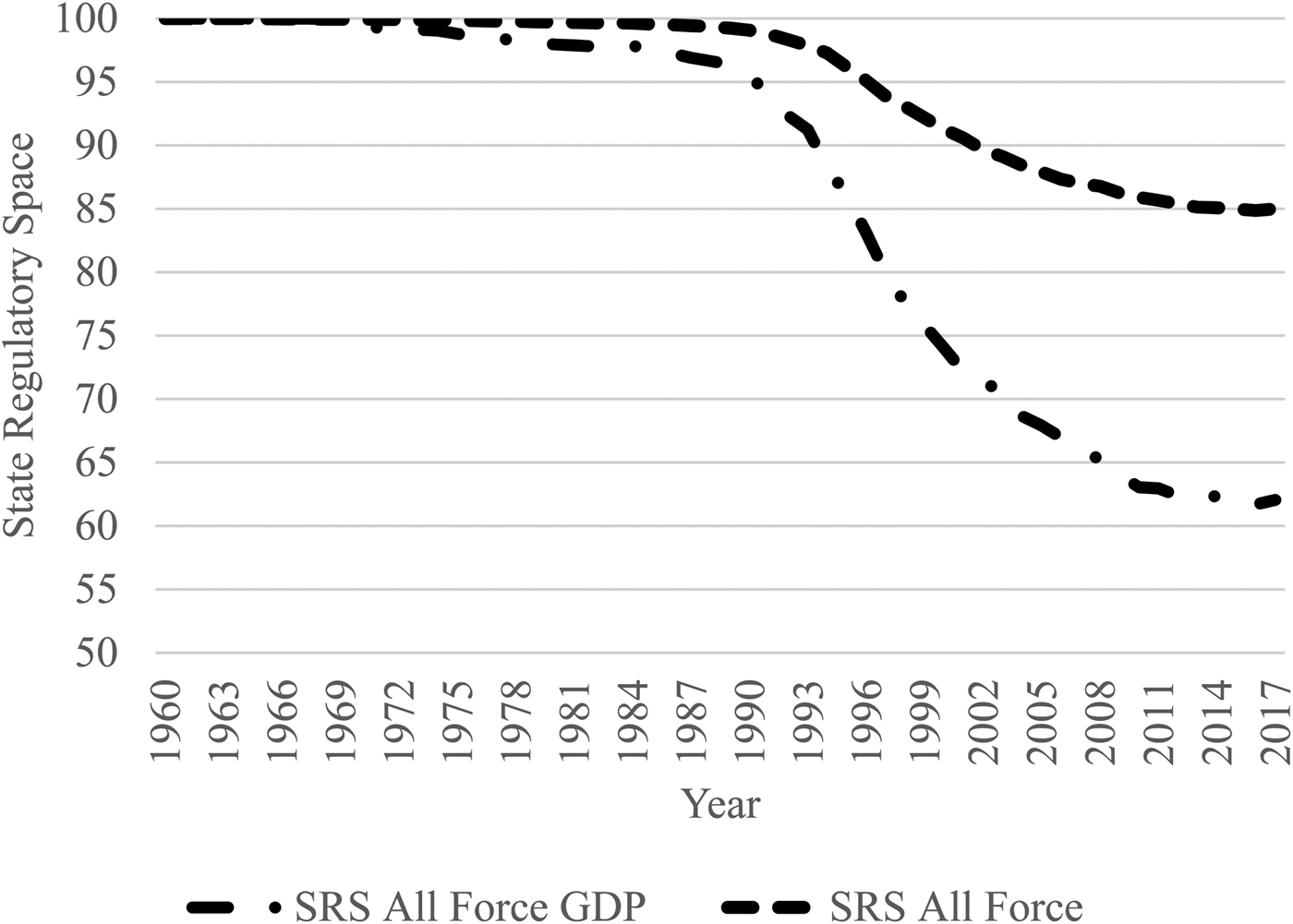
To provide a sense of the variation on the dependent variables, Figure 1 reports the average annual levels of SRS All Force GDP and SRS All Force for all countries in our sample. As this figure shows, the SRS value is one, or very close to it, in the Regime's early years, as very few countries concluded BITs. Moreover, those treaties that were concluded during this time did not relinquish much regulatory space. In particular, many of them lacked ISDS provisions. SRS decreased very gradually in the 1970s and 1980s, but then dropped much more sharply in the 1990s, especially if one takes into account the economic size of the treaty partner. This decline reflects the rush to sign BITs in the post-Cold War era, many of which embraced investor protection at the expense of national sovereignty (Elkins et al., Reference Elkins, Guzman and Simmons2006; Poulsen, Reference Poulsen2015). Moreover, many of these treaties were signed with large, capital-exporting, countries. SRS begins to level off in the late 2000s and early 2010s, echoing the reality that, following costly investment disputes, many states adjusted their approach to the IIA Regime (Jandhyala et al., Reference Jandhyala, Henisz and Mansfield2011). As several studies demonstrate, governments have stopped signing new IIAs or started to either renegotiate or terminate them during these years (Poulsen and Aisbett, Reference Poulsen and Aisbett2013; Haftel and Thompson, Reference Haftel and Thompson2018).
Average Levels of SRS All Force GDP and SRS All Force for Sixty-Four Developing Countries, 1960–2017.

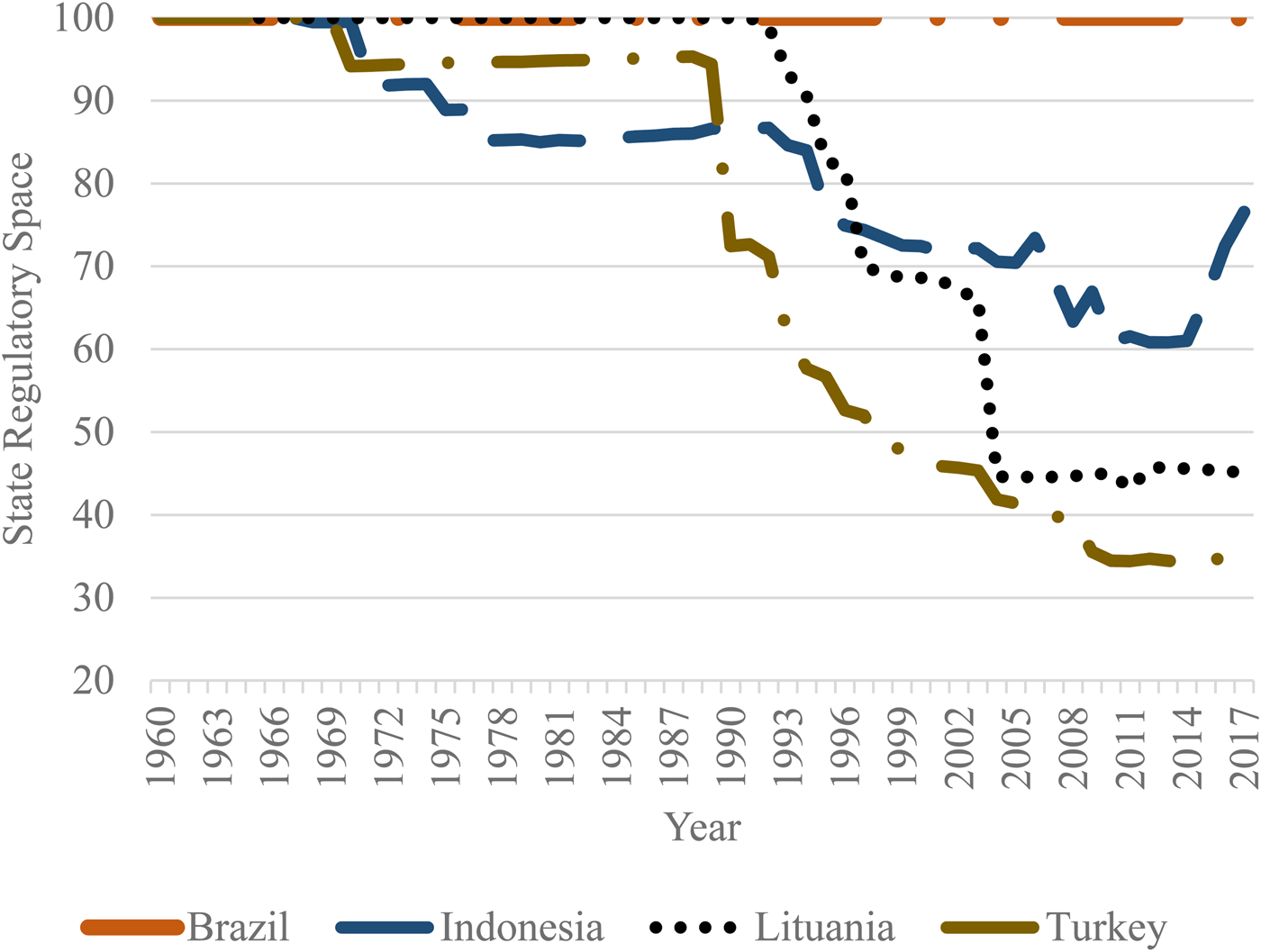
To be sure, this annual average masks a great deal of variation across HIDCs. To illustrate this variation, Figure 2 depicts the annual values of SRS All Force GDP for four countries in our sample. Lithuania's approach to the IIA Regime is, perhaps, representative of those HIDCs that remain mostly FDI recipients. It signed investor-friendly BITs in droves in the 1990s and early 2000s, but only a handful afterwards. Turkey exemplifies HIDCs that embraced the IIA Regime even more and, as already mentioned, belongs in the category of countries in which outwards FDI is an important consideration. Thus, like Lithuania, it concluded a large number of IIAs in the 1990s and 2000s. Unlike Lithuania, however, it has continued to do so in the 2010s, giving up more and more SRS. In fact, Turkey's SRS value of about thirty-four in 2015 is the lowest in the sample.
Levels of SRS All Force GDP for Brazil, Indonesia, Lithuania, and Turkey, 1960–2017.

Indonesia is one of several countries that were initially very enthusiastic about IIAs, but then had a change of heart. As Figure 2 shows, it not only stopped signing new IIAs after being hit by costly investment claims but also started renegotiating and terminating existing IIAs. As a result, its annual SRS has increased from about sixty in the early 2010s to about seventy-six in 2017. In an extreme case, Brazil remained outside the IIA Regime for the entire period, concluding that it is sufficiently attractive to FDI even without such agreements.Footnote 14 While it signed fourteen BITs in the 1990s, it ratified none. Nevertheless, as discussed in the previous section, it recently concluded several CFIAs with other developing countries, a handful of which entered into force after 2017. While these treaties do not forgo much SRS compared to traditional BITs, they still reflect a meaningful increase of Brazilian exposure to the IIA Regime. With this variation in mind, we now turn to the independent variables.
3.3 Independent and Control Variables
FDI Flows – based on the theoretical framework, we expect high levels of FDI outflows to strengthen commitment to investor protection. While theoretical expectations are less clear with respect to FDI inflows, it is still important to examine their effect. We account for these factors with FDI Outflows and FDI Inflows, which are based on net annual flows reported by UNCTAD in millions of current US dollars.Footnote 15 To account for economic size, both variables are measured as a percentage of the country's gross domestic product (GDP).
Here, we note that we considered alternative measures of FDI, i.e. absolute FDI flows as well as FDI stocks, either as a volume or as a share of GDP. We believe that the measure used here, flows as a percentage of GDP, is superior to these alternatives on both theoretical and methodological grounds. Theoretically, we submit that the for FDI flows to matter for forming preferences on investment governance, they have to be economically important in proportion to the size of the economy; raw FDI flows do not indicate much about its importance. As to FDI stocks, they reflect accumulation of decades of investments when HIDCs were not (yet) incentivized to assert SRS, so we would not expect them to affect institutional preferences. Methodologically, it is well established that FDI stocks data are of poor quality, which is why most studies still employ FDI flow data (Bonnitcha et al., Reference Bonnitcha, Poulsen and Waibel2017).Footnote 16 Moreover, much of the critique of the weighted measure emerged with respect to FDI as a dependent variable, rather than an independent variable (Kerner, Reference Kerner2018). In fact, to the best of our knowledge, most studies that account for countries’ IIA policies use FDI (or trade, as a substitute) weighted by GDP, rather than absolute values, as independent variables (Elkins et al., Reference Elkins, Guzman and Simmons2006; Allee and Peinhardt, Reference Allee and Peinhardt2010; Jandhyala et al., Reference Jandhyala, Henisz and Mansfield2011; Haftel and Thompson, Reference Haftel and Thompson2013). Thus, our approach is very much in line with the current state-of-the-art.Footnote 17
Experience with Investment Arbitration – we expect experience with investment arbitration to affect exposure to the IIA Regime amongst HIDCs. As mentioned earlier, as foreign investors have begun to slap host governments with claims in international arbitration forums, some governments have taken steps to curb their exposure to the IIA Regime. There are good reasons to suspect that this trend did not skip HIDCs. Indeed, such countries as India, South Africa, and Indonesia have reviewed and overhauled their IIA programs after facing costly investment claims (Ranjan, Reference Ranjan2014; Poulsen, Reference Poulsen2015). Importantly for our purposes, ISDS experience may be correlated with FDI flows, and thus a potential confounder.
We account for this factor with two variables. We begin with a state's experience as a respondent to investment claims, counting the cumulative number of claims submitted against the given country. This variable, labeled Dispute Respondent, captures the aggregate impact of claims on a state's approach to IIAs. Next, it is possible that states are not only affected by claims against them, but also by claims of their own investors against other countries. We account for this possibility with Dispute Claimant, which is the cumulative number of investment claims filed by the country's own investors.Footnote 18 Data for these two variables are taken from UNCTAD's Investment Dispute Settlement Navigator.Footnote 19
Regime Type and other Domestic Political Factors – democratic and non-democratic HIDCs might behave differently with respect to the IIA Regime as well as to FDI. The specific implications of regime type are ambiguous, however. On the one hand, several studies suggest that democracies are more likely to liberalize trade and capital account, as well as to sign free trade agreements, compared to other regime types (Mansfield et al., Reference Mansfield, Milner and Rosendorff2002; Milner and Kubota, Reference Milner and Kubota2005; Eichengreen and Leblang, Reference Eichengreen and Leblang2008; Mansfield and Milner, Reference Mansfield and Milner2012). This logic can be extended to IIAs: insofar as policy-makers believe that these agreements increase FDI flows and that FDI brings about growth and employment, democracies will be more enthusiastic about signing them.
On the other hand, recent studies indicate that democracies are more likely to shun exposure to the IIA Regime and assert greater regulatory space, especially given the growing number of ISDS claims against democratic countries and the ‘backlash’ they brought about (Waibel et al., Reference Waibel, Kaushal, Kyo-Hwa Chung, Balchin, Waibel, Kaushal, Kyo-Hwa Chung and Balchin2010; Simmons, Reference Simmons2014; Manger and Peinhardt, Reference Manger and Peinhardt2017; Pelc, Reference Pelc2017; Haftel, Reference Haftel and Kim2020). Moreover, assuming that democratic regimes are more stable and predictable than autocratic ones, the latter may be more likely to enter into IIAs than the former (Elkins et al., Reference Elkins, Guzman and Simmons2006; Arias et al., Reference Arias, Hollyer and Rosendorff2018).
We account for this factor with the Polity measure, which varies from 10, for full democracies, to −10, for full autocracies. In line with conventional practice, we turn these values into a dichotomous variable, labeled Democracy. It scores 1 for Polity values of six or higher, and zero otherwise. This measure is based on the Polity 2 variable in the Polity IV Project (Marshall et al., Reference Marshall, Gurr and Jaggers2017).Footnote 20
We contemplate the impact of two additional variables pertaining to the domestic political environment. First, the level of political constraints on the executive might affect its ability or willingness to enter into international investment commitments (Mansfield et al., Reference Mansfield, Milner and Pevehouse2008; Allee and Peinhardt, Reference Allee and Peinhardt2010; Mansfield and Milner, Reference Mansfield and Milner2012) We account for Political Constraints with the POLCON III measure developed by Henisz (Reference Henisz2000). Given that regime type and political constraints conceptually and empirically overlap,Footnote 21 they are included in separate models.
Second, respect for the rule of law in a country may be associated with more or less commitment to investor protection as well as FDI (Allee and Peinhardt, Reference Allee and Peinhardt2010; Tobin and Rose-Ackerman, Reference Tobin and Rose-Ackerman2011). We assess the effect of this factor on the exposure to the IIA Regime with Law & Order. This variable is based on the Political Risk Service's (PRS) International Country Risk Guide's (ICRG) measure, which ranges from zero to six for low and high levels of law and order, respectively.Footnote 22 Data are taken from Henisz (Reference Henisz2000). Data coverage for this variable is relatively limited, resulting in a loss of about 20% of the sample. We therefore present models with and without this variable.
Economic Factors – we control for two conventional economic variables that might affect a country's IIA policies and FDI flows. First, economic size might affect a country's capacity to sign investment treaties and its bargaining power in treaty negotiations as well as its ability to attract more foreign capital. We account for this possibility with GDP, measured with the logged GDP in constant 2010 US dollars. Second, the level of economic development might have implications for a state's capacity, need for FDI inflows, and ability to export FDI. This is controlled for with GDPPC, which is the logged GDP per capita in constant 2010 US dollars. Finally, several states in the sample, e.g. all the Gulf states, Iran, Venezuela, Ecuador, and Russia, are major producers and exporters of energy, especially oil. Such countries may be less dependent on IIAs to attract foreign capital. We control for this possibility with Oil Rents, which is the difference between the value of crude oil production at regional prices and total costs of production as a percentage of GDP. Data for these three variables are taken from the World Bank's World Development Indicators.
3.4 Methodology
The empirical analysis implements the augmented Arellano–Bond estimator (Arellano and Bond, Reference Arellano and Bond1991; Arellano and Bover, Reference Arellano and Bover1995; Blundell and Bond, Reference Blundell and Bond1998), appropriate for analyzing panel data with a lagged dependent variable on the right-hand side. Our dependent variables capturing a state's SRS score over time are strongly path-dependent, as existing IIAs continue to contribute to the construction of a state's SRS scores so long as the agreements are in effect. The analysis accounts for this by including a lagged dependent variable. The augmented Arellano–Bond estimator is designed for panel data with temporal variation, in which explanatory variables are not strictly exogenous and thus correlated with error terms in the current if not past periods.
This model also incorporates cross-country fixed-effects and accounts for heteroskedasticity and autocorrelation within the units. The analysis sample includes sixty-four countries (some lost later due to missing data) observed over a range of twenty-eight to fifty-nine years. The analysis implements the system-GMM estimator to generate robust and more efficient estimates (Windmeijer, Reference Windmeijer2005).Footnote 23 All models also include year fixed-effects to account for global temporal trends.
4. Results
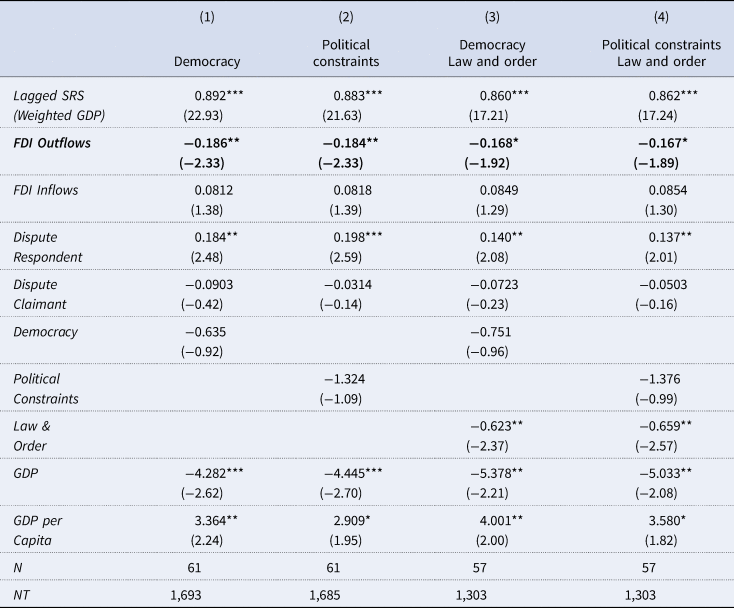
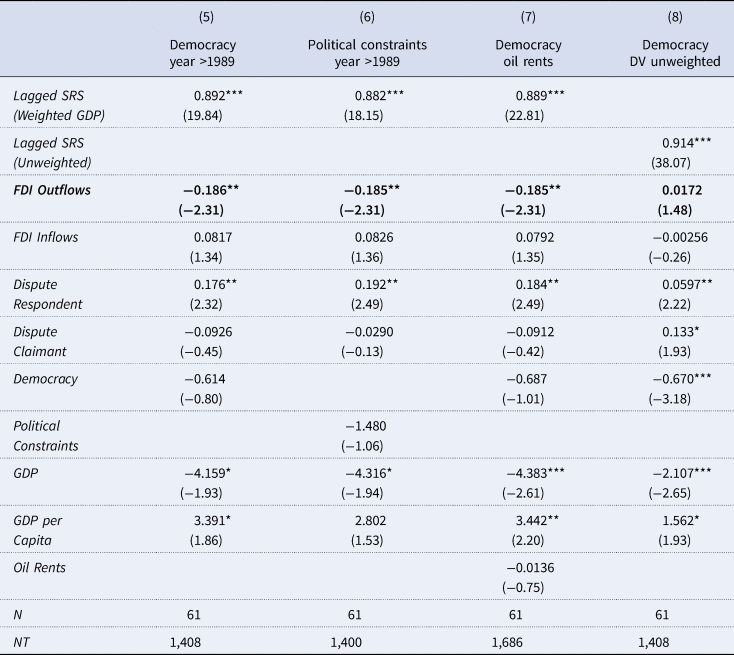
Tables 1 and 2 report the results of eight GMM models. All models in Table 1 report the results with respect to SRS All Force GDP. Model 1 includes Democracy and Model 2 includes Political Constraints. Models 3 and 4 are similar to the first two models, respectively, with the exception that they also include Law & Order. Table 2 presents four robustness checks. First, as the previous section demonstrates, there is limited variation on the dependent variables until the early 1990s. Models 5 and 6 in Table 2 therefore replicate models 1 and 2 for the 1990–2017 time-period. Model 7 includes Oil Rents and Model 8 substitutes the main dependent variable with the unweighted dependent variable, SRS All Force.
GMM models of the sources of SRS in high income developing countries

All models include year fixed-effects. t statistics in parentheses. *p < 0.1, **p < 0.05, ***p < 0.01.
GMM models of the sources of determinants of SRS in high income developing countries, robustness checks

All models include year fixed-effects. t statistics in parentheses. *p < 0.1, **p < 0.05, ***p < 0.01.
Consistent with our theoretical expectations, FDI Outflows is negative and statistically significant in all models pertaining to the GDP-weighted dependent variable. The greater the outflows in FDI as a share of GDP for a given HIDC, the lower the overall level of regulatory autonomy in its IIAs. Substantively, a 1% increase in the percentage of FDI outflows out of a country's GDP is associated with a two-point decrease in the mean annual SRS score. As we have argued, HIDCs that turn from mostly recipients of FDI to senders of significant amounts of capital appear to become more enthusiastic about investor protection through IIAs, presumably as an instrument to reduce the political risk of their own investors abroad. This finding underscores the changing position of several HIDCs, such as China, Russia, South Korea, and Singapore, in the global economy. The insignificant coefficient on the SRS measure that does not account for economic size suggests that capital-exporting developing countries are especially interested in concluding IIAs with other large economies, presumably because their investors’ stakes are higher in these countries.
The estimates for FDI Inflows are positive but not statistically significant in all models related to SRS All Force GDP. This suggests that higher levels of incoming capital may be associated with greater regulatory space; however, the effect is weak and inconclusive for this study. The positive estimate suggests, albeit weakly, that high levels of FDI may obviate the need to conclude intrusive and potentially costly IIAs. Nevertheless, the lack of a strong finding indicates that other, countervailing, forces may also be at work.
While the inflows of investment appear not to have an impact on IIA commitments, the results do show that the prior experience of a HIDC government as a respondent in previous ISDS cases strongly shapes government preferences. That is, states hit by investment claims become less enthusiastic about the IIA Regime and work to reclaim regulatory space in subsequent investment agreements. The estimate of Dispute Respondent is positive and statistically significant across all models. This finding reinforces several recent studies that underscore the reality that states begin to rethink their commitment to investor protection after being hit by investment claims (Poulsen and Aisbett, Reference Poulsen and Aisbett2013; Poulsen, Reference Poulsen2015; Manger and Peinhardt, Reference Manger and Peinhardt2017; Haftel and Thompson, Reference Haftel and Thompson2018; Thompson et al., Reference Thompson, Broude and Haftel2019). Apparently, this logic also applies in the specific context of HIDCs. Estimates for Dispute Claimant are negative, with the exception of the model with the unweighted dependent variable (Model 8), but are not statistically significant. Possibly, states may be less sensitive to investment arbitration in which they are not directly involved (Thompson et al., Reference Thompson, Broude and Haftel2019).
Turning to domestic political factors, Democracy is always negative, but statistically significant only with respect to the unweighted dependent variable. This result suggests that democratic HIDCs were more willing to give up regulatory space in exchange for FDI, but that there may be countervailing factors that weaken this effect. For example, as we noted earlier, several emerging democracies, e.g. South Africa, Indonesia, and India, spearheaded the backlash against the IIA Regime in recent years. Another explanation is that the Polity measure is largely time-invariant for the individual state and that the GMM setup absorbs much of the cross-sectional variation. We find similar results for Political Constraints. This variable is always negative and statistically insignificant, pointing to a weak association between greater constraints on the executive and lower SRS. Thus, in contrast to existing research on FTAs, there is no clear evidence that more constrained leaders find it more difficult to sign IIAs that forgo national sovereignty.
The third domestic political variable, Law & Order, is negative and highly statistically significant. This result suggests that HIDCs with greater respect to the rule of law forgo more SRS through their IIAs, compared to their more corrupt peers. One possible explanation for this finding is that less corrupt states are more willing to commit to a hospitable treatment of foreign investors, because they intend to treat them this way regardless of the IIA. They therefore have little reason to worry about claims filed by disgruntled foreign investors (Allee and Peinhardt, Reference Allee and Peinhardt2010). From a similar perspective, it could be that potential partners are more enthusiastic about IIAs with countries that are more likely to respect their international agreements. As Tobin and Rose-Ackerman (Reference Tobin and Rose-Ackerman2011) have argued, IIAs cannot fully substitute for a poor legal environment. Rather, to attract FDI, IIAs should be complemented with a respect to the rule of law. Perhaps IIA negotiators take the same view.
Among the economic variables included as controls, GDP and GDP per Capita are statistically significant across all models, with effects going in opposite directions. The negative coefficient of GDP indicates that economic size is associated with lower SRS and thus greater acceptance of the IIA Regime. One possible explanation for this result is that larger economies have more capacity to sign and ratify IIAs. Another is that larger economies are more attractive to potential treaty partners. The positive sign on GDP per Capita suggests that more developed HIDCs are less inclined to forgo SRS. Perhaps such countries are not as thirsty for foreign capital and therefore face less pressure to offer foreign investors protection through IIAs. As Model 7 shows, Oil Rents is statistically insignificant and does not affect the results on other variables. Finally, estimates for the lagged dependent variables are positive and highly statistically significant. This is expected, given the ‘stickiness’ of the dependent variables: the group of IIAs in force for a given state is likely to persist in subsequent years as these are treaties with a lengthy duration. Notably, from our perspective, the effect of FDI outflows remains robust to the inclusion of this and other control variables.
5. Conclusion
In this article, we examined how the emerging role of high-income developing countries as investors in the global economy has affected their policies with respect to the rules governing foreign investment. Of particular interest has been the degree to which this key group of countries is likely to integrate further into or withdraw from the so-called IIA Regime, as observed in the degree to which they claim SRS in their IIAs. The analytical framework hypothesized that greater FDI outflows from HIDCs has led these countries to seek greater protection of investor rights. In IIAs, this commonly means lower overall levels of regulatory space that tip the balance in favor of protection of investor rights. The empirical analysis tested this hypothesis for a sample of sixty-four developing countries. The analysis examined the impact of FDI outflows as a share of economic size on ‘exposure’ to the IIA Regime, juxtaposing FDI outflows with FDI inflows and experience with ISDS that highlight their existing roles as host countries for international investment and also controlling for a host of other political and economic variables.
The empirical analysis tested these expectations using an original data set of SRS values at the state level for a large sample HIDCs in the 1960–2017 period. Aside from exhibiting marked variation across space and time, the results also identify the conditions under which these countries opt for greater or lesser SRS across their IIAs. The results support the central hypothesis that high levels of FDI outflows as a share of GDP, or as HIDCs become significant home to investors on their own, encourages greater exposure of these countries to the IIA Regime. This is balanced, on the other end, by the effect in the opposite direction of extensive experience with investment arbitration, especially involvement as a respondent to ISDS claims. The analysis finds that rather than FDI inflows, it is past experience with investment arbitration that leads HIDC governments to claim greater state-level autonomy in regulating investment.
The findings of this study call for further research into the role of emerging market economies such as these HIDCs on the evolution of global investment rules. The pressures on these countries as both host and home countries encapsulate the long-standing dilemma of investor versus host country rights that have been central to investment governance and the failure to form a multilateral investment protection agreement. As one of the first studies to analyze the IIA Regime from the perspective of emerging market economies at the national rather than dyadic level, the findings call for deepening our understanding of how these countries are reconciling their often conflicting interests as both home to foreign investors and host countries. Insights into this process, perhaps focusing on the political economy of investment in these HIDCs, may well generate fruitful directions more broadly for negotiating and pursuing multilateral solutions to investment governance.
Supplementary Materials
To view supplementary material for this article, please visit https://doi.org/10.1017/S1474745621000434.
Acknowledgements
Earlier drafts of this article were presented at the 2018 Annual Meeting of the European Political Science Association, the 2019 Political Economy of International Organizations Conference, and the 2019 Pacific International Politics Conference. We thank Leo Baccini, Sarah Brooks, Adrian Shin, the anonymous reviewers, and the Editor for helpful comments and suggestions. Darren Cheong, Kirthana Ganeson, and Valentine Herzl provided valuable research assistance.