1. Introduction
The Agreement Establishing the African Continental Free Trade Area (AfCFTA) was signed on 21 March 2018 by 44 African countries, members of the African UnionFootnote 1 (AU).Footnote 2 Recently at the 31st African Union Summit at Nouakchott, five additional African states signed the Agreement.Footnote 3 The Agreement has been ratified by six states and will come into force when it is ratified by 22 states.Footnote 4 The parties agreed a number of Protocols to the Agreement.Footnote 5 The Agreement provides a mechanism for the settlement of disputes, but between its member states and not by private commercial entities. However, it is these private entities that will engage in the actual trade in goods, services, and investments across the continent. The interaction of private parties will invariably give rise to commercial or business disputes. This makes it necessary to examine whether the current framework for the resolution of intra-African commercial disputes is fit for purpose and whether the framework can be improved to enable it deliver on the goals of the AfCFTA. This article particularly examines the framework for resolving intra-African commercial disputes.
This article in Section 2 briefly introduces the AfCFTA and mentions some of the legal and non-legal barriers to the access and growth of intra-African trade in goods and services, and some of the steps being taken at the continental level to address these issues. This is in recognition of the fact that the primary purpose of the AfCFTA is to remove the barriers to the free flow of trade in goods, services, and investment within the African continent.Footnote 6Section 3 mentions some of the types of private economic actors that operate in the African market as examples of those entities that will drive the growth of this free flow of trade in goods and services across the African continent. These entities will most likely be the disputants in the framework for dispute resolution as reimagined in this article. Section 4 critically examines the current framework for the resolution of disputes arising from such commercial transactions on the continent. It determines whether the current framework can efficiently serve the expected growth in disputes arising from increased intra-African trade with the implementation of the AfCFTA. Section 5 looks at two proposals for a more efficient continental arbitration regime. The first proposal is for the designation of some Regional Arbitration Centres (RACs), which will be located across the eight Regional Economic Communities (RECs) recognized by the AU; and the second proposal is for the establishment of a continental African Commercial Court (ACC) which will have limited jurisdiction to enforce or annul the final awards from such arbitral references. Section 6 concludes.
2. The African Continental Free Trade Agreement (AfCFTA)
The AfCFTA aims at ‘integrating Africa's markets’, to ‘strengthen our economic relations’, and to create ‘a continental market with the free movement of persons, capital, goods and services’.Footnote 7 The signing of the agreement on the AfCFTA signalled the move towards the attainment of part of the vision of the heads of governments of African states, as articulated in the African Union (AU) Agenda 2063 for, ‘an integrated, prosperous and peaceful Africa, driven by its own citizens and representing a dynamic force in the international arena’.Footnote 8 This vision enables African governments to work towards creating, at the continental level, the necessary environment for private agencies and entities to conduct business across the African continent.
The AfCFTA Protocol on Rules and Procedures on the Settlement of Disputes creates a Dispute Settlement Body (DSB) and a Dispute Settlement Panel (DSP) to determine, ‘disputes arising between State Parties concerning their rights and obligations under the provisions of the Agreement’.Footnote 9 This provision limits the scope of the dispute and nature of the parties that can access the dispute resolution mechanism under the Protocol. It leaves out commercial disputes between the private actors who engineer and facilitate the trade in goods and services across the African continent. The vast majority of such transactions will fall within the trade in goods dichotomy. The nature of the disputes arising from such transactions is primarily private and not public which will otherwise engage the regulatory actions or measures imposed by a state (acta jure imperii). The disputes arising from the effect of such regulatory measures on a foreign investor will fall within the investment dispute settlement regime.Footnote 10
The AfCFTA seeks to remove both legal and non-legal barriers to trade in Africa. There are several legal and non-legal barriers to trade in goods and services generally and in particular for intra-African trade. According to Roberto Longo and Khalid Sekkat, the obstacles to intra-African trade include
insufficient or non-existing transport and communications networks; the existence of the multiplicity of non-convertible currencies for countries outside the CFA franc zone; ethnic, cultural and linguistic diversity; and very high political instability … (including) new sets of variables: infrastructure, economic policy and threats to political stability.Footnote 11
The issues on this list are all acknowledged to have a negative impact on intra-African trade.Footnote 12 Other notable barriers include the exportation of, primarily, raw materials and commodities by African states, lack of available markets for the conversion of such raw materials into finished goods within Africa, competition between African states for access to the same foreign markets, lack of value added chains, and heavy dependence on the importation of finished or processed goods from non-African countriesFootnote 13 – all of which negatively affect their balance of payments.Footnote 14
The AfCFTA Agreement marks an important milestone for Africa. This is because all relevant datasets confirm the very low level of intra-African interaction as it relates to wealth creation activities, such as exchanges in trade in goods, services, and investment.Footnote 15 This is irrespective of the fact that African states are geographically closer to each other than they are to their colonialist countries with which they all maintain higher trading levels. It is this reality that makes the signing of the AfCFTA an exciting and welcome development. This is irrespective of the delay by one of the major economies on the continent in signing the Agreement.Footnote 16
Article 21 of the AfCFTA refers to dispute settlement and establishes a dispute settlement mechanism (DSM) akin to the mechanism used under the World Trade Organization (WTO) Instruments.Footnote 17 The AfCFTA DSM system applies, ‘to the settlement of disputes arising between state Parties’. The reference to state Parties as possible disputants under the DSM system, essentially removes from its purview commercial disputes arising from exchanges or trade in goods and services between private actors. This is understandable because (just like any other Free Trade Agreement, FTA) the AfCFTA deals with public law actors (states) and public law issues (for example, tariffs) relevant to the elimination of barriers to, and the facilitation of, trade in goods and services, and investments within the African continent.Footnote 18 The Agreement engages with actions that fall within the remit of the state and its regulatory and fiscal powers.Footnote 19 This leaves out the micro-level engagement of private actors who execute the trade in goods and services and make the necessary investments, across the borders of African states. These private actors are physical and legal persons and may include a state entity acting in a commercial capacity.
It is recognized that the primary actor that suffers the effects of the imposition of a tariff or non-tariff measure, which breaches the provisions of the AfCFTA, will usually be a physical or legal person who will not have standing (in their personal capacity) before the DSM.Footnote 20 The question that therefore arises is whether the African state whose citizen has suffered loss as a result of such measures can espouse the claims of its citizen. Jurisprudence from the WTO DSM does not technically preclude such espousal, which can also be on the basis of diplomatic protection.Footnote 21 The primary question is whether it will be desirable for states to use the DSM provided under the AfCFTA to espouse the claims of their citizens. In some situations, it may be preferable that a state or group of states pursue redress for their citizens via the DSM against another state or group of states. However, in the vast majority of cases, the dispute will fall within the commercial contract between the transacting parties. The discussion in this article focuses on the participation of these private actors in the provision of intra-African trade in goods and services, and investment, and explores the need for an appropriate and modern dispute resolution mechanism that will support the growth of intra-African trade.
3. Intra-African Commercial Actors
This section briefly sets out the types of economic actors that operate in the African market space and explores their participation in intra-African trade in goods, services, and investment, which will drive the success of the AfCFTA. According to the United Nations Conference on Trade and Development (UNCTAD), with the AfCFTA,
Intra-African trade is expected to rise by US$ 34.6 billion (52.3 per cent above the 2022 baseline), if agriculture/food, industrial goods, and services are included, with the highest impact being in industrial goods (as US$ 27.9 billion, or 52.3 per cent above the baseline).Footnote 22
It is recognized that this increase in trade will be driven by small and medium-sized firms and new tech start-ups.Footnote 23 The legal status of corporations or business entities trading or carrying on business across one or more African countries varies from the informal to the formal. These include family businesses, micro, small, and medium-sized enterprises (MSME) that constitute the vast majority of business entities, as well as large companies.Footnote 24These corporations are active in the agricultural, telecommunications, banking, retail, and mining sectors, and some of them transact across several African states.Footnote 25 Technology companies are also gaining ground on the continent. Forbes.com lists the following as the top new tech start-ups in Africa: VConnect, MeQasa, Flutterwave, Sliide Airtime, Printivo, and LIfeQ.Footnote 26 Therefore, there is good basis for the prediction of the growth of cross-border or intra-African trade.
In addition to the big and emerging corporations are the small and medium-sized enterprises (SME) across the continent. These extend their transactions beyond one state, especially across neighbouring countries. They usually trade within the same Regional Economic Community (REC). In discussions on intra-African trade flows, we must not discount the role of operators (who are mainly individuals) in the informal sector. African states have very large informal sectors in which citizens transact outside the formal monetary and legal systems.Footnote 27 Such enterprises are usually not registered under the law, may not operate a bank account, keep few or no records of their transactions, employ casual labour, and lack access to legal advice and or financial services.Footnote 28 However, such informal business entities have a major impact on the development and living standards of a very large proportion of African citizens.Footnote 29 For example, these informal businesses create jobs (usually low-skilled jobs), which aid the development of African citizens.
These examples show that there are different types and sizes of actors operating in the commercial spaces across the African continent. These range from the big business entities that may have formal presence in more than one African country and have access to legal, financial, and insurance services to the smaller business entities that do not have such formalized presence or access to relevant support services. The ability to access such business support services (legal, financial, and insurance) also impact on the type of dispute resolution process actors resort to when a commercial dispute arises.
4. Resolution of Intra-African Commercial Disputes
The discussion in this section will focus on disputes arising from purely private commercial transactions. Such disputes will typically be between two or more private, commercial, or business entities. It may also include a state or a state agency performing a commercial transaction and acting in a commercial capacity. The current framework for the resolution of such commercial disputes is through litigation before national courts (1), mediation, (2), or arbitration (3). For completeness, investment disputes between African states and African investors may also arise under these transactions and these may be resolved through investment arbitration (4).
4.1 Litigation
The 54 independent African countries all have a State sponsored judiciary with clearly defined court hierarchies. In the vast majority of African states, these court structures are contained in their written constitutions, which also provide detailed appeal structures.Footnote 30 Citizens of African states generally have constitutionally protected rights of access to their national courts to pursue the vindication of their legal rights. However, the timeline for pursuing claims before the courts of most African states is notoriously long,Footnote 31 with most of the judicial systems dating back to the colonial period, and with very little modernization having been made. This inefficiency in the court systems is balanced by low court fees (in comparison to court fees payable in developed jurisdictions), which support access to the courts and litigation as the primary dispute resolution mechanism.
One major disadvantage of cross-border litigation is that each African state has a different legal system as part of its colonial heritage. The vast majority of the continent was colonized, and the colonizers introduced their own legal systems, laws, and court structures in their colonies. This gave to the different African countries the civilFootnote 32 or commonFootnote 33 law or Roman–DutchFootnote 34 legal systems. In some states, the Sharia and customary laws also play central roles in the judicial process and systems.Footnote 35 To add further to the complexity, in some states their Supreme courts lack jurisdiction over some types of business laws so that a supranational court determines disputes arising from such business transactions.Footnote 36 This is the position in all 17 OHADA member states,Footnote 37 where the Common Court of Justice and Arbitration (CCJA) is the court of final jurisdiction over all matters falling within the OHADA Uniform Acts.Footnote 38
In addition to differences in legal systems, there are language barriersFootnote 39 and rights of audience before the national courts.Footnote 40 With regard to litigation, in any jurisdiction in the world, lawyers need to be qualified in the particular jurisdiction to enable them to represent their clients in litigation before national courts. The routes to legal qualification (or applicable exemptions) usually differ, being national in context. The most critical hindrance to cross-border litigation, however, is the lack of a continental treaty on the enforcement of court judgments issued in one African country in another African country. This negatively impact on the enforcement of court judgments arising from cross-border litigation and thus severely limits the negotiability of national court judgments across Africa. There is no African state that is party to either the Hague Convention on the Recognition and Enforcement of Foreign Judgments in Civil and Commercial Matters of 1971Footnote 41 or the Hague Convention on Choice of Court Agreement, 2005.Footnote 42 Both conventions enable the recognition and enforcement of court judgments from one convention state in another. African states may choose to join either of these two conventions to ease the enforcement of cross-border court judgments. Alternatively, the AfCFTA may be an opportunity for African states to explore the possibility of negotiating such a treaty that will create a legal regime for the free movement of court judgements across the continent.
To these differences and complexities, we can add the lack of familiarity with the legal systems across the African continent by lawyers outside each jurisdiction. It is misconceived for any party to presume that the same legal regime applies, and in the same way, in a particular country as in other African countries. It is this issue of differences in legal systems that makes the harmonization regime under the OHADA Treaty attractive. This is because as it relates to business laws, the same text applies in those 11 areas of law where uniform acts are in effect in the OHADA jurisdictions and one supranational court interprets the texts.Footnote 43 The East African Community Court of Justice (EACJ) is another supranational court operational within the East African Community (EAC) comprising of Burundi, Kenya, Rwanda, Tanzania, and Uganda. One jurisdiction of the EACJ is to take referrals from its constituent national courts and make preliminary rulings in the interpretation of EAC laws.Footnote 44 Similar to the OHADA CCJA, natural and legal persons have standing before the EACJ.Footnote 45 However, the EACJ will not determine commercial disputes arising between two or more trading parties which dispute does not engage EAC law. The EACJ however, has jurisdiction to sit as an arbitral tribunal with its judges acting as arbitrators over commercial disputes.Footnote 46
The current reality however, is that only 17 of the 54 African states have harmonized their business laws with a supranational court as the final arbiter of disputes arising from the business laws. One practical way for litigants to ameliorate the impact of the differences mentioned above, on their cross-border transactions, is to refer to local lawyers. Such a referral will add to their transactions cost and cost of dispute resolution. This will have a negative impact on MSMEs and operators in the informal sector who are the main drivers of intra-African trade in goods and services. Cross-border intra-African litigation is, therefore, not the best dispute resolution mechanism to adopt.
4.2 Mediation
In this article, the word, ‘mediation’ is used in a very broad sense to refer to all non-adjudicative alternative dispute resolution (ADR) processes.Footnote 47 The basic idea behind all such processes is to empower the disputants to manage their dispute and its resolution either by themselves or with the intervention of a neutral third party.Footnote 48 Such processes align well with traditional dispute resolution processes of various pre-colonial African communities.Footnote 49 These traditional processes (which remain in use) are applied to resolve all types of disputes, including civil, family, communal, and commercial disputes. With reference to the enforcement of decisions from such traditional dispute resolution processes, each community formulated its own enforcement measures.Footnote 50In post-colonial Africa, enforcement of the outcomes of some of these processes – for example, customary arbitration – can be enforced through the formal justice systems and national courts.
The primary advantage of mediation and similar processes is the settlement of disputes through a non-acrimonious process that may encourage the retention of the relationship between the disputants going forward. In this sense, it serves to preserve business relationships and transactions, and protect community cohesion.Footnote 51 For those parties who wish to, and can, this process gives disputants power over the resolution of their dispute and can be informal and not overly technical or legalistic. However, the major disadvantage of these processes (in their modern iteration) is their lack of definitive and self-enforceable outcome. In mediation, a settlement may be reached, but such settlement, not being an imposed decision, relies on the will of the parties for its performance. This is a primary disadvantage which commercial parties will not desire, since it lacks certainty and finality.Footnote 52
Does this imply that mediation and similar processes are not useful in commercial dispute resolution? We do not think so. In our view, dispute resolution processes can be organized on a spectrum from the informal (bilateral negotiations) to the formal (litigation before state courts). There are several other processes in between the two ends of the spectrum. And since most transacting parties have become more sophisticated, and can buy legal advice and insurance, it is our view that the state can safely entrust them with formulating or fashioning the dispute resolution processes that they feel will better serve their particular purposes and needs. On this understanding, most states grant commercial disputants powers over their choice of dispute resolution tools and mechanisms, and provide a supportive court that, subject to their public policy norms, will lend their powers to support the processes and enforce the outcomes.
This shift in the position and outlook of states, as it relates to dispute resolution processes and gives effect to their outcomes, is the policy that underpins regimes that enforce settlements from these processes (including enforcement of arbitral awards). One example from Lagos State (Nigeria) is the court annexed mediation process of the Multidoor Court House and the enforcement of the settlement agreement as a judgment of the court.Footnote 53 In the international space, UNCITRAL has recently agreed the text of a draft Convention on the Enforcement of Mediation Settlement Agreements, which evidences the progress being made in this field.Footnote 54 ICSID is also not left out in the push for the use of mediation in resolving investment disputes.Footnote 55
Codification of mediation as a process is gaining traction. OHADA very recently adopted a Uniform Act on MediationFootnote 56 following the EU Mediation Directive of 2008.Footnote 57 UNCITRAL has also recently proposed a Model Law on International Commercial Mediation as an amendment to its Model Law on International Commercial Conciliation.Footnote 58 There are various arguments on both sides of the mediation codification debate. However, in our view, it is the flexibility of the process that makes mediation attractive. If codification becomes prescriptive and causes mediators and parties the loss of initiative in working out creative solutions to intractable disputes, then such codification fails the parties and the process, and should not be encouraged.
Thus, mediation, an attractive tool that empowers the parties to find solutions to their disputes with the help of a neutral third party, is a developing system, which must be encouraged. However, for now, disputing commercial parties need decisions that are recognized and enforceable by a state if not voluntarily complied with by a party.
4.3 Arbitration
Arbitration is an adjudicative dispute resolution process in which the parties give the control or power to determine their dispute to a neutral third party, the arbitral tribunal. The tribunal determines the dispute and the rights and obligations of the disputants. In arbitration, the parties need to persuade the arbitral tribunal of the validity of their claims. This is unlike in most mediation processes where the disputants communicate with each other, even when the communication is through a neutral third party. In this way, arbitration is likened to litigation before national courts, only private, and the arbitrator is likened to a private judge. In arbitration therefore, the disputants receive a final determination or decision by the arbitral tribunal over their dispute, just as they do in litigation. This gives some degree of certainty and finality.Footnote 59
Nation states accord a certain status to arbitral awards and the vast majority of African jurisdictions, accord to arbitral awards the same status as a final judgment of their national (first instance) courts.Footnote 60 This status is priceless to arbitration as a private dispute resolution mechanism. It effectively means that the arbitration process covers the equivalent of the first instance court proceeding that would have had jurisdiction over the dispute, only better. The arbitral hearing process is better because the findings of the arbitral tribunal on the facts generally, cannot be reopened and the award can only be challenged on very limited grounds and not open to full blown appeal as the judgment of a national court.Footnote 61 In addition, of the 159 states that are members of the New York Convention, under which foreign arbitral awards can be enforced or challenged, although on very limited grounds, there are currently 38 African states.Footnote 62
With such currency, can arbitration be attractive for use in cross-border intra-African commercial disputes? An enumeration of the advantages of arbitration will lead to an affirmative answer to this question. However, we note at the outset, that arbitration may not be suitable for all types of disputes and is not designed to replace litigation before national courts. Indeed, arbitration needs a supportive national court to thrive.Footnote 63 Having said that though, it is argued that arbitration will be suitable for the resolution of the vast majority of intra-African commercial disputes.
4.3.1 Advantages of Arbitration
According to the 2006 Queen Mary International Arbitration survey, 73% of the in-house counsel they interviewed, prefer arbitration to litigation. And by the 2008 survey, 88% of the respondents had used arbitration and this number rose to 97% in their latest survey of 2018, with 99% of respondents willing to recommend arbitration for use in the resolution of their cross-border disputes.Footnote 64
In the same 2006 survey, the top reasons for this choice were flexibility of procedure, enforceability of awards, privacy of the process, and the ability of the parties to select their arbitrators.Footnote 65 However, according to the 2018 Queen Mary International Arbitration survey, enforceability of awards has become the most important advantage of arbitration, followed by avoiding specific legal systems/national courts, flexibility, and ability to choose arbitrators.Footnote 66 One little acknowledged advantage of arbitration is its positive impact on litigation practice; 64.9% of the respondents to the 2018 SOAS Arbitration in Africa survey acknowledged this positive impact.Footnote 67 Some examples of how arbitration has positively impacted litigation in some African jurisdictions include, ‘the concept of front loading documents and pre-trial conferences’; ‘adoption of more flexible, commercial and pragmatic approach by litigators’, and, ‘approach to litigation tends to be less traditional and more commercial’.Footnote 68
The message from these empirical sources is that commercial parties who transact across borders prefer arbitration as their dispute resolution mechanism of choice.
4.3.2 Disadvantages of Arbitration
In the 2006 Queen Mary International Arbitration survey, the expense (cost), length of time it took to resolve disputes by arbitration, and risk of court intervention in arbitration were the top disadvantages of arbitration.Footnote 69 In their 2018 survey, cost, lack of effective sanctions during the process, lack of power against third parties, and lack of speed were the top disadvantages.Footnote 70
Therefore, the cost of prosecuting an arbitration may negatively impact on the choice of arbitration for the resolution of cross-border intra-African commercial disputes, especially where MSMEs are parties to the disputes. This is an important determinant. This is primarily because the vast majority of commercial actors in Africa are MSMEs and also operators in the informal sector. As already mentioned, one of the features of operations in the informal sector is the lack of engagement of lawyers, non-written transactions (usually based on trust), which are also cash based and thus may not pass through the banking system.Footnote 71 These features imply that the commercial or trading transactions will not have pre-dispute arbitration agreements in the first place. This may be fatal since without an arbitration agreement, the consensual process of arbitration will not unfold. We acknowledge that such fatality can be cured by the parties entering into a submission (post dispute) arbitration agreement. Though, in practice when a dispute arises, it becomes very difficult to get the parties to agree on anything, least of all, arbitration, which may by itself remove a perceived ‘home advantage’ (of litigating before a national court) from one of the parties.
Disputing parties enjoy great powers in arbitration. These powers, which are covered by the principle of party autonomy, are granted by the state (evidenced in the relevant arbitration legislation of each state). These powers also evidence the confidence the state has in the disputing parties to make informed decisions for themselves. Some of these issues, which are relevant to intra-African cross-border transactions, include the determination of the: language of the proceedings, applicable laws, and rules to govern both the arbitral procedure and the substantive rights, obligations, and remedies of the parties.Footnote 72 The ultimate issue however remains the ability of the disputing parties to appoint the decision makers, the arbitrators.Footnote 73 This is one power the parties cannot exercise in litigation before national courts where a judge is assigned to their case, usually without their input.
These issues are very important and are genuine advantages that make arbitration in some cases, preferable over litigation. Take for example, a transaction between a Nigerian supplier (English), a Beninese intermediary (French), and a Mozambican buyer (Portuguese) for delivery of goods in Maputo to be performed by Ethiopian Airlines (English/Amharic).Footnote 74 When a dispute arises between any or all of these parties, which party will want to go to the national courts of the other? None of these parties will be our answer. But, we can easily envisage the same parties opting for arbitration, even in a neutral third party (African) venue.
4.3.3 Enforcement of Intra-African Cross-border Arbitral Awards
One last important point to mention is the enforceability of arbitral awards within the African continent. Thirty-eight African statesFootnote 75 have ratified and are members of the 159 member-state strong New York Convention for the Recognition and Enforcement of Foreign Arbitral Awards 1958 (New York Convention).Footnote 76 The New York Convention facilitates the recognition and enforcement of foreign arbitration agreementsFootnote 77 and awards made in one Convention state, in another Convention state.Footnote 78 There is no equivalent mechanism for the enforcement of foreign court judgments among these 38 (or the 54) African states.Footnote 79 This therefore means that even where parties obtain a judgement from a national court in an African state, they will need to overcome the various (possibly unfamiliar) hurdles to obtain recognition and enforcement in another African state.Footnote 80 With arbitration, the requirements to obtain recognition and enforcement of foreign arbitral awards are at least known.Footnote 81 The arbitral award will still need to survive the understanding, interpretation, and attitude of the enforcing court in the African jurisdiction.Footnote 82 But so long as the judgement debtor has assets in any of the remaining 121 non-African member states of the New York Convention, the judgment creditor can still pursue enforcement of the award in those other jurisdictions, most of which are favourably disposed towards the enforcement of foreign arbitral awards. Thus, as it relates to certainty of the recognition and enforcement of the outcome of the chosen dispute resolution process, the arbitral award has a higher cross-border recognition and enforcement value than the judgment of a national court.
4.4 Investment Arbitration
Where the commercial actor qualifies as a foreign investor and there is a relevant investment agreement or law, the investment related dispute may fall within the investor-state dispute settlement (ISDS) domain. However, most intra-African commercial disputes will fall outside the ISDS system for primarily not implicating the state or a state agency as a party to the dispute, and the nature of the dispute not emanating from an investment related regulatory measure taken by the state that caused the investor compensable harm.Footnote 83 Where an African company qualifies as a foreign investor and the state measure that caused the loss complained about falls within the regulatory actions of the state and is covered under an investment agreement, such dispute may be resolved through international investment arbitration.Footnote 84 This is already happening.Footnote 85
According to statistics from the International Centre for the Settlement of Investment Disputes (ICSID) for example, African investors are increasingly becoming claimants in investment arbitration and conciliation disputes.Footnote 86 Interestingly, most of these African investors sue African states.Footnote 87 This is understandable since those are the states that predominantly host their investments. With the commencement of negotiations of the investment chapter of the AfCFTA,Footnote 88 the publication of the text of the Pan-African Investment Code (PAIC),Footnote 89 and the various regional investment regulations,Footnote 90 it is anticipated that there will be an increase in this regime of disputes between African states and African investors and investment entities.
It can therefore, be concluded that, for purely commercial disputes, recourse to arbitration for the determination of cross-border intra-African commercial disputes, will be the preferred option in comparison to either recourse to litigation before national courts or non-adjudicative processes, such as mediation.
5. Arbitration of Intra-African Commercial Disputes
This section explores the current framework for the arbitration of intra-African commercial disputes and re-imagines this framework to argue for a more effective regime that will contribute to the attainment of the vision behind the AfCFTA. To reimagine, it is important to understand what already exists and examine whether the current system remains fit for purpose. This section shall therefore discuss the current regimes for the arbitration of intra-African commercial disputes (1) and, thereafter, reimagine the current framework by exploring some ideas on how the current system can be improved to better serve its users (2).
5.1 Current Arbitration Framework for intra-African Commercial Disputes
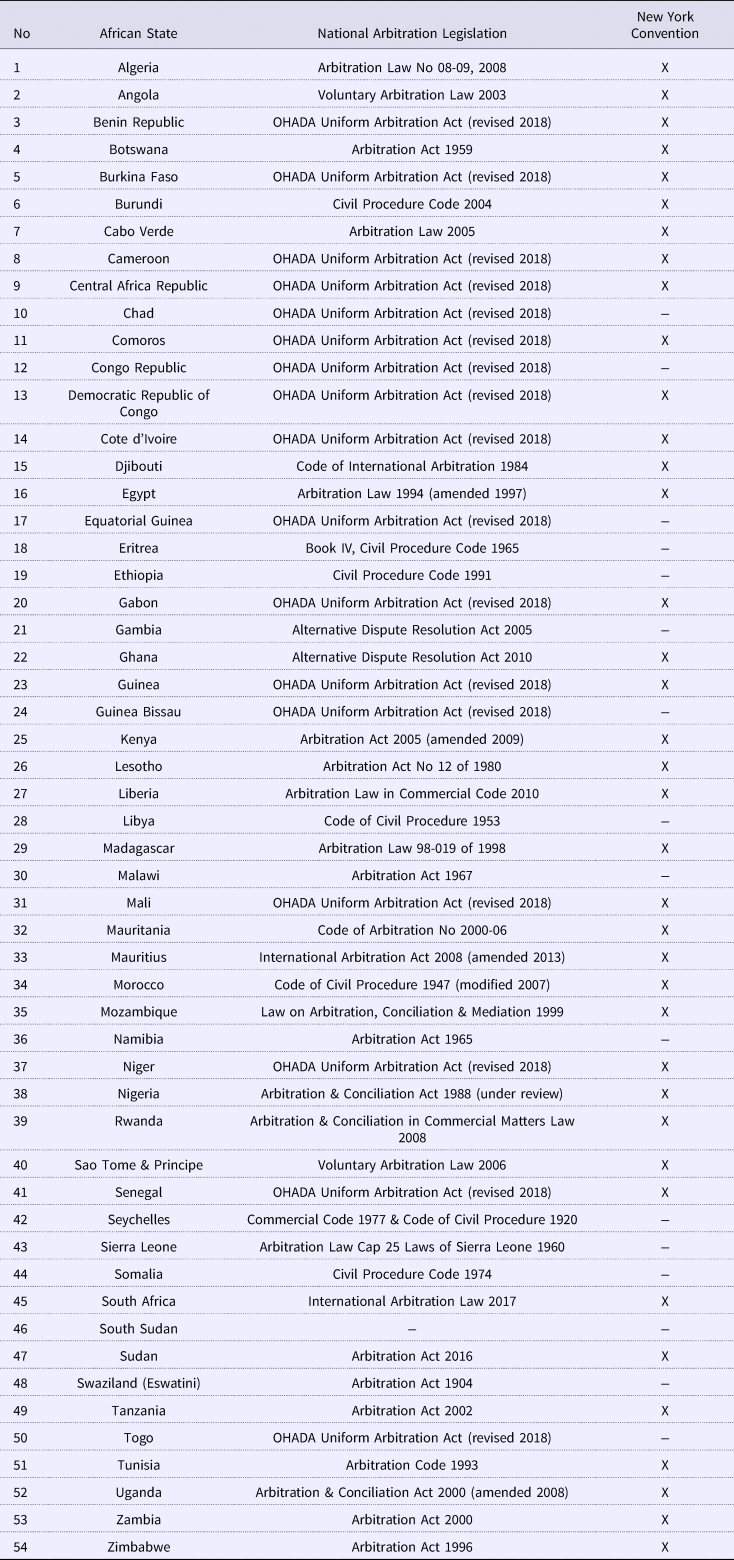
As already mentioned, arbitration is a recognized dispute resolution mechanism in practically all African states, particularly for the resolution of commercial or business disputes. In support of this process, all but one of the states in Africa (South Sudan) have enacted into law modern (and in some cases not so modern) arbitration legislations.Footnote 91 Though there is no continent-wide arbitration law,Footnote 92 there is a uniform arbitration law binding on the 17 OHADA member states.Footnote 93 Some of these national legislations are currently under review while, in our view, a majority of the laws need to be reviewed to modernize their provisions so they remain fit for use by sophisticated commercial parties. Interestingly, 55% of the respondents to the 2018 SOAS Arbitration in Africa survey believe their national arbitration laws are effective with 45% believing their national arbitration laws are not effective or need review.Footnote 94 Thus, there is legislative framework for the operation of arbitration in almost all African countries evidencing the acceptance of the dispute resolution mechanism by African states.
The second evidence of the supportive regime for arbitration in Africa is the availability of arbitration centres or institutions that administer arbitration references under their bespoke or other arbitration rules. One count in 2015, lists 71 such centres in 39 African countries.Footnote 95 It is not very clear how busy all of these centres are, but for those centres that publish their annual statistics, such as the Cairo Regional Centre for International Arbitration (CRCICA) and the Kigali International Arbitration Centre (KIAC), they have recorded year-on-year increases in their caseload. For example, CRCICA, in the first quarter of 2018, registered 20 new cases against 16 at the same time in 2016; and since its inception in 1979, 1,246 cases have been filed with the centre.Footnote 96 KIAC on its part had, as at the beginning of December 2018 registered 97 cases since it opened for business in 2012.Footnote 97 These are encouraging statistics and it is expected that there will be an increase in the caseload of the various centres as the AfCFTA beds down and the projected increase in intra-African trade in goods, services, and investments materialize.
There are also major arbitration centres in each region of the continent. For example, the CRCICA in North Africa, KIAC, and the Nairobi Centre for International Arbitration (NCIAFootnote 98) in East Africa; the OHADA CCJAFootnote 99 in the OHADA region; the Arbitration Foundation of South Africa (AFSAFootnote 100) in Southern Africa; the Lagos Regional Centre for International Commercial ArbitrationFootnote 101 (another AALCO centreFootnote 102) and the Ghana Arbitration Centre (GAC) in West Africa.Footnote 103 Thus, Africa does not lack arbitration centres. What needs to be interrogated is the experience and effectiveness of the centres in performing their tasks, and how they collaborate (if at all) with each other, and share their spaces.Footnote 104 To support this task of collaboration, the first SOAS Arbitration in Africa conference was held in Addis Ababa in 2015 to interrogate the role of the arbitral centres in supporting the development of arbitration in Africa.Footnote 105 This conference brought together the leaders of many of the arbitration centres operating in Africa, who thereafter, formed relationships. It is hoped that these relationships will blossom into proper coordination and support for each other and the sharing of best practices going forward.
As already mentioned, arbitration needs a supportive judiciary to thrive. African courts and judges, over the years, have started making the transition from opposition to support for commercial arbitration.Footnote 106 Such support must be sustained through the continued training of judges, engagement between the national and continental arbitration communities and African judiciaries, publication of arbitration-related judgements from African judiciaries, and increased expert support for African legislatures revising their arbitration laws.Footnote 107
The fourth limb of support for an effective arbitration regime in Africa is the availability of arbitration practitioners who are trained and have experience to discharge the functions of arbitrator, counsel, and tribunal secretary in arbitration references.Footnote 108 The SOAS Arbitration in Africa 2018 survey revealed that there are many trained arbitration practitioners in Africa but they are not evenly spread across the continent.Footnote 109 This implies that there are swathes of the continent with shortages of qualified arbitration practitioners to take on the tasks when the increase in disputes materializes. One solution to this shortage is the provision of training in the jurisdictions that lack trained arbitration practitioners, preferably, by other qualified African arbitration practitioners.
One disturbing finding from the SOAS Arbitration in Africa survey is that most of the arbitration practitioners do not have practical experience of sitting as arbitrator, acting as counsel in arbitration, or acting as tribunal secretary. Over the five-year reporting period, only 10% of the respondents sat as arbitrator in over ten domestic arbitration references, 22% acted as counsel in six or more domestic arbitration disputes, and 22.5% of respondents had acted as tribunal secretary in domestic references over the same period.Footnote 110 It is critically important that the trained practitioners have opportunities to sit as arbitrators and act as tribunal secretaries in domestic disputes where they can acquire experience in preparation to function in intra-African commercial disputes. African arbitration centres and appointing authorities may have a role to play in engaging trained African arbitration practitioners to sit as arbitrators and act as tribunal secretaries.
Aligned to this limb, is the need for the establishment of an umbrella continental arbitration organization that can coordinate some of these tasks and maintain the momentum created by the SOAS Arbitration in Africa conference series (2015–2018) and the ICCA Mauritius Congress of 2016.Footnote 111 Such an association, formally known as the African Arbitration Association (AfAA), was launched on 29 June 2018 in Abidjan.Footnote 112 The four limbs on which an effective arbitration regime can stand (modern arbitration laws, supportive courts, arbitration centres, and arbitration practitioners) exist on the continent. These support the development and growth of arbitration in Africa, particularly in the context of the disputes that will emanate from intra-African trade as a consequence of the implementation of the AfCFTA. The AfAA will be expected to coordinate the various efforts to ensure that arbitration receives the attention it needs at the continental level.
5.2 Re-imagination of the Framework
Some of the gaps in the effective utilization of arbitration for intra-African commercial disputes mentioned above point to the need to reimagine the current framework. To do this, and in light of the goals of the AfCFTA (greater African integration), this section will explore two proposals. The first is the need to designate ‘Regional Arbitration Centres’ across the continent to administer intra-African commercial disputes; such centres may be closely linked to particular RECs as the identified building blocks of the African Economic Commission.Footnote 113 The second proposal will be to establish an African Commercial Court. These proposals are focused on removing intra-African commercial arbitration references and the enforcement of the outcome, the award, from purely national or domestic constraints.
5.2.1 Designating Regional Arbitration Centres
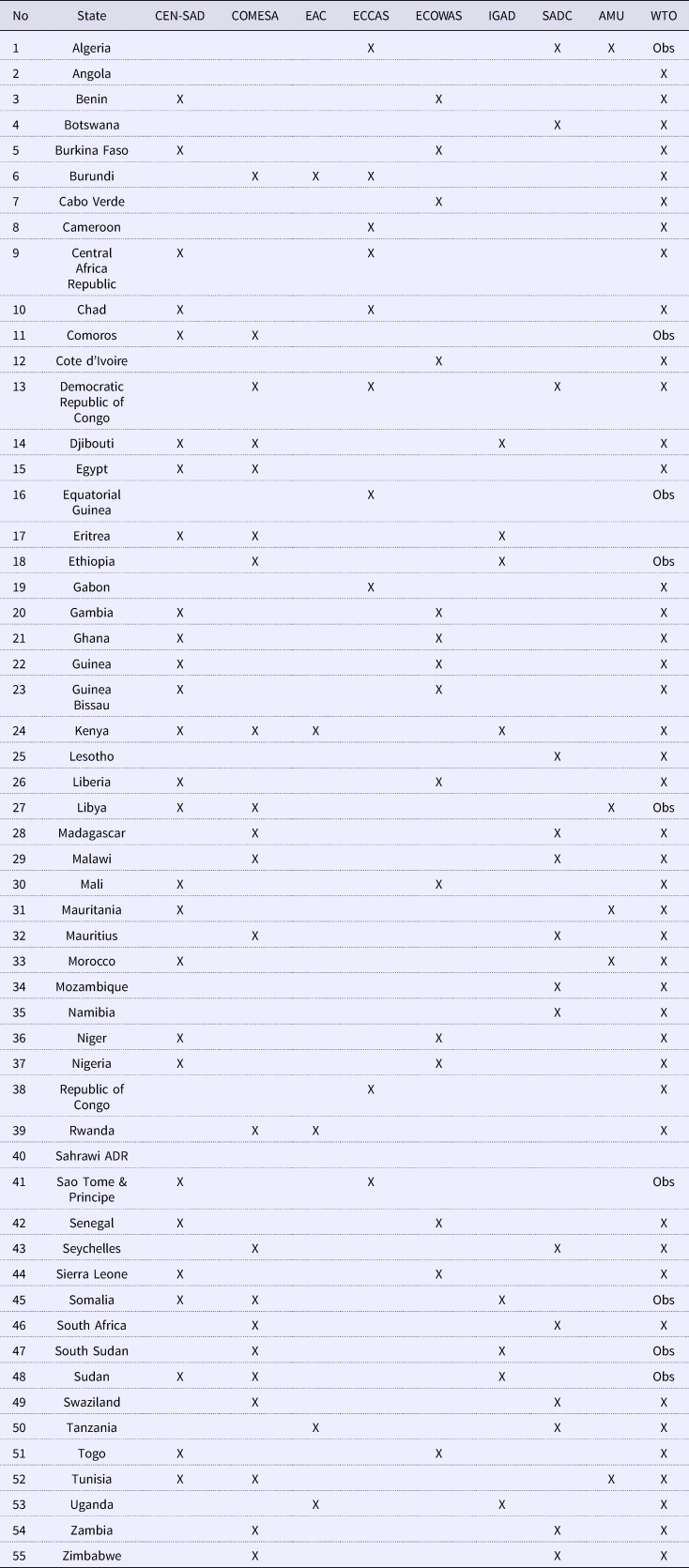
The proposal to link these Regional Arbitration Centres (RACs) to the RECs, first, recognizes that in some states there are no active arbitration centres.Footnote 114 Second, and in recognition of the role assigned to the RECs in delivering the goals of the AfCFTA, the geographical spread of the eight RECs is recognized by the African Union.Footnote 115 From the list of state membership of the RECs listed Table 1, it is apparent that there are overlapping memberships of African states in the RECs. The Economic Commission for Africa (ECA) and the AU have noted that this overlapping membership is responsible for the inability of African States to, ‘honour their contribution obligations, low programme implementation, low meeting attendance, and duplication or conflicting programme implementation’.Footnote 116
African States and REC Memberships as at 26 July 2018

Legend:
CEN-SAD: Community of Sahel-Saharan States
COMESA: Common Market for Eastern and Southern Africa
EAC: East African Community
ECCAS: Economic Community of Central African States
ECOWAS: Economic Community of West African States
IGAD: Intergovernmental Authority on Development
SADC: Southern African Development Community
AMU: Arab Maghreb Union
WTO: World Trade Organization [Obs: observer government]
These multiplicity of REC memberships can however, be turned into a positive attribute in determining the arbitral centre for use by disputants. The proposal on designating RACs shall not include hard borders but it should ensure that there are viable arbitral centres in the geographical space of each REC that disputants can confidently access and which can efficiently deliver the services such disputants need.
The major arbitral centres in the relevant regions are the CRCICA (Egypt) and Casablanca International Mediation and Arbitration Centre (CIMAC, MoroccoFootnote 117) in North Africa; KIAC (Rwanda) and NCIA (Kenya) in East Africa; OHADA CCJA (Cote d'Ivoire) for Francophone West and Central Africa; Lagos Regional Centre (Nigeria) and Ghana Arbitration Centre (Ghana) for English West Africa; and AFSA and the Mauritius Chamber of Commerce and Industry Arbitration Centre (MCCIFootnote 118) in South Africa. These arbitral centres can be endorsed as regional hubs for the arbitration of intra-African commercial disputes.Footnote 119 To ensure a fair distribution of arbitration references across African states, these centres will need to be willing to administer references outside their location or domicile and under their arbitration rules. Most of these centres already offer such services, which will give disputants greater choice.
The RACs will need to expand their arbitrator panel lists to be more inclusive, and also allow disputants to select non-listed persons (who are duly qualified) as arbitrators. Though the RACs will be identified and actively promoted to administer the arbitration of intra-African disputes, disputants will not be limited to appointing such centres, and may choose other centres (within and outside the continent) for the resolution of their disputes. In this way, party autonomy is not forfeited and party choice will still take precedence. However, the RACs will receive special mention by member states of the AU and AfCFTA, who will actively encourage disputants to appoint them in their transactions and agreements.
The designation of RACs will serve the dual purpose of identifying those arbitration centres that can administer intra-African disputes, and distinguish them from those centres that administer purely domestic disputes. In this way, the RACs will begin to build a reputation for stability and efficiency, comparable to those of other such international centres, such as the International Chamber of Commerce (ICC) Court of Arbitration. As already mentioned, there are several arbitration centres operating on the continent but information on the exact services they render and their experience is sparse. Finally, the RAC badge may be evidence to be used in identifying the more viable centres.
5.2.2 Establishment of an African Commercial Court
The second re-imagining of the current arbitration framework in Africa is the proposal to establish a continental level court for the enforcement of intra-African arbitral awards arising from commercial disputes. If we recall one of the findings from the Queen Mary 2018 survey report, the most important benefit of arbitration to its users is the enforcement of the award emanating from the process. From the same survey, respondents noted, as one major reason for choosing arbitration, the avoidance of certain legal systems and national courts. It is true, as already noted, that most courts and judges in African states have started the movement towards better support for arbitration, but this is still in its early stages and broad based in some states, and by no means uniform across the continent.Footnote 120 This lack of uniformity of treatment of such an important aspect of arbitration, makes it imperative that an effective and efficient mechanism is designed to ensure the fast and effective enforcement (or annulment) of such arbitral awards.Footnote 121 This is primarily because the basis on which to construct a continent-wide arbitration legislation or convention and the political will to drive such a legal document may not exist in the current state of affairs in Africa. More importantly is that for now, there is no empirical data to suggest that the arbitration laws operating in African states are not satisfactory. To the contrary, only 12% of the respondents to the SOAS Arbitration in Africa survey believe their national arbitration law is not effective,Footnote 122 reducing the priority level at this time of the need for a continental arbitration treaty.Footnote 123
African States: Arbitration Laws and Membership of the New York Convention as at 26 July 2018

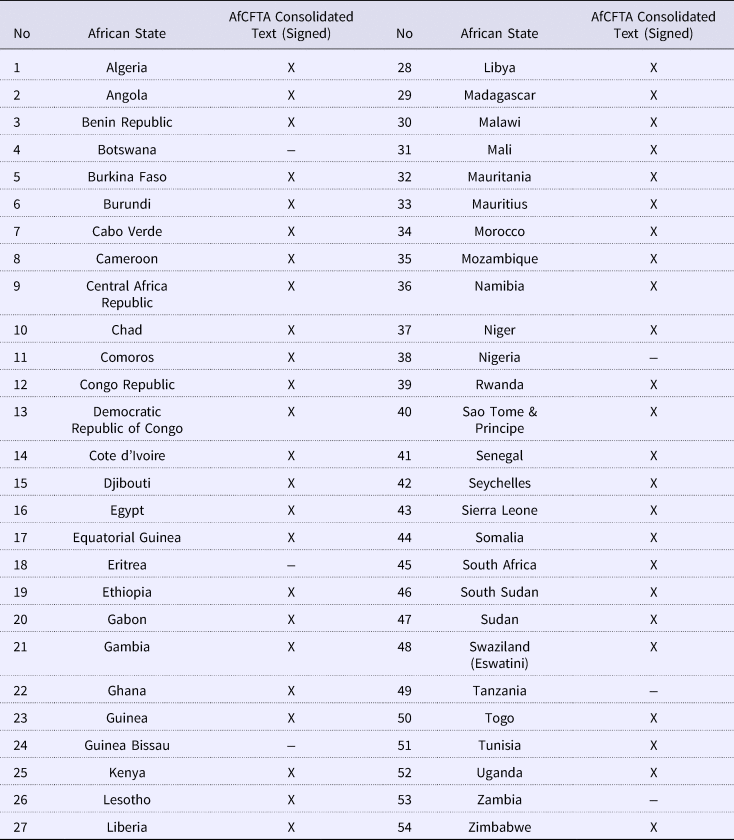
African States: Signatures of the AfCFTA as at 17 December 2018

The Saharawi Republic recognized as a sovereign state under the African Union also signed the AfCFTA.
This section therefore briefly explores whether the creation of an African Commercial Court (ACC) for the enforcement and annulment of cross-border African arbitral awards, as a one stop court, will create such an enabling environment and confidence in the greater recourse to arbitration for the resolution of intra-African commercial disputes. To actualize this proposal, several issues will need to be settled. Some of these issues can be divided into jurisdictional (i) and operational (ii) issues. There are also some hindrances (iii) to the actualization of the proposal.
(i) Jurisdictional Issues
The ACC is proposed to be a continental supranational court and, as such, its jurisdiction and its limitations must be clearly formulated. This proposal is targeted at limiting the jurisdiction of the court to the enforcement and challenge of arbitral awards from disputes over intra-African trade in goods and services. This jurisdiction may later be expanded to include international awards.Footnote 124 As part of the jurisdictional issues, the procedure of the ACC will also include clear and strict timelines. This will ensure that enforcement or challenge applications are determined without undue delay.Footnote 125
(ii) Operational Issues
This proposal is for either a wholly new court or a Chamber of the African CourtFootnote 126 to be established and granted this jurisdiction. This proposal is not new, though different. For example, the UNECA in its 2016 Report, ‘Investment Policies and Bilateral Investment Treaties in Africa: Implications for Regional Integration’, suggests the establishment of a similar court as a branch of the African Court.Footnote 127 Another strong proponent of a continental court is Chrispas Nyombi, who proposed the establishment of a pan-African Investment Court for, ‘intra-Africa investment agreements and investment disputes’.Footnote 128 These proposals focus on investment disputes not purely commercial disputes as is proposed for the ACC.
The ACC proposal will be for judges of the new court (or Chamber of the African Court) to be selected from experts in arbitration or arbitration practitioners or judges from different African countries. It is also proposed that all member states of the AU and AfCFTA will commit to honour and enforce the decision of this special court and treat such decision as equivalent to a final decision of their Supreme or highest national Courts (or for the OHADA region, the CCJA). In this manner, the ACC will effectively have coordinate jurisdiction with the Supreme Courts (or CCJA) in matters that fall within its jurisdiction.
(iii) Possible Hindrances
There are a number of possible hindrances to the actualization of this proposal. The most obvious hindrance is the cost of establishing a new court. In our view, there are various ways the court could be funded. It can be funded by the state parties to the AfCFTA (with a surcharge for citizens of non-member AfCFTA states seeking to use the court), or by the users of the court through the payment of court fees. The disadvantage of the users funding the operation of the court is that it will add to the cost of doing business within the continent and may also price out MSMEs from taking recourse to the court. The second hindrance is the availability of the political will of the heads of African states and governments to donate some of their sovereignty to this supranational continental court.
It will be useful to briefly explore any examples of similar courts operating on the continent. The OHADA CCJA, as already mentioned, is an example of a supranational court that is functional within the OHADA space. However, the major difference between the operation of the CCJA and the proposed African Commercial Court (ACC) is that the ACC shall not act as an appellate court that will hear appeals from African national courts. The ACC shall be a one-stop continental court with limited jurisdiction over final arbitral awards emanating from the arbitration of intra-African commercial disputes. African states will donate some of their sovereignty as it relates to the adjudication of matters falling within the jurisdiction of the ACC. Disputants will have the option to choose to either bring their application before the ACC or pursue their claim before a national court. At the time they choose one option, they forfeit their right of access to the second option. This has the advantage of preserving party choice and the opportunity for African national courts to determine such disputes that may be referred to them.
The second example of a court that operates in the fashion proposed, is the International Arbitration Courts in Mauritius over which three ‘Designated Judges’ preside.Footnote 129 One difference with the procedure under the Mauritian International Arbitration Act and the proposed ACC is that there shall be no appeals, least of all such appeals to the Judicial Committee of the Privy Council as is the case in Mauritius. The Mauritian judges are specially trained in arbitration matters.Footnote 130 The judges of the ACC can also be specially trained in both arbitration and general commercial law to equip them to determine the applications for the enforcement or annulment of awards that will come before them.
One relevant question at this stage relates to the enforcement or execution of the decisions of the ACC. The proposal here is to adopt the enforcement system under both the OHADA CCJAFootnote 131 and the East African Community Court of JusticeFootnote 132regimes for decisions of the ACC. All that will be required for a national court or registry to enforce the decision of the ACC will be the verification of the authenticity of the stamp or order as emanating from the African Commercial Court upon application for enforcement by an applicant. National courts will be required to treat the judgement from the ACC as equivalent to the judgement of their Supreme Courts. In this manner, immediately a judge (or Court Registrar) confirms the authentication of the stamp or order of the ACC, an enforcement order will be issued and the internal processes of the enforcing jurisdiction for the execution of judgments in each African state will be followed.
This proposal deals with the problem of weak court systems and the attendant difficulties with the enforcement of arbitral awards in African countries. It creates the opportunity for the ACC to contribute to the interpretation and understanding of internationally accepted grounds for the enforcement or challenge of arbitral awards, for example under the New York Convention and UNCITRAL Model Law.
6. Conclusion
This article examined the reference of disputes arising from intra-African commercial transactions to the different types of dispute resolution mechanisms of litigation, mediation, and arbitration, and argued that arbitration will be the most appropriate mechanism for the resolution of such disputes. It then explored the current intra-African arbitration framework, identified some gaps, and reimagined this framework. It proposed the identification of Regional Arbitral Centres (RACs) spread over the eight identified RECs by the AU, which will be actively promoted to administer arbitration references on disputes emanating from intra-African commercial transactions. To assure the effective judicial support for the arbitration of intra-African disputes and the enforcement or annulment of the awards from such references, this article proposed the creation of an African Commercial Court with the sole jurisdiction of enforcing or nullifying arbitral awards from such intra-African arbitration references. Decisions of the ACC would be directly enforceable in all member states of the AU and the AfCFTA. These proposals do not exclude revisiting in the future the possibility of concluding a continental arbitration law. The implementation of these proposals will ensure that arbitration, as the dispute resolution of choice by commercial parties, will play a supportive role in the actualization of the goals of greater intra-African trade in goods, services, and investments envisioned in the AfCFTA.
Acknowledgements
I am grateful to the reviewers for their helpful comments on the earlier draft of this article.