Introduction
The Fontan surgery is a palliative surgical procedure developed to allow survival for individuals born with a functionally univentricular heart, where the heart has only one effective pumping chamber. Introduced in the early 1970s,Reference Fontan and Baudet1 its primary aim was to improve survival to adulthood for these patients by creating a pathway for deoxygenated blood to passively flow directly to the pulmonary arteries. While the precise global prevalence is not definitively known, an epidemiologic study from 2020 estimated that there were 47.881 people currently living with the Fontan circulation in 11 selected countries, a number projected to increase to 59.777 by 2030.Reference Plappert, Edwards and Senatore2 Importantly, this study did not include data from some of the most populated countries, such as China and India. Current estimates indicate that patients undergoing the Fontan procedure with modern techniques may hope for 20-year survival rates ranging from 61 to 85% and potentially around 85% at 30 years.Reference Rychik, Atz and Celermajer3
Drawing on the work of Gewillig and colleagues,Reference Gewillig, Brown and van de Bruaene4 the haemodynamics of the Fontan circulation are fundamentally characterised by the absence of a subpulmonary ventricle, leading to a circulation where systemic venous return flows directly to the pulmonary arteries. This unique arrangement results in chronically elevated systemic venous pressures necessary to drive pulmonary blood flow against pulmonary vascular resistance. Consequently, the Fontan circulation typically operates with a decreased cardiac output, especially during exercise. These haemodynamic features are central to understanding the potential complications faced by patients with Fontan circulation, which include arrhythmias, heart failure, protein-losing enteropathy, thrombotic events, the need for reintervention, heart transplantation and death.Reference Talla, Best and Challa5
To better predict Fontan decline, it is necessary to study long-term outcomes and identify predictive factors of adverse events. Understanding the clinical evolution of these patients and the factors influencing their survival is fundamental to optimisinge their follow-up and treatment. In this sense, the present study aims to contribute to this area of knowledge, using our cohort of patients with Fontan circulation, whose findings were published in 2020.Reference Rato, Sousa and Cordeiro6,Reference Rato, Mendes and Sousa7
Methods
Study design
This study is a retrospective longitudinal analysis of a previously characterised cohort of patients with Fontan circulation, initially described in two manuscripts published in 2020.Reference Rato, Sousa and Cordeiro6,Reference Rato, Mendes and Sousa7 The cohort included children and young adults who underwent comprehensive clinical, functional, and imaging assessments on the same day, between April 2018 and April 2019, including cardiopulmonary exercise testing and advanced echocardiography. In this follow-up analysis, we aimed to evaluate 5-year outcomes and identify baseline predictors of adverse events. The primary outcome was a composite of all-cause mortality, listing for heart transplantation, hospitalisation for heart failure, and conduit thrombosis. Potential predictive factors were assessed, including demographic and clinical variables, functional assessments, and imaging-derived measures such as atrial strain. This design enabled us to explore the prognostic significance of earlier clinical and imaging markers in relation to major adverse outcomes in this population.
Patient selection
Patients were selected from a previously established cohort of individuals with Fontan circulation who had been evaluated at our tertiary care centre.Reference Rato, Sousa and Cordeiro6,Reference Rato, Mendes and Sousa7 Inclusion criteria for the original cohort comprised a diagnosis of single ventricle physiology palliated with a Fontan procedure, age ≥ 8 years at the time of baseline assessment, and availability of comprehensive clinical, imaging, and functional data, including cardiopulmonary exercise testing and echocardiographic measures. For the present follow-up study, all patients from the original cohort were eligible. Follow-up data regarding clinical outcomes were successfully obtained for all participants through review of medical records and/or direct contact. No patients were excluded due to loss to follow-up.
Cardiopulmonary exercise testing protocol
Cardiopulmonary exercise testing was prospectively performed using a treadmill and the Bruce protocol. Gas exchange was measured continuously with breath-by-breath analysis, and data were reported as 20-second averages. Equipment was calibrated according to the manufacturer’s specifications before each session and prior to each test. Expired gases, including oxygen uptake, carbon dioxide production, and minute ventilation, were monitored throughout the exercise and for 3 minutes at rest. Electrocardiogram, heart rate, and oxygen saturation were continuously recorded, while arterial pressure was measured at rest, every 3 minutes during exercise, and at 1 and 3 minutes post-exercise. Test termination criteria included patient request due to fatigue or attainment of a respiratory exchange ratio of 1.10. No tests were interrupted due to adverse events such as arrhythmias or desaturation. Peak oxygen uptake was defined as the highest oxygen uptake value attained during exercise, indexed to body weight, and derived as a percentage of the predicted value. Adequate performance of the cardiopulmonary exercise testing was defined as a respiratory exchange ratio ≥ 1, a threshold deemed acceptable for maximum effort by children and adolescents on a treadmill.Reference Van Brussel, Bongers and Hulzebos8 For the present analysis, predicted values for peak oxygen uptake were derived from both weight- and height-based Cooper equations for participants aged ≤17 yearsReference Cooper, Weiler-Ravell and Whipp9,Reference Cooper, Weiler-Ravell and Whipp10 and from the JonesReference Jones, Makrides and Hitchcock11 and Wasserman equationsReference Wasserman, Hansen and Sue12 for those >17 years. We also calculated the z-score of peak oxygen uptake derived from the work of Gavotto et al.Reference Gavotto, Mura and Rhodes13 which we extended until 25 years of age.
Echocardiogram protocol
Transthoracic echocardiography was performed at baseline with standard techniques on the same day before cardiopulmonary exercise testing. Transthoracic echocardiography was evaluated especially for atrioventricular valve regurgitation, outflow tract and aortic or neo-aortic valve regurgitation or stenosis, aortic arch flow, pericardial effusion, and thrombus. Valve regurgitation was classified by two experienced operators in 2 groups: absence of significant regurgitation (none or mild) or significant regurgitation (moderate or severe). Systolic function of the dominant ventricle was assessed using post-processing with EchoPAC® (GE Medical Systems), and for the current evaluation, we included assessment of ejection fraction on an apical four-chamber view using the Simpson’s method. Due to univentricular anatomical variability, there is no defined standard for the collection of this data, and we consider that the use of the classical four-chamber view allows a standardised approach to functional analysis in these patients. To establish a reproducible four-chamber view for these complex ventricular anatomies, an apical view including a transverse plane of the extracorporeal conduit was considered as reference. The assessment of ejection fraction included the entire volume of the developed chambers in the four-chamber view. These were, for example, the left ventricle in tricuspid atresia, the right ventricle in hypoplastic left heart syndrome, both ventricles in unbalanced atrioventricular septal defect, or the single ventricle in double inlet left ventricle. Hypoplastic chambers were excluded. The same anatomical approach was used for the assessment of longitudinal strain by STE in the four-chamber view. For the assessment of atrial function, we used the standard methods. The dominant atrium was defined as the atrium connected to the dominant ventricle. In cases with two separate atria and an anatomical univentricular heart, for example double inlet left ventricle, the dominant atrium was the one receiving the pulmonary venous return . In cases with a common atrium or a large interatrial defect, the speckle-tracking region of interest included the limits of the entire atrium, bypassing the interatrial septum. A single cardiac loop from the four-chamber view was selected. The following measures were selected for this analysis: the peak positive strain (ϵcon = conduit strain) corresponding to atrial early diastolic emptying and total ϵres = reservoir strain (calculated by ϵcon—ϵact) corresponding to total atrial expansion.
Statistical analysis
Data were analysed using standard statistical software. Continuous variables were tested for normality using the Shapiro–Wilk test and are presented as mean ± standard deviation or median with interquartile range, as appropriate. Comparisons between patients with and without the composite outcome were performed using independent samples t-tests for normally distributed variables and Wilcoxon rank-sum tests for non-normally distributed variables. Categorical variables were compared using chi-square or Fisher’s exact tests.
Univariable logistic regression analyses were performed to explore associations between independent variables and the outcome of interest. Variables showing significant associations were subsequently considered for inclusion in multivariable analysis. A complete-case approach was used. Linearity of continuous predictors in the logit was verified with lowess plots, and multicollinearity was assessed using variance inflation factors. Variables with VIF > 5 were excluded to avoid collinearity. The final model followed the rule of one variable per ten cases, and five predictors were initially considered with a step-down approach.
Model performance was assessed using the area under the receiver operating characteristic curve. A two-sided p-value < 0.05 was considered statistically significant.
Results
Cohort characteristics (Table 1)
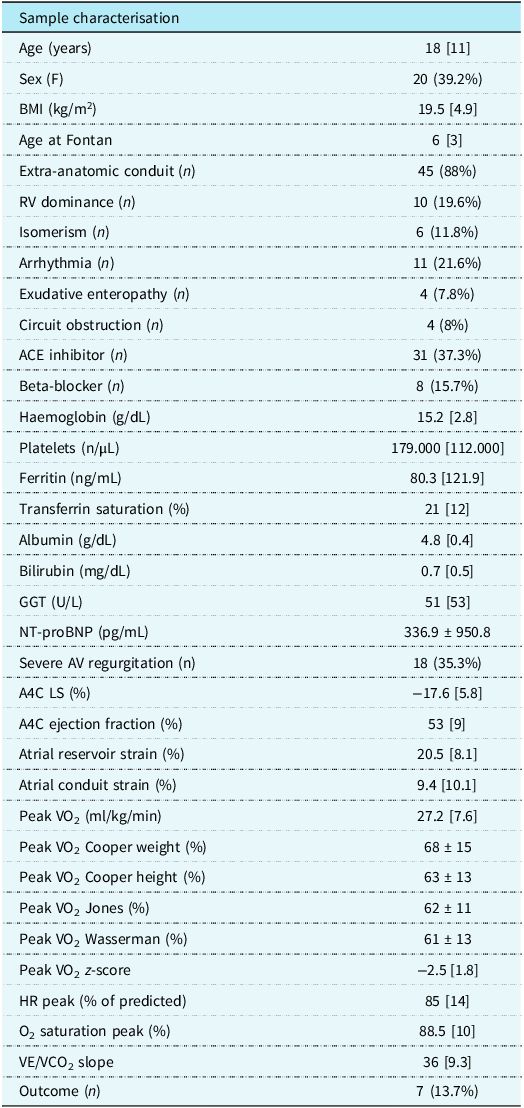
This was a cohort of young patients—median age 19 years old, ranging from 9 to 36 years, mostly male (61%). Baseline characteristics are pointed out in Table 1. It is relevant that most of these patients had a low body mass index (median 19.5 kg/m2, IQR 4.9) at the time of evaluation. The baseline morphology was predominantly of a systemic left ventricle (80%), and most of them had an extra-anatomic conduit (88%), consistent with the most recent surgical eras. Age at Fontan completion was a median of 6 years old (IQR 3). Outcomes were few (n = 7, 14%): 1 patient listed for transplant, 2 patients admitted for heart failure in this period, 1 circuit thrombosis despite anticoagulation, and 3 deaths (2 sudden deaths for probable cardiac cause and 1 from severe heart failure).
Sample characterisation

Continuous variables were tested for normality using the Shapiro–Wilk test and are presented as mean ± SD or median [IQR], as appropriate. Categorical variables are presented as absolute numbers and percentages. A4C = apical 4-chamber; ACE = angiotensin-converting enzyme; AV = atrioventricular; BMI = body mass index; HR = heart rate; LS = longitudinal strain; RV = right ventricular.
Globally, laboratory analysis showed mildly elevated haemoglobin (median 15.2 g/dL, IQR 2.8), mildly reduced platelet count (179.000 platelets per µL, IQR 112.000), mildly elevated GGT (51 U/L, IQR 53), and elevated NT-proBNP (mean 336.9 pg/mL ± 950.8) with a wide range. On the echocardiogram, relevant findings showed mild degrees of circuit obstruction in 4 patients (8%), 2 at the aortic arch and 2 at the bulboventricular foramen, and severe atrioventricular valve regurgitation in 18 patients (35%). Ejection fraction and longitudinal strain in the apical 4-chamber plane were evaluated in 48 patients and showed globally normal values. Atrial strain values were evaluated in 39 patients and were reduced (Table 1). Lack of strain values is related to poor echocardiographic windows or, in the case of atrial strain, non-sinus rhythm.
On cardiopulmonary exercise testing, 48 patients performed a maximal test (respiratory exchange ratio > 1.0). Median peak oxygen uptake was 27.2 ml/kg/min, IQR 7.6, which corresponded to a percentage of the predicted value of 68% ± 15 using the weight-based Cooper equations for participants aged ≤17 years; 63% ± 13 using the height-based Cooper equations for participants aged ≤17 years; 62% ± 11 using the Jones equations for participants aged >17 years; and 61% ± 13 using the Wasserman equations for participants aged >17 years. The median z-score was −2.5 for patients ≤25 years. Chronotropic capacity was maintained, with patients achieving a median maximal heart rate of 85%, IQR 14, predicted for age, and there was mild cyanosis at peak exercise (median O2 peak peripheric saturation 88.5%, IQR 10).
Group differences (Table 2)
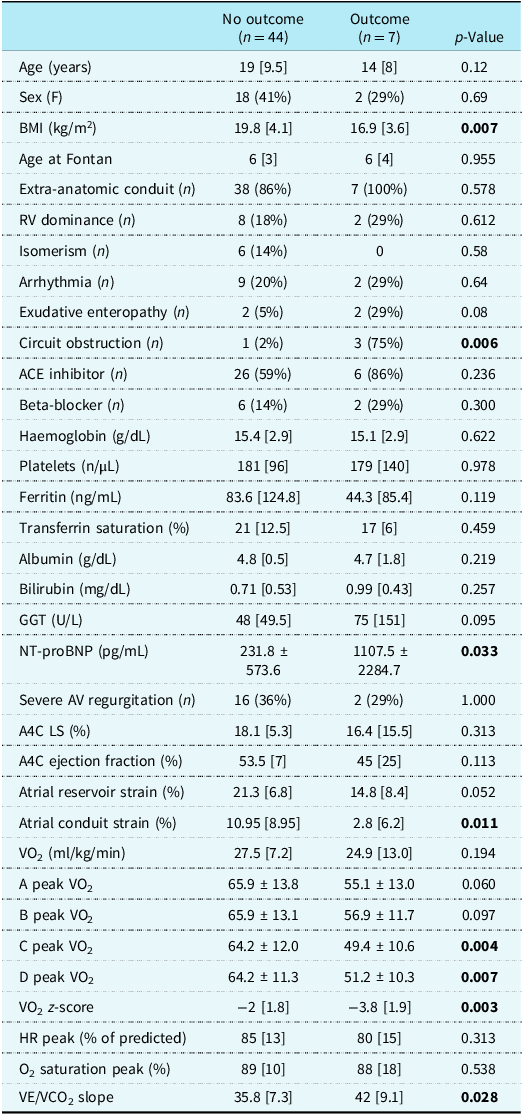
Patients with an adverse outcome had a lower body mass index (p = 0.007). Three of them had some form of ventricular or arch obstruction (75%) compared to only one (2%) in the group with no adverse outcomes. NT-proBNP was higher (p = 0.033), and atrial conduit strain was lower (p = 0.011). The percentage of predicted peak oxygen uptake using the Cooper height, Wasserman and Jones equations was significantly lower in patients that met the outcome (p = 0.004 and p = 0.007), as was the z-score of peak oxygen uptake (p = 0.004). The VE/VCO2 slope was higher (p = 0.028).
Sample characterisation by presence of outcome

A, B, C and D peak VO2 are composite variables corresponding to the percentage of predicted peak VO2, using the following formulas for patients ≤17 years and >17 years: A – Cooper weight + Wasserman; B - Cooper weight + Jones; C - Cooper height + Wasserman; D - Cooper height + Jones. A4C = apical 4-chamber; ACE = angiotensin-converting enzyme; AV = atrioventricular; BMI = body mass index; HR = heart rate; LS = longitudinal strain; RV = right ventricular.
Significant values, p < 0.05, in bold.
Logistic regression (Tables 3 and 4)
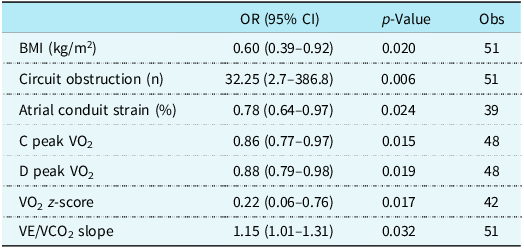
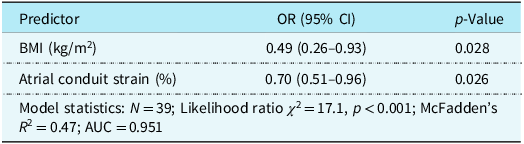
In univariable analysis, lower body mass index, presence of circuit obstruction, reduced atrial conduit strain, lower oxygen uptake measures (absolute, percentage of predicted, and z-score), and higher VE/VCO2 slope were all significantly associated with the composite outcome. When these variables were considered for multivariable analysis, inclusion of circuit obstruction led to complete separation of the outcome, precluding reliable estimation with standard logistic regression; this predictor was therefore excluded. After assessing collinearity and model fit, the final model included body mass index and atrial conduit strain. Both remained independently associated with the outcome: lower body mass index was associated with higher odds of the outcome (OR 0.49, 95% CI 0.26–0.93; p = 0.028), and reduced atrial conduit strain was likewise predictive (OR 0.70, 95% CI 0.51–0.96; p = 0.026). The model demonstrated strong performance (N = 39; likelihood ratio χ 2 = 17.1, p < 0.001; McFadden’s R 2 = 0.47) and excellent discrimination (AUC = 0.951).
Results of univariable analysis

C and D peak VO2 are composite variables corresponding to the percentage of predicted peak VO2, using the following formulas for patients ≤17 years and >17 years: C - Cooper height + Wasserman; D - Cooper height + Jones. BMI = body mass index; OR = odds ratio.
Results of multivariable analysis

BMI = body mass index; OR = odds ratio.
Discussion
Main findings of this study
This study aimed to evaluate five-year outcomes in a young Fontan cohort and to identify baseline predictors of adverse clinical events. We describe a relatively young population, predominantly with a systemic left ventricle and extra-anatomic conduits, with reduced exercise capacity and impaired atrial strain.Reference Rato, Sousa and Cordeiro6 During follow-up, 14% of patients experienced major adverse outcomes, including death, transplantation listing, heart failure hospitalisation, or conduit thrombosis. Univariable analysis identified lower body mass index, circuit obstruction, reduced atrial conduit strain, impaired exercise capacity, and ventilatory inefficiency as predictors of these outcomes. Due to complete separation, circuit obstruction could not be included in the multivariable model, and lower body mass index and reduced atrial conduit strain emerged as independent predictors, with strong model performance and excellent discriminatory capacity. Our findings suggest that both nutritional status and atrial functional parameters may be risk stratification markers in Fontan patients.
Importance for clinical practice
The evaluation of atrial strain imaging has emerged in cardiology as a strong tool to improve the assessment of diastolic function in heart failure,Reference Carluccio, Cameli and Rossi14 with relevant prognostic implications: in a recent meta-analysis each unit decrease in atrial reservoir strain was independently associated with a 5% increase for all-cause mortality and HF hospitalisation in patients with acute and chronic heart failure.Reference Pastore, Vigna and Saglietto15 In our 2020 publication, we showed that the analysis of atrial strain was feasible in patients with univentricular hearts after Fontan surgery, and it was strongly correlated with functional capacity,Reference Rato, Mendes and Sousa7 beyond the evaluation of ventricular function. Our reasoning was clear: given the several limitations of properly evaluating heart function in these patients with a significantly different anatomy, atrial strain proved a much more efficient method. The association with peak oxygen uptake, a strong marker of prognosis in these patientsReference Rychik, Atz and Celermajer3 and a good surrogate for heart function, proved just that. Since then, several publications have mentioned similar findings, confirming that atrial strain is, indeed, an important addition for the functional evaluation of the univentricular heart.Reference Ten Harkel and Van der Hulst16,Reference Khayyat, Ordonez and Marelli17 A recent study demonstrated a 13% decrease in the risk of death/transplant for every 5% increase in atrial reservoir strain in adult patients with Fontan palliation.Reference ElZalabany, Moustafa and Ali18 The current study adds to the literature in that it shows that this prognostic significance is true for both children and adults after the Fontan surgery and highlights the role of conduit strain. This particular finding recalls the study of Critser et al.: atrial conduit strain of <10%, assessed by cardiac magnetic resonance in young adults with Fontan, predicted an end-diastolic pressure ≥12 mmHg with a sensitivity of 67% and specificity of 83%.Reference Critser, Truong and Powell19 Overall, these findings underscore the value of assessing atrial strain in all Fontan patients and support its integration into routine risk stratification.
Another interesting finding is the importance of body mass index. Our population was characterised by a healthy weight in patients that did not meet the outcome (19.8 kg/m2 [4.1]) and underweight in patients with the outcome (16.9 kg/m2 [3.6]). Body mass index, in itself, is an inadequate measure of body composition in Fontan patients,Reference Tran, D’ambrosio and Verrall20 often hiding low skeletal muscle mass and increased adiposity, which is common in these patients.Reference Van den Berg, Pos and Scheffers21 While elevated body mass index has been associated with worse clinical outcomes,Reference Yogeswaran, Anigwe and Salahuddin22 lower skeletal muscle mass has also been associated with late complications.Reference Powell, Wittekind and Alsaied23 We did not study body composition, but we may speculate that these severe, underweight patients represent an extreme end of the ‘’myopenic Fontan profile,’’Reference Tran, D’ambrosio and Verrall20 akin to the cachexia profile seen in older patients with heart failure. These patients have a higher incidence of inpatient mortality and other adverse outcomes.Reference Mohamad Alahmad, Acharya and Gibson24 Nevertheless, whether low body mass index primarily reflects disease severity or contributes directly to adverse outcomes cannot be determined from this study. It is possible that body mass index acts as a marker of advanced circulatory failure rather than a modifiable causal factor. From a practical perspective, careful monitoring of nutritional status and timely interventions to optimise growth and body composition, including exercise, should be an integral part of the follow-up of all Fontan patients.Reference Tran, D’ambrosio and Verrall20,Reference Powell, Wittekind and Alsaied23 Our findings support that body mass index should not be regarded as a mere descriptive variable but as a clinically relevant risk marker that can be readily assessed in all settings.
Other variables, while not significant in the final multivariable statistical model, should not be disregarded. Cardiopulmonary exercise testing remains the reference, non-invasive tool to quantify integrative cardiovascular performance in Fontan physiology.Reference Rychik, Atz and Celermajer3 Among cardiopulmonary exercise testing indices, peak oxygen uptake captures the global limit of oxygen transport and extraction, while the VE/VCO2 slope reflects ventilatory efficiency and is sensitive to abnormal pulmonary blood flow—core pathophysiology in the Fontan circulation. Both parameters carry robust prognostic information across CHD cohorts, and, specifically in Fontan patients, lower peak oxygen uptake and higher VE/VCO2 slope consistently associate with adverse outcomes and clinical deterioration.Reference Wadey, Weston and Dorobantu25 Because reference equations strongly influence %-predicted oxygen uptake, we tested multiple standards to identify the most discriminatory for our clinical workflow. This side-by-side approach showed that percentages of the predicted peak oxygen uptake derived from height-based Cooper combined with adult (Wasserman/Jones) equationsReference Wasserman, Hansen and Sue12 and the z-score approach of Gavotto et al.Reference Gavotto, Mura and Rhodes13 delivered the clearest separation for adverse events in univariable analysis. In everyday practice, we recommend using age-appropriate, height-sensitive references for growing patients; reporting both absolute peak oxygen uptake and the percentage of the predicted values from a chosen standard; and considering z-scores when following patients across the paediatric–adult transition to reduce misclassification from rapid somatic changes. It is essential to maintain a rigorous approach to assure longitudinal comparability. Taking it one step further, newer works that scale peak oxygen uptake to measures of fat-free mass or lean mass may better reflect cardiorespiratory fitness and even improve outcome assessment,Reference Wadey, Barker and Graham Stuart26 which may justify their inclusion in the diagnostic armamentarium as well. Finally, although circuit obstruction was excluded from the multivariable model due to complete separation, its potential relevance remains unquestionable: the Fontan circulation requires unobstructed systemic outflow to function adequately,Reference Gewillig27 even when gradients are mild.
Strengths and limitations
A major strength of this study is the focus on a well-characterised cohort of young Fontan patients, evaluated with a comprehensive protocol including advanced imaging and cardiopulmonary exercise testing. This design allowed for the integration of clinical, functional, and imaging markers and provided novel insight into the prognostic value of atrial conduit strain and body mass index in this population. Methodologically, we applied rigorous statistical procedures, including testing assumptions of logistic regression, verifying linearity and collinearity, and adopting a conservative variable-to-event ratio in multivariable modelling, which reinforces the internal validity of our findings. The use of multiple reference standards for peak oxygen uptake further strengthens the robustness of our functional assessment and offers practical guidance for clinical practice.
Nevertheless, this study has important limitations. The sample size is small, reflecting the rarity of the Fontan circulation, and the number of adverse events was limited. As a result, statistical power is reduced and confidence intervals are wide, limiting the ability to detect or confirm weaker associations. Complete separation with one variable (circuit obstruction) further illustrates the challenge of modelling rare outcomes in small datasets. Additionally, although this is a single-centre study with uniform protocols, the findings may not be generalisable to all Fontan populations, particularly those with different surgical techniques, follow-up strategies, or demographic characteristics.
Future studies should aim to mitigate these limitations through collaborative, multicentre registries and prospective studies with larger cohorts, which would allow for more robust multivariable modelling, external validation of predictors, and exploration of interactions between several parameters. Incorporating longitudinal follow-ups across centres may further clarify the prognostic role of atrial function, nutritional status, and cardiopulmonary exercise testing parameters. Ultimately, such efforts could help build predictive models tailored to Fontan patients and guide individualised surveillance and intervention strategies.
Conclusion
In this young Fontan cohort, both reduced atrial conduit strain and lower body mass index were independently associated with adverse outcomes over five years, underscoring the value of atrial function, which reflects diastolic function, and nutritional status in these patients. Strategies must be overtaken to ensure optimisation of these parameters in the building and care of the Fontan circuit. These findings emphasise the importance of routinely incorporating multimodality evaluations into the daily clinical care of Fontan patients and of refining protocolised pathways for their assessment.
Financial support
There was no financial support for the production of this manuscript.
Competing interests
There is no conflict of interests for the production of this manuscript for any of the authors.
Ethical standard
The authors assert that all procedures contributing to this work comply with the ethical standards of the relevant national guidelines on human experimentation and with the Helsinki Declaration of 1975, as revised in 2008, and have been approved by the local institutional committees.