INTRODUCTION
Grieving the death of a relative or close friend is a universal experience. It can be one of the most stressful life experiences, and has been associated with emotional and physical morbidity, as well as increased mortality for the bereaved (Osterweis et al., Reference Osterweis, Solomon, Green and Zisook1987). A number of group psychosocial interventions have been developed to meet the needs of grieving individuals.
Bereavement groups have included different formats, types of leaders (peer counselors to professionals), and durations (a few weeks to open-ended). Participants' gender, relationship to the deceased, and the deceased's mode of death varied across studies (Barrett, Reference Barrett1978; Constantino, Reference Constantino1981; Marmar et al., Reference Marmar, Horowitz and Weiss1988; Sabatini, Reference Sabatini1988; Levy & Derby, Reference Levy and Derby1992; Tudiver et al., Reference Tudiver, Hilditch and Permaul1992; Kay et al., Reference Kay, de Zapien and Wilson1993; Levy et al., Reference Levy, Derby and Martinkowski1993; Hopmeyer & Werk, Reference Hopmeyer and Werk1994; Heiney et al., Reference Heiney, Ruffin and & Goon-Johnson1995; Thuen, Reference Thuen1995; Constantino & Bricker, Reference Constantino and Bricker1996; Goodkin et al., Reference Goodkin, Blaney and Feaster1999; Picton et al., Reference Picton, Cooper and Close2001; Sikkema et al., Reference Sikkema, Hansen and Kochman2004). These differences and study design limitations (small sample sizes, lack of randomization, and uncontrolled designs) contribute to the difficulty in drawing conclusions from the literature and may have obscured possible effects of the groups.
Recent reviews and meta-analyses to evaluate the safety and efficacy of these support and mutual-aid groups indicate that the interventions may not be helpful for all participants and, indeed, may harm some. They may help high-risk participants (high level of distress, sudden traumatic death, parents) (Potocky, Reference Potocky1993; Jordan & Neimeyer, Reference Jordan and Neimeyer2003) who spontaneously seek help (rather than being recruited) even though the effect size of these studies may be small (Jordan & Neimeyer, Reference Jordan and Neimeyer2003).
Depressive symptoms are considered to be a normal part of the grief process (Clayton et al., Reference Clayton, DesMarais and Winokur1968; Pasternak et al., Reference Pasternak, Reynolds and Frank1993; American Psychiatric Asssociation, 1994), and some findings seem to indicate that the depressive and grief symptoms are separate entities and may require different interventions (Jacobs et al., Reference Jacobs, Nelson and Zisook1987; Pasternak et al., Reference Pasternak, Reynolds and Schlernitzauer1991). However, not all studies examined both symptoms of grief and depression.
Of the studies that examined grief symptoms, investigators have reported decreased grief (Sabatini, Reference Sabatini1988; Constantino & Bricker, Reference Constantino and Bricker1996; Goodkin et al., Reference Goodkin, Blaney and Feaster1999; Sikkema et al., Reference Sikkema, Hansen and Kochman2004) increased grief (Barrett, Reference Barrett1978), or no change in grief (Lieberman & Yalom, Reference Lieberman and Yalom1992). Sikkema et al. (Reference Sikkema, Hansen and Kochman2004) reported reduction in grief symptoms for women compared with controls. However, men participants and controls both experienced reductions of grief, suggesting men improve even without intervention. Of the studies that examined depression and anxiety symptoms, some reported reductions in depressive symptoms (Constantino, Reference Constantino1981; Kay et al., Reference Kay, de Zapien and Wilson1993; Marmar et al., Reference Marmar, Horowitz and Weiss1988; Sikkema et al., Reference Sikkema, Hansen and Kochman2004) and anxiety (Kay et al., Reference Kay, de Zapien and Wilson1993; Marmar et al., Reference Marmar, Horowitz and Weiss1988; Sikkema et al., Reference Sikkema, Hansen and Kochman2004), sometimes without change in grief (Constantino, Reference Constantino1981), whereas others reported no treatment effect on depression and anxiety (Lieberman & Yalom, Reference Lieberman and Yalom1992; Tudiver et al., Reference Tudiver, Hilditch and Permaul1992; Levy et al., Reference Levy, Derby and Martinkowski1993) except among women (Sikkema et al., Reference Sikkema, Hansen and Kochman2004).
There is some evidence about the differences among those who choose to participate in group interventions and those who do not. Levy and Derby (Reference Levy and Derby1992) compared joiners (participants in at least one meeting of a group intervention) with nonjoiners, and found that joiners scored significantly higher on measures of depression, anger, anxiety, and subjective stress compared with nonjoiners. Both groups had equivalent levels of social support and both saw those who joined as less self-sufficient, which the authors felt might indicate some sense of mild stigma associated with joining.
In this article, we report on the results of a study evaluating the effects of a manualized, 8-week educational and supportive group intervention for a heterogeneous group of bereaved individuals. Our psychosocial and pastoral care department has been offering these free groups for a number of years. Each group is cofacilitated by two mental health professionals. As part of a program to evaluate our groups, we established a series of before and after questionnaires. We examined both grief and mood symptoms (depression and anxiety) before and after group participation. We used validated, reliable questionnaires, so that participants' scores might be compared with published norms, as we did not have sufficient numbers of participants to make a wait-listed comparison group.
We hypothesized that scores for grief would lie within the normal range cited for bereaved individuals and would decrease during the assessment period. Because grief symptoms gradually diminish over time (Lindemann, Reference Lindemann1944; Parkes, Reference Parkes1970; Williams & Polak, Reference Williams and Polak1979; Zisook et al., Reference Zisook, DeVaul and Click1982; Osterweis et al., Reference Osterweis, Solomon, Green and Zisook1987; Pasternak et al., Reference Pasternak, Reynolds and Frank1993), we expected that participants' grief symptoms, even without intervention, would decrease. But, one might expect that the decrease over an 8-week interval would be slight. Second, we hypothesized that depression and anxiety scores for our sample would be lower than the norms for psychiatric outpatients published for the measure we used and that scores for depression and anxiety symptoms would show less change with time, because this was not a treatment group for mood symptoms. Last, we compared the scores of participants who later dropped out of the groups with the baseline scores of those who completed the group, to examine, in a preliminary way, whether there were any differences between participants who completed the program and those who dropped out.
METHODS
Subjects
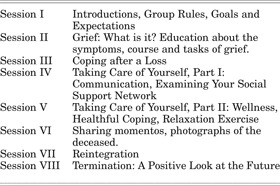
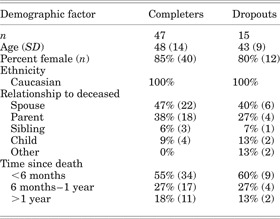
Forty-seven bereaved women and men living in the Providence, Rhode Island, area who responded to newspaper and television advertisements participated in groups that met weekly for eight 90-min sessions from 1995 to 1996. Two mental health professionals cofacilitated the groups and structured the sessions according to a manual developed at Brown University (The manual is available on request; content is presented in Table 1). Participants included 40 women and 7 men with a mean age of 48. Most had lost a spouse (47%) or parent (38%), three had lost a sibling (6%), four a child (9%). Thirty-four (55%) experienced the loss less than 6 months prior to entry into the group, 17 (27%) between 6 and 12 months, and 11 (18%) greater than a year. There were 15 additional women and men who dropped out after the first session and completed only the first battery of questionnaires. Dropouts were slightly younger than participants who completed the group sessions (43 vs. 48). The dropouts included 12 women (80%) and 3 men (20%). Six (40%) had lost a spouse, 4 (27%) a parent, 1 (7%) a sibling, 2 (13%) a child, and 2 “other” (13%). The time since the loss was similar to that of completers, with most of the losses occurring within the last 6 months (60%). Demographic information is summarized in Table 2.
An 8-week bereavement support/mutual aid group

Demographic characteristics of the participants

Procedure
At the first and last group meeting, each participant filled out the Profile of Mood States Short Form (POMS-SF). A subset of 31 participants (including 24 who completed the program and 7 dropouts) filled out the Texas Revised Inventory of Grief (TRIG) and the Unresolved Grief Index (UGI).
The POMS-SF (McNair et al., Reference McNair, Lorr and Droppleman1992) is a 30-item measure that has been used extensively in research studies. It has been normed in psychiatric outpatients and college students. The POMS taps a variety of mood states including tension (anxiety), depression, anger, vigor, fatigue, confusion, and total mood disturbance. Reliability estimates range from .75 to .90 for women and from .75 to .93 for men.
The TRIG (Faschingbauer, Reference Faschingbauer1981; Faschingbauer et al., Reference Faschingbauer, Zisook, DeVaul and Zisook1987) is a 21-item questionnaire that measures an individual's experience of grief. It consists of two scales: Past Behavior and Present Feelings. Alpha reliability for Part I (Present Feelings) is .77 and .89 for Part II (Past Behavior). It has been normed, although the published norms combine the scores for both men and women (63% were female), and men and women may respond differently to grief.
The UGI (Zisook & DeVaul, Reference Zisook and DeVaul1983) is comprised of three items used clinically to identify unresolved grief: (1) I feel I have grieved for the person who died, (2) Now I can talk about the person without discomfort, (3) I feel I have adjusted well to the loss. Each item is scored from 0 to 4. Total scores range from 0 to 12. It has not been tested for validity and reliability, but it has been normed in a convenience sample of 211 of the authors' friends, colleagues, and their neighbors. The sample was mostly female (62%), white (65%), middle class, middle-aged, and well educated (13.7 years). The authors arbitrarily decided that a score of 0 to 1 denoted resolved grief, while a score of 6 or more indicated unresolved grief. Of their sample, 30 (14%) scored in the range of unresolved grief.
Analyses
Mean scores and standard deviations were calculated for all participants. One participant failed to fill out baseline POMS scores, and mean scores of the remaining participants were used to replace the missing data. Both baseline and follow-up questionnaires were analyzed for 47 subjects (completers). Their scores were compared with published norms available for some of the measures and then analyzed by paired t tests.
For analyses comparing dropouts to the completers, chi-squared analyses were used to determine if there were between-group differences in gender, relationship to the deceased, and time since the death. An ANOVA was used to determine if there was any difference between groups in age. The 15 dropouts' scores on the POMS, TRIG, and UGI were calculated and compared with the published norms. Then, a one-way ANOVA was used to compare the dropouts' scores with baseline scores of subjects who completed the entire group.
RESULTS
Below are completers' scores at the first and last session.
Grief
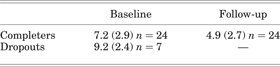
The means and standard deviations on the TRIG for participants (both completers and dropouts) are presented on Table 3. Both past grief behavior and present feelings of grief, as measured by the TRIG, were above two standard deviations of the means provided by the authors of the TRIG (Faschingbauer, Reference Faschingbauer1981; Faschingbauer et al., Reference Faschingbauer, Zisook, DeVaul and Zisook1987). Completers' scores remained two standard deviations above the mean at follow-up. Despite their high scores, at 8 weeks follow-up, participants who completed the program reported significant improvements in present grief scores on the TRIG (t = 3.09, df = 23, p = .005). Mean scores dropped from 54 to 48 by 8 weeks. Mean unresolved grief scores decreased from 7 to 5 (t = 4.8, df = 23, p < .001) and are presented on Table 4. A score of 7 is considered to be in the range indicating unresolved grief, whereas a score of 5 is not (Zisook & DeVaul, Reference Zisook and DeVaul1983).
Mean (SD) scores on the TRIG with norms

Norms from Faschingbauer, Reference Faschingbauer1981; Faschingbauer et al., Reference Faschingbauer, Zisook, DeVaul and Zisook1987.
Scores on the Unresolved Grief Index (6 or higher indicates unresolved grief)
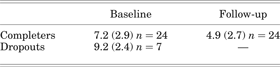
Threshold for unresolved grief from Zisook and DeVaul, Reference Zisook and DeVaul1983.
Mood
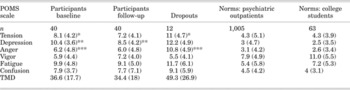
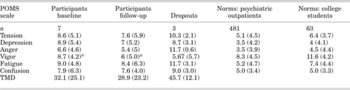
The participants' mood scores from the POMS are presented in Table 5 (for women) and Table 6 (for men), along with norms from the POMS manual. For both women and men, scores were comparable to those of psychiatric outpatients. Only the Depression subscale score was more than one standard deviation above the mean for psychiatric outpatients. For women, at follow-up, Depression scores decreased yet remained above one standard deviation of the mean. But the decrease was statistically significant. Depression scores dropped from 10.4 to 8.5 (t = 2.9, df = 39, p = .006). For men Depression scores fell within one standard deviation of the mean for psychiatric outpatients at follow-up, a change that was not significant on paired t test. However, for men, Vigor scores decreased significantly from 8.7 to 6 (t = 2.7, df = 6, p = 0.04).
POMS scores for females compared with norms

Baseline and follow-up scores compared via paired t tests. Baseline with dropouts' scores compared via ANOVA. Norms from McNair et al., Reference McNair, Lorr and Droppleman1992.
*Significant difference, F(1, 50) = 4.2, p = .046.
**Significant difference t = 2.9, df = 39, p = .006.
***Significant difference, F(1, 50) = 8.5, p = .005.
POMS scores for males compared with norms

Baseline and follow-up scores compared via paired t tests. Baseline with dropouts' scores compared via ANOVA. Norms from McNair et al., Reference McNair, Lorr and Droppleman1992.
*Significant difference, F(1, 8) = 2.7 p = 0.04.
Comparison of Dropouts and Completers
There were no group differences in age, gender, time since loss, or relationship to the deceased between dropouts and completers. Dropouts were slightly younger, but the difference was nonsignificant (43 as compared with 48).
Dropouts' grief scores on the TRIG, along with completers' and published norms, are presented on Table 3. Like those who participated in all the sessions, dropouts had scores higher than two standard deviations above the norm on both subscales of the TRIG. There were no differences in grief as measured by the TRIG when the dropouts' scores were compared with the completers' baseline scores. Differences in the UGI scores for the two groups were nonsignificant, as well.
Both male dropouts' (Table 6) and female dropouts' (Table 5) scores on the POMS were greater than one standard deviation above the mean for five of six POMS subscales (Tension, Depression, Anger, Fatigue, and Confusion). The 12 women who dropped out scored significantly higher on Anger (F = 8.5, df = 1, 50, p = .005), Tension/Anxiety (F = 4.2, df = 1, 50, p = .05) on the POMS compared with women who completed the entire eight sessions. There were no significant differences between men dropouts compared with men completers. Mean score for female dropouts on the Anger scale of the POMS was 10.8 (SD = 4.9) compared with 6.2 (4.8) for completers. Mean Tension score for female dropouts was 11 compared with 7.2 for completers.
DISCUSSION
Contrary to our first hypothesis, participants' grief scores did not lie in the normal range. Our sample was more than two standard deviations above the mean at baseline and follow-up in grief scores as measured by the TRIG. These scores are well outside the norms for the TRIG, and this difference is probably not due to chance. The higher TRIG scores in our sample may reflect the larger percentage of women in our sample compared with the TRIG normative sample (85% vs. 63%). Women tend to score higher on anxiety, depression, and probably grief. The higher scores may be related to sample bias; our participants were a volunteer sample who sought help in dealing with their grief. Perhaps individuals who seek assistance in dealing with their grief (beyond that of the support of family and friends) are a more distressed group, as other authors suggest (Levy & Derby, Reference Levy and Derby1992; Jordan & Neimeyer, Reference Jordan and Neimeyer2003). Our scores are comparable to those reported by other authors who used the TRIG as an assessment for bereavement group participants (Sabatini, Reference Sabatini1988). The reasons for higher scores in bereavement group participants remains to be explored.
Contrary to our second hypothesis, depression and anxiety were not lower than psychiatric outpatients, whom one would expect to be distressed. Our participants scored higher on depression than psychiatric outpatients and had scores comparable to psychiatric outpatients on all the other POMS subscales. The women were more distressed than the men, and the women dropouts were the most distressed of all. This supports Levy and Derby's (Reference Levy and Derby1992) data that those who participate in bereavement groups have high anxiety and depression.
Grief symptoms decreased significantly at follow-up for group participants. The change in grief scores is consistent with what some consider the natural history of grief (that it diminishes with time) and with the data from other authors (Sabatini, Reference Sabatini1988; Constantino & Bricker, Reference Constantino and Bricker1996; Goodkin et al., Reference Goodkin, Blaney and Feaster1999; Sikkema et al., Reference Sikkema, Hansen and Kochman2004). This is a different finding from researchers who have reported increased or no change in grief following group interventions for the bereaved (Barrett, Reference Barrett1978; Marmar et al., Reference Marmar, Horowitz and Weiss1988; Lieberman & Yalom, Reference Lieberman and Yalom1992). In all the studies, the grief instruments were tested in very small samples and the small samples may not have had adequate power to detect clinically meaningful differences. That we have been able to see a drop in grief scores in 8 weeks seems promising and supports the data summarized in two review papers (Potocky, Reference Potocky1993; Jordan & Neimeyer Reference Jordan and Neimeyer2003) that bereavement groups may be helpful for the more distressed.
Mood symptoms improved for women but worsened for men, even though the focus of the group was grief. For women the Depression subscale score decreased significantly, though the change was small and possibly not clinically significant (10 to 8). That only women experienced a decrease in depression is consistent with the findings of Sikkema et al. (Reference Picton, Cooper and Close2004), however. In our sample, men reported a decreased score on the Vigor subscale at follow-up. The Vigor subscale captures positive affect, a mood of vigorousness, ebullience, and high energy (McNair et al., Reference McNair, Lorr and Droppleman1992). This finding of worsening in mens' vigor symptoms is different from the findings of Sikkema et al. (Reference Sikkema, Hansen and Kochman2004), who found that both male participants and controls experienced improved mood symptoms. Unfortunately, we did not have a control group, so one cannot conclude that the group worsened mens' distress. But the findings support the evidence cited by Jordan and Neimeyer (2003) that one should be cautious about the effects of these groups on men. Clearly, more work needs to be done to determine whether groups are harmful to men. Despite the lack of change in most mood symptoms and the worsening of Vigor scores, men continued to participate in the group and did not drop out.
Although POMS measures a cluster of mood symptoms with both psychological and physical components, it is not an indicator of psychiatric disorders such as the DSM-IV TR diagnosis of depression. These data do not suggest that psychiatric disorders such as depression might improve with a bereavement group. However, for women, mood symptoms that are part of the grief process might be ameliorated. That the drop in grief for men and women was statistically significant as measured by both scales whereas only the Depression subscale scores decreased significantly (and this, only for women) supports our hypothesis that mood would not improve as much as grief because this was not a treatment for depression or anxiety.
Women who dropped out of the group had significantly higher Anger and Tension/Anxiety than women who completed the group. Both male and female dropouts scored higher than one standard deviation above the mean for psychiatric outpatients on five of six POMS subscales. This is contrary to the data from Levy and Derby (Reference Levy and Derby1992) which indicated that participants had greater anger and anxiety than nonjoiners. Our dropouts participated in the first session and did not return, whereas nonjoiners in Levy and Derby's (Reference Levy and Derby1992) study did not participate in bereavement groups at all. Our dropouts would have been considered “joiners” by Levy and Derby's criteria and are not comparable with their nonjoiners. Furthermore, our participants responded to advertisements, whereas Levy and Derby's participants were approached via a hospice. Our data support the data from other studies indicating that bereavement groups may be more efficacious for mourners who voluntarily participate (Jordan & Neimeyer, Reference Jordan and Neimeyer2003). Perhaps participants should be prescreened with the POMS, and those with high Anger and Tension/Anxiety should be enrolled in interventions that address their particular needs, with a focus on acceptance of negative emotions very early in the intervention. Whether these participants might benefit from referral for professional treatment has not been determined.
These findings demonstrate improvement in grief for men and women, improvements in depression for women, and worsening for men of vigorousness, ebullience, and high energy (McNair et al., Reference McNair, Lorr and Droppleman1992) in a heterogeneous group of individuals participating in bereavement support groups.
There are a number of limitations to the study. Our sample was 100% Caucasian and mainly women, which limits generalizability, and it was a voluntary sample, which allows for selection bias. The lack of a control group makes it impossible to attribute the changes to the group intervention. But one would not expect much change in grief in 8 weeks. In addition our groups were run by two mental health professionals, which some authors suggest, produces better results (Potocky, Reference Potocky1993; Jordan & Neimeyer, Reference Jordan and Neimeyer2003).
We suggest that an evaluation of a bereavement intervention include measures of both grief and mood symptoms, preferably with validated, reliable instruments that have been normed. Findings for men and women should be assessed separately. If numbers permit, a wait-listed comparison group would be helpful. The questions of the efficacy of bereavement group interventions, which interventions are appropriate for whom, and at what point following the loss will require randomized, controlled trials.
ACKNOWLEDGMENTS
Thanks to Elinor Collins and James Willsey for facilitating so many of the groups. Thanks also to Ramin Mojtabai. This material was presented at the American Psychiatric Association Annual Meeting in New York, New York, in May 1996.