Introduction
Terrestrial gastropod molluscs (slugs and snails) (Mollusca: Gastropoda) constitute approximately 35,000 species, making them one of the most successful animal groups in the terrestrial ecosystem (Barker, Reference Barker2001). Although no formal method has been developed for differentiating between slugs and snails, an organism is considered to be a slug when it has no external shell, or when the shell is small in comparison to its body size, and it is considered to be a snail when it has a large external shell (Barker, Reference Barker2001). All slugs have evolved from snails, with such evolution having occurred multiple times throughout evolution (South, Reference South1992).
Terrestrial molluscs lay eggs that hatch into juveniles, which have a similar shape to the adults, albeit varying in colour. As adults, they reproduce by means of either amphimixis or hermaphroditism, with the hermaphrodites either being self-fertilizing (e.g. Arion intermedius Normand, 1852) or fertilizing by means of outcrossing (e.g. Deroceras reticulatum (Müller, 1774)). The timing of the life cycle varies between species, with some being opportunistic breeders (D. reticulatum) that can go through multiple generations within 1 year, whereas some are annual breeders (Arion spp.), and some span several years (Achatina fulica Bowdich, 1822). A detailed biology of molluscs has been described by Barker (Reference Barker2001).
Terrestrial molluscs have colonized all inhabited continents, having become important agricultural pests in the process (Barker, Reference Barker2002). In Europe, slugs damage arable (wheat, oilseed rape), ornamental (e.g. hostas, orchids) and vegetable crops (e.g. lettuce, Brussels sprouts, asparagus) (Ester & Wilson, Reference Ester, Wilson, Grewal, Ehlers and Shapiro-Ilan2005). In North America, slugs target soybean and field corn (Hammond & Byers, Reference Hammond, Byers and Barker2002), whereas snails attack citrus production (Sakovich, Reference Sakovich and Barker2002). In Central America, slugs attack beans (Rueda et al., Reference Rueda, Caballero, Kaminsky, Andrews and Barker2002). In Africa, the giant African snail, A. fulica, is a serious economic pest in relation to a number of important crop types, with it consuming up to 10% of its own weight daily (Schreurs, Reference Schreurs1963). In addition, slugs have been recorded as being serious pests of canola crops in South Africa (Ross et al., Reference Ross, Ivanova, Sirgel, Malan and Wilson2012). In Australasia, slugs target pasture establishment in New Zealand (Wilson & Barker, Reference Wilson and Barker2011), with snails being a problem in terms of vine (Sanderson & Sirgel, Reference Sanderson, Sirgel and Barker2002) and wheat production (Baker, Reference Baker and Barker2002) in Australia.
Molluscs attack plants by destroying their stems and growing points, causing a reduction in their growth and vigour. In addition, they target seedlings and seeds, and reduce the leaf area (South, Reference South1992). In some cases, the damage that is done to germinating seeds is so severe that entire fields must be re-sown, resulting in huge economic losses to both growers and farmers (Willis et al., Reference Willis, Bohan, Choi, Conrad and Semenov2006).
In addition to crop pests, many terrestrial mollusc species are intermediate hosts to parasites, making them a potential health risk to humans and wildlife (South, Reference South1992). A detailed review of nematodes using molluscs as intermediate hosts has been written by Grewal et al. (Reference Grewal, Grewal, Tan and Adams2003a).
Chemical molluscicide toxins include iron phosphate, carbamate compounds (methiocarb and thiodicarb) and metaldehyde (for a review of chemical control see Bailey, Reference Bailey and Barker2002). However, the use of chemical molluscicides carries a number of environmental risks. Metaldehyde and methiocarb compounds have proven to be toxic to a range of vertebrates (Fletcher et al., Reference Fletcher, Hunter and Barnet1994), as well as to some species of isopods (Santos et al., Reference Santos, Ferreira, Soares and Loureiro2010), with methiocarb being toxic to a number of beneficial invertebrates, such as carabid beetles and earthworms (Purvis & Bannon, Reference Purvis and Bannon1992). In addition, growers often overuse slug pellets, as they are unaware of the intensity of their slug populations, resulting in such exaggerated environmental problems as surface wash-off after heavy rain (O'Brien et al., Reference O'Brien, Spillane, Meade and Mullins2008). As a result, the European Union has voted to ban methiocarb across Europe, due to the effects of the pesticide on key organisms (Jones, Reference Jones2014). In addition, metaldehyde contamination of drinking water has received much attention since the UK Environmental Agency, in 2008, warned that the metaldehyde levels in some areas exceeded European and UK drinking water standards.
Cultural methods of controlling molluscs include the use of physical barriers, irritants, antifeedants and chemical repellents. The most effective cultural control methods for use against slugs include cinnamamide, garlic, mulch, copper foil, copper ammonium carbonate, aluminium foil, Tex-R® and Snailban®, although such methods are not cost-effective for extensive use with large-scale crops (Schüder et al., Reference Schüder, Port and Bennison2003). Slugs can also be controlled by means of trapping, drilling at greater depth, ploughing, crop rotation, increased cropping diversity and firm seedbed preparation (Glen, Reference Glen2000).
Establishing a method of control for molluscs that is effective, but that is neither harmful nor toxic to its surrounding environment, is important. One such method entails the use of biological control, in terms of which one or more living organisms are used to control another living organism. Gastropods have a number of predators and parasites that could be developed for biological control; however, to date, the European nematode parasitic in molluscs, Phasmarhabditis hermaphrodita (Schneider, Reference Schneider1859) Andrássy, Reference Andrássy1983 (Rhabditida: Rhabditidae), has shown the greatest commercial potential (Rae et al., Reference Rae, Verdun, Grewal, Robertson and Wilson2007).
Nematodes associated with molluscs as definitive hosts
Current knowledge of nematodes that use molluscs as definitive hosts is based on surveys that have been conducted in Europe (Ross et al., Reference Ross, Ivanova, Hatteland, Brurberg and Haukeland2016a), Asia (Ivanova et al., Reference Ivanova, Pham Van Luc and Spiridonov2016), North America (Ross et al., Reference Ross, Ivanova, Severns and Wilson2010a), Australia (Charwat & Davies, Reference Charwat and Davies1999) and Africa (Ross et al., Reference Ross, Ivanova, Sirgel, Malan and Wilson2012), along with a number of individual nematode parasites found globally (for reviews see Grewal et al., Reference Grewal, Grewal, Tan and Adams2003a; Morand et al., Reference Morand, Wilson, Glen and Barker2004). These surveys revealed that there are eight families of nematodes that associate with molluscs as definitive hosts, namely: Agfidae, Alaninematidae, Alloionematidae, Angiostomatidae, Cosmocercidae, Diplogastridae, Mermithidae and Rhabditidae (including the genus Phasmarhabditis). Detailed reviews of the characterization and host range of these nematode families can be found in Grewal et al. (Reference Grewal, Grewal, Tan and Adams2003a) and Morand et al. (Reference Morand, Wilson, Glen and Barker2004). Ross et al. (Reference Ross, Ivanova, Spiridonov, Waeyenberge, Moens, Nicol and Wilson2010b) has demonstrated that Agfidae, Angiostomatidae and Rhabditidae (Phasmarhabditis genus) form a tight monophyletic group, indicating that they evolved from a single mollusc-colonizing ancestor.
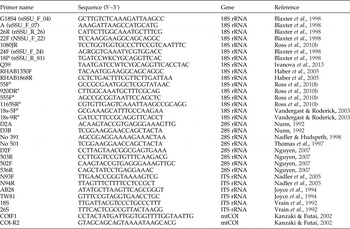
Parasitic nematodes in molluscs should be identified using a combination of morphological and molecular analysis. Often field-collected molluscs have been found to contain a mixed nematode infection (Ross et al., Reference Ross, Ivanova, Hatteland, Brurberg and Haukeland2016a), requiring that molecular analysis should be conducted on individual nematode specimens. There are many methods for DNA extraction (see Tandingan De Ley et al., Reference Tandingan De Ley, Mundo-Ocampo, Yoder and De Ley2007; Ross et al., Reference Ross, Ivanova, Spiridonov, Waeyenberge, Moens, Nicol and Wilson2010b) and amplification should be based on numerous genes: small subunit (SSU or 18S) rRNA gene; the D2D3 large subunit (LSU or 28S) rRNA gene; the internal transcribed spacer regions (ITS-1, 5.8S, ITS-2) rRNA genes; and the mitochondrial cytochrome c oxidase subunit 1 (mtCOI) gene. Table 1 summarizes the primers that have been used successfully to identify nematodes associated with molluscs.
Primers for amplifying 18S rRNA, 28S rRNA, ITS rRNA and mtCOI that have been used successfully for the molecular identification of parasitic nematodes in molluscs.

aPrimers for Mermithidae.
Rhabditida: Agfidae
Currently, three known species exist within the Agfidae family: Agfa flexilis (Dujardin, 1845), Agfa morandi Ribas & Casanova, 2002 and Agfa tauricus Korol & Spiridonov, 1991 (Morand et al., Reference Morand, Wilson, Glen and Barker2004). Agfa flexilis has been recorded in Europe, the USA and Africa (Ross et al., Reference Ross, Ivanova, Severns and Wilson2010a, Reference Ross, Ivanova, Hatteland, Brurberg and Haukeland2016a), whereas A. morandi has only been isolated in the French Pyrenees (Ivanova et al., Reference Ivanova, Spiridonov, Clark, Tourna, Wilson and Barker2013). Agfa tauricus has been found in several locations in the Crimea and Bulgaria (Ivanova et al., Reference Ivanova, Spiridonov, Clark, Tourna, Wilson and Barker2013). Agfids are obligate parasites that are isolated in the adult and juvenile stages and are characterized by means of their long, thin neck region. All three agfids parasitize limacid hosts, with the exception of A. tauricus, which has been found to associate with agriolimacids and a zonitid snail, and A. flexilis, which has been found associating with Arion vulgaris Moquin-Tandon, 1855 (also known as Arion lusitanicus Mabille, 1868) (Ross et al., Reference Ross, Ivanova, Hatteland, Brurberg and Haukeland2016a). Little is known about the life cycle of the Agfidae family, apart from the fact that they are obligate parasites of molluscs. To date, no study has investigated the potential of agfids to serve as biological control agents for molluscs.
Panagrolaimorpha: Alaninematidae
Little is known about the family Alaninematidae, which consists of only one genus, Alaninema Théodoridès, 1957. To date, three species have been described: Alaninema venmansi Théodoridès, 1957, which was found in Amphidromus contrarius (Müller, 1774) from Indonesia; Alaninema njoroensis Puylaert, 1970, which was isolated from an unidentified mollusc host in Africa; and Alaninema ngata Ivanova et al., 2013, which is known to parasitize the intestines of endemic leaf-veined slugs in New Zealand (Ivanova et al., Reference Ivanova, Spiridonov, Clark, Tourna, Wilson and Barker2013). Another undescribed species is said to occur in Athoracophoridae in New Zealand (Morand et al., Reference Morand, Wilson, Glen and Barker2004). The biology of the nematodes mentioned is unknown, but they associate with the pallial cavity, or digestive tract, of their mollusc host (Morand et al., Reference Morand, Wilson, Glen and Barker2004).
Rhabditida: Alloionematidae
Currently, three known genera exist within the Alloionematidae family: Rhabditophanes Fuchs, 1930 associates with insects; while Alloionema Schneider, 1859 and Neoalloionema Ivanova et al., 2016 associate with molluscs.
Alloionema is represented by Alloionema appendiculatum Schneider, 1859, and was recently re-described by Nermut’ et al. (Reference Nermut’, Půža and Mráček2015). Although initial reports stated that A. appendiculatum is non-pathogenic to hosts (Charwat & Davies, Reference Charwat and Davies1999), more recent studies have shown that the nematode is, indeed, capable of attaining significant mortality in Petri dish experiments involving A. lusitanicus (Laznik et al., Reference Laznik, Ross, Tóth, Lakatos, Vidrih and Trdan2009). With the nematode exhibiting both free-living and parasitic life cycles, during its parasitic phase third- and fourth-stage larvae become encapsulated into the pedal musculature (Morand et al., Reference Morand, Wilson, Glen and Barker2004). Alloionema appendiculatum, which is widespread, has been isolated in North America, Europe and Australasia (Charwat & Davies, Reference Charwat and Davies1999; Ross et al., Reference Ross, Ivanova, Severns and Wilson2010a, Reference Ross, Ivanova, Spiridonov, Waeyenberge, Moens, Nicol and Wilsonb, Reference Ross, Ivanova, Hatteland, Brurberg and Haukeland2016a).
Neoalloionema is represented by Neoalloionema tricaudatum Ivanova et al., 2016, a specialist nematode of Cyclophorus sp., isolated in Vietnam. The nematode associates with the pallial cavity of its snail hosts. Little is known of its life cycle; however, the nematode's ability to grow on the tissues of a dead host indicates that it undergoes a free-living stage in its life cycle (Ivanova et al., Reference Ivanova, Pham Van Luc and Spiridonov2016).
Rhabditida: Angiostomatidae
The family Angiostomatidae consists of two known genera, Angiostoma Dujardin, 1845 and Aulacnema Pham Van Luc et al., 2005. The Angiostoma genus has 18 known species, whereas Aulacnema is monotypic. Molluscan angiostomatids are obligate parasites of the intestine, hepatopancreas, oesophagus, buccal mass, crop, mantle cavity, salivary gland and pallial cavity (Ross et al., Reference Ross, Ivanova, Hatteland, Brurberg and Haukeland2016a, Reference Ross, Ivanova and Haukelandb). In addition to being molluscan angiostomatids, four species have, so far, been isolated from the intestine and bronchi of their amphibian and reptile hosts (Falcón-Ordaz et al., Reference Falcón-Ordaz, Mendoza-Garfias, Windfield-Perez, Parra-Olea and Perez-Ponce de Leon2008). The potential of angiostomatids as biological control agents is, as yet, unknown.
Ascaridida: Cosmocercidae
The Cosmocercidae family has two genera that associate with molluscs, namely Nemhelix Morand & Petter, 1986 and Cosmocercoides Wilkie, 1930. Cosmocercoides associates with terrestrial molluscs in North America, whereas Nemhelix associates with European snails (Morand et al., Reference Morand, Wilson, Glen and Barker2004).
Cosmocercoides is represented by Cosmocercoides dukae Holl, 1928. Little is known about the potential of this nematode as a biological control agent of molluscs; however, a study on the transmission process found that when third-stage larvae leave the mantle cavity, and are placed on the foot sole of a new mollusc host, they enter the respiratory pore and mantle cavity to develop further internally. In addition, larvae have also been found to be present in the genital tract and eggs of slugs (Morand et al., Reference Morand, Wilson, Glen and Barker2004).
The Nemhelix genus is represented by three known species, all of which infect the reproductive organs of terrestrial snails in Europe. Nemhelix bakeri Morand & Petter, 1966 is a parasite of Cornu aspersum (Müller, 1774), with Nemhelix lamottei Morand, 1989 being a parasite of Cepaea nemoralis (Linnaeus, 1758) and Nemhelix ludesensis Morand, 1989 being a parasite of Cepaea hortensis (Müller, 1774) (Morand et al., Reference Morand, Wilson, Glen and Barker2004).
Although the family Cosmocercidae is also known to affiliate with reptilian and amphibian hosts, it has been suggested that cosmocercids only occur in amphibians due to the ingestion of infected mollusc hosts (Vanderburgh & Anderson, Reference Vanderburgh and Anderson1987).
Diplogastrida: Diplogastridae
Although the family Diplogastridae is usually associated with invertebrates, or has a free-living life cycle in soil, nematodes in adult and juvenile stages have been found in molluscs. Hugotdiplogaster neozelandia Morand & Barker, 1995 infects molluscs in its adult stage, whereas Diplogaster Shultze 1857 infects molluscs during their larval stages (Morand et al., Reference Morand, Wilson, Glen and Barker2004). The potential of members of the Diplogastridae family as biological control agents of molluscs has not yet been investigated.
Mermithida: Mermithidae
Mermithidae is a family of nematodes of which the members can be extremely large, ranging from 1 to 10 cm in length (Poinar, Reference Poinar1983). Mermithids produce pre-parasitic juveniles that infect hosts either through direct penetration, or by means of the ingestion of eggs and paratenic hosts. Although mermithids are usually obligate parasites of insects and arthropods (e.g. spiders and crustaceans), they have also been found to associate with molluscs (Morand et al., Reference Morand, Wilson, Glen and Barker2004). Their potential as biological control agents of molluscs has not yet been investigated.
Rhabditida: Rhabditidae
The Rhabditidae comprises a large family, with species ranging from being free-living nematodes to being parasites of invertebrates or commensals of insects (Morand et al., Reference Morand, Wilson, Glen and Barker2004). The several different genera that are associated with molluscs include Rhabditis Dujardin, 1845, Caenorhabditis (Osche, 1952) Dougherty, 1953 and Phasmarhabditis Andrássy, 1976. In contrast to other true parasites (e.g. Agfidae and Angiostomatidae), Phasmarhabditis spp. are facultative parasites that live on compost, leaf litter, slug faeces, and dead earthworms and insects (Nermut’ et al., Reference Nermut’, Půža and Mráček2014). They also exhibit a necromenic strategy in relation to the larger slug species (e.g. Arion ater (Linnaeus, 1758)) (Rae et al., Reference Rae, Robertson and Wilson2009). In addition, Petersen et al. (Reference Petersen, Hermann, Barg, Schalkowski, Dirksen, Barbosa and Schulenburg2015) have demonstrated that Caenorhabditis elegans Maupas, 1900 can invade the intestine of molluscs, exiting still alive through the faeces. To date, P. hermaphrodita is the only rhabditid to be developed as a commercial biological control agent (Rae et al., Reference Rae, Verdun, Grewal, Robertson and Wilson2007).
Phasmarhabditis hermaphrodita
Classification
In a revision of the ‘Papillosa’ group in the genus Pellioditis Dougherty, 1953 sensu Sudhaus (Sudhaus, Reference Sudhaus1976, Reference Sudhaus2011; Sudhaus & Fitch, Reference Sudhaus and Fitch2001), Andrássy (Reference Andrássy1976) proposed a completely different genus, Phasmarhabditis. The new genus was conceived of five different species, including Phasmarhabditis papillosa (Schneider, 1866) Andrássy, 1983 as the type species, P. hermaphrodita and Phasmarhabditis neopapillosa (Mengert, 1952) Andrássy, 1983 from the ‘Papillosa’ group, and two littoral/marine species (Phasmarhabditis nidrosiensis Allgén 1933 and Phasmarhabditis valida Sudhaus 1974) (Andrássy, Reference Andrássy1983).
In a more recent revision, Sudhaus (Reference Sudhaus2011) moved the nidrosiensis and valida littoral/marine species to another genus (Buetschlinema Sudhaus, 2011). The remaining Phasmarhabditis species were transferred to the ‘Papillosa’ group, located within the Pellioditis genus (Sudhaus, Reference Sudhaus2011). The fundamental similarity of Pellioditis sensu Sudhaus (Sudhaus, Reference Sudhaus1976, Reference Sudhaus2011; Sudhaus & Fitch, Reference Sudhaus and Fitch2001) and Phasmarhabditis sensu Andrássy (Andrássy, Reference Andrássy1976, Reference Andrássy1983) can be seen in them comprising the stem species of the ‘Papillosa’ group (P. hermaphrodita, P. neopapillosa and P. papillosa). The nomenclature ‘Pellioditis’ has priority over ‘Phasmarhabditis’; however, both names refer to the same group of rhabditids (P. hermaphrodita, P. neopapillosa and P. papillosa), but are based on different perceptions. In order to avoid taxonomic confusion, new species have been referred to as Phasmarhabditis. To date, the Phasmarhabditis Andrássy, 1976 genus is known from six species (P. hermaphrodita; P. neopapillosa; P. papillosa; Phasmarhabditis tawfiki Azzam, 2003; Phasmarhabditis huizhouensis Huang et al., 2015; and Phasmarhabditis californica Tandingan De Ley et al., 2016).
Isolation
The first description of P. hermaphrodita (referred to as Pelodytes hermaphroditus) was undertaken by Schneider in 1859, who found the nematode associating with an Arion sp. (Schneider, Reference Schneider1859). Later, Maupas (Reference Maupas1900) re-isolated the nematode (referred to as Rhabditis caussaneli) from the intestine of an A. ater collected in Normandy (France), maintaining the nematode culture on rotting flesh. Maupas (Reference Maupas1900) noted that the nematode, instead of reproducing sexually, produced protandrous autogamous hermaphrodites, with males occurring only very rarely (1 male/715 females). Mengert (Reference Mengert1953), in conducting a study on nematodes associated with terrestrial molluscs, failed to find P. hermaphrodita, although the closely related species, P. neopapillosa, was isolated from the slug, Limax cinereoniger Wolf, 1803. Mengert (Reference Mengert1953) suggested that P. hermaphrodita, P neopapillosa, and an additional species, P. papillosa, are all from the same ecological grouping, with them all undergoing the same form of non-parasitic life cycle. Andrássy (Reference Andrássy1983) found that P. hermaphrodita and P. neopapillosa were identical in their morphology, with their only distinguishable feature, in relation to each other, being their sex ratios – the latter being characterized by its equal numbers of males and females, in contrast to the rare occurrence of males in the former.
In 2003, a new member of the genus, P. tawfiki, was described, which was isolated in Egypt from the terrestrial snail Eobania vermiculata (Müller, 1774) and the slug Limax flavus Linneaus, 1758 (Azzam, Reference Azzam2003). In 2015, another new species, P. huizhouensis was described from its location in rotting leaves in the Guangdong Province of China (Huang et al., Reference Huang, Ye, Ren and Zhao2015). In the following year, P. californica was described from D. reticulatum collected in California, USA (Tandingan De Ley et al., Reference Tandingan De Ley, Holovachov, McDonnell, Bert, Paine and De Ley2016). A number of undescribed Phasmarhabditis spp. have also been identified across the USA (Tandingan De Ley et al., Reference Tandingan De Ley, McDonnell, Lopez, Paine and De Ley2014) and South Africa (Ross et al., Reference Ross, Ivanova, Sirgel, Malan and Wilson2012), along with several individual isolates from Slovenia and Tanzania (Ross, unpubl.) (fig. 1). The increase in the number of species discovered, as well as the finding of the, so far, undescribed Phasmarhabditis species, indicates that the genus is more diverse than was initially anticipated.
Current retail market and distribution of Phasmarhabditis hermaphrodita (Schneider, 1859) Andrássy, 1983 (Rhabditida: Rhabditidae), along with localities of undescribed Phasmarhabditis spp.

Life cycle
The life cycle of P. hermaphrodita has been studied by Wilson et al. (Reference Wilson, Glen and George1993) and by Tan & Grewal (Reference Tan and Grewal2001), using the grey field slug, D. reticulatum. Third-stage infective dauer juvenile larvae, upon entering the slug through the dorsal integumental pouch, travel to the shell cavity lying immediately below the mantle. After recovery, the larvae develop into self-fertilizing hermaphrodites, whereupon they reproduce (Wilson et al., Reference Wilson, Glen and George1993; Tan & Grewal, Reference Tan and Grewal2001). Phasmarhabditis hermaphrodita usually produces approximately 250–300 offspring, with the second generation spreading throughout the slug's body, in which it develops. Following the death of the slug, a third generation of nematodes is produced, which feed on the cadaver. On depletion of the food source, new dauer juveniles are produced that then enter the soil to find new hosts. Host death, which usually occurs between 4 and 21 days after nematode infection, is dependent on factors relating to external temperature and inoculum density (Wilson et al., Reference Wilson, Glen and George1993; Tan & Grewal, Reference Tan and Grewal2001). Under laboratory conditions, P. hermaphrodita dauer juveniles infect D. reticulatum within a period of 8–16 h (Tan & Grewal, Reference Tan and Grewal2001). Although dauer juvenile nematodes act as the infective stage, Tan & Grewal (Reference Tan and Grewal2001) have proved that when such nematodes are injected directly into the slug, both adult and juvenile nematodes are capable of causing the mortality of D. reticulatum.
Phasmarhabditis hermaphrodita has a life cycle that is similar to that of the entomopathogenic nematodes (i.e. Steinernematidae and Heterorhabditidae). Members of the Steinernematidae and Heterorhabditidae families, which are lethal parasites of a variety of soil-dwelling insects, have been developed commercially as biological control agents (Campos-Herrera, Reference Campos-Herrera2015). Third-stage infective dauer juvenile nematodes, when applied as a water-dispersible formulation, can infect insect larvae through their natural openings (anus, mouth and spiracles). The former then release their symbiotic bacteria (Enterobacteriaceae: Xenorhabdus Thomas & Poinar, 1979 for Steinernematidae, and Photorhabdus (Thomas & Poinar, 1979) for Heterorhabditidae), causing the insects involved to die within 24–48 h of exposure. The nematodes then recover and continue their life cycle on the insect cadaver, thereby producing 2–3 generations, depending on the size of the insect involved. On depletion of the food source, new infective dauer juveniles are produced that move off into the soil, in search of new insect hosts.
Host range
A wide range of slug species are susceptible to P. hermaphrodita, including the families Agriolimacidae, Arionidae, Limacidae, Milacidae and Vagnulidae (Rae et al., Reference Rae, Verdun, Grewal, Robertson and Wilson2007). However, a number of species within these families are unaffected, including Limax maximus Linnaeus, 1758, Arion subfuscus (Draparnaud, 1805) and Arion hortensis Férussac 1819 (Grewal et al., Reference Grewal, Grewal and Hammond2003b). The immunity of such species could be due to their size. Speiser et al. (Reference Speiser, Zaller and Newdecker2001) demonstrated the failure of P. hermaphrodita to kill, or to inhibit the feeding of, A. lusitanicus that are over 1 g in mass, indicating that the nematode can offer crop protection against only the younger stages of the species, thus reducing the effectiveness of its use (Speiser et al., Reference Speiser, Zaller and Newdecker2001). Field trials with A. hortensis and Arion distinctus Mabille, 1868 have also revealed that such slugs have low susceptibility to P. hermaphrodita (Rae et al., Reference Rae, Verdun, Grewal, Robertson and Wilson2007).
Snail species that are susceptible to P. hermaphrodita include: Cornu aspersum (Müller, 1774), Cepaea hortensis (Müller, 1774), Lymnaea stagnalis (Linnaeus, 1758) and Monacha cantiana (Montagu, 1803) (Rae et al., Reference Rae, Verdun, Grewal, Robertson and Wilson2007). In addition to identifying two strains of P. hermaphrodita from the snail species Theba pisana (Müller, 1774) and Trochoidea elegans (Gmelin, 1791), Coupland (Reference Coupland1995) conducted pathogenicity studies on Cochlicella acuta (Müller, 1774), Cernuella virgata (Da Costa 1778) and T. pisana. The nematode concerned was found to cause 80–100% mortality within 8 days of initial exposure (Coupland, Reference Coupland1995). Phasmarhabditis hermaphrodita has also been isolated from the following snail species: Oxychillus draparnaudi (Beck, 1837), Pomatias elegans (Müller, 1774), Cepaea nemoralis (Linnaeus, 1758), Succinea putris (Linnaeus, 1758), Discus rotundatus (Müller, 1774), Euomphalia strigella (Draparnaud, 1801), Monacha cartusiana (Müller, 1774) and Helix pomatia Linnaeus, 1758 (Morand et al., Reference Morand, Wilson, Glen and Barker2004). However, its effect on the snail species in question is, as yet, unknown (Morand et al., Reference Morand, Wilson, Glen and Barker2004). Snail species that are not susceptible to P. hermaphrodita include: Cepaea nemoralis (Linnaeus, 1758), Physa fontinalis (Linnaeus, 1758), P. elegans, Oxychilus helveticus (Blum, 1881), Ponentina ponentina (Morelet, 1845), Clausilia bidentata (Ström, 1765), D. rotundatus and A. fulica (Rae et al., Reference Rae, Verdun, Grewal, Robertson and Wilson2007; Williams & Rae, Reference Williams and Rae2015). Achatina fulica has the ability to encapsulate and destroy invading nematodes within its shell (Williams & Rae, Reference Williams and Rae2015).
A study of freshwater snails has demonstrated that wild L. stagnalis, Planorbarius corneus (Linnaeus, 1758) and Bithynia tentaculata (Linnaeus, 1758) can remain unaffected by the nematode, possibly due to an increased immune response (Whitaker & Rae, Reference Whitaker and Rae2015).
In addition to molluscs, the commercial strain of P. hermaphrodita has also been tested on a range of non-target invertebrates, being found to be non-pathogenic to several insects, acarids, collembolans and earthworms (Iglesias et al., Reference Iglesias, Castillejo and Castro2003). Both UK and US strains of earthworms have been tested, including Lumbricus terrestris Linnaeus, 1758, Eisenia andrei Bouché, 1972, Eisenia fetida (Savigny, 1826), Eisenia hortensis (Michaelsen, 1890) and Dendrodrilus rubidus (Savigny, 1826), as well as the platyhelminth Arthurdendyus triangulatus (Dendy, 1894), with all the mentioned species being unaffected by the nematode (Rae et al., Reference Rae, Robertson and Wilson2005). However, the results in question contradict initial studies conducted by Zaborski et al. (Reference Zaborski, Gittenger and Roberts2001), who found a ‘Phasmarhabditis-like’ species infecting L. terrestris. Nevertheless, the results obtained in the latter instance might have come about due to a misdiagnosis (Rae et al., Reference Rae, Verdun, Grewal, Robertson and Wilson2007).
Commercialization and current distribution
In the early 1990s, Wilson et al. (Reference Wilson, Glen and George1993) patented the use of P. hermaphrodita as a biological molluscicide, after the nematode was found actively reproducing within the mantle cavity of a diseased D. reticulatum (Wilson et al., Reference Wilson, Glen and George1993). Further research has shown that P. hermaphrodita is capable of infecting a wide range of terrestrial slug species, including the families Agriolimacidae, Arionidae, Milacidae, Limacidae and Vagnulidae (Rae et al., Reference Rae, Verdun, Grewal, Robertson and Wilson2007), resulting in extensive interest in developing the nematode for in vitro production. In 1994, the biological molluscicide, Nemaslug®, was commercially released by MicroBio Ltd (which was later acquired by Becker Underwood in 2000, to be taken over by BASF in 2012). Nemaslug® is currently sold in 15 different European countries, based on its natural distribution: Belgium, the Czech Republic, Denmark, Finland, France, Germany, Ireland, Italy, The Netherlands, Norway, Poland, Spain, Sweden, Switzerland and the UK (G. Martin, pers. comm., 24 March 2015) (fig. 1). The molluscicide is an important part of BASF's nematode business, with current retail sales standing at approximately €1 million, although the amount sold tends to fluctuate in response to annual rainfall patterns (G. Martin, pers. comm., 24 March 2015).
Nemaslug® has a number of potential markets outside Europe, with studies documenting the presence of P. hermaphrodita in Egypt (Genena et al., Reference Genena, Mostafa, Fouly and Yousef2011), Iran (Karimi et al., Reference Karimi, Kharazi-Pakadel and Robert2003), Chile (France & Gerding, Reference France and Gerding2000), New Zealand (Wilson et al., Reference Wilson, Burch, Tourna, Aalders and Barker2012) and the USA (Tandingan De Ley et al., Reference Tandingan De Ley, McDonnell, Lopez, Paine and De Ley2014) (fig. 1). However, care must be taken to confirm the identity of the isolates mentioned, as no molecular data or accession numbers are provided by Genena et al. (Reference Genena, Mostafa, Fouly and Yousef2011), and no morphological analysis is provided by Wilson et al. (Reference Wilson, Burch, Tourna, Aalders and Barker2012). Furthermore, France & Gerding (Reference France and Gerding2000) omit any information regarding the methodology that they used for confirming P. hermaphrodita identification in Chile.
When expanding nematode products into new regions, care must be taken that the proper protocol is followed, as many countries have strict biopesticide regulations (Wilson & Rae, Reference Wilson, Rae and Campos-Herrera2015). An example of such regulation is the 1998 Hazardous Substances and New Organisms (HSNO) Act that regulates the use of biological pesticides in New Zealand. In terms of such legislation, organisms that are not known to have been present in the country prior to the 1998 HSNO Act are classified as being ‘new organisms’ in the country. Therefore, the identification of P. hermaphrodita in New Zealand (Wilson et al., Reference Wilson, Burch, Tourna, Aalders and Barker2012) does not automatically allow the sale of Nemaslug® in the region, as the nematode involved was identified post-1998 (Wilson & Rae, Reference Wilson, Rae and Campos-Herrera2015). In order to overcome such bureaucratic restrictions, surveys must be conducted to demonstrate the widespread distribution of P. hermaphrodita in New Zealand (Wilson & Rae, Reference Wilson, Rae and Campos-Herrera2015). Similarly, in the USA, the use of nematodes as biological control agents is regulated by the Animal and Plant Health Inspection Service (APHIS), along with the regulation that is administered by other federal agencies (Wilson & Rae, Reference Wilson, Rae and Campos-Herrera2015). Although BASF (formally Becker Underwood) tried to overcome the problematic nature of the issue in question by surveying nematodes that parasitize molluscs in the USA, no Phasmarhabditis spp. were recorded from the 2126 slugs collected from 70 different US sample sites (Ross et al., Reference Ross, Ivanova, Severns and Wilson2010a). However, more recently, P. hermaphrodita has been found associating with three species of European molluscs in the USA (Tandingan De Ley et al., Reference Tandingan De Ley, McDonnell, Lopez, Paine and De Ley2014) (fig. 1). Likewise, in South Africa, nematodes as biocontrol agents are regulated by the Agricultural Pests Amendment Act, No. 18, of 1989, which prohibits the introduction of exotic animals into the country (Ross et al., Reference Ross, Ivanova, Sirgel, Malan and Wilson2012). However, many large-scale organizations have tried to overcome the attendant challenge by registering nematode products as ‘agricultural remedies’.
Mass production
Methods for mass-producing P. hermaphrodita have been adapted from entomopathogenic nematode protocols. The methods concerned include modifying solid-phase foam-chip and deep-liquid cultures; however, the in vivo production of P. hermaphrodita is more difficult than is that of entomopathogenic nematodes (in the case of the commercially produced Galleria mellonella (Linnaeus, 1758) (Lepidoptera: Pyralidae) and Tenebrio molitor Linnaeus 1758 (Coleoptera: Tenebrionidae)), as slug hosts must be either field-collected or laboratory-reared (Rae et al., Reference Rae, Verdun, Grewal, Robertson and Wilson2007).
In the light of the above, the research that has been undertaken so far has focused on in vitro production using xenic (P. hermaphrodita and an unknown mix of bacterial species) or monoxenic cultures (P. hermaphrodita and one known bacterial species) (Wilson et al., Reference Wilson, Glen, Pearce and Rodgers1995). The latter production has been favoured, as it offers a more predictable result than does the former, and helps to ensure the production of high numbers of dauer juveniles, with consistent infectivity (Wilson et al., Reference Wilson, Glen, Pearce and Rodgers1995).
Wilson et al. (Reference Wilson, Glen, Pearce and Rodgers1995) conducted the initial monoxenic studies using 16 different bacterial isolates, comprised of 13 different species. Results indicated that the bacterial isolates Providencia rettgeri (Hadley et al., 1918) (Enterobacteriaceae) and Moraxella osloensis (Bøvre & Henriksen, 1967) (Moraxellaceae) produced the highest yields of dauer juveniles, with P. rettgeri producing the highest numbers overall (85,000 dauer juveniles ml−1). Investigation of the virulence of the nematodes grown on different bacterial isolates revealed not only that M. osloensis produced high yields of dauer juveniles, but that it was also consistently pathogenic to D. reticulatum. Therefore, it was chosen as the bacterium for the commercial production of P. hermaphrodita (Rae et al., Reference Rae, Verdun, Grewal, Robertson and Wilson2007). However, M. osloensis does not associate naturally with P. hermaphrodita, which is in contrast to the commercially available entomopathogenic nematodes (Wilson & Rae, Reference Wilson, Rae and Campos-Herrera2015).
To date, P. hermaphrodita has been mass produced in large-scale 20,000-litre fermenters, using monoxenic liquid cultures of M. osloensis. After each run, dauer juveniles are extracted from the medium by means of centrifugation and repeated washing with water. Dauer juveniles are then mixed with an inert gel polymer to produce a water-dispersible formulation (G. Martin, pers. comm., 6 January 2016). The mixtures are then sealed and packaged in sizes of 30 million and 250 million nematodes per pack.
Field application
Nemaslug® is effective against molluscs in a number of crop types, including winter wheat (Wilson et al., Reference Wilson, Glen, George, Pearce and Wiltshire1994), oilseed rape (Ester & Wilson, Reference Ester, Wilson, Grewal, Ehlers and Shapiro-Ilan2005), strawberries (Glen et al., Reference Glen, Wiltshire, Hughes, Ester, Van Rozen, Castillejo, Iglesias, Speiser, Coupland and Gwynn2000), Brussels sprouts (Ester et al., Reference Ester, Huiting, Molendijk, Vlaswinkel and Dussart2003a), sugar beet (Ester & Wilson, Reference Ester, Wilson, Grewal, Ehlers and Shapiro-Ilan2005), cabbages (Grubisic et al., Reference Grubisic, Ostrec, Dusak and Dussart2003), asparagus (Ester et al., Reference Ester, Van Rozen and Molendijk2003b), lettuce (Ester & Wilson, Reference Ester, Wilson, Grewal, Ehlers and Shapiro-Ilan2005), hostas (Grewal et al., Reference Grewal, Grewal, Taylor and Hammond2001) and orchids (Ester et al., Reference Ester, Van Rozen, Hazendonk and Dussart2003c). The product is sold as a water-dispersible formulation that can be applied with a watering can, a hydraulic sprayer or specialized nematode application equipment, which has been designed to inject P. hermaphrodita into water for boom or gun irrigators, while keeping the nematode solution agitated and aerated (Brown et al., Reference Brown, Barker, Hopkins and Nelson2011).
The standard application rate for Nemaslug® is 3 × 10⁹ dauer juveniles ha−1 (Rae et al., Reference Rae, Verdun, Grewal, Robertson and Wilson2007). However, high production costs mean that it is not feasible to use P. hermaphrodita on a large scale. However, the use of novel application methods may reduce application costs, thus making employment of the nematode more appealing than it has been in the past. Although the success of P. hermaphrodita has been documented on numerous occasions, the failure of the nematode to provide adequate protection has been reported (Glen et al., Reference Glen, Wiltshire, Hughes, Ester, Van Rozen, Castillejo, Iglesias, Speiser, Coupland and Gwynn2000). However, such a lack of success might have been due to unfavourable environmental factors, poor nematode handling or the presence of non-susceptible species (Rae et al., Reference Rae, Verdun, Grewal, Robertson and Wilson2007).
Conclusion
So far, the number of studies of nematodes associated with molluscs as definitive hosts has been too few to establish much knowledge of their geographical diversity, life cycles, biology and effect on their mollusc hosts. However, studies of P. hermaphrodita have shown this nematode to be capable of controlling an array of mollusc species, with it already having been developed successfully as a biological molluscicide in Europe. However, further research is still required to improve the mass production protocols and the application techniques concerned, so as to improve the competitiveness of the product. Also, new retail markets for the product still require exploration, as sales of the product have, so far, remained relatively limited to Europe, based on the lack of understanding of the natural distribution of P. hermaphrodita.
Acknowledgements
We are grateful to Mr Gareth Martin from BASF (formally Becker Underwood) for his contribution and to Dr Willem Sirgel for his continued support of the project. We would also like to thank Stellenbosch University and the University of Aberdeen.
Financial support
This work was supported by the Protein Research Foundation (Trust 5802/94 – Project P07/20/179/14) and by the National Research Foundation of South Africa (NRF-THRIP TP14062571871).
Conflict of interest
None.