1. Introduction
Perception is core to human experience, and, as such, how people talk about their perceptual experiences is one of the principal questions for linguists and cognitive scientists alike. This interest has driven investigations into how our senses interact with our thoughts and cultures (for example, Levinson & Majid, Reference Levinson and Majid2014; Majid, Roberts et al., Reference Majid, Roberts, Cilissen, Emmorey, Nicodemus, O’Grady and Levinson2018; Viberg, Reference Viberg1983; Winter, Reference Winter2019).
In the West, smells are often associated with some of the most tabooed areas of life, from sex and bodily functions to disease and death, leading English speakers to deodorise our words and to avoid talking about our sense of smell, and when we do, the words we use become contaminated (Allan & Burridge, Reference Allan and Burridge2006). With this in mind, it is unsurprising to find that only recently has there been a surge of research that has investigated smells cross-culturally and cross-linguistically, which shows that smell is not always of little use (Burenhult & Majid, Reference Burenhult and Majid2011), and that many cultures reference smelling more often than say, touching, tasting, or hearing (San Roque et al., Reference San Roque, Kendrick, Norcliffe, Brown, Defina, Dingemanse and Majid2015). These recent investigations demonstrate how our prior understanding of the sense of smell was largely based on the Western view that people are bad at smelling (McGann, Reference McGann2017).
As part of the increase in odour studies, researchers have found that many cultures have extensive and dedicated odour lexicons, which was originally unattested (Majid & Kruspe, Reference Majid and Kruspe2018; Majid, Roberts et al., Reference Majid, Roberts, Cilissen, Emmorey, Nicodemus, O’Grady and Levinson2018). For instance, the following non-exhaustive list of languages all have a dedicated odour lexicon: Cha’palaa (Barbacoan language: Floyd, San Roque, & Majid, Reference Floyd, San Roque and Majid2018), Seri (language isolate: O’Meara & Majid, Reference O’Meara and Majid2016), Jahai, Semelai, Semaq Beri, and Maniq (Austroasiatic languages: Majid & Burenhult, Reference Majid and Burenhult2014; Majid & Kruspe, Reference Majid and Kruspe2018; Wnuk, Reference Wnuk2016; Wnuk & Majid, Reference Wnuk and Majid2014).
There are a number of descriptive strategies that speakers can employ, and the usage of these differs between languages, with or without dedicated odour lexicons. Descriptions can be categorised into three main types (Majid & Burenhult, Reference Majid and Burenhult2014):
• Abstract, relating to the qualities of the percept, such as sweet or musty;
• Source-based, with reference to a real-world entity, such as minty or like dirt;
• Evaluative, making an evaluation on the percept, such as nice or gross.
The hunter–gatherer speakers of Jahai were shown to describe smells, almost exclusively, by using Abstract descriptions, in the same way as English speakers describe colours (Majid & Burenhult, Reference Majid and Burenhult2014). The Jahai speakers, with their elaborated olfactory lexicon (Burenhult & Majid, Reference Burenhult and Majid2011, p. 23), also have a salient olfactory culture, which features commonly in communication about everyday life, like hunting and spirituality (Burenhult & Majid, Reference Burenhult and Majid2011). In contrast, when English speakers describe a smell, they very heavily rely on Source-based descriptions (Majid & Burenhult Reference Majid and Burenhult2014). Culture and subsistence mode have been shown to be important factors in determining how likely it is that speakers of a language will produce descriptions that demonstrate a higher level of abstraction (Majid, Speed, Croijmans, & Arshamian, Reference Majid, Speed, Croijmans and Arshamian2017).
The notion of abstraction is also tied to codability. Majid and Burenhult (Reference Majid and Burenhult2014, p. 267, based on Brown & Lenneberg, Reference Brown and Lenneberg1954) operationalise codability according to three parameters: degree of agreement between speakers, the length of utterance, and the description strategies, with Abstract descriptions signifying a higher degree of codability. In their study, the codability of smells for English speakers was much lower than for colours on all three measures. First, English smell descriptions were much longer (per letter) and had fewer Abstract descriptions. Finally, participants also showed less between-speaker agreement. Agreement was measured according to Simpson’s Index (Simpson, Reference Simpson1949), which considers the number of types and the relative abundance of those types to calculate the probability that any two random selections, in this case descriptions, from the dataset are the same.
We also see imbalances within many of the languages that have highly elaborated odour vocabularies, where there is a trend for greater differentiation of more unpleasant smells (see Lee, Reference Lee2014, p. 327; O’Meara & Majid, Reference O’Meara and Majid2016, p. 125). The importance of hedonic valence has been shown in odour perception (Khan et al., Reference Khan, Luk, Flinker, Aggarwal, Lapid, Haddad and Sobel2007; Rouby & Bensafi, Reference Rouby, Bensafi, Rouby, Schaal, Dubois, Gervais and Holley2002; Yeshurun & Sobel, Reference Yeshurun and Sobel2010) and memory (Larsson, Öberg-Blåvarg, & Jönsson, Reference Larsson, Öberg-Blåvarg and Jönsson2009), as well as description (Dubois, Reference Dubois2000; Sezille, Fournel, Rouby, Rinck, & Bensafi, Reference Sezille, Fournel, Rouby, Rinck and Bensafi2014). We also see this in English, with its few dedicated odour terms leaning towards the unpleasant end of the scale (Winter, Reference Winter2016, Reference Winter2019), something not unique among European languages (Rouby & Bensafi, Reference Rouby, Bensafi, Rouby, Schaal, Dubois, Gervais and Holley2002). It seems that the English lexicon is constantly deteriorating the connotations of even the most basic words for smells, a trend that has persisted throughout the history of English (Allan & Burridge, Reference Allan and Burridge2006).
Hedonic valence has also been closely linked to familiarity (Moss, Miles, Elsley, & Johnson, Reference Moss, Miles and Johnson2016), which is exemplified in olfactory interactions with emotion (Soudry, Lemogne, Malinvaud, Consoli, & Bonfils, Reference Soudry, Lemogne, Malimvaud, Consoli and Bonfils2011) and memory (Engen & Ross, Reference Engen and Ross1973). Given that experience and learning have a major role in olfactory cognition (Wilson & Stevenson, Reference Wilson and Stevenson2006), it is no wonder that the typicality and salience of odours play roles in odour categorisation (Chrea et al., Reference Chrea, Valentin, Sulmont-Rossé, Ly Mai, Hoang Nguyen and Abdi2004, p. 672; Dubois, Reference Dubois2000) and in a way that is dependent on culture (Chrea, Valentin, Sulmont-Rossé, Hoang Nguyen, & Abdi, Reference Chrea, Valentin, Sulmont-Rossé, Hoang Nguyen and Abdi2005). Specifically, salience here refers to the conflation of distinctiveness and memorability, in that higher salience means that a scent is easier to remember, and is easier to distinguish from others (Chrea et al., Reference Chrea, Valentin, Sulmont-Rossé, Ly Mai, Hoang Nguyen and Abdi2004, p. 671).
We have seen that culture plays a major role in odour description: where odours are used in subsistence and ways of life, this facilitates a higher odour description frequency, degree of abstraction, and codability. However, it cannot be said that all smells in Western culture are equally unimportant. Some smells will be more common, and others likely more unfamiliar. We use smells in our everyday life, to scent our homes and bodies, to mask tabooed odours. So, it stands to reason that a combination of factors could play a role in the degree to which an English speaker can describe an odour abstractly in a way that may not be representative of how English speakers describe odours overall. It is not yet entirely clear in the literature how exactly these factors interact and affect description strategy.
In order to address these issues, this study investigates the following three questions: (A) How do English speakers describe scents? (B) How is the olfactory conceptual space for English speakers structured? and (C) Do description strategies and codability vary over this space? Two studies were conducted to answer these questions. The first task was an odour description task based on a range of different stimuli to answer (A), and the second was a similarity-based pile-sorting task focused mainly on answering (B). By using the same stimuli in both tasks, we can use the results from both to answer (C), which shows how and when certain description strategies are more likely, and gives us a starting point into why those particular smells and those particular areas in the conceptual space lend themselves to certain description strategies.
2. Odour description task
2.1. METHODS
First, to address (A) on the strategies English speakers rely on to describe scents, a description task was used to elicit a large number of descriptions based on a range of different scents. From this, we categorised each response into each description strategy to get an overall view of the preferences from speakers.
2.1.1. Participants
In total, 21 people participated in the first task. In order to participate in this task, participants were required to be native English speakers, be over 18, and have no known anosmia (i.e., inability to smell). Participants’ ages were between 18 and 34 with 10 men and 11 women. One participant of each gender identified as a smoker.
2.1.2. Site
Participants were tested in a private, enclosed, and ventilated room. There were no scent-based products (e.g., candles, diffusers, etc.) present in the room, and there were no noticeable pre-existing odours. The rooms used also had a view of the outdoors with various buildings and trees present. The rooms themselves were located in suburban areas of Melbourne, Australia.
2.1.3. Stimuli
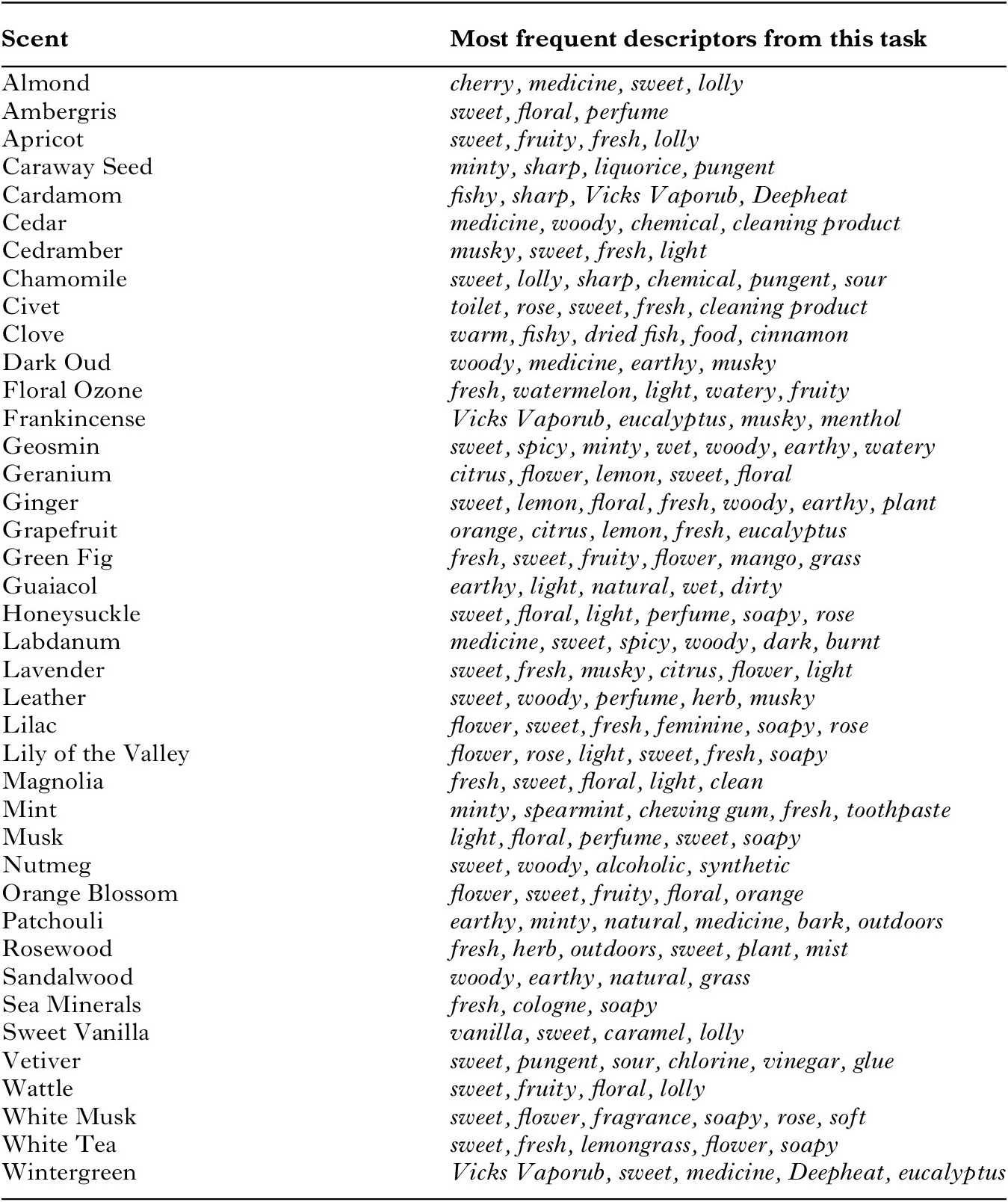
A set of 40 scents were chosen in consultation with an experienced perfumer (Emma J. Leah, Master Perfumer of Fleurage Signature Scent Design), from whom the odorants were sourced (see Table 1 for full list). This selection sample included a wide range of scents. At the same time, some scents were comparable enough for participants to recognise strong similarities.
List of scents in sample with their most frequent descriptors (taken from description task)

The scents covered a number of potentially key dimensions discussed in prior research (see Agapakis & Tolaas, Reference Agapakis and Tolaas2012; Crisinel & Spence, Reference Crisinel and Spence2012; Dubois & Rouby, Reference Dubois, Rouby, Rouby, Schaal, Dubois, Gervais and Holley2002; Holley, Reference Holley, Rouby, Schaal, Dubois, Gervais and Holley2002; Zarzo, Reference Zarzo2008, Reference Zarzo2012; Zarzo & Stanton, Reference Zarzo and Stanton2009, as examples). For example, some scents were selected for being particularly pleasant or unpleasant. Some of the more pleasant scents included Honeysuckle, Ambergris, Green Fig, etc., while some of the more unpleasant scents included Chamomile, Labdanum, or Guaiacol (note that these scents are unpleasant in their current dilutions and may vary from expectations based on knowledge, e.g., Chamomile here is quite different from that of the tea). Because familiarity and salience play a large role in odour judgements, scents like Sweet Vanilla, Mint, and Lavender were selected as well. To contrast these scents, a range of potentially less common scents was also included, such as Floral Ozone or Guaiacol. Additionally, the chosen scents originate from a range of domains. For example, there are several florals, spices, perfume-restricted, plants, food, etc. used.
The odorants were presented in an amber glass bottles to stop participants making any judgements influenced by the odorants’ colour, which ranged from clear to yellow to dark brown. Some odorants had a thicker, oily appearance too, which could not be distinguished through these bottles. The bottles were labelled with characters represented in the Japanese katakana script. This was done for two reasons. The first was to avoid using a familiar, ordinal coding system such as Roman numerals or the Latin alphabet. While the script may have been familiar to some, any effect of the ordinal structure would have been reduced greatly. The second purpose of using a visible coded label, as opposed to numbering on the bottom of the bottle, etc., was to allow the participants to create their own arbitrary reference points. For example, the Sweet Vanilla scent was represented by the character ラ (ra). The participant may have then associated that character with the Sweet Vanilla and not have needed to re-smell the sample. Reducing the number of times that a participant must smell the scents is critical in avoiding olfactory fatigue (see Köster & de Wijk, Reference Köster, Wijk, Laing, Doty and Breipohl1991). Participants were told explicitly that these characters were purely for referential purposes and did not have any significance as to what the scent was, nor any of its qualities.
2.1.4. Procedure
Participants were given each scent in a randomised order one-by-one and prompted, “How does it smell?” as opposed to “What does it smell like?” so as to not elicit purely Source-based responses. A few participants asked how much they had to say, to which they were told however much they felt was appropriate.
In order to avoid fatigue, participants were told initially that they were able to take as many breaks, and for however long was required, and were further encouraged to do so when participants showed signs of fatigue (i.e., extensive pauses, etc.). Participants also had the option of smelling a jar of coffee beans, as is commonly used in the perfume industry as a ‘palette cleanser’.
2.1.5. Coding
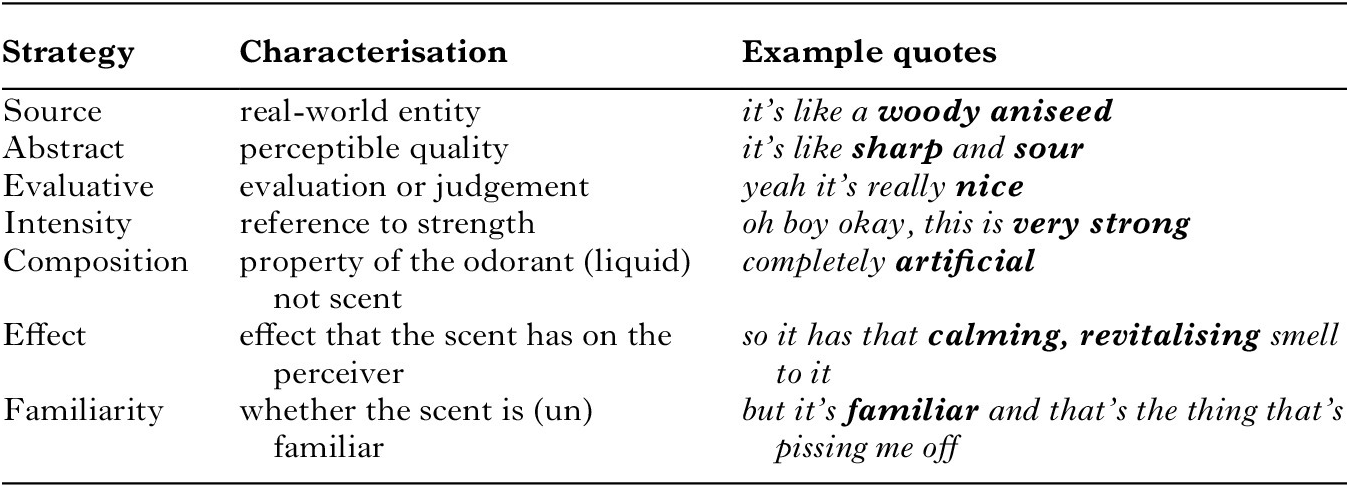
Participants’ responses to each scent were transcribed and coded into seven categories (see Table 2): Source, Abstract, Evaluative (also subcategorised into positive and negative evaluations), Intensity, Familiarity, Effect, and Composition. This coding system is a revised version of Majid, Burenhult et al.’s system (2018),Footnote 1 and covered all of the descriptions given by these participants.
Examples of descriptions from the odour description task, and how they were coded

Both main semantic content and modifiers were coded to get a full understanding of the description strategies being employed. For example, Participant 2 described Wattle as “very strong, very strong sweet florally odour”, which produced two Intensity descriptions (strong), one Abstract description (sweet), and one Source-based description (florally). Repeated words and phrases (excluding false starts) were coded twice as it showed that these descriptions were more accessible to the participant. In many cases, this was used for emphasis, and by coding these twice, the results can speak to which types of strategies are used more.
This coding system was tested for inter-rater reliability. An independent researcher coded 37.6% (by word count) of the data, which resulted in a Brennan–Prediger coefficient  $ {\hat{K}}_q $ (Brennan & Prediger, Reference Brennan and Prediger1981) of 0.74,Footnote 2 which suggests a ‘substantial’ extent of agreement (Landis & Koch, Reference Landis and Koch1977). This coefficient is a chance-corrected method calculated using
 $ {\hat{K}}_q $ = (
 $ {p}_a $-(1/q))/(1-(1/q)), where
 $ {p}_a $ is the percent agreement of total codes agreed upon against the total number of coded items, and where q is the total number of nominal categories.
Each of the descriptions were also used in the calculations for the other measures of codability. First, for length of description, the length was based on the total number of coded items for each stimulus. Second, the number of participants who used a particular descriptor was also used to calculate Simpson’s Index (Simpson, Reference Simpson1949), the same index used in Majid and Burenhult (Reference Majid and Burenhult2014), to measure between-speaker agreement. This index is calculated using D = ∑n(n-1)/N(N-1) with n being the total number of participants who responded with a descriptor and N being the total number of descriptors given by participants. An index of 1 indicates all participants gave the same descriptor; an index of 0 indicates that each participant provided a unique response.
The raw data for these results can be found on the Open Science Framework repository at <https://osf.io/dgwm5/> (Poulton, Reference Poulton2020a).
2.2. RESULTS
(A) How do English speakers describe scents?
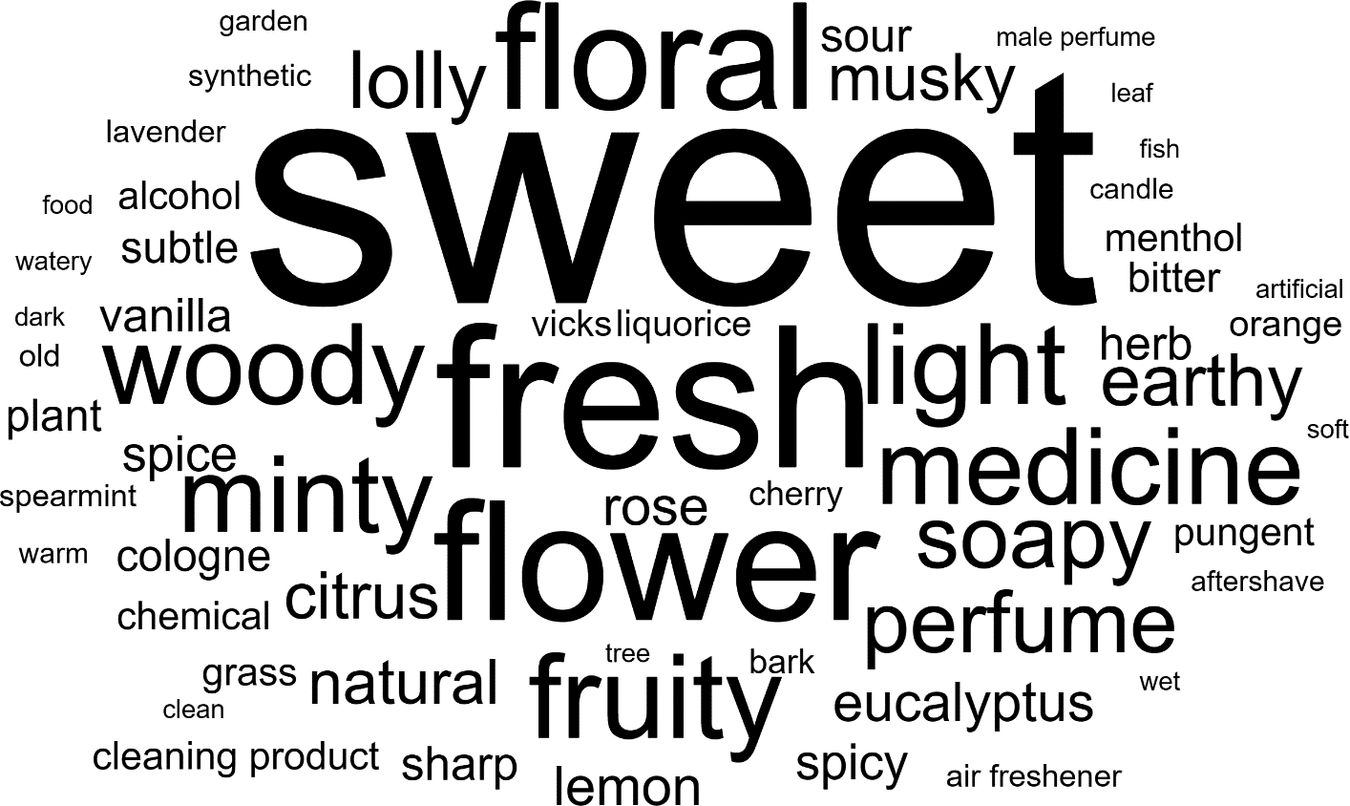
The description task results are designed to give insight into the strategies that English speakers use in their descriptions. Moreover, by eventually separating the strategies per scent, we can also see the variation in which scents are more likely to attract particular strategies, and whether similar scents (as decided in the odour sorting task) also attract the same strategies. In total, there were 3895 coded descriptions, and between Source, Abstract, Effect, and Composition, there were 601 unique descriptors, with the 60 most frequent being shown in Figure 1. On average, each response included 27.9 words, ranging from a minimum of 1 word to a maximum of 202 words.
The 60 most frequent descriptors of Source, Abstract, Effect, and Composition.

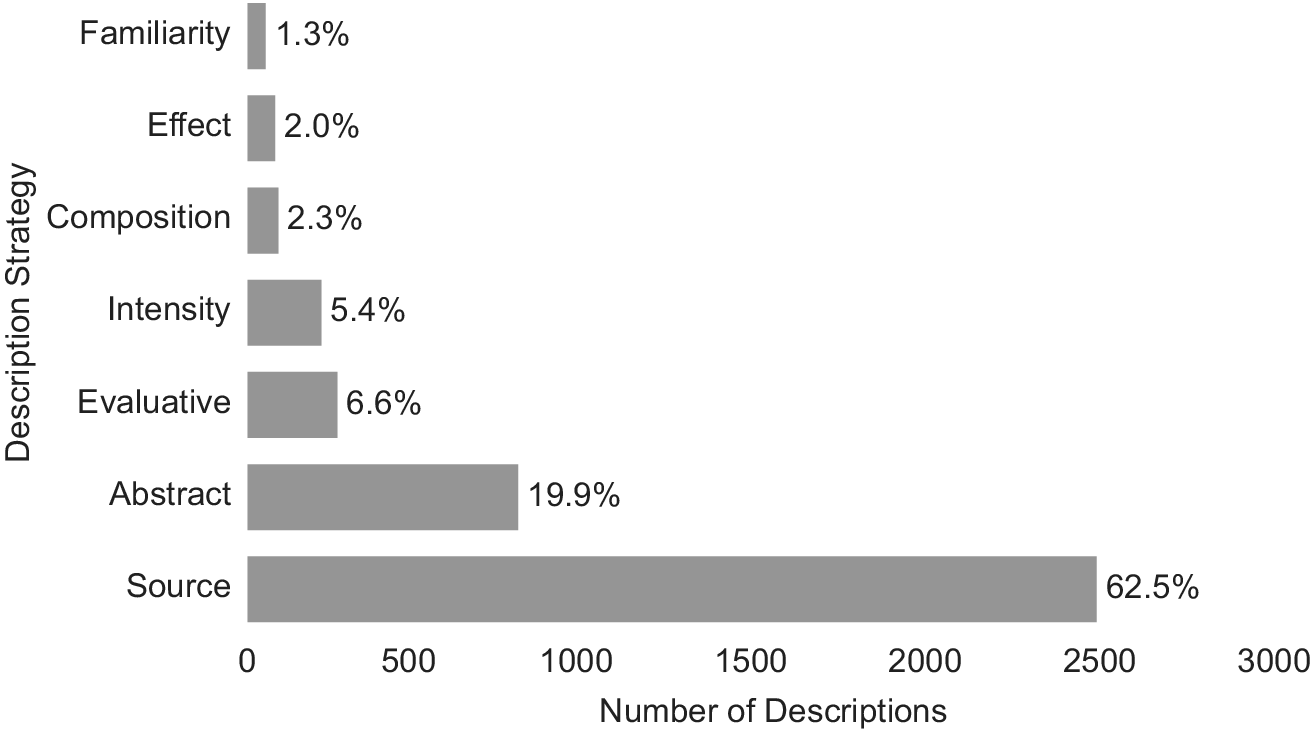
As shown in Figure 2, 2433 (62.5%) descriptions were Source-based, 775 (19.9%) were Abstract, 257 (6.6%) were Evaluative and giving either a positive or negative evaluation, 211 (5.4%) were Intensity, 88 (2.3%) were regarding what the composition of the odorant was, 79 (2.0%) were for the perceived physical or emotional effect, and finally 52 (1.3%) referenced whether the scent was familiar or not.
Types of strategies used to describe the scents.

When breaking down the Evaluative category into both positive and negative evaluations, we see that negative descriptions (e.g., I don’t like this smell, not very pleasant, or that’s offensive) were slightly more common (139, 3.6%), compared to positive ones (118, 3.0%). Additionally, the top six scents to receive the most negative descriptions were Clove and Cardamom on 19 (13.7% of all negative descriptions), Nutmeg on 14 (10.1%), and Caraway Seed, Chamomile, and Vetiver all on 10 (7.2%). The highest number of positive descriptions, on the other hand, was Wattle on 9 (7.6% of all positive descriptions), which suggests that negative descriptions were given more regularly to fewer scents than positive descriptions.
These proportions are very much in line with previous studies. An English-speaker preference for Source-based descriptions was established in Majid and Burenhult (Reference Majid and Burenhult2014), and Dutch participants in Majid, Burenhult et al.’s study (2018, p. 5) showed 64.7% of descriptions being Source. However, this in an of itself cannot answer how these descriptions may vary over the conceptualised space for smells, so for that we turn to the second task.
3. Odour sorting task
3.1. METHODS
To answer (B), on how the olfactory conceptual space for non-professional English speakers is structured, this study used an adaptation of the Successive Pile Sorting Task (Boster, Reference Boster1994, for the original design; Malt et al., Reference Malt, Ameel, Imai, Gennari, Saji and Majid2014, for an adapted design). In the original description for the task, Boster gives the example of sorting piles of cards with pictures of various birds on them. Participants were asked to categorise the birds into groups of their choosing, however many groups they deemed appropriate. They were then asked how they would divide their groups (n being number of original groups) into consecutively more groups (n + 1 groups, then n + 2 groups, and so on) until each bird was in its own group. Participants then reverted to their original groups (n) and were asked how they would combine them into consecutively fewer groups (n – 1 groups, and so on) until all birds were in one group. Outcomes were analysed by looking at how many times throughout the task any two given birds appeared in the same group. The more often they were in the same group, the higher they scored in similarity, and, as a result, a lower score represented higher dissimilarity.
Prior to the development of this task, a generally accepted methodology was to do time-consuming triad tests, where participants are given every combination of three stimuli and are asked to choose which two are the most similar. However, this process results in a large number of combinations. For the current task with 40 stimuli, it would mean that participants would have to judge 9880 combinations. The Malt et al. (Reference Malt, Ameel, Imai, Gennari, Saji and Majid2014) task provides a smaller still adaptation of the Successive Pile Sorting Task. Their methodology was used to categorise human locomotion such as walking, running, jumping, etc., based on videos on a computer. Participants were asked to click-and-drag the videos into groups. If they created more than five groups, they were then asked to group them further into fewer groups. If participants created five or fewer, they were asked to break the groups up further. In order to avoid olfactory fatigue, and reduce time, the current task was modelled more closely to the Malt et al. version as seen below.
The results of the sorting task were used to produce a similarity matrix which was then analysed via Multi-Dimensional Scaling (MDS) to investigate the structure of olfactory conceptual space in Australian English. This statistical technique reduces a large set of similarity ratings to a smaller set of dimensions, which helps to characterise the conceptualisations.
3.1.1. Participants
Under the same exclusion criteria for the odour description task, the sorting task had 42 participants, in total. Three participants were excluded from this task due to identifying as non-native English speakers in the metadata survey. After the exclusions, there were 39 participants left for that task, whose results remained in the study. These participants consisted of 17 men and 22 women, aged between 18 and 57. Six participants reported that they were smokers and four participants reported that they had some experience in either selling or creating fragrances through either perfumery or essential oils. Seven participants participated in both tasks. The odour description task was conducted approximately six months after the sorting task.
3.1.2. Site
This task was conducted under the same conditions as the description task; refer to previous site section for details.
3.1.3. Stimuli
This task was conducted using the same 40 scents as used in the odour description task (see Table 1 for list). This enabled direct comparison of results to answer (C); showing how and when certain description strategies are more likely gives us a starting point for identifying why those particular scents and those particular areas in the conceptual space lend themselves to particular description strategies.
3.1.4. Procedure
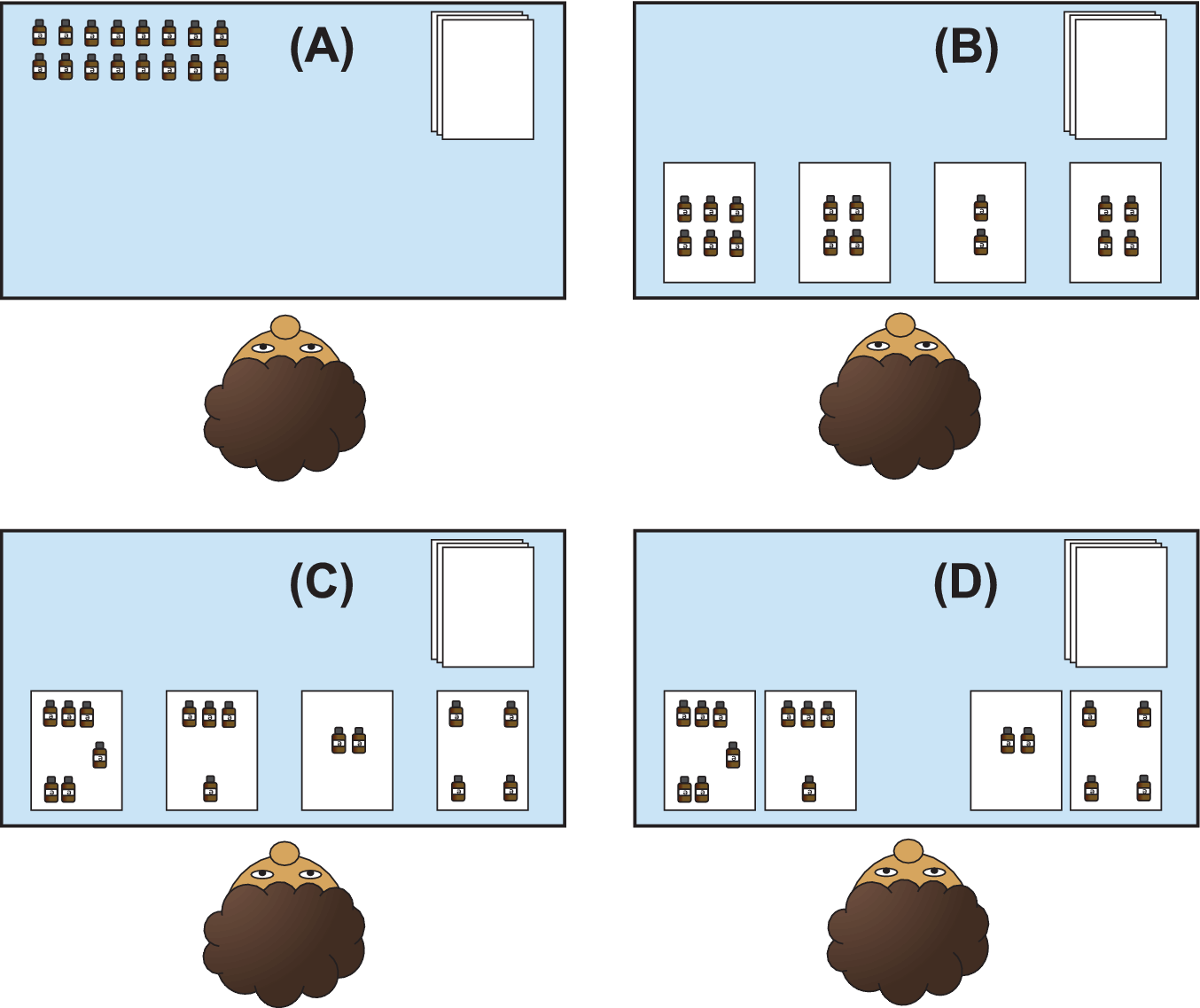
Participants were presented with the scents listed in Table 1 and displayed in randomised positions (see Figure 3 (A) for layout of task, and demonstration of each Stage). In Stage 1, the participants were given a stack of blank A4 sheets of paper, and they were told to smell each of the scents and place them on a sheet of paper that represented a category of scent. If they wished to add a category, they could take another piece of paper and start adding to it. They could add as many categories as they felt was appropriate, and each category could have as many or as few scents as required. They were also told that each category did not need to be balanced, and that if they felt it necessary, they could have varied numbers of scents per category. They repeated this until all scents were categorised. They were also told that at any point they could change their minds on which category a scent belonged in, and that they could smell each scent as many times as needed. However, constant or repeated smelling was discouraged to avoid fatigue.
Layout of the odour sorting task: (A) shows how the set-up is at the beginning of the task; (B) shows the first categories from Stage 1; (C) shows the separation into categories as in Stage 2; and (D) shows the the final layout with groupings into Stage 3 categories.

The purpose of Stage 2 of the task was to create subgroups within each category, when participants’ memories of the symbols and the scents were most recent in their minds. Participants were asked to go through each sheet of paper, making as many subgroups as they felt were required, if any. Once they settled on these categories, they were divided spatially on the paper and marked with a pen to separate them. Participants could keep a category from Stage 1 undivided, should they see those scents as very similar. However, it was required for there to be some level of division in at least one of them.
Next was Stage 3, which was to create the larger categories. They were asked to carefully move sheets containing the Stage 1 categories around into larger groups, or if a category was not judged similar to any of the others, it could be left alone. As with the odour description task, participants were encouraged to use coffee beans between stimuli and have as many breaks as they felt necessary.
One participant in this study created only two categories in Stage 1. When moving onto the Stage 3, the only option was to pool all 40 scents into a single category, which offered no information on similarity. For this reason, this participant’s results were excluded from the study, as the initial groupings suggested that the discrimination was not one based on similarity. In total, 38 participants contributed to the MDS solution.
3.1.5. Coding
The results from this task allow for the quantification of similarity judgements. Each possible scent pair was given a score that reflects its degree of similarity. If the two scents appeared in the same larger category from Stage 3, they were awarded +1 point of similarity. If the two scents were found in the same Stage 1 category (i.e., on the same sheet of paper), they were awarded +1 point. If two scents were within the same Stage 2 category (i.e., drawn in the same drawn circle), they were awarded +1 point. This scoring system meant that any two scents could have anywhere between 0 and 3 points of similarity between them (0 points represent two scents that did not appear in the same category at any level). These were then put into a 40 x 40 matrix showing the points scored for each pair of scents, for each participant.
As participants varied in the number of categories they created, the scoring system meant that they would have a higher number of similarity points between scents as more appeared in fewer groups. Therefore, the similarity scores from each participant were weighted by converting each participant’s matrix into percentages. Those who were less discriminatory in their grouping (higher cumulative scores in the matrix due to fewer but larger groupings) had each point of similarity count for less compared to those who were more discriminatory (lower total similarity scores) where their scores counted for more. By weighting the data based on total number of similarity points given for each participant, no single participant contributed more to the final aggregated similarity matrix than any other. This similarity matrix was then used as a proximity matrix to formulate the MDS solution, which shows scents with the highest similarity score being proximal and the lowest scoring pairs of scents being distant.
The raw data for these results can be found on the Open Science Framework repository at <https://osf.io/d59h8/> (Poulton, Reference Poulton2020b).
3.2. RESULTS
(B) How is the olfactory conceptual space for non-professional English speakers structured?
Taking the aggregated similarity matrix as input for the MDS solution, the results were found to be displayed adequately in a two-dimensional space. The scree plot in Figure 4 shows the ‘elbow’ at the second dimension indicating the best fit. By using a two-dimensional plot, there is an ‘excellent’ absolute stress value of 0.01 (see Kruskal, Reference Kruskal1964). In this type of study, 2- and 3-dimensional solutions are common (see Kaeppler & Mueller, Reference Kaeppler and Mueller2013, p. 201; for example, Chrea et al., Reference Chrea, Valentin, Sulmont-Rossé, Ly Mai, Hoang Nguyen and Abdi2004).
Scree plot showing the reduction of Normalised Raw Stress for each added dimension.

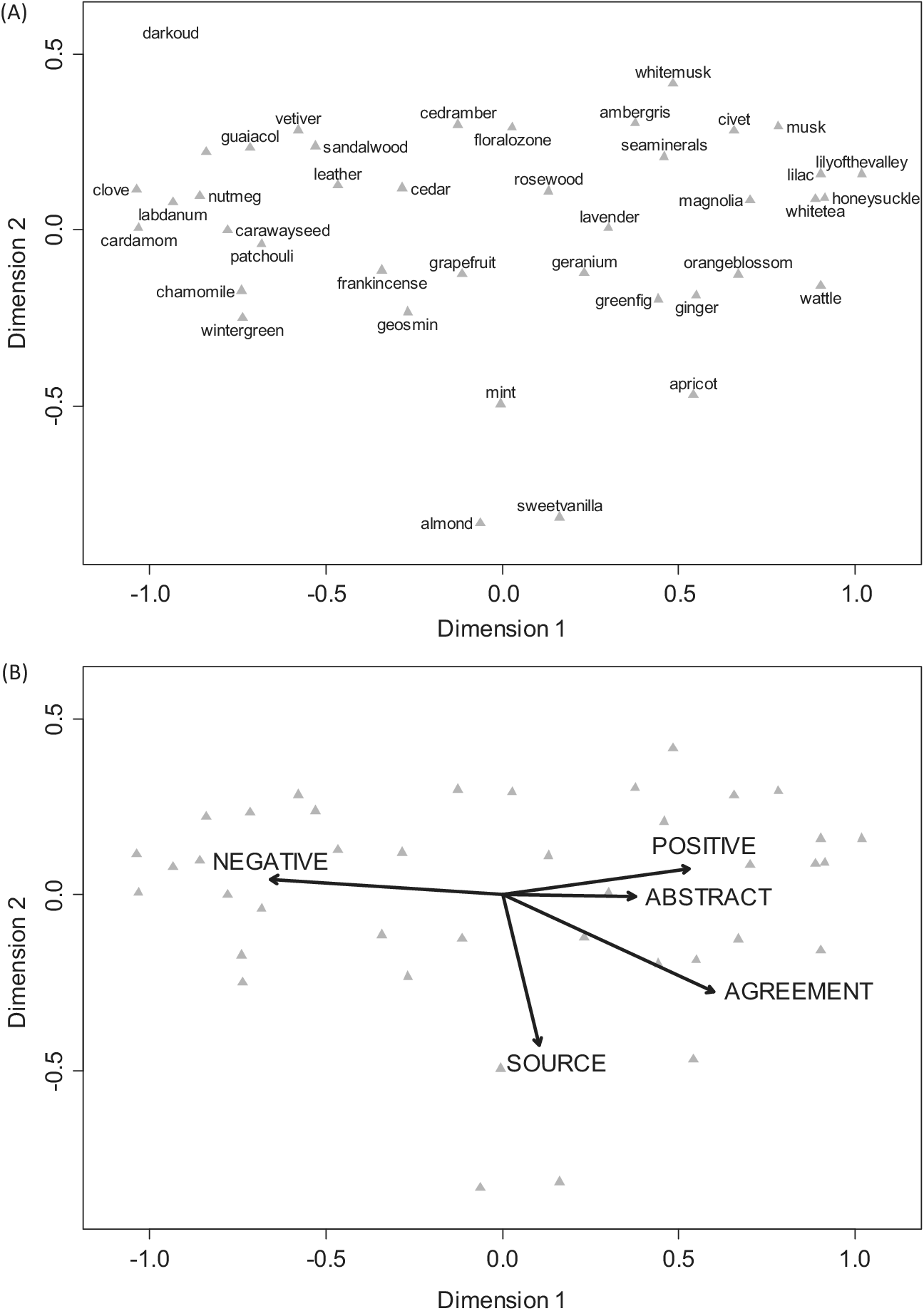
The solution in Figure 5 (A), then, is a good representation of the similarities that underlie the groupings produced by participants. Similarity is plotted as proximity between scents; for example, we can infer that White Tea and Honeysuckle are very similar scents because they are the closest to each other. On the other hand, Lily of the Valley and Clove are very dissimilar, as shown by the relative distance between them.
(A) MDS solution with stimulus labels; and (B) MDS solution with added description strategies and speaker agreement (see Table 3).

For interpreting the solution, moving left to right across Dimension 1, we can see that many of the spices are close together, like Clove, Cardamom, and Nutmeg. Moving further right, there are scents from woods, with the more traditionally woody scents higher along Dimension 2, and with scents like Wintergreen and Frankincense being different in that they share a similar quality to menthol and eucalyptus, two shared descriptors used in the description task. Further towards the centre, there are many of the plant-based scents, with sweet foods like Sweet Vanilla and Mint quite low on Dimension 2, suggesting that they are the most consistently different from other scents. Furthest to the right, from top to bottom we have traditional perfume scents, florals, and finally fruits, again heading closer to the sweet scents.
Dimension 1 could be interpreted in a number of ways. Taken at face value, Dimension 1 appears to be something like spice-floral, with Clove and Cardamom at one end, and Lily of the Valley and Honeysuckle at the other. However, looking at the most frequent descriptors for the scents in Table 1, we see that Clove, Cardamom, and Nutmeg, which are the furthest left in the solution, are not commonly described as spices, with descriptors like warm, and fishy being more common. When applying the results from the description task (discussed further in the next section), the Evaluative responses reaffirm the hedonic valence hypothesis showing that the scents further left on Dimension 1 are frequently described negatively, and those further right are frequently described positively. This interpretation is much more in line with previous research on the predominance of hedonic valence in olfactory processing (Khan et al., Reference Khan, Luk, Flinker, Aggarwal, Lapid, Haddad and Sobel2007), suggesting that hedonic valence is a more likely interpretation than spice-floral.
For interpreting Dimension 2, the results could be seen to demonstrate (non-)edibility or (non-)sweetness, with Almond (akin to marzipan, children’s cherry-flavoured cough syrup, etc.), Sweet Vanilla, Mint, and Apricot, being both edible and sweet, although sweet was still a common descriptor for many of the traditional perfume scents. White Musk, as the furthest along Dimension 2, for example, had sweet as the most common descriptor (see Table 1), which rules out sweetness as the underlying dimension here. As for edibility, there are also scents like Geosmin, the smell of warm rain, and Wintergreen, an ingredient commonly found in Australia in pain relief creams, relatively low on Dimension 2; both uncommon flavours in food. Additionally, Floral Ozone, quite high on Dimension 2, was frequently described as watermelon or fruity, which is incongruent with edibility as a dimension.
Instead, it may be that the lower end of Dimension 2 demonstrates scents that are more salient to Australians (see Chrea et al., Reference Chrea, Valentin, Sulmont-Rossé, Ly Mai, Hoang Nguyen and Abdi2004). I use this term as distinct from ‘familiarity’, as, while there was data on familiarity-related responses, I do not think that the responses necessarily occurred with the most (un)familiar scents. For example, participants may find describing Mint as familiar redundant. Although scents at either end of Dimension 2 may still be familiar to participants, the scents high on Dimension 2, like White Musk and Dark Oud, are not particularly any more representative of their category (perfume and woody, respectively) than any other, in that they are not so conceptually distinguishable. In other words, scents such as mint and vanilla, are ubiquitous in Western society, being popular flavours used in many food and non-food products. Because of their prominence, they become more distinct as to what is and what is not within the conceptualisation of ‘mint’ or ‘vanilla’, etc., compared to the scents high on Dimension 2, like Civet or Ambergris; two scents that most people could not name, but could link to being generally common in cosmetic products.
Looking at the number of similarity points from the sorting task, Almond (514) and Sweet Vanilla (527) were the only two scents to have fewer than 700 total points between each of them and all other scents. The rest of the scents ranged between 703 (Mint) and 971 (Lavender), a notable gap. The fact these were seen as so distinctive, through less frequent grouping, is then shown as dissimilarity and relative isolation in the MDS solution from the rest of the other scents, which were more frequently grouped together.
4. The relationship between odour describing and odour sorting
(C) Do description strategies and codability vary?
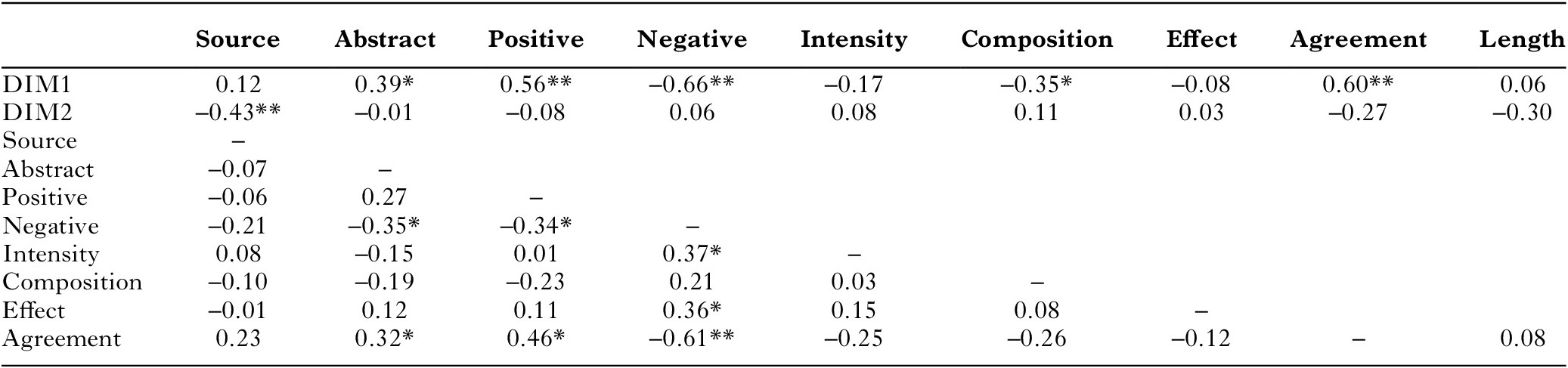
To answer (C), we need to integrate the results from both tasks, to show how the differences across the conceptual space represented in the MDS can be seen to correlate with differences in the number of times a description strategy was used and measures of codability from the odour description task. Table 3 shows the Spearman correlation matrix of the dimensions, and description strategies, as well as length and speaker agreement. Familiarty was not included due to too few responses.
Spearman correlation matrix of the MDS dimension coordinates; the number of descriptions for each strategy per scent

Notes. ** significant at 0.01; * significant at 0.05.
As discussed earlier, Dimension 1 is shown to be significantly correlated with negative and positive descriptions (separated from the larger Evaluative category due to their polarity), reinforcing the idea that Dimension 1 should be interpreted as the dimension of hedonic valence, with increased pleasantness being further along the dimension. Using the correlation matrix, we can plot the correlation coefficients onto the MDS solution produced by the sorting task to show which scents are more likely to attract particular description strategies, compared to the average, shown as the origin (0, 0). This is shown in Figure 5 (B), with description strategies and agreement added. The arrow lengths correspond to the explanatory power of the variables: the longer the arrow, the more the chosen strategy can be explained by the MDS solution. From this we can infer that the relative position of the scents explains more of the variance in the number of negative descriptions compared to the other strategies, as it has the longest arrow. This allows us to see how the underlying dimensions of the MDS solution may be influencing the variation in the differences of description strategy.
There is also a significant positive relationship between Dimension 1 and the number of Abstract descriptions, which means that the scents to the right of the MDS are more often described through Abstract terms, like sweet.
Dimension 2 shares no significant relationships with the descriptions strategies that are significant with Dimension 1. Dimension 2, though, has a significant negative correlation with Source-based descriptions, which further suggests that Dimension 2 is related to salience, as Source-based descriptions have the benefit of being more precise (Plümacher, Reference Plümacher, Plümacher and Holz2007 p. 66; Winter, Reference Winter2019, pp. 23–25).
In addition to the description strategies, agreement scores were calculated. The higher the index score, the more likely two descriptions were going to be the same. While all scents showed low agreement scores (ranging from 0.001 for Dark Oud, to 0.094 for Mint), this measure was correlated significantly with Dimension 1 and the number of Abstract descriptions, suggesting that positive valence and abstraction result in higher agreement. On the other hand, unpleasant scents with relatively lower agreement scores means that there was much more diversity in the responses.
Finally, regarding the length of description, there is no significant correlation between either of the dimensions, or speaker agreement. While this implies that any differences in length between the scents were relatively inconsequential, it highlights the fact that the measures of codability, being abstraction, concision, and agreement, need to be considered separately, although in this case, abstraction and agreement do show some relationship.
5. General discussion
5.1. HEDONIC VALENCE AND ABSTRACT DESCRIPTIONS
The results from the MDS solution show that the primary dimension of conceptualisation for smells is based on hedonic valence, with pleasant and unpleasant scents being depicted the furthest apart. This is not surprising given the importance of valence of smells shown in behavioural studies (Engen, Reference Engen1983; Stevenson, Reference Stevenson2010), conceptualisation (Khan et al., Reference Khan, Luk, Flinker, Aggarwal, Lapid, Haddad and Sobel2007; Rouby & Bensafi, Reference Rouby, Bensafi, Rouby, Schaal, Dubois, Gervais and Holley2002; Yeshurun & Sobel, Reference Yeshurun and Sobel2010), and description (see Dubois, Reference Dubois2000; Reference Lee2015 Lee, Reference Lee2014, p. 327;O’Meara & Majid, Reference O’Meara and Majid2016, p. 125; Sezille et al., Reference Sezille, Fournel, Rouby, Rinck and Bensafi2014; Winter, Reference Winter2016, Reference Winter2019).
However, we do not see the same predominance reflected in the number of Evaluative descriptions. In this task, only 6.6% of descriptions were Evaluative. While these pale in comparison to Source-based and Abstract descriptions, it is still a higher proportion of Evaluative descriptions than for other modalities (sight, hearing, touch, and taste) shown in a comparative task run by Majid, Roberts et al. (Reference Majid, Roberts, Cilissen, Emmorey, Nicodemus, O’Grady and Levinson2018, p. 11374). Even though it is by no means rare for a language to exhibit relatively low Evaluative responses for smells, there are speakers of languages such as Umpila, Dogul Dom, or Yélî Dnye who do have much higher proportions of Evaluative responses. The differences in proportions here could suggest cultural preoccupations with which properties of a smell are more important to describe and, given the cultural taboo around smells for English speakers, it might account for the lower proportions found here.
Taboo culture could contribute to why we do not see as many Abstract descriptions for unpleasant smells. For Australians, and most Western societies, unpleasant smells are seen as something to be avoided. As many of these smells also relate to many other taboo areas, such as sex, death, disease, bodily functions, etc., we also avoid talking about them (Allan & Burridge, Reference Allan and Burridge2006). The pleasant scents are perhaps, then, relatively more likely to be discussed, and more so in terms of their abstract qualities. Often, the functions of smells for the layperson will be in the act of scenting something, be it their homes, or their bodies, with pleasant smells. Here though, it is expected that people have different preferences, and will engage with particular qualities that they prefer, such as sweet smells, or fresh ones. In these contexts, the source of the smell is not as important as the function of the scent. How well it functions is dependent on its qualities, which could be why they more likely to attract Abstract descriptions.
The high proportion of abstract descriptors for positive smells also fits the general principle that positive concepts are over-represented in the lexicons of languages (Warriner & Kuperman, Reference Warriner and Kuperman2015). Thus, smell language in English is one specific instance of the general characteristic that positive conceptual domains are more lexically differentiated.
5.2. SALIENCE AND SOURCE-BASED DESCRIPTIOS
The secondary dimension of conceptualisation is salience, with more salient scents being more distinguishable from others (Chrea et al., Reference Chrea, Valentin, Sulmont-Rossé, Hoang Nguyen and Abdi2005; Dubois, Reference Dubois2000). In this study, the more salient scents are Almond (similar to a common flavouring used in a popular children’s medicine), Sweet Vanilla, and Mint, all of which are very common or known in Australian culture. These scents appearing relatively isolated from the other scents was likely due to participants using them as discriminatory criteria for the other scents, and as none of the others fell into the category of ‘vanilla’, etc. they were grouped separately more frequently during the sorting task.
The salience of smells is an important property to consider in olfactory research, as they are likely culturally dependent through speakers living in different olfactory environments. By constantly updating our olfactory knowledge through experience and context, we can assume that the function of the construed source of these particular smells is important to English speakers. When engaging with smells that are limited to specific contexts that have uses in our lives, whether it be food or medicine in these cases, we are not only more readily able to identify the source, relatively speaking, but are also more motivated to do so. On the other hand, smells on the other end of Dimension 2, indicating lower salience, do not have the strong associations with specific products and their functions, as reflected in fewer Source-based descriptions.
We can also see the effects of experience and salience of the construed source in different cultures with speakers of the same language. For example, Chrea et al. (Reference Chrea, Valentin, Sulmont-Rossé, Ly Mai, Hoang Nguyen and Abdi2004, p. 673) discuss salience of Wintergreen in French, American, and Vietnamese cultures, with the Americans categorising Wintergreen as ‘sweet’ due to its use in confectionery in the United States. However, the results from the description task here suggest that, to Australian English speakers, the conceptualisation of Wintergreen is as a medicinal product, aligning closer with the French and Vietnamese groups who categorised it as ‘medicine’ and ‘traditional medicine/floral’, respectively. The differences between these cultures, and comparing the Americans to the Australian participants of this study, show how odour categorisation can be based on function and context from learned experience, which may detract from conceptualising based purely on the odour qualities.
5.3. MEASURES OF CODABILITY
The first measure of codability (see Majid & Burenhult, Reference Majid and Burenhult2014, p. 267) is abstraction, which as mentioned in Section 5.1, varies along the hedonic dimension, but overall is still quite poor for English speakers. The second is the length of the description, which again, is much longer on average for odour descriptions than for colour descriptions (Majid & Burenhult, Reference Majid and Burenhult2014). Unlike abstraction, though, length of description did not vary significantly across the MDS solution. Given the other measures of codability, we could have easily expected to see variation on the length of descriptions, especially considering the role of taboo. The neutrality of description length across this space could suggest that concision is driven by factors other than hedonic valence or salience, if anything.
Finally, the third measure of codability is speaker agreement, which was correlated significantly with both pleasant and salient scents. As for the relation with pleasantness, the contributing factors that allow for higher degrees of abstraction are likely also influencing agreement. The qualities that are preferential to Australians will then be in turn more common and will result in higher “communicative need” for these qualities over others, to achieve mutual understanding (Winter, Reference Winter2019, pp. 43–46). This mirrors findings in other modalities, such as more colour terms in cultures with colour technology (Levinson, Reference Levinson2000), revealing our cultural preoccupations for particular perceptible qualities (Levinson & Majid, Reference Levinson and Majid2014, p. 419–421).
Again, the hypothesis that the function of pleasant smells in Western society is simply to smell good, and in doing so mask unpleasant smells, resonates with the emphasis of other studies on the functionality of smells. Chrea, Ferdenzi, Valentin, and Abdi (Reference Chrea, Ferdenzi, Valentin and Abdi2007, p. 11) argue that codability of smells, in this case agreement specifically, is not driven by the ability to identify the smell by its label, but by the associated functions, so that speaker agreement is actually a measurement of “consensus of the function” among speakers.
For languages with dedicated odour lexicons, we also see many examples of the functional aspects of the concepts being commonly lexicalised, including food and hunting (Majid & Burenhult, Reference Majid and Burenhult2014; Majid & Krupse, 2018), medicine and spiritual practices (Burenhult & Majid, Reference Burenhult and Majid2011; O’Meara & Majid, Reference O’Meara and Majid2016; Shepard, Reference Shepard1999; Wnuk & Majid, Reference Wnuk and Majid2014), social markers (Beer, Reference Beer2014), environment (Lee, Reference Lee2014), and more (see Barkat-Defradas & Motte-Florac, Reference Barkat-Defradas and Motte-Florac2016, for further examples). These domains are all easily related to three functions of human olfaction from a behavioural science perspective, these being “ingestive behavior, environmental hazard avoidance, and social communication” (Stevenson, Reference Stevenson2010, p. 14).
6. Conclusion
As part of the recent wave of research interest into olfactory language, there has been a surge of cross-linguistic and cross-cultural investigations into how speakers of different languages vary in the strategies they employ to describe olfactory experiences. This paper is an investigation into the variation within a single language, i.e., Australian English, on when and why speakers may prefer one strategy to another. Three main questions were put forward to encapsulate this research approach: (A) How do English speakers describe scents? (B) How is the olfactory conceptual space for English speakers structured? and (C) Do description strategies and codability vary over this space?
For (A), this study has shown that, overall, participants described scents predominantly with Source-based descriptions (62.5%), followed by Abstract descriptions (19.9%). These proportions are very much in line with what has been found for English speakers in other, similar studies. Next, for (B), this study used a similarity-based sorting task to show that the conceptual space of smells for English speakers is primarily on hedonic valence, and secondarily on cultural salience, which highlights research from not only linguistics but psychology and behavioural studies that hedonic valence is an integral part of odour processing, as is experience and learning.
Finally, and most importantly, for (C), this paper looked at how description strategies and codability vary, depending on hedonic valence and cultural salience. The more pleasant a smell is seen as, the more likely is it to attract Abstract descriptions and have higher speaker agreement, and the more culturally salient the smell is, the more likely it will attract Source-based descriptions, to aid in precision.
These forms of variation speak to the functionality of smells in a given culture. In this study, smells that are used aesthetically can be discussed, and more consistently discussed, in terms of their qualities, while smells of salient products used in society are more readily identifiable and named by their construed source. While these factors may surface differently culture to culture, the importance of functionality is also present in languages with dedicated odour lexicons, suggesting that this may not be exclusive to Western societies. Therefore, it would be fruitful to explore this variation in a more targeted and explicit way to fully encapsulate the intricacies and nuances of odour description. Thus, we will be taking a step further into understanding just how our conceptualisations and our cultural preoccupations affect the way in which we verbalise our sensory experiences.