Introduction
The cercaria, a free-living larva ensuring the infection of the second intermediate or the definitive host, is an important transmission stage in the complex life cycle of digenetic trematodes (Trematoda, Digenea). In comparison with miracidia, which are microscopic larvae infecting the first intermediate hosts (generally molluscs, or polychaetes in Aporocotylidae), cercariae have a greater dispersion potential and a more complex behaviour, and infect a broad range of hosts, invertebrate as well as vertebrate (reviewed in Combes, Reference Combes2001; Galaktionov & Dobrovolskij, Reference Galaktionov and Dobrovolskij2003; Poulin, Reference Poulin2007). Free-living larvae, both miracidia and cercariae, are sensitive to environmental factors such as temperature, light, salinity, water pH, etc. (for review, see Galaktionov & Dobrovolskij, Reference Galaktionov and Dobrovolskij2003; Poulin, Reference Poulin2006; Morley & Lewis, Reference Morley and Lewis2013). Transmission becomes possible only when optimal conditions for the life activity of the larvae are combined within a certain temporal frame, the transmission window. The size of this window may vary significantly in different ecosystems and different geographical regions. In tropical seas, where there are no considerable seasonal fluctuations of the environmental parameters, the transmission may be effected all year round (Cannon, Reference Cannon1979; Aeby, Reference Aeby2007), though even there some seasonal fluctuations are possible (May-Tec et al., Reference May-Tec, Herrera-Castillo, Vidal-Martínez and Aguirre-Macedo2020). In contrast, in ecosystems with a pronounced seasonality the transmission window is more narrow and, in addition, the infection intensity of downstream hosts within the window is uneven (e.g. Galaktionov et al., Reference Galaktionov, Irwin, Prokofiev, Saville, Nikolaev, Levakin and Hurd2006; Fermer et al., Reference Fermer, Culloty, Kelly and O'Riordan2010; Studer & Poulin, Reference Studer and Poulin2012; Galaktionov, Reference Galaktionov2017).
The intensity of the cercarial flow of a particular digenean species in a particular biotope has been assessed in various ways, but three main approaches may be distinguished. The first approach implies prediction based on field data on the estimated presence of infective larvae in different seasons in the biotope under study. This approach may rely on indirect estimation – that is, the presence of parthenitae (sporocysts or redia) groups capable of cercarial production in the first intermediate hosts in a given season (e.g. Galaktionov et al., Reference Galaktionov, Irwin, Prokofiev, Saville, Nikolaev, Levakin and Hurd2006; Fermer et al., Reference Fermer, Culloty, Kelly and O'Riordan2010; May-Tec et al., Reference May-Tec, Herrera-Castillo, Vidal-Martínez and Aguirre-Macedo2020), or on seasonal changes in the numbers of the component population of metacercariae in the second intermediate hosts (e.g. Fermer et al., Reference Fermer, Culloty, Kelly and O'Riordan2010; Studer & Poulin, Reference Studer and Poulin2012; May-Tec et al., Reference May-Tec, Herrera-Castillo, Vidal-Martínez and Aguirre-Macedo2020), or on direct counts of dispersal stages in a water body (e.g. Brassard et al., Reference Brassard, Curtis and Rau1982; Johnson et al., Reference Johnson, Bolick, Alexander, Huffman, Oborny and Monroe2012). The latter method requires a great deal of effort and is feasible only in relatively small freshwater bodies such as streams, rivulets and ponds. The second approach is based on extrapolation of the data on cercarial emergence and infectivity obtained in the laboratory to the natural biotope (e.g. Karvonen et al., Reference Karvonen, Paukku, Valtonen and Hudson2003; Galaktionov et al., Reference Galaktionov, Irwin, Prokofiev, Saville, Nikolaev, Levakin and Hurd2006; Thieltges & Rick, Reference Thieltges and Rick2006).
Finally, the third approach employs a direct assessment of the intensity of host infection during a certain time interval in field experiments. In this case, uninfected downstream hosts are placed into the zone of the possible contact with dispersive digenean larvae (miracidia or cercariae) and after a certain time interval the larvae that have infected the host are counted (e.g. Pitchford & Visser, Reference Pitchford and Visser1965; Brassard et al., Reference Brassard, Curtis and Rau1982; Karvonen et al., Reference Karvonen, Seppälä and Valtonen2004; Thieltges & Rick, Reference Thieltges and Rick2006; Thieltges, Reference Thieltges2008; de Montaudouin et al., Reference de Montaudouin, Blanchet, Desclaux-Marchand, Lavesque and Bachelet2016a). In our opinion, field experiments of this kind allow the best assessment of the duration of the transmission window and the most reliable determination of the intensity of the process of infection of downstream hosts within the window. In addition, the results of field experiments make it possible to verify the laboratory data on the dependence of the emergence and infectivity of miracidia and cercariae on abiotic factors. This was the approach we used in the present work.
The aim of our study was to determine the boundaries of the transmission window and the period of the most intensive infection of the second intermediate hosts by the cercariae in the subarctic White Sea. Similar research has been previously done only in temperate seas (Thieltges & Rick, Reference Thieltges and Rick2006; de Montaudouin et al., Reference de Montaudouin, Blanchet, Desclaux-Marchand, Lavesque and Bachelet2016a). At the White Sea, the boundaries of the transmission window and the intensity of the infection flow within it have been estimated for cercariae of two digenean species using the first of the approaches outlined above (Nikolaev et al., Reference Nikolaev, Levakin and Galaktionov2020). The results of the present study verify and complement those data. Our study objects were the same digenean species as in Nikolaev et al. (Reference Nikolaev, Levakin and Galaktionov2020) ‒ Himasthla elongata (Mehlis, 1831) Dietz, 1909 (Himasthlidae) and Cercaria parvicaudata Stunkard & Shaw, Reference Stunkard and Shaw1931 (Renicolidae). These species differ significantly in morphology and biology of all lifecycle stages, but use the same animal species as hosts (Stunkard & Shaw, Reference Stunkard and Shaw1931; Werding, Reference Werding1969; Galaktionov et al., Reference Galaktionov, Solovyeva and Miroliubov2021). The molluscs Littorina littorea act as the first intermediate host. The parthenitae developing in them produce cercariae, which leave the molluscan host and, for their further development, must infect the second intermediate host, the mussels (Mytilus edulis). Sea gulls play the role of definitive hosts.
Material and methods
Study site
The field experiment was conducted at the littoral site of Krasnyi Cape in the Kandalaksha Bay of the White Sea (66°24′61″N, 33°42′17″E) in 2020. This area of the White Sea is characterized by strong seasonal fluctuations of water temperature and salinity. Throughout the year the average temperature of the surface waters fluctuates from −1.5 to 20°С, and the average salinity, from 26.2 to 14.5 ppt. In winter (November to May) the coastal water areas are covered with ice 1–1.5 m thick (Berger et al., Reference Berger, Dahle, Galaktionov, Kosobokova, Naumov, Rat'kova, Savinov and Savinova2001). The site is a lagoon with an area of 2200 m², limited on the seaward side by a boulder bar submerged at high tide. The tides are semidiurnal, with the maximal amplitude of 2.0–2.1 m. The minimum water level in the lagoon at low tide is ~20 cm. The sediment is mostly represented by stones and gravel with relatively large sandy patches. Fucoids, mostly Fucus vesiculosus and Ascophyllum nodosum, are distributed patchily. Periwinkles were represented by L. littorea and L. fabalis. It has been shown in an earlier study (Nikolaev et al., Reference Nikolaev, Prokofiev, Levakin and Galaktionov2017) that snails L. littorea in the lagoon are infected with parthenitae of H. elongata and C. parvicaudata, while L. fabalis are free from infection. The density of L. littorea in the lagoon does not show any considerable fluctuations, either seasonal or long-term (at least, during the time of our observations, since 2012 until the present), remaining at a level of 30‒35 individuals/m2 (authors’ unpublished observations). Seasonal changes in the water temperature were calculated based on the data of the surface water temperature, measured every ten days at the D1 station in direct vicinity of the experimental site (for details, see Usov et al., Reference Usov, Kutcheva, Primakov and Martynova2013).
Experimental design
To determine the boundaries of the seasonal transmission window and the character of mussel infection with metacercariae of H. elongata and C. parvicaudata within it, cages with uninfected molluscs were placed in the lagoon near Krasnyi Cape. The cages, 160 × 160 × 80 mm in size, were made of plastic mesh fabric with a mesh diameter of 4 mm. This is much larger than the size of H. elongata and C. parvicaudata cercariae, which means that these larvae could enter the cages freely with water currents. In total, four groups of cages were placed, three cages in a group, in the following periods: (1) early summer (1 June–11 July); (2) late summer (11 July–21 August); (3) early autumn (21 August–29 September); and (4) late autumn (29 September–9 November). Each group of cages was exposed for 40 days. Mussels were taken from artificial substrates of a sea farm. The sea farms in the White Sea are situated at a distance of at least 50 m from the nearest shore, and mussels cultivated there are uninfected with renicolid and himasthlid larvae (Nikolaev et al., Reference Nikolaev, Levakin and Galaktionov2020). For the experiment, we chose mussels with the shell size of 15–20 mm. This size-age class of mussels is the most successfully infected with the cercariae of the digeneans under study (Levakin et al., Reference Levakin, Losev, Nikolaev and Galaktionov2013). Thirty mussel individuals were placed into each cage. The cages were placed at a depth of about 20 cm (in the period of low tide water) at a distance of 5 m from each other. After the end of the exposure, all mussels were dissected, and their soft tissues were squeezed between two microscope slides. They were then viewed under a stereomicroscope and the number of H. elongata and C. parvicaudata metacercariae in each mussel was counted.
Statistics
In this study, the prevalence (P) of parasites is defined as the percentage of infected molluscs within the total sample. Mean abundance (MA) of H. elongata or C. parvicaudata metacercariae in mussels was calculated in accordance with recommendations of Bush et al. (Reference Bush, Lafferty, Lotz and Shostak1997) as the total number of metacercariae of each parasite species in a sample divided by the total number of the mussels examined (both infected and uninfected). Statistical treatment of the data followed standard recommendations (Sokal & Rohlf, Reference Sokal and Rohlf1995). Confidence intervals of prevalence were calculated according to the exact Fisher's formula. All the confidence intervals were calculated with the 95% significance level. The significance of differences in MA was assessed with the use of one-way analysis of variance (ANOVA). Data were log-transformed prior to the analysis resulting in homogenous variances and normality (Underwood, Reference Underwood1997). Post-hoc calculations were done with Tukey's Tukey's honestly significant difference (HSD) test for unequal N. Standard errors are given for MA values. All calculations were made with the use of Statistica 7.0 (Statsoft, https://statistica.software.informer.com/7.0/) software package.
Results and discussion
Mussel mortality was insignificant throughout the experiments, making up, on average, 0.3–0.5 individuals per cage. The prevalence of metacercariae of H. elongata and C. parvicaudata in the mussels kept in the cages at the littoral site in early summer, late summer and early autumn reached 100% (table 1). In late autumn the prevalence of metacercariae of both digenean species in the mussels was an order of magnitude lower (table 1).
Prevalence (%) of metacercariae of Himasthla elongata and Cercaria parvicaudata in molluscs Mytilus edulis during the field experiment (values of the confidence intervals are given in brackets).

The absence of the differences in the prevalence of metacercariae of H. elongata and C. parvicaudata in mussels during all summer periods and in early autumn seems to be due to a high prevalence of the parthenitae of these digeneans in the first intermediate hosts in the area where the experiment was performed. It has been shown (Nikolaev et al., Reference Nikolaev, Prokofiev, Levakin and Galaktionov2017) that the prevalence of parthenitae of H. elongata in L. littorea in this area makes up 30.3 ± 4%, while that of parthenitae of C. parvicaudata makes up 0.5 ± 0.4%, and that these values do not fluctuate considerably from year to year. This is due to the fact that these snails have a long life span, reaching 20 years at the White Sea, and accumulate the infection for several years (Galaktionov et al., Reference Galaktionov, Podvyaznaya, Nikolaev and Levakin2015). Elimination of some infected individuals seems to be compensated by the development of the young infection. At the same time, since the formation of the parthenitae group takes a long time (several months), they reach the stage when they actively shed cercariae only in the summer of the next year (i.e. the year after the year when they became infected) (Galaktionov et al., Reference Galaktionov, Podvyaznaya, Nikolaev and Levakin2015; Nikolaev et al., Reference Nikolaev, Prokofiev, Levakin and Galaktionov2017, Reference Nikolaev, Levakin and Galaktionov2020).
The values of the infection of L. littorea with parthenitae of H. elongata and C. parvicaudata recorded in the lagoon are much higher that the prevalence of these parasites in L. littorea at the nearby intertidal areas, where they are 5–7% for H. elongata and 0.05–0.1% for C. parvicaudata (authors’ pers. obs.). The prevalence of metacercariae in mussels there fluctuates in the range of 30–80% (Nikolaev et al., Reference Nikolaev, Levakin and Galaktionov2020).
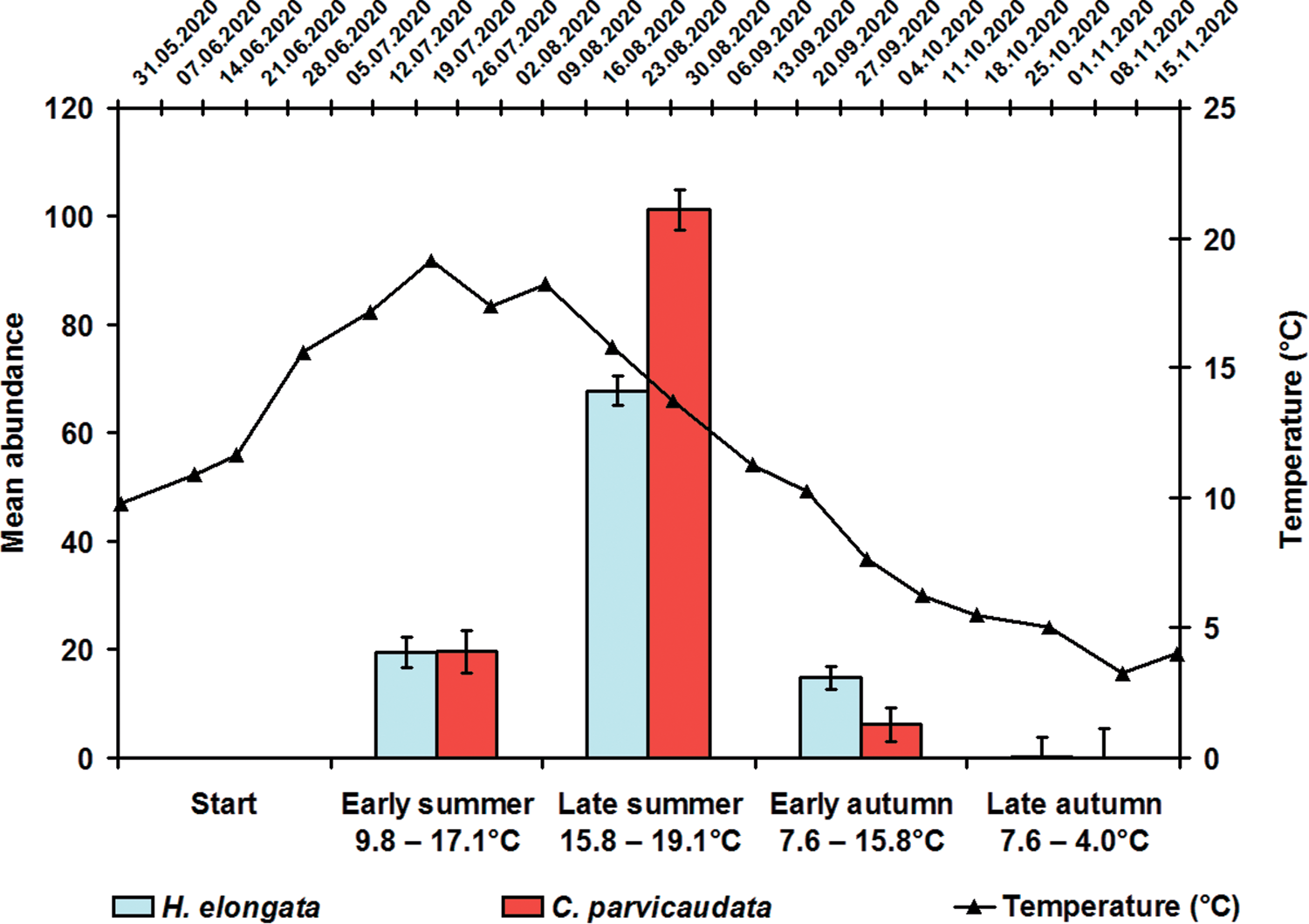
We observed pronounced changes in the MA of metacercariae of both digenean species in experimental mussels (ANOVA; H. elongata: F = 222.37, df = 3, P < 0.001; C. parvicaudata: F = 251.88, df = 3, P < 0.001). In early summer, MA of metacercariae of both H. elongata and C. parvicaudata demonstrated a similar modest increase (fig. 1). In late summer, a considerable growth of МА of metacercariae of both digenean species was observed, being more pronounced for the larvae of C. parvicaudata (Tukey HSD test; H. elongata: P = 0.000008; C. parvicaudata: P = 0.000008) (fig. 1). During the next period, in early autumn, МА decreased dramatically for the metacercariae of both digenean species (Tukey HSD test; H. elongata: P = 0.000008; C. parvicaudata: P = 0.000008) (fig. 1), dropping to almost zero in late autumn (Tukey HSD test; H. elongata: P = 0.000008; C. parvicaudata: P = 0.000008) (fig. 1).
Mean abundance (±standard error) of metacercariae of Himasthla elongata and Cercaria parvicaudata in mussels Mytilus edulis during the transmission window (based on the results of the field experiment). Time periods and ranges of seawater temperature (°С) during these periods are given under the x-axis.

High values of МА of H. elongata and C. parvicaudata metacercariae in mussels in cages are due to the same reason as their almost 100% prevalence (table 1): a high (by the standards of the White Sea) prevalence of parthenitae of these trematodes in L. littorea in the lagoon.
The revealed high heterogeneity in the intensity of the mussel infection with cercariae of H. elongata and C. parvicaudata during the warm season agrees well both with the earlier data on the seasonal dynamics of groups of parthenitae of H. elongata and C. parvicaudata in the first intermediate hosts, molluscs Littorina spp. (Nikolaev et al., Reference Nikolaev, Levakin and Galaktionov2020), and with the character of temperature dependence of cercarial emergence from the molluscan host (e.g. Mouritsen, Reference Mouritsen2002; Poulin, Reference Poulin2006; Thieltges & Rick, Reference Thieltges and Rick2006; Koprivnikar & Poulin, Reference Koprivnikar and Poulin2009; Morley & Lewis, Reference Morley and Lewis2013; Prokofiev et al., Reference Prokofiev, Galaktionov and Levakin2016, Reference Prokofiev, Levakin, Nikolaev and Galaktionov2017, Reference Prokofiev, Galaktionov, Levakin and Nikolaev2020; de Montaudouin et al., Reference de Montaudouin, Blanchet, Desclaux-Marchand, Lavesque and Bachelet2016a, Reference de Montaudouin, Blanchet, Desclaux-Marchand, Bazairi, Alfeddy and Bacheletb). The most intensive accumulation of metacercariae of H. elongata and C. parvicaudata in the mussels took place in late summer (11 June–21 August) (fig. 1) – that is, at the time when the water temperature in the White Sea is within the optimal range for the emergence of cercariae of H. elongata and C. parvicaudata (15–20°C) (Galaktionov et al., Reference Galaktionov, Irwin, Prokofiev, Saville, Nikolaev, Levakin and Hurd2006; Prokofiev et al., Reference Prokofiev, Levakin, Nikolaev and Galaktionov2017). In addition, it is during this period that the proportion of mature parthenitae groups, capable of cercarial production, in infected periwinkles including L. littorea is the greatest (Galaktionov et al., Reference Galaktionov, Irwin, Prokofiev, Saville, Nikolaev, Levakin and Hurd2006; Nikolaev et al., Reference Nikolaev, Levakin and Galaktionov2020). However, by the end of August, when the water temperature drops to 10°С and below, cercarial emergence starts to decrease sharply and then stops altogether (Galaktionov et al., Reference Galaktionov, Irwin, Prokofiev, Saville, Nikolaev, Levakin and Hurd2006).
In addition to controlling the intensity of cercarial emergence, the temperature also affects the infectivity of cercariae, the duration of the period when they remain infective and their lifespan, as well as the susceptibility of mussels to infection (e.g. Pietrock & Marcogliese, Reference Pietrock and Marcogliese2003; Thieltges & Rick, Reference Thieltges and Rick2006; Studer et al., Reference Studer, Thieltges and Poulin2010; Morley & Lewis, Reference Morley and Lewis2013, Reference Morley and Lewis2014, Reference Morley and Lewis2015). When the temperature increases within the optimal range, cercarial activity and infectivity increase, but the time when they remain infective and the lifespan decrease (Thieltges & Rick, Reference Thieltges and Rick2006; Studer et al., Reference Studer, Thieltges and Poulin2010; Morley & Lewis, Reference Morley and Lewis2013, Reference Morley and Lewis2015). At low temperatures, cercariae become inactive and lose the ability to infect second intermediate hosts (Morley, Reference Morley2011; Morley & Lewis, Reference Morley and Lewis2013, Reference Morley and Lewis2015). Pumping activity of mussels is also temperature-dependent and increases with increasing temperature (Jørgensen, Reference Jørgensen1990). This affects their infection with cercariae, which get inside with water currents through the inhalant siphon (Nikolaev et al., Reference Nikolaev, Sukhotin and Galaktionov2006). All these factors undoubtedly affect the seasonal dynamics of the mussel infection with the larvae of the species under study. Therefore, our data should be regarded as a kind of an integral index, resulting from the influence of many temperature-dependent factors on the process of infection of the second intermediate hosts. Out of these factors, the seasonal dynamics of cercarial emergence appears to be the most convenient parameter, which is also relatively easy to determine. It can serve as a benchmark when determining the limits of the transmission window.
Relatively low infection indices of mussels in early summer (fig. 1), despite a relatively high water temperature, are due to the fact that parthenitae groups need some time to leave the state of winter developmental arrest and reach the peak of reproductive activity. It has been shown that in the tropics about four weeks are necessary for the production of Schistosoma mansoni cercariae from molluscs Biomphalaria glabrata to reach maximum values again after the dry season, when the molluscs are inactive, even though the temperature during this period is optimal for the development of the parthenitae and for mass cercarial emergence (Pitchford & Visser, Reference Pitchford and Visser1965; Pflüger, Reference Pflüger1976). Judging by the dynamics of mussel infection in our experiment, in the subarctic White Sea this process takes about a month and a half. This is associated with a slow warming of the water after the winter and, as a consequence, a prolonged period of maturation of the parthenitae groups. A similar picture has also been recorded in a study of the dynamics of infection of cockles Cerastoderma edule, exposed in cages at the intertidal zone of the temperate North Sea, with cercariae of H. elongata and Renicola roscovita (Thieltges & Rick, Reference Thieltges and Rick2006). Though the water temperature in late spring–early summer was close to optimal for cercarial emergence, the prevalence of metacercariae in the cockles during this period was low (Thieltges & Rick, Reference Thieltges and Rick2006).
The results of our field experiment indicate that under conditions of the subarctic Kandalaksha Bay of the White Sea, the seasonal transmission window of the cercariae of the two digenean species under study is limited by the period from the end of May to the middle of September. This observation confirms an earlier suggestion concerning the boundaries of the transmission window for cercariae of H. elongata and C. parvicaudata based on the comparison of the data on the seasonal dynamics of the prevalence of parthenitae and metacercariae in, respectively, periwinkles and mussels (Nikolaev et al., Reference Nikolaev, Levakin and Galaktionov2020). Water temperature is, undoubtedly, the key factor determining the intensity of larval transmission within the window (Prokofiev et al., Reference Prokofiev, Galaktionov and Levakin2016, Reference Prokofiev, Galaktionov, Levakin and Nikolaev2020). An additional corroboration of the crucial role of the temperature is the fact that under conditions of the temperate climate (Arcachon Bay, south-west of the Atlantic coast of France), where temperature fluctuations throughout the year are less pronounced than at the White Sea, the transmission of cercariae proceeds with a high intensity from the middle of May to the end of September, as shown in a field experiment on the infection of molluscs C. edule with cercariae of Himasthla quissetensis (de Montaudouin et al., Reference de Montaudouin, Blanchet, Desclaux-Marchand, Lavesque and Bachelet2016a). In contrast, at the White Sea, as shown in our experiments, the transmission is intensive for a very brief period in late summer – in fact, for a month – starting at some moment after 10 July and continuing until the middle of August. During this time period, the mussels accumulated 66.3 ± 6.2% metacercariae of H. elongata and 79.7 ± 5.3% metacercariae of C. parvicaudata out of the total number of the larvae accumulated during the experimental period. At the same time, the autumn–winter arrest of the cercarial transmission is abrupt both in our case and in studies by Thieltges & Rick (Reference Thieltges and Rick2006) and de Montaudouin et al. (Reference de Montaudouin, Blanchet, Desclaux-Marchand, Lavesque and Bachelet2016a, Reference de Montaudouin, Blanchet, Desclaux-Marchand, Bazairi, Alfeddy and Bacheletb). This is due to the decrease of the water temperature down to the threshold level, below which there is no mass emergence of the larvae (Galaktionov et al., Reference Galaktionov, Irwin, Prokofiev, Saville, Nikolaev, Levakin and Hurd2006). During the following winter period, which at the White Sea lasts more than half a year, cercarial emergence stops entirely because the parthenitae enter the state of developmental arrest (Galaktionov et al., Reference Galaktionov, Irwin, Prokofiev, Saville, Nikolaev, Levakin and Hurd2006; Galaktionov, Reference Galaktionov2017; Nikolaev et al., Reference Nikolaev, Levakin and Galaktionov2020).
The ongoing climate warming is predicted to intensify the transmission of digeneans, especially in high latitudes, where the climate changes are especially pronounced (e.g. Marcogliese, Reference Marcogliese2001; Galaktionov et al., Reference Galaktionov, Irwin, Prokofiev, Saville, Nikolaev, Levakin and Hurd2006; Poulin, Reference Poulin2006; Galaktionov, Reference Galaktionov2017). Our data suggest that the intensification of the transmission may be associated not so much with the broadening of the transmission window in general, but rather with the extension of the period with optimal water temperatures for cercarial emergence. It has been shown for temperate seas that if the water temperature increases, it may rise above the optimal range for cercarial emergence at the peak of the warm season and have a suppressive effect on this process (de Montaudouin et al., Reference de Montaudouin, Blanchet, Desclaux-Marchand, Bazairi, Alfeddy and Bachelet2016b). Considering that in high-latitude seas the water temperature is significantly lower and the temperature tolerance of cercariae is high (Morley & Lewis, Reference Morley and Lewis2013), a much longer period of climatic changes will be probably required there, as compared with temperate seas, before the temperatures for the emergence of cercariae from the molluscan hosts rise above the optimum. In the short term, however, an increase in the intensity of digenean transmission in the nearshore areas of high-latitude seas during the warming of the Arctic looks fairly probable.
Acknowledgements
We are grateful to the staff of the White Sea Biological Station of the Zoological Institute of the Russian Academy of Sciences for their help during the fieldwork. We are grateful to Natalia Lentsman for her help with the translation of the manuscript into English.
Financial support
This study was funded by the Russian Science Foundation. The field experiment settle and the material treatment were funded by the Russian Science Foundation (grant number 18-14-00170). The field work at the White Sea Biological Station was supported by a research programme of the Zoological Institute of the Russian Academy of Sciences (project numbers AAAA-A19-119020690109-2 and AAAA-A19-119022690122-5).
Conflicts of interest
None.
Ethical standards
The authors assert that all procedures contributing to this work comply with the ethical standards of the relevant national and institutional institutional guides on the care and use of laboratory animals.