Successful language processing requires the active interplay of accessing and processing linguistic structures, together with the support of more general cognitive abilities. Although investigating processing in typical language users (i.e., adult, healthy, highly skilled monolingual speakers) is undoubtedly useful, it may not offer the most revealing context to reveal the differential contributions of these factors. In contrast, atypical populations, such as speakers with aphasia, may represent an opportunity to begin to tease apart the factors that contribute to language comprehension and production. Persons with aphasia show a variety of language deficits that allow researchers to investigate in some detail specific grammatical structures that have become vulnerable. Therefore, investigating the ability to process particularly complex linguistic structures in people with aphasia can serve to identify how linguistic structures that differ in complexity are differentially impaired and help to examine how linguistic and cognitive processes interplay during language processing.
The present paper examines these issues by investigating language production in a group of Italian-speaking agrammatic speakers, utilizing a specific linguistic structure (clitic pronouns) as an illustration of a particularly complex and vulnerable syntactic structure. Syntactic priming was adopted as a key tool to investigate how supporting the access and processing to language structures might influence language performance. Experiment 1 analyzes the production of clitic pronouns in spontaneous and semispontaneous elicited speech, while Experiments 2 and 3 investigate the effects of syntactic priming on two specific types of clitics varying in complexity (i.e., direct-objects and indirect-objects clitics) in various sentential contexts. Finally, the results from these three experiments will help in adjuducating between linguistic theories that have been proposed to explain agrammatic aphasia and more general informing theories of language processing.
Agrammatic aphasia is an acquired language impairment resulting from damage to various brain areas primarily involved with language processing (e.g., Brodmann areas 44, 45, and 6) but also from lesions outside the typical language areas (i.e., along the whole perisylvian cortex; Vanier & Caplan, Reference Vanier, Caplan, Menn and Obler1990). Agrammatism primarily compromises grammatical language abilities in production (Goodglass, Reference Goodglass, Rosenberg and Koplin1968; Menn & Obler, Reference Menn and Obler1990; Miceli & Mazzucchi, Reference Miceli, Mazzucchi, Menn and Obler1990; Miceli, Silveri, Romani, & Caramazza, Reference Miceli, Silveri, Romani and Caramazza1989) and comprehension (Caramazza & Zurif, Reference Caramazza and Zurif1976; Grodzinsky, Reference Grodzinsky1995; Luzzatti et al., Reference Luzzatti, Toraldo, Guasti, Ghirardi, Lorenzi and Guarnaschelli2001; Shapiro, Reference Shapiro1990), leading to diminished speech rate, a deficit in the use of closed class words (free grammatical morphemes like determiners, prepositions, or pronouns are often omitted, while bound morphemes are rather substituted), and an impoverished use of syntax-dependent morphology (Goodglass, Reference Goodglass2001).
Various theories have accounted for agrammatic deficits.Footnote 1 Some accounts of agrammatic speech production assume that agrammatism results from an underlying deficit in syntactic representations or a deficit in accomplishing syntactic operations. For example, the absence or underspecification of a projection or a group of projections within the syntactic tree has been claimed to account for the observed difficulties in producing some types of morphosyntactic agreement. For example, the tree pruning hypothesis (TPH; Friedmann, Reference Friedmann2001; Friedmann & Grodzinsky, Reference Friedmann and Grodzinsky1997) states that the syntactic tree of agrammatic speakers is pruned between the tense and the agreement nodes, resulting in an impairment in the production of elements that are represented at (or above) the tense node and a preserved production of what is represented at (or below) the agreement node (see Friedmann, Reference Friedmann2001, for a schematic example of the syntactic pruned tree). In more recent developments, the TPH has been used to account for the variability observed among degree of severity in agrammatism and to explain the spontaneous recovery of agrammatic speakers who manage to produce higher projections as their recovery proceeds (Friedman, Reference Friedmann2005). Data supporting the TPH come from Hebrew agrammatic speakers who show intact verb agreement morphology but severely impaired verb tense agreement and impaired use of embedded sentences, which are functionally represented in the complementizer phrase, showing that agrammatic speakers exhibit major difficulties in producing correct tense agreement. Nevertheless, these studies also highlight that agrammatic speakers are partly able to correctly produce tense agreement and that the error rate can be modulated by computational load (Kok, van Doorn, & Kolk, Reference Kok, van Doorn and Kolk2007).
Another set of theories hypothesizes that the underlying deficit in agrammatism does not derive from a deficit in representation but rather from a deficit to syntactic operations. For example, the derived order problem hypothesis (DOP-H; Bastiaanse & Van Zonneveld, Reference Bastiaanse and Zonneveld2005) proposes that the problem underlying agrammatism is the inability to derive a word order that differs from the basic one (which is language specific). Whenever a word order has to be derived from one's language's basic word order, its production will be impaired. This account has been mainly based on verbal production data in Dutch and English (Bastiaanse, Koekkoek, & Van Zonneveld, Reference Bastiaanse, Koekkoek and Van Zonneveld2003), by demonstrating that verbs that have to be produced in matrix sentences (e.g., finite sentences in Dutch) are more difficult than verbs in other sentential constructions in which verbs are in their canonical position. This view has been validated in Turkish with object scrambling constructions (Yarbay Duman, Aygen, Özgirgin, & Bastiaanse, Reference Yarbay Duman, Aygen, Özgirgin and Bastiaanse2007) and in Greek with verb and pronouns production (Stavrakaki & Kouvava, Reference Stavrakaki and Kouvava2003). In addition, alternative theories of agrammatic language processing assume that agrammatism results from a general reduction in neurocognitive resources or processing capacities that are required to implement syntactic representations and operations in real time (Carpenter, Miyake, & Just, Reference Carpenter, Miyake, Just and Gernsbacher1994; Haarman, Just, & Carpenter, Reference Haarmann, Just and Carpenter1997; Kolk, Reference Kolk1995; Swinney, Zurif, Prather, & Love, Reference Swinney, Zurif, Prather and Love1996; Zurif, Swinney, Prather, Solomon, & Bushell, Reference Zurif, Swinney, Prather, Solomon and Bushell1993). In particular, a deficit in verbal working memory has been suggested as the cause for both agrammatic comprehension (Waters & Caplan, Reference Waters and Caplan1996) and production (Hartsuiker & Barkhuysen, Reference Hartsuiker and Barkhuisen2006). Verbal working memory has been suggested to support the linear production and processing of long (vs. short) sentences by retrieving and maintaining all lexical and grammatical elements active until the speech plan is executed. Alternatively, working memory has been claimed to play a prominent role in supporting the production of relatively short but yet syntactically complex constructions, as, for example, passive sentences or sentences with derived word orders.
Even though the above illustrated theories attempt to explain the underlying linguistic deficits in agrammatism, it is still unclear how well they can account for grammatical constructions that vary along different layers of complexity. In addition, the question remains open as to whether and to what extent the access and processing of those linguistic structures can be modulated online. To better examine this issue, we focus here on a specific structure (the clitic pronoun) that is particularly complex and that allows investigating at the same time of two aspects of grammar, that is, morphosyntactic complexity (in terms of morphosyntactic traits that are shared with the antecedent) and word order complexity (investigating constructions with a nonderived and a derived word order). It is important that syntactic priming will be used as the central methodology to assess whether the production of clitic pronouns in different sentential constructions can be modulated in agrammatic speakers. Syntactic priming or syntactic persistence in language production has been observed in a series of studies in healthy populations, showing that speakers tend to reuse the syntactic structure that they just heard or saw in a prime sentence (Bock, Reference Bock1986; Bock & Loebell, Reference Bock and Loebell1990; Bock, Loebell, & Morey, Reference Bock, Loebell and Morey1992; Branigan, Pickering, Liversedge, Stewart, & Urbach, Reference Braningan, Pickering, Liversedge, Steward and Urbach1995). For example, Hartsuiker, Kolk, and Huiskamp (Reference Hartsuiker, Kolk and Huiskamp1999) and Hartsuiker and Westenberg (Reference Hartsuiker and Westenberg2000) primed the oral and written production of different types of sentences in Dutch healthy individuals, showing that there is a significant effect of the prime sentence over the target produced construction. In a few studies, the use of syntactic priming has been extended to investigate aphasic speech production (Haarmann & Kolk, Reference Haarmann and Kolk1991, Reference Haarmann and Kolk1992; Hartsuiker & Kolk, Reference Hartsuiker and Kolk1998; Hartsuiker & Westenberg, Reference Hartsuiker and Westenberg2000; Saffran & Martin, Reference Saffran and Martin1997). Results show that agrammatic speakers who generally exhibit a deficit in producing a variety of syntactic structures significantly improve in their production once they are primed with the same grammatical structure. These past results have been widely interpreted as suggesting that the observed limitations in the production of complex syntactic structures may not be caused by underlying disruption in the syntactic representation of those very structures but that their access and retrieval might be limited owing to diminished computational resources that are necessary to access and process those structures in real time.
In this paper, we extend the use of syntactic priming in agrammatic speakers to test the production of a novel syntactic structure (i.e., Italian clitic pronouns), which, as mentioned above, permits us to simultaneously investigate the role of morphosyntactic complexity and word order complexity. In addition, using syntactic priming in combination with clitic pronouns will allow testing of a series of predictions that will finally permit us to adjudicate between the theories that have been proposed to explain agrammatism. In what follows, an introduction to the Italian clitic system, including a basic description of the linguistic background on clitics that will be necessary for the understanding of the experimental manipulations, will be provided. A prediction section, which will introduce the three experiments, will also be provided.
THE ITALIAN CLITIC SYSTEM
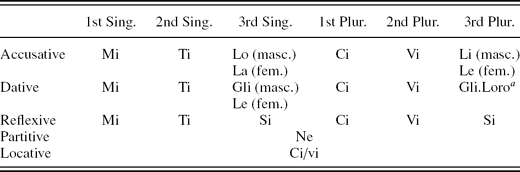
The Italian clitic system is composed by six types of clitics (Cardinaletti, Reference Cardinaletti and van Riemsdijk1999a; Cardinaletti, Reference Cardinaletti and van Riemsdijk1999b; Cardinaletti & Starke, Reference Cardinaletti, Starke, De Cat and Demuth2008; Kayne, Reference Kayne1975, Reference Kayne1991; Rizzi, Reference Rizzi1982): direct-object clitics (Maria lo lava; Maria washes it), indirect-object clitics (Maria gli da la mela; Maria gives him the apple), reflexive clitics (Maria si lava; Maria washes herself), partitive clitics (Maria ne mangia; Maria eats some), locative clitics (Maria ci va; Maria goes there), and impersonal “si” clitic (Si mangia; Let's eat). Widely accepted in the linguistic literature, one of the primary notions linked to clitics is clitic movement (Kayne, Reference Kayne1991; Rizzi, Reference Rizzi1982), intended as a syntactic rule that moves clitics from their base-generated position to their final position. Specifically for Italian, Belletti (Reference Belletti and Riemsdijk1999) proposes that clitics are generated in the determiner phrase and that they undergo syntactic movement higher in the syntactic tree to check their case features. Clitics first move from their base position to an agreement object projection and later cliticize with the verb to an even higher projection, the agreement subject phrase. It is important to mention here that syntactic movement (for a variety of structures) has been proposed to be among the primary causes underlying agrammatism. Clitics vary in their morphosyntactic complexity. For example, direct-object clitics are marked for number and gender, and indirect-object clitics are marked for person, number, and gender, where gender marking is explicit only for the third-person singular (i.e., “le do”: “I give her” versus “gli do”: “I give him). As proposed by Belletti (Reference Belletti and Riemsdijk1999), the morphosyntactic complexity between these two clitics is instantiated in the number of case features that have to be checked in syntax. While direct-object clitics have to check number and gender case features, indirect-object clitics must check an additional case feature, that is, person. As such, the underlying structure of indirect-object clitics is more complex. A table that illustrates the complete Italian clitic system is presented in Appendix A. Finally, one of the main characteristics of Italian clitics is that they appear in different sentential positions, varying according to the characteristic of the verb. For the purpose of this paper, we will focus on two structures of interest: finite and restructuring sentences. In finite sentences, Italian clitics are placed obligatorily before the finite verb, or before the finite auxiliary. Instead, in “restructuring sentences” (formed by an infinitival verb preceded by a modal or an aspectual verb), clitics can be optionally placed before the verbal complex (the climbed position) or after the verbal complex (the enclisis position), as shown in Examples (1) and (2).Footnote 2 It is central to mention here Rizzi's analysis (Reference Rizzi and Keyser1978, Reference Rizzi1982) of restructuring sentences and clitic placement. In Rizzi's proposal, restructuring is a syntactic rule that combines two distinct verbs, creating a single verbal complex. If restructuring applies, the two verbs are reanalyzed as one single verbal complex, allowing the clitic pronoun to appear in the climbed position. On the contrary, if restructuring does not apply, the two verbs do not unite in a verbal structure and the only clitic placement rule that can apply would allow only enclisis.
(1) Clitic position in finite sentences. In (1a) the clitic is placed before the finite lexical verb, and in (1b) it is before a finite auxiliary.
a. Daniele la beve
Daniele itDir. obj. sg. fem. clitic drinks
“Daniele drinks it”
b. Daniele lo ha assaggiato
Daniele itDir. obj. sg. masc. clitic has tasted
“Daniele tasted it”
(2) Clitic position in restructuring sentences. In (2a) the clitic is placed before the verbal complex, and in (2b) it is after the verbal complex.
a. Marco lo deve mangiare
Marco itDir. obj. sg. masc. clitic mustFin. modal verb eatInfin. lex verb
“Marco must eat it”
b. Marco deve mangiarlo
Marco must Fin. modal verb eat- Infin. lex verb itDir. obj. sg. masc. clitic
“Marco must eat it”
It is important to mention that in standard Italian both clitic positions in restructuring sentences are available. However, the optionality in clitic placement has been related to dialectal variations (Benincá, Reference Benincà, Holtus and Ringgerr1986). Northern Italian regions (Veneto and Piedmont region) show a preference for placing the clitic after the verbal complex (enclisis), whereas central regions (Tuscany and Latium) allow both clitic positions and southernmost regions (Calabria and in some parts of Apulia) prefer placing the clitic before the verbal complex (climbed position). More recently, Egerland (Reference Egerland, Cardinaletti and Munaro2009) proposed a more variationist approach to clitic position in restructuring sentences, suggesting that clitic placement in restructuring sentences can vary in speakers who are proficient in both standard Italian and a dialectal variant of Italian.
Clitic pronouns have been shown to be a particularly difficult grammatical structure to process, and this has been observed in studies that span across research fields and across languages. For example, clitic production has been investigated in first language acquisition (for Italian: Antelmi, Reference Antelmi1997; Guasti, Reference Guasti1994) and also in children with specific language impairment (Arosio et al., Reference Arosio, Branchini, Forgiarini, Roncaglione, Carravieri, Tenca and Yukio2010; Bortolini et al., Reference Bortolini, Arf≫, Caselli, Degasperi, Deevy and Leonard2006). First, results show that clitic pronouns are produced later in the linguistic development (i.e., around 22 months) with respect to other grammatical structures and that children show a preference to produce full nouns instead of the clitic counterpart or omit clitics till approximately the age of 27 months. Second, when clitics are produced in restructuring sentences, they are consistently produced after the verbal complex (Antelmi, Reference Antelmi1997). In the realm of aphasia, few studies have described or investigated clitic processing, mainly focusing on spontaneous speech (for Italian, Lonzi & Luzzatti, Reference Lonzi and Luzzatti1993; Miceli & Mazzucchi, Reference Miceli, Mazzucchi, Menn and Obler1990; and Miceli et al., Reference Miceli, Silveri, Romani and Caramazza1989; for Spanish, Reznik, Dubrovsky, & Maldonado, Reference Reznik, Dubrovsky and Maldonado1995; for Greek, Stavrakaki & Kouvava, Reference Stavrakaki and Kouvava2003). The observed pattern of impairment has been revealed to be similar across languages, showing that the most common error pattern is represented by clitic omissions and/or clitic substitution with its full noun counterpart. These studies are of great importance for describing the general pattern in the production of clitic pronouns both during acquisition and in aphasia, and for revealing an intriguing similarity in the pattern of performance between children acquiring the use of this grammatical structure and speakers with agrammatic aphasia who have partly lost the ability to process it. However, to date, no study has sufficiently exploited this grammatical structure as a powerful tool for investigating in a fine-grained way the nature of the deficit underlying aphasic language processing.
AIMS AND PREDICTIONS
In this paper, we investigate the production of clitic pronouns in a group of seven speakers with agrammatic aphasia and in an aged-matched control group using syntactic priming. The three experiments reported here were designed to investigate whether the production of particularly complex grammatical constructions can be modulated by syntactic priming, using clitic pronouns as an ad hoc grammatical construct to test these accounts. The aim of Experiment 1 was to collect a corpus of spontaneous speech that would contain a representative sample (in number and type) of clitic pronouns, in order to allow a detailed quantitative and qualitative analysis of clitic use in spontaneous speech and to allow a direct comparison between agrammatic and non-brain-damaged speakers. The data from Experiment 1 also provide a baseline against which performance can be compared in the subsequent experiments. Experiments 2 and 3 were specifically designed to determine whether the production of direct- and indirect-object clitics (which vary in their level of morphosyntactic complexity, as proposed by Belletti, Reference Belletti and Riemsdijk1999) in two different sentential constructions (finite and restructuring) can be modulated utilizing syntactic priming, because it has been suggested that syntactic priming might facilitate the accessing and processing of grammatical structures that vary in morphosyntactic complexity.
The primary question in both Experiments 2 and 3 was whether the production of clitic pronouns in speakers with agrammatic aphasia (as well as in the non-brain-damaged control group) would be influenced by syntactic priming. If syntactic priming actively supports the accessing and processing of complex grammatical structures, a positive effect of priming might be expected. In addition, if a positive effect of syntactic priming were to be observed, that could be taken as evidence that agrammatic speakers do not experience hard constraints in accessing the representations of clitic pronouns, but rather that syntactic priming facilitates the access of their representations. In other words, if the reduced level of clitic production observed in natural speech reflects a restriction to access to morphosyntactic information when processing clitics online, then agrammatic speakers might not be expected to be sensitive to the priming manipulation. Moreover, agrammatic speakers are sensitive to syntactic priming, and there is then a question as to whether the presence or degree of priming is modulated by the level of morphosyntactic complexity. There are at least two possible alternative predictions for differential effects of priming for direct- and indirect-object clitics. If greater priming is expected for structures that are generally more difficult to process, then indirect-object clitics should reveal overall greater priming effects than do direct-object clitics. However, if the difficulty of computing the structure impedes processing, then less priming might be predicted for the indirect than for the direct-object clitics. In addition, if considering morphosyntactic complexity in terms of movement (as predicted by the DOP-H; Bastiaanse & Van Zonneveld, Reference Bastiaanse and Zonneveld2005), modulation in production should be observed for clitics that will need to be produced in the enclisis or in the climbed position. Specifically, the production of clitics that require a longer movement, (i.e., in restructuring contexts with the clitic in the climbed position) will be more difficult with respect to the production of clitics that require a shorter movement (the enclisis position). It is therefore expected that if clitics are produced at all, there will be a preference for producing them in the enclisis when the choice is given (i.e., in restructuring sentences). In addition, for restructuring sentences, the production of clitic pronouns in the climbed position should be possible if restructuring, as postulated by Rizzi (Reference Rizzi1982), applies. If speakers with agrammatic aphasia face a difficulty in applying restructuring, then we should observe an overall preference in producing clitics in the enclisis position and a smaller priming effect for clitics primed in the climbed position.
EXPERIMENT 1: SPONTANEOUS SPEECH PRODUCTION
Participants
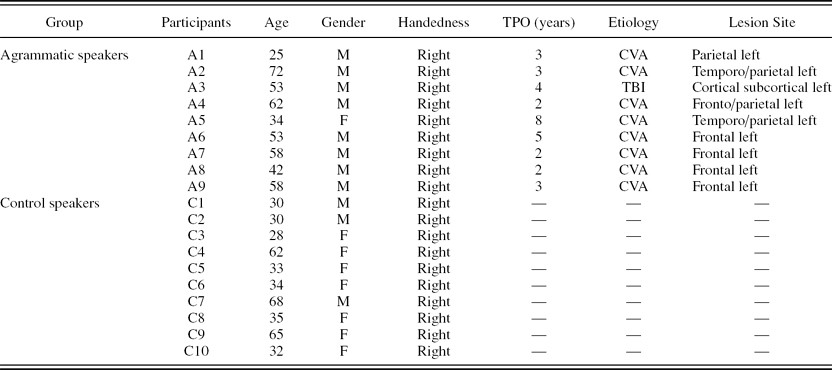
Nine Italian agrammatic speakers (8 males, 1 female, all right-handed) and 10 Italian non-brain-damaged speakers (3 males, 7 females, all right-handed) were recruited to participate in the three experiments.
Agrammatic speakers were recruited from two different Italian rehabilitation centers, all in the Veneto region. All of them followed formal schooling in standard Italian (all patients completed at least 5 years of obligatory schooling) and reported to fluently speak standard Italian prior to the stroke. Because of the availability of formal testing batteries in standard Italian only, no formal assessment of their language abilities in Veneto (the variant of Italian spoken in the Veneto region) was possible. However, all participants reported to understand the local variant of Italian but reported to be primarily fluent in standard Italian. Two agrammatic speakers (A8 and A9) were excluded from participation because they were dominant speakers of Veneto, even prior to the stroke. As a result, a total of 7 agrammatic speakers participated in the three experiments. The 10 non-brain-damaged speakers who were tested as a control group were recruited from the same speech community in order to match the linguistic characteristics of the agrammatic speakers. The age range of the two groups of participants was matched, and the mean age between the two groups did not differ, t (15) = −1.16, p = .26. Moreover, participants from both groups were matched for levels of education. All agrammatic speakers were aphasic owing to a single brain lesion in the left hemisphere as reported in the neurological reports and computed tomography scans, and were at least 1 year postonset (mean = 3.6 years). To assess the type and level of the linguistic impairment, the Italian version of the Aachen Aphasia Test (Luzzatti, Willmes, & De Bleser, Reference Luzzatti, Willmes and Bleser1994) was administered in addition to the available neuropsychological diagnoses. All agrammatic speakers were diagnosed as Broca's aphasics spanning from mild to severe, and they were all characterized by typical nonfluent speech. A requirement for participation was to have a level of severity that would allow speech production at least at the sentence level. Among the agrammatic speakers, Participant 2 showed a quite severe level of impairment. However, it was decided not to exclude him from the data set for important reasons. First, Participant 2 fulfills the requirement of being able to produce speech at the sentence level. Second, his performance might be representative of one tail of the continuum in the degree of agrammatic deficit. Third, despite the low level of clitic production he exhibits, the error pattern analysis might be crucial to determine which are the strategies to compensate the (even if severe) deficit and to determine whether the error pattern is qualitatively different from the one observed in the other agrammatic speakers. The participants’ data are summarized in Table 1.
Patient data

Note: TPO, Time post onset; CVA, cerebrovascular accident; TBI, traumatic brain injury.
Materials
Spontaneous and elicited speech was collected by means of three tasks: answering the questions in the Italian version of the Aachen Aphasia Test (Luzzatti et al., Reference Luzzatti, Willmes and Bleser1994) to elicit spontaneous speech, describing the “Cookie theft picture” (Boston Diagnostic Aphasia Examination Test; Goodglass & Kaplan, Reference Goodglass and Kaplan1972), and retelling the fairytale “Little Red Riding Hood” (illustrated by four drawings to facilitate story recall).
Procedure
Participants sat in a quiet room together with the experimenter, who led the entire session. Participants’ responses were recorded with a digital voice recorder (Marantz PMD 660).
Coding and data analysis
The quantitative and qualitative analysis of spontaneous speech in persons with aphasia requires considering a complex set of variables. Over the years, several methods have been proposed for how to best analyze spontaneous speech specifically in the field of aphasiology. One influential method has been described by Saffran, Berndt, and Schwartz (Reference Saffran, Berndt and Schwartz1989). More recently, Marini, Andreetta, del Tin, and Carlomangno (Reference Marini, Andreetta, Tin and Carlomagno2011) have described a multilevel approach for the analysis of narrative language in persons with aphasia that considers four main aspects of linguistic processing: productivity, lexical and grammatical processing, narrative organization, and informativeness. Specifically, they identify a set of parameters for sentence segmentation including acoustic, semantic, grammatical, and phonological criteria. According to the acoustic criterion, an utterance can be identified if surrounded by clear pauses. According to the semantic criterion, an utterance can be defined as a homogeneous piece of information (i.e., a predicate with its arguments). Finally, according to the grammatical criterion, a clause can be recognized when it forms a grammatical complete sentence. The method described by Marini et al. (Reference Marini, Andreetta, Tin and Carlomagno2011) provides a sensitive method to capture many aspects of language production in persons with aphasia. Rossi and Bastiaanse (Reference Rossi and Bastiaanse2008) followed a very similar multilevel approach as described in Marini et al. (Reference Marini, Andreetta, Tin and Carlomagno2011). In their method, four main criteria for sentence extraction were used: the syntactic criterion, the prosodic criterion, the analysis of pauses (planning criterion), and the semantic indicator. In Rossi and Bastiaanse (Reference Rossi and Bastiaanse2008), these criteria were followed in the given order, but the presence of one criterion did not automatically exclude the application of the others. In the present study, the multilevel approach used in Rossi and Bastiaanse (Reference Rossi and Bastiaanse2008) will be used.
All sessions were audiorecorded with a digital voice recorder in a quiet setting, and production was transcribed for analysis. Intonation contours were marked throughout. Intonational contours and pauses (longer than 2 s) were marked in the transcript. Next, the samples were segmented into sentences. Four main criteria for sentence extraction, as in Rossi and Bastiaanse (Reference Rossi and Bastiaanse2008), were followed. Specifically, a syntactic criterion was utilized to determine sentence boundaries. Utterances that contained a grammatical subject (overt or nonexpressed), a verb (lexical or copula), and complements (obligatory or optional) were classified as sentences. Given that agrammatic speech is characterized by non-well-formed sentences, in many cases the syntactic criterion was not sufficient to determine the boundaries of a sentence. Therefore, the prosodic criterion was also used. A clear falling pitch was considered to signal the end of a sentence, a rising intonation signaled a question, and a neutral pitch indicated the possible continuation of an utterance. Pauses were used the next third criterion. A clear pause (together with a falling pitch) was considered to mark the end of a sentence. Finally, a semantic criterion (if an utterance had a semantic meaning) was used. For an extended description of the methodology used, see Rossi and Bastiaanse (Reference Rossi and Bastiaanse2008). The application of these criteria resulted in 1,143 sentences: 391 for agrammatic speakers and 752 for non-brain-damaged speakers.
Clitics that were produced in each sentence were coded for frequency (1 or more), type of clitic (direct, indirect, reflexive, locative, or partitive), accuracy (correct or incorrect), and sentential position (before a finite verb in finite sentences and before a finite verb or after a nonfinite verb in restructuring sentences). For example, for the sentence “Il dottore lo mise sul mio petto” (The doctor placed it on my chest), the coding would be: “1 clitic,” direct-object clitic, correct clitic, and clitic produced in a finite sentence. Omissions were coded as “0,” and errors were classified as person, number gender, or other. All statistical analyses were performed on proportions, that is, the total number of clitics produced by each participant divided by the total number of utterances produced by a specific participant in which clitic production would have been possible (sentences with intransitive verbs were therefore excluded). Proportions permit to directly compare the data between the two groups of participants, thereby avoiding any biases in the results that may be created by the different number of utterances produced by each participant. Finally, individual and group results are reported to acknowledge the variability that might be observed among individuals (both for agrammatic speakers and for controls). All the analyses that have been performed using chi-square tests have been performed using raw data. Raw data will be presented in tables.
Results
Quantitative clitic production
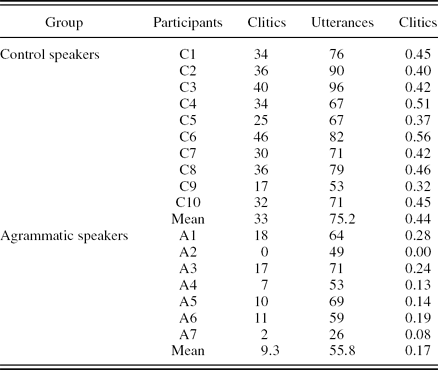
Overall, agrammatic speakers produced fewer clitics than did non-brain-damaged speakers,Footnote 3 Mann–Whitney U: non-brain-damaged speakers, median = 0.43, interquartile range (IQR) = 0.08; agrammatic speakers, median = 0.15, IQR = 0.16; Z = −3.42, r = .86, p < .001. Individual and group results are given in Table 2. To test whether this difference resulted from the variability in utterance length between groups, mean length of utterance in words was calculated. Results revealed that agrammatic speakers produced shorter sentences than did non-brain-damaged speakers (non-brain-damaged speakers: median = 10.32, IQR = 1.24; agrammatic speakers: median = 6.06, IQR = 0.40; Z = −3.41, r = .94, p < .001). Given this result, a separate analysis was conducted on utterances having the same length (mean length of utterance in words = 4, 5, 6, and 7) between the two groups of participants. The results still revealed a significant difference in clitic production (Z = −3.03, r = .75, p < .002). The qualitative error analysis revealed that agrammatic speakers omitted clitic pronouns in five obligatory contexts, but they produced no errors for gender, person, or number. Non-brain-damaged speakers did not produce any errors.
Number of clitics, number of utterances, and proportion of produced clitics per utterance
The results of the first analysis confirmed that the tested group of speakers with aphasia showed prototypical agrammatic production. Agrammatic speakers produced fewer and shorter sentences than did the control group, and critically, they showed a quantitative difference in the production of clitic pronouns. This descriptive result alone cannot determine whether the deficit in clitic production is the result of a representational or a cognitive deficit, but it confirms earlier observations that clitic pronouns are vulnerable in agrammatic speech, among other linguistic structures.
Qualitative clitic production
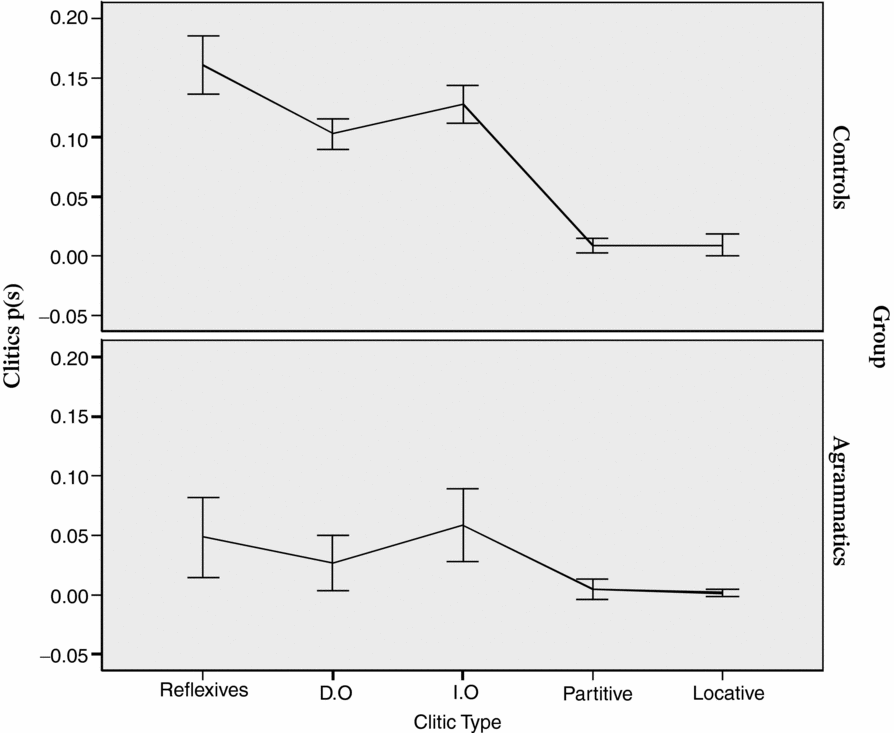
A second analysis was conducted to examine clitic production from a qualitative viewpoint. Statistical tests were performed for both groups under the null hypothesis of no difference (in number of produced clitic) among clitic types. For non-brain-damaged speakers a significant difference among clitic categories was found (χ2 = 34.93, df = 4, p < .001). Contrasts for these speakers showed that reflexive clitics were produced significantly more than direct- and indirect-object clitics (between which no difference was found), which in turn were produced more than were partitive and locative clitics. For the agrammatic speakers’ group, a main difference among clitic categories was found (χ2 = 14.16, df = 4, p = .007). Direct-object, indirect-object, and reflexive clitics were produced more frequently than were partitive and locative clitics, but there was no significant difference among direct-object, indirect-object, and reflexive clitics. The between-group analysis reveals that agrammatic speakers produced fewer reflexive clitics (non-brain-damaged speakers: median = 0.16, IQR = 0.07; agrammatic speakers: median = 0.06, IQR = 0.09; Z = −3.42, r = .86, p = .001), fewer direct-object clitics (non-brain-damaged speakers: median = 0.09, IQR = 0.03; agrammatic speakers: median = 0.01, IQR = 0.05; Z = −3.43, r = .81, p = .001), and fewer indirect-object clitics (non-brain-damaged speakers: median = 0.13, IQR = 0.05; agrammatic speakers: median = 0.007, IQR = 0.08; Z = −3.24, r = .72, p = .001) than did non-brain-damaged speakers. The difference was not significant for partitive and locative clitics. The results are shown in Figure 1.
The proportion of different types of produced clitics in both experimental groups.
These results highlight important aspects of agrammatic clitic production. Despite quantitative differences in clitic production, agrammatic speakers maintain the qualitative use of clitic pronouns, that is, the pattern of their clitic production is similar to the one observed for non-brain-damaged speakers. This result indicates that agrammatic speakers maintain a normal language framework and that the observed difference in clitic use between agrammatic and nonagrammatic speakers is quantitative rather than qualitative in nature. Moreover, these results provide partial support for cognitive-based theories of agrammatism that assume a reduction in resources but not a disruption in the ability to access linguistic information itself, given that the main result of this analysis shows that agrammatic speakers show still sensitivity to clitic structures, despite the general impairment.
Clitic position
A third analysis was performed to determine the sentential constructions in which clitics were produced and to examine the position of the clitic with respect to the verb. In obligatory clitic placement contexts, both groups always produced clitics in correct positions. No instances of illegal clitics placement, that is after a finite verb (e.g., L'uomo mangia lo/The man eats it) or before a nonfinite verb (e.g., Lo bere, mi piacerebbe/It to drink, I would like), were observed. Optional clitic contexts (restructuring sentences) in which clitics can be placed either in the climbed or the enclisis positions were rare in both groups of speakers. Non-brain-damaged speakers produced 12 optional sentential contexts that contained a clitic pronoun. These appeared 50% of the time in the enclisis position and in 50% in the proclisis position. Agrammatic speakers produced only 1 restructuring sentence in combination with a clitic, which was placed in the enclisis position.
Interim conclusions
These first results confirm previous observations on the production of clitic pronouns in spontaneous speech. Experiment 1 shows that agrammatic speakers are impaired in clitic production and that the deficit can be characterized in quantitative terms rather than qualitative ones. In addition, the description of the observed patterns of errors provides detailed evidence for which are the most effective compensatory strategies utilized by agrammatic speakers to achieve optimal speech production. Generally, these first findings demonstrate that despite the overall deficit, agrammatic speakers do produce clitic pronouns, suggesting that access to the grammatical representation of clitics is partly preserved. These results on agrammatic speakers are of importance for a more general view on language processing. As mentioned earlier, a similar pattern of performance has been observed for children during first language acquisition and also for children with specific language impairment (Arosio et al., Reference Arosio, Branchini, Forgiarini, Roncaglione, Carravieri, Tenca and Yukio2010; Bortolini et al., Reference Bortolini, Arf≫, Caselli, Degasperi, Deevy and Leonard2006), suggesting that those constructions that are difficult during initial acquisition may be more vulnerable in processing following brain damage. Whether the compensatory mechanisms engaged by children and patients are the same is an issue to be investigated in the future. Moreover, Rossi and Dussias (Reference Rossi and Dussias2013) observed a striking similarity in performance in native English second language learners of Spanish (a language that entails clitic pronouns like Italian), with clitic pronouns being omitted or substituted with their full noun counterpart. This suggests that similar language processing strategies might be at play across different populations of interest.
However, to further evaluate the factors that might contribute to the production of clitic pronouns in agrammatism, a more fine-grained experimental design is needed. The following two experiments address this issue by utilizing syntactic priming to elicit the production of direct-object and indirect-object clitics in obligatory and optional sentence constructions. Data collected during Experiment 1 will provide a baseline for Experiments 2 and 3. In the absence of any priming manipulations in Experiment 1, controls produced 44% of clitics per utterance while agrammatic speakers produced 17%. If syntactic priming promotes the accessing and processing of clitics, then a general increase in clitic production is expected in both Experiments 2 and 3.
EXPERIMENT 2: PRIMING OF DIRECT-OBJECT CLITICS
Participants
The participants were the same as described in Experiment 1.
Materials
In this experiment, the production of direct-object clitics was tested in two conditions: an obligatory condition (using finite sentences in which clitics must be produced before the finite verb) and an optional condition (using restructuring sentences in which clitics can be produced either in a preverbal complex or a postverbal complex position). A total of 4 practice sentences and 60 experimental sentences were used: 30 sentences for the obligatory condition and 30 for the optional condition. Stimuli consisted of incomplete sentences that were uttered by the experimenter and that participants had to complete. For each sentence, a colored picture of the objects referring to the clitic pronoun in the sentence was presented on a computer screen. For example, if the experimental sentence was: “Oggi Maria lo beve . . .” (Today Maria drinks it), the picture would represent a bottle of wine. In the obligatory condition sentences, stimuli contained an overt subject, a clitic pronoun, a finite verb, and the beginning of a subsequent sentence that participants were asked to complete, as in the following example:
(3) Obligatory condition (finite sentences)
Experimenter: Ieri Maria non l'ha bevuto, ma oggi Maria . . .
Yesterday Maria not itDir. obj. sg. masc. clitic has drunk, but today Maria . . .
“Yesterday Maria did not drink it, but today Maria . . .”
Participant: . . . lo beveFootnote 4
. . . itDir. obj. sg. masc. clitic drinks
“it drinks”
In the optional condition, all experimental items were constructed with the modal verb “volere” (want), plus a lexical verb that changed in each item and a clitic pronoun, which was presented in half of the sentences (15) after the verbal complex (i.e. in the enclisis position) and in the other half before the verbal complex (i.e. in the climbed position). The modal verb was kept the same across all sentences to avoid overloading the production system, particularly for agrammatic speakers. In the response, participants could produce clitics in either position. The examples below illustrate two restructuring sentences:
(4) Optional condition (restructuring sentences with clitic prompted after the verbal complex)
Experimenter: Maria non vuole tagliarlo, invece Gianni . . .
Maria not wants to cut-itDir. obj. sg. masc. clitic, instead Gianni . . .
“Maria does not want to cut it, instead Gianni . . .”
Participant: . . . vuole tagliarlo or . . . lo vuole tagliare
. . . wants to cut-itDir. obj. sg. masc. clitic it or . . . itDir. obj. sg. masc. clitic wants to cut
“Wants to cut it”
(5) Optional condition (restructuring sentences with clitic prompted before the verbal
complex)
Experimenter: Maria non lo vuole tagliare, invece Gianni . . .
Maria not itDir. obj. sg. masc. clitic wants to cut it, instead Gianni . . .
“Maria does not want to cut it, instead Gianni . . . ”
Participant: . . . vuole tagliarlo or . . . lo vuole tagliare
. . . wants to cut-itDir. obj. sg. masc. clitic it or . . . itDir. obj. sg. masc. clitic wants to cut
“Wants to cut it”
Procedure
The experiment was conducted in a quiet room. Participants sat in front of a computer screen. The experimenter spoke aloud the priming sentence, which was presented together with a colored picture of the object to which the clitic pronoun referred. Participants were asked to complete the sentence fragment provided by the experimenter. The instructions were first explained to the participants, and the experimental procedure was then practiced with four practice trials. If necessary, additional practice sentences were added until the task was understood. The entire experiment was recorded with a digital voice recorder (Marantz PMD 660).
Coding and data analysis
Only sentences with a correct sentence structure were analyzed. For each experimental sentence with a correct structure, clitic production was scored as follows. If the clitic was grammatically correct, the value “1” was assigned. When clitics were omitted or grammatically incorrect, the value “0” was assigned, together with a specification about the type of error (omission, gender error, number error, person error, or substitution with a full noun phrase [NP]). Clitic position was scored as follows. In the obligatory condition, clitics were coded as being produced in a correct or an incorrect position. For the optional condition, produced clitics were labeled according to the position in which they were produced: climbed if produced before the verbal complex and enclisis if produced after the verbal complex.
All the following analyses have been performed using chi-square tests. All analyses have been performed using raw data.
Results direct-object clitics
Quantitative and error analysis
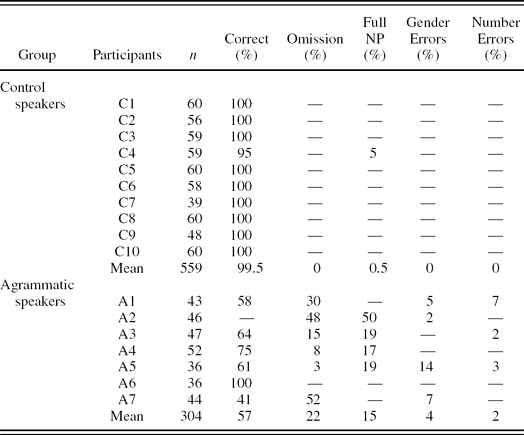
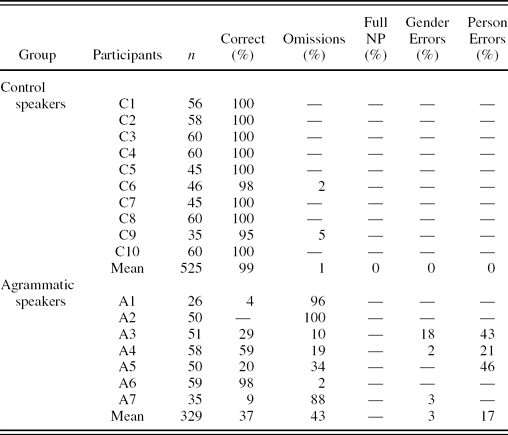
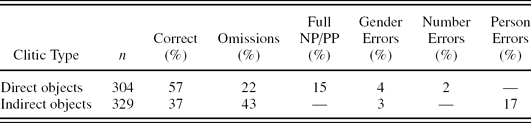
Overall, non-brain-damaged speakers produced significantly more correct clitics than did agrammatic speakers, χ2 = 279, df = 1, odds ratio (OR) = 1.74, p < .001. The error analysis indicates that non-brain-damaged speakers substitute clitic pronouns with a full NP in 0.5% of cases. Agrammatic speakers, instead, omit clitics 22% of the time, substitute clitics with their full NP in 15% of cases, assign incorrect gender in 4% of cases, and assign incorrect number in 2% of cases (results are presented in Table 3).
Production of direct-object clitics within a correct sentence structure
Note: NP, noun phrase.
Clitic position
In the obligatory condition, once clitics were produced, they were produced 100% of the time in the correct position, both by non-brain-damaged speakers and by agrammatic speakers.
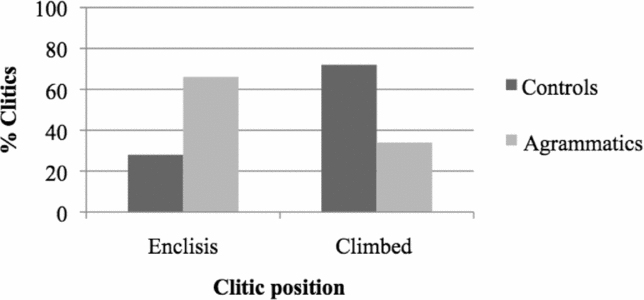
In the optional condition, agrammatic speakers produced significantly more clitics in the enclisis position and fewer clitics in the climbed position than did non-brain-damaged speakers (χ2 = 42.84, df = 1, OR = 4.2, p < .01). Agrammatic speakers produced 66% (n = 61) of clitics in the enclisis position and 34% (n = 31) of clitics in the climbed position, whereas non-brain-damaged speakers produced 28% (n = 83) of clitics in the enclisis position and 72% (n = 215) of clitics in the climbed position, as shown in Figure 2.
The percentage of direct-object clitics produced in the enclisis and the climbed position.
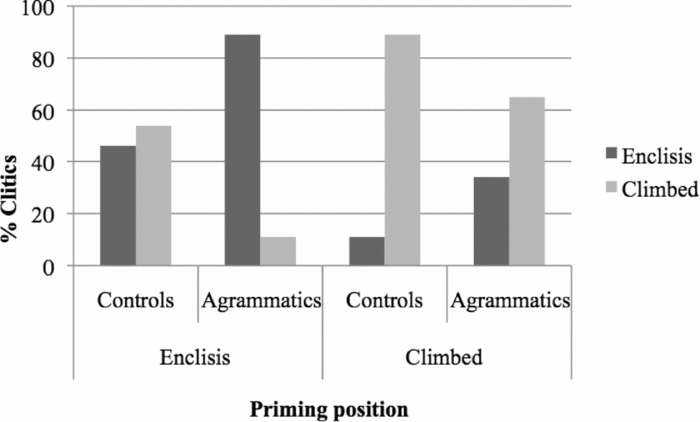
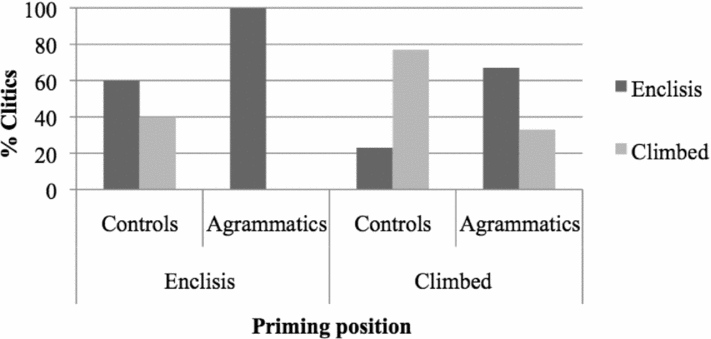
In order to determine whether there was an association between the position in which clitics were primed and the position in which clitics were produced, chi-square tests were performed for both groups of participants. The results revealed that for both groups there was a significant association between the position in which clitics were primed and the position in which they were produced (non-brain-damaged speakers: χ2 = 43.78, df = 1, OR = 4.5, p < .01; agrammatic speakers: χ2 = 29.84, df = 1, OR = 2.6, p < .01). Data are shown in Figure 3.
The association pattern between the direct-object clitic priming position and the production position.
These results illustrate that agrammatic speakers show an effect of priming when clitics are primed in both the enclisis and the climbed positions. In other words, they produce more enclitics when they are primed with a clitic in the enclisis position, and they produce more clitics in the climbed position when they are primed with clitics in the same position. However, the effect of priming is larger when clitics are primed in the enclisis position. Instead, non-brain-damaged speakers show a stronger priming effect when clitics are primed in the climbed position, but they show a smaller effect when clitics are primed in the enclisis position. They produce 46% of clitics in the enclisis position and 54% in the climbed position.
Interim conclusions
The results of Experiment 2 show that agrammatic speakers produce fewer direct-object clitics than do non-brain-damaged speakers (agrammatic speakers = 55%, non-brain-damaged speakers = 99.5%) and that the main error types agrammatic speakers exhibit are clitic omissions (22%) and clitic substitutions with a full noun (15%). A very small percentage of errors were represented by gender (4%) and number (2%) errors. These first results on the overall pattern of production are in line with previous results in the literature showing that freestanding grammatical morphemes (among which clitics) are primarily omitted, not only in spontaneous speech but also in an experimental paradigm. However, that speakers with agrammatic aphasia substitute unproduced clitics with the full NP form (which is the second most frequent error) suggests that the implicit knowledge of the syntactic structure to be produced is still available. This is clear from the pattern of error that shows that when the target structure is too complex to be produced in the requested form (as clitic pronouns), agrammatic speakers rely on a grammatically simpler form, that is, producing a determiner and a full noun.
The analysis of the clitic position shows that, in the obligatory condition, agrammatic speakers never produced clitics in the wrong position (i.e., after the finite verb). In the optional condition, agrammatic speakers produced more clitics in the enclisis position (66%) than in the climbed position (34%). This data confirms that, for agrammatic speakers, producing clitics that require a longer movement (in the climbed position) is more difficult with respect to producing them in a position that requires a shorter movement (i.e. the enclisis position), supporting the idea that syntactic movement is complex for agrammatic speakers, as suggested by the DOP-H (Bastiaanse and van Zonneveld, Reference Bastiaanse and Zonneveld2005) and that longer movements are more difficult than shorter ones. An alternative explanation for the observed pattern of performance in restructuring sentences in agrammatic speakers is that they might face the inability to restructure the two verbs into a unique verbal complex, that is, they might not apply restructuring (as in Rizzi, Reference Rizzi1982). As a consequence, if restructuring does not apply, clitic pronouns will be primarily produced in the enclisis position. Moreover, if the difficulty of accessing morphosyntactic complex structures combines with producing them in a derived position, a higher number of morphosyntactic errors could be expected for clitics that will be produced in a derived position (either in finite or restructuring constructions). Even though the number of gender and number errors was very low (total 6%; n = 40), the data confirm this prediction: gender and number errors were mostly produced in a derived position (90% of the times). This data contrasts with that observed in non-brain-damaged speakers, who produced 28% of direct-object clitics in the enclisis position and 72% of clitics in the climbed position. The last analysis confirms that both agrammatic and non-brain-damaged speakers show a significant effect of syntactic priming, revealing an association between the priming position and the position in which clitics are produced. Agrammatic speakers show a priming effect when clitics were primed in both the enclisis and the climbed positions, with a larger effect in the enclisis position. Non-brain-damaged speakers show a more selective pattern of priming restricted to clitics in the climbed position. This effect is similar to the results of syntactic priming experiments in healthy speakers, which show that less preferred structures are primed more strongly than are dominant structures (Bock, Reference Bock1986; Ferreira, Reference Ferreira2003; Hartsuiker, Kolk, & Huiskamp, Reference Hartsuiker, Kolk and Huiskamp1999). What may be important in explaining the observed pattern is that all of the non-brain-damaged participants in the present study are dominant speakers of standard Italian who live in the northern part of Italy in the Veneto region, where speakers have been reported to show a general preference to produce clitics in the enclisis position (Benincá, Reference Benincà, Holtus and Ringgerr1986). As such, these speakers, although being dominant speakers of standard Italian, might not only maintain the regional preference for clitic placement in restructuring constructions (i.e., enclisis) but also have available and utilize clitic climbing. As shown by the spontaneous speech data of Experiment 1, these very same speakers utilize both the enclisis and the climbed clitic positions. However, the data points of Experiment 1 are probably too few to be used as a baseline to determine clitic placement preference. To conclude, the results of Experiment 2 reveal that despite the fact that agrammatic speakers are impaired in clitic production, they do manage to a certain extent to produce them, and they show overall a positive effect of priming, indicating that priming supports accessing and processing of particularly complex linguistic structures, with the result of facilitating their production. Moreover, that agrammatic speakers showed a larger priming effect for clitics that require a shorter movement (i.e., in the enclisis position) with respect to when clitics require a longer movement (i.e. in the climbed position) suggests that the syntactic priming effect in agrammatic speakers is modulated complexity in syntactic movement. The difficulty observed for agrammatic speakers to produce clitics in the climbed position in restructuring sentences might be a reflection of the inability to reanalyze the two verbs as a single verbal complex (as assumed by Rizzi, Reference Rizzi and Keyser1978, Reference Rizzi1982). In Experiment 3, the same paradigm will be used to test the production of indirect-object clitics, which have been proposed to be morphosyntactically even more complex that direct-object clitics, because they have an additional case feature that has to be checked in syntax (Belletti, Reference Belletti and Riemsdijk1999).
EXPERIMENT 3: PRIMING OF INDIRECT-OBJECT CLITICS
Participants
The participants were the same as described in Experiment 1.
Materials
In this experiment, the production of indirect-object clitics was tested in two conditions: an obligatory condition (using finite sentences in which clitics must be produced before the finite verb) and an optional condition (using restructuring sentences in which clitics can be produced either in a preverbal complex or a postverbal complex position). A total of 4 practice sentences and 60 experimental sentences were used: 30 sentences for the obligatory condition and 30 for the optional condition. As in Experiment 2, stimuli consisted of incomplete sentences accompanied by colored pictures that participants had to complete. In the obligatory conditions, stimuli contained an overt subject, a clitic pronoun, a finite verb, and the beginning of a subsequent sentence that participants needed to complete, as in the following example:
(6) Obligatory condition (finite sentences)
Experimenter: Ieri Maria non mi/ti/le/gli ha inviato la lettera, ma oggi Maria . . .
Yesterday Maria not himIndir. obj. 3rdpers. sg. masc. clitic has sent the letter but today Maria. . .
“Yesterday Maria did not send me/you/her/him the letter but today Maria . . .”
Participant: . . .gli invia la letteraFootnote 5
. . . himIndir. obj. 3rdpers. sg. masc. clitic sends the letter
“Sends him the letter.”
In the optional condition, all experimental items were constructed with the modal verb “volere” (want), plus a lexical verb that changed from item to item, and a clitic pronoun, which was presented in half of the stimuli (15) after the verbal complex (i.e., in the enclisis position) and in the other half before the verbal complex (i.e. in the climbed position), as in the following examples:
(7) Optional condition (restructuring sentences with clitic prompted after the verbal complex)
Experimenter: Maria non vuole raccontargli una favola, invece Gianni . . .
Maria not wants to tell-himIndir. obj. 3rdpers. sg. masc. clitic a fairytale, instead Gianni . . .
“Maria does not want to tell him a fairytale, instead Gianni . . .”
Participant: . . . vuole raccontargli una favola or . . . gli vuole raccontare una favola
. . . wants to tell-himIndir. obj. 3rdpers. sg. masc. clitic a fairytale it or . . . himIndir. obj. 3rdpers. sg. masc. clitic wants to tell a fairytale
“Wants to tell him a fairytale”
(8) Optional condition (restructuring sentences with clitic prompted before the verbal complex)
Experimenter: Maria non gli vuole raccontare una favola, invece Gianni . . .
Maria not himIndir. obj. 3rdpers. sg. masc. clitic wants to tell a fairytale, instead Gianni . . .
“Maria does not want to tell him a fairytale, instead Gianni . . .”
Participant: . . . vuole raccontargli una favola or . . . gli vuole raccontare una favola
. . . wants to tell-himIndir. obj. 3rdpers. sg. masc. clitic a fairytale it or . . . himIndir. obj. 3rdpers. sg. masc. cliticwants to tell a fairytale
“Wants to tell him a fairytale”
In the indirect-object clitics stimuli, clitics were subdivided as follows: 15 sentences prompted the use of the clitic in the first-person singular, that is “mi” (to me); 15 prompted the use of second-person singular clitics, that is, “ti” (to you); 15 sentences prompted the use of the third-person feminine singular, that is, “le” (to her); and 15 sentences the use of the third-person masculine singular, that is, “gli” (to him).
Procedure
The procedure was the same as used in Experiment 2.
Coding and data analysis
The coding and data analysis were the same as in Experiment 2.
Results for indirect-object clitics
Quantitative and error analysis
Overall, non-brain-damaged speakers produced significantly more correct clitics (99%) than did agrammatic speakers (37%;χ2 = 523.7; df = 1; OR = 2.7, p < .001). The error analysis indicated that non-brain-damaged speakers omitted indirect clitic pronouns in 1% of cases.Footnote 6 Agrammatic speakers, instead, omitted clitics 43% of times; they never substituted indirect-object clitics with the full prepositional phrase (the noncliticized form of indirect-object clitics), they assign incorrect gender in 3% of cases, and they assign incorrect person in 17% of cases (results are presented in Table 4).
Production of indirect-object clitics
Note: NP, noun phrase.
Clitic position
In the obligatory condition, once clitics were produced, they were always produced in the correct position, both by non-brain-damaged speakers and by agrammatic speakers.
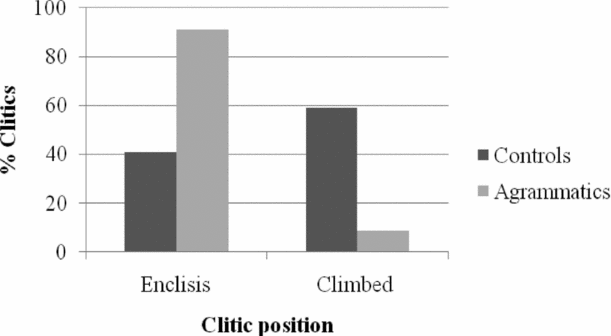
In the optional condition, agrammatic speakers produced significantly more clitics in the enclisis position and fewer clitics in the climbed position than did non-brain-damaged speakers (χ2 = 47.76, df = 1, OR = 6.8, p < .01). Agrammatic speakers produced 91% (n = 52) of clitics in the enclisis position and 9% (n = 5) of clitics in the climbed position, whereas non-brain-damaged speakers produced 41% (n = 122) and 59% (n = 176) in each of these conditions, respectively (see Figure 4).
The percentage of indirect-object clitics produced in the enclisis and the climbed positions.
Chi-square analyses were performed to determine whether there was an association between the clitic priming position and the position in which clitics were produced. The results revealed that for both groups there was a significant association between clitics’ priming position and production position (non-brain-damaged speakers: χ2 = 43.14, df = 1, OR = 0.29, p < .01; agrammatic speakers: χ2 = 10.21, df = 1, OR = 5, p < .01). Regarding the direction of the association, the data (see Figure 5) reveals that non-brain-damaged speakers showed a strong priming effect when clitics were primed in the climbed position but a smaller priming effect when clitics were primed in the enclisis position. In contrast, agrammatic speakers showed a strong priming effect when clitics were primed in the enclisis position, but they did not show a priming effect when clitics were primed in the climbed position.
The association pattern between the indirect-object clitic priming position and the clitic production position.
Interim conclusions
The results of Experiment 3 show that agrammatic speakers produced fewer indirect-object clitics than did non-brain-damaged speakers (agrammatic speakers = 37%, non-brain-damaged speakers = 99%). The main error types for the agrammatic patients were clitic omission (43%), person errors (17%), and gender (3%) agreement errors. No instances of substitution of indirect-object clitics with a prepositional phrase were observed.
The analysis of the clitic position showed that, in the obligatory condition, agrammatic speakers never produced clitics in an illegal position, that is, after the finite verb. In the optional condition, agrammatic speakers produced more clitics after the verbal complex (91%) than before the verbal complex (9%), a pattern that differs significantly from the one observed for non-brain-damaged speakers. Non-brain-damaged speakers produced indirect-object clitics before the verbal complex in 59% of cases and after the verbal complex in 41% of cases. This analysis demonstrates that non-brain-damaged speakers showed a stronger priming effect when clitics were primed in the climbed position, therefore confirming that the less preferred structure was primed more strongly than the more preferred structure. Speakers with agrammatic aphasia showed instead a different pattern of performance, with an effect of priming when clitics were primed in the enclisis position. However, when clitics were primed in the climbed position, agrammatic speakers still show a preference for producing clitics in the base position, therefore failing to show a clear priming effect. The main finding of Experiment 3 confirms the one of Experiment 2. Both non-brain-damaged speakers and agrammatic speakers are sensitive to syntactic priming, suggesting that syntactic priming supports the accessing and processing of these structures, leading to facilitation in clitic production. However, unlike what was found for direct-object clitics, for indirect-object clitics there was a smaller effect of priming when clitics were primed in the climbed position, suggesting that syntactic priming may boost the processing of grammatical structures that show different levels of morphological complexity in a differential way.
This set of experiments shows that agrammatic speakers are impaired in the production of both direct- and indirect-object clitics. However, indirect-object clitics appear to be more impaired than direct-object ones. The goal of the last set of analyses is to compare the production of these two structures in order to verify whether the production of indirect-object clitics differs significantly from that of direct-object clitics. Moreover, comparing direct and indirect clitics error patterns may be informative to determine which are the most salient parameters that lead to a differential level of impairment. This direct comparison is legitimate because the structure of the material used to elicit direct- and indirect-object clitics was the same. Only verbs types were different for obvious reasons.
A first analysis revealed that overall direct-object clitics were produced more frequently than were indirect-object clitics (χ2 = 23.31, df = 1, OR = 1.53, p < .01). A comparison of the error patterns showed that indirect-object clitics were omitted more frequently than were direct-object clitics (χ2 = 7.8, df = 1, OR = 0.5, p < .01) and that substitutions of the clitic with a full phrase (NP for direct objects and prepositional phrase for indirect objects) only happened with direct-object clitics. No instances of this error type were found when agrammatic speakers produced indirect-object clitics. Finally, there were no differences in the number of gender errors (χ2 = 1.1, df = 1, p = .1), and person errors were only produced when producing indirect-object clitics (28% of errors). These data are presented in Table 5.
Comparison in the production of direct- and indirect-object clitics
Note: NP/PP, noun phrase/prepositional phrase.
Regarding clitic placement in the obligatory condition (i.e., finite sentences), results showed that there was no difference between direct- and indirect-object clitics. When clitics were produced, they occurred before the finite verb and never in an illegal position (i.e., after the finite verb). In the optional condition, instead, direct-object clitics were produced significantly more often before the verbal complex (the climbed position) than were indirect-object clitics, which were produced most frequently after the verbal complex (the enclisis position; χ2 = 11.9, df = 1, p < .001).
GENERAL DISCUSSION
The goal of this paper was to investigate agrammatic speech production using a particularly taxing linguistic structure (clitic pronouns) as a window to examine whether the production of complex syntactic structures may be modulated via syntactic priming. Syntactic priming was utilized to determine whether it was possible to influence clitic production in speakers with agrammatic aphasia. To summarize the main findings, it was shown that agrammatic speakers are impaired in the production of clitic pronouns. However, results of Experiment 1 show that agrammatic speakers pattern qualitatively similarly to the control group, suggesting some residual sensitivity despite their overall poorer performance. In both Experiments 2 and 3, a positive effect of syntactic priming was observed for speakers with agrammatic aphasia, suggesting that when contextual support is provided, they are able to partly access and produce structures that might be otherwise less available. These findings carry some important implications for the theories of agrammatic speech production presented in an earlier section of this paper. The reported results suggest that the most extreme versions of representational accounts of agrammatic speech production (e.g., the TPH; Friedmann, Reference Friedmann2001; Friedmann & Grodzinsky, Reference Friedmann and Grodzinsky1997) cannot fully account for the observed pattern of performance. Assuming Belletti's analysis of clitic movement, clitics move with the verb to the agreement subject phrase projection that is assumed to be above the tense phrase (Belletti, Reference Belletti and Riemsdijk1999). As such, stronger versions of the TPH, which assume that syntactic nodes above the tense phrase are unavailable to agrammatic speakers, would predict that the production of clitic pronouns should not be available, even under priming conditions. If those linguistic representations were unavailable, priming would not be effective at all. However, as observed from the results reported in Experiments 2 and 3 for agrammatic speakers, there is a clear difference in how effective priming is between clitics that were primed in the enclisis and in the climbed positions, and how different the effect of priming is for direct- and indirect-object clitics. It is important to remember that direct-object clitics need to check syntax gender and number case features, whereas indirect-object clitics need also to check person case (specifically for the third-person singular; Belletti, Reference Belletti and Riemsdijk1999). As such, indirect-object clitics are inherently more complex structures to access and produce. Results show that agrammatic speakers are more impaired in the production of indirect- than direct-object clitics and that indirect-object clitics are produced even more consistently after the verbal complex than direct-object clitics. In addition, agrammatic speakers show a smaller priming effect for indirect-object clitics when primed before the verbal complex (Experiment 3), whereas they show it for direct-object clitics (Experiment 2). One possible way to interpret these effects is to assume that the deficit underlying agrammatic speech production reflects the interaction of both a deficit in accessing the representations underlying the grammatical structures of interest and a decrease in the ability to process the syntactic rules that are necessary to produce those structures under the constraints of real-time processing. It might be hypothesized that syntactic priming supports accessing the representations of clitic pronouns, at least in some conditions, hence the observed positive effect of priming particularly for direct-object clitics in the climbed position in restructuring contexts. However, the observed decrease in priming effects for direct-object clitics primed in the climbed position, and particularly for the more syntactically complex clitics (i.e., indirect-object clitics), might reflect a limitation in the effectiveness of syntactic priming, starting to reveal a deficit in accessing the representations of the more complex structures. The present data suggest that syntactic priming might be utilized as a very effective tool for rehabilitation purposes.
In addition, in Experiments 2 and 3, non-brain-damaged speakers showed a stronger priming effect when clitics were primed in the climbed position. This pattern fits with previous results, which show that less preferred structures are primed more strongly than are dominant structures (Bock, Reference Bock1986; Ferreira, Reference Ferreira2003; Hartsuiker et al., Reference Hartsuiker, Kolk and Huiskamp1999). In one respect, the findings for the non-brain-damaged speakers are informative about the general preference for the clitic in optional contexts. However, they suggest that agrammatic speakers face a specific difficulty in producing clitics before the verbal complex (i.e., in a derived position). Similarly to healthy speakers, the question could be asked of whether the preference observed in agrammatic speakers to produce clitics in the enclisis position might partly be related to the preference of producing clitics in the enclisis position as described for northern varieties of Italian. However, the fact that controls, who spoke the same variety of Italian, produced clitics in the climbed position (as primed by the experimental paradigm) suggests again that the pattern of performance observed in agrammatics might be primarily due to the agrammatic deficit.
CONCLUSION
To conclude, the reported data for both healthy and agrammatic speakers show that participants were sensitive to syntactic priming. For agrammatic speakers, the observed production patterns could be explained assuming a deficit in accessing the representations of the most syntactically complex clitic forms and a reduction in the ability to perform the syntactic operations (for example, syntactic movement) that are central to the processing of these structures in real time. Accessing and producing indirect-object clitics that require additional case marking with respect to direct-object clitics (Belletti, Reference Belletti and Riemsdijk1999), together with producing them in the climbed position, which requires a longer syntactic movement, could impose overall greater computational load, resulting in a better performance to produce direct-object clitics and to produce them for positions that require a shorter movement (i.e., in the enclisis position). As mentioned before, specifically for restructuring constructions, the difficulty observed in producing clitics in the climbed position should also be explained in terms of inability to restructure the two verbs as a single verbal complex (Rizzi, Reference Rizzi and Keyser1978, Reference Rizzi1982), preventing as a consequence the production of clitics in the climbed position.
The focus of the present investigation was to further assess to what extent syntactic priming would modulate accessing the syntactic representations and processing the syntactic operations that are necessary to produce different types of clitic pronouns in agrammatic production. Because in the present study no data were available regarding more general cognitive measures for agrammatic speakers (as, for example, verbal working memory), no direct claim can be advanced suggesting that an observed positive effect of syntactic priming observed in clitic production also supported more general cognitive functions that have been proposed to be central to linguistic processing. However, a general discussion on this view is important for thinking about future developments in studies on language processing in various populations. Syntactic priming has been suggested to support cognitive resources that are central for language processing even in healthy speakers (Bock, Reference Bock1986; Bock & Loebell, Reference Bock and Loebell1990; Bock et al., Reference Bock, Loebell and Morey1992, 1995; Hartsuiker et al. Reference Hartsuiker, Kolk and Huiskamp1999; Hartsuiker & Westenberg, Reference Hartsuiker and Westenberg2000), by means of facilitating the access and the processing of structures that seem otherwise difficult to process (Haarmann & Kolk, Reference Haarmann and Kolk1991, Reference Haarmann and Kolk1992; Hartsuiker & Kolk, Reference Hartsuiker and Kolk1998; Hartsuiker & Westenberg, Reference Hartsuiker and Westenberg2000; Saffran & Martin, Reference Saffran and Martin1997). Under this view, syntactic priming could have facilitated the overall production of clitics both in the enclisis and in the climbed positions. Italian clitics encode important morphosyntactic features that need to be retrieved and kept active throughout the entire production process. Under the cognitive view proposal, retrieving clitics’ representations in the real time course of speech production would also require the active support of cognitive resources that are necessary to retrieve and maintain the information active during speech execution. A similar explanation has been proposed by Tuller, Delage, Monjauz, Piller, and Barthez (Reference Tuller, Delage, Monjauze, Piller and Barthez2011) in an analysis of typically developing French children in two age ranges (6 and 11 years old) and in a group of adolescents with a spectrum of pathologies impacting language processing.
Finally, it is important to acknowledge how data on speakers with agrammatic aphasia still contribute to the understanding of language processing more generally. Contrary to a general intuition, studying language processing in adult, healthy, highly skilled monolingual speakers (as the prototypical population) may not offer the most revealing context for investigating language processing. In contrast, atypical populations, such as agrammatic speakers, or other groups of speakers that are still considered to a certain extent “atypical” (e.g., bilingual speakers) may represent an optimal opportunity to describe different patterns of performance that might inform language processing more generally (Kroll, Dussias, Bogulski, & Valdes-Kroff, Reference Kroll, Dussias, Bogulski, Valdes-Kroff and Ross2012). Specifically, investigating agrammatic speech allows highlighting of the various mechanisms that interplay during normal language processing in a variety of grammatical structures. It is only quite recently that researchers have the technical resources to study language while processing unfolds (e.g., utilizing event-related potentials or functional magnetic resonance imaging) and that they are able to answer more fine-grained questions about the neurophysiological and the localizational aspects of language. Despite the technical advances, investigating aphasic speech still represents a rich research environment that deserves to be pursued.
The Italian clitic system
ACKNOWLEDGMENTS
The writing of this paper was supported in part by a Marica De Vincenzi Postdoctoral Research Fellowship to the author and by NIH Grant R01-HD053146 to Judith F. Kroll, which provided support to the author as a postdoctoral fellow. I am grateful to Judith Kroll and Giuli Dussias for their support during all phases of this paper's preparation and for the constant opportunity to work with them. I thank John Lipski for the useful comments and Serena De Pellegrin and Francesca Meneghello for the opportunity to access the rehabilitation center and help in data collection.