ROFITABILITY COMPUTATIONS
The most profitable between two alternative techniques of production is the one generating a higher net present value. Accordingly, a general formula for the profitability of the jenny (indexed by J) relative to the spinning wheel (indexed by S) would readFootnote 2

On the side of outflows, K is the upfront cost of capital and m its yearly maintenance cost, while w is the daily wage paid for each of the L work days in a year. Inflows are instead constituted by the price p obtained for each of the q units of output sold in a year. Finally, T is the life time of the jenny and the unknown r is the rate of return from choosing the jenny over the spinning wheel. Hence, spinners will adopt the jenny if the rate of return r that solved equation 1 is higher than the prevailing rate of interest.
Starting from equation 1, two alternative assumptions can be made to carry out viable profitability computations given the available data. Before moving to them, the following notation is introduced. Each technology is characterized by a labor input coefficient α such that αq = L; consequently, α −1 is the labor productivity of the technology in question and the term P = αS/αJ is the labor productivity of the jenny relative to the spinning wheel.
Scenario 1: Fixed Output and Decreased Labor
To reach the specific profitability computation used by Allen, output has to be assumed constant. In fact, when qS = qJ the revenues from the two production techniques are the same and no longer figure in the profitability calculation that only depends on differences in labor input. The amount of labor supplied by the spinner has to decrease with the adoption of the jenny by an amount equal to the gain in relative efficiency generated by the jenny its self.Footnote 3 If the spinner uses LS units of labor with a spinning wheel to produce q = LS/αS, then she can produce the same q with αJq units of labor and a jenny. Hence, LJ = LSαJ/αS. Defining LS = Y·D, where Y is the number of working days in a year and 0 < D ≤ 1 is the part time fraction that workers devote to spinning cotton with the spinning wheel, implies that LJ = Y·D·αJ/αS. It then follows that the profitability formula for fixed ouput is

Equation 2 is exactly the one used by Allen to assess the profitability of the spinning jenny across different countries, which are characterized by a different value of KJ and w. Crucially, the value of r as obtained with equation 2 is flawed in two distinct regards.
First, the assumption of fixed output is implausible when discussing the adoption of a new technology. In fact, a reduction of marginal costs would lead any profit-maximizing producer to increase output. Not surprisingly, this is what happened also to cotton spinners during the Industrial Revolution: as Allen himself recalls, “Producers were paid by […] the pound that they spun, and they bought jennies to increase their production and thus their earnings.”Footnote 4
Second, equation 2 provides a downward biased estimate of profitability. Indeed, precisely because labor inputs fall, the utilization rate of capital drops after adoption. In effect, spinners are forced to buy more capital than they will ever use: this reduces the profitability of the jenny by inflating capital costs. An example clarifies the point. Suppose, like Allen does, that a cotton spinner worked 100 full working days in a year, and set this level of capital utilization to be 100 percent.Footnote 5 If we maintained the fixed output assumption, what would the spinner do if the jenny turned out profitable with P = 3? She would substitute her one spinning wheel with one jenny to end up producing the same fixed output in one third of the time. Hence, the adoption of the jenny would lead her to devote only 33.3 full working days per year to spinning! In parallel, the utilization rate of capital would drop to 33.3 percent, while for the remaining 66.6 percent of the time the jenny would be left idle. Hence, Allen's computation shows how profitable it is to buy a jenny that is kept it in the closet for 332 days a year while being used in the remaining 33 days. It would seem likely that even if the original spinner only works 33 days, she would want to either hire another spinner to work on the machine, or rent out the machine to someone else.
Scenario 2: Fixed Labor and Increased Output
It is possible to carry out a profitability computation that does not suffer from the limitations discussed above. Let us turn for a moment to some considerations on the price of output. An analysis of the profitability of the jenny relative to the spinning wheel is relevant only if p ≥ wαS. Otherwise, if p < wαS, spinning wheels would be out of business since the variable cost wαS would exceed the marginal revenue p. Then, if price must be such that p ≥ wαS, it follows that p > wαS would guarantee higher revenues as compared to p = wαS for any technique in use. Under these considerations, setting p = wαS is a “safe” assumption since it cannot overestimate the profitability of the jenny. Hence, equation 1 becomes
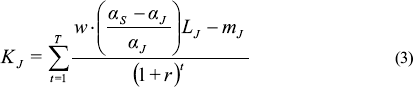
Notably, according to equation 3, the value of r is increasing in LJ. Therefore, it would not be surprising if cotton spinners during the Industrial Revolution decided to substitute labor for leisure, as argued by Jan De Vries: working more would make the adoption of the new technology more profitable.Footnote 6 Nonetheless, labor supply will be here assumed to remain constant after adoption in order to make results especially robust and transparent, hence LJ = LS = L = Y D. Under this assumption, equation 3 becomes
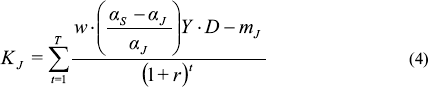
Notably, equation 4 differs from equation 2 by the term P = αS/αJ, which is the labor productivity of the jenny relative to the spinning wheel. More precisely, multiplying w in equation 2 by P yields exactly equation 4. It must also be noticed that equation 4 could be obtained even without any specific assumption on the value of p. In particular, equation 4 can be recovered expressing per unit of output both inflows and outflows of equation 1. This is equivalent to imputing exactly as much capital services as those actually enjoyed by the adopter, contrarily to what happens with equation 2.
DATA FOR ENGLAND AND FRANCE
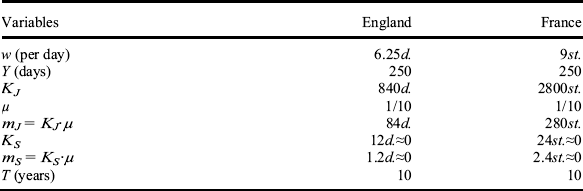
Notes:
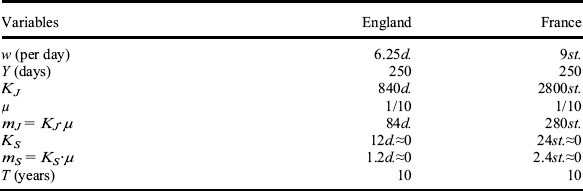
Money values are expressed in pence (d.) and sous tournois (st.). Variables: w, daily wage; Y, working days in a year; KJ, purchase price of the jenny; μ, yearly maintenance rate; mJ, yearly maintenance cost of the jenny; KS, purchase price of the spinning wheel; mJ, yearly maintenance cost of the spinning wheel; and T, years of life of the jenny.
Source:
All data from Allen, “Spinning Jenny,” p. 916.
RESULTS
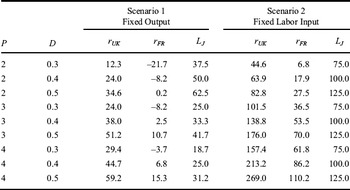
The profitability of the jenny relative to the spinning wheel is computed here according to the two different scenarios discussed above. The necessary data are taken directly from Allen, as summarized by Table 1. Given these data, the values of r as computed with equations 2 and 4 are reported in Table 2. The results are exposed for varying values of the part time fraction D and of the productivity of the jenny relative to the spinning wheel P, identically to what Allen does in his work. Moreover, Table 2 shows explicitly the level of LJ implied by the assumptions on labor supply specific to each scenario.
The values of r obtained under SCENARIO 1 are systematically lower than those under SCENARIO 2. The third and fourth column of Table 2 report the downward biased values of r obtained by Allen using equation 2, while the sixth and seventh column report those obtained with equation 4. Notice that the results in SCENARIO 1 are based on implausibly low levels of yearly working days (fifth column of Table 2), which imply unreasonably low utilization rates of the jenny. As soon as SCENARIO 1 is abandoned and SCENARIO 2 is considered, the jenny becomes always profitable both in England and France. In particular, under SCENARIO 2, r exceeds the expected rate of return on alternative activities, which Allen deems to be 15 percent.Footnote 7 This is always true in both countries but in the totally unlikely case of P = 2 and D < 0.4. To realize how remote this case is, consider that other authors suggest much higher ranges of P compared to the one investigated by Allen; for instance, David Landes estimates the productivity of the jenny relative to the spinning wheel to be “anywhere from six up to twenty-four to one for the jenny.”Footnote 8 Notice that also a third scenario would be economically reasonable: one in which spinners decided to work more with the jenny than they did with the spinning wheel precisely to increase the profitability of adopting the former. In that case, profitabilities would be even higher since r is increasing in LJ.
THE PROFITABILITY OF THE JENNY IN ENGLAND AND FRANCE

Notes:
Values of r are expressed in percentage terms, while LJ indicates the number of full working days per year associated to each value of P and D across the two scenarios. P is the productivity of the jenny relative to the spinning wheel. D is the share of working time devoted to spinning. The values of r in the third and fourth column (Scenario 1) are computed with equation 2. The values of r in the sixth and seventh column (Scenario 2) are computed with equation 4.
CONCLUSION
Differentials in the price of labor relative to capital are insufficient to explain why the spinning jenny spread in England but not in France. The quantitative assessments carried out in the present work reveal that the jenny was profitably adoptable in both countries, despite their difference in terms of relative prices. Nonetheless, it was James Hargraeves and not some French inventor to develop the jenny. This implies that the potential demand for innovation might be necessary but nonsufficient to generate a corresponding supply of inventions. The riddle of the different fortunes of the spinning jenny in England and in France during the Industrial Revolution remains open.