Extreme weather events are frequently seen as important drivers of migration. For example, the Intergovernmental Panel on Climate Change contends that the movement of people is likely to be triggered by climate change in the form of stronger and more frequent storms and floods (sudden onset, short-term events) or droughts and rising sea levels (gradual, long-term events).Footnote 1 Warraich, Zaidi, and Patel report that several million people were internally displaced in the aftermath of the 2010 floods in PakistanFootnote 2 and globally, an estimated average of 22.5 million people have been displaced by climate-related disasters each year between 2008 and 2014.Footnote 3 This number equals about 62,000 individuals each day—with almost all of these displacements occurring in developing countries with weak political institutions.Footnote 4 Some studies even predict that climate change could force 200 million people to move permanently or temporarily in the future.Footnote 5
The influx of environmentally induced migrants into new areas, combined with poor socioeconomic conditions and weak political institutions, could lead to higher pressures on resources in those receiving areas and, subsequently, induce conflict.Footnote 6 In this article, we shed light on the conditions under which environmental change could influence conflict by examining the migration mechanism at the micro level. While some studies argue that individuals impoverished by environmental degradation “become desperate people, all too ready to challenge governments,”Footnote 7 we contend that such claims might be too deterministic in how they imply that all types of environmental change lead to conflict and that all environmental migrants are equally prone to conflictive behavior. Against this background, we develop an argument and empirically test how exposure to different types of environmental events in the migrants' former locations shape their conflict perception in their new place of residence.
Existing research on the environment-conflict nexus has not provided robust empirical evidence so far.Footnote 8 One reason might be that most empirical studies, although often accounting for some contextual factors, model this relationship directly.Footnote 9 While environmental/climatic conditions per se are unlikely to cause conflict, environmental change could act as a “threat multiplier”Footnote 10 because it has the potential to exacerbate a wide range of existing and often interacting conflict drivers, such as high population growth, resource scarcity, or poor governance. Recent studies thus began to analyze the relationship between climate/environmental change and conflict in a multistage framework: conditional effects and indirect links from the environment and climate change to conflict, mostly via economic conditions, food insecurity, and production shocks, are now increasingly being considered.Footnote 11 Most of this work finds support for such indirect links, but the migration channelFootnote 12 (through which changes in the environment could significantly increase the probability of conflict) has rarely been explored, and existent empirical evidence remains ambiguous.Footnote 13
The challenge to quantitatively study how environmentally induced migration affects conflict lies in isolating the effect of environmental change on migration. Existing research on the environment-conflict relationship mainly focuses on aggregated levels of analysis, for example, the country or region level, but this risks drawing imprecise inferences because of the difficulties in separating the effect of environmental change from the many other determinants of conflict. In detail, the challenge is to show that it was indeed environmental change in the first place that led people to become migrants and, second, that conflict in the host region arose as a result of the influx of exactly these migrants. With this research, we seek to overcome this challenge by focusing on the individual—the micro level—and analyzing newly collected survey data on environmental changes, migration, and conflict perceptions. We are thereby able to pinpoint whether migration decisions are motivated by environmental events and whether this, in turn, influences individuals' conflict perceptions.
There is substantial variation among environmental migrants in perceiving conflict in their new locations. The question is whether different forms of environmental change contribute to this variation.Footnote 14 We concentrate on two types of environmental change, gradual, long-term versus sudden, short-term environmental events, and analyze how they affect migrants' perceptions of conflict.Footnote 15 In doing so, we follow a recent trend in international relations that seeks to understand and evaluate the micro foundations of existing macro-level results.Footnote 16 Focusing on the micro level allows us to carefully identify the different steps establishing the presumed causal chain leading from environmental change to migration and then to conflict. Because it is practically impossible to systematically analyze actual conflict behavior at the individual level, we concentrate on the stage preceding real conflict by studying the willingness requirement for overcoming the barriers of violent collective action,Footnote 17 namely environmental migrants' conflict perceptions.Footnote 18
In our survey, migrants could express their conflict perceptions of different issue areas, such as economic hardship, political conflict, social challenges, and environmental stress. While some of these forms of conflict perceptions (e.g., economic hardship) might not necessarily be directly related to real conflict, other types of conflict perceptions like perceived political conflict are closer to actual conflict behavior.Footnote 19 The literature emphasizes that perception is the first aspect of behavior,Footnote 20 and highlights that there are strong links between conflict attitudes and actual conflict conduct.Footnote 21 As a result, examining whether environmental events are associated with environmental migrants' grievances, which eventually induce a heightened perception of conflict, will allow us to gain valuable insights into whether any presumed link between environmental change and conflict behavior rests on a sound micro-level foundation.
Our argument is that direct exposure to environmental change in their former location shapes migrants' conflict perception in their new place of residence. By inflicting casualties and destruction, environmental events have the potential to induce widespread grievances that could render exposed individuals to contemplate violence to rectify the situation that gave rise to these grievances. However, while people might be aggrieved by the “absolute” destruction of their livelihood, we argue that they are more likely to be aggrieved by their negative assessment of their “relative” well-being over time. We thus differentiate the impact of different environmental events on individuals' conflict perceptions, in particular gradual, long-term versus sudden, short-term environmental events.
Sudden, short-term environmental events should affect most individuals equally and people are exposed to these incidents only for a short period of time. Therefore the likelihood to develop relative deprivation and grievances that will lead to an increased conflict perception is low. Short-term events thus lead to (absolute) grievances of the people affected and might even instill a sense of common fate and solidarity.Footnote 22 By contrast, gradual, long-term environmental events should increase the likelihood of conflict perceptions by fostering relative deprivation resulting from differences in adaptive capacities and a longer time period of exposure. Here, individuals are exposed to small-scale adverse climatic conditions that make them steadily try to adapt their productive strategies (e.g., use drought-resistant crops, invest in irrigation systems) until adaptation fails, and they then decide or are forced to migrate. Sustained exposure to climatic events and unsuccessful adaptation thus raise an individual's (relative) deprivation as well as her conflict perception. The rationale is that deep-seated feelings of anger and injustice continue to live in migrants' minds for a long time. Recent research from psychology suggests that exposure to and especially the duration of traumatic events can influence social functioning and how individuals perceive mechanisms that promote justice and fairness.Footnote 23
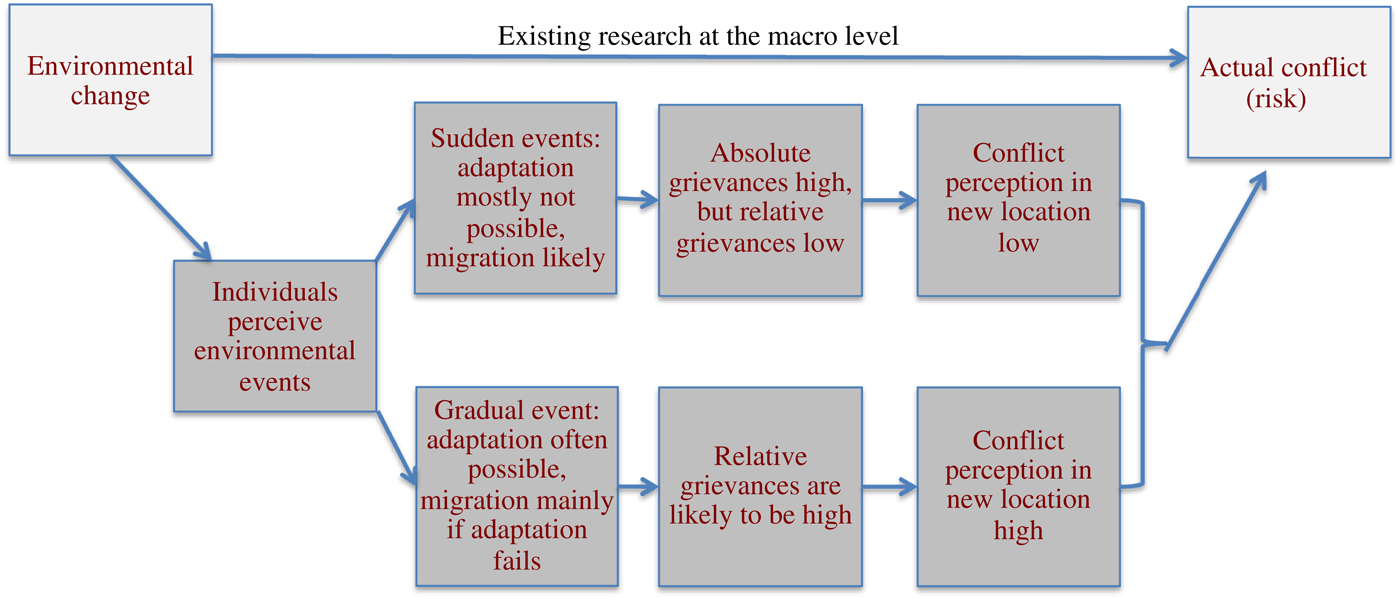
We expect that migrants who were exposed to gradual, long-term environmental events are more likely to perceive conflict in their destination location than migrants who experienced sudden, short-term events. Figure 1 illustrates the theoretical contribution of this study.
Overview of theoretical framework

Conflict Perception and Its Determinants: Gradual, Long-Term vs. Sudden, Short-Term Environmental Events
Are individuals who migrated from their former homes because of adverse environmental conditions more likely to perceive conflicts in their new locations? Although there is evidence that conflict refugees are more likely to have developed social norms in which violence is seen as a normal way to address problems,Footnote 24 migrants originating from conflict-affected areas do not always harbor conflictive attitudes in their new location.Footnote 25 Furthermore, studies in psychology show that migrants experience “acculturative stress”Footnote 26 in reaction to socioeconomic and cultural predicaments encountered in the new location and “these stressors can be exacerbated by conditions inherent in the immigrants' society of origin.”Footnote 27
While our focus on conflict perceptions allows us to make only indirect inferences about actual conflict behavior, it mirrors a more recent strand of the literature on individual-level conflict perceptions. By analyzing popular support for different militant groups in Afghanistan and Pakistan, Blair and colleaguesFootnote 28 and Lyall, Blair, and Imai,Footnote 29 for instance, claim that without knowing how individuals in conflict settings perceive inflicted harms, we lack a key aspect of understanding the micro-level processes underlying these conflicts. Consequently, Lyall, Blair, and Imai suggest that “rather than relying solely on event data, we should integrate perceptions of harm and other individual level characteristics into our models if we are to understand how violence is understood by civilians and how it affects both attitudes and subsequent behavior.”Footnote 30 Research also shows that individuals who are dissatisfied with political and economic conditions are more susceptible to manipulation by militant groups.Footnote 31 Our research thus elaborates on one key component in the causal relationship between environmental change and conflict. It rests on the assumption that without individuals perceiving environmentally induced migration as challenging enough to make them discontent with their current situation, environmental change is unlikely to play its envisaged role as a conflict promoter.
Earlier work on the migration channel produced only mixed findings. For example, Reuveny examines thirty-eight cases of recognized environmental migration episodes, with about 50 percent of them having seen conflict occurring.Footnote 32 He concludes that it is difficult to identify “purely environmental” clashes. Raleigh, Jordan, and Salehyan also find little evidence that environmentally induced migration worsens already-volatile situations in the developing world.Footnote 33 Ghimire, Ferreira, and Dorfman report that displacement caused by catastrophic floods is likely to lengthen the duration of an existing civil conflict, but it does not affect the risk of new outbreaks.Footnote 34 Bohnet, Cottier, and Hug show that disaster-induced displacement does not significantly increase the risk of social unrest.Footnote 35 However, for the period 2008 to 2011, they obtain some evidence that administrative units in the direct vicinity of a flood and displacement triggered by that event had a significantly higher probability of conflict. Finally, using irregular rainfall patterns in migrant-sending Indian states as an instrument for migration, Bhavnani and Lacina demonstrate that greater rates of internal migration are associated with a higher risk of riots.Footnote 36
The literature demonstrates that environmental change can lead to conditions of resource scarcity and, thus, as a stressor that potentially endangers individuals' well-being, decreases their personal income from production, or lowers their chances for future employment.Footnote 37 Accordingly, it is likely that environmental change directly and negatively affects the perceptions of individuals regarding their satisfaction with and well-being in their present location.Footnote 38 When the environmental stress becomes too severe, people might be increasingly discontented with the widening gap between their actual level of economic achievement and the level they feel they deserve and could have achieved under better climatic conditions.Footnote 39 Moreover, some individuals are likely to be more dissatisfied because elites could use their power to maintain their standards of living despite declining environmental conditions. These economic and political inequalities may incite relative deprivation and grievances that shape individuals' conflict perceptions.Footnote 40
In this context, we contend that the impact on conflict perception depends on the type of environmental change because distinct environmental events should affect individuals differently. To this end, our argument distinguishes between gradual, long-term, and sudden onset, short-term environmental change.Footnote 41 Gradual, long-term environmental events, such as droughts or desertification, have a rather small immediate impact on individuals. People may adjust their productive strategies over time when facing such problems. Responses include, among others, investments in irrigation systems, the use of drought-resistant plant and animal varieties, or the diversification of income sources. Despite the relatively small effects in the short term and the plausible adaptation strategies, however, in the longer term such events are likely to disrupt economic growth,Footnote 42 raise income inequality,Footnote 43 and weaken state capacity.Footnote 44 All these aspects of gradual, long-term events might increase the willingness for violenceFootnote 45 and, hence, intensify conflict perceptions.Footnote 46
Gradual, long-term environmental events are likely to fuel personal grievances since individuals' life satisfaction not only depends on perceived differences between what they possess and what they do not, but also on whether they observe progress in their own current or future status.Footnote 47 Prediger, Vollan, and Herrmann demonstrate that sustained exposure to adverse climatic conditions might affect the likelihood of conflict behavior.Footnote 48 They report results from a joy-of-destruction game in Namibia, where pastoralists, who were exposed to resource scarcity caused by prolonged drought, were more likely to exhibit antisocial behavior—a higher willingness to reduce a fellow resource user's income at their own cost—relative to comparable neighboring pastoralists who had not suffered from similar sustained scarcity. Such experiences can have a lasting impact on individuals' cognitive, moral, and personality development as well as interpersonal relationships and coping cabilities.Footnote 49 Social learning theorists emphasize that people become socialized to aggressive behavior and violence when they are constantly exposed to deprivation and grievances over a longer period of time.Footnote 50 This is especially the case when aggressive behavior is seen as appropriate as it might be in situations of resource scarcity.Footnote 51
By breeding relative deprivation, a gradual, long-term environmental event promotes grievances that could lead to the creation of individual conflict perceptions that persist in individuals' minds for a long time.Footnote 52 Sen exemplifies how retained grievances shape the way in which potential conflict might materialize: “the nineteenth-century Irish Famine not only represented massive deprivation and hardship, but also led to deep-seated feelings of anger and disrespect that continue to live on in the minds of later generations that cannot have been directly affected.”Footnote 53 Therefore, we expect
H1
Environmental migrants having experienced gradual, long-term environmental events to be more likely to reveal conflict perceptions in their new location as they carry grievances to the new location.
Sudden, short-term environmental events such as storms and floods, conversely, despite the immediacy and the possible scale of their impact on society in the form of, for example, a large number of casualties, considerable damage to agricultural crop, or the destruction of infrastructure, are unlikely to generate feelings of relative deprivation and widespread grievances that shape individual conflict perceptions. These events usually inflict hardship on all individuals regardless of whether they earn their livelihoods from agriculture, manufacturing, or services and are therefore more likely to lead to absolute deprivation—which in turn leads people to blame fate rather than their own adaptive capacity vis-à-vis others in society.
The equal exposure to a common fate at the group level might even lead to increased solidarity or prosocial behavior between victims of disasters, as the literature on disasters in social psychology shows.Footnote 54 For example, Drury and colleagues argue that the perception of a common fate induces a shared social identity, which in turn makes survivors of environmental disasters show solidarity rather than acting antisocial.Footnote 55 While such solidarity may be confined to the immediate aftermath of disasters, it should render the occurrence of relative grievances less likely.
Finally, despite the severity of their impact, short-term environmental events are typically only of a rather brief duration. Hence, individuals' experience with any potentially aggressive behavior and violence should not be that strongly developed. A common argument in the literature is that there is an increased risk for future aggression when individuals become socialized for violence in conflictive environments.Footnote 56 That said, affected individuals must be exposed to these negative environmental effects for a longer period of time. While this is the case for gradual, long-term environmental events, this is unlikely to be the case for sudden, short-term ones and so migrants should be less likely to carry forward feelings of violence and aggression to their new location. To this end, we hypothesize that
H2
Environmental migrants having experienced sudden, short-term environmental events are less likely to reveal conflict perceptions in their new location.
Research Design
Survey Overview
To systematically analyze the determinants of migrants' conflict perception, we rely on newly compiled data that allow for a quantitative analysis of individual-level conflict perceptions. In a first step, we focus on a data set made up of migrants only—people who decided to leave a specific area that experienced an environmental event and moved to another area within the same country. However, since migrants are unlikely to be a random sample and since those factors influencing conflict perceptions might also affect the initial decision to migrate, the appendix discusses an analysis that focuses on both nonmigrants and migrants who originally come from the same area. When comparing individuals who have stayed in the area with those who have left, we are able to isolate the effect of environmental stressors on the decision to migrate because comparing individuals from the same region ensures that the context for all individuals is identical. At the same time, we can effectively control for selection effects. That said, the main results and those obtained through the selection estimator do not differ in either substance or the direction of the effects.
Our data are based on individual, micro-level surveys in five countries: Vietnam, Cambodia, Uganda, Nicaragua, and Peru. The surveys were conducted between 2013 and 2014 and yielded 3,689 completed questionnaires in total of which about 50 percent (N = 1,854) stem from migrants. The models we discuss are based on smaller samples as a result of missing values on some of the explanatory variables (discussed later). We focus on internal migration, since there is strong consensus in the literature that most migration flows associated with environmental factors are of an internal nature.Footnote 57
The five case-study countries were chosen according to the following criteria. First, countries are regularly affected by weather-related events (storms, floods, droughts, etc.) and are vulnerable to climatic changes.Footnote 58 Second, since our theory postulates different individual reactions to gradual, long-term versus sudden, short-term environmental events, the countries we chose contain different regions experiencing these types of stressors. This allows us to disentangle the effects of the two types of environmental events. And, third, countries come from different regions of the world (Southeast Asia, Sub-Saharan Africa, and Central and Latin America).Footnote 59 Since existing research emphasizes that the environment-conflict relationship is rather context specific, our rationale for this last selection criterion was to study countries that widely differ in their political systems, their economic composition, and development, but are rather similar in their vulnerability to climate change—they experience both climate-induced gradual, long-term and sudden, short-term environmental events. While selecting such diverse countries might lower internal validity to some degree, our intention is to enhance external validity by showing that the same relationship between environmental change, migration, and conflict perceptions exists across a wider range of countries that differ in key underlying political and socioeconomic conditions. Following these three criteria, the five countries we have chosen provide an ideal testing ground for our theory.
Based on information obtained from the EM-DAT/OFDA/CRED International Disaster DatabaseFootnote 60 and archival research, we first identified relevant regions/provinces in each survey country that are mainly characterized by one particular environmental stressor that can be classified either as a gradual, long-term or a sudden, short-term environmental event.Footnote 61 In turn, we randomly chose the departments/districts for the location of the survey.Footnote 62 Finally, we randomly selected communes or villages in these departments or districts by using a grid system with random starting points in which the interviews of the nonmigrants took place.
In contrast, a random sampling of migrants is hardly possible, since (by definition) they no longer live in the same community as nonmigrants. In the locations they have migrated to, we do not know ex ante whether a specific person has migrated from relevant areas. We therefore relied on a snowballing or chain-referralFootnote 63 process to identify individuals who came from the same locations as the nonmigrants, but who left their homes to live elsewhere, usually the regional or the national capital. Starting points for the snowballing were obtained by asking the nonmigrant interviewees whether they knew of any individuals who had left their community or district after having experienced the same environmental event(s), but did not belong to the same household. In total, our sample includes 1,854 migrants across the five countries. A migrant is then also the unit of analysis.Footnote 64
To illustrate this further, consider the following examples for each event in one of our sample countries. First, with respect to long-term events, individuals experienced droughts in Uganda in the Kotido and Moroto districts in the Karamoja region (Northeast Uganda) and then migrated to Mbale and Kampala. The migrants were then interviewed in Mbale and Kampala, while the relevant nonmigrants were interviewed in the Karamoja region. Second, for an example of a sudden, short-term event, consider Vietnam. Individuals who experienced cyclones in the Giao Thuy district in the Red River Delta (North Vietnam) migrated to Hanoi, whereas individuals who suffered from floods in the Chau Phy district in the Mekong Delta (South Vietnam) moved to Ho Chi Minh City. Thus, migrants were interviewed in Hanoi and Ho Chi Minh City about why they migrated and about their conflict perceptions, while nonmigrants were interviewed in the areas of Giao Thuy or Chau Phy.
Operationalization of Dependent Variables
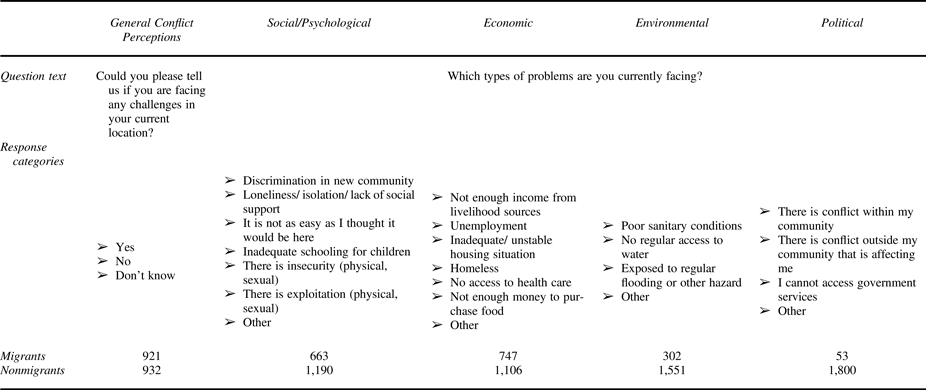
To capture conflict perceptions we rely on five differently specified, yet interrelated dependent variables. All of these items are based on the survey and code migrants' perceptions. In detail, the first dependent variable captures conflict perception in the most general sense: we analyze an item that captures whether respondents indicated they “faced any challenges in their current location” (1; 0 otherwise). With this formulation, we capture both individuals' conflict perception as well as conflict perception in the broadest way since “challenges” could pertain to any conflict or tension (even low-intensity ones) in the migrants' new location. Out of 1,853 completed questionnaires for this conflict-perception item, 921 (49.7%) individuals said that they perceived some form of challenge in the place they moved to. Our sample is basically balanced for this first dependent variable.Footnote 65
However, not all conflict perceptions are created equal and the first dependent variable may be too broad. To this end, we also asked respondents whether they could assign specific types of conflicts to the challenge identified. Table 1 specifies the subcategories for these types of conflict perceptions. Using this information, we created four additional binary dependent variables, one for each subcategory of the general conflict-perception variable, and re-estimated the models. These types pertain to (1) social/psychological conflict perceptions (N = 663/1,853; 35.78%), (2) economic conflict perceptions (N = 747/1,853; 40.31%), (3) environmental conflict perceptions (N = 302/1,853; 16.3%), and (4) political conflict perceptions (N = 53/1,853; 2.86%). By relying on various different conflict-perception variables, we are not only able to ensure a maximum of generalizability for our findings, but we also obtain an in-depth disaggregated perspective on the drivers of migrants' conflict perception.
Conflict perception: Survey questions overview and descriptive statistics

The descriptive statistics (displayed in the bottom rows of Table 1) suggest that some assumptions on the migration-conflict nexus are unlikely to hold. That is, earlier studies rely on the claim that most migrants suffer from grievances and frustration regarding their situation, and carry these perceptions and attitudes forward to the new location, which then increases the risk of conflict there.Footnote 66 Our data highlight that not all migrants have conflict perceptions, but that there actually is a lot of variance on conflict perception both at the general and more disaggregated levels.
Operationalization of Main Explanatory Items
Our two main independent variables on environmental change pertain to sudden, short-term and gradual, long-term events, respectively. As in the case of the dependent variable, these items are not based on “objective” data, but on interviewees' answers in the survey and, therefore, their perceptions regarding the particular environmental event.Footnote 67 We do not use objective meteorological data because individuals tend to react to environmental changes based on their perception of it, rather than environmental change identified objectively with scientific data.Footnote 68 Environmental perception encompasses direct experience of environmental events, yet, mediated by individuals' ability to cope with environmental change.Footnote 69
For capturing these, we asked respondents to describe the main weather events they experienced over the past five years in their location/place of origin. Respondents could choose between several events such as heavy rain, storms and floods, or drought and salinity, but could also list any other weather occurrence that was not listed in the questionnaire. They could also state that no incidents had occurred in the recent past. On the one hand, if individuals mentioned that they experienced any heavy rain, storm, flood, hail/snow, hurricane, cyclone, typhoon, and/or landslide/mudslide, we coded this event as a sudden, short-term environmental event. According to our theoretical arguments, we expect that short-term environmental events do not have much of an impact on individuals' conflict perception. On the other hand, we coded salinity, drought, or desertification as gradual, long-term environmental events. Because of their long-term nature, we expect these to lead to more grievances and thus a higher likelihood of having perceptions of conflict.
Operationalization of Control Variables
Coming to our control variables, we build on earlier research on conflict, conflict perception, and individual-level migration. Most of our broad set of controls not only correlate with the conflict-perception dependent variables and thus address the issue of omitted variable bias but they may have also influenced an individual's decision to migrate in the first place. This latter aspect is particularly important for controlling for possible selection problems. The data for all of the control variables come from our survey. First, there is a respondent's gender and age because women as well as older individuals are less likely to migrate and may also have different conflict views than males or younger respondents. For example, age might be related to psychological phenomena, such as depression, under certain circumstances, although “most studies have shown that older adults differ little from younger adults in their approaches to coping with stress.”Footnote 70 Eisler, Skidmore, and Ward,Footnote 71 among others, report that “stress appraisal is gender related,” with men being more stress-prone than women.
Second, following recent explanatory models of migration networks emphasizing that migration decisions are made in a broader socioeconomic context,Footnote 72 we also incorporate a binary variable on whether another household member has migrated. Such networks increase the likelihood that relatives will follow once the first migrant has settled in her/his destination by sharply reducing the costs and risks associated with migration.Footnote 73 This household-migration variable is also likely to affect conflict perceptions: if an individual moves to a place where a household member already lives, the adaptation to the new environment might be less difficult and existing grievances could be less well pronounced.Footnote 74
To control for potential economic influences, we rely on four different proxy variables from our survey, which we introduce into our models separately due to collinearity concerns. In general, the better the economic condition of an individual, the less likely she may perceive conflict in her new location. This corresponds to earlier research linking economic hardship with conflict and stress perceptions.Footnote 75 In addition, an individual's economic condition could also have affected the initial decision to migrate.Footnote 76 First, we consider a respondent's level of education as a proxy for economic opportunity via three dummy variables: whether a respondent has no formal education, whether a respondent received at maximum primary education, or whether a respondent received at maximum secondary education. Individuals with higher education levels serve as the baseline category.
Second, there is the interviewers' classification of the respondents' economic household status. Hunter, Luna, and Norton emphasize that “migration is often a household strategy to diversify risk.”Footnote 77 In particular, interviewers classified whether a household is economically below average, at average, or above average. We constructed two dummy variables—below and above average—based on this information, while those individuals with an average economic status constitute the reference category.
Third, there is the respondents' self-assessment of whether economic reasons influenced their decision to migrate. In particular, all migrants were asked about their reasons for migrating and they could choose between, for example, social, political, environmental, or economic reasons. For all respondents who stated that economic reasons contributed to their decision to migrate, we assigned the value of 1 to the variable economic reason (0 otherwise). While this self-assessment might be problematic because individuals could have the incentive to over- or underestimate certain factors for personal reasons (e.g., migrants might not want to admit that they are not doing well economically), this variable controls for the potential self-selection problem (i.e., self-selection into migration) more accurately than the other items. In light of this rationale, individuals' self-selection into migration for economic reasons might also affect whether they perceive conflict in their new location. People who go to a new location of residence “more voluntarily” to improve their economic situation tend to perceive less conflict than those who were forced to move to a new place because of changing environmental conditions.
The final variable as an alternative determinant of conflict perceptions and a control for the opportunity costs of migration captures a respondent's profession. This is a proxy for economic well-being and we include the following five professions in our models: civil servants, individuals living from business sales, craft and trade workers (industry, handicrafts, etc.), individuals with elementary occupations such as day labor, and individuals living from other sources of income such as remittances. Individuals working in the agriculture sector serve as the baseline category.
Empirical Findings
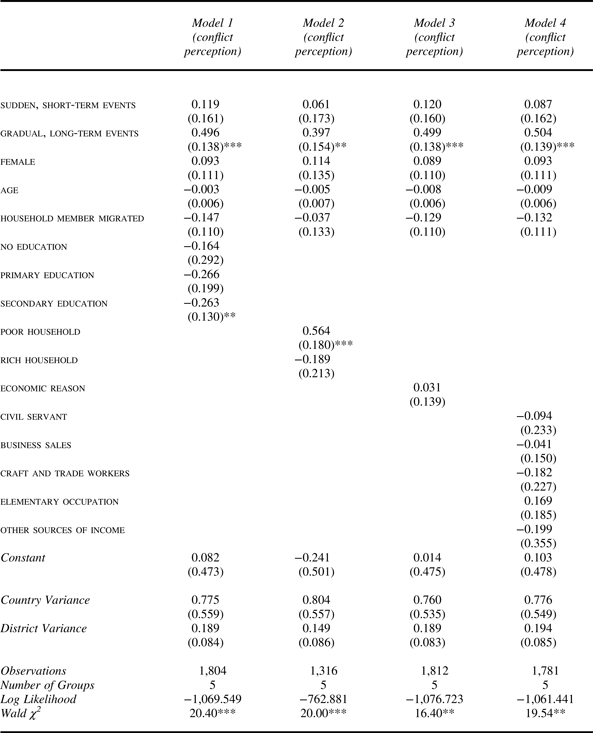
How do perceptions of sudden, short-term or gradual, long-term environmental events in their previous location affect migrants' perception of conflict in their new home? We pooled the data across the five countries to examine the aggregated conflict-perception item, and we rely on a multilevel regression framework that allows us to control for influences beyond the micro level. Table 2 reports the results of the multilevel logistic regression models for the aggregated conflict-perception variable—the most general and broadly defined way to capture migrants' conflict perception. Models 1 to 4 are virtually identical when we consider in all these models our core variables of interest (gradual, long-term events and sudden, short-term events) as well as the standard individual-level demographics. However, we vary the set of variables on potential economic influences. Model 1 focuses on the education variables; model 2 considers only the household-level income; model 3 relies on whether a migrant moved for economic reasons; and model 4 focuses on the occupation of a respondent.
General conflict perception multilevel logistic regression models

Notes: Table entries are coefficients from multilevel logistic regression models with country-level and district-level random effects; standard errors in parentheses. *p < .10; **p < .05; ***p < .01.
Because of the structure of our data stemming from the hierarchical sampling procedure within countries, we use a random-intercept approach. We deliberately chose specific regions in each of the countries because of the environmental problems they face, then relied on random sampling below this level, and used this information to identify the migrants in turn. We therefore have to control for certain regional factors located at either the macro or meso levels. Hunter, Luna, and Norton similarly point to influences coming from “a region's historical-political context.”Footnote 78 Hence, we incorporate a country-level as well as a regional-level intercept to account for the specific hierarchical, three-level nature of the pooled data set in each of the models in Table 2 and the models on the disaggregated conflict-perception variables (Tables 3–6). This accounts for unobserved heterogeneity at the regional and country levels.Footnote 79 Both random intercepts are modeled according to a normal distribution.Footnote 80
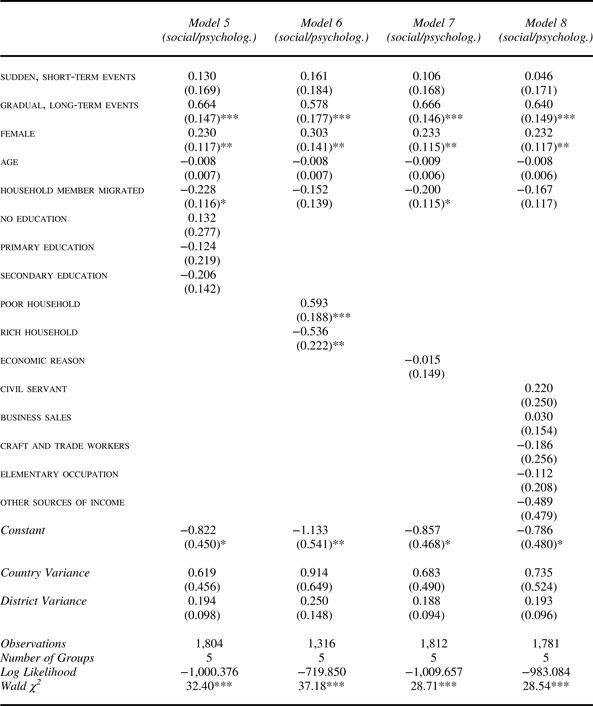
Social/psychological conflict multilevel logistic regression models

Notes: Table entries are coefficients from multilevel logistic regression models with country-level and district-level random effects; standard errors in parentheses. *p < .10; **p < .05; ***p < .01.
Economic conflict multilevel logistic regression models

Notes: Table entries are coefficients from multilevel logistic regression models with country-level and district-level random effects; standard errors in parentheses. *p < .10; **p < .05; ***p < .01.
Environmental conflict multilevel logistic regression models

Notes: Table entries are coefficients from multilevel logistic regression models with country-level and district-level random effects; standard errors in parentheses. *p < .10; **p < .05; ***p < .01.
Political conflict multilevel logistic regression models

Notes: Table entries are coefficients from multilevel logistic regression models with country-level and district-level random effects; standard errors in parentheses. *p < .10; **p < .05; ***p < .01.
Two main results follow from Table 2. First, standard demographic variables have little impact on migrants' conflict perception. Only economic conditions matter under some circumstances. Specifically, we find that women (female) and younger individuals (age) are more likely to perceive conflict in their new locations, but the relationship is not statistically significant at conventional levels when looking at the models relying on the aggregate dependent variable. And while there is a conflict-perception lowering effect of networks, that is, if a member of the household has already migrated, this is associated with lower conflict perception—this impact is also not statistically significant. For the economic conditions, it seems that neither the occupational status nor economic reasons to migrate in the first place seem to play a crucial role, but less-educated migrants and those coming from a poor household are more likely to have overly conflictive perceptions. Thus, there is some evidence that poverty leads to heightened conflict perceptions, which could then fuel actual conflictive behavior. This is in line with earlier studies at the individual or macro level. For example, Urdal argues that violence is strongly associated with an unequal access to employment or education.Footnote 81 Situations of widespread, severe inequality then heighten the potential for alienated, frustrated, and excluded populations and, particularly, younger men to engage in violence.Footnote 82 Brett and Specht also confirm this because they find strong micro-level support for the expectation that poverty, lack of schooling, and low alternative income opportunities are important reasons for conflict.Footnote 83
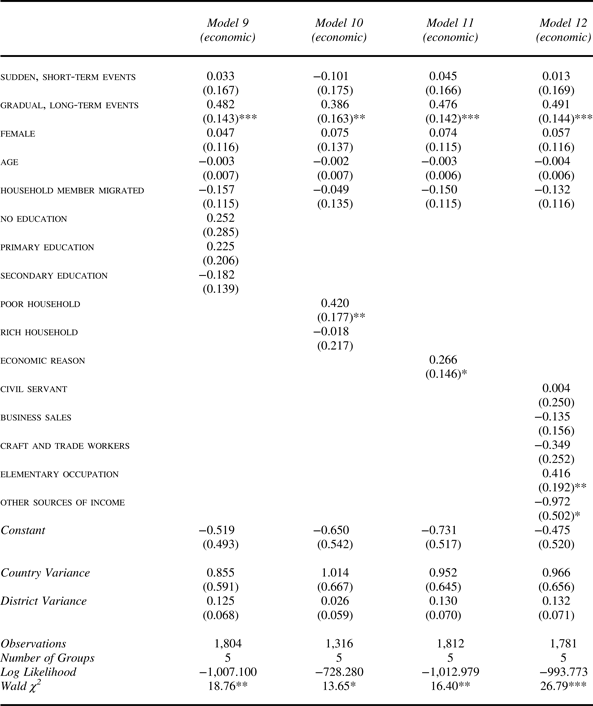
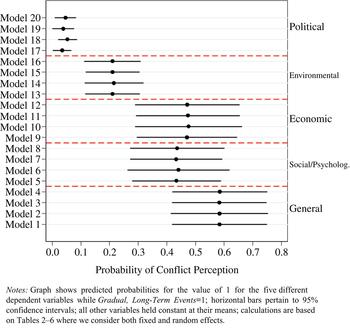
Second, we find support for our theoretical argument that it is particularly gradual, long-term environmental change that affects migrants' grievances, which then makes these individuals more likely to perceive conflict in their new location. This is supported by the positive and constantly significant coefficient estimate for gradual, long-term events in Table 2. In contrast, sudden, short-term events is associated with a positive coefficient estimate, but it is statistically insignificant throughout Models 1–4. Because coefficients in nonlinear setups like our hierarchical models for binary variables cannot be interpreted directly, we also calculated predicted probabilities for conflict perception = 1 for gradual, long-term events, while holding all other variables constant at their means. Figure 2 displays these substantive effects for each model in Table 2 and also for the disaggregated conflict-perception items (Tables 3–6) we discuss later.
The probability of conflict perception for gradual, long-term events
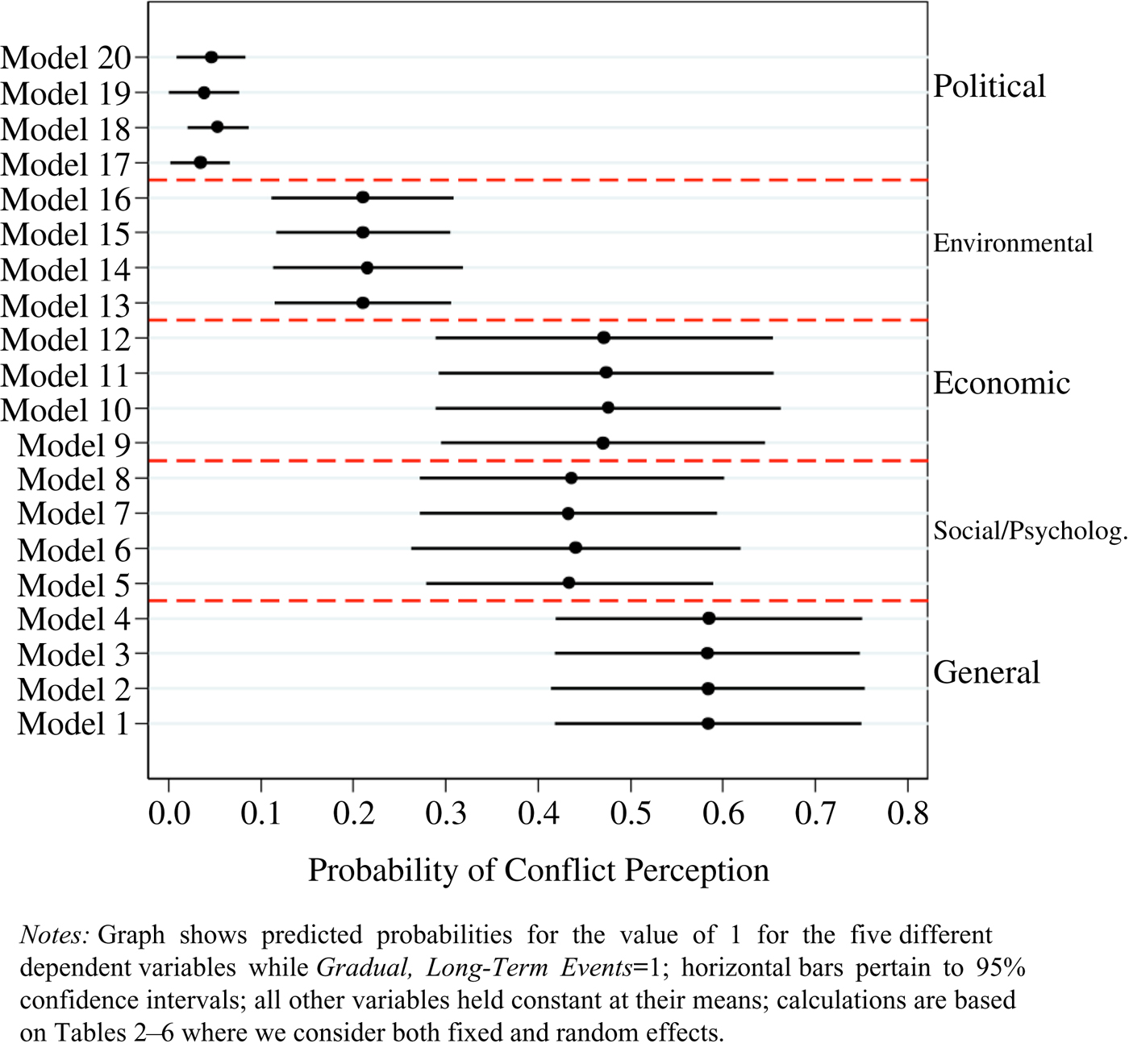
When examining Models 1–4 pertaining to Figure 2 (gradual, long-term events), we see that all scenarios independent of model specification are associated with positive probabilities of conflict perception. For example, the probability of perceiving challenges in the new location is on average nearly 60 percent when gradual, long-term events is set to 1 and all other variables held constant at their mean values. In other words, gradual, long-term events have, ceteris paribus, a strong and statistically significant effect on conflict perception.
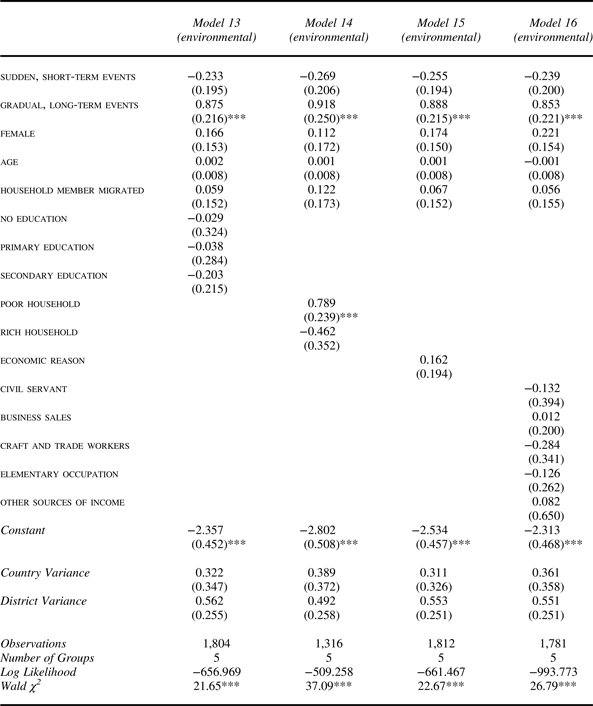
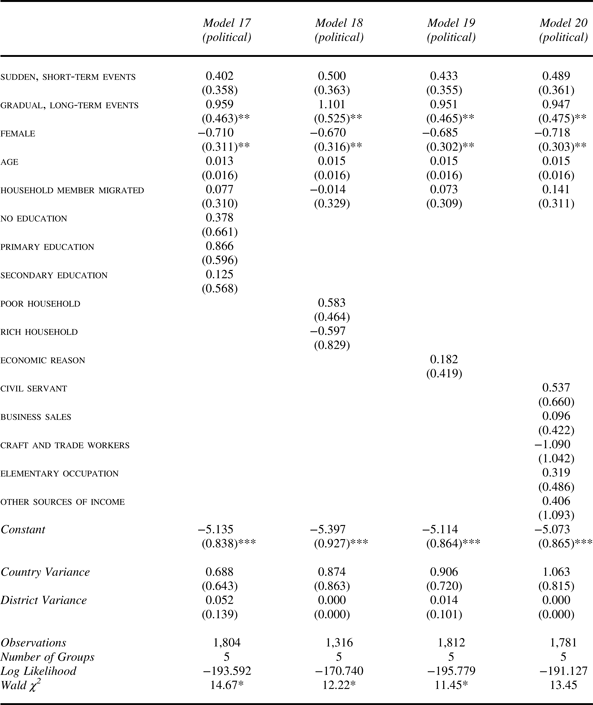
Coming to the disaggregated versions of our dependent variable, Table 3 summarizes the findings when focusing on social/psychological conflict perceptions, Table 4 reports our results for economic conflict perceptions, Table 5 pertains to environmental challenges, and Table 6 relates to political conflict. Two findings appear particularly striking. On one hand, our core result of a positive and significant effect of gradual, long-term events holds across all models in Tables 3 to 6. It is therefore not a particular type of conflict perception that drives our estimations, but gradual, long-term environmental events at the original location/home of a migrant that affect conflict perceptions generally. The substantive results for gradual, long-term events summarized in Figure 1 support this. For both economic challenges and social/psychological problems the probability of perceiving challenges in the new environment lies at around 45 percent when gradual, long-term events is set to 1 and all other variables held constant at their mean values. The predicted probabilities we obtain are somewhat smaller in substance for political and environmental challenges, yet positive and statistically different from 0. The smaller effect size is likely to be driven by the fact that fewer people actually perceived conflict at a political (N = 53/1,853; 2.86%) or an environmental level (N = 302/1,853; 16.30%).
In the disaggregated conflict-perception estimations (Tables 3–6), some of the demographic controls now exert an impact that is statistically significant at conventional levels. For example, female migrants are much more likely than males to perceive social/psychological conflict (Table 3), but are statistically less likely than male migrants to perceive political conflict (Table 6). Second, the income-household effect we identified in Table 2 seems to be driven by those cases pertaining to social/psychological conflict. That is, conflict is much more likely to be perceived in poorer households. However, this effect largely disappears when looking at other types of conflict perception (although the effect for poor household persists in Models 10 and 14). Third, if someone migrated for economic reasons, this person is also more likely to perceive economic conflict (Model 11). The variable economic reason is not associated with a statistically significant coefficient estimate in any other model. However, it may well be that endogeneity is responsible for this result: a migrant anticipates conflict at home, migrates because of this, and carries this attitude forward to the new location. She is then, not surprisingly, also more sensitive toward economic challenges.
To ensure the robustness of our results, we changed a variety of model specifications and re-ran the estimations. In addition to incorporating other important drivers of conflict perceptions, such as a variable capturing political exclusion, we also show that our results are robust to controlling for selection into migration by employing a Heckman-type probit selection model. All results can be found in the online appendix. The appendix also provides detailed maps of the survey locations as well as more details on the implementation of the survey, such as the questionnaire.
Conclusion
Do environmental changes increase the risk of conflict through their impact on migration? While policymakers, the media, and public institutions tend to highlight this possibility, few scientific studies offer a direct test of this relationship. Our research contributes toward filling this gap by studying individual migrants' conflict perceptions and shedding light on the impact of environmental change on these perceptions. This approach allows us to better understand the causal mechanism that supposedly leads from environmental change via migration to conflict behavior.
We argued that individual-level conflict perceptions depend on the type of environmental event that migrants experienced. Sudden, short-term environmental incidents should affect most individuals equally and people are exposed to these environmental changes for only a short period of time. The likelihood of developing relative deprivation and grievances that will lead to an increased conflict perception is therefore low. In contrast, gradual, long-term environmental events, by fostering relative deprivations arising from differences in adaptive capacities and a longer time period of exposure, should induce heightened grievances and migrants should be likely to perceive conflicts at their new locations.
Our empirical analysis relying on individual-level survey data from five developing countries strongly and robustly supports our argument. Whereas sudden, short-term environmental events do not significantly affect migrants' conflict perception, migrants who have experienced gradual, long-term environmental changes are significantly more likely to perceive conflict. These findings, while clearly highlighting the conflict potential of environmental migrants, suggest that previous treatments of environmental change, migration, and conflict may have been overly deterministic: not all migrants are always more “conflict prone” under any circumstance.
One limitation of our approach is the reliance on pure perception-based measures in both assessing environmental events and conflict, which is rooted in our motivation to study the micro foundation of the climate change/migration-conflict nexus. Using either objective data on environmental change or on conflict would automatically imply a shift to a more aggregated level of analysis. With this kind of aggregation comes the challenge to show that environmental change indeed triggers individuals to become migrants in the first place, and that these kinds of migrants then might contribute to actual violence in their new host regions. One way for future research to overcome this challenge might be to rely on spatially disaggregated data. While such data exist for environmental change, we do not know of any such source for migration patterns. However, new data-compilation efforts, such as the use of remote sensing data to track the movement of migrants in regions with adverse environmental conditions, seems to us one way forward.
In general, our results lead to important implications for existing theories of environmental conflict. While environmental migration does not necessarily lead to conflictive behavior under all circumstances, there might still be situations in which environmentally induced migrants can be drivers of and behind conflict. This underscores the need to thoroughly examine the mechanisms that affect environmental migrants' conflict behavior. Researchers should make the development and testing of theories that account for plausible intervening and conditional factors a priority, since the type of an environmental event and the nature of the local context in which it occurs (as well as individual characteristics) can exacerbate the challenges people face. They can also create new risks when people move.
It is, hence, crucial to understand the exact causes of why migrants left their homes to be able to prevent potential conflict at new locations. It is equally important to examine the role that perceptions play. Incorporating and better understanding individual perceptions of climatic changes requires addressing the “why” behind these perceptions. Only then can we comprehensively explain why people react to environmental changes the way they do and we are then better positioned to study their conflict behavior. Finally, to achieve a robust, general understanding of the environmental migration-conflict nexus, we concur with Lyall, Blair, and Imai that we should strive to connect individual conflict perceptions to actual conflict behavior and to group-level conflict by elevating individual conflict perceptions “from their current neglected status in our theories to the foreground of our study of civil war dynamics.”Footnote 84
Supplementary Material
Supplementary material for this article is available at <https://doi.org/10.1017/S0020818318000231>.