Introduction
Direct care-givers can be classified into three main types based on service location: those employed by care institutions, working under nurse supervision; home care or personal care-givers employed by the local government or non-profit agencies, assisting the disabled with daily life activities; and the third type, independent providers, hired directly by individual customers (Stone Reference Stone2004). When some industrialised countries set ageing-in-place as the goal of long-term care (LTC) policies in the 1990s, home service and community service became priority projects for planning and execution. This trend caused the demand for home service to increase dramatically. As recruitment and training of care-givers is important in the LTC field (Brannon et al. Reference Brannon, Barry, Kemper, Schreiner and Vasey2007; Harris-Kojetin et al. Reference Harris-Kojetin, Lipson, Fielding, Kiefer and Stone2004), a shortage of local care-givers has caused ageing countries to devise tactics for finding capable manpower, so an immediate and effective solution has been to import care-givers (Doyle and Timonen Reference Doyle and Timonen2009; Walsh and Shutes Reference Walsh and Shutes2013).
Related literature can be classified into three aspects. First, those that studied the policies aspect both examined the role of foreign workers in LTC policies and delved into the effects of recruiting foreign workers on said countries’ demand, supply and method of service delivery for LTC (Organisation for Economic Co-operation and Development 2005; Stone and Wiener Reference Stone and Wiener2001; Yeoh and Huang Reference Yeoh and Huang2010). In some countries, foreign care-givers already play a substantial role in LTC systems (Spencer et al. Reference Spencer, Martin, Bourgeault and O'Shea2010). For example, Cangiano et al. (Reference Cangiano, Shutes, Spencer and Leeson2009) found that 28 per cent of the United Kingdom's long-term care-givers, and 32 per cent of Ireland's, are foreign workers; 72 and 50 per cent of Italy's and Israel's care workers, respectively, are foreign-born (Colombo et al. Reference Colombo, Llena-Nozal, Mercier and Tjadens2011). Second, other studies researched the interactions between care receiver, care-giver (employer) and foreign worker. These studies also focused on the quality of care provided and the workload or burden of care (Berdes and Eckert Reference Berdes and Eckert2001, Reference Berdes and Eckert2007; Timonen and Doyle Reference Timonen and Doyle2010; Walsh and Shutes Reference Walsh and Shutes2013). For example, Ayalon (Reference Ayalon2009a , Reference Ayalon2009b , Reference Avalon2009c , Reference Ayalon2010, Reference Ayalon2011) studied extensively the relationship between foreign workers, care receivers and employers and quality of care: on one hand, asserting that foreign home care-givers develop a ‘family-like’ relationship with care receivers, endowing them with the role of ‘fictive kin’; on the other hand, the long work hours, pressure and workload foreign care-givers are under leads to the abuse of care receivers. Degiuli (Reference Degiuli2007) documented the 24-hour job description of foreign workers (live-in and live-out) from waking time to bedtime, highlighting the intense level of burden of their work hours and job description on their physical and psychological states. The third type looked into the relationship between foreign and local care-givers, and the trends of supply. Foreign workers were no longer just supplementing for the manpower shortage in the formal care sectors; instead they were directly employed by individual households (sometimes illegally) to supplement or substitute for households’ informal care (Anderson Reference Anderson2007; Ungerson Reference Ungerson2004).
Among the theories explaining why developed countries import care-givers, the correlation between labour promoting the national economic cycle initially proposed by the neoclassical economics perspective and manpower shortage is most frequently discussed. However, the dual labour market theory, which interprets international migration, does not emphasise the exporting country's push factors (e.g. low salaries or high unemployment), but instead advocates the importing country's economic development and the inevitable demand for foreign workers due to social change (Liu Reference Liu2000; Massey et al. Reference Massey, Arango, Hugo, Kouaouci, Pellegrino and Taylor1993; Piore Reference Piore1980). In other words, demand for labour is centred on primary fields that are stable, specialised and have high levels of prestige – including high operating income, pleasant work conditions, systematic work regulations and opportunity for career growth – but the secondary fields in the economic structure cannot disappear because of this. A simple, low-cost tactic is to import low-level labourers as a reserve army in case of a labourer shortage. Thus, as developed countries recruit low-level labourers from less-developed countries – those of the secondary labour market having to endure low income, unfavourable work conditions, job instability, a lack of quality work regulations, fewer opportunities for promotion and a high turnover rate (Doeringer and Piore Reference Doeringer and Piore1971) – a single country's ‘occupational hierarchy’ evolves into an international economic body's ‘occupational (or racial) hierarchy’ model (Holt Reference Holt2002; Lichtenberg Reference Lichtenberg, Zack, Shrage and Sartwell1998; Miles Reference Miles, Back and Solomos2000).
However, England and Folbres (Reference England, Folbres, Ferber and Nelson2003) believe that those economic theories provide an incomplete explanation, arguing that care work itself has distinctive characteristics which help explain the economic vulnerability of those providing it. As Browne and Braun (Reference Browne and Braun2008: 16) have duly noted, meeting long-term elder-care needs with female immigrants ‘may result in great access to needed employees’ and add to the ‘continued devaluation of eldercare as a profession’. It also, according to Browne and Braun, adds to the ongoing failure to recognise the non-technical competencies (e.g. compassion, patience and dedication) required for providing proficient elder-care. Because of this, elder-care work undertaken by female foreign care workers continues to defy the traditional logic of economic theory, and its economic value remains low even when demand outstrips the supply (Huang, Yeoh and Toyota Reference Huang, Yeoh and Toyota2012).
Within the general context, paid care is very polarised. LTC's primary sector is comprised of professionals – doctors, nurses, occupational and physical therapists, and social workers – while the secondary sector includes low-skill care-givers directly providing care services – also known as nurse's aides or care workers – whose job description involves assisting care receivers with eating, waste-handling, household care, cleaning, washing, etc. This requires minimal formal education and skill, and as work experience is often unnecessary it is low-paid and lacks advancement opportunities, and excludes job security such as welfare (Kane, Kane and Ladd Reference Kane, Kane, Ladd, Kane, Kane and Ladd1998; McFarlane and McLean Reference McFarlane and McLean2003; Duffy 2005; Duffy, Armenia and Stacey Reference Duffy, Armenia and Stacey2015). This results in labourers being mostly middle-aged to older women with little education, and turnover is very high (Lu and Chen Reference Lu and Chen2009; McFarlane and McLean Reference McFarlane and McLean2003; Potter, Churilla and Smith Reference Potter, Churilla and Smith2006).
Studies have found that when countries started importing workers to reduce their shortage of labourers in the secondary labour market, what they filled were usually individual care-giver jobs, which lack salary and benefit guarantees the most (Anderson Reference Anderson2007; Ayalon Reference Ayalon2009b ; Brannon et al. Reference Brannon, Barry, Kemper, Schreiner and Vasey2007; Duffy 2015). Redfoot and Houser (Reference Redfoot and Houser2005) use the dual LTC market to explain foreign workers’ being used to supplement a country's shortage of low-level labour. However, even in a secondary labour market, care institution employees’ salaries and benefits are higher than those in home care institutions or individual households, causing segregation of this labour market into two levels based on service location. For example, the number of home care-givers receiving health insurance is comparatively low and most are paid hourly. Moreover, since they work in their subjects’ homes, the boundaries are blurry (Stone and Dawson Reference Stone and Dawson2008; Stone and Harahan Reference Stone and Harahan2010). In fact, care workers occupy a unique position in that many of their jobs exist outside standard employment relationships and therefore fall into categories that are exempt or excluded from protection by these regulations (Duffy, Armenia and Stacey Reference Duffy, Armenia and Stacey2015).
The present dual labour theories have already corrected the past theories’ hypotheses, further segregating the primary labour market into upper primary and lower primary markets, revising the dual labour market to ternary labour market segregation (Piore Reference Piore, Edwards, Reich and Gordon1975). The previous theories focused on the importation of foreign labourers and described the market as further using ‘racial segregation’ (Fan Reference Fan2005; Holt Reference Holt2002).
Thus, this study attempts to improve on the limitations of current theories and research first by advocating that the influx of foreign workers into the secondary labour market causes occupational segregation. Second, differences in the workplace lead to inequality, i.e. vertical occupational and horizontal occupational segregation. The former refers to local care-givers holding better positions in the occupational hierarchy; the latter, both locals and foreigners working in the same area, but foreign workers holding lower positions (Hakim Reference Hakim2000). The final goal of this paper is based on the point of law and social policy to examine how occupational segregation occurs in this secondary labour sector due to the influx of foreign workers. According to Taiwan's long-term data, I advocate that the three market segments’ group differences already occur in the secondary labour market. The indicator of this segmentation is the Labour Standards Act as the boundary line, dividing the sector into secondary insider labour and secondary outsider labour markets: those covered and those not covered, respectively.
History and policies regarding foreign care-givers in Taiwan
Taiwan's Employment Service Act, set in 1992, covers the hiring and management of the entire foreign employee population, regardless of profession, displaying a kind of class segmentation. Foreign labourers in Taiwan, according to the government, the general public and the media, are referred to as ‘low-class labourers’ (Liu Reference Liu2000) because they receive differential treatment, e.g. how long they can reside as employees in Taiwan, restrictions on jobs they can work in (allocated by an industry's quota) and the inability to change employers or work locations at will. Regardless of how long they reside in Taiwan, their industry or country of origin, however, labourers obtaining citizenship is not an option afforded to them. White-collar ‘high-level’ foreign employees, also not given long-term immigrant visas, can stay at will, even long term. It is evident that different policies exist for foreign employees in the different sectors of the dual labour market (Tseng Reference Tseng2004).
As opposed to other studies on international migration, which usually include all of the secondary labour industries in their scope, this paper focuses on Taiwan's LTC system, looking into the occupational segregation and obstacles as foreign workers enter the secondary care labour market, and the occupational segregation and changes among Taiwanese and foreign care-givers. Taiwan's ‘Temporary Measure to Address Shortages of Manpower for Providing Care for Households’ Disabled’, implemented in 1992, specifies how secondary labour sectors should import foreign employees. Its objective is to help fill the needs of families with disabled members, as defined by the Barthel Index, the LTC field's most used assessment tool for activities of daily living (Pearson Reference Pearson, Kane and Kane2000), and its contents are as follows: strengthen the advocacy of job opportunities and conduct vocational training for Taiwanese care-givers; instead of society's needs and the imbalance between care-givers’ supply and demand, foreign care-givers may be requested to supplement care in institutions and households. In 1999, care institutions too were allowed to hire foreign care-givers. It is therefore apparent that the main purpose for hiring foreign care-givers is to ‘supplement’ the Taiwanese workforce.
A significant gap, however, has always existed between foreign ‘home’ and ‘institutional’ care-givers’ salaries, job descriptions and labour security. Because of the segregation of the labour market into primary and secondary sectors, there is little interaction. The primary market being divided into upper and lower primary labour markets displays a ternary labour market segmentation phenomenon (Edwards Reference Edwards1979; Piore Reference Piore, Edwards, Reich and Gordon1975), in which the upper includes professional, technical, managerial and administrative jobs, as well as those considered creative, independent, prestigious and with higher opportunities for occupational mobility, and the latter comprising clerical and skilled work which emphasises one's ability to follow and comply. As foreign workers increasingly enter the secondary labour care market, it is worth investigating whether or not the secondary labour care market is in fact similar to the primary labour market with segmentation.
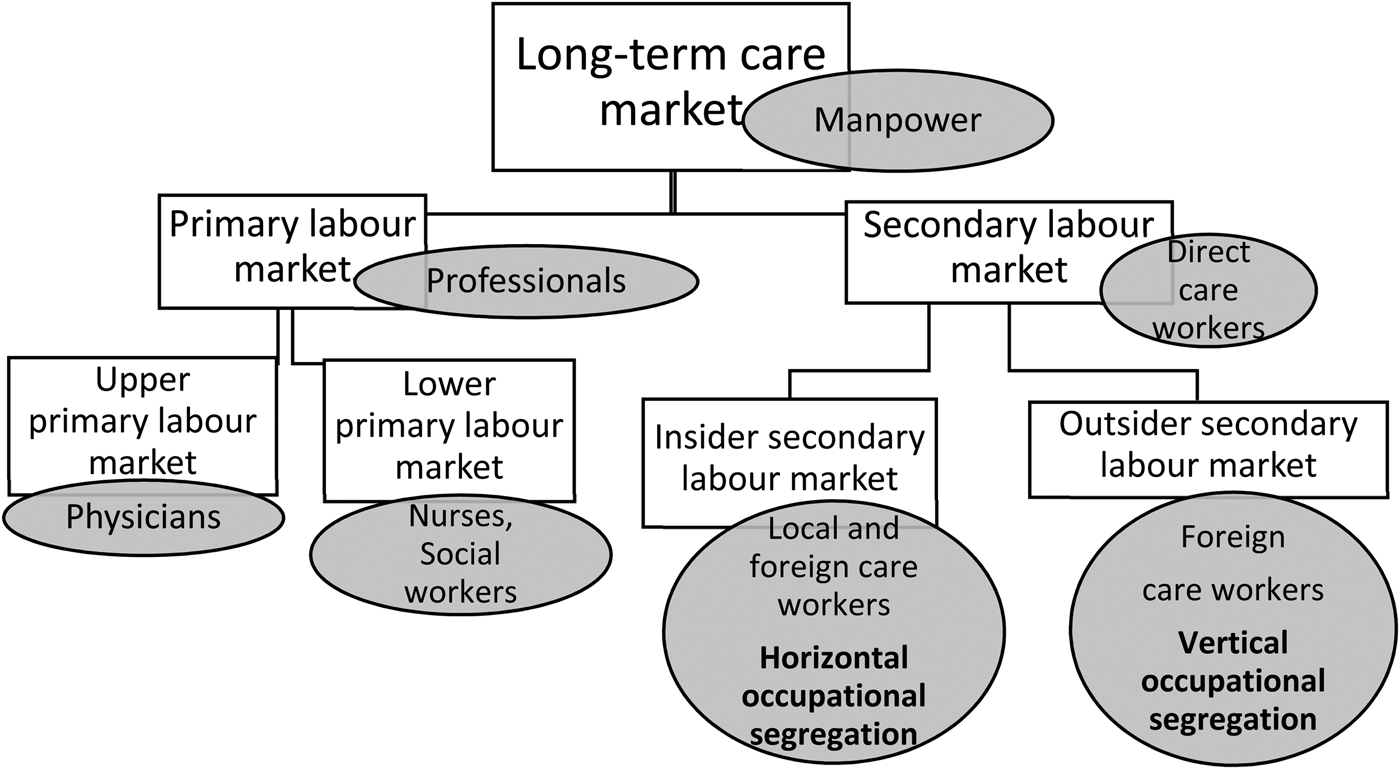
Using the dual labour market and occupational segregation theory frameworks as reference, and basing this framework on Taiwan's 23 years’ of long-term data, the three market segmentations’ group differences already occur in the secondary labour market. The Labour Standards Act as the boundary line indicates this segmentation, dividing the sector into secondary insider labour and secondary outsider labour markets – those covered and not covered under the Act, respectively. Due to foreign home care-givers being considered from a policy perspective as merely ‘supplementary’, their rights and work conditions will continue to suffer until the government acknowledges that they are no longer merely supplementary. (See Figure 1 for the research architecture.)
Research concept.

Data sources and methods
This research uses a mixed-method approach structured around the key informants of foreign care-givers’ employers in different workplaces, and Taiwanese home care-givers. The main nationalities of Taiwan's foreign care-givers, in order from greatest to least, are Indonesian, Vietnamese, Thai and Filipino (Ministry of Labor 2015). Including data from multiple sources was necessary to capture the full picture of the occupational segmentation between foreign and Taiwanese care-givers. These data were particularly useful for testing the supplementation or substitution hypothesis, and for ascertaining the impact of work opportunities in Taiwan's LTC system. First, I used documents from government sectors to display the trends of foreign workers from different nationalities in the secondary labour market. Of the two data sources, one applies the secondary data analysis method to study the population of care-givers in care institutions and households. The Labour and Immigration departments together follow the number of foreign care-givers; data on Taiwanese care-givers is from the Ministry of Health and Welfare, requiring that home service providers regularly post online their worker numbers and work-condition data, showing the trends in the variations. Also in scope is the occurrence of occupational segmentation for the past 23 years and the degree of changes since 1992. The second source, also from the Labour Department, uses document analysis to analyse how the Labour Act causes occupational segmentation in the secondary care sector's various locations. Additionally, to improve data reliability, I compared two data-sets from different sources to ensure data consistency.
Because all care institutions can hire foreign care-givers to supplement their shortage of workers, to understand the conditions faced in different types of institutions, this paper also includes data from 198 face-to-face interviews with foreign institutional care-givers’ employers between 2011 August and 2013 March in Taipei and New Taipei cities – those with the largest populations; the latter, with the most care institutions. These institutions are then segmented according to their policies and nature (Table 1). Only a few institutions fall under the first three types, so all of them were used as the sample; 316 belong to the fourth type, so 159 (50%) were randomly selected. The total interview completion rate was 83.3 per cent.
Interview per type of care institution

Note: Percentages are given in parentheses.
The third data collection method included interviewing foreign home care-givers’ employers. Applying simple random sampling, I selected 32 adult children who had hired foreign care-givers for their disabled parents and conducted semi-structured face-to-face interviews with them between 2011 January and 2012 March. The interview topics included: (a) reasons for hiring foreign care-givers; (b) experiences with foreign care-givers; (c) when applicable, the differences in job descriptions between foreign and Taiwanese care-givers. To understand the salaries, occupational welfare and work conditions of Taiwanese care-givers, I interviewed home care organizations’ managers in the two cities – 15 and 14 organisations, with a total interview completion rate of 93 and 100 per cent, in Taipei and New Taipei, respectively.
Finally, to further understand households’ hiring processes of foreign workers, I interviewed a physiatrist and a neurologist responsible for writing diagnostic certificates, as well as brokers – the head and the commissioner of a manpower brokerage firm – and three Bureau of Employment and Vocational Training (BEVT) officials. Through these interviews, the paper illuminates the evolution of policies for the labour segmentation of foreign care-givers and the influencing factors causing occupational segmentation.
All interviews were audio-recorded, transcribed and coded. With foreign care-givers, I first developed a set of inductive codes from both (institutional and home care-givers) interview transcripts. To develop a coding frame, these codes were then cross-referenced on the basis of qualitative analytic criteria (credibility, transferability, dependability and confirmability; Guba and Lincoln Reference Guba, Lincoln, Denzin and Lincoln1994). The coding frame was then compared across workplaces and countries to ensure broad consistency, and refined as thematic analysis was performed on each category's data-set. Guided by the analytical framework developed from previous literature, thematic commonalities and differences across workplace and country data-sets were then identified and used for the comparative aspects of this paper.
This paper is further organised as follows. I begin by looking into the vertical segmentation phenomenon and changes for all foreign care workers, followed by an analysis of the horizontal segregation and variation of Taiwanese and foreign institutional care-givers, then by looking at the vertical segregation of Taiwanese and foreign home care-givers. Finally, this paper delves into the impacts of Taiwan's secondary labour market on its LTC system with the influx of foreign workers.
Research findings
Vertical segmentation phenomenon and changes for foreign care workers
Occupational segmentation in the labour market is a phenomenon seen not only in society's overall labour market but also within an industry, e.g. the LTC sector. As mentioned above, Taiwan's foreign care-givers are classified as either institutional or home workers. Foreign institutional workers’ inclusion in the Labour Standards Act protects them from their employers extending their work hours indefinitely, and requires a dedicated resting space to be provided, protecting their right to ample rest.
The receivers of care from household foreign care-givers are severely disabled. The wording of the policy, ‘severity of disability’, is unclear, and they generally require 24-hour care. This undocumented hiring standard then leads to employers asking foreign care-givers to provide 24-hour home care. According to Chen's (Reference Chen2011b ) findings, most live with the care receiver in one room because this arrangement allows for immediate help whenever needed. Also expected is a responsibility for clients’ daily life care, excluding medical treatment or procedures. However, drawing a clear line between ‘client's daily life care’ and ‘household chores’, which is typically required by employers of live-in foreign care-givers, is difficult (Chung Reference Chung2010).
Regarding foreign home care-givers’ ability to bear long work hours, the majority of employers expressed the following sentiment: ‘That's how I took care of them before!’ According to Wu (Reference Wu2006), foreign home care-givers work more than 13 hours a day regardless of having set hours. In fact, a close correlation between care-givers’ long work hours and where they work clearly exists. When care-givers live in clients’ rooms, unless exempted from assisting with feeding or nighttime bathroom duties, they rarely get enough rest. Although some employers understand this and allow daytime naps for foreign care-givers, it is questionable whether the quality and volume of rest is sufficient for care-givers to regain their strength in lieu of the physical demands.
Why foreign home care-givers are not included in the Labour Standards Act stems from issues deeply rooted in local culture. Seen only as short-term supplementary workers within the LTC industry, it is likely that including them in such benefits was deemed ‘unnecessary’. This itself stems from seeing workers from ‘less-developed Asia’ as people of lower status, and a widespread belief by many locals that foreign workers come to Taiwan for economic gain rather than out of need of employment, which often leads to the feeling that ‘imported’ workers do not deserve the same benefits that Taiwanese citizens, or skilled white-collar Western employees, do (Lan Reference Lan2005).
Additionally, it is important to consider why specifically foreign home care-givers are not covered by the Labour Standards Act, while foreign institutional care-givers are. This, too, is rooted in local cultural beliefs. Most Taiwanese think of the home as ‘not a workplace’, and place great importance on family privacy (Lan Reference Lan2006). Therefore, hiring a foreign domestic care-giver makes one less willing to accept so many restrictions from the government, seeing such policies as intrusive and a violation of personal liberties. To demonstrate this phenomenon, Taiwan put into place domestic abuse laws in 1997, but domestic abuse is still rampant compared to other countries (Yu Reference Yu2014). Also, if employers are not allowed to enjoy the benefits of hiring foreign care-givers, there is little incentive for them not to hire Taiwanese care-givers.
Although a foreign workers’ rights advocacy group has been fighting to include foreign care-givers in the Labour Standards Act or to implement a separate ‘household service act’ to guarantee labour conditions, these policy suggestions have been unacknowledged by labour authorities and objected to by many employers. Also of little effect due to workers’ concern about job security and immigration status (Chen Reference Chen2011b ), an airport care service project and a labour counselling and protection hotline for arriving foreign care-givers have been implemented.
The foreign care-giver hiring process requires that brokers provide employers a copy of the labour contract upon care-giver arrival so that both parties’ rights and obligations are understood, as well as regularly visiting the home to check on work conditions. However, other than for serious crimes, e.g. physical or sexual abuse, brokers rarely take action on complaints about work-hour abuse or overload. Based on my interviews with brokers, many foreign workers are not willing to work overtime, but employers use this as an excuse for requesting that the broker company change to another care-giver. A broker expressed the following: ‘A Filipino maid told her employer: “I've worked eight hours today already. My time is up.” The employer was shocked because she had to be the one to do the suctioning next. She had worked all day already and when she came home, she had to take care of her father-in-law and do his suctioning. She was angry and asked if she could request someone else.’
It is evident that although employees can advocate their own labour rights, employers can use a ‘request for a replacement care-giver’ to show their superior position. Based on a special regulation – the 59th provision of the Employment Service Act – foreign home care-givers must be requested by individual households. Unless the employer's family emigrates, or the care receiver dies, or the employer is unable to pay the stipulated salary, the foreign home care-giver has no freedom to change employers. The unequal standings between employers and care-givers cause the latter to forfeit their freedom to choose work conditions. Consequently, care-givers fall into a victimised situational disadvantage in which they are unable to ask for help. Although BEVT conducts administrative checks on Taiwan's 400,000 foreign labourers, there are only 240 inspectors. It is reasonable, then, that only a few illegal instances are detected. Also since such crimes are taken less seriously, punishment is rare and not severe (Chen Reference Chen2011b ).
Facing the situation of foreign care-givers being overworked, even a broker assessed by BEVT as ‘outstanding’ for many years suggests that the government's failure to implement administrative inspections causes the public to imitate others’ methods of using foreign care-givers, sharing that most employers maximise the use of foreign care-givers. After hearing that working a care-giver more than eight hours in a day would result in the employer being fined, the employer responded, ‘Whose side are you on? Everybody does the same!’ In the end, the only thing the broker could do was tell the employer not to be so flagrant and ask that the labourer be more patient. In fact, as Lan (Reference Lan2005) noted, Taiwan has recently witnessed a decline in the recruitment of Filipina care-givers and a consequent increase in the number of Indonesian care-givers, and as a result, the tendency of recruitment agents to establish differences between ‘unruly Filipinas’ and ‘docile Indonesians’ to rationalise market segmentation and hierarchical labour conditions.
In addition, ‘mutual agreements’, which are common between employers and care-givers, cover up the way in which care-givers are expected to work illegally. One employer recalled how a foreign home care-giver was severely exhausted because she was required to provide care in the middle of night; one family member recommended compensating her NT $3,000. When the interviewee proclaimed the bonus would not reduce the worker's fatigue, the family member argued: ‘[They] come to Taiwan to make money. As long as you provide [her] more money, she won't complain.’ This scenario exemplifies how some employers use financial incentives to encourage foreign care-givers to accept such a ‘mutual agreement’.
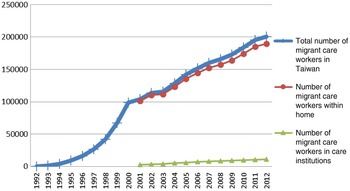
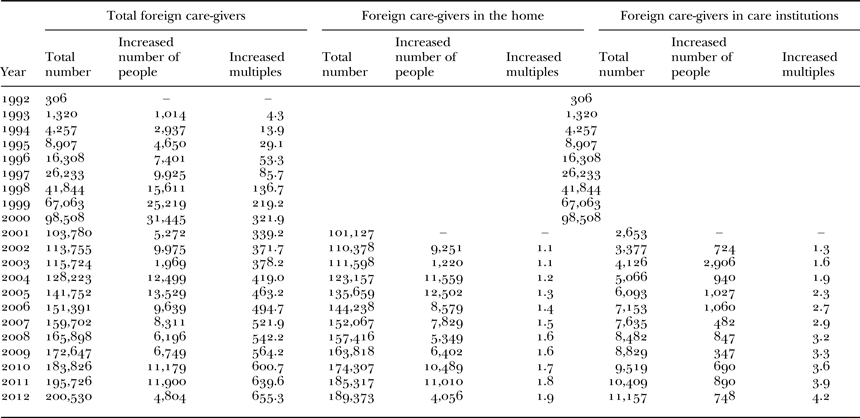
For these reasons, when the secondary care market introduced foreign care-givers in Taiwan, foreign home care-givers encountered occupational vertical segregation due to the conditions in their work spaces. The key factor of such segregation is that they are excluded from the schemes of the Labour Standards Act. As previously stated, one of the key factors of occupational segregation is the industry scale. Despite foreign care-givers’ understanding that Taiwan's secondary care labour market is divided into interior and exterior markets, why do they not choose to work in the secondary interior market? Regardless of the number of foreign workers employed by care institutions having increased since 2001 (see Figure 2), when compared to the industry scale of home care-givers, the secondary care labour market has provided more employment opportunities for foreign workers as home care-givers. As shown in Table 2, a significant difference between the number of home care-givers and institutional care-givers, as well as most employers in Taiwan's secondary care labour industry seeking home care-givers, can be seen.
Trends and variation of foreign care-givers within the home versus care institutions. Source: Council of Labour Affairs and Bureau of Employment and Vocational Training (http://statdb.mol.gov.tw/statis/jspProxy.aspx?sys=210&kind=21&type=1&funid=c13090&parm1=code1=0).

The number of foreign care-givers employed within the home versus care institutions, 1992–2012
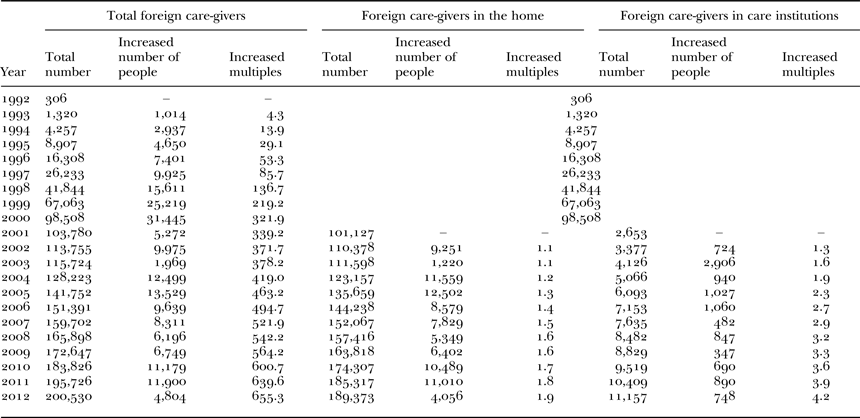
Source: Council of Labour Affairs and Bureau of Employment and Vocational Training (http://statdb.mol.gov.tw/statis/jspProxy.aspx?sys=210&kind=21&type=1&funid=c13090&parm1=code1=0).
In fact, Taiwan introduced strict laws for foreign care-givers in the secondary care labour market. First, when a care institution hires foreign care-givers, the total number of foreign workers cannot exceed that of Taiwanese care-givers; the number of these two does not correspond to one another, so in principle there should be fewer foreign care-givers than Taiwanese. Second, when a foreign home care-giver runs away, the employer can apply for another care-giver after six months. In contrast, when an institutional foreign worker runs away, the institution can re-apply only after finding the worker and his or her deportation has been filed. This has effectively controlled the growth of the number of institutional foreign care-givers, leading to a major imbalance between the two workplaces.
Conversely, from the perspective of institutional employers, as all care-givers in institutions are included in the schemes of the Labour Standards Act, this reduces the employers’ willingness to hire foreign workers. For instance, a director from a care institution mentioned that,
Before foreign workers were included under the Labour Standards Act, their salary was fixed at NT $15,840, and there was no overtime pay … Nowadays, the salary difference has been shrinking annually.Footnote 1 If employers ask them to work overtime, they might not agree to it … Even if employers force them, these workers will make telephone complaints [to the Council of Labour Affairs (CLA)] and increase staffing costs!
Additionally, when the authorities carry out evaluations on care institutions, the work shift arrangements and accommodation are included as indicators. Unlike the work conditions for home care-givers, which are rather difficult to evaluate, those for care institutions are governed by more regulations and monitored much more frequently. Based on these many factors, this persuades institution owners to hire foreign workers and further influences the scale of the secondary interior labour market, costing those foreign workers who wish to join this labour market much more time to enter it. Also, although minor, because secondary interior market workers’ salaries are much higher than those of foreign home workers, brokerage fees also are significantly more, which has prompted many foreign workers to enter the secondary exterior labour market instead.
One reason the scale of the secondary exterior labour market has enlarged gradually is that home care-givers are not protected by the Labour Standards Act and their salary has been NT $15,840 since 1992. The other key factor is that the application and hiring processes for foreign home care-givers is rather subjective, and have been amended several times, with two core ideas included. First, it is hoped that the introduction of foreign care-givers could be regulated through severity of disability and that the Barthel Index would evaluate the needs of care services, and that professional medical staff carry out evaluations. However, clients’ reported physical functions might differ from those observed in their daily lives. In addition, individual physical function can vary at any moment, sometimes due to personal motivation or a lack of personal interest, physical inability, limited support given by the environment or assistive devices, etc. For example, a client may appear to be more helpless when being evaluated for home health-care services, but appear much stronger and able when family members desire he or she move into a care facility (Pearson Reference Pearson, Kane and Kane2000). Thus, when clients fail to perform certain physical functions, observers cannot truly distinguish the reasons contributing to such failures. A physiatrist thus elaborated on her difficulties and awkwardness while carrying out the evaluation:
It is difficult to evaluate many items in this [Barthel Index]. For instance, when it comes to using the lavatory, I am able only to ask patients if it is possible for them to do it by themselves. Patients provide answers in accordance with how they wish to be diagnosed.
A neurologist also describes the limitations of using the Barthel Index in medical facilities. She expressed that
Appointments are usually very rushed. Patients waiting outside wish to come in sooner; when you talk with one patient longer, those waiting outside will come in to check on you. When family accompanies patients to their appointments, even though you wish to evaluate them yourself, family members most often occupy the doctor's time, describing the patient's situation, their perceived symptoms and problems, etc. How can I know if the patient can truly eat by himself or not? Sometimes we will arrange for patients to be hospitalised for a few weeks for further observation. However, this is rather difficult for us!
The above interview data show the difficulty for doctors to use the Barthel Index to evaluate clients’ care needs because these spaces are rather different from clients’ home environments. Likewise, whether evaluations are completed by direct observation, designated answers or self-evaluation, physical capabilities might not be evaluated on the same basis, especially when the results are used as the basis for service applications. It can also be expected that service receivers will fake their ability or refuse to perform certain physical functions. In fact, several interviewees explained how they decided to hire foreign care-givers: ‘We thought that if we hired a foreign care-giver, at least the patient would feel safer seeing there was someone there to look after her, and we would feel more at ease!’ This indicates that ‘protective oversight’ is used as an excuse to break away from legal bindings. Therefore, unlike the severe staffing control mechanism in care institutions, evaluations on foreign care-givers are more subjective and flexible. These reasons have encouraged more employers to increasingly hire foreign workers and contributed to the growth of the secondary exterior market.
One of the social costs of excluding foreign care-givers from the secondary interior labour market is that many foreign home care-givers have run away due to the burdens of providing the required care servicesFootnote 2 (Lan Reference Lan2006; Ma and Tu Reference Ma and Tu2010). Additionally, employers’ abuse of foreign care-givers lowers care quality. From my interviews, many employers reported accidental falls due to care-givers’ insufficient sleep and inability to fulfil their responsibilities carefully.
According to the Employment Standards for Hiring Foreign Care-givers, most clients have to be bed-ridden and highly dependent on help, and more than 90 per cent have gastric tubes or bladder catheters and require intensive care. The interviewed home health organisations reported that care-givers themselves sometimes replace gastric tubes in order to prevent additional punishment or unfair treatment from employers. Moreover, if care-givers and employers lack the necessary care-giving know-how or skills, clients more often show complications such as pressure sores, urinary tract infections (UTIs) or pneumonia; in some cases, bladder catheters are improperly disinfected, leading to UTIs, increasing the probability of clients being re-admitted to hospitals, and possibly worse (Huang et al. Reference Huang, Chau, Hsiao, Huang, Wang, Tseng and Chen2003).
To understand better why care-givers take charge of nursing care (e.g. replacing tubes), I asked foreign care brokers if they were aware that these actions were illegal. One broker indicated that it is ‘heartbreaking for me to see that foreign care-givers need to be trained to work independently [dealing with tubes], or they are considered unqualified care-givers! I have always told employers not to demand that foreign care-givers suction phlegm or replace nasogastric tubes!’ In short, brokers report that employers still prefer to hire foreign home care-givers, regardless of the risks and lower quality of service. This indicates that although the authorities have set up regulations to restrict foreign care-givers from performing medical care, in practice foreign home care-givers are supervised by family members who function as care supervisors, and are expected also to perform technical medical care (Ayalon Reference Ayalon2009b ).
In sum, foreign institutional care-givers entering the secondary care industry are regulated by the Labour Standards Act, which has divided the labour market into interior and exterior markets and formed a vertical occupation segregation. Foreign institutional care-givers are insiders, whose salary, work hours and benefits are protected by the Act. In contrast, foreign home care-givers, excluded from such protection, are expected to obey all employers’ requests. This has shown that the actual application of the Act not only influences preferences for hiring and the industry scale but also directly impacts foreign care-givers’ work conditions.
Horizontal segregation among Taiwanese and foreign institutional care-givers
In response to the difficulty of hiring Taiwanese care-givers and the instability of the staff, in 1999 the government finally agreed that care institutions could hire foreign care-givers as supplementary workers as long as their number does not exceed more than half of that of Taiwanese care-givers, also thereby qualifying them for coverage under the Labour Standards Act (Wang Reference Wang2012).
When Taiwanese and foreign care-givers work alongside one another in the secondary interior care labour market, and if the government enforces the equal distribution of these two care-giver types, it is questionable whether the work conditions are truly equal. Additionally, if foreign care-givers are categorised based on workplace, when they live with employers, the care services provided are enlisted as home care services. However, for many years, the government has prohibited home care institutions from hiring foreign care-givers, revealing an attempt to construct a clear market segregation between Taiwanese and foreign care-givers in the so-called home spaces, and thus resulting in vertical occupational segregation and dual systems for Taiwanese and foreign care-givers in the secondary home care labour market (Chen Reference Chen2011a ). So, do such measures truly guarantee and protect Taiwanese home care-givers’ employment opportunities? Also how do such measures influence Taiwan's LTC system?
In other studies, the occupational segregation among Taiwanese and foreign care-givers through the differences in salary and job were analysed. This salary regulation, for example, being slightly higher than that in other Asian countries, has become a key factor for attracting foreign care-givers to Taiwan. Ironically, the Taiwanese minimum wage has thus become the highest wage for all of Taiwan's foreign workers (Fan Reference Fan2005; Lan Reference Lan2006).
A care institution owner confessed to dividing care-givers into three categories. Taiwanese care-givers receive the highest wage, approximately NT $30,000, followed by foreign spouses (merely legal residents due to their local marital status), about NT $25,000, and last, foreign care-givers, roughly NT $20,000. But in terms of the job content, care institutions wish to make the best use of foreign care-givers. During my visits to institutions, in order to reduce staffing costs, foreign care-givers also frequently were expected to do kitchen work. However, according to the Establishment Standards for Care Institutions, kitchen workers must possess professional culinary certification, which includes at least eight hours of annual nutritional and sanitation training. In addition, as the ages of Taiwanese care-givers are on average higher, care institutions have divided the tasks in adaptation to the advantages of these two types of care-givers: Taiwanese care-givers’ tasks tend to require less physical strength and focus on language expression, such as feeding or accompanying care receivers to hospital appointments. In fact, many request to be assigned less physically strenuous tasks. They also expect better and more stable work shifts. ‘Foreign workers have no families to care for, so they can work any time’ is a common sentiment among Taiwanese care-givers and managers. Also as foreign care-givers, by contrast, are typically younger and in better health, their tasks are related mostly to direct care which requires physical strength, such as turning, moving and bathing care receivers.
During an interview, when asked how tasks are divided among foreign and Taiwanese workers, the owner asked me to listen carefully to see if I could distinguish between the features of this institution. In fact, she wanted me to listen to the sounds created from patting the service receivers, which had lasted since my arrival. She expressed proudly, ‘This is why my institution has great service quality. I ask [foreign care-givers] to assist service receivers in turning and patting their backs four times per day, each time for 30 minutes. You cannot demand a Taiwanese care-giver to do so…’ These foreign care-givers also frequently work overtime, sometimes 12 hours straight.
In addition to work hours and job content being unequal, the regulations governing numbers of care-giver positions also benefit Taiwanese workers. In practice, some Taiwanese care-givers do not actually work in the institutions; rather, like independent contractors, they are outsourced to work in hospitals for NT $2,000 a day. Institution owners pay for Taiwanese care-givers’ labour and health insurance in exchange for their professional certification, and to balance the Taiwanese–foreign care-giver ratio. In response, many owners agreed: ‘We have to. Otherwise we will be unable to hire foreign workers!’ In fact, this situation means that institutions lack manpower and results in foreign workers taking on much heavier workloads, and Taiwanese taking further advantage of the system.
However, the insufficient staffing and the demands for highly physical work are part of the reason for foreign care-givers’ running away (Lan Reference Lan2006; Wang Reference Wang2012); additionally, this leads to decreased care quality and damage to the rights of the service receivers. One owner of a care institution confessed that when foreign workers are too tired or homesick, responsive strategies include abusing service receivers, such as hitting or pinching them. Despite the care institutions’ attempts to prevent such behaviours through amends or statements of repentance, such phenomena indicate that this is the cost that care institutions must bear when employing foreign care-givers.
Vertical occupational segregation of Taiwanese and foreign home care-givers
Regarding the governmental strategies on the introduction of foreign care-givers, the home care industry has been divided into two labour markets. Foreign care-givers providing home care are not protected under the schemes of the Labour Standards Act, considered outsiders in the secondary exterior care labour market in this research. The others, insiders, are Taiwanese home care-givers, protected and receiving in addition benefits such as 90 hours of government-subsidised pre-vocational training. They also are paid hourly, at NT $180 per hour.Footnote 3 Their job responsibilities are confirmed through a service contract signed by the supervisor and employer; if disputes with employers arise, supervisors will negotiate on their behalf. This means that their work conditions and job content are clear and protected.
In contrast, to ‘punish’ households that choose to employ foreign care-givers, the government has also strictly excluded these types of households from receiving subsidies for long-term home care services.Footnote 4 In other words, if a household replaces its Taiwanese home care-giver with a foreign worker, the subsidy for in-home services ends. The same is true for households who choose to hire foreign care-givers in addition to their pre-existing Taiwanese home care-givers. This illustrates the government's hope for guaranteeing the employment opportunities of Taiwanese home care-givers through the dual system of in-home care services.
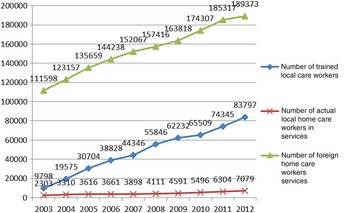
However, Figure 3 shows that the actual number of home care-givers is still very small despite various training courses being held each year. Taking 2012 as an example, only 7,079 Taiwanese care-givers remained in home care, which accounts to 8.4 per cent of the total trainees and less than 3.7 per cent of the total number of foreign home care-givers. This means that the occupational segregation installed by the government does not guarantee the protection of employment opportunities, and that Taiwanese home care-givers have actually been replaced by foreign workers.
A comparison of the number of trained Taiwanese care-givers, actual Taiwanese care-givers in home service and foreign care-givers within the home. Source: Council of Labour Affairs and Bureau of Employment and Vocational Training (http://statdb.mol.gov.tw/statis/jspProxy.aspx?sys=210&kind=21&type=1&funid=c13090&parm1=code1=0).

In fact, various employers have experience hiring Taiwanese home care-givers. During my interviews, the CLA's ‘Employment Plan for Taiwanese Care-givers’, including a monthly subsidy of NT $10,000 per month for one year, was offered to employers to help persuade them to hire Taiwanese care-givers. Yet, most employers still complain about Taiwanese home care-givers being paid hourly and that these services are provided mostly during the daytime only. This is especially important for employers with full-time jobs as it is exhausting for them to need to provide care after work or wake up in the middle of the night several times. Ms Huang, an interviewee, elaborated on hiring a foreign worker instead of a Taiwanese home care-giver:
At the time, I had a Taiwanese care-giver. But she was not a member of my family, so I could not leave all the responsibility to her. In addition, Taiwanese care-givers only look after patients; they don't do housework. I am really tired after work and I still need to pick up my children and look after their homework, so I really don't have the time and energy to do more [care]…
While Taiwanese care-givers identify their work clearly through legal regulations related to home care services, the 24/7 services provided by foreign care-givers, as well as their disadvantaged positions, have prompted employers to demand obedience from foreign care-givers. An employer thus described how her father-in-law expected care from foreign care-givers:
No matter how hard-working Taiwanese care-givers can be, they aren't as obedient as foreign care-givers. In addition, Taiwanese care-givers will do nothing but care for their patients … they will not help with laundry, meal preparation and cleaning, etc. She will only take care of the patient. Take the foreign care-giver working for us as an example: she will massage my father-in-law four times per day to prevent atrophy in his feet, take care of all the housework, and prepare all the meals and snacks. This will also cheer him up. In addition, when elders are sick, they are frequently depressed and might scold and insult others. Taiwanese care-givers cannot endure such situations, especially elders who swear a lot.
In fact, a long-time feature of the secondary labour market lies in its high turnover rate. However, when foreign care-givers were introduced to the secondary labour market, the government deprived them of mobilisation within the Taiwanese labour market and pushed them towards the most disadvantaged positions. As expressed above, according to the Employment Services Act, foreign workers can work for only the employers specified in their contracts; they are allowed to switch employers only under special circumstances. When they cannot switch employers legally, foreign workers can choose only to either endure the unfair treatment or run away (Liu Reference Liu2000). The regulations that disallow foreign workers from switching employers not only assist employers by providing an advantaged position over their employees but also thus reduce the turnover rate in the secondary labour market. Also due to home care employers being able to apply for new foreign care-givers following a care-giver running away, foreign home care-givers are considered disposable in the related policies.
The actual political strategy for home care is to divide the secondary labour market in two based on care worker nationality, providing free pre-job training, protection under the Labour Standards Act and supervision for Taiwanese home care-givers. In addition, foreign home care-givers’ employers are ‘punished’ through the deduction of service subsidies. Such dual LTC systems not only transformed foreign home care-givers into cheap and disposable labourers but also made it extremely competitive for Taiwanese care-givers due to said benefits. Finally, despite the government's proposed subsidies and punishment measures, the data presented in Figure 3 indicate that in the last 23 years, employers have given up hiring Taiwanese home care-givers for hiring foreign home care-givers, who are more obedient and lack the bargaining power. This proposed benefit system has actually also resulted in a disadvantage for Taiwanese home care-givers.
Conclusion and policy implications
As in many developed countries, paid care of the older individuals in Taiwan is increasingly taking place in institutional and household spaces. Although each country has different care systems for elder-care, the literature refers more to domestic/household foreign care workers rather than those providing care in institutions (Cuban Reference Cuban2013: 9–10). In fact, workplace exploitation is ‘rife’ in the care sector, and that is related to the lack of labour rights enforcement for its migrant workers (Cuban Reference Cuban2013: 17). Taiwan's case shows that the policies have divided the secondary labour market into institutions and home spheres, allowing foreign care-givers only within care institutions protection under the Labour Standards Act. Furthermore, this results in care-givers being segregated into three levels: the worst, foreign home care workers, followed by foreign institutional care workers and, finally, Taiwanese care-givers, regardless of work location. Additionally, as the policies have provided employers a high level of control over foreign home care-givers and enlisted measures allowing employers to re-apply for supplementary workers after a foreign worker runs away, after six months, foreign home care-givers have become the cheapest, most obedient and most adaptable products in the secondary care labour market. In the end, although these policies were expected to deliver greater quality of care, the result is Taiwanese home care-givers having become much less competitive in the same market because these jobs have been filled by foreign care-givers. This phenomenon is consistent with that of Duffy, Armenia and Stacey (Reference Duffy, Armenia and Stacey2015), who argue that the distribution of care workers in these jobs is linked to class, race, ethnicity and citizenship, and that the experiences of providing paid care are universal and vary considerably depending on who is providing care, where and under what conditions.
The essence of Taiwan's LTC policies is to introduce foreign home care-givers as supplementary workers. Improving the work conditions therefore is aimed at encouraging more qualified Taiwanese workers to join the care market. But more than 200,000 foreign care-givers had joined the care services as of 2013, indicating that foreign care-givers are no longer supplementary; they have a significant role in replacing Taiwanese workers in Taiwan's LTC industry.
Several publications on the secondary care labour market proclaim that local employees should be introduced to the market through various incentives. These articles, which emphasise more the training and retaining of local workers, rarely take sides with employers or provide further analysis on employers’ strategies in selecting care-givers for different working conditions (Brannon et al. Reference Brannon, Barry, Kemper, Schreiner and Vasey2007; Colombo et al. Reference Colombo, Llena-Nozal, Mercier and Tjadens2011; Kemper et al. Reference Kemper, Heier, Barry, Brannon, Angelelli, Vasey and Anderson-Knott2008). This article reviews the historical transformation of how foreign care-givers gradually replaced local care-givers in Taiwan and asserts that two types of occupational segregation have prompted foreign home workers being favoured by employers in Taiwan's secondary care labour market. As Cuban (Reference Cuban2013: 199) has noted, markets and states exert indirect control through setting qualification standards and by defining ‘skill’ in the care labour market, but pay gaps have led to an over-supply of care in the global action. This occupational segregation, separating the ‘skilled’ from the ‘less skilled’ or ‘unskilled’, and the accompanying discrepancies in pay, is very much at play in Taiwan's LTC system.
In care institutions, despite foreign and Taiwanese care-givers both being treated as insiders, the government has controlled the division of labour between Taiwanese and foreign institutional care workers in terms of the number of employees. However, without proper understanding of how institutions make use of care-givers, the government has overestimated how the current system would protect the employment of Taiwanese care-givers and underestimated the horizontal occupational segregation of foreign care-givers.
On the other hand, instead of accusing employers of exploiting foreign care-givers, i.e. overworking them and asking them to go beyond their job descriptions, it is important to understand the conflicts and struggles service receivers and their family members face in using the various LTC services. Facing the policy's dual system forces care receivers to choose between two unsatisfactory options, each with its own service quality inadequacies, and the more preferred one involving serial exploitation of foreign care-givers. Thus, the LTC policy should not be based on the traditional bias in which ‘foreign care-givers have stolen Taiwanese care-givers’ employment opportunities’. Rather, it is more imperative to face the fact that foreign home care-givers have become the main service providers in the in-home care services in Taiwan's current LTC system. Since 1992, the policies have shown that such occupational segregation does not promote hiring Taiwanese care-givers but rather encourages hiring workers who can meet employers’ specific care needs at a lower cost. In the end, this exploitation of foreign care-givers has resulted in an increased number of runaway workers.
Following the claim of Huang, Yeoh and Toyota (Reference Huang, Yeoh and Toyota2012), this case study also shows that the ‘particularistic’ associations between nationality and work location should be put to rest. The gap between the dual care system and workforce regulations clearly has resulted in occupational segregation in the secondary care labour market. Practically speaking, rather than maintaining the current dual system, this research advocates that foreign home care-givers should be made insiders, equally protected by labour regulations. In other words, only when the management, training and work conditions of foreign care-givers are equal to those of local care-givers will the former be protected, allowing service receivers to choose care-givers without exploiting foreign care-givers, and therefore also guaranteeing more employment opportunities to local care-givers and an improvement in the overall quality of care.
The phenomenon of ‘insiders and outsiders’ is rather introspective for long-term policies and workforce development. The occupational segregation policy not only blocks the rights of foreign care-givers from changing employers freely but also encourages employers to choose the most beneficial labour product. It is, therefore, hoped that the imbalance in occupational segregation in the secondary care labour market will be corrected by amending the policy. More importantly, it is hoped that the government will do away with the doctrine that ‘foreign workers are supplementary workers’.