Introduction
Monogeneans are among the most common parasites of marine, brackish and freshwater fish. They have a simple direct life cycle without any requirements for intermediate hosts, and new hosts can be infected by tiny, free-swimming, ciliated larvae, or oncomiracidia (Kearn, Reference Kearn2014). Gyrodactylids, however, are the exception to this, by giving birth to unciliated individuals similar in size to the parent (Kearn, Reference Kearn1998). The simplicity of the life cycle allows gyrodactylids to invade new hosts and habitats with their hosts (Kennedy, Reference Kennedy, Pike and Lewis1994; Mo, Reference Mo, Pike and Lewis1994). Gyrodactylus alviga Dmitrieva et Gerasev, 2000 is a generalist species registered from many Black Sea fishes, but whiting is known to be its main host (Dmitrieva & Gerasev, Reference Dmitrieva and Gerasev1997). It is the only monogenean parasite reported so far on the gills of whiting Merlangius merlangus in the Black Sea. This fish species is widely distributed in the eastern North Atlantic Ocean, the northern Mediterranean, western Baltic and the Black Sea (International Council for the Exploration of the Sea, 2006). It is particularly distributed along Romanian, Bulgarian, Turkish, Ukrainian and Caucasus coasts in the Black Sea (Burdak, Reference Burdak1960; Svetovidov, Reference Svetovidov1964; Gönener & Bilgin, Reference Gönener and Bilgin2010; Özer et al., Reference Özer, Öztürk, Kornyushin, Kornyychuk and Yurakhno2014).
The objective of the present study was to investigate the infection levels of G. alviga on whiting, M. merlangus (L., 1758) from the Turkish and Russian Black Sea coasts, to provide an ecological analysis of G. alviga in both locations for the first time.
Materials and methods
Whiting samples were collected from May 2011 to March 2014 from commercial fishing vessels in the Black Sea off Sinop, in Turkey, and Balaklava Bay, in Russia. In total, 690 fish from Turkey and 423 from Russia were measured to the nearest centimetre of total length and then examined for parasites. Fish were transferred to the laboratory and, using conventional methods, they were examined for parasites, which were identified and counted by screening whole smears of the skin, fins and gills using a light microscope at × 100 magnification. Malmberg's stain (ammonium picrate glycerine) was applied for preparing and mounting parasite specimens, according to Malmberg (Reference Malmberg1957), and special care was taken to obtain completely flattened individuals. Taxonomic features indicated by Malmberg (Reference Malmberg1970) in discriminating parasites to species level were followed. The gyrodactylid species was identified after Dmitrieva & Dimitrov (Reference Dmitrieva and Dimitrov2002) using an Olympus microscope (BX53; Olympus, Tokyo, Japan) at × 400. The prevalence, mean intensity and mean abundance values were determined according to Bush et al. (Reference Bush, Lafferty, Lotz and Shostak1997). Quantitative Parasitology 3.0 software (Reiczigel & Rózsa, Reference Reiczigel and Rózsa2005) was used to calculate Sterne's exact 95% confidence limits for prevalence, bootstrap 95% confidence limits (number of bootstrap replications = 2000) for mean abundances, mean intensity, variance to mean ratio and exponent of the negative binomial (k). Differences in prevalence values between two fish populations from two sampling locations and between two fish sexes were determined by the exact unconditional test, which maintains the prescribed type I error rate and has a higher statistical power in a small sample size (N < 100). Differences in prevalence values between sampling seasons, age and length categories were determined using the Fisher's exact test, while the differences in mean abundance and intensity were performed by the bootstrap two-sample t-test.
Results
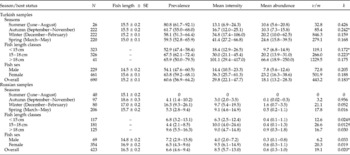
Gyrodactylus alviga Dmitrieva et Gerasev, 2000 was the only monogenean identified on the gills, skin and fins of whiting M. merlangus collected from Sinop and Balaklava Bay in the Black Sea. Infection parameters of the 690 fish from Sinop and 423 fish from Balaklava Bay were determined (table 1). Prevalence of infection, mean intensity and mean abundance values in Turkish samples were higher than those in Russian samples. These results suggested that propagation of G. alviga in the Turkish population was more successful than that of the Russian population. Distributions in both fish species are aggregated, displaying a typical negative binomial pattern.
Levels of infection of Gyrodactylus alviga on the whiting, M. merlangus, from the Turkish and Russian coasts of the Black Sea during 2011–2014. N, number of fish examined; fish length given ± standard error; CI, 95% confidence intervals, given in parentheses; v/m, variance/mean ratio.

*, Level of significance with P < 0.05; †, sample numbers too small for statistical analysis.
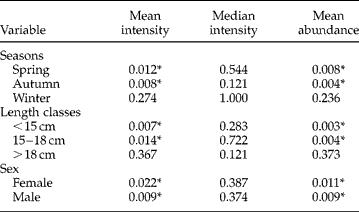
Seasonal prevalence, mean intensity and mean abundance values of G. alviga infecting M. merlangus at both localities were determined (table 1). Seasonal prevalence was between 58.1% and 80.8%, mean intensity was between 13.1 and 41.4, and mean abundance was between 10.3 and 24.6 in the fish samples from the Turkish coast. When the samples from the Russian coast were evaluated in terms of these infection indices, seasonal prevalence was found to be between 4.1% and 16.3%, mean intensity was determined to be between 3.0 and 9.7, and mean abundance was between 0.1 and 1.6. It must be mentioned that G. alviga was not determined in summer samples from the Russian coast. Seasonal differences in prevalence and median intensity (variable) of G. alviga in Turkish and Russian samples were compared (table 2). While there was no statistically significant difference in prevalence (P= 0.156) and median intensity (P= 0.233) between seasons in Turkish samples, there were significant differences in prevalence (P= 0.006) between seasons in Russian samples. Seasonal differences in prevalence, mean/median intensity and mean abundance of G. alviga between Turkish and Russian samples were compared (table 3). Statistically significant differences between sampling locations were determined in prevalence (P< 0.05), mean intensity (P< 0.05) and mean abundance (P< 0.05) values in spring and autumn, and there were significant differences only in prevalence (P< 0.05) values in winter. However, median intensity did not change according to seasons in both of the localities. These data were not compared in summer as Russian samples did not yield any infection.
Comparative statistical differences in prevalence, mean intensity, median intensity and mean abundance of G. alviga in Turkish and Russian samples relative to season, fish size and sex.

*, Level of significance with P < 0.05.
Comparative statistical differences in mean intensity, median intensity and mean abundance of G. alviga between Turkish and Russian samples relative to season, fish size and sex. Differences in all prevalence (%) values were significant at P < 0.05.
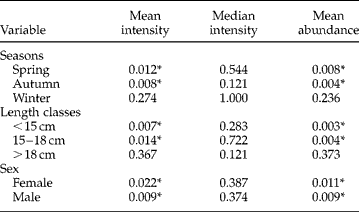
*, Level of significance given as P < 0.05.
Prevalence, mean intensity and mean abundance values of G. alviga infecting three length classes of M. merlangus at both localities were determined (table 1). Prevalence was between 52.9% and 67.5%, mean intensity was between 18.4 and 101.1, and mean abundance was between 9.7 and 66.6 in samples from the Turkish coast. On the other hand, for fish samples from the Russian coast, prevalence was between 4.4% and 9.6%, mean intensity was 6.3 and 10.0, and mean abundance was 0.4 and 0.9. The differences in prevalence, mean/median intensity and mean abundance of G. alviga between Turkish and Russian samples in terms of fish-length classes are compared (table 3). Statistically significant differences between sampling locations were determined in prevalence (P < 0.05), mean intensity (P < 0.05) and mean abundance (P < 0.05) values in fish-length classes of < 15 cm and 15–18 cm. There were significant differences only in prevalence values (P < 0.05) in the fish-length class of >18 cm. However, median intensity did not change in the fish-length classes from both of the localities.
Prevalence, mean intensity and mean abundance values of G. alviga infecting different sexes of M. merlangus at both localities were determined (table 1). All of the above-mentioned infection indices between female and male whiting in Turkish samples had statistically significant differences (P< 0.05) (table 2); however, the difference between female and male whiting in Russian samples was not statistically significant (P> 0.05) (table 2). Differences in prevalence, mean/median intensity and mean abundance of G. alviga between Turkish and Russian samples in terms of the sex of fish were compared (table 3). The differences were statistically significant between sampling locations in prevalence (P< 0.05), mean intensity (P < 0.05) and mean abundance (P< 0.05) values in females, as well as in males. However, median intensity did not change in female and male fish groups from both of the localities (table 3).
Discussion
The present study has revealed, for the first time, the seasonality and host–parasite interrelationships of G. alviga found on the gills, skin and fins of whiting M. merlangus, and compared its occurrence between two geographically distant southern and northern localities of the Black Sea. Dmitrieva & Gerasev (Reference Dmitrieva and Gerasev1997) reported that G. alviga was the only monogenean infecting whiting in the Black Sea, and the results were the same in our 3-year period of research study. Williams & Jones (Reference Williams and Jones1994) noted that monogenean parasites of fish exhibited a high degree of host specificity, leading to infection of most fish species by one or more specific parasites. This assumption suited well the G. alviga–M. merlangius host–parasite interaction in the Black Sea.
In general, gyrodactylids reproduce continuously throughout the year (Özer et al., Reference Özer, Öztürk and Öztürk2004). However, studies on the seasonal occurrence of Gyrodactylus species show that there is a strict influence of temperature on the prevalence and intensity of infections, which generates a definite seasonal cycle of the parasite (Özer et al., Reference Özer, Öztürk and Öztürk2004). While some species show a maximum prevalence in spring (Molnar, Reference Molnar1968; Lux, Reference Lux1990), others show this high prevalence in summer (Jensen & Bakke, Reference Jensen and Bakke1991; Mo, Reference Mo1992) or in winter (Harris, Reference Harris1982; Dmitrieva, Reference Dmitrieva1997). Gyrodactylus alviga occurred all year round in Turkish samples; however, its occurrence showed a seasonal pattern in Russian samples, where winter was the season with the highest prevalence and intensity of infection. These results clearly indicate that the reproductive ability of G. alviga is not so affected by environmental factors, especially by temperature which is accepted to be the major triggering factor for gyrodactylid infections, as reported by the above-mentioned authors. The results of this study also correspond with the fact that Gyrodactylus spp. are cold-water parasites and are known to demonstrate peaks of abundance in the Black Sea at about 18°C (Dmitrieva, Reference Dmitrieva1997). Overall, infection values determined in the present study were about 3–7 times higher in Turkish samples than in Russian samples, and the differences were mostly statistically significant. More than 85% of the total amount of whiting harvested in the Black Sea is caught in Turkey, mainly near Sinop, while other Black Sea countries use only a small part of whiting stocks. Thus, it can be assumed that the larger stock size of whiting off the coast of Sinop than in Balaklava Bay might be affecting the infection pattern of whiting with G. alviga. Schooling behaviour of hosts is affected by breeding, along with seasonal temperature, and is an important factor for the increase in parasite populations. Direct contact is one of the main routes for gyrodactylid infections, and it might be another reason for higher prevalence and intensity levels, a fact that corroborates the results of this study. It is also known that the Black Sea whiting is divided into different populations due to their reproductive isolation, which is determined by spatially isolated spawning areas (Burdak, Reference Burdak1960), and thus regional differences were expected in the component structure of the Black Sea whiting parasites.
One of the most important factors influencing the composition of the parasite fauna is age or size of the host (Özer & Öztürk, Reference Özer and Öztürk2005). The results of this study indicated that larger hosts had more infection and a higher parasite load. Similarly, in a study by Cable & van Oosterhout (Reference Cable and van Oosterhout2007), it was proved that Gyrodactylus spp. continued to proliferate on relatively large strains of several guppy (Poecilia reticulate) hosts. In their study, it was also revealed that higher mortality rates occurred in larger hosts. However, it was not possible for us to test this finding as the fish were collected for this study from the wild. In some cases, this may simply reflect the fact that larger fish were more susceptible to gyrodactylids because of the availability of surface area for attachment, and larger hosts provide more nutrient resources and space which, in turn, promote parasite growth. In the present study, larger length classes of whiting had higher infection indices than that of the smallest length class, in both Turkish and Russian samples. Anderson & Gordon (Reference Anderson and Gordon1982) reported that the higher parasitism observed in larger fish over smaller ones might be a result of change in diet of the fish and higher activity involved in the search for food. Morsy et al. (Reference Morsy, Abdel-Monem, Abdel-Ghaffar, Bashtar, Al-Ghamdi and Abdel-Gaber2011) also found similar results, indicating that larger fish were able to compete better for food than the smaller fish groups, which meant that when there is more contact with food there is a higher tendency to become infected with parasites.
Differences in parasitic infections on fish of different sexes have been suggested to be of behavioural and physiological origin (Pickering & Christie, Reference Pickering and Christie1980; Esch et al., Reference Esch, Kennedy, Bush and Aho1988), and susceptibility to parasites is greater for some species of fish during the reproductive period (Machado et al., Reference Machado, Almeida, Pavanelli and Takemoto2000). In the present study, significant differences were observed in the prevalence and intensities of G. alviga between females and males of whiting in Turkish samples. On the other hand, there was no difference in prevalence and intensities between the sexes in Russian samples. In detail, the prevalence of infection calculated for female fish was higher, with a statistically significant difference, in Turkish samples and the situation was the reverse in Russian samples, in which male fish had a higher prevalence of infection, without any significance. In addition, it is clear in this study that female fish had higher parasite intensities at both localities, and this could be the result of higher activity of females in the search for food and larger surface area of female fish than that of males of the same age/length, which enables parasite settlement and attachment for food. There are, on the other hand, several studies reporting a lack of differences in infection intensities of monogenean gill parasites between host sexes (Özer, Reference Özer2002; Siqueira et al., Reference Siqueira, Seriani, Ranzani-Paiva, Romagosa, Paiva and Andrade-Talmelli2002; Özer et al., Reference Özer, Öztürk and Öztürk2004; Ferrari-Hoeinghaus et al., Reference Ferrari-Hoeinghaus, Takemoto, Oliveira, Makrakis and Baumgardner2006).
In conclusion, G. alviga infected the gills, skin and fins of whiting, in contrast to the general assumption of gyrodactylids being the skin parasites of their hosts. Infection occurred all year round off the coast of Turkey and a more seasonal appearance was determined off Russian coasts; winter and spring being the most appropriate seasons at both sampling localities. Larger length classes of Black Sea whiting provided more space for the settlement and food supply for G. alviga, along with a significant effect of host sex on the parasite's occurrence in Turkish samples only. In the present study, higher infections obtained from Turkish samples than from Russian samples may reflect the fact that whiting populations at both sampling localities are different, as a result of their reproductive isolation determined by spatially isolated spawning areas, and as a result, regional differences can be expected in the infection structure of the Black Sea whiting parasites.
Acknowledgements
The comments provided by the anonymous reviewers are gratefully acknowledged. The authors express their gratitude to the engineer Andrew Zavyalov of the Institute of the Biology of the Southern Seas in Sevastopol for technical assistance in the processing of fish for parasitological research. Authors also thank to the Sinop University Academic Writing Centre for their corrections to the text.
Financial support
The authors are grateful to the Scientific and Technological Research Council (TÜBİTAK) of Turkey and National Academy of Sciences (NASU) of Ukraine for their financial support (project number 110O475).
Conflict of interest
None.