1. Introduction
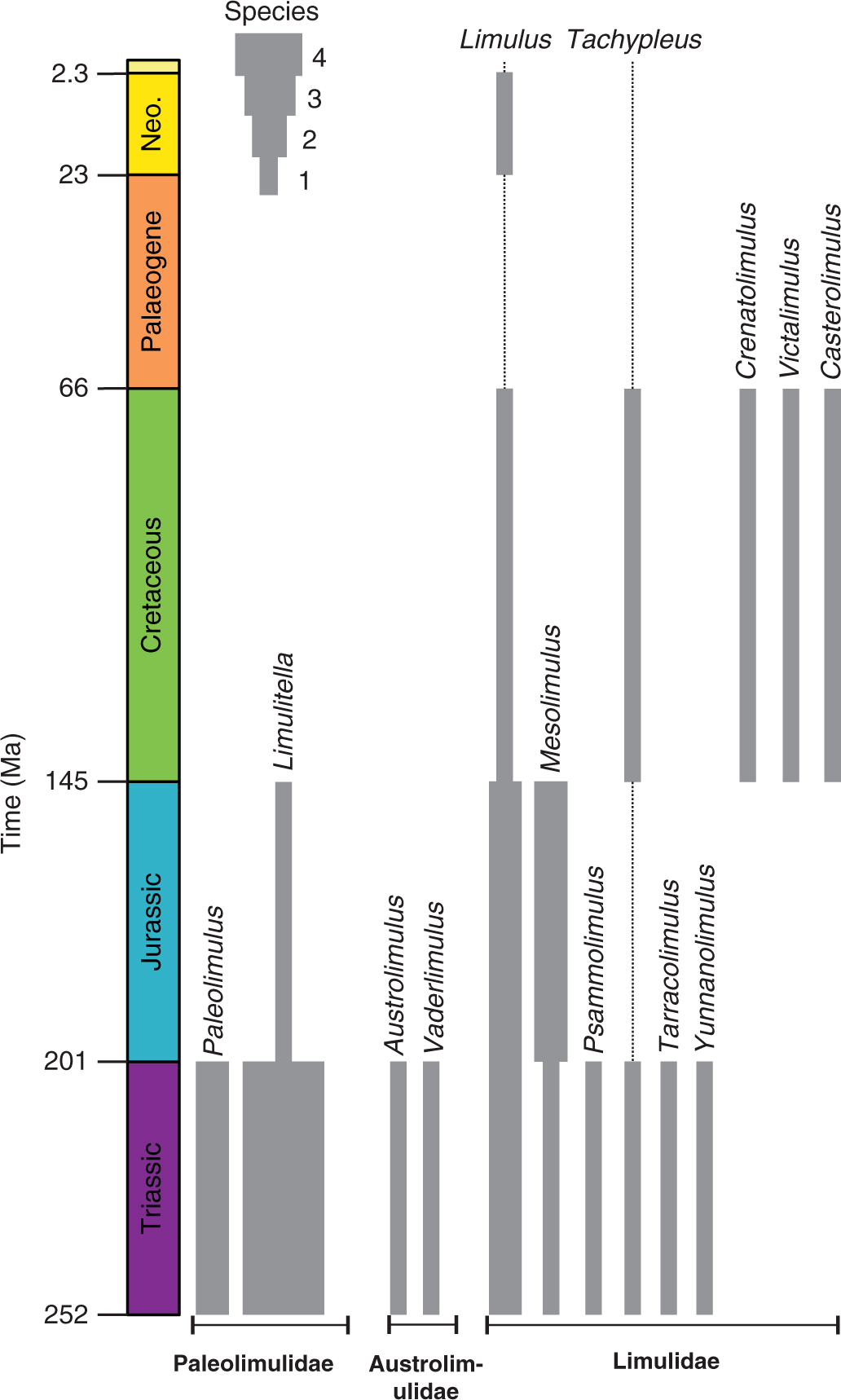
Horseshoe crabs are iconic chelicerates that have been extensively studied by both biologists and palaeontologists. Extant taxa have been subject to detailed anatomical (Owen, Reference Owen1872; Lankester, Reference Lankester1881; Shultz, Reference Shultz2001; Bicknell et al. Reference Bicknell, Klinkhamer, Flavel, Wroe and Paterson2018 a, c, d Bicknell & Pates, Reference Bicknell and Pates2019), biochemical (Kaplan et al. Reference Kaplan, Li and Kehoe1977), biomechanical (Bicknell et al. Reference Bicknell, Ledogar, Wroe, Gutzler, Watson and Paterson2018 b), ecological (Sokoloff, Reference Sokoloff1978; Shuster Jr, Reference Shuster1982; Shuster Jr & Sekiguchi, Reference Shuster, Sekiguchi, Tanacredi, Botton and Smith2009; Fairuz-Fozi et al. Reference Fairuz-Fozi, Satyanarayana, Zauki, Muslim, Husain, Ibrahim and Nelson2018) and genetic (Sokoloff, Reference Sokoloff1978; Obst et al. Reference Obst, Faurby, Bussarawit and Funch2012) studies. Palaeontological interest in horseshoe crabs stems from the extensive xiphosuran fossil record from Early Ordovician time to today (Van Roy et al. 2010, Reference Van Roy, Briggs and Gaines2015), and the observation that Mesozoic crown-group horseshoe crabs (Xiphosurida) are morphologically similar to extant species, such that two extant genera have fossil records extending back to Triassic time (Błażejowski, Reference Błażejowski, Carmichael, Botton, Shin and Cheung2015; Lamsdell & McKenzie, Reference Lamsdell and McKenzie2015; Błażejowski et al. Reference Błażejowski, Gieszcz and Tyborowski2016). The morphological similarity has been used to illustrate delayed evolution (Fisher, Reference Fisher, Eldredge and Stanley1984) and stunning morphological conservation over at least 148 Ma (Avise et al. Reference Avise, Nelson and Sugita1994; Rudkin & Young, Reference Rudkin, Young, Tanacredi, Botton and Smith2009; Kin & Błażejowski, Reference Kin and Błażejowski2014; Bicknell et al. Reference Bicknell, Pates and Botton2018 d). Despite extensive study, Mesozoic horseshoe crab diversity is low (Fisher, 1982, Reference Fisher, Eldredge and Stanley1984) with only 13 genera, known mostly from the Triassic Period (Fig. 1). These are the extinct genera Austrolimulus, Limulitella, Mesolimulus, Paleolimulus, Psammolimulus, Tarracolimulus, Vaderlimulus, and Yunnanolimulus, and two extant genera Limulus and Tachypleus (Dunlop et al. Reference Dunlop, Penney and Jekel2018). The number of genera reflects either a limited diversity or the requirement for exceptional preservation in Konservat-Lagerstätten to preserve the xiphosurid cuticular exoskeleton (Babcock & Merriam, Reference Babcock and Merriam2000; Babcock et al. Reference Babcock, Merriam and West2000). Here, we increase the Triassic horseshoe crab diversity by presenting the first exceptionally preserved horseshoe crab from a Middle Triassic Konservat-Lagerstätte in northern Slovenia. To our best knowledge, this is the only horseshoe crab fossil reported from an alpine Triassic deposit. We also pioneer geometric morphometrics as a tool for horseshoe crab research to show where the new specimen is located in morphospace relative to 48 horseshoe crab specimens that range from the Carboniferous Period to today.
Abundance of xiphosurid genera since the Triassic Period. Maximum abundance and diversity arose during the Triassic Period and decreased dramatically afterwards. The plot does not include Carcinoscorpius rotundicauda (Latreille, Reference Latreille1802), as the genus does not have a fossil species. Data from Dunlop et al. (Reference Dunlop, Penney and Jekel2018).

2. Geological history and setting
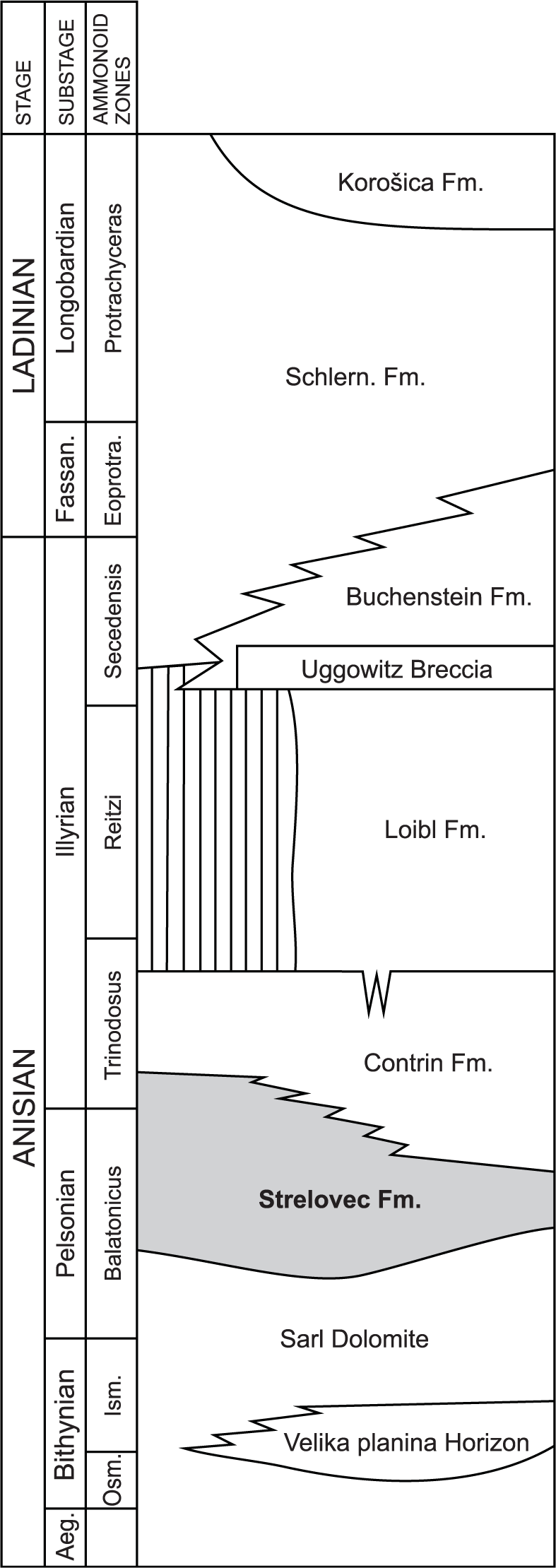
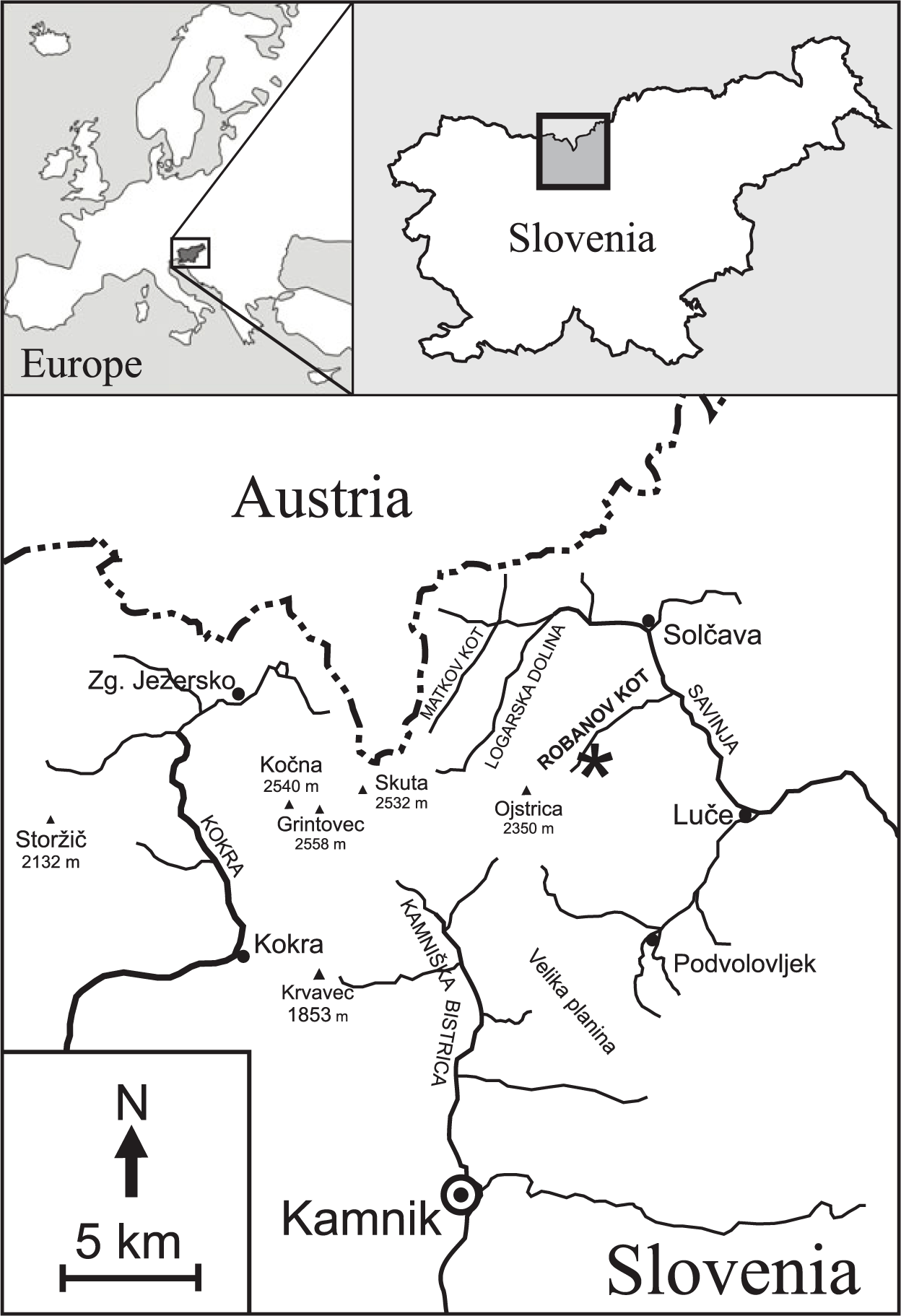
The investigated horseshoe crab fossil was found in the Strelovec Formation (Fig. 2) in the Kamnik-Savinja Alps on the northern slopes of the Križevnik Mountain (1909 m) in the Robanov Kot Valley (Fig. 3). The Kamnik-Savinja Alps are located in northern Central Slovenia between the town of Kamnik (south) and the Savinja river (north) (Fig. 3). The Kamnik-Savinja Alps represent the eastern extension of the Southern Alps from NE Italy that cross NW Slovenia. During Middle Triassic time, this area was located on the southwestern Neotethyan embayment at the opening of the Meliata-Maliac Ocean (Stampfli et al. Reference Srijaya, Pradeep, Mithun, Hassan, Shaharom and Chatterji2002; Schmid et al. Reference Schmid, Bernoulli, Fügenschuh, Matenco, Schefer, Schuster, Tischler and Ustaszewski2008).
Stratigraphic column of the Križevnik mountain area. Modified from Celarc et al. (Reference Celarc, Goričan and Kolar-Jurkovšek2012).

Map of the Kamnik-Savinja Alps. Slatinski Plaz location is indicated with an asterisk.

Stratigraphic development of Triassic units in the Kamnik-Savinja Alps resulted from crustal extension during the middle–late Anisian and Ladinian ages. This produced successive splitting of the Slovenian Carbonate Platform that almost completely covered the Slovenian territory beginning during late Permian time (Buser et al. Reference Buser, Ramovš and Turnšek1982, Reference Buser, Kolar-Jurkovšek and Jurkovšek2007, Reference Buser, Kolar-Jurkovšek and Jurkovšek2008; Haas et al. Reference Haas, Kovacs, Krystyn and Lein1995). A detailed stratigraphic succession from the Križevnik area was previously described in B. Celarc (unpublished PhD thesis, University of Ljubljana, 2004), Celarc & Goričan (Reference Celarc and Goričan2007), and Celarc et al. (Reference Celarc, Goričan and Kolar-Jurkovšek2012). The oldest rocks are of Early Triassic age and variably consist of sandstone and marly limestone intercalated with oolitic limestones and dolostone beds (Werfen Formation) (B. Celarc, unpublished PhD thesis, University of Ljubljana, 2004). These beds locally contain abundant ammonoid (Tirolites cassianus Quenstedt, Reference Quenstedt1845), gastropod (Natiria costata Münster, Reference Münster1841), and trace fossils (Hitij et al. Reference Hitij, Žalohar, Celarc, Križnar, Renesto and Tintori2010 b). The Anisian succession is above the Lower Triassic strata. The lower Anisian Sarl Dolomites containing foraminifera Meandrospira dinarica Kochansky-Devide & Pantić, Reference Kochansky-Devide and Pantić1966, can be correlated to the Sarl Dolomite of the Italian Southern Alps. The Sarl Dolomite is divided into the Lower and Upper Sarl Dolomite. The Velika planina Horizon lies between the two dolomite units, and consists of dark, laminated, bituminous, vertebrate-bearing limestones. The exact age of this deposit is unknown (B. Vičič, unpublished PhD thesis, University of Ljubljana, 2014; Vičič et al. Reference Vičič, Vrabec, Gale, Hitij, Žalohar, Rožič, Verbovšek and Vrabec2014); however, biostratigraphically, the Velika planina Horizon is pre-Pelsonian, probably of Bithynian age (Tintori et al. Reference Tintori, Hitij, Jiang and Sun2014, B. Vičič, unpublished PhD thesis, University of Ljubljana, 2014; Vičič et al. Reference Vičič, Vrabec, Gale, Hitij, Žalohar, Rožič, Verbovšek and Vrabec2014).
The Upper Sarl Dolomite is conformably overlain by the Strelovec Formation which is of deeper-water origin, and is of Pelsonian – early Illyrian age (B. Celarc, unpublished PhD thesis, University of Ljubljana, 2004). The age was derived from the stratigraphic position of the unit (Celarc et al. Reference Celarc, Goričan and Kolar-Jurkovšek2012) and faunal similarities with the Panxian and Luoping faunas of Pelsonian age from China (Tintori et al. Reference Tintori, Hitij, Jiang and Sun2014). Outcrops of the Strelovec Formation are exposed across the Kamnik-Savinja Alps (B. Celarc, unpublished PhD thesis, University of Ljubljana, 2004; Hitij et al. Reference Hitij, Žalohar, Celarc, Križnar, Renesto and Tintori2010 b; Celarc et al. Reference Celarc, Goričan and Kolar-Jurkovšek2012) and partly the Julian Alps (Hitij et al. Reference Hitij, Žalohar, Celarc, Križnar, Renesto and Tintori2010 b; Žalohar & Hitij, Reference Žalohar and Hitij2013). The Strelovec Formation is up to 250 m thick and contains a succession of dark, laminated, bituminous limestones, bright yellow, thin- to thick-bedded limestones and dolomites, and green thin-bedded limestones (B. Celarc, unpublished PhD thesis, University of Ljubljana, 2004). Various plant, mollusc, decapod, brachiopod, thylacocephalan, xiphosurid, echinoid, ophiuroid, crinoid, fish and reptile remains were found in this formation (Hitij et al. Reference Hitij, Tintori, Žalohar, Renesto, Celarc, Križnar and Kolar-Jurkovšek2010 a, b).
Massive light-grey platform limestones of the Contrin Formation overlie the Strelovec Formation (B. Celarc, unpublished PhD thesis, University of Ljubljana, 2004). Very thin (millimetre scale) beds of dark marl and claystone appear with plant remains and small brachiopods (B. Celarc, unpublished PhD thesis, University of Ljubljana, 2004). The Contrin Formation is cut by neptunian dykes, filled with red silty sediment and overlain by the Loibl Formation, consisting of thin, radiolarian-rich horizons of red pelagic limestones (Celarc & Goričan, Reference Celarc and Goričan2007). The radiolarians indicate the late Anisian (Illyrian) age (Celarc & Goričan, Reference Celarc and Goričan2007) and record the late Anisian break-up and drowning of the platform. The Loibl Formation is covered by polymict breccia or conglomerate that is equivalent to the Uggowitz Breccia. The megabreccias were deposited in half-graben structures formed from differential movements of blocks during extensional tectonics (Celarc & Goričan, Reference Celarc and Goričan2007). The formation grades upwards into the plant-, invertebrate- and vertebrate-rich marlstones and marly limestones of the Buchenstein Formation. Laterally continuous rhyolite layers are present and are partly redeposited as clasts in the Uggowitz Breccia (B. Celarc, unpublished PhD thesis, University of Ljubljana, 2004). Above the Buchenstein Formation is the Ladinian-aged Schlern Formation, which is composed of thick, massive limestone reaching a thickness of more than 600 m (B. Celarc, unpublished PhD thesis, University of Ljubljana, 2004). The Schlern Formation is the youngest formation in the Robanov Kot Valley and records progradation of the shallow-water platform over the deeper basin (Celarc et al. Reference Celarc, Goričan and Kolar-Jurkovšek2012). In some areas the shallow-water carbonate sedimentation was uninterrupted during the platform break-up, and the Schlern Formation concordantly overlies the Contrin Formation.
3. Locality
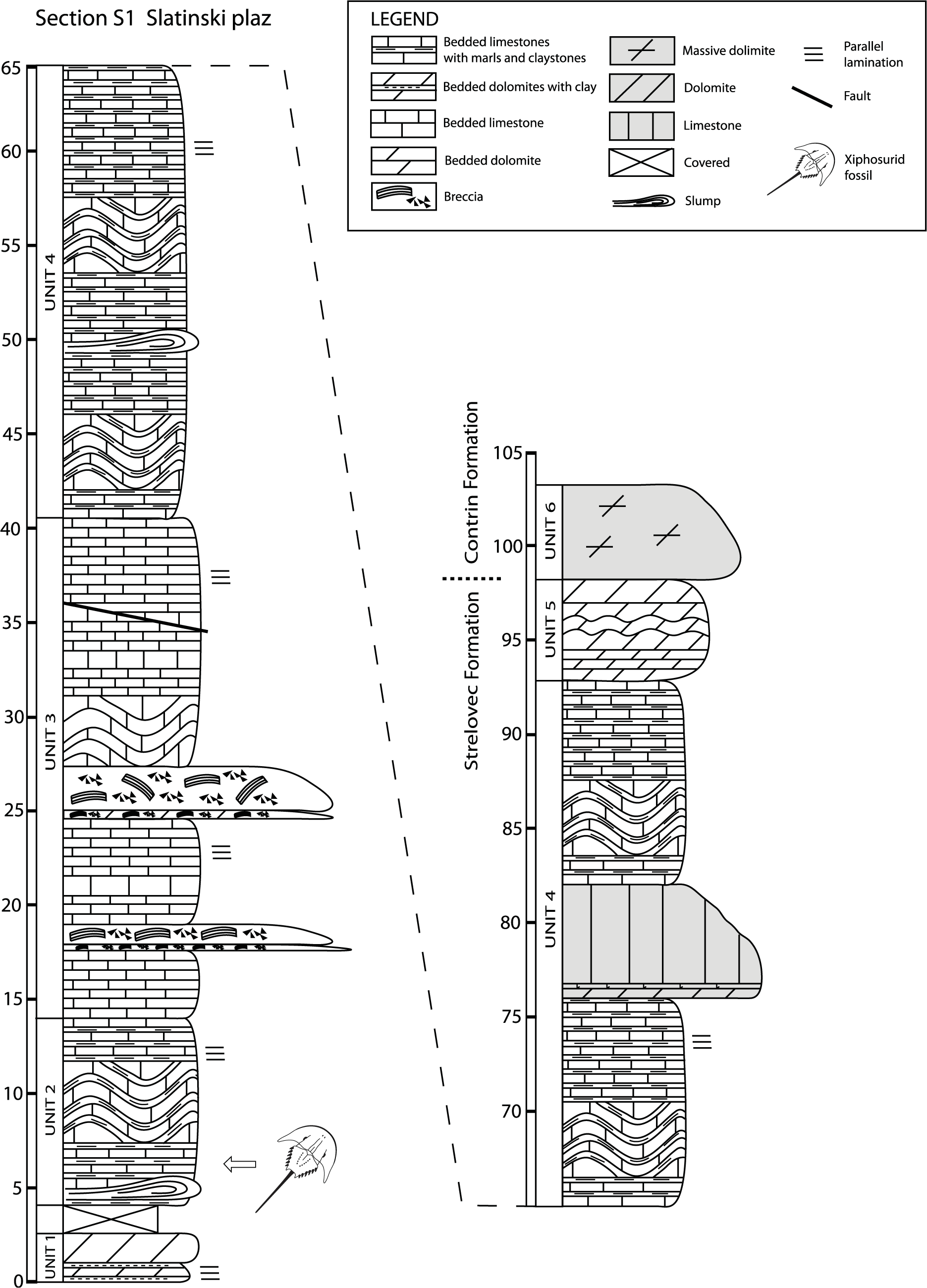
The investigated horseshoe crab fossil was found in Unit 2 of the Strelovec Formation in Section S1 of the Slatinski Plaz (46° 21′ 55.76′′ N, 14° 39′ 29.23′′ E). The Slatinski Plaz Section S1 is divided into six distinct lithostratigraphic units (Fig. 4) (Miklavc et al. Reference Miklavc, Celarc and Šmuc2016).
Slatinski Plaz Section (S1). The xiphosurid fossil was found near the base of Unit 2. Modified with permission after Miklavc et al. (Reference Miklavc, Celarc and Šmuc2016).

Unit 1 is the base of the Slatinski Plaz Section and is a 2.5 m thick unit of dark-grey, thin- to thick-bedded dolostones that alternate with thin, dark-grey clay beds (Miklavc et al. Reference Miklavc, Celarc and Šmuc2016). An abundant, very well-preserved fish fauna has been documented in this unit, in addition to small crustaceans and lingulid brachiopods (Hitij et al. Reference Hitij, Žalohar, Celarc, Križnar, Renesto and Tintori2010 b).
Unit 2 conformably overlies Unit 1 but the contact is obscured. Unit 2 is 10 m thick and is represented by an alternation of black laminated, thin-bedded limestones and dark-grey marls (Miklavc et al. Reference Miklavc, Celarc and Šmuc2016). The studied xiphosurid fossil is the only fossil collected from Unit 2, and it was located in situ within this unit. Celestine crystals are found in the layers of dark laminated bituminous limestone in the upper part of Unit 2.
Unit 3 conformably overlies Unit 2 and the contact is gradual over a short distance. Unit 3 is 27 m thick, and characterized by black limestones with rare interbeds of breccias (Miklavc et al. Reference Miklavc, Celarc and Šmuc2016). Fish fossils and lingulid brachiopods are relatively common.
Unit 4 conformably overlies Unit 3. Unit 4 is 52 m thick and is composed of limestones and marls identical to Unit 2. Megablocks of light-grey limestone occur in the upper part of Unit 4. Numerous channels are eroded into underlying beds, producing slumps and synsedimentary folds (Miklavc et al. Reference Miklavc, Celarc and Šmuc2016). Rare, well-preserved fish remains have been found in Unit 4.
Unit 5 lies conformably above Unit 4, is 5.5 m thick, and represents the uppermost part of the Strelovec Formation. It is characterized by thin- to medium-bedded laminated dolostones that contain small channels that eroded into underlying beds (Miklavc et al. Reference Miklavc, Celarc and Šmuc2016). This unit has yielded bivalve beds and disarticulated vertebrate remains.
Unit 6, the Contrin Formation, conformably overlies Unit 5. The Contrin Formation begins with a 60 cm thick dolostone bed, followed by massive dolostone (Miklavc et al. Reference Miklavc, Celarc and Šmuc2016).
4. Depositional environment of the Strelovec Formation
Microfacies in units of the Strelovec Formation sections share similar features (Miklavc et al. Reference Miklavc, Celarc and Šmuc2016). The predominance of fine-grained textures (mudstones), the presence of organic matter, horizontal lamination and thin bedding, and the absence of shallow-water elements (with the exception of rare peloids), suggest hemipelagic and pelagic sedimentation in a hydrodynamically quiet marine environment (Miklavc et al. Reference Miklavc, Celarc and Šmuc2016). According to Stow’s (1986) classification of pelagic facies, these rocks are a well-laminated and well-bedded organic-rich facies. Celestine crystals in these beds may indicate seawater evaporation. Brines refluxing into underlying or laterally adjacent sediments may have leached substantial strontium to reach chemical equilibrium with sediments, forming celestine crystals (Hanor, Reference Hanor2004).
Some beds also exhibit normal grading, wispy and wavy discontinuous laminations, and are channelized into underlying beds (Miklavc et al. Reference Miklavc, Celarc and Šmuc2016). These sedimentary structures indicate deposition of low-density, fine-grained, muddy turbidites (Piper & Stow, Reference Piper, Stow, Einsele and Seilacher1991).
Slumps, synsedimentary folds, and intraformational breccias are also present in hemipelagic limestones and fine-grained muddy turbidites. In rare circumstances, deformation of individual beds is noted and initial folding, breaking, and disintegration producing individual clasts is observed. These mass movement deposits represent a continuum of facies that evolved along a slope environment (Miklavc et al. Reference Miklavc, Celarc and Šmuc2016). Facies include slides slumps that, in some cases, evolved from debris flows to mudflows, and then turbidites (sensu Coniglio & Dix, Reference Coniglio, Dix, Walker and James1992; Flügel, Reference Flügel2010).
In the upper part of the succession, large blocks of light-grey, shallow-water dolomitized limestones are embedded within pelagic deeper-water rocks. These are interpreted as resedimented olistoliths that were transported from the edges of a prograding, shallow-water platform (Miklavc et al. Reference Miklavc, Celarc and Šmuc2016). Additionally, they could represent clasts from the collapse of the platform edge.
In the uppermost part of the succession, brown dolomitic bindstones and bioclastic wackestones are present. The presence of numerous shallow-water clasts and the absence of any resedimentation indicates that the limestones were formed in a moderate- to high-energy, subtidal environment, likely a sand belt in a marginal part of a shallow-water carbonate platform (Flügel, Reference Flügel2010; Miklavc et al. Reference Miklavc, Celarc and Šmuc2016).
Vertebrate and decapod specimens are articulated and excellently preserved, suggesting a predominantly anoxic environment (Hitij et al. Reference Hitij, Žalohar, Celarc, Križnar, Renesto and Tintori2010 b). The abundance of fish and decapod fossils in Unit 1 compared with other units suggests the brief formation of an isolated sedimentary basin. Limited access to the open sea during this time period would allow salinity to increase, resulting in the production of an anoxic brine. These conditions would also have excluded scavengers, while preserving the fine sediments. Fossilized organisms were likely washed into this sedimentary basin from the ocean or land and were preserved in exceptional condition.
It is therefore notable that the studied specimen is found in situ within Unit 2 where no other fossils have been reported. Sedimentation and the anoxic hemipelagic conditions continued into Unit 2, while the black laminated limestones interbedded with dark-grey marls were deposited. However, the increased occurrence of slides, slumps and fine-grained turbidites suggest sedimentation on a steeper slope compared with Unit 1 and/or increased tectonic activity that may have triggered mass movements (Miklavc et al. Reference Miklavc, Celarc and Šmuc2016). More amorphous organic matter was washed into the basin, producing the darker sediment. Higher up in the section, the connection to the open sea appears to be severed. This may have prevented fish or shrimp from entering the basin, explaining the absence of these groups. It is possible that organisms capable of surviving sub-aerially, such as horseshoe crabs, were able to enter the basin. After doing so, individuals unable to escape from the basin died, and were preserved in the anoxic environment. An alternative is that examples of other fossil groups have not yet been identified, an outcome that would preclude complete separation from the ocean. A third option is that the studied horseshoe crab specimen was swept into the anoxic basin during a storm event, as opposed to walking into the anoxic condition. The second option is less likely because Unit 2 was investigated several times. This leaves options 1 and 3 as possible explanations. Regardless of the mode of transport, seawater evaporation in this basin resulted in sediment reflux and strontium-rich minerals leached from the brine and into the horseshoe crab’s body. The low-pH sediment later dissolved the exoskeleton, preserving only the external mould. Spherical crystal bundles formed during the process and these are similar to the ‘dumb-bell’ structures documented on fossil arthropods (Briggs & Kear, Reference Briggs and Kear1994; Tetlie & Van Roy, Reference Tetlie and Van Roy2006), and notably in fossil horseshoe crabs (Briggs & Wilby, Reference Briggs and Wilby1996). These structures potentially reflect microbial activity prior to fossilization (see discussion in Briggs & Wilby, Reference Briggs and Wilby1996 and Tetlie & Van Roy, Reference Tetlie and Van Roy2006).
5. Materials and methods
The sample PMSL T-993 is preserved as a flattened external mould with no cuticle on a slab of black laminated, thin-bedded limestone located in situ within Unit 2 of the Slatinski Plaz Section (S1). No counterpart was recovered, because the specimen was exposed on the site. PMSL T-993 is housed in the Hitij & Žalohar Paleontological Collection, which is registered according to Slovenian legislation with the Natural History Museum of Slovenia (Ljubljana) (PMSL), Slovenia. When describing PMSL T-993, we followed the systematic taxonomy of Lamsdell (Reference Lamsdell2016). Anatomical terminology used here follows Bicknell et al. (Reference Bicknell, Klinkhamer, Flavel, Wroe and Paterson2018 a), Dunlop & Lamsdell (Reference Lamsdell2016) – the main sources for dorsal anatomical terms – and select terms from Lerner et al. (Reference Lerner, Lucas and Lockley2017). Specifically, we use the term splay from Lerner et al. (Reference Lerner, Lucas and Lockley2017) when referring to the outwards extension of xiphosurid genal spines. PMSL T-993 was photographed with a Canon EOS 70D with a Canon 100 mm F2.8 macro lens and low-angled light. The specimen was coated in ammonium chloride, but there are remains of paper dust and silicon from the previous moulding process. This could not be removed without damaging the specimen. The silicon cast (PMSL T-993.C) was also ammonium chloride coated and photographed with the Canon EOS 70D with a Canon 100 mm F2.8 macro lens.
A morphometric analysis was conducted to quantitatively assess where the specimen is located in morphospace relative to other taxa. A landmark and semi-landmark analysis of 49 specimens was conducted (online Supplementary Datafile S1, available at http://journals.cambridge.org/geo). The species considered range are of Carboniferous–Recent age and are from the families Austrolimulidae, Paleolimulidae and Limulidae (online Supplementary Datafile S2). Landmarking and semi-landmarking was conducted using the thin-plate spline (TPS) suite (http://life.bio.sunysb.edu/morph/index.html). A TPS file was constructed using tpsUtil64 (v.1.7). The TPS file was imported into tspDig2 (v.2.26), which was used to place four landmarks and 30 semi-landmarks along the right cephalothorax (online Supplementary Figure S1). Semi-landmarks were placed in a clockwise direction. Points are digitized as x–y coordinates. In cases where the right side was poorly preserved, the left side was used instead and the data mirrored. These points populated the TPS file with landmark and semi-landmark data. The TPS file was imported into an R environment. The geomorph package (Adams & Otárola-Castillo, Reference Adams and Otárola-Castillo2013) conducted the Procrustes superimposition and principal components analysis (PCA) of the data. Procrustes superimposition standardizes for size and orientation, such that only cephalothoracic shape variation was assessed. Thoracetrons were not assessed as they were observed to preserve slightly less commonly and are often more fragmentary than the cephalothoraxes. Generic and family assignment and age data follow Dunlop et al. (Reference Dunlop, Penney and Jekel2018). Variation in preservational mode of specimens, ranging from completely flat to vaulted, may have introduced a small amount of error to the data. Photographs of specimens that were taken in a completely top-down perspective were therefore used to adjust for this issue. However, a small degree of variation will be inherent in the morphometric data. To confirm that preservational mode minimally impacted the data, a plot of the principal component (PC) data using PC1 and PC2 was made and points were colour-coded for vaulted and not vaulted (online Supplementary Figure S2 and Supplementary Datafile S3). No pattern was noted in PC space, confirming the biological signal is the most prominent in PC1 and PC2. Photographs of studied taxa were requested to illustrate the morphological range of taxa. An Austrolimulus fletcheri Riek, Reference Riek1955 photograph was provided by the Australian Museum. A Tachypleus gadeai (Vía Boada & De Villalta, Reference Vía Boada and De Villalta1966) photograph was provided by the Museu Geologic del Seminari de Barcelona. A Victalimulus mcqueeni Riek & Gill, 1971 photograph was provided by Museums Victoria.
6. Systematic palaeontology
Phylum Euarthropoda Lankester, Reference Lankester1904
Subphylum Chelicerata Heymons, Reference Heymons1901
Order Xiphosurida Latreille, Reference Latreille1802
Suborder Limulina Richter & Richter, Reference Richter and Richter1929
Family Limulidae Zittel, Reference Zittel1881
Genus Sloveniolimulus nov. gen.
Etymology. Generic name Sloveniolimulus is suggested as the species is the only known example from Slovenia and Limulus is the genus of the extant and iconic North American horseshoe crab.
Type species. Sloveniolimulus rudkini, new species.
Distribution. Strelovec Formation, Kamnik-Savinja Alps, Slovenia; Middle Triassic (Anisian).
Diagnosis. Genus is distinguished from other genera in the family by a semi-circular cephalothorax with indented genal spines deflected away from the thoracetron. Deflection of genal spines occurs at the position of the indentations, in the last one-fifth of the genal spine. Genal spines extend along the anterior third of the thoracetron. The thoracetron is approximately the same length as the cephalothorax. The thoracetron and telson are of approximately equal length.
Sloveniolimulus rudkini nov. sp.
Fig. 5
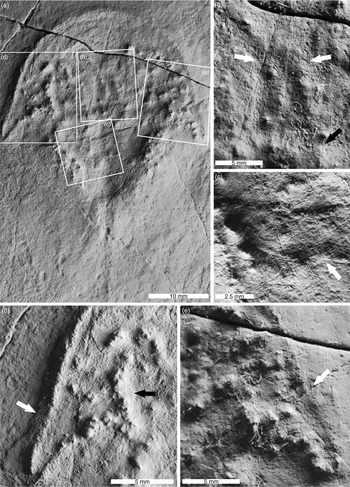
Sloveniolimulus rudkini holotype (PMSL T-993). (a) Complete specimen. Pustule (‘dumb-bell’) structures evident across entire specimen. (b) Close-up of cardiac lobe (white arrows) and cephalothoracic-thoracetron hinge (black arrow). (c) Close-up of left side of thoracetron. Thoracetronic border defined by pustules and possible distal section of a gill operculum (white arrow). (d) Close-up of left genal spine and cephalothorax. Indentation in genal spine (white arrow) and ophthalmic ridge (black arrow) noted. Ophthalmic ridge defined by pustules. (e) Close-up of right genal spine. Genal spine indentation (white arrow) slightly less pronounced than on left side. Specimen was coated with ammonium chloride.

Etymology. Trivial name rudkini was chosen in recognition of David Rudkin who has contributed extensively to invertebrate palaeontology and horseshoe crab research throughout his career.
Holotype. PMSL T-993.
Distribution. As for genus.
Type locality and horizon. Unit 2 of the Strelovec Formation in Section S1 of the Slatinski Plaz, Robanov Kot Valley, Kamnik-Savinja Alps, Slovenia.
Diagnosis. As for genus.
Preservation. PMSL T-993 is preserved as a flattened external mould in black, thin-bedded limestone. The slight depression in the external mould suggests the specimen had a vaulted exoskeleton in life. There are several pustules within the specimen. The pustules are asymmetric and random. These pustules may reflect substantial mineral precipitation within the exoskeleton during fossilization. Small holes behind the fossil may represent a possible walking trace. However, extensive erosion precludes confident assignment of this feature.
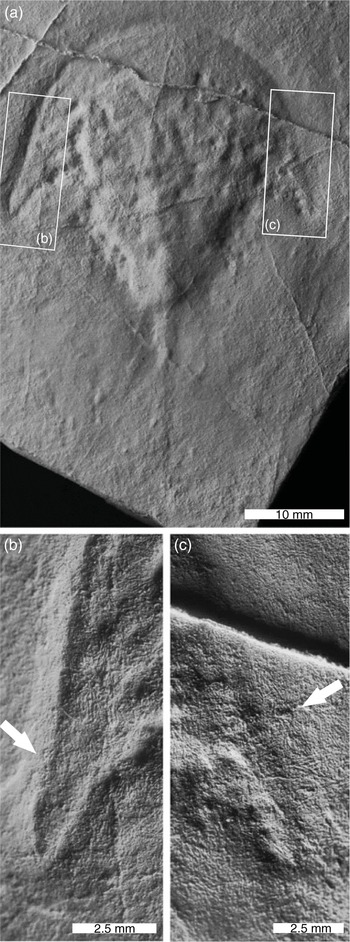
Description. PMSL T-993 is an articulated cephalothorax, thoracetron and telson preserved as an external mould and likely represents a carcass (Fig. 5a). Little relief is observed. The specimen is c. 50 mm long, including telson. The cephalothorax is semi-circular and 16.1 mm long at midline. The cephalothoracic left side is preserved slightly better than the right. The cephalothoracic width across the posterior margin of lateral rims is 20.2 mm. Genal spine tips are separated by 36.5 mm. A cephalothoracic rim is preserved along margins and attains a greatest width of c. 1 mm (Fig. 5a). No cephalothoracic doublure is visible. The left ophthalmic ridge is partly preserved as pustules and is parallel to the cardiac lobe (Fig. 5d). The ridge is straight and 7.7 mm long. The right ophthalmic ridge is not preserved. No lateral compound eyes can be confidently discerned on either side of cephalothorax. The cardiac lobe is cone-shaped (Fig. 5b). The lobe is 6.5 mm wide posteriorly, tapering to 3.4 mm anteriorly and bordered by two 6.9 mm long interopthalmic ridges. A cardiac ridge is faintly present and is 6 mm long. The lobe region is somewhat poorly defined due to pustule structures. Ocelli are not observed. Genal spines are a quarter the length of the cephalothorax. They extend posterolaterally to a third of thoracetron length. Lateral extent between genal spine tips and thoracetron is 9.6 mm (left side) and 8.2 mm (right side), suggesting a degree of deformation during preservation. The angle between genal spines and the thoracetron varies minimally: left side, 62°; right side, 66°. Genal spines have indentations 4 mm from the spine terminal point, deflecting genal spines away from cephalothorax (Figs 5d, e, 6a–c). The inner margin of the genal spines is curved anteriorly. No cephalothoracic appendages are preserved.
Silicon cast of Sloveniolimulus rudkini holotype (PMSL T-993.C) used to highlight genal spine deflection. (a) Complete cast, showing more clearly the putative walking trace at the posterior end of the specimen. (b) Close-up of left genal spine, showing deflection at distal section of spine (white arrow). (c) Close-up of right genal spine, showing less-pronounced deflection at distal section of spine (white arrow). Specimen was coated with ammonium chloride. Images were reflected to mirror the holotype.

The thoracetron is trapezoidal, 15.8 mm long and 20 mm wide at the anterior, tapering to 5 mm posteriorly. The axis is lobe-shaped and does not taper, is 17.1 mm long and 4.5 mm wide, and lacks any segmentary furrows or median ridge (Fig. 5a). No apodemes are noted. The left pleural lobe is flat and lacks relief. No segmentation is noted. The lobe is 5.7 mm wide anteriorly, tapering to 2.3 mm posteriorly. The marginal rim is 1.3 mm wide, tapering slightly posteriorly. The rim has little relief, defined mostly by pustules. The distal edge of the left marginal rim is not smooth, preserving possible movable spines. The right pleural lobe is wider than the left: 7.6 mm wide anteriorly, tapering to 2.2 mm posteriorly. Segmentation or tergal expression are absent on the right side of the thoracetron. The right marginal rim is 2.4 mm wide along its length. No evidence of movable spines is preserved on the right side of the thoracetron. The distal section of gill opercula may be preserved (Fig. 5c), although preservational mode makes this hard to determine. The telson is articulated with the posterior thoracetronic margin. The telson is 18.01 mm long and has a putative axial ridge.
7. Geometric morphometric results
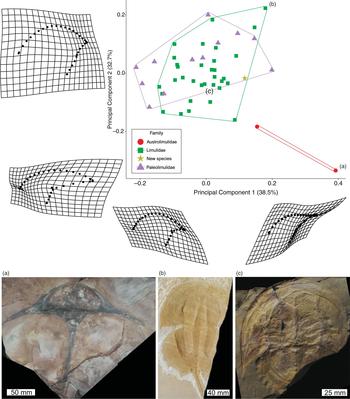
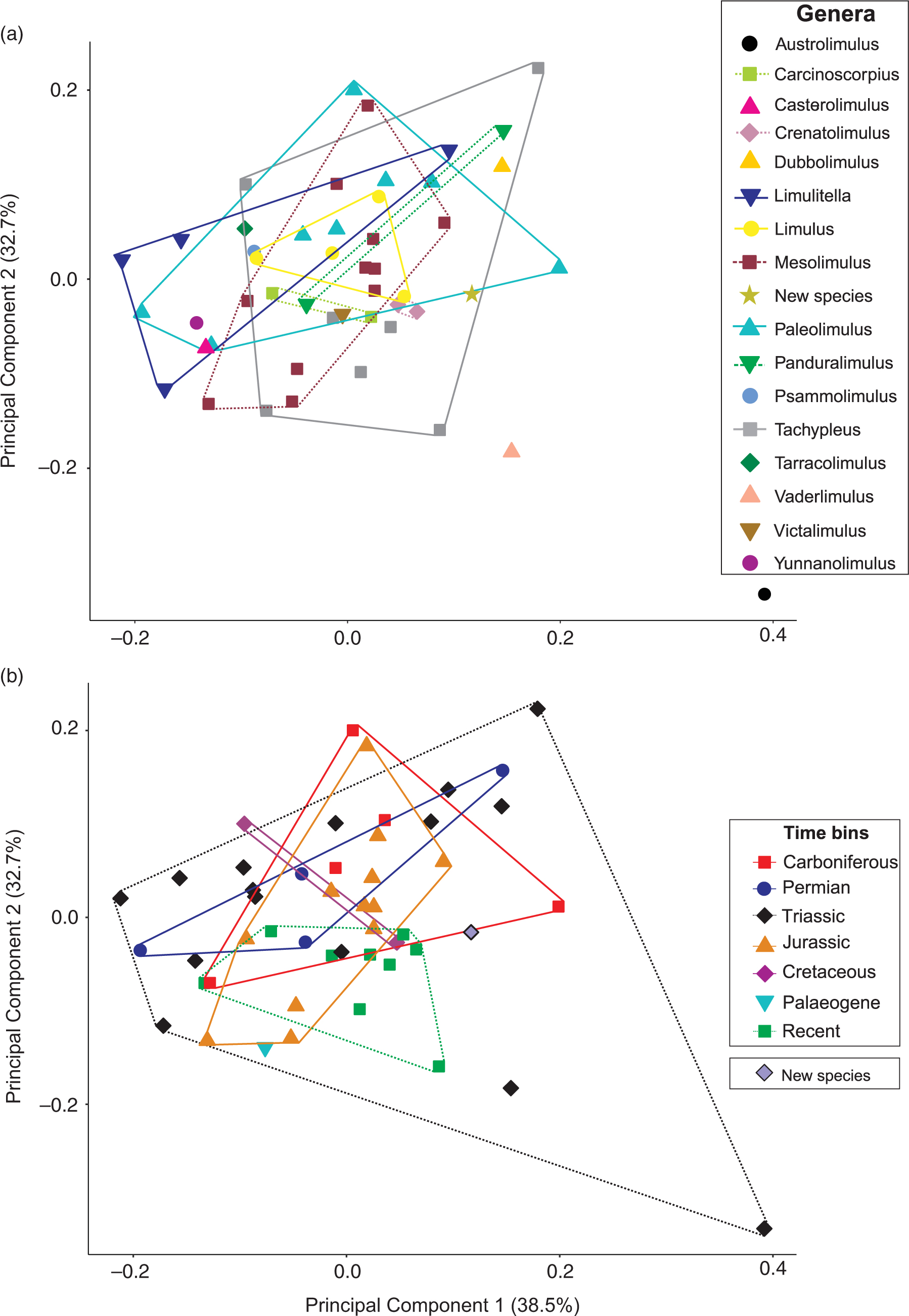
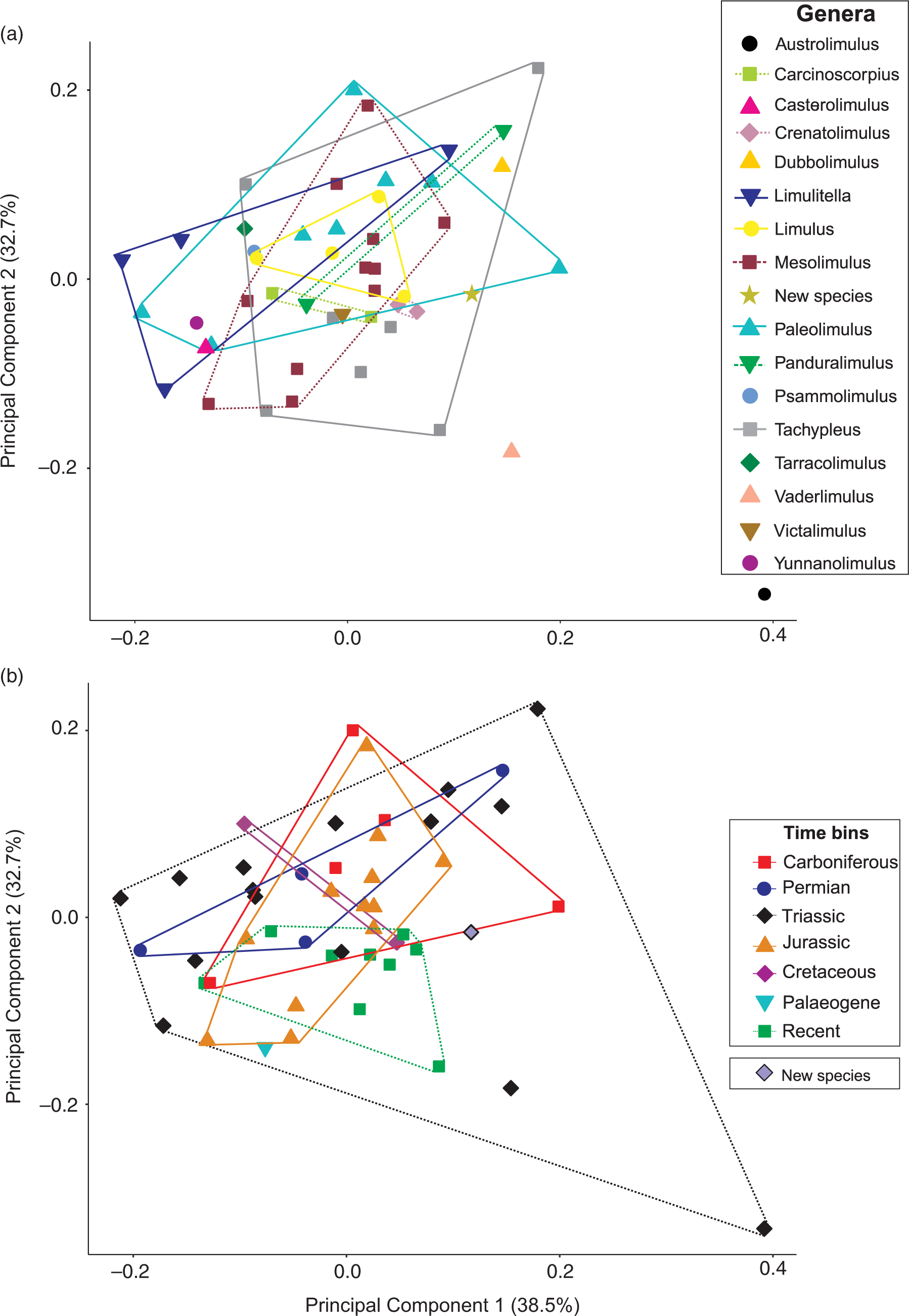
PCA plot shows that PC1 (38.9% shape variation) describes how lengthened the genal spine is relative to the cephalothorax (Fig. 7). Austrolimulus fletcheri therefore falls in a distinctly positive PC1 space. PC2 (32.1% shape variation) describes the posterior elongation of the genal spines relative to the cephalothorax. Austrolimulus fletcheri has the most negative PC2 value as the genal spines extend sideways to the thoracetron base. Conversely, Tachypleus gadeai is located in positive PC2 space and has genal spines that terminate at the cephalothorax–thoracetron hinge. Sloveniolimulus rudkini is located in slightly positive PC1 space (PC1 = 0.11) and a PC2 value of ∼0 (PC2 = −0.019) (Fig. 7). The genus falls into shape space occupied by the convex hulls of Limulidae and Paleolimulidae (Fig. 7). However, when considering generic distribution, PMSL T-993 falls into the space occupied by Tachypleus species (Fig. 8a). Plotting PC data in time-bins (Fig. 8b) shows a constrained spread in PC space prior to the end-Permian extinction. The Triassic genera have the largest spread within PC space. The spread in PC space then decreases in the Jurassic, Cretaceous and Recent taxa.
Carboniferous–Recent xiphosurids in PCA space. Austrolimulids fall in very positive PC1 space, reflecting their extreme cephalothoracic morphologies. Limulids and paleolimulids occupy a similar PC space. Sloveniolimulus rudkini falls into the extremes of shape space occupied by Limulidae and Paleolimulidae. (a) Austrolimulus fletcheri (AM F 38274, holotype). Note the large genal spines and splay. Courtesy of Josh White; Australian Museum specimen. (b) Tachypleus gadeai (MGSB 19195, holotype). Note termination of genal spines about cephalothorax-thoracetron hinge. Courtesy of Pedro Adserà; Museu Geologic del Seminari de Barcelona specimen. (c) Victalimulus mcqueeni (MV P22410B, holotype). A less extreme fossil morphology compared with A. fletcheri. Courtesy of Frank C. Holmes; Museums Victoria specimen.

PCA plots detailing morphospace occupied by genera and the morphospace explored across the seven time-bins. (a) Xiphosurid genera bound by convex hulls. Sloveniolimulus rudkini falls outside of the Paleolimulus cluster, excluding the new species from Paleolimulidae. (b) Taxa colour-coded for time-bin and bound by convex hulls. Triassic taxa cover largest PC space, followed by Carboniferous and Jurassic taxa.
8. Discussion
We present the first geometric morphometric assessment of fossil and extant horseshoe crab taxa, expanding on studies that used linear measurements (Riska, Reference Riska1981; Vijayakumar et al. Reference Vijayakumar, Das, Chatterji and Parulekar2000; Chiu & Morton, Reference Chiu and Morton2003; Srijaya et al. Reference Srijaya, Pradeep, Mithun, Hassan, Shaharom and Chatterji2010; Jawahir et al. Reference Jawahir, Samsur, Shabdin and Rahim2017) and landmarks analysis (Faurby et al. Reference Faurby, Nielsen, Bussarawit, Intanai, Van Cong, Pertoldi and Funch2011) of extant taxa. PMSL T-993 falls outside austrolimulid shape space and is therefore not an austrolimulid (sensu Dunlop et al. Reference Dunlop, Penney and Jekel2018). The mathematical results are in agreement with the lack of a key feature of austrolimulids: genal spines terminating at, or about, the posterior thoracetron (Riek, 1955; Reference Riek1968; Lerner et al. Reference Lerner, Lucas and Lockley2017). The new species could therefore be a limulid or paleolimulid. Figure 7a shows Sloveniolimulus rudkini in shape space bound by both families. The key morphological features that exclude S. rudkini from Paleolimulidae are: (1) the ophthalmic ridge lacks curvature, so could not converge with the other (not preserved) ridge; and (2) the thoracetron lacks tergal expression (Størmer, Reference Størmer and Moore1955; Schram, Reference Schram1979; Babcock & Merriam, Reference Babcock and Merriam2000; Babcock et al. Reference Babcock, Merriam and West2000; Lerner et al. Reference Lerner, Lucas and Mansky2016). Further evidence to support placement of PMSL T-993 in Limulidae is that PMSL T-993 falls into the morphospace occupied by Tachypleus when considering the generic distribution of specimens (Fig. 8a). Using both the geometric morphometric results and the systematic palaeontology, we therefore confidently assign specimen PMSL T-993 to Limulidae. Could PMSL T-993 therefore be placed into Tachypleus? We consider this unlikely as PMSL T-993 has a genal spine splay more extensive than Tachypleus gadeai, T. gigas (Müller, Reference Müller1785), T. syriacus (Woodward, Reference Woodward1879), and T. tridentatus (Leach, Reference Leach1819) (Lamsdell & McKenzie, Reference Lamsdell and McKenzie2015). We therefore did not place PMSL T-993 in Tachypleus. One aspect that might support a Tachypleinae assignment of PMSL T-993 is the identification of dimorphic features in any new S. rudkini specimens (sensu Lamsdell & McKenzie, Reference Lamsdell and McKenzie2015). Finally, to our knowledge, no limulids have such obvious deflections along the genal spines as observed in PMSL T-993, excluding the species from other limulid genera.
One final consideration must be given to Paleolimulus fuchsbergensis Hauschke & Wilde, Reference Hauschke and Wilde1987: a Triassic-aged paleolimulid from the Upper Keuper Sandstone, Germany that has genal spines that deflect away from the thoracetron. The deflection is less pronounced than in Sloveniolimulus rudkini and the holotype of P. fuchsbergensis used in the PCA is located in more positive PC2 space (online Supplementary Datafile S3) than S. rudkini. This confirms that they are distinct genera. However, the morphological similarity reinforces the idea that P. fuchsbergensis may not be a paleolimulid: recent research suggests that P. fuchsbergensis and some other Paleolimulus species are likely austrolimulids (Lamsdell, Reference Lamsdell2016; Lerner et al. Reference Lerner, Lucas and Lockley2017). We did not follow these suggestions in Figures 7 and 8 as the taxa have not formally been reassigned to Austrolimulidae (see Dunlop et al. Reference Dunlop, Penney and Jekel2018). However, further research may highlight the validity of this reassignment. This will therefore require that the morphospace occupied by Austrolimulidae, Limulidae and Paleolimulidae be reconsidered.
Taphonomy as a means of explaining the diagnostic features of Sloveniolimulus rudkini is also worth discussing. Babcock et al. (Reference Babcock, Merriam and West2000) demonstrated that post-mortem modification of the horseshoe crab exoskeleton is common as the exoskeleton becomes pliable after death. It is therefore possible that the deflection in the genal spines observed on PMSL T-993 is taphonomic. We suggest this is unlikely as similar features have been noted in Paleolimulus fuchsbergensis – a very well-preserved taxon (Hauschke & Wilde, Reference Hauschke and Wilde1987) – and as the deflection is noted on both genal spines of PMSL T-993. Nonetheless, further specimens of S. rudkini are needed to confirm that the genal spine deflection is indeed diagnostic, as PMSL T-993 is not particularly well preserved due to weathering and there was also limited identification of other diagnostic features.
A striking result from considering the PC data in time bins is the realization that xiphosurids reached their greatest morphological disparity during Triassic time, occupying an area of morphospace that is greater than at any other point in their evolutionary history. This reflects an exploratory and innovative period for Xiphosurida when the group exploited different niches and variable Baupläne. Evidence for recovery and diversification after the end-Permian extinction has been noted in fossil deposits (e.g., Hu et al. Reference Hu, Zhang, Chen, Zhou, Lü, Xie, Wen, Huang and Benton2011), and was suggested for other arthropods (e.g., Blagoderov et al. Reference Blagoderov, Grimaldi and Fraser2007; Zheng et al. Reference Žalohar and Hitij2018) and vertebrates (Brusatte et al. Reference Brusatte, Benton, Ruta and Lloyd2008 a, Reference Brusatte, Benton, Ruta and Lloydb; Ruta et al. Reference Ruta, Angielczyk, Fröbisch and Benton2013; Benson et al. Reference Benson, Campione, Carrano, Mannion, Sullivan, Upchurch and Evans2014). While this explosion of diversity has been noted previously for xiphosurids (Moore et al. Reference Moore, McKenzie and Lieberman2007; Rudkin & Young, Reference Rudkin, Young, Tanacredi, Botton and Smith2009), it has not been assessed quantitatively. The geometric morphometric data also show that limulids and paleolimulids occupy approximately the same morphospace. This confirms the long-held idea that taxa of both families are morphologically conservative (Fisher, Reference Fisher, Eldredge and Stanley1984). Further, and somewhat unsurprisingly, austrolimulids are located into their own shape space reflecting their ‘odd-ball’ (Eldredge, Reference Eldredge1976, p. 175) status among xiphosurids.
An extension of the geometric morphometric method could involve a selection of belinurids. This would allow researchers to examine how morphospace was utilized by mostly freshwater forms prior to the end-Permian extinction. This extension was beyond the scope of our research as we limited analyses to families known from the Triassic Period, and belinurids did not survive the end-Permian extinction (Moore et al. Reference Moore, McKenzie and Lieberman2007). One further extension would be to involve more exoskeletal sections. Cephalothoraxes were used here as they preserve slightly more commonly than other exoskeletal sections. Involving the thoracetron in geometric morphometric analyses may produce interesting comparative results and allow questions regarding the transition from enrolment to burrowing to be addressed (Fisher, Reference Fisher1981; Waterston, Reference Waterston1985). Notably, these analyses will need to omit taxa such as Casterolimulus kletti Holland et al. Reference Holland, Erickson and O’Brien1975 and ‘Limulus’ kieri figured in Hauschke et al. (Reference Hauschke, Wilde and Pietrzeniuk1992) as no thoracetron is known for these taxa. The exclusion of thoracetronic data here may have impacted our interpretation of where PMSL T-993 is located in morphospace as the thoracetron presents important taxonomic and morphometric data. A further study considering both the cephalothorax and thoracetron may therefore place PMSL T-993 within a different group in morphospace.
8.a. Life mode and reconstruction of Sloveniolimulus
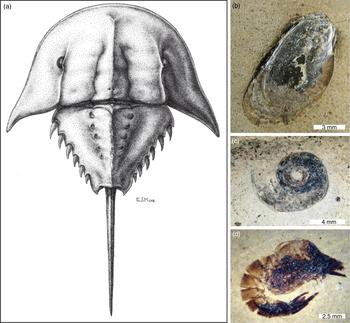
Extant horseshoe crabs are bottom feeders that live in coastal waters and come ashore annually to mate (Shuster Jr, Reference Shuster1982; Botton, Reference Botton1984; Akbar John et al. Reference Akbar John, Kamaruzzaman, Jalal and Zaleha2012; Razak & Kassim, Reference Razak and Kassim2018). Due to the variable habitats they are omnivores, consuming, among other material, small molluscs, crustaceans and polychaete worms (Shuster Jr, Reference Shuster1982; Akbar John et al. Reference Akbar John, Kamaruzzaman, Jalal and Zaleha2012; Bicknell et al. Reference Bicknell, Ledogar, Wroe, Gutzler, Watson and Paterson2018 b). Given the marine palaeoenvironment, the proposed life mode of Sloveniolimulus rudkini was likely similar to extant taxa. Although no prey taxa are present in Unit 2, numerous potential prey is preserved in other units including abundant lingulids, bivalves, gastropods, juvenile decapod crustaceans and small ammonoids (Fig. 9b–d). All of these would have been ideal prey for S. rudkini.
Reconstruction of Sloveniolimulus rudkini and its possible prey. (a) Reconstruction of the studied PMSL T-993. Courtesy of Elissa Martin. (b–d) Examples of potential prey items found in the Slatinski Plaz Section: (b) Bivalve species Modiolus sp.; (c) small ammonoid; and (d) juvenile decapod crustacean Aeger sp.

The preservation of PMSL T-993 precluded the confident identification of features such as lateral compound eyes and apodemal pits. However, these anatomical features were included in the reconstruction (Fig. 9a) as they are known to be present in extant limulids (Shuster Jr, Reference Shuster1982) and have been documented on well-preserved extinct limulids (see Hu et al. Reference Hu, Zhang, Feldmann, Benton, Schweitzer, Huang, Wen, Zhou, Xie, Lü and Hong2017). It was therefore parsimonious to assume that, in life, Sloveniolimulus rudkini would have displayed these characters.
9. Conclusions
We present here the first horseshoe crab from the Slovenian Alps and quantify the new genus and species, Sloveniolimulus rudkini, using geometric morphometrics to augment the systematic palaeontology. This is the first time that traditional taxonomic work and advanced morphometric techniques have been combined in the study of horseshoe crabs, and to explore the evolution of horseshoe crab morphological disparity after the end-Permian extinction. We anticipate that the continued research and identification of similar marine Triassic-aged deposits will likely increase documented xiphosurid diversity during this period of radiation, when the morphological diversity of the clade reached its absolute peak.
Author ORCIDs
Russell Bicknell 0000-0001-8541-9035
Acknowledgements
This research was supported by funding from an Australian Postgraduate Award (to RDCB) and a Charles Schuchert and Carl O. Dunbar Grants-in-Aid award (to RDCB). We thank Elissa Martin for her stunning reconstruction of Sloveniolimulus rudkini. We thank Frank C. Holmes (Museums Victoria), Josh White (Australian Museum), and Pedro Adserà (Museu Geologic del Seminari de Barcelona) for photographs of specimens. We thank Nicolás Campione for useful discussions and ideas. Finally, we thank Allan Lerner, Peter Van Roy, and an anonymous third referee for their useful reviews and comments that thoroughly improved the text.
Declaration of interest
We declare no conflict of interest.
Supplementary material
To view supplementary material for this article, please visit https://doi.org/10.1017/S0016756819000323