Introduction
The relationship between subjective memory complaints (SMCs) and memory performance has been of considerable interest to researchers over the past 30 years. The interest generated in this relationship is not surprising given the important role SMCs could play in the early identification of memory problems associated with Alzheimer's disease and other dementias. However, it is often found that little or no relationship exists between SMCs and memory performance on objective tests (e.g. Schmidt et al., Reference Schmidt, Berg and Deelman2001; Minett et al., Reference Minett, Da Silva, Ortiz and Bertolucci2008). Instead, it is frequently reported that memory complaints are more indicative of psychological distress (e.g. Zandi, Reference Zandi2004; Potter et al., Reference Potter, Hartman and Ward2009) or aspects of personality (Pearman and Storandt, Reference Pearman and Storandt2004; Reference Pearman and Storandt2005).
The literature suggests that depression in particular is often found to be a prominent predictor of SMCs (e.g. Levy-Cushman and Abeles, Reference Levy-Cushman and Abeles1998; Jorm et al., Reference Jorm, Christensen, Korten, Jacomb and Henderson2001). Jorm et al. (Reference Jorm, Christensen, Korten, Jacomb and Henderson2001) report that while memory complaints do appear to precede future memory decline, they are more often reflective of the presence of negative affect (particularly depression). Anxiety has also been reported to play a role in people's beliefs about their own memory functioning (Stein et al., Reference Stein, Linn, Stein and Linn1983; Jorm et al., Reference Jorm, Christensen, Korten, Jacomb and Henderson2001), whereby greater levels of anxiety are associated with reports of more memory problems. Potter et al. (Reference Potter, Hartman and Ward2009) also recently demonstrated that SMCs are associated with stress. In a study of 54 female older adults, Potter et al. found stress to be significantly associated with SMCs, even after variance associated with symptoms of depression and anxiety was removed.
While it is not surprising that affect might play a central role in determining the severity of SMCs, the typically weak relationship found between memory complaints and memory performance is somewhat intriguing. One issue that has received little attention in the literature is the possibility that this relationship may be restrained somewhat by one or more suppressor variables. Maassen and Bakker (Reference Maassen and Bakker2001) discuss three types of suppressor variables, of which one might play a role in mediating the relationship between SMCs and performance on objective tests of memory. A “classical” suppressor in a regression analysis is a predictor variable related to another predictor variable but not to the outcome variable. Given obvious differences between the actions of judging one's own memory performance and recalling, for example, episodic information over relatively short periods of time, it is perhaps not surprising that a number of variables might be associated with one and not the other. Two variables in the literature that appear to fit this definition of classical suppression in the context of memory complaint–performance congruency are age and premorbid intelligence (IQ). We use the phrase “complaint–performance congruency” throughout this paper to represent the strength of the relationship between SMCs and performance on objective tests of memory.
Although performance on many objective tests of memory declines with age (Sinnett and Holen, Reference Sinnett and Holen1999), the severity of SMCs is often found to remain consistent (Mendes et al., Reference Mendes2008). Thus, it may be the case that many older adults often judge their memory performance against what they expect it should be for someone their age. The product of this in a correlational analysis examining the relationship between SMCs and memory performance is that age may act in a manner that Maassen and Bakker (Reference Maassen and Bakker2001) define as “classical suppression”. Likewise, premorbid IQ also appears to be unrelated to memory complaints (Jorm, Reference Jorm2004) but strongly related to memory performance (Frick et al., Reference Frick, Wahlin, Pachana and Byrne2011). Thus, it may be the case that both age and premorbid IQ suppress the strength of the relationship between memory complaints and memory performance. For age, this effect would only be present in research utilizing raw score measures of memory, since age-normed data would effectively remove the relationship between age and memory performance, which would likely remove the effect of suppression.
If age and premorbid IQ were found to act as suppressor variables in the relationship between SMCs and memory performance, such a result would be noteworthy given that raw score measures of memory continue to be utilized in SMC research (e.g. Mendes et al., Reference Mendes2008; Minett et al., Reference Minett, Da Silva, Ortiz and Bertolucci2008). To examine this possibility, the current study utilized a correlational design to assess whether the relationship between SMCs and memory performance was suppressed by age and premorbid IQ. Given that, according to previous research, age and premorbid IQ appear to meet the criteria for classical suppression developed by Maassen and Bakker (Reference Maassen and Bakker2001), it was anticipated that the relationship between SMCs and memory performance will be strengthened by partialing out the effect of age and premorbid IQ on memory performance.
Methods
Participants
The participants comprised 121 community-dwelling older adults (81 females, 40 males) aged between 66 and 90 years (M = 73.83, SD = 6.34). Mean years of formal primary, secondary, and postsecondary education was 12.64 (SD = 3.08, range = 8–24) and all participants spoke fluent English. Participants were invited to take part in the study via advertisements in local newspapers distributed around Perth, Western Australia. All participants were asked about any vision or hearing impairments, current medications, previous head injuries, stroke, and whether they had sought assistance for any difficulties relating to memory or language. However, participants were only excluded from the present study when testing was not feasible (e.g. due to vision or hearing impairments) or when they had previously sought professional help for problems with memory or language (since the relationship between SMCs and memory performance might be artificially inflated by feedback provided by any formal testing carried out previously).
Apparatus
Subjective memory complaints were assessed using the Memory Functioning Questionnaire (MFQ) (Gilewski et al., Reference Gilewski, Zelinski and Schaie1990). The MFQ is a 64-item, self-report questionnaire that assesses various aspects of memory through a general rating of memory problems and four scales: (1) General Frequency of Forgetting, (2) Seriousness of Forgetting, (3) Retrospective Functioning, and (4) Mnemonics. All items are assessed on a seven-point Likert scale and scores on the MFQ range from 0 to 448, with higher scores indicating subjective beliefs of better memory functioning.
Memory performance was assessed using raw scores from the Visual Reproduction (VR) and Logical Memory (LM) subtests of the Wechsler Memory Scale – Fourth Edition (WMS-IV) (Wechsler, Reference Wechsler2009). These subtests provide scores for immediate (VR-I and LM-I) and delayed (VR-II and LM-II) measures of memory for both visual and verbal information. Scores for these tests range from 0 to 43 (VR-I and VR-II), 0 to 53 (LM-I), and 0 to 39 (LM-II). Premorbid IQ was estimated using the National Adult Reading Test (NART) (Nelson, Reference Nelson1982). To maintain consistency with the MFQ and WMS-IV measures (so that higher scores imply better functioning), scores for the NART were calculated as the number of correctly pronounced irregular words out of 50.
Given that severity of depression is often found to be a pre-eminent predictor of SMCs, depression was assessed using the Depression Scale from the Depression Anxiety Stress Scales (DASS) (Lovibond and Lovibond, Reference Lovibond and Lovibond1995). The DASS is a 42-item, self-report questionnaire; the Depression Scale comprises 14 of the 42 items and measures characteristics such as self-disparagement, pessimism about the future, life dissatisfaction, and inertia. Items are scored on a four-point Likert scale that reflects the extent to which the participant has experienced such characteristics of depression over the past two weeks. Scores on the Depression Scale range from 0 to 42, with higher scores reflecting a greater degree of distress.
Procedure
After providing informed consent, participants gave their date of birth and details regarding their education, any vision or hearing problems, current medications, previous head injuries, strokes, and any language or memory impairments about which they had spoken to a health professional. Participants then completed the immediate recall component of the VR and LM subtests (VR-I and LM-I). After 25 minutes, the delayed components of the VR and LM subtests were completed (VR-II and LM-II). In between the immediate and delayed components of the VR and LM subtests, participants completed the MFQ, DASS, and one other questionnaire used for a related study (NEO-Five Factor Inventory; Costa and McCrae, Reference Costa and McCrae1992). Participants generally did not finish all three questionnaires within 25 minutes, in which case they were put aside to be completed later in the session. However, the MFQ was given first and completed within the allocated time by all participants. Participants then undertook categorical fluency and picture description tasks, also being used in a related study. Finally, participants completed the NART. The session typically took around 100 minutes but ranged from approximately 90 to 120 minutes.
Data analysis
All analyses were conducted using SPSS (version 17). Zero-order correlations were carried out between all variables, which were then followed by two main sets of analyses: multiple regression and rank contrast correlations.
Multiple regression analyses
Hierarchical regression analyses were carried out to observe whether age and premorbid IQ suppress the relationship between SMCs and memory performance. There are many definitions of what constitutes a suppressor variable and much debate has taken place with regard to how and why suppression occurs. However, the concept fundamentally represents a situation whereby the predictive value of an independent variable increases, rather than decreases, after variance associated with an additional independent variable is partialed out (Conger, Reference Conger1974; Velicer, Reference Velicer1978).
To test whether age and premorbid IQ increase the predictive value of the memory performance measures in predicting MFQ scores, four separate hierarchical regression analyses were conducted. We chose to conduct a separate regression analysis for each measure of memory rather than conduct a single regression analysis that incorporated all four memory measures as predictors for two reasons. First, there is likely to be considerable shared variance (possibly multicollinearity) between the four memory measures which, if entered into the same regression model, would likely return distorted regression weights and correlations that do not truly reflect the nature of their relationship with MFQ scores (this would be particularly problematic for predictors that typically show such weak zero-order correlations with SMCs). Second, any effect of suppression from age and premorbid IQ on complaint–performance congruency identified in the current study would depend on correlations among the four memory measures (which would be illogical given different studies incorporate different measures of memory). While the memory measures could be collapsed together to produce a single “memory” predictor, we felt this was inappropriate given they each assess theoretically distinct facets of memory functioning. For each regression analysis, the measure of memory performance, depression, and education were entered into the model first (model 1), followed by age (model 2), and then NART scores (model 3). Model 1 represents an analysis one might typically carry out when examining the unique relationship between SMCs and memory performance (i.e. with depression and education partialed out). Models 2 and 3 provide an indication of whether age and premorbid IQ suppress this unique relationship.
Rank contrast correlations
Correlations were then carried out to observe how complaint–performance congruency was related to age and premorbid IQ. To obtain a measure of congruency between complaints and performance, a set of “rank contrast” scores was calculated for each participant, which reflects the difference between each participant's rank on the MFQ and their ranks on each of the four measures of memory performance. For example, a rank of 75 on the MFQ and 55 on LM-II (where ranks of 1 and 121 correspond to the worst and best functioning, respectively) would provide a rank contrast score of 20 for LM-II for that participant (i.e. 75–55 = 20). When two or more raw score values were tied, mean rank values were used. The rank contrast scores provide an indication of the discrepancy between a participant's rating of their own memory in relation to their actual memory performance on each of the memory measures, relative to the rest of the sample. Rank contrast scores greater than 0 indicate that the participant's MFQ rank is higher than their rank on a particular measure of memory, suggesting they rated their memory as better than their performance suggests, relative to the rest of the sample. On the contrary, rank contrast scores of less than 0 indicate that the participant's MFQ rank is lower than their rank on a particular memory measure, suggesting they rated their memory as poorer than their performance suggests, relative to the rest of the sample.
Results
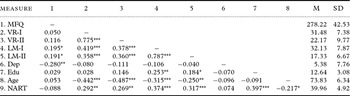
Means and standard deviations for MFQ, VR-I, VR-II, LM-I, LM-II, the Depression Scale, education, age, and NART, as well as all zero-order Pearson correlations between them, are provided in Table 1.
Zero-order correlations among MFQ scores, memory performance, age, and NART scores

Note: MFQ = Memory Functioning Questionnaire, VR-I = Visual Reproduction I, VR-II = Visual Reproduction II, LM-I = Logical Memory I, LM-II = Logical Memory II, Dep = Depression Scale scores, Edu = years of education, NART = National Adult Reading Test. *p < 0.05, two-tailed. **p < 0.01, two-tailed. ***p < 0.001, two-tailed.
Two-tailed Pearson correlations among the measures of memory performance were all positive, medium to very large (r between 0.358 and 0.787), and significant at p < 0.001. Correlations between age and measures of memory performance were all negative, medium to large (r between −0.250 and −0.487), and also generally significant at p < 0.001 (age and LM-II were significant at p = 0.006), suggesting that raw score memory performance declines with aging. Of the four measures of memory performance, only LM-I (r = 0.195) and LM-II (r = 0.191) were significantly related to MFQ scores (p = 0.032 and 0.036, respectively). However, all correlations between memory performance and MFQ scores were in the expected direction. Correlations between NART scores and all memory performance measures were significant and of medium strength (r between 0.269 and 0.374), suggesting that memory performance is positively associated with premorbid IQ. Scores on the NART correlated significantly and negatively with age (r = −0.217, p = 0.017), suggesting that estimates of premorbid IQ decline with increasing age. However, NART scores did not correlate significantly with MFQ scores (r = −0.088, p = 0.335), suggesting little relationship with memory complaints. Finally, no significant relationship was found between MFQ scores and age (r = 0.053, p = 0.561).
Regression analyses
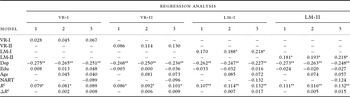
Table 2 provides a summary of the semipartial correlations, R2 and ΔR2 values for each model in each of the four regression analyses. While correlations were generally small for all memory measures across all three models, the semipartial correlations for all four measures of memory performance increased after adding both age and NART scores to each regression analysis. Semipartial correlations for memory performance measures in model 1 ranged from 0.028 to 0.181, with only LM-II reaching significance (p = 0.040). Semipartial correlations for memory measures in model 2 (age included) ranged from 0.045 to 0.193, with both LM-I and LM-II reaching significance (p = 0.034 and p = 0.029, respectively). Semipartial correlations in model 3 (age and NART scores included) ranged from 0.067 to 0.218, with LM-I and LM-II reaching significance (both p = 0.014).
Semipartial correlations, R squared (R2), and R squared change (ΔR2) values for each model in each hierarchical regression analysis

Note. VR-I = Visual Reproduction I, VR-II = Visual Reproduction II, LM-I = Logical Memory I, LM-II = Logical Memory II, Dep = Depression Scale scores, Edu = years of education, NART = National Adult Reading Test.
*p < 0.05, two-tailed. **p < 0.01, two-tailed.
Depression Scale scores were consistently related to MFQ scores across the three models in all regression analyses. Across the four regression analyses, semipartial correlations for Depression Scale scores ranged between −0.262 (p = 0.003) and −0.275 (p = 0.002) in model 1, between −0.247 (p = 0.006) and −0.265 (p = 0.004) in model 2, and between −0.227 (p = 0.010) and −0.251 (p = 0.006) in model 3. In contrast, years of education, age, and NART scores were not related to MFQ scores. For all three models in all four regression analyses, semipartial correlations for years of education, age, and NART scores were not significant (p > 0.05).
Overall, each of the regression models accounted for a relatively small amount of variance in MFQ scores, with R2 values ranging from 0.079 to 0.132. The R2 values for regression models that contained LM-I and LM-II (ranging from 0.107 to 0.132) were larger than the R2 values for regression models that contained VR-I and VR-II (ranging from 0.079 to 0.101), suggesting that models incorporating verbal memory performance better predicted MFQ scores than models incorporating visual memory performance. All R2 values were significant (ranging from p = 0.003 to p = 0.042), with the exception of model 3 for the VR-I regression analysis (p = 0.054). However, none of the R2 change values were significant for any model in any of the regression analyses, suggesting that while the inclusion of age and NART scores improves the predictive value of each of the memory measures, it does not improve the ability to predict MFQ scores in general.
Rank contrast correlations
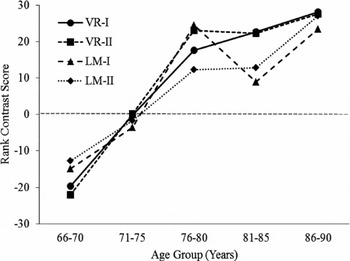
Given that the inclusion of both age and NART scores increased semipartial correlations for memory measures across all four regression analyses, rank contrast correlations were carried out to observe how age and NART scores were related to complaint–performance congruency. Two-tailed Spearman correlations were carried out between the participant's age and the rank contrast scores for each of the memory measures. Age was significantly related to rank contrast scores for all four measures of memory. Rank contrast scores were most strongly related to age for VR-II (Spearman's ρ = 0.409, p < 0.001), followed by VR-I (Spearman's ρ = 0.361, p < 0.001), LM-I (Spearman's ρ = 0.290, p = 0.001), and LM-II (Spearman's ρ = 0.252, p = 0.005). The correlations suggest medium to large positive relationships between complaint–performance congruency and age, whereby younger participants rated their memory more stringently relative to their performance in comparison to older participants. To provide further indication of how complaint–performance congruency is related to age, the mean contrast scores across five age bands for each of the four measures of memory are displayed in Figure 1.
Mean rank contrast scores across age groups for each measure of memory.

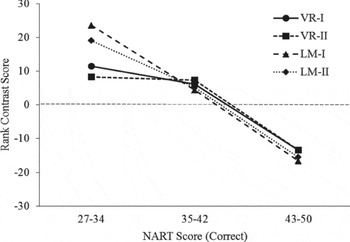
To determine how complaint–performance congruency was related to premorbid IQ, two-tailed Spearman correlations were carried out between NART scores and each of the rank contrast scores. As with age, NART scores were significantly related to rank contrast scores for all four measures of memory. Congruency was most strongly related to NART scores for LM-I (Spearman's ρ = −0.356, p < 0.001), followed by LM-II (Spearman's ρ = −0.319, p < 0.001), VR-II (Spearman's ρ = −0.279, p = 0.002), and VR-I (Spearman's ρ = −0.253, p = 0.005). The correlations suggest medium-strength negative relationships between complaint–performance congruency and NART scores, whereby participants with higher NART scores rated their memory more stringently relative to their performance compared to participants with lower NART scores. To provide further indication of how complaint–performance congruency is related to NART scores, the mean contrast scores across three groups for each of the four measures of memory are displayed in Figure 2.
Mean rank contrast scores across NART score groups for each measure of memory.

Discussion
As hypothesized, the strength of the relationship between SMCs and memory performance increased after partialing out variance in memory performance associated with age and premorbid IQ. In all four regression analyses predicting MFQ scores, semipartial correlations for each of the memory performance measures increased after adding both age (model 2) and NART scores (model 3). These increases in semipartial correlations were small but consistent. Semipartial correlations for Depression Scale scores were considerably stronger than for the memory performance measures in model 1, although this discrepancy reduced after partialing out variance associated with age and NART scores. Indeed, the strength of the semipartial correlations for LM-I and Depression Scale scores were comparable in model 3 (0.218 and −0.227, respectively). The contrasting effect of partialing out age and premorbid IQ on semipartial correlations for the memory performance measures and Depression Scale scores is worth noting given depression is generally accepted as the pre-eminent predictor of SMCs. It is also worth noting that partialing out variance associated with age and premorbid IQ had almost no effect on the overall R2 value for any of the regression models (no R2 change statistics were significant). Thus, differences in age and premorbid IQ partly explain why memory performance is generally a poor predictor of SMCs but they do not appear to improve the overall predictability of memory complaints.
Different types of suppressor variables have been depicted in the literature, although according to the definition of Maassen and Bakker (Reference Maassen and Bakker2001), age and premorbid IQ act as classical suppressor variables in the relationship between memory performance and SMCs. That is, both are related to other predictor variables but are not associated with the outcome variable. Age, for example, was significantly correlated with all memory performance measures (r between −0.250 and −0.487) but not significantly correlated with MFQ scores (r = 0.053). Likewise, NART scores also correlated significantly with all memory performance measures (r between 0.269 and 0.374) but not significantly with MFQ scores (r = −0.088). Given that age and premorbid IQ fit the description of a classical suppressor, it is possible that they have contributed to an underestimation of the value of memory performance measures in predicting SMCs in previous research, even if this contribution is small. However, as far as we are aware, age and premorbid IQ have not been identified as suppressor variables in memory complaint–performance congruency beyond this study and this result may be dependent on the use of the MFQ or WMS-IV measures. Further research or re-analysis of available data could help to clarify whether this result extends to different measures of subjective and objective memory.
The rank contrast correlations help to further explicate the manner in which age and premorbid IQ are related to complaint–performance congruency. The significant, positive, and medium-strength Spearman correlations between age and complaint–performance congruency, as well as the mean rank contrast scores plotted in Figure 1, suggest that younger participants rated their memory more stringently relative to their performance compared to older participants. This result does not indicate that people over a certain age tend to overestimate their memory performance per se; rather it suggests that when using the MFQ (and possibly other SMC questionnaires) subjective appraisals of one's own ability appear to become more lenient with increasing age. This is presumably a consequence of the strong effect of aging on memory performance but lack of a relationship with memory complaints. Thus, while aging is clearly associated with decreases in raw score memory performance, it appears to be taken into account when subjective estimates are made about one's own memory (at least on the MFQ). This might explain the age-related differences in complaint–performance congruency found by Mendes et al. (Reference Mendes2008) and why older participants appeared to overestimate their memory performance in the study by Frerichs and Tuokko (Reference Frerichs and Tuokko2006). The significant, negative, and medium-strength Spearman correlations between NART scores and complaint–performance congruency, as well as the mean rank contrast scores plotted in Figure 2, also suggest that participants with a higher premorbid IQ score rate their memory more stringently relative to their performance than participants with a lower premorbid IQ score. Again, this result does not suggest that participants over a certain premorbid IQ score underestimate their memory performance; it simply suggests that subjective appraisals of memory are more lenient in those with lower premorbid IQ scores.
An outcome of these relationships is that by increasing variance in age and premorbid IQ in a sample, variance is introduced into memory performance that is not shared with SMCs. An important consequence of this that extends to previous literature and future research is that the strength of correlations between SMCs and raw score measures of memory will depend partly on the ranges of age and premorbid IQ of participants in the sample. Studies with samples of greater age and premorbid IQ ranges are likely to have more variance in memory performance not shared with SMCs and should expect, all other things being equal, to find weaker correlations with SMCs. Given that correlations between SMCs and memory performance are often weak but in the expected direction, this might account for some degree of inconsistency in the literature regarding whether or not memory performance is classified as a meaningful predictor of SMCs.
It is also unlikely that age and premorbid IQ are the only variables that act to suppress the relationship between memory performance and SMCs. For example, situational fatigue may be negatively related to memory performance but not related to SMCs (given that SMCs are typically based on past experiences). As a result, it may be premature at this stage to conclude that memory complaints are not a good indicator of current memory functioning and it raises the question of what other variables might suppress complaint–performance congruency by introducing variance into memory performance that is not shared with SMCs.
In terms of future research, there are several strategies that can be adopted to limit the effect of suppression on complaint–performance congruency resulting from differences in age and premorbid IQ. One option is to utilize norms, where available, to provide participants with a standard score for memory that is adjusted for age and IQ (although norms adjusted for both are rarely available). A second option is to utilize SMC questionnaires that incorporate norms, such as the Memory Assessment Clinics Self-rating Scale (MAC-S) (Crook and Larrabee, Reference Crook and Larrabee1992). It would be interesting to repeat the current study with the MAC-S (rather than the MFQ) to observe any differences in complaint–performance congruency when raw scores and scores based on normed data for the MAC-S are used. A third option to minimize suppression in correlational studies is to use the method employed in the current study; that is, to record age and take a measure of premorbid IQ and to take these variables into account when observing correlations between memory performance and SMCs. This third option is a quick and simple solution, given that a measure of premorbid IQ can be obtained from most participants via the NART in less than five minutes.
The results obtained in the present study need to be considered within the context of a few limitations. First, screening for previous testing of memory or language in participants was based exclusively on self-reports, which may have been unreliable. Participants may have forgotten about testing carried out in the past (although, in this case, the effect of previous testing on SMCs might have been small or nonexistent) or may have omitted details of previous testing due to associated feelings of embarrassment or distress (which likely would have inflated correlations between SMCs and memory performance, since feedback from formal testing would presumably influence beliefs about one's own memory abilities).
Second, mean NART scores were unusually high for an Australian sample (cf. Kiely et al., Reference Kiely, Luszcz, Piguet, Christensen, Bennett and Anstey2011), as were years of education relative to other SMC studies (cf. Schmidt et al., Reference Schmidt, Berg and Deelman2001; Zandi, Reference Zandi2004; Minett et al., Reference Minett, Da Silva, Ortiz and Bertolucci2008). However, we expect that these differences in premorbid IQ and education had little influence on the results reported here and may, in fact, be attributable to the sampling procedures used. Given the sample was recruited via newspaper advertisements, those with a greater interest in research and education might have been more likely to respond. Likewise, we may have recruited participants who, on average, were more concerned about their memory than other similarly aged people in the community. We also feel, however, that this would have had little or no effect on these results.
Finally, it is standard procedure to administer the Verbal Paired Associates subtest of the WMS-IV (Wechsler, Reference Wechsler2009) between the immediate and delayed parts of the VR and LM subtests, though this was replaced with three questionnaires in the current study. As a result, mean raw scores on the delayed component of the VR and LM subtests (i.e. VR-II and LM-II) should be interpreted with caution, given that the questionnaires may exhibit more or less interference than the Verbal Paired Associates subtest. Again, however, we feel that these factors were unlikely to have much effect on the results presented here.
Another issue worth pointing out is that the current study compared four theoretically distinct measures of memory with a single, overall measure of subjective complaint. While some aspects of the MFQ more closely reflect visual and verbal memory (e.g. remembering names and faces), the questionnaire is not designed to delineate between visual and verbal or immediate and delayed aspects of memory functioning. If the measures of memory performance were compared against SMC questions that matched these measures of performance, it is likely that stronger relationships would have been reflected between complaints and performance. While we can only speculate on this point, we see no reason why age and premorbid IQ would not also act as suppressor variables when using SMC questions that are matched to each of the four measures of memory utilized in this study.
In summary, the results of the present study suggest that age and premorbid IQ act as suppressor variables in the relationship between memory performance and memory complaints. For immediate and delayed measures of visual and verbal memory, semipartial correlations increased after adding both age and NART scores to regression analyses designed to predict scores on the MFQ. Zero-order correlations indicated that age and premorbid IQ act in a manner consistent with what Maasen and Bakker (2001) describe as classical suppression. Finally, rank contrast correlations demonstrated memory complaint–performance congruency to be related to age and premorbid IQ, whereby older participants and those with a lower premorbid IQ judged their memory ability more leniently than younger participants and those with a higher premorbid IQ. An important consequence of these relationships is that congruency between SMCs and raw score memory performance in correlational research will depend partly on the range of age and premorbid IQ in the sample. This may account in part for whether or not the typically weak associations between SMCs and memory performance are deemed significant. The effect of suppression from age and premorbid IQ on complaint–performance congruency in correlational studies can easily be avoided by taking these variables into account, measures of which can usually be obtained in less than five minutes.
Conflict of interest
None.
Description of authors' roles
Matt Merema helped design the study, collected the data, conducted the analysis, and wrote the paper. Craig Speelman helped design the study, supervised the collection of data and analysis, and reviewed the paper. Elizabeth Kaczmarek helped design the study, supervised the collection of data, and reviewed the paper. Jonathan Foster helped design the study, supervised the collection of data, and reviewed the paper.
Acknowledgments
This research was supported by an Edith Cowan University Postgraduate Research Scholarship (ECU-PRS) awarded to Matt Merema.