



Anhedonia, defined as the diminished interest and/or capacity for pleasure, is one of psychiatry’s most widely shared symptoms. It reaches the ordinary rewards of life; food that no longer tastes worth eating, music that no longer moves and the company of others that no longer draws one in. Anhedonia is a key diagnostic criterion across depressive disorders, a cardinal negative symptom across the schizophrenia spectrum and recurs in anxiety, substance use, neurodevelopmental and many other conditions. Its span across psychiatry is, in fact, beginning to be well established. Yet this breadth coexists with striking neglect. Anhedonia is typically treated as secondary to whichever diagnosis it accompanies, measured with a single global item and rarely targeted in its own right. That tension, a symptom central to prognosis, risk and recovery, still handled as an afterthought, is what this editorial takes up.
Part of the difficulty is that anhedonia is not a single construct. It is multidimensional, spanning anticipatory, consummatory and motivational reward components with common but dissociable neural underpinnings. Reference Liang, Wu, Hanxiaoran, Greenshaw and Li1 Definitions differ in which of these they emphasise, and some extend further to reduced energy or emotional blunting. These distinctions are not merely semantic, since they determine which component an instrument captures and therefore what a given literature can show. The two best-studied traditions illustrate this. In major depressive disorder (MDD), anhedonia sits within the mood domain and reaches reward liking and in-the-moment consummatory pleasure alongside anticipatory deficits. In schizophrenia, it is defined independently of mood and driven more by neurocognitive impairments in representing reward value than by any loss of consummatory pleasure, which is often relatively preserved, a dissociation known as the schizophrenia anhedonia paradox. Reference Liang, Wu, Hanxiaoran, Greenshaw and Li1 The disorders thus differ in which reward component is most affected, locating the shared vulnerability at the level of reward components rather than surface definitions. We argue that anhedonia is a transdiagnostic, multidimensional construct of psychopathology that shapes prognosis, indexes common biological liability and remains modifiable, yet is still treated as a secondary symptom. Evidence for this view converges across symptom structure, clinical outcomes, genetic liability, neurobiological circuitry and intervention.
Anhedonia reliably appears across conditions with distinct symptom profiles, implicating a transdiagnostic dimension of vulnerability rather than a disorder-specific feature. In a large, highly comorbid clinical sample, Reference Guineau, Ikani, Rinck, Collard, van Eijndhoven and Tendolkar2 symptoms spanning depression, anxiety sensitivity, attention-deficit/hyperactivity disorder (ADHD) and autism-spectrum traits were modelled within a dimensional network framework. Anhedonia emerged as a central node linking multiple symptom clusters, with associations extending beyond depression severity. It appears to occupy a central position within the phenotypic organisation of psychopathology.
If anhedonia operates across diagnostic categories, its consequences should extend beyond any single disorder. In a naturalistic cohort of 1570 out-patients treated for MDD, Reference Vinckier, Gourion and Mouchabac3 improvement in anhedonia was the strongest predictor of improvement in psychosocial functioning over 10 to 14 weeks, exceeding the predictive value of overall depressive symptom reduction. Persistence of anhedonia predicted a dissociation of response, in which mood symptoms improved, but social and occupational functioning did not. Negative symptoms in schizophrenia, including anhedonia, are likewise among the strongest predictors of functioning and quality of life. Reference Liang, Wu, Hanxiaoran, Greenshaw and Li1 To our knowledge, no large-scale studies to date have assessed the transdiagnostic extent of anhedonia’s long-term impact on functional outcomes.
Anhedonia’s impact extends to suicide risk. In a meta-analysis of psychiatric and community samples, Reference Gillissie, Le, Rhee, Cao, Rosenblat and Mansur4 elevated anhedonia was significantly associated with suicidal ideation and behaviour, even after accounting for depressive symptom severity. This points to a contribution to suicidality that is not reducible to overall mood disturbance. Diminished reward anticipation and a reduced sense that future activity is worthwhile may weaken engagement with the goals and relationships that ordinarily protect against suicide. Collectively, these data position anhedonia as more than an accompanying feature of illness, with its severity and persistence tracking burden and risk. Failure to systematically assess and target anhedonia directly may therefore leave a clinically significant construct unaddressed, even when diagnostic criteria for remission are met.
Converging biological evidence supports a transdiagnostic interpretation of anhedonia. In the largest genome-wide association study (GWAS) of anhedonia to date, Reference Ward, Lyall, Bethlehem, Ferguson, Strawbridge and Lyall5 comprising 375 724 UK Biobank participants, 11 genome-wide significant loci were identified, with modest single-nucleotide polymorphism (SNP)-based heritability. Genetic correlations revealed substantial shared liability with MDD (rg = 0.77), and significant correlations with schizophrenia (rg = 0.28) and bipolar disorder (rg = 0.12), but not with obsessive–compulsive disorder or Parkinson’s disease. This pattern suggests anhedonia indexes partially shared genetic risk architecture rather than disorder-specific vulnerability. In a neuroimaging subsample, higher polygenic risk for anhedonia was associated with reduced grey matter volume, including in the orbitofrontal cortex (OFC), and altered white matter integrity. Reference Ward, Lyall, Bethlehem, Ferguson, Strawbridge and Lyall5 Given the OFC’s role in reward valuation and goal-directed behaviour, these findings implicate disrupted frontostriatal systems in genetic liability for anhedonia. Neuroimaging across depression and schizophrenia similarly implicates dysregulation of ventral striatal, orbitofrontal, anterior cingulate and mesolimbic dopaminergic circuitry, alongside alterations in aversion-related regions such as the habenula and insula. Reference Liang, Wu, Hanxiaoran, Greenshaw and Li1 Across diagnoses, anhedonia is consistently linked to hypofunction within frontostriatal and mesocorticolimbic circuits, a convergent circuit-level substrate. These associations were observed dimensionally in a population-based sample rather than within diagnostic categories, underscoring that genetic and neural variation linked to anhedonia can be studied independently of formal diagnoses.
Biological convergence does not settle how anhedonia should be measured. The genome-wide study operationalised it using a single self-report item capturing ‘recent little interest or pleasure’ in activities, which fails to separate the components that convergent-looking scores may combine. That these components come apart in practice is shown directly by a recent study Reference Parsons, Tollånes, Cella, Hirsch and Young6 integrating behavioural indices of reward anticipation, questionnaire-based anhedonia assessments and 7 days of smartphone-delivered experience sampling. Behavioural performance indexing reward anticipation tracked daily anticipated reward but not daily consummatory pleasure, whereas questionnaire-based anhedonia predicted both. Measurement modality therefore determines which aspect of reward dysfunction a study can detect, and a single global score conflates distinct processes, limiting mechanistic inference and leaving intervention targets poorly specified. This problem compounds in intervention research, where some trials rely on single items from broader mood scales, such as the inability-to-feel item of the Montgomery–Åsberg Depression Rating Scale, while others use dedicated pleasure scales, effort-based and motivational measures, or behavioural reward tasks. Ostensibly similar trials may therefore measure non-equivalent constructs, making the current evidence base difficult to appraise.
Given dopamine’s central role in reward processing, dopaminergic dysfunction has long been thought to underlie anhedonia, but recent evidence complicates that view. In a recent living systematic review and network meta-analysis of human trials and animal studies, Reference Serretti8 pro-dopaminergic agents produced only small reductions in anhedonia in depression, with prediction intervals that included no effect, and some non-dopaminergic antidepressants performed comparably or better. Dopaminergic modulation in humans thus appears neither necessary nor sufficient. Animal studies tell a different story, with large effects in sucrose preference paradigms, Reference Ostinelli, Salanti, Macleod, Chiocchia, Smith and Stringaris7 though these rest on a single behavioural proxy. The gap between robust animal and modest human findings marks a translational divide, part of which may be methodological. Dopamine is increasingly understood as acting on the anticipatory and motivational (‘wanting’) components of reward rather than on consummatory pleasure, yet the human trials indexed anhedonia largely through global or consummatory self-report scales, and no human reward- or effort-based task data were available. Reference Ostinelli, Salanti, Macleod, Chiocchia, Smith and Stringaris7 Outcome measures weighted towards consummatory pleasure are therefore relatively insensitive to the approach-related processes that dopaminergic manipulation most directly engages, so the small, pooled effects may reflect a mismatch between intervention target and outcome measure rather than an absence of any dopaminergic contribution. This reinforces the broader case for matching outcome measures to the specific reward component an intervention is expected to modify.
Pharmacological work has begun to target anhedonia more selectively. A recent treatment review reports that ketamine improves anhedonia across anticipatory, consummatory and motivation-related components, and that a kappa-opioid receptor antagonist increased ventral striatal reward-anticipation activation and improved anhedonia in a transdiagnostic sample. Reference Serretti8 These findings suggest that reward circuitry can be engaged through mechanisms beyond direct dopaminergic stimulation, consistent with a distributed account.
Intervention and modifiability are not limited to pharmacology. Despite its centrality, anhedonia has rarely been the primary target of psychological intervention, and most treatments are evaluated on overall symptom reduction rather than change in reward-related processes. Where it has been targeted directly, it responds. In a randomised trial that recruited participants dimensionally by elevated anhedonia rather than diagnosis, Reference Serretti8 Behavioural Activation Treatment for Anhedonia was compared against Mindfulness-Based Cognitive Therapy. Both produced substantial reductions in anhedonia severity, with large within-group effects and no significant difference between treatments, despite targeting distinct processes. Positive affect therapy (PAT) targets reward sensitivity more directly through pleasant-activity scheduling, attention training towards positive emotion and cultivation of positive affect. In a randomised trial in depressed or anxious adults with low positive affect, PAT raised positive affect and engaged reward anticipation-motivation and reward attainment more than a negative-affect comparator. Reference Craske, Meuret, Echiverri-Cohen, Rosenfield and Ritz9 Anhedonia thus appears modifiable through several pharmacological and psychological routes, each engaging partly distinct processes. Targeting it directly, independent of diagnostic category, may represent a clinically viable approach aligned with transdiagnostic models, challenging disorder-bound frameworks and moving psychiatry towards mechanism-informed treatment.
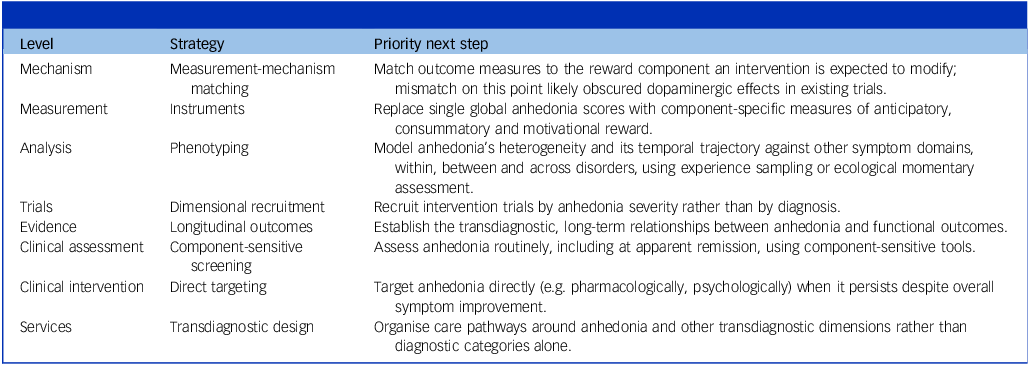
Taken together, the evidence no longer supports treating anhedonia as a peripheral symptom confined to discrete disorders, but as a salient transdiagnostic feature of psychopathology. Symptom-level modelling places it as a central node linking diverse presentations; longitudinal and meta-analytic findings show that its persistence and severity constrain functional recovery and amplify suicide risk; genetics and neuroimaging reveal shared liability and convergent frontostriatal involvement that cuts across diagnostic boundaries; and intervention studies show that anhedonia is modifiable through psychological and pharmacological approaches that engage reward processes directly. Yet research and clinical practice remain organised around diagnostic categories, where anhedonia is measured globally rather than by component, is targeted inconsistently and is rarely prioritised as a therapeutic objective. Recognising its transdiagnostic nature is not simply a matter of conceptual clarity. Anhedonia erodes the capacity to want, to pursue and to stay connected to others, much of what makes a life feel worth living and what recovery ultimately depends on. Attending to it as a transdiagnostic dimension in its own right translates into concrete next steps for research and practice (Table 1).
Priority next steps for research and clinical practice

Table 1 Long description
A table with three columns and eight rows. The columns are labeled Level, Strategy, and Priority next step. The rows are as follows: Row 1: Level, Mechanism; Strategy, Measurement-mechanism matching; Priority next step, Match outcome measures to the reward component an intervention is expected to modify; mismatch on this point likely obscured dopaminergic effects in existing trials. Row 2: Level, Measurement; Strategy, instruments; Priority next step, Replace single global anhedonia scores with component-specific measures of anticipatory, consummatory and motivational reward. Row 3: Level, Analysis; Strategy, Phenotyping; Priority next step, Model anhedonia’s heterogeneity and its temporal trajectory against other symptom domains, within, between and across disorders, using experience sampling or ecological momentary assessment. Row 4: Level, Trials; Strategy, Dimensional recruitment; Priority next step, Recruit intervention trials by anhedonia severity rather than by diagnosis. Row 5: Level, Evidence; Strategy, Longitudinal outcomes; Priority next step, Establish the transdiagnostic, long-term relationships between anhedonia and functional outcomes. Row 6: Level, Clinical assessment; Strategy, Component-sensitive screening; Priority next step, Assess anhedonia routinely, including at apparent remission, using component-sensitive tools. Row 7: Level, Clinical intervention; Strategy, Direct targeting; Priority next step, Target anhedonia directly (e.g. pharmacologically, psychologically) when it persists despite overall symptom improvement. Row 8: Level, Services; Strategy, Transdiagnostic design; Priority next step, Organise care pathways around anhedonia and other transdiagnostic dimensions rather than diagnostic categories alone.
Author contributions
I.D.M. led the conceptualisation and drafting of the manuscript, including literature selection and synthesis. K.M.L. and D.R.-C. contributed to conceptual development and provided critical revisions. All authors approved the final version of the manuscript.
Funding
K.M.L. and D.R.-C. are supported by salary awards through the Fonds de Recherche du Québec Santé (#367856 and #367157, respectively).
Declaration of interests
D.R.-C. reports personal fees from Otsuka Canada and AbbVie outside the submitted work. K.M.L. reports personal fees from Otsuka Canada, Lundbeck Canada and Boehringer Ingelheim. I.D.M. reports no conflict of interest.
Declaration of AI use
During preparation of this work, the authors used Claude to assist with structure and language editing. After using this tool, the authors reviewed and edited the content as needed and take full responsibility for the content of the publication.



eLetters
No eLetters have been published for this article.