Introduction
Loneliness and social isolation are important factors that impair quality of life (QoL) in older adults. They may impact adversely on cognitive performance, which is instrumental in maintenance or repair of QoL, and both have been associated with an increased risk of dementia (Sutin et al., Reference Sutin, Stephan, Luchetti and Terracciano2018; Wilson et al., Reference Wilson2007). Broadly, loneliness and isolation may be complementary, with the former reflecting more subjective negative affective states and the latter, objective social engagement parameters (Lee and Cagle, Reference Lee and Cagle2017). It remains unclear if these characteristics predispose to dementia, if they are prodromal features of the dementing process, or if they react reciprocally with cognitive changes that are central to the development of dementia.
Loneliness among older people is related to mental health, particularly depression (Tomas et al., Reference Tomas, Pinazo-Hernandis, Oliver, Donio-Bellegarde and Tomas-Aguirre2019) and physical health and well-being (Hawkley and Cacioppo, Reference Hawkley and Cacioppo2010). It may be associated with increased risk of developing dementia and Alzheimer’s disease (AD) (Hawkley and Cacioppo, Reference Hawkley and Cacioppo2010; O’Luanaigh et al., Reference O’Luanaigh2012; Wilson et al., Reference Wilson2007). When it co-occurs with depression, loneliness seems to increase the mortality rates of older people (O’Luanaigh et al., Reference O’Luanaigh2012). In a 10-year follow-up of 75-, 80-, and 85-year-old citizens of Helsinki, both cognitive decline and mortality were doubled among people feeling lonely (Tilvis et al., Reference Tilvis, Kahonen-Vare, Jolkkonen, Valvanne, Pitkala and Strandberg2004). The association between age and loneliness differs across studies because while social losses contribute to older individuals’ vulnerability to loneliness, many older adults are able to adapt by implementing a variety of coping strategies, e.g. deepening existing relationships (Baltes and Carstensen, Reference Baltes, Carstensen, Staudinger and Lindenberger2003).
Loneliness is also associated with social isolation, but these terms are not synonymous because loneliness is a subjective experience based on intrapsychic interpretations of the environment, whereas social isolation represents the objective or observable level of interaction with other people in the environment. Loneliness may co-vary with depression. Depression and lack of energy, or anergia, have been studied extensively, and most studies show that these factors can increase the likelihood of development of dementia (Byers and Yaffe, Reference Byers and Yaffe2011; Devanand et al., Reference Devanand1996; Jorm, Reference Jorm2000). The important question of whether there are bidirectional influences (or reciprocity) of these variables on memory or dementia has not been examined systematically.
Impairment in instrumental activities and social functioning has been shown to predict dementia, including AD (Brown et al., Reference Brown, Devanand, Liu and Caccappolo2011; Devanand et al., Reference Devanand, Liu and Brown2017; Tabert et al., Reference Tabert2002) at the mild cognitive impairment stage. Restriction of physical and other everyday activities, however, has rarely been studied explicitly as a predictor of cognitive decline and dementia. For example, physical difficulty in lifting objects and other physical impairments can affect QoL, with or without impairment in instrumental activities of daily living. In individuals without a diagnosis of dementia, it remains unclear to what degree restriction of activities is associated with incident cognitive decline or dementia and the mechanism by which such an effect would occur. Identifying these potential predictor effects is important because in addition to providing information related to QoL, and prognosis, interventions can be tailored to address these specific domains of impairment with the goal of improving QoL and reducing disability, cognitive decline, and mortality.
The objective of this study was to evaluate the association of restriction of activities with memory decline and incident dementia and to contrast it with other measures of QoL, including social isolation, affective suffering (as an index of depression), anergia, and loneliness in older individuals without dementia participating in a longitudinal multi-ethnic older community dwelling cohort study (Devanand et al., Reference Devanand2015). In particular, we wanted to understand the inter-relationships among Restriction, Isolation, and Loneliness and their potentially reciprocal associations or influences with memory decline and dementia over time.
Methods
The North Manhattan Aging Project, subsequently also referred to as the Washington Heights/Inwood Columbia Aging Project, consists of individuals recruited from a stratified random sample of 50% of all Medicare beneficiaries aged 65 years and older in northern Manhattan, New York City. Participants were originally recruited in 1992 and assessed on average every 2 years. For this report, analyses were restricted to the first three follow-ups (average follow-up 5.3 ± 0.85 years). The Columbia University Institutional Review Board approved the study protocol and written informed consent forms.
Participants
All 2226 participants received a computer-assisted survey interview that examined a large number of measures likely to impact on health, cognition, functioning, and QoL. Of these 2226 participants, 855 participants consented to a formal dementia diagnostic evaluation, which included neuropsychological testing, at the baseline visit as described by Stern et al. (Reference Stern1992). This subset of 855 participants provides the sample for this report. Critically, all participants diagnosed with dementia at baseline were excluded from all analyses. Demographic and selected cognitive characteristics of the sample at baseline are in Supplementary Table 0.
Instruments
For this report, scales from the survey that can impact cognition, functioning, and QoL were examined. These factor scales, derived a priori from the CARE survey of QoL, covered 8 items for restriction (health problems get in the way of doing things that the participant wants to do; breathless, heart pounding, or exertion pain interferes with what one wants to do; problems with memory make it difficult to do accustomed things), isolation (24 items, including not going to club or center, no contact with friends, if ill might go unnoticed for 24 h, health interferes with social activities or leisure activities), loneliness (6 items, including often feels lonely, does not feel close to anyone, no one to talk to about problems), anergia (7 items, including recently not enough energy, felt slowed physically in past month, wakes up feeling tired), and affective suffering (18 items including worries about almost everything, being sad or depressed over the past month, is pessimistic about the future). Items from each scale are listed in Supplementary Table 1 (Cheng et al., Reference Cheng, Gurland and Maurer2008; Golden et al., Reference Golden, Teresi and Gurland1984; Gurland and Wilder, Reference Gurland and Wilder1984; Teresi et al., Reference Teresi, Golden, Gurland, Wilder and Bennett1984). All scales were administered by a trained examiner. The scale scores were computed as the percent of items endorsed (items endorsed/items administered) so long as responses to over 50% of the items in the given Scale were obtained.
The neuropsychological test battery was used in an algorithm-based consensus diagnostic process as previously described (Stern et al., Reference Stern1992). The standardized neuropsychological test battery included measures of learning and memory, orientation, abstract reasoning, executive function, language, and visuospatial ability. It was administered by a trained technician. We evaluated total immediate recall from the 12-item, 6-trial, Selective Reminding verbal list learning test as our critical measure of decline, given its close association with AD dementia (Devanand et al., Reference Devanand2008).
Assessments
Participants received both CARE scales and neuropsychological tests at baseline (T0), and 2 years (T1), 4 years (T2), and 6 years (T3) after baseline.
Statistical analyses
Memory trajectory analysis using mixed effect s models
We examined the effect of the QoL scale scores on longitudinal memory trajectories using mixed effects models. For memory trajectories, verbal episodic memory scores were obtained at baseline and up to 3 follow-up visits. At the four time points, data from 855, 610, 509, and 416 participants were obtained. For the primary analysis, we dichotomized baseline QoL Scale scores using median split (high vs. low scores). We elected to use this categorical approach to improve and clarify the interpretation of main effects and interactions and to avoid spurious findings driven by outliers. We supplement the primary findings by providing the results obtained with QoL scales treated as continuous variables in Supplement 3. Note that high scores indicated a greater propensity to endorse QoL Scale items (e.g. more Restriction, etc.). Separate mixed effects analysis was conducted with verbal episodic memory scores as the dependent variables, each of the QoL Scale groups, time, group × time interactions, age, sex, and education at baseline as the fixed effects. Within-subject correlation due to repeated assessment was accounted for by adding a random intercept. Statistical significance was set at α less than 0.05. Post-hoc least squared means were computed to examine QoL Scale group differences by time points. As a part of sensitivity analysis, we conducted multiple imputation using age, sex, and dementia status to impute the missing memory scores in the follow-ups. Similarly, the same analyses were conducted for the participants who were followed to the last time point (n = 416).
Cross-lagged panel analysis
To address the possible reciprocal relationship between QoL variables and memory, Cross-Lagged Panel Model analysis (Hamaker et al., Reference Hamaker, Kuiper and Grasman2015) was conducted. Since only Isolation and Restriction showed significant association with memory trajectories, we tested the longitudinal effects of these three variables over the three follow-ups (total four time points). These measures were treated as continuous. At each time point, Isolation, Restriction, and Memory were allowed to simultaneously predict these same variables at the next time point, adjusted for gender and age at baseline. The three measures at each time point were specified as correlated, and we forced the effects as time-invariant. Missing data were managed with full information maximum likelihood for the primary analysis. As a sensitivity analysis, we conducted the same analysis for individuals who had baseline and endpoint data.
Cox regressions
To examine the effect of QoL Scales on dementia transition, we conducted discrete Cox regression for the subset of participants who were followed at least once beyond baseline (n = 636). The proportional hazards assumption was evaluated by testing a non-zero slope in linear regression models of the Schoenfeld residuals as a function of event time.
Statistical environment
All analyses were conducted in R (version 3.6.0, R Core Team, 2019) with lmerTest (Kuznetsova et al., Reference Kuznetsova, Brockhoff and Christensen2017; Rosseel, Reference Rosseel2012; Therneau, Reference Therneau2014). All β coefficients were standardized.
Results
Descriptive analysis
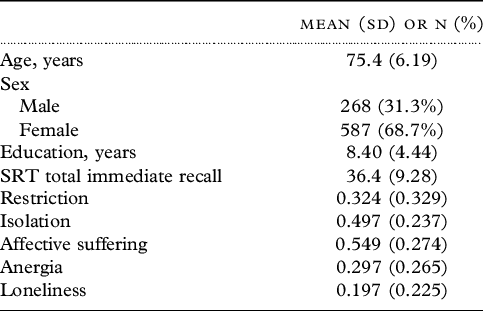
Demographic and scale information is in Table 1. The sample was predominantly female. Mean education in years was 8.0. The mean age of the sample was 74 years. Correlations among Scales at baseline are shown in Table 2. Restriction was strongly correlated with Anergia (r = 0.66), Affective Suffering (r = 0.41), and Isolation (r = 0.37). Loneliness correlated with Affective Suffering (r = 0.39), but weakly correlated with Isolation (r = 0.07). In general, scores on these QoL Scales did not show consistent declines (i.e. worsening) over time.
Demographic, quality of life scales, and memory of the sample (n = 855) at baseline

Correlation of QoL scales at baseline

Pearson correlation coefficients.
* P < 0.05.
*** P < 0.001.
Primary analyses
QoL on Memory Trajectories
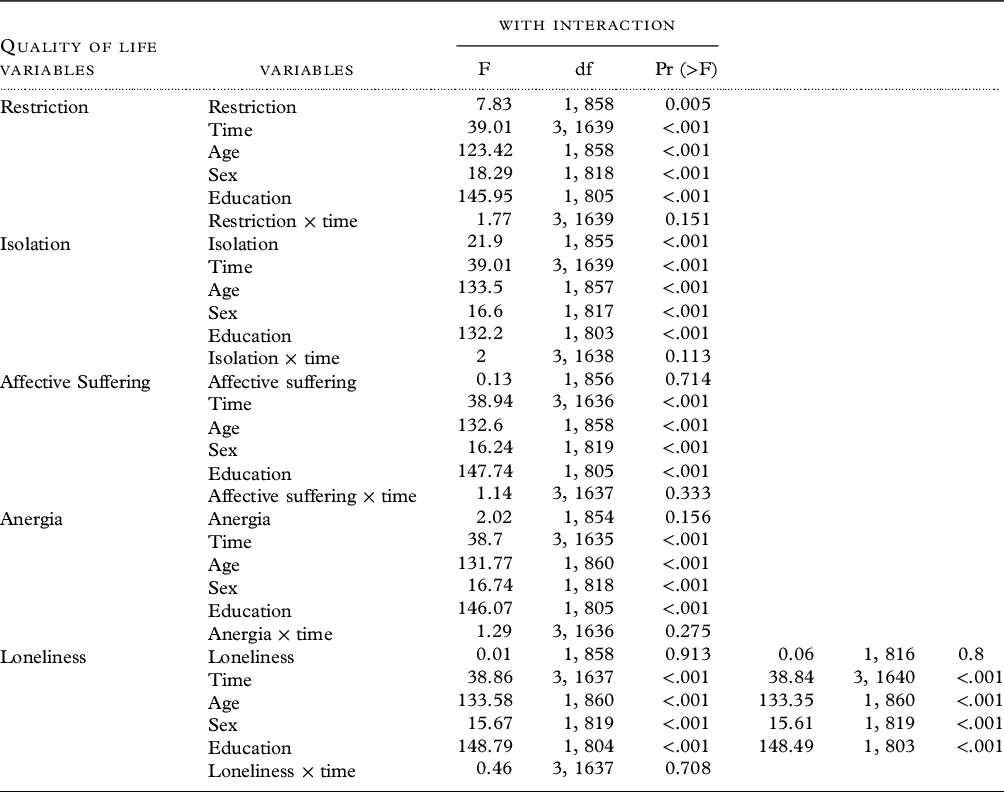
In order to determine the impact of QoL Scale scores on verbal episodic memory over time, we conducted mixed effect regression. For each analysis, F values, degree of freedom, and P values for main effects and the interaction term from the type 3 ANOVA are in Table 3.
Type 3 ANOVA table of longitudinal trajectory analysis with and without interaction with time

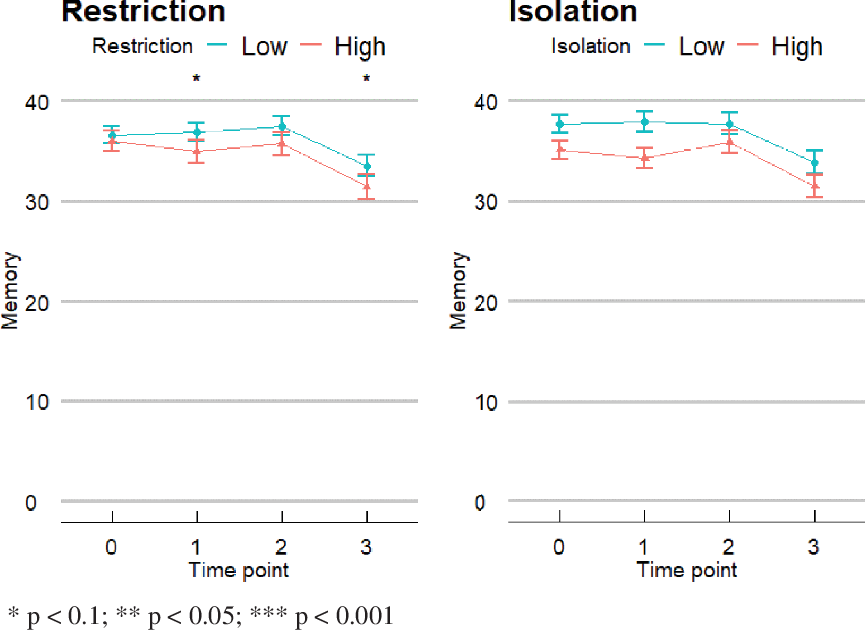
For Restriction, we found a significant main effect of group (F 1,817 = 5.77, P = 0.017), such that individuals who scored high on restriction, i.e. endorsed more indicators of Restriction, performed 1.35 times worse on memory (β = −1.35, 95% CI [−2.44, −0.25], P = 0.017) than individuals who scored low at all time points (Figure 1 and Supplement Table 3). We also found a significant effect of time. The results indicate that memory fluctuated over time (P < 0.001), although the effect of Restriction on memory remained consistent over time (Restriction × Time, P = 0.15). To examine Restriction Scale with more granularity, we conducted separate regression analyses of the items that appeared to reflect physical activities (6) and those that reflected mental or neuropsychiatric symptoms (2). We found that both contributed independently and significantly to the prediction of objective memory performance on the Selective Reminding test over time (as in Supplement Table 7).
Least squares mean of Memory measure (SRT Total recall) for Restriction and Isolation Scales. High and Low groups are based on a median split at baseline. High indicates greater Restriction or Isolation; Low indicates less Restriction or Isolation. Error bars are SEMs.

A similar pattern was found for Isolation, such that individuals with high scores on Isolation performed 2.66 times worse on memory (Figure 1 and Supplement Table 3, β = −2.66, 95% CI [−3.72, −1.59], P < .001) and the effect did not change over time (Isolation × Time, p = 0.11).
For other scales, no significant difference was found between high and low groups (P’s > 0.26) nor time-specific effects (P’s > 0.27), nor scale × time interactions (P’s > 0.33).
When we examined a combination of Restriction and Isolation (namely, high in both, low in both, or high in one, and low in the other at baseline), we found, not unexpectedly, that individuals who were high in both Restriction and Isolation had the lowest (i.e. worst) memory scores over time and those who scored low in both Restriction and Isolation had the highest memory scores over time (see Supplement Table 4).
QoL Scales and Transition to Dementia
Restriction (HR = 2.22, 95% CI [1.42, 3.47], P < .001) and isolation (HR = 1.78, 95% CI [1.17, 2.70], P = 0.007) were strongly associated with incident dementia controlling for age, sex, and education (see Supplement Table 5). We also found that both the physical items of the scale and the mental items contributed significantly and independently to dementia incidence (data not shown). We found that anergia was also associated with incident dementia (HR = 1.60, 95% CI [1.04, 2.46], P = 0.032). Other QoL scales were not associated with incident dementia (P’s > .1). With both Restriction and Isolation in the same model, Restriction remained significant (HR = 1.97, 95% CI [1.24, 3.14], P = 0.004), while Isolation was no longer significant (HR = 1.51, 95% CI [0.96, 2.40], P = 0.077) (see Supplement Table 5). We did not find a significant interaction between Restriction and Isolation in this analysis (P = 0.2681).
Cross-lagged Panel Analysis for Memory and QoL scales
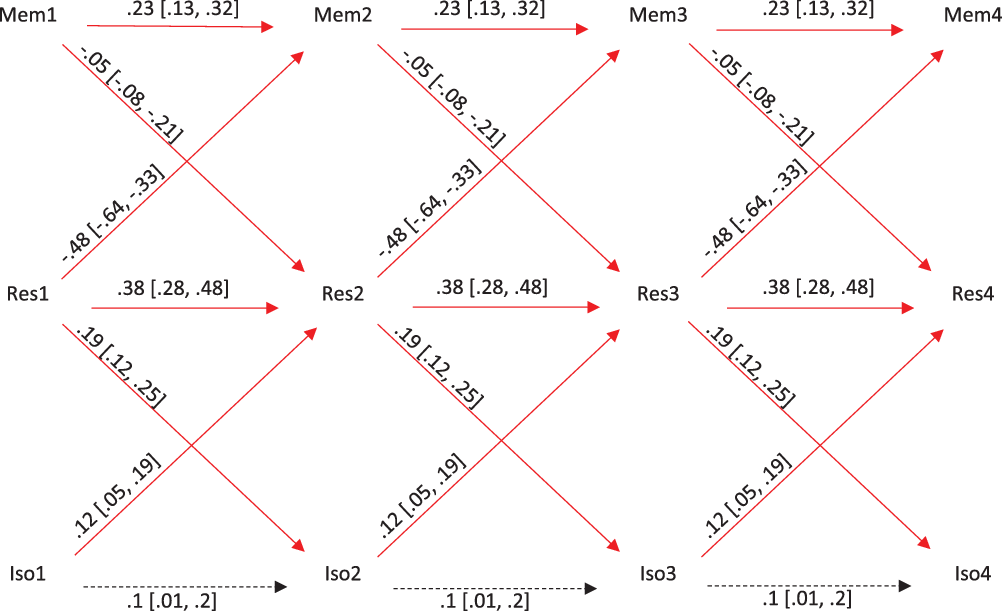
Last, we conducted a cross-lagged panel analysis utilizing the two scales that had the largest effects on memory (Isolation and Restriction) to determine the reciprocal influences over time among these scales and our primary outcome measure, memory impairment. We found that Restriction and Isolation had reciprocal influences (Restriction to Isolation: β = 0.159, 95% CI [0.09, 0.229], P < .001; Isolation to Restriction: β = 0.126, 95% CI [0.053, 0.199], P < .001) indicating that Restriction at the previous time point increased current Isolation, which in turn increased Restriction at the next time point. However, only Restriction had direct influence on Memory (β = −0.48, 95% CI [−0.64, −0.33], P < .001), and Memory had a direct influence on Restriction only (β = −0.05, 95% CI [−0.08, −0.02], P < .001). This can be seen in Figure 2. Thus, Restriction and Memory were inversely related.
Cross-lagged panel analysis with time-invariant effects. All arrows indicate significant relationships among variables across time points. Note the significant and reciprocal relationship between Restriction and Memory. Coefficients are standardized. Brackets include 95% confidence intervals. Res = Restriction. Mem = SRT Memory total score. Numerical suffixes indicate time point. (e.g. Res1 = Restriction score at baseline). All measures treated as continuous variables.

Sensitivity analyses
We examined if demographic variables and the Scales (Affective Suffering, Isolation, Restriction, Loneliness, Anergia) differed at baseline between those who completed the study (i.e. had T3 data) versus those who did not. Non-completers were older, with worse memory, less isolation, and more affective suffering at baseline (see Supplemental Table 2). The rest of the demographic or baseline characteristics did not differ by group.
When we removed the participants who transitioned to dementia over follow-up (n = 100), our primary results indicated that only Isolation had significant effects on memory. These results are listed in Supplemental Table 2. We conducted analyses after the imputation of missing data using repeated-measures ANOVA. Again, results remained similar to those found in the mixed effects model.
When we treated the QoL variables as continuous, we found essentially the same results. These are listed in Supplement Table 6. Significant main effects were observed for Restriction and Isolation (but not the other measures). In contrast to median split analyses, we found significant Restriction × time (when the restriction is treated as continuous, P = 0.023) and Isolation × time (when the isolation was split into three groups based on the tertiles, P = 0.025) terms. However, these did not have a systematic nor interpretable pattern.
Last, we examined the role of the two items in the Restriction scale that were cognitive in nature separately from the six items that were “physical.” We found that both were significant predictors of dementia outcome (HR = 1.65, 95% CI [1.06, 2.56], P = .025 for cognitive items; HR = 2.07, 95% CI [1.37, 3.29], P = .002 for physical items).
Discussion
To our knowledge, this is the first study to carefully dissect restriction-related behaviors from other behaviors and subjective experiences in older adults, and to examine its associations with other QoL indicators of affective suffering, loneliness, social isolation, and anergia in relation to episodic verbal memory decline and dementia incidence over a 6-year follow-up period in a large, multi-ethnic cohort.
The study has several robust and important findings. First, the baseline level of Restriction, but neither Loneliness nor Affective Suffering, demonstrated the strongest relationship to memory performance measured with a verbal list learning test, and to dementia transition. Restriction experiences were also more robustly predictive of memory test performance than were isolation and anergia. These findings were derived from rigorous mixed effects models, Cox regression hazard analyses, and cross-lagged panel analysis. In the mixed effects models, Restriction was associated with worse memory throughout follow-up, but the effect did not differ by follow-up time point. Further sensitivity analyses involving imputation were confirmatory of the primary analyses.
We also sought to address interrelationships between Restriction and other QoL indicators, and episodic verbal memory, longitudinally. Perhaps, most striking was the finding that restriction and memory were fully reciprocally related to a cross-lagged panel analysis. Thus, Restriction was able to influence Memory impairment, and Memory impairment was able to influence Restriction. Importantly, this was bi-directional such that improvements in one could yield improvements in the other, while worsening in one could yield worsening in the other. This analysis also supports the interpretation that these functional domains and memory may demonstrate plasticity and their interplay can yield both successive improvements and decline depending on the degree of adaptation to late-life changes. However, the influence of Restriction on Memory was larger than the converse.
In principle, interventions could be targeted at multiple levels. It may be possible to alternatively or simultaneously provide individualized and direct attempts to reduce those obstacles that produce restriction and also attempt to improve memory through cognitive training. Thus, rolling interventions targeted either early or even late at restriction behaviors or memory could have advantageous outcomes. Furthermore, although we have focused on Restriction, it should be possible to influence Restriction through reducing Isolation and hence indirectly modulate memory. Such interventions, if successful, could interrupt the progression of a dementing disorder. However, we cannot say with certainty whether the relationships described above are causal. Unknown or unmeasured confounds might underlie the relationships and/or be mechanistic.
Restriction of activities can have multiple causes, psychiatric, psychological, disease-related (pulmonary disease, heart disease, pain, orthopedic conditions, autoimmune disorders such as rheumatoid arthritis, neurological disorders), as such it can be viewed as a final common pathway. The mechanisms by which Restriction influences memory are not known. Speculatively, it may relate to both cognitive stimulation and physical exercise, both of which are known to produce improvements in brain health (La Rue, Reference La Rue2010; Livingston et al., Reference Livingston2017; Woods et al., Reference Woods, Aguirre, Spector and Orrell2012). From a theoretical perspective, 'quality of life’ is constructed, maintained, and repaired through the mechanisms of assembling choices and selecting among them; restrictions interfere with this process and thus can lead to impaired QoL (Gurland and Gurland, Reference Gurland and Gurland2009). The Restriction Scale is composed of both items related to physical stamina and neuropsychiatric symptoms. We found that both types of items contributed to prediction of objective memory performance and incident dementia. They all reflect in principle an individual’s desire or intention to conduct some mental operation or behavioral activity but are restricted from doing so. The frailty phenotype is an important construct related to aging (Hoogendijk et al., Reference Hoogendijk, Afilalo, Ensrud, Kowal, Onder and Fried2019). While we did not explicitly measure it, items in our Restriction Scale may to some extent overlap with frailty. This is an important topic for further research.
The study has multiple strengths. The sample was large and ethnically diverse (and so included large representations of Hispanic, African-American, and Caucasian participants), increasing its generalizability. The study was longitudinal (with 6 years of follow-up data), so that intra-individual measures could be tracked without necessitating inferences based on cross-sectional data. The statistical approach is rigorous and state of the art. Moreover, this study carefully dissects loneliness, isolation, depression, anergia, and restriction. The former four well-known constructs have been associated with a variety of unfavorable outcomes in late life. Restriction is less well-known and characterizes both on physical and cognitive changes that make it difficult to complete specific everyday activities. Here, we show that it is Restriction which acts as a key hub for late-life changes involving memory decline and dementia using cross-lagged panel analyses. None of the other scales was significantly or directly associated with memory or dementia when contrasted with Restriction. Moreover, we show that restriction and memory influenced each other reciprocally and bi-directionally over the 6-year follow-up. Thus, interventions could potentially be targeted at restriction and/or memory training and at multiple time points. This study thus can and should open a new direction for research in this area. Last, we used a validated scale of Restriction that has heretofore not been examined as a predictor of memory decline. Limitations were the self-selection of a subset of all participants for more intensive diagnostic evaluation for dementia and the moderately high dropout rate over time. Attrition was not unexpected in this diverse, low income population and was the likely result of illness, death, financial stress, immigration, household moves, and/or legal difficulties. We statistically managed attrition with both mixed models and imputation. We also acknowledge that we did not measure the behaviors in the Restriction scale directly (e.g. activity level with actometers) and as such it may also reflect the participants “sense of restriction.”
Conclusions
Restriction and Isolation represent risk factors for dementia, and restriction played a more prominent role in its impact on reciprocal associations with memory decline. The development of these impairments in QoL, particularly Restriction, may provide warning signs of future cognitive decline and dementia. Further study is needed to determine if these QoL indices are malleable to therapeutic interventions that may delay the development of cognitive decline and dementia. In sum, this study opens an area for further investigation both in terms of better understanding the construct of Restriction, the mechanisms that may account for bidirectional influences of memory and Restriction, and interventions aimed at these two constructs.
Acknowledgment
We thank the Stroud Foundation for funding DPD and BG.
Conflict of interest
None of the authors report no conflicts of interest.
Source of funding
Funding from the Stroud Foundation (B. G. and D. P. D.).
Description of authors’ roles
T. G. wrote the paper and designed the study. D. D. edited the paper and designed the study. B. G. collected the data and designed the study. S. L. and J. C. conducted and designed statistical analyses.
Supplementary material
To view supplementary material for this article, please visit https://doi.org/10.1017/S1041610221000776