INTRODUCTION
Rice production needs to be increased by 1.0% annually to feed the growing world population (Rosegrant et al., Reference Rosegrant, Ageaoili-Sombilla and Perez1995), and a greater contribution to this is expected from irrigated cultivation. It is a challenging task in view of the fact that 15–20 million hectares of irrigated rice is likely to suffer from some degree of water shortage by 2025 (Tuong and Bouman, Reference Tuong, Bouman, Kijne, Barker and Molden2003). Compared to other major staple crops like wheat and maize, rice under transplanted conditions requires almost twice as much water (3000–5000 l) to produce 1.0 kg of grain (Singh and Chinnusamy, Reference Singh and Chinnusamy2006). Hence, it is important to look for more efficient techniques that can reduce the water requirement of rice without sacrificing the yield. The term ‘aerobic rice’ was coined by the International Rice Research Institute, Philippines, for the practice of growing rice under aerobic condition throughout the growing season with less water than the traditional irrigated anaerobic rice (Bouman et al., Reference Bouman, Xiaoguang, Huaqui, Zhiming, Junfang, Changguti and Bin2002; Reference Bouman, Humphreys, Tuong and Barker2007a). In this aerobic system, high-input responsive varieties, with drought-tolerance characteristic of the upland types and high yield potential of the lowland types, are direct-sown under well-drained, non-puddled and unsaturated soil conditions (Bouman et al., Reference Bouman, Peng, Castaneda and Visperas2005). The aerobic rice can be either rainfed or irrigated, where a fundamental approach for reducing water requirement is to balance the water outflows (evapotranspiration, seepage, percolation and runoff) with the water inflows (irrigation and rainfall). This practice of rice cultivation is followed in the temperate regions of northern China and Brazil, but it is still in the research and development phases in the Asian tropics (Bouman et al., Reference Bouman, Feng, Tuong, Lu, Wang and Feng2007b).
In India, the growing demand for water from various non-agricultural sectors is likely to reduce the availability of irrigation water by 10–15% by 2025 (Ghosh et al., Reference Ghosh, Rao, Signh, Dash, Samal, Pandey, Kumar and Zaou2009). This looming crisis of water supply will adversely impact rice production in irrigated cultivation, which occupies more than half of the total rice area and contributes about two-thirds of the total rice production in the country. The water requirement of irrigated rice in India is reported to be between 1300 and 2000 mm, depending on the soil type and climatic conditions, but it could be reduced considerably by efficient irrigation and soil management (Singh and Pannu, Reference Singh, Pannu, Yadav, Singh, Prasad and Ahlawat1998). A modest increase of 10% in the water-use efficiency could achieve more than 50 million tonnes of extra rice from the existing irrigated areas (Rai, Reference Rai, Aggarwal, Lada, Singh, Devakumar and Hardy2009).
Signs of a water crisis in agriculture have already been evident in India, with the falling water table due to the overexploitation of groundwater. If this trend is not checked soon, the country might become a net importer of rice by 2020 (Narasimhan, Reference Narasimhan2008). This calls for development of a suitable agro-technology for growing aerobic rice with less water but without any yield penalty. There are reports from some temperate countries, such as China and the Philippines, on utilization of irrigation water in aerobic rice based on the root-zone soil moisture potential (Bouman et al., Reference Bouman, Lampayan and Tuong2007c; Xue et al., Reference Xue, Yang, Bouman, Deng, Zhang, Yan, Zhang, Rouzi and Wang2008). However, information on this technique is not available from India. Therefore, a field study was undertaken to determine the threshold level of soil moisture tension at the rice root-zone depth for scheduling irrigation for ensuring the optimum crop and water productivity.
MATERIALS AND METHODS
Location and design of the experiment
The study was conducted at the research farm of the Central Rice Research Institute, Cuttack, India (20°30′N, 86° E; 22 m asl), during the dry season (January–May) in 2005 and 2006. The soil was an Aeric Haplaquept (8–10% sand, 32–35% silt and 60–65% clay) with pH 6.8, 0.83% organic C, 0.09% total N, 12 mg kg−1 available (Olsen) P and 65 mg kg−1 available K with pH of 6.8.
‘Apo’ (IR 55423-01), a medium duration (120 days), photo-sensitive, semi-tall rice variety was sown in dry soil by dribbling in the first week of January at a spacing of 20 × 15 cm. The sowing was done in 5 × 4 m plots using a seed rate of 80 kg ha−1. Fertilizers were applied at the recommended dose of 80 kg N, 17.5 kg P and 33.2 kg K ha−1. The entire dose of P and K, and 50% of N were applied at the time of sowing. The remaining N was applied in two equal splits at 45 and 60 days after sowing (DAS). Four treatments comprised irrigation application at soil moisture tension of 0 (soil saturation), 20, 40 and 60 kPa at the root-zone depth (30 cm). The experiment was laid out in a randomized complete block design with five replications.
A set of 50-cm deep double drains was dug in between all the treatment plots to prevent the entry of water from adjacent plots. The drains were connected to a 75-cm deep channel dug around the periphery of the field, through which the accumulated seepage water was pumped out of the field. Further, thin metal sheets were inserted up to 40-cm soil depth all around the bunds of each plot.
Quantification of water inputs and outputs
Soil moisture tension at the root-zone depth was monitored throughout the crop growing period with a portable electronic tensiometer (SMS 2500S, No.0660727, Eijkelkamp Agrisearch Equipment BV, The Netherlands). Five tensiometer tubes of 35-cm length were installed at 30-cm soil depth in each plot. The groundwater level was monitored using a piezometer installed down to 125-cm depth at the centre of each plot. The quantity of irrigation water applied in each treatment was measured with a ‘water-flow’ meter (CM/L0151526, 50 mm, Class-A, non magnetic, DASMESH, India).
Rainfall, daily maximum and minimum temperatures, and pan evaporation were recorded at the meteorological observatory. Evapotranspiration (ET) was estimated by the field water balance method (Michael, Reference Michael1981; Mohapatra, Reference Mohapatra2006), whereby ET = ∑(R + I +Sp − SP − R0), where, R = rainfall, I = irrigation water applied in each treatment, Sp = soil profile contribution, and SP = seepage and percolation, measured by field drums and R0 = runoff. However, as the experiments were conducted during the dry season, no runoff occurred following either irrigation or rainfall.
Sp is determined by the following equation:
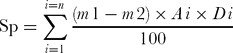
where, n = number of soil layers sampled in each plot (four layers at 10, 20, 30 and 40 cm depth) at weekly interval during growing season;
m1 and m2 = soil moisture percentage at the root-zone depth at the time of the first and second successive weekly sampling in each plot;
A i = apparent specific gravity;
D i = depth of the ith layer in each plot.
Crop growth and yield
Growth and yield parameters of rice were recorded at harvest from a fixed sample of 1.0 m2 area in the centre of each plot. Grain yield was determined from a harvest of 10 m2 sample area taken at the centre of each plot, and it was expressed at 14% moisture content.
Efficiency of water use
Water application efficiency and water productivity were determined by the following formulae:

where, ET, I and R are evapo-transpiration, irrigation and rainfall, respectively and Y is the grain yield in g m−2.
The data were statistically analysed following the analysis of variance technique (Gomez and Gomez, Reference Gomez and Gomez1984) using the ‘CropStat’ (version 6.1) package. The treatment means were tested using least significant difference tests and compared at p < 0.05 level of significance.
RESULTS
Temperature and rainfall pattern
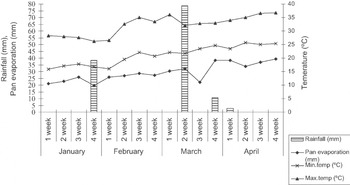
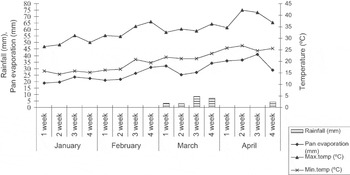
Weekly minimum/maximum temperature ranged from 16–25° C to 27–38° C in 2005 and 14–25°C to 27–37 °C in 2006 (Figures 1 and 2). In 2005, there were slight fluctuations in minimum/maximum temperature until the first week of February, and thereafter the temperatures rose gradually up to the last week of April. In 2006, a very similar trend was observed for minimum temperatures but maximum temperatures started rising from the first week of January, with some fluctuations. Total seasonal pan evaporation during 2005 and 2006 was 536 and 525 mm respectively (Figures 1 and 2). Weekly pan evaporation was in the range 20–39 mm in 2005 and 21–42 mm in 2006.
Variation in temperature, rainfall and pan evaporation during cropping season in 2005.

Variation in temperature, rainfall and pan evaporation during cropping season in 2006.

The amount of rainfall was 80% higher in 2005 than in 2006. Total rainfall was spread over only three months (January, March and April) in 2005 and two months (March and April) in 2006. In 2005, 38 mm rainfall fell during the third week of January and was effective for the initial stand establishment, and subsequent rainfall during the second (79 mm) and fourth week (11 mm) of March facilitated the crop growth, and curtailed the requirement of irrigation water during those periods.
Groundwater level and irrigation water requirements
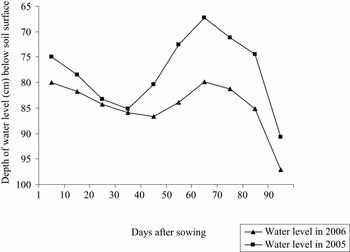
Figure 3 depicts fluctuation of groundwater level during the crop growth period. The groundwater level was generally higher with relatively wider fluctuations during 2005 than in 2006. In the beginning of the growing season up to 30 DAS, the groundwater level was lowered from 75 to 85 cm in 2005 and 80 to 86 cm in 2006. It started rising during 40–60 DAS and then there was a sharp decline until crop maturity, the level falling beyond the piezometer depth after 90 DAS.
Fluctuation of sub surface water level during growing period in 2005 and 2006.

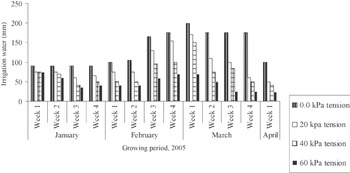
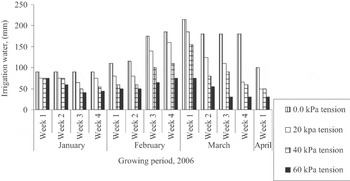
The irrigation water requirement was less (7%) in 2005 than in 2006 due to the larger contribution of rainfall, although the water requirement during the stand establishment period in both the years was similar (Figures 4 and 5). The irrigation requirement increased during tillering to panicle development stages; thereafter it decreased and remained more or less constant during flowering to grain-filling stages. Irrigation water had to be applied at intervals of 2–3, 3–4 and 5–6 days to maintain 20, 40 and 60 kPa soil moisture tension, respectively, while every alternate day irrigation was required to maintain 0 kPa soil moisture tension.
Irrigation water requirement in aerobic rice during 2005.

Irrigation water requirement for aerobic rice during 2006.

Water balance
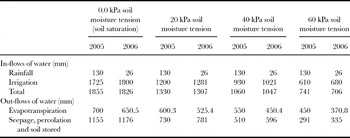
Inflows and outflows of water determined the water use pattern during the crop growth period (Table 1). In both years, rainfall was insufficient for the crop growth; thus, supplementary irrigation mitigated the demand for water inflows in both years, although more irrigation water was required in 2006. Evidently, the crop grown at 0 kPa soil moisture tension experienced maximum water outflows during the entire cropping period. The daily ET rate ranged from 4 to 5 mm in the earlier part and from 6 to 7 mm in the later part of the season, while average daily seepage and percolation rates during the corresponding periods varied from 5 to 6 mm and 8 to 10 mm respectively.
Inflows and outflows of water in aerobic rice during the rice-growing season in 2005 and 2006.

Crop growth and yield
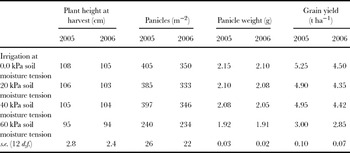
In both years, plant height, panicle number m−2 and panicle weight at maturity were similar in treatments receiving irrigation at 0, 20 and 40 kPa soil moisture tension (Table 2). These parameters were reduced significantly when irrigation was applied at 60 kPa soil moisture tension. The grain yield of rice under irrigation at 0–40 kPa soil moisture tension was also similar (4.90–5.25 t ha−1 in 2005 and 4.35–4.50 t ha−1 in 2006), while irrigation at 60 kPa soil moisture tension decreased the yield significantly by 42.9% in 2005 and 36.7% in 2006 as compared with irrigation at 0 kPa soil moisture tension (soil saturation).The grain yield was comparatively higher (5–17%) in 2005 than in 2006, irrespective of the irrigation treatment.
Grain yield and yield attributes in aerobic rice.

Water use efficiency
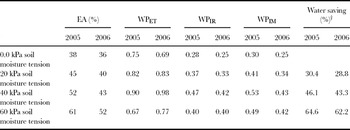
Applying irrigation at 60 kPa soil moisture tension resulted in the highest water EA, while the efficiency was the lowest under irrigation at the 0 kPa tension (Table 3). However, the overall water productivity was higher at 0–40 kPa soil moisture tension, beyond which it decreased. It was higher with respect to evapotranspiration (WPET), followed by irrigation (WPI) and irrigation plus rainfall (WPIR). Water saving increased with the increasing level of soil moisture tension (Table 3). Compared to the soil saturation (0 kPa tension), the water saving was the highest at 60 kPa and the lowest at 20 kPa soil moisture tension.
Water application efficiency(EA), and water productivity (g grain kg−1water) with respect to ET (WPET), I and R(WPIR), I (WPIM) and water saving (%) in aerobic rice.

†Water saving in comparison with soil saturatio
DISCUSSION
In this study, irrigation water was applied at 0, 20, 40 and 60 kPa soil moisture tension at the root-zone depth (30 cm) to determine the threshold level of moisture tension for irrigation in aerobic rice without any yield penalty. Application of irrigation at 20 and 40 kPa soil moisture tension resulted in more than 40% water saving and produced grain yield at par with the irrigation at 0 kPa. Irrigation at 60 kPa resulted in more than 60% water saving, but it caused a significant yield penalty (40%). The finding suggests that moisture stress up to the level of 40 kPa caused no permanent deformation in the plant system. More than 35% water saving without any yield reduction has been reported with irrigation at 20–40 kPa soil moisture tension in northern India (Singh and Chinnusamy, Reference Singh and Chinnusamy2006). In the Philippines, irrigation at 30 kPa moisture tension led to nearly 40% water saving with 27% yield reduction (Bouman et al., Reference Bouman, Peng, Castaneda and Visperas2005). In northern China, there was 37% water saving with slight yield reduction (7%) when irrigation was applied at 30 kPa soil moisture tension, while irrigation at 70 kPa resulted in 46% water saving and 17% yield reduction (Feng et al., Reference Feng, Bouman, Tuong, Cabangon, Li, Lu and Feng2007). However, moisture tension in these experiments was measured at 15-cm soil depth, as against 30 cm in the present study. This seems to be the limitation in those studies as soil water potential at the root-zone depth greatly influences the crop responses to their aerobic adaptation (Bouman and Tuong, Reference Bouman and Tuong2000). The moisture stress beyond 40 kPa tension had an adverse effect on the growth and grain yield of rice. This could be mainly due to a reduction in cell division/elongation, photosynthesis and biomass production (Belder et al., Reference Belder, Bouman, Cabangon, Lu, Quilang, Spiertz and Tuong2004; Bouman et al., Reference Bouman, Peng, Castaneda and Visperas2005; Maheswari et al., Reference Maheswari, Margatham and Martin2007).
Irrigation water requirement gradually increased with the crop growth until about 60 DAS, remained more or less constant up to 90 DAS and then declined at flowering. It depended on the seasonal rainfall and ET. The total ET in both the years decreased with increasing soil moisture tension (Bouman et al., Reference Bouman, Peng, Castaneda and Visperas2005) and was related to the total pan evaporation during the cropping season. Estimated ET at 0 and 60 kPa tension was on an average 1.27 and 0.75 times greater than the corresponding pan evaporation values. The higher ET/pan evaporation ratio at 0 kPa could be due to better crop growth. Increasing temperature and pan evaporation with the advancement of the season might have also contributed to the higher ET, particularly at later growth stages.
Water EA values suggest that the percentage of the total water (I + R) utilized in ET was greater at higher soil moisture tensions. This is because not only less water was needed to maintain the soil moisture level at higher tensions, but also the water loss through percolation was negligible. The smaller EA in 2006 than 2005 was due to the lower seasonal ET. Water productivity expressed on the basis of ET, I + R or I showed a similar trend with respect to soil moisture tensions. The increase in water productivity with increasing soil moisture tension up to 40 kPa was due to the reduction in ET and I values without any adverse effect on grain yield (Hafeez et al., Reference Hafeez, Bouman, Giesen and Vlek2007; Peng and Bouman, Reference Peng, Bouman, Spiertz, Strunk and Van Laar2007). However, there was decrease in water productivity at 60 kPa due to significantly lower grain yield.
CONCLUSION
We conclude with the recommendation that irrigation should be applied at 40 kPa soil moisture tension at 30-cm soil depth for optimum crop and water productivity in aerobic rice in India. This would help to achieve more than 40% water saving that increases the crop acreage and total rice production, particularly in areas with water shortage. Further studies need to be followed up scheduling irrigation in aerobic rice for optimum water use under different soil and agro-climatic conditions.