Introduction
Enhancing quality of life (QOL) of older adults has been an international area of focus for several decades (Diener et al., Reference Diener, Suh, Lucas and Smith1999; WHO, 2002). It is important to better understand the factors that promote QOL in this age group. QOL is a multidimensional construct that essentially refers to overall subjective well-being and life satisfaction (Lawton, Reference Lawton, Birren, Lubben, Rowe and Deutchman1991; Stewart and King, Reference Stewart, King, Abeles, Gift and Ory1994; Diener et al., Reference Diener, Suh, Lucas and Smith1999). QOL can also refer to subjective evaluations of various domains of life such as family or community. The World Health Organization (WHO) defines QOL as “an individual's perception of their position in life in the context of culture and value systems in which they live, and in relation to their goals, expectations, standards and concerns” (WHOQOL-Group, 1994). Other definitions include purpose in life and sense of belonging. The scientific conceptualization of QOL for older adults coincided with the paradoxes that emerged with the increase in lifespan (Lawton et al., Reference Lawton, Moss, Hoffman, Grant, Ten Have and Kleban1999). That is, living longer does not mean better in terms of life enjoyment or quality; likewise, disability is not always associated with lower QOL.
The identification of factors that contribute to QOL for older adults enables an understanding of mechanisms for ultimately maintaining optimal levels of QOL. Several key determinants of QOL have been identified, including lifestyle (e.g. activities, habits), social and community environment (e.g. social network and transportation resources), clinical status and healthcare (e.g. medical conditions and management), and socioeconomic and demographic factors (e.g. financial resources) (Stewart and King, Reference Stewart, King, Abeles, Gift and Ory1994). A large body of research has demonstrated that various lifestyle behaviors can affect QOL in older adults. For example, participating in activities such as volunteering or physical exercise is associated with higher QOL in older adults (Hao, Reference Hao2008; Morrow-Howell, Reference Morrow-Howell2010). Participating in community-based cultural/creative arts, such as attending concerts or singing in a choir, may also promote QOL in older adults, but few studies have been done (Gick, Reference Gick2011). Several studies have linked participation in cultural activities with increased survival (Bygren et al., Reference Bygren, Konlaan and Johansson1996; Konlaan et al., Reference Konlaan, Theobald and Bygren2002; Hyyppä et al., Reference Hyyppä, Maki, Impivaara and Aromaa2006; Väänänen et al., Reference Väänänen, Murray, Koskinen, Vahtera, Kouvonen and Kivimäki2009) and decreased risk for cognitive decline (Verghese et al., Reference Verghese2003). In one recent population-based study of over 50,000 adults in Norway, participation in cultural activities (including music, singing, and dance) was associated with life satisfaction (Cuypers et al., Reference Cuypers, Krokstad, Holmen, Skjei Knudtsen, Bygren and Holmen2011). In general, greater participation in creative cultural activities was associated with higher life satisfaction, but there were some gender differences.
Singing in a choir may contribute to QOL. Several studies of non-professional, community choral singers have found that a high percentage report that singing in a choir contributes to their well-being and psychological QOL (Beck et al., Reference Beck, Cesario, Yousefi and Enamoto2000; Clift and Hancox, Reference Clift and Hancox2001; Clift et al., Reference Clift, Hancox, Morrison, Hess and Stewart2010). In addition, Clift and Hancox (Clift et al., Reference Clift, Hancox, Morrison, Hess and Stewart2010) found that women reported greater QOL benefits of choral singing than men. Making music in a group, such as choral singing, is a demanding activity that can involve a wide variety of social, affective, cognitive and physical processes. Singing in a choir may promote higher QOL through several of these processes. For example, social aspects of choir singing may include working toward a common goal with others, group support, and developing social networks, while having opportunities to express emotions may influence affect and mood (Louhivuori et al., Reference Louhivuori, Salminen, Lebaka, Campbell, Drummond, Dunbar-Hall, Howard, Schippers and Wiggins2005). Choral singing also involves cognitive (e.g. attention and memory) and physical skills (e.g. balance), which may in turn promote health and influence QOL. The biological mechanisms by which participating in a choir may promote QOL, however, are largely unknown. A few studies have documented the effects of choir singing on several biomarkers including cortisol, oxytocin, and fibrinogen, but the results are mixed (Beck et al., Reference Beck, Cesario, Yousefi and Enamoto2000; Grape et al., Reference Grape, Sandgren, Hansson, Ericson and Theorell2003; Kreutz et al., Reference Kreutz, Bongard, Rohrmann, Hodapp and Grebe2004; Grape et al., Reference Grape, Wikstrom, Ekman, Hasson and Theorell2010). Singing in a choir may also help reduce pain and promote relaxation (Kenny and Faunce, Reference Kenny and Faunce2004). However, additional studies are needed to better understand the mechanisms by which choral singing may promote QOL.
Therefore, the purpose of this study was to examine QOL in older choral singers from Finland, where choral singing is a popular activity throughout the lifespan and is actively supported by community infrastructure. We hypothesized that there would be a positive relationship between the self-reported benefits of singing in a choir and QOL in these older choral singers.
Methods
Participants
The study was conducted in Jyväskylä, Finland, which has approximately 130,000 residents (14% of whom are age 65 or older; Association of Finnish Local and Regional Authorities, 2012). Finland has a long-standing tradition of choral singing. The Finnish choral singing movement began in Jyväskylä in the late 19th century as an integral part of the curriculum for teacher training. Jyväskylä hosted the first song festival in Finland in 1884. The city continues to support the tradition with numerous choirs of different styles, sizes, and demographics available throughout the lifespan, which makes it an ideal geographic location to study the impact of a choral singing on QOL. Jyväskylä is home to six community choirs that are dedicated to older adults. In the current study, a “community choir” is defined as a choir that draws its membership from a community at large, is inclusive, and non-professional (e.g. absence of compensation, not professionally trained). The number of choral singers in Finland is estimated to be approximately 105,000, which is approximately 2% of the Finnish population (H. Lindblom, personal communication, 6 March, 2011); however, specific estimates for Jyväskylä are not available.
In the current study, participants older than 55 were recruited from eight (secular) community choirs in Jyväskylä (six are dedicated to older adults, and two included older adults). The participants were self-selected and recruited through short informational presentations at choir rehearsals. For the choir members interested in participating, the questionnaire (detailed below) was taken home, filled out, and either returned at the next choir rehearsal or mailed to the investigators. The sections below describe the data that were collected.
Measures
Measures of QOL and depressive symptoms were selected based on prior research suggesting that choral singing promotes QOL, and because depression is a risk factor for poor health outcomes in older adults (Heikkinen and Kauppinen, Reference Heikkinen and Kauppinen2011). In addition, a questionnaire about self-perceived benefits of choral singing was administered to all participants.
Demographic variables
Six questions were used to document demographic background. In addition to age and gender, we obtained information about marital status (single, married/co-habitating, widowed), living status (alone or with spouse/partner/others), and education (primary, secondary, lower tertiary, upper tertiary). We also asked participants the number of years they had been singing in a choir.
Quality of life
We used the WHOQOL-Bref (Skevington et al., Reference Skevington, Lotfy and O'Connell2004), which is a widely used self-report questionnaire developed by the WHO. It has been translated and validated in Finnish (Vaarama et al., Reference Vaarama, Pieper and Sixsmith2008). Two general questions include subjective evaluations of overall QOL (“How would you rate your overall quality of life?”) and overall satisfaction with health (“How satisfied are you with your health?”). The additional questions assess four QOL domains, including physical health (six items), psychological health (six items), social relationships (three items), and environment (eight items). Sample questions are “How much do you enjoy life?” and “How satisfied are you with your personal relationships?”. Each question is rated on a 1–5 Likert-type response scale, with higher scores indicating better QOL. Domain scores were calculated by taking the average of the raw scores from each domain and multiplying by four (WHOQOL-Group, 1998). Thus, domain scores ranged from 4 to 20, with higher scores indicating better QOL. We excluded data when more than two items were missing for the physical, psychological, and environmental domains, and when one or more items were missing from the social relationships domain.
Depressive symptoms
We included a screening measure for depression based on previous studies that found a relationship between depression and QOL (Brett et al., Reference Brett, Gow, Corley, Pattie, Starr and Deary2011). Depressive symptoms were assessed using the 15-item Geriatric Depression Scale (GDS; Sheikh and Yesavage, Reference Sheikh, Yesavage and Brink1986), which is a short version of the original 30-item GDS (Yesavage et al., Reference Yesavage1983). The GDS was previously translated into Finnish. The GDS uses a dichotomous-response method (yes/no) for each item. Higher scores indicate more depressive symptoms. Scores greater than 7 on the 15-item GDS suggest the likelihood of depression (Sheikh and Yesavage, Reference Sheikh, Yesavage and Brink1986).
Benefits of Choral Singing Measure – development sample
A questionnaire about the benefits of choral singing for older adults was developed for the current study. This measure was an adaptation of a previously developed questionnaire (254 items) that was part of a cross-cultural study about choral singing and social capital. The original questionnaire was completed by 713 choral singers (age 16–91) in five countries (Finland, Estonia, Rumania, Belgium, and Republic of South Africa).
To develop a measure of choral singing that was appropriate for older adults, the authors selected 36 items from the original questionnaire that were subjectively judged to reflect possible benefits of singing in a choir for older adults. These questions focused on different types of benefits experienced with choral singing such as social contacts, expression of emotions, and artistic expression.
An exploratory factor analysis (EFA) was done using data from the original sample to identify the factor structure for these 36 items. The EFA used data from the 519 Finnish participants who completed the original questionnaire (mean age = 49.7 years, age range = 16–91 years; 56% were female). Factors were extracted using the maximum likelihood method with a varimax rotation and Kaiser normalization. Based on the scree plot, the EFA yielded five factors that explained a total of 37.3% of the variance for the entire set of variables. The eigenvalue for each of the factors was greater than 1.9. The EFA proceeded with several steps, dropping items that had non-significant factor loadings or cross loaded to another factor. After a review of the items that loaded on each factor, the factors were labeled: emotional benefits, relaxation benefits, reasons for choir participation (motivations), social support benefits, and health benefits of singing.
We examined the internal consistency of these scales corresponding to the five factors using Cronbach's α coefficients. Three scales had α coefficients >0.70 with all item–scale correlations greater than 0.3, including the emotional benefits (12 items, α = 0.78), relaxation benefits (7 items, α = 0.71), and motivations (7 items, α = 0.77). The social support scale (three items) had a Cronbach's α of 0.60 and item–scale correlations above 0.3. The health benefits scale (three items) had the lowest Cronbach's α of 0.54 and was excluded from the analysis. The final four scales included 29 items. Bivariate Pearson correlations between the four scales ranged from 0.22 to 0.46, indicating relative independence.
We performed a linear transformation so that all scales have a possible range of 0–100. We created an overall summary score by averaging the four subscales identified in the EFA to yield a total score in which possible scores also ranged from 0 to 100. Higher scores indicated greater perceived benefits of choral singing reflected in the factor scores. The Benefits of Choral Singing measure (Benefits measure) had good internal consistency (α = 0.85).
Benefits of Choral Singing Measure – confirmatory factor analysis in older adult sample
The adapted Benefits measure was administered prospectively to the sample of older choir singers in the current study. A confirmatory factor analysis (CFA) was used to confirm that the initial EFA factor solution derived from the original choir sample (n = 519) would be applicable to the older adult choir sample used in this study (n = 117) and to identify the items that were statistically related to one of the latent factors. The items were expected to measure four factors: emotional benefits, relaxation benefits, motivations, and social support. The CFA was completed by specifying the maximum likelihood parameter method that uses estimates with robust standard errors and a scaled χ2 test statistic (MLR estimator in Mplus version 6; Muthén and Muthén, Reference Muthén and Muthén1998–2010). This estimation method is robust to non-normality. The CFA proceeded with several steps, dropping items that had non-significant factor loadings or cross loaded to another factor. From the 16 initial items measuring emotional benefits, four items were dropped; three items were dropped from the ten items measuring relaxation benefits, none were dropped from the seven items measuring motivation, and one item was dropped from the seven initial items measuring social support. Finally, after choosing 32 items representing the four latent factors, three parcels were calculated for each of the factors to test the fit of the model. In the final CFA, there were 12 parcels measuring four latent factors, and the factors were allowed to correlate. After a review of the residual correlation matrix, three residual correlations were included in the CFA. The goodness of fit for the resulting model was adequate based on the following indicators: a non-significant χ2 test value, a value greater than 0.95 for the comparative fit index (CFI, 0.98) and the Tucker–Lewis index (TLI, 0.96), a value less than 0.06 for the root mean square error of approximation (RMSEA, 0.043), and a value less than 0.08 for standardized root mean square residual (SRMR, 0.06; χ2(44) = 53.45, p = 0.16; Muthén and Muthén, Reference Muthén and Muthén1998–2010). The standardized factor loadings are emotional benefit (0.61, 0.67, 0.84), relaxation (0.50, 0.70, 0.78), for motivation (0.53, 0.55, 0.88), and social support (0.43, 0.76, 0.85). The emotional benefits factor correlated with the relaxation factor (0.64), the motivation factor (0.69), and the social support factor (0.33). The relaxation factor correlated with the motivation factor (0.37). Finally, the motivation factor correlated with the social support factor (0.55) (all p < 0.05).
Statistical analysis
Means (with standard deviations) and percentages were calculated to describe the characteristics of the sample. Correlation coefficients were used to examine the association between the demographics, Benefits measure, and the WHOQOL-Bref domains. To determine appropriate covariates, we examined the correlations between demographics, depressive symptoms, and QOL domains. Spearman's ρ correlation coefficients were used with categorical variables (gender, education level, marital status, and living status), and bivariate Pearson's product moment correlation coefficients were used with continuous variables. A Student's t-test was used to assess possible gender differences on the Benefits measure. For comparison with the Clift and colleagues study (Clift et al., Reference Clift, Hancox, Morrison, Hess and Stewart2010), who found a significant correlation between their choral singing measure and the WHOQOL-Bref psychological QOL domain for women but not men, we also examined the correlation coefficients between the Benefits measure and the WHOQOL-Bref domains separately for men and women.
To examine the relationship between the Benefits measure and each of the four QOL domains (dependent variables) in both unadjusted and adjusted models, we used regression analyses. For this, we conducted a series of hierarchical linear regression modeling. The first model was unadjusted. For the adjusted model, variables with a significant correlation (p < 0.01) with the dependent variable (WHOQOL-Bref domains) were entered using a stepwise method into the multiple linear regression analyses. Thus, the second model added age and GDS. All tolerance statistics were ≥0.81, suggesting that multicollinearity was not an issue. Data were analyzed with SPSS (version 9.1) Any p values lower than 0.05 were considered significant.
Results
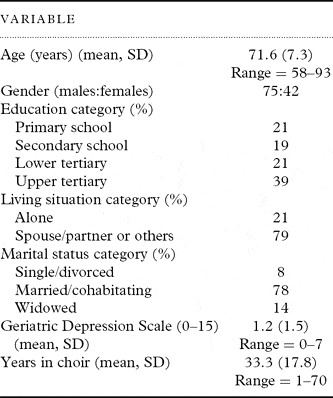
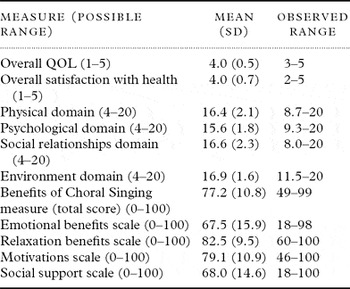
The sample included 117 older adults who were currently singing in a community choir in Jyväskylä, Finland. This reflected an overall response rate of 86%. The demographic variables and GDS scores are summarized in Table 1. The mean age was 71 years, and the participants reported singing in a choir for an average of 33.3 years. Sixty-four percent were men, and 21% of the total sample lived alone. Scores on the GDS were low (mean = 1.2 ± 1.5 out of 15). None of the choral singers endorsed more than seven depressive symptoms, and 40% scored zero on the GDS. The results on the WHOQOL-Bref are found in Table 2. With regard to the two general questions on the WHOQOL-Bref, a majority (86%) of choral singers rated their overall QOL as good or very good (score of 4 or 5), and 86% were satisfied or very satisfied with their health.
Demographic characteristics of choral singers (n = 117). Mean (and standard deviation) or percentage

SD = standard deviation.
Scores for older adult choral singers on the WHOQOL-Bref and the Benefits of Choral Singing measure

There were small to modest significant correlations between age and the psychological, social relationship, and environmental WHOQOL-Bref domains (all significant correlations range between −0.18 and −0.30, p < 0.05) but not the physical QOL domain. Thus, increasing age was generally associated with lower QOL. There were also significant correlations between the number of depressive symptoms (GDS) and three of the QOL domains (i.e. physical, psychological, and environment; all significant correlations range between −0.33 and −0.57, p < 0.01) but not the social relationships QOL domain. Thus, choral singers with higher scores on the GDS were more likely to have lower QOL. There were small correlations between marital status, living situation, and education with several QOL domains (all significant correlations range between −0.20 and 0.22, p < 0.05). Gender did not correlate with QOL domains. Because age and GDS had significant correlations (p < 0.01) with QOL domains, they were selected as covariates for the adjusted regression model.
Results for the Benefits measure are found in Table 2. There were significant correlations between the Benefits measure and three of the four QOL domains (psychological, social relationships, and environment; all significant correlations range between 0.25 and 0.27, p < 0.01) but not the physical QOL domain. The Benefits measure also correlated with the overall QOL (r = 0.28, p < 0.01) but not overall satisfaction with health. Thus, higher Benefits scores were generally associated with higher ratings on the majority of QOL domains and overall QOL. In contrast, the Benefits measure did not correlate with age, years of singing in a choir, GDS, education, marital status or living status. Women (M = 80.4, SD = 9.8) scored significantly higher than men (M = 75.4, SD = 11.0; t(115) = 2.5, p = 0.02) on the Benefits measure. As expected, the number of years singing in choir was significantly associated with age (r = 0.51, p < 0.001). However, years of singing in a choir did not correlate with the Benefits measure, the QOL domains, or the GDS (all p > 0.05).
When examining the correlation between the Benefits measure and each WHOQOL-Bref domain separately for men and women, the correlation patterns differed by gender for two of the four QOL domains. That is, there were significant correlations between the Benefits measure and the psychological QOL domain for women (r = 0.56, p < 0.001) but not men. In contrast, there was a significant correlation between the Benefits measure and the social relations QOL domain for men (r = 0.38, p = 0.001) but not women. There were no gender differences in the pattern of correlations with the physical and environment QOL domains.
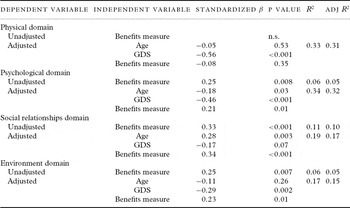
Table 3 summarizes the findings for the regression analysis. In the unadjusted models, the Benefits measure was significantly associated with three of the four WHOQOL-Bref domains: psychological, social relationships, and environment. The level of explained variance (multiple coefficient of correlation) ranged between 0.06 and 0.11. In contrast, the Benefits measure did not predict the physical domain in unadjusted models. The results were similar after controlling for age and number of depressive symptoms. After adjustment for these variables, the Benefits measure was significantly associated with the same three WHOQOL-Bref domains (psychological, social relationships, and environment). The addition of age and depressive symptoms in the models increased the level of explained variance (multiple coefficient of correlation), which varied between 0.17 and 0.34.
Results of hierarchical linear regression for predicting WHOQOL-Bref domains

n.s. = not significant; Adj = adjusted; Benefits measure = Benefits of Choral Singing measure (total score).
Discussion
In a sample of older adult choral singers from Jyväskylä, Finland, experiences associated with choral singing were related to QOL. That is, choral singers with higher scores on the Benefits of Choral Singing measure had higher ratings of psychological, social relationship, and environment QOL as measured by the WHOQOL-Bref. This relationship remained significant after controlling for age and depressive symptoms. In contrast, there was no relationship between the Benefits measure and the physical QOL domain. These results suggest that reported benefits of singing in a choir may be more strongly associated with psychosocial aspects of QOL than physical QOL. There were also a few gender differences. The women scored higher than men on the Benefits measure, and the correlations with the psychological and social relationships QOL domains differed by gender. Finally, the older choral singers in the study reported few symptoms of depression and high overall QOL and satisfaction with health. Taken together, these results suggest that there is a relationship between the benefits associated with choral singing and several aspects of QOL in older adults in Finland who participate in choral singing for many years.
The findings from the current study corroborate prior studies of non-professional choral singers who report that singing in a choir influences QOL and well-being (Beck et al., Reference Beck, Cesario, Yousefi and Enamoto2000; Clift and Hancox, Reference Clift and Hancox2001; Clift et al., Reference Clift, Hancox, Morrison, Hess and Stewart2010). Clift and colleagues (Clift et al., Reference Clift, Hancox, Morrison, Hess and Stewart2010) administered the same WHOQOL-Bref questionnaire to a sample of 633 choral singers in England (mean age = 61 years, 77% women) but only reported the results for the psychological QOL domain. Similar to our study, Clift and colleagues found that the women had higher scores than men on their “Effects of Choral Singing” measure. They also found a significant correlation between their measure and the WHOQOL-Bref psychological QOL domain for women, but not men. We found a similar pattern in our study, with significant correlations between the Benefits measure and the psychological QOL domain for women, but not men. The women in our study also scored higher than men on the Benefits measure. For men (but not women), we found significant correlations between the Benefits measure and the social relationships QOL domain. Thus, it is possible that the way in which men and women experience choral singing differs. It is also possible that the way in which singing in a choir promotes well-being may also differ for men and women. In a large population-based study in Norway, Cuypers and colleagues (Reference Cuypers, Krokstad, Holmen, Skjei Knudtsen, Bygren and Holmen2011) found gender differences in the relationship between participation in cultural activities and well-being. In another study from Finland, Hyyppä and colleagues (Reference Hyyppä, Maki, Impivaara and Aromaa2006) found gender-related effects on survival that were mediated by participation in leisure activities. Future studies should explore this association in more detail.
In the regression analyses in our study, the Benefits measure was a significant predictor of three out of the four QOL domains (psychological, social relationships, and environment). The results remained significant after adjusting for age and depressive symptoms. These results, therefore, suggest that singing in a choir may impact multiple aspects of well-being and that reported benefits of singing in a choir may be more strongly associated with psychological and social aspects of QOL than physical QOL. The current study utilized a measure that focused on four types of benefits of choral singing, namely emotional benefits, relaxation benefits, motivations, and social support. Although there is not yet a comprehensive conceptual model for how singing in a choir, particularly as an older adult, promotes well-being, it is possible that the multimodal aspects of choir singing may be important. Singing in a choir may offer a combination of opportunities for developing social relationships and receiving social support, but also opportunities for emotional expression and relaxation. As discussed above, several studies suggest that singing may help reduce pain and promote relaxation (Kenny and Faunce, Reference Kenny and Faunce2004), but these studies were not done with older adults. The association between the Benefits measure and environment QOL domain was somewhat unexpected. However, the older choral singers in the study attend weekly choir rehearsals and travel to attend choir performances, thereby interacting with their physical environment on a regular basis. The WHOQOL environment QOL domain includes questions about physical environment, opportunities for leisure, and feelings of safety, which may be associated with regular choral singing. In addition, a recent study from the same city found a relationship between urban outdoor environment and QOL in community-dwelling older adults (Rantakokko et al., Reference Rantakokko, Iwarsson, Kauppinen, Leinonen, Heikkinen and Rantanen2010). It is possible that older adults who stay active and engaged with their physical environment have higher QOL. It is also possible that older adults who interact with their physical environment might also be more likely to sing in a choir. When considering the major determinants of QOL of older adults (Stewart and King, Reference Stewart, King, Abeles, Gift and Ory1994) as discussed above, singing in a choir as an older adult may promote QOL through social and community engagement and lifestyle factors (e.g. participation in a creative activity). Choral singing is a multifactorial activity, and activities that involve a combination of social, affective, cognitive and physical aspects may confer additional health benefits over activities that involve primarily one element or are done alone (e.g. doing puzzles; Karp et al., Reference Karp, Paillard-Borg, Wang, Silverstein, Winblad and Fratiglioni2006). Additional research is needed to help determine the mechanisms that influence how choral singing may affect well-being and health.
The choral singers in the current study also reported few depressive symptoms, and none of the singers scored in the range suggestive of a clinical depression. Despite relatively low scores on the GDS, the number of depressive symptoms was a significant and independent predictor of three of the four QOL domains in our study. Other studies have also documented a strong relationship between depressive symptoms and QOL in older adults (Brett et al., Reference Brett, Gow, Corley, Pattie, Starr and Deary2011). In Finland, the prevalence of depression between the age 65 and 84 is estimated to range from 3% to 8% (Salminen et al., Reference Salminen, Raiha, Heinonen and Kivela2012). Several cross-sectional studies have found that participation in cultural activities is associated with lower levels of depression and anxiety (Nummela et al., Reference Nummela, Sulander, Rahkonen and Uutela2008; Cuypers et al., Reference Cuypers, Krokstad, Holmen, Skjei Knudtsen, Bygren and Holmen2011). It is possible that singing in a choir can help reduce symptoms of depression. It is also possible that older adults who are not depressed choose to stay active and involved in activities. Thus, longitudinal studies are needed to determine whether choral singing can directly influence depressive symptoms in older adults. In one clinical trial with older adults involving 12 months of participation in a community choir, there was a non-significant trend for a greater reduction of depression in the group that sang in a choir compared with the usual activity control group (Cohen et al., Reference Cohen, Perlstein, Chapline, Kelly, Firth and Simmens2006). It is also important to note that the older adults who sang in the Cohen study reported less loneliness, better morale, fewer falls, less medication use, fewer doctor visits, and higher self-rated physical health (compared with usual activity group). In another study, lower-income older adults who sang in a community choir for four weeks (twice weekly) had significant improvements on personal growth, compared with no treatment controls (Noice and Noice, Reference Noice and Noice2009). Of note, neither of these studies documented the singing background of the participants, but singing experience was not required for participation in the study. Thus, it is likely that singing in a choir as an older adult may influence multiple aspects of QOL, including depressive symptoms. However, possible bidirectionality of this finding should be explored.
There are several limitations to the study. The study was cross-sectional, so a causal link between choral singing and QOL cannot be confirmed. Future studies should explore the use of randomized designs or longitudinal studies to test the hypothesis that choral singing promotes QOL. The study was conducted in a country where choral singing is a popular activity throughout the lifespan. These aspects may limit the generalizability of the findings to countries where the arts are not as actively supported as in Finland. It is not also yet clear if participating in a choir for many years is needed to experience its beneficial effect on QOL. In our study, the perceived benefits of choir singing, but not years of singing in a choir, correlated with the QOL domains. Thus, it is possible that the degree of perceived benefit of singing or depth of engagement are more closely linked to QOL than actual years of singing. Finally, the majority of singers in the current study were men, while other studies from Germany and England involve choral singers who are primarily women.
In conclusion, research has consistently found health benefits for older adults participating in different types of activities, such as volunteering, social groups, civic activities, adult learning, worship, gardening, and employment (Konlaan et al., Reference Konlaan, Theobald and Bygren2002; Verghese et al., Reference Verghese2003; Reference Verghese2006; Fratiglioni et al., Reference Fratiglioni, Paillard-Borg and Winblad2004; Hyyppä et al., Reference Hyyppä, Maki, Impivaara and Aromaa2006; Nummela et al., Reference Nummela, Sulander, Rahkonen and Uutela2008; Akbaraly et al., Reference Akbaraly2009; Morrow-Howell, Reference Morrow-Howell2010). A growing body of literature suggests that participation in the creative/cultural arts may also benefit the health of older adults (Putland, Reference Putland2008; Stuckey and Nobel, Reference Stuckey and Nobel2010; Wan and Schlaug, Reference Wan and Schlaug2010; Batt-Rawden and Tellnes, Reference Batt-Rawden and Tellnes2011). Because having a variety of health-promoting activity options for older adults is ideal, participation in the creative arts such as choral singing may be an additional potentially novel avenue for promoting health and well-being in older adults.
Conflict of interest
None
Description of authors’ roles
J.K. Johnson designed the study, collected the data and wrote the paper. J. Louhivuori helped design the study, collected the data and assisted with writing the paper. A.L. Stewart helped interpret the data, assisted with statistical design, and assisted with writing the paper. A. Tolvanen was responsible for the statistical design of the study and for carrying out the statistical analysis. L. Ross assisted with the statistical design and assisted with writing the paper. P. Era helped design the study, assisted with data collection and writing of the paper.
Acknowledgments
This work was supported by the U.S. Fulbright Scholar Program and the Fulbright Commission in Finland (Mid-Career Professional Development grant) to JKJ. We also want to thank the choral directors and choral singers in Jyväskylä, Finland, who helped make this study possible.