Introduction
This article seeks to engage with a pedagogical challenge in contemporary Chinese folk music education. Recent Government policy made explicit an expectation that examples of China's cultural music heritage are to be incorporated into music curricula, both in school and also higher education (HE). Yet the pedagogy of HE (and school) curricula have been heavily influenced by the formalised learning of Western and Chinese classical musics, whereas Chinese folk music is essentially characterised by an oral tradition. In order to explore this issue, a set of lessons were initiated that involved one HE student, a traditional folk performer and two university-based music tutors. The chosen music for this study was Hua’er, a folk song tradition that is shared by people of more than nine ethnic groups across north central and northwest China. Hua’er songs have an extensive traditional repertoire and are performed unaccompanied using lyrics that are improvised in line with certain verse structures. Traditionally, rural people perform these songs widely during daily work or for special community occasions, such as singing festivals, where they share their praise for young love, as well as the weariness of farming life in contrast to the joy of singing. In former times, Hua’er song singers were mostly self-taught and/or learned orally. However, since the 1990s folk music revival in China, Hua’er has become seen as (a) an active musical vehicle in cultural exchange across ethnicities and popular rural entertainment for young generations (Dong, Reference DONG2009); and (b) a valuable teaching resource in formal music education.
With a successful nomination as a ‘Representative Intangible Cultural Heritage of Humanity’ by UNESCO in 2009, Hua’er music has been given particular attention in tertiary level music curricula. Previously, folk music education was required to be included into the school-based formal music education as an outcome of the 1989 arts curricula reform (Ministry of Education PRC, 1989). Following a revival of folk music across the 1990s, the 2005 National Curriculum for College Music Education (Ministry of Education PRC, 2004) embraced ‘local’ (which was also often labelled as ‘authentic’) folk music performances as a necessary learning topic for all music students in HE.Footnote 1 In this curriculum design, 180 hours (10 credits) were allocated exclusively for indigenous Chinese music. One outcome was that folk song pedagogies emerged as a key issue in educational transformation (Tillmann & Salas Reference TILLMANN, SALAS, Stephan and Bertus2006; Zhang Reference ZHANG2010). A recent related study, for example, has suggested that the current music curriculum system that was developed from the perspective of Western and Chinese Classical music learning may be less effective in the learning of authentic folk songs (Yang & Welch, Reference YANG and WELCH2014). The reasons for this were believed to be: (1) oriental folk music has always been learnt by imitation (Cook, Reference COOK1990); and (2) orally transmitted folksongs are living entities that always change from time to time (Palmer & Leach, Reference PALMER and LEACH1978). Although the latter findings were not drawn solely from Chinese folk music, the same issues have been identified in a number of recent studies concerning Chinese music education (e.g. Zhao, Reference ZHAO2008; Zhu, Reference ZHU2010).
Consequently, the question to be addressed was: Would it be logical to exclude folk music from the formal music education provision of higher education because of its ‘incompatibility’ with the current teaching system? A short answer seems to be ‘No’. As has been suggested by research into folk music education in Finnish Higher Education institutions (e.g. Sibelius Academy), folk traditions are not inherently incompatible with formal education in the practice of reviving folk musics (Ramnarine, Reference RAMNARINE2003, pp. xii, 65), or in an evolving recreation of them (Edgar, Reference EDGAR2004, p. 223). Instead, the introduction of folk music study into Higher education has been reported to be an effective channel by which to address cultural inclusivity in a society, as shown in Australia (Southcott & Joseph, Reference SOUTHCOTT and JOSEPH2010). Drawing on recent research findings on effective teaching and learning pedagogies in formal music education (Nielsen, Reference NIELSEN2006; Entwistle, Reference ENTWISTLE2009), the research reported below compares and discusses a set of teaching/learning pedagogies along with a possible theoretical model that incorporates both formal and informal approaches to achieve effective learning in the context of Chinese folk music education.
Data collection
A multi-methodological approach was adopted in this research, which comprised data collection from video-recorded teaching observations and supporting structured interviews. The observation data were quantified in time units and then coded by eight teaching-learning activities for pedagogical analysis using NVivo 8 (QSR International, 2008), whilst the interview data were coded by 24 ‘themes’ that emerged from the transcriptions. Subsequently, these two sets of coded data were compared and collated with each other to identify consistencies or discrepancies between them, which respectively account for a researcher's view and the participants’ perspectives on the same lessons. By drawing research evidence from this meta-analysis, differences between ‘formal’ and ‘informal’ approaches are able to be discussed in terms of teaching-learning experiences and pedagogical strategies.
Initially, four individual (one-on-one) music lessons were recorded at a music studio in the Northwest Normal University, Western China, which comprised a conservatory pedagogical approach (termed here as ‘formal’) and a folk-learning approach (termed ‘informal’). Personal contact was made with research participants in advance, and the research plan was explained both orally and in written form to ensure that ethical consent was agreed. The three voluntary participants were:
Folk singer (F): A 35-year-old male singer who was reported to be a very promising folk singer of the new generation and was famous for his authentic singing style of Hua’er music.
Student (S): A Year-3 undergraduate student in music who was initially enrolled as the only local student with a specialty in folk song singing. He had some informal learning experience of Hua’er songs previously, but had little direct contact with field folk singers (such as F).
Tutor (T): A professional music tutor who had been teaching vocal music over 40 years. He was trained as a Western classical tenor at a music conservatory and had been teaching singing in Western classical and Chinese classical styles. He had much experience of listening to Hua’er music through previous research contact with F for two years.
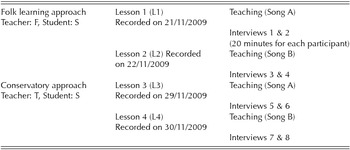
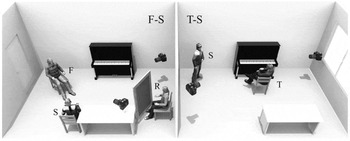
In the observed lesson design, the participants were divided into two separate teaching-learning dyads (F-S and T-S), i.e. the same student, but two different teachers. Each dyad was given the same two Hua’er songs to work on (one for each lesson). Overall, four lessons were recorded, two for each dyad (see Table 1). There was an eight-day interval between the recording of F-S lessons (L1 and L2) and T-S lessons (L3 and L4). The four 55-minute (approximate) lessons were video-recorded using two camcorders positioned at corners of the room (see c1 and c2 in Figure 1). One researcher (R) was monitoring the recording process behind a mirror during L1 to ensure that the video camera locations were appropriate. Similar arrangements were not needed for subsequent lessons.
Data collection plan.

Recording settings of F-S and T-S studio lessons.

Subsequently, in a similar setting, short interviews were conducted with each participant individually after the lessons to acquire participants’ feedback and evaluation on the learning and teaching experience.
Data analyses
The analyses of the two sets of data, namely teaching-learning observations and interview transcriptions, were intended to explore the pedagogical strategies that possibly contribute to the teaching style of each teacher, and set alongside student's self-perceived learning strategies and experiences of the same.
Analyses of teaching-learning behaviour
The observation of lessons sought to: (1) identify the teaching-learning behaviour patterns of the participants; and (2) investigate differences and/or similarities amongst the ‘Folk’ and the ‘Conservatory’ dyads (i.e. F-S and T-S) on the basis of the observed behaviour patterns. Using a similar analysis method to Ward's study (Reference WARD2004),Footnote 2 every lesson was coded (using NVivo 8) with eight types of identified teaching-learning activities in quantified time units (as exemplified in Figures 3, 4, 5 and 6). These types of teaching-learning activities were: Concurrent singing, Demonstration, Discussion (Student), Discussion (Teacher), Feedback, Instrumental playing, Solo practice and Verbal instruction. Behaviours that had no clear educational intention, such as leisure chat and mobile phone playing, were treated as ‘idle time’ and have not been included in the following analyses.
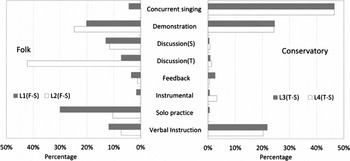
Overall time spent in eight teaching-learning activities across four lessons.

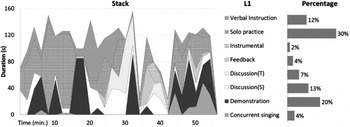
In order to demonstrate the structural composition of the above eight observed activities in a time sequence, each video-recorded lesson was divided into consecutive sections of 120 seconds, in which durations of activities were calculated individually by section. These data outputs were processed and plotted using MS Excel in the form of an abstracted mapping of overall teaching-learning behaviour pattern (see Figures 3, 4, 5 and 6). By plotting data points (based on duration) of a particular activity from each section, the eight activities were presented collectively as stacked diagrams, which indicate the changes of behaviour patterns of these activities across a lesson. Different from Ward's mapping strategy, any activity that went beyond the given time unit of 120 seconds, namely ‘cross-unit activity’, was presented by one (rather than multiple) data point. Although this method generated overflows (see Figure 3, Sec. 31) and shortfalls (see Figure 3, Sec. 42) in the stacked duration contour, it is advantageous in tracking longitudinal behaviour transformation across the lesson and, therefore, provided further information on the ‘systematicity’ of lesson structuring. The analyses of each lesson are detailed as below.
L1 accumulative activity time stack and percentages.

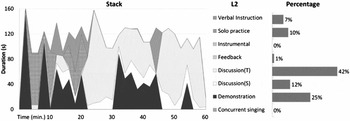
L2 accumulative activity time stack and percentages.Footnote 3

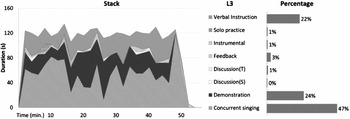
L3 accumulative activity time stack and percentages.

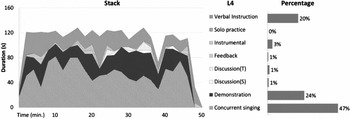
L4 accumulative activity time stack and percentages.

Figure 2 shows the total percentages of time of the eight types of behaviour across four video-recorded lessons. In general, ‘Demonstration’ and ‘Verbal Instruction’ are two common activities shared by all lessons, whilst F (the folk singer) gave less Verbal Instruction than T (the college teacher) during the teaching process. Behavioural differences were also evident between dyads. The ‘Folk’ dyad shows varied emphasis on a number of activities. Amongst these, the percentages for Demonstration, Discussion (S) and Verbal Instruction were similar, whilst Discussion (T) took over 42% of the overall lesson time in L1 and Solo Practice occupied 30% of time in L2. In addition, S had significantly more time in conversations at lessons with F, particularly in L2 (over 40%). In contrast, the three dominant activities in the ‘Conservatory’ dyad were Demonstration, Verbal Instruction and Concurrent Singing. T had more than 45% of the lesson singing together with the student, but appeared to be much less involved in tutor-initiated discussions (Discussion (T)). In general, it can be seen that the behavioural patterns are very similar in a ‘Conservatory’ context (L3 and L4), whilst the ‘Folk’ examples (L1 and L2) showed a more variant activity composition in terms of overall proportions of time. Analyses indicated that the ‘Folk’ dyad tended to be more interactive; whist the ‘Conservatory’ dyad might be considered to be more ‘didactic’ in style. However, it does not necessarily mean that the latter was not ‘communicative’. As was later reported in after-lesson interviews, the difference of the approaches for interaction should also be taken into account.
In L1, ‘Demonstration’ and ‘Solo Practice’ were major teaching activities, whilst ‘Discussion (S)’ and ’Verbal Instruction’ are secondary. A few ‘Discussion (T)’ moments occurred, primarily at mid-lesson, along with a little ‘Solo Practice’ singing from the student at the end. As is indicated by the intermittent horizontally sections, the continuity of all activities appeared to be relatively poor. It was inferred that the overall organisation of pedagogical strategies might not be very ‘systematic’ in this particular case, at least in in terms of teaching fluency.
In L2, ‘Discussion (T)’ was the dominant activity and occurred mostly after minute 20, and ‘Demonstration’ listed the second important activity. ‘Discussion(S)’ continued across most of L2, whilst ’Solo practice’ shared a significant part in the first 20 minutes, but diminished afterwards. It would seem that the progress of teaching-learning activities was steadier than L1, showing less fluctuation around 120s (the total amount of one unit). But, as was illustrated by the discontinued sections, activities were found unevenly distributed across time. In other words, the Folk teacher's teaching flow was not ‘fluent’ in the sense that the same pedagogical strategies were not applied in an obvious coherent fashion.
In the ‘Folk’ dyad (L1 and L2), five major teaching-learning activities occupied 80% of the lessons. These were: ‘Demonstration’, ‘Discussion (by student S)’, ‘Discussion (by teacher T)’, ‘Verbal Instruction’ and ‘Solo Practice’. In-group variations were seen amongst major activities. Compared with L1, ‘Discussion (T)’ increased by 35% in L2, whereas ‘Solo practice’ decreased by 20%. Minor differences were also identified amongst the remaining activities, such as ‘Concurrent Singing’, which occurred occasionally in L1, but were not evident in L2. In terms of teaching-learning patterns, most activities in L1 were observed to be occurring across the entire lesson, whilst L2 showed a clearer division in all activities (except for ‘Demonstration’) around minute 20. In addition, there were a number of ‘cross-unit’ activities in the second half of L1, which suggests a less constant usage of multiple teaching and/or learning methods. As the overall patterns of teaching-learning activities appeared to be neither highly consistent nor systematically structured, it was inferred that the pedagogical strategies applied in the ‘Folk’ dyad were not ‘well defined’ at least in terms of the observational analysis. One inference is that F (and S) were less experienced in studio-based folksong learning; whilst another is that the teaching style was more fluid and open and perhaps ‘of the moment’.
In L3, ‘Concurrent Singing’, ‘Demonstration’ and ‘Verbal Instruction’ were the three dominant activities that accounted for 93% of the teaching-learning content and were distributed steadily across time. Amongst these, ‘Concurrent Singing’ occupied 45%, whilst the other two equally shared the remaining 45%. As the proportions of student-initiated activities (‘Discussion (S)’ and ‘Solo practice’) are extremely low, the implication is that T tended to lead the lesson by giving continuous demonstration and verbal/non-verbal instruction to S (42 short ‘Feedback’ elements were delivered by T during L3). The stable horizontal contour of the overall accumulation duration around 120s suggests that the teaching pattern of T was highly consistent within a lesson. It also implies T was using a set of core teaching-learning activities for folk music teaching and had a strong preference for specific pedagogical strategies.
L4 demonstrated a very similar behavioural pattern as L3, regardless of the fact that two different songs were used as the teaching foci. ‘Verbal instruction’ decreased very slightly through the lesson, but ‘Demonstration’ and ‘Concurrent Singing’ were identical. Overall, these three activities embraced 91% of the content. As previously, ‘Solo Practice’ and ‘Discussion’ were marked by their virtual absence.
The analyses of L3 and L4 suggested that T had a clear bias in his teaching pedagogy, which consisted of ‘Concurrent Singing’, ‘Demonstration’ and ‘Verbal Instruction’ as the three major teaching components. This pedagogical approach was consistent regardless of the different teaching materials (two folksongs), in the sense that the time variations of all eight activities were 2% or less between L3 and L4. The three major activities were observed across over 90% of the lesson, whilst the other five activities were very marginal. T also appeared to have a precise sense of time management and was able to integrate teaching activities in a coherent manner. As his teaching was characterised by high rate of ‘Concurrent Singing’, S had little opportunity for ‘Solo Practice’ and direct verbal communication with him. In general, the ‘Conservatory’ dyad appeared to have a distinctly consistent teaching/learning strategy that may reflect the kinds of stability arising with significant experience of a formalised conservatory pedagogical model, at least with this tutor.
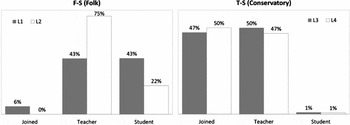
The eight teaching-learning activities can be further categorised into three sets of data: (a) Joined activity (Concurrent singing and Instrumental); (b) Teacher's activity (Demonstration, Discussion (T), Feedback and Verbal instruction); (c) Student's activity (Discussion (S) and Solo practice). This provides an overall comparative display of teaching-learning dynamics between the dyads of tutors and student (see Figure 7).
Comparison of three teaching-learning clustered activity categories in Folk and Conservatory teaching contexts.

It was seen that the Teacher and Student categories were dominant, whilst Joined activities were marginal in the Folk context. This indicated that the two ‘Folk’ participants (F and S) tended to take turns in the two lessons, one then the other. In contrast, Joined activities and Teacher's activities were dominant and equally important in the Conservatory context, but there had been almost no time for more student-initiated action. L1, L3 and L4 are similar in the overall percentage of Teacher's activities (around 45%). Interestingly, if we compensate the reduction of Student's activities in L2 in relation to L1 with the increase of Teacher's activities in L2 (in relation to L1 again), the ‘Folk’ dyad would show even proportions of Teacher's and Student's activities. Any such balancing amongst the three categories (in terms of proportion) highlights the actual dynamic nature of the pedagogical approach in the observed folksong teaching/learning. The ‘Folk’ context seems to favour the provision of an opportunity for a leading role by both teacher and student across the lesson, whilst in the ‘Conservatory’ context the student tends to be seen more perhaps as an ‘obedient apprentice’. However, the two teachers (F and T) showed a strong sense of lesson time management in both contexts. Therefore, each dyad appeared to favour a specific teaching/learning style, whilst the ‘Conservatory’ model appeared to be more stable in comparison to the two ‘Folk’ examples.Footnote 4
Analyses of interview transcriptions
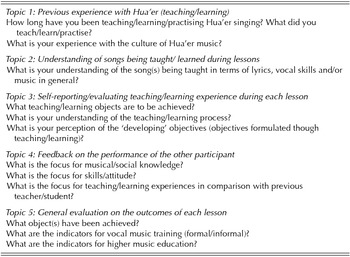
In order to verify or critique any primary observational findings from a more ‘subjective’ perspective, eight interviews were conducted in total after the four lessons with F, S and T individually. A list of questions was provided for discussions in advance, which covered five main topics from participants’ to teaching/learning experience during these lessons (see Table 2).
Interview questions under five topics.

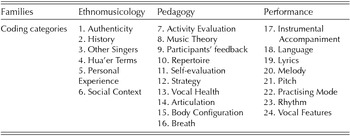
Table 3 shows the grouping of 24 coding categories that emerged from the interview transcriptions, which were perceived as three interrelated aspects of singing education (headed under ‘Ethnomusicology’, ‘Pedagogy’ and ‘Performance’). Amongst these, Pedagogical aspects were discussed the most across the eight interviews. In the ‘Ethnomusicology’ grouping, the three interviewed participants tended to give information about their previous learning and teaching experience, along with the social context where such music practices occurred. ‘Participant feedback’ and ‘Strategy’ were emphasised overall across all interviews, whilst ‘Activity evaluation’ and ‘Self-evaluation’ were discussed more in some instances. The ‘Performance’ grouping had the largest number of coding categories (11 items), where ‘Vocal feature’ and ‘Lyrics’ were the two issues of greater importance.
Three families of interview transcription coding categories.

The definition of each node is given below, along with coding examples.
-
1. Authenticity: Contents that related to ‘authentic style’, a term that was used specifically as equivalent to ‘Yuan Sheng Tai’Footnote 5 in this research.
Example 1:
R: What is the ‘authentic style’?
F: It uses local dialects. However, students could succeed [in their future career] much easier by mixing Hua’er [the authentic style] with other styles, such as Bel Canto, Chinese classical or even pop music. The authentic approach is tough for him [S], but if the authentic style gives way to the Chinese classical completely, Hua’er will not be exhibited any more.
-
2. History: Knowledge and information about the past of Hua’er music culture.
Example 2:
F: The senior members [in my county] said Hua’er is about stories of love, which were restricted in town and at home. However, when the time comes, many people start singing at private occasions [such as friends gathering and leisure time entertainment].
-
3. Other Singers: Comments, such as singers’ performances and careers, those concern singer(s) other than the interviewee.
Example 4:
R: Which singing style is Suonan Subing's performance?
F: He is [singing in a] Pop style.
-
4. Hua’er Terms: Words that were established by Hua’er singers to address specific singing activities, such as ‘Ba Shi’, ‘Ling’ and ‘Shan’
Example 3:
T: ‘Tiao’ is an instant crescendo followed by a retraction in terms of musical and emotional movement. It has been practiced for hundreds of years by local people and plays as one of the authentic ‘flavours’ of this style. However, it may not be ‘appropriate’ from a professional perspective.
-
5. Personal Experience: General self-reports of learning experiences, music career and daily activities of the interviewee
Example 5:
S: It was in my third year of high school, when the officers from the music department came to our school for a student with a specialty in Hua’er singing. I have never thought that Hua’er could be performed on stage. Since only one candidate was going to be enrolled, I was not very confident at first, but just to have a try.
-
6. Social Context: Social reputation and status of Hua’er music and Hua’er singers, such as people's attitudes towards singing and cultural expectations on folk singers.
Example 6:
S: Young people are often singing during farm-work. My bigger brothers used to sing during farming, but they usually stopped when I was there . . . Based on their understanding of the context, [local] singers will only perform ‘proper’ songs on certain occasions . . . singing celebrations will be relocated if Akhond opposed.
-
7. Activity Evaluation: Evaluative descriptions of the outcome or effect of teaching-learning activities
Example 7:
R: Do you think the face-to-face approach that we used for this session would be helpful for other students in the process of folk song learning?
F: Yes, I believe so. Both pop style and Bel Canto have some advantages [in singing learning] in general, which, however, need to be tested within the practices of a particular style [such as folk singing].
-
8. Music Theory: Statements or principles devised to explain a set of facts or phenomena of Hua’er music, especially ones that have been formalised and widely agreed.
Example 8:
T: Generally speaking, the pitch span of each slide note depends on local convention, which totally depends on singers’ ‘perception’ [of musical expressiveness] and usually much wider than those ones in Classical music.
-
9. Participants’ feedback: Comments on the singing performances of other research participants.
Example 9:
F: I was thinking that he would not need further instruction if everything goes fine. But, there were incomplete phrases and messy articulations in his singing today.
S: He [F] mainly focused mainly on the accuracy of song forms, melodies, intros and padding words, which may not be as professional [as the teacher’s].
T: His (S) singing was also improved as a consequence of a developed understanding of lyrics, emotional expression, facial expression and the imagination of musical content.
-
10. Repertoire: Folk song collection and related discussions on this topic.
Example 10:
F: Not all people in Linxia are able to sing ‘He Zhou Da Ling’ [河州大令], whilst ‘He Zhou Er Ling’ [河州二令], ‘San Ling’ [三闪令] and ‘Ga Ma Er Ling’ [尕马儿令] are much more common.
-
11. Self-evaluation: Self-reports on singing performance and learning/teaching experiences.
Example 11:
R: What is your advantage?
S: An artistic voice, which comes from the professional training of my voice's ‘focus’ and resonance. In addition, a clear articulation of words makes lyrics understandable for the audience.
-
12. Strategy: A set of methods that was applied by the tutor (either folk singer or music teacher) through which the goals of students’ studies are achieved.
Example 12:
T: A ten-minute voice practice first, where three moderate exercises were introduced in terms of pitch and range (within five tones). And vowels used are basically ‘forward’, such as [, e, a; no ‘backward’ vowel . . . I believe this is very necessary for folk song singing, such as Hua’er singing . . . Then, we moved on to lyrical analysis of ‘San Shan Ling’.
-
13. Vocal Health: Issues that relate to clinical change within the vocal instrument and any syndrome that occurred alongside these changes.
Example 13:
T: First, the quality of his voice needs to be improved, because the middle and lower registers of Hua’er singers are often not as good as their higher register or falsetto. ‘Shouting’ should not be a solution for the passage between middle and lower registers. Instead, an open throat will benefit him with a more stable and sustainable voice . . . As I noticed that S was ‘shouting’ a little at high pitches in the last session, I suggested to him to focus on the support from the waist and respiration skills. And it works.
-
14. Articulation: The configurations of vocal expression; utterance or enunciation for singing.
Example 14:
T: Articulating techniques of standard Chinese need to be introduced to enhance the pronunciations of local dialect, namely to use pronunciations as the foundation and leading role of tone making [以字行腔、字领腔行].
-
15. Body Configuration: Body posing, gestures and muscle configurations that are related to singing.
Example 15:
F: Gestures are a must for interactive stage performances. This is one of the hand gestures for Hua’er singing [cup your left hand behind the left ear with your palm facing forward], or stretch your right hand and arm forward with the left hand holding a microphone.
-
16. Breath: Breathing skills of singing, such as discussions that focused on respiration issues during singing.
Example 16:
F: I suggest to him that he practise his breath every morning in this way: breathe in slowly and then release slowly. Do not try to boost the voice, keep it delicate. Otherwise, his vocal instruments will be harmed.
-
17. Instrumental Accompaniment: Musical instruments that were used to accompany Hua’er singers.
Example 17:
F: He should have made significant progress [after a year of music study at university]. However, he is developing toward a pop style, rather than the authentic. The reason is that the authentic singing is not compatible with instrumental accompaniment, whilst the pop style is.
-
18. Language: The usage of language(s) in Hua’er performing, such as in a local dialect or ‘Pu Tong Hua’ (standard spoken Chinese).
Example 18:
T: Unlike the others, students who are going to learn Hua’er songs should use an ‘amended’ local dialect, rather than Pu Tong Hua, as much as possible.
-
19. Lyrics: Contents that concern lyrical features in Hua’er songs, such as syllables, sentence structure, prosody and phrase patterns.
Example 19:
R: So, the composition of Hua’er lyrics is not merely a matter of words; it's improvisation is a skill needs to be refined and contextualised in real practice?
S: That is correct.
T: Therefore, padding words are related to the local singing traditions, namely the style. It matters for the flavour of Hua’er music and determines the quality of performance.
-
20. Melody: Melodic features of tunes in Hua’er music; such as improvisation
Example 20:
F: He mistook the intro from ‘Xia Si Chuan’ [下四川] as ‘Wu Tong Ling’ [梧桐令], which makes the melody . . . [a bit strange].
-
21. Pitch: The ability or effort to reach/maintain singing at certain pitches and discussions that related to these issues.
Example 21:
R: Do you suggest that there is no such standard pitch [for each song]? Instead, singers are able to choose a certain key that they feel comfortable for singing?
T: That is right.
-
22. Practising Mode: Participants’ self-reports of general psychological or physical conditions during interview and performance.
Example 22:
F: He was a bit nervous yesterday for some reason. It seems that he was ‘afraid’ of something . . . Maybe he felt a bit uneasy in front of me [as a folk singer].
-
23. Rhythm: Rhythmic features of Hua’er music, such as any reported rhythmic difference in relation to other music genres.
Example 23:
T: ‘Wu Tong Ling’ has clear three-beat units for each one or two words . . . which makes it one of the representative Hua’er songs from Linxia . . . however, it also showed a certain influence from Zang peoples (Chinese Tibetans).
-
24. Vocal features: Discussions on vocal ornamentations, such as ‘Shan’, trill and slide and techniques.
Example 24:
T: [Regarding Classical and authentic singing styles,] It is all about singing ‘horizontally’ or ‘vertically’ and an emphasis on voice or style. In order to preserve the authentic music style, the basic rules of Hua’er singing should be studied further, which embraces a combination of ‘true voice’ and falsetto, ‘flat’ vocal timbre at lower register and a high throat position.
The content analyses emerging from the coded interviews provided structured information that either underpinned or offered an extended understanding of the behaviour reported in the observations above. The participants were given an opportunity to offer direct verbal explanations on their teaching/learning behaviour, which provided insights into the behaviour analyses with examples that illustrated how different types of activities were integrated into the procedure of teaching and learning in both contexts.
Interview findings
Analyses of the research data suggested that all three participants were generally very positive on their experiences during the lessons and it may be inferred that both folk and conservatory approaches were likely to be helpful for S's musical development in folk song singing. The participants also offered critical evaluations on both these learning approaches. F expressed serious concerns that a ‘scholastic’ style may potentially weaken the authentic ‘flavour’ of Hua’er music. S valued highly his learning opportunities with F, especially concerning details of the authentic performance style for lyrics and melodies, although he tended to seek ‘professional’ advice on singing technique, such as ‘voice placement’, from T, and this bias was also admitted indirectly by F. T was very confident in working ‘cooperatively’ with F and S, but he emphasised that the vocalisation used by folk singers may not be ‘suitable’ for student beginners. Therefore, ‘systematic’ practice needed to be introduced to ‘improve’ certain pronunciation of local dialect and, consequently (for T), achieve a better voice quality in singing.
These lessons provided an opportunity for the participants to develop further their understanding of each other's musical practices. F realised how musical notation might be very useful to ‘spread’ folk songs without the limitations of time or literacy, but, on the other hand, such notation could be ‘really distractive and misleading’ in reproducing authentic performances. T had further developed his competency in folk music teaching/learning through immediate engagement in this study with F and S, where the formal music learning hegemony was being challenged by an evolving political and educational demand on musical diversity. This new context suggested not only the ‘embracing of folk music content’, but also a celebration of different learning approaches, in which T himself recognised that he may also need to ‘learn from folk singers and students’. S was aware that F and T tended to focus on certain aspects (such as breathing and lyrics) in music learning, which required him to ‘try two different ways of singing’ that may make his performance ‘either get better or worse’. Although S was perceived as the ‘trainee’ during the lessons, it did not prevent him from participating in the learning process by raising questions actively (as was evidenced at least in the ‘Folk’ dyad). Interview data suggested that S was able to adjust his learning strategy (with or without piano accompaniment) and switch between the two approaches, as well as evaluate different instructions from F and T independently. By weighing the pros and cons of each approach, he stated that ‘as vocal instruments and learning environment varied across people, I will stick to my method in falsetto singing, instead of his (F) . . . but traditional repertoire and intangible knowledge can only be learnt from folk singers’.
In addition to these in-lesson pedagogical biases, both T (college teacher) and F (folk singer) reported pre-lesson preparations, which set up teaching guidelines for their teaching-learning activities, along with teaching objectives to be achieved. These objectives varied between T and F, who clearly focused on different aspects of the student's musical development. Whilst the teaching content (two folk songs) was assigned in advance, both F and T introduced additional music material into lessons. The teaching observation of L2, for example, suggested that F moved onto additional folk song repertoire alongside intensive discussion on other folk musics that related to Hua’er songs. Whilst both contexts were reported to be pedagogically challenging but productive, a number of pedagogical strategies were identified as being shared between these two cases of folk and conservatory approaches. Amongst these, ‘Singing demonstration’ was one of the methods that was used the most. Instant verbal or non-verbal feedback was given by F and T on a regular basis to support the student's practice. T affirmed that his initial teaching objectives had been achieved in the two consecutive lessons. F was also very positive about the student's performance. S was satisfied with his learning experience and outcomes, which also seemed to give him the confidence for more insightful self-practice in the future. The data analyses suggested that the folk context was particularly encouraging for S in the sense of a more active critical participation. In general, observational findings were coherent with the after-lesson feedback from the participants, which confirmed that lesson activities were developed consistently with certain types of teaching strategies as was seen in Figure 3, 4, 5 and 6.
Discussion
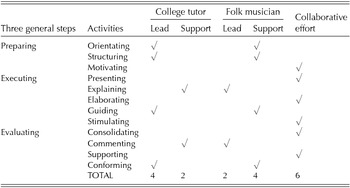
The pedagogical findings above lead to a matter of possible cognitive approaches in the effective support of student's learning. Elsewhere, Nielsen (Reference NIELSEN2006) has presented a three-stage modelFootnote 6 of music students’ development towards being a pianist, and this has resonance with the empirical findings here concerning the singing development of vocal music students. Neilsen's model was defined from a cognitive perspective and tends to assume that the teacher should have expertise in the music to be taught and should also lead the development of the students. This might be effective in a traditional conservatory context, where teachers have established their professional expertise and reputation through teaching and performing. But, in the case of indigenous folk song singing, which has just been introduced into this formal context, this approach is likely to be challenging in the context of a relative absence of discursive disciplinary knowledge for both the teacher and the student, at least initially. It was suggested that students would be very likely to have a less than effective teaching and learning experience if the syllabi developed for Classical music traditions was adopted for a ‘new’ music style (such as, for instance, the chosen Hua’er songs) without any amendment. In terms of the ‘Conservatory’ dryad, S could be considered to be at the early stages of Kerchner's (Reference KERCHNER2006) extended five-stage developmental model (namely, the silenced knower, received knower, subjective knower, procedural knower and constructed knower). Kerchner's stages, whilst needing review in the context of non-Classical musics, suggest that teaching materials need to be flexibly responsive to the stages of cognitive development of students, rather than a list of repertoire that increases in difficulty in the syllabus. Such customary syllabi are likely to focus more on the outcomes, rather than how these were achieved, in other words, the process of learning development, which – we argue – is a crucial feature in the introduction of new musical genres into established pedagogical contexts (such as Classical). Based on analysis of the influences on learning from the subject and how it is taught, Entwistle's ‘heuristic model’ (2009, p. 118) offers a ‘checklist’ for a set of 12 activities that support learning. In line with these 12 principled teaching activities, it is possible to elaborate the research findings above in a suggested sequencing cognitive package of learning development (see Table 4). This shows how tutors with experience of formal or informal learning might be able to cooperate with, and support, each other in this particular (folk) music genre context.
Teachers’ activities to support each phase of a student's learning cycle (after Entwistle, Reference ENTWISTLE2009).

To consolidate the student's music development though the three phases of learning (Preparing, Executing and Evaluating) in a higher education context, the college (classical) music tutor was very likely to take a leading role in four learning activities: Orientating, Structuring, Guiding and Conforming, whilst the folk singer's instructions appeared to be much more concerned with two learning activities: Explaining and Commenting. The analyses of the remaining six activities in the learning cycle suggest that, at least in this particular instance, the student's learning would be more effective if collaborative support can be provided by the college tutor and the folk singer working together.
Summary
Hua’er music had not been introduced into formal practice in higher institutions before 2006. But, there has been no research so far dedicated to this type of music from a pedagogical perspective (according to the search results of CNKI)Footnote 7 . The current research study compared two different approaches of folksong learning and provided examples of pedagogies that were used in the observed Folk and Conservatory context. The research findings revealed a set of musical components and pedagogical strategies that were utilised by the two instructors for Hua’er song teaching in Conservatory and Folk contexts. Differences between the two approaches also reflected the structural and conceptual diversity within the music education system, which is challenging a ‘mono-cultural’ ideology within current college-based formal music practice. Whilst the Folk approach seemed to be less consistent in term of pedagogical structure, the Conservatory approach appeared to be much more systematic. However, the systematicity of teaching pedagogy was reported to have no direct effect on the learning experience and sense of accomplishment of the student. Rather, the effectiveness of student's learning was primarily associated with the ‘authenticity’ and coherence of learning materials (course content). On the other hand, clearly constructed pedagogical strategies (related to course structure), as seen in the Conservatory context, may provide better clues for learning recall and evaluation. Therefore, it is proposed that the two approaches can be used together to increase the effectiveness of folk music education, in which innovative teaching contents and performances were supported by a systematic critical review of appropriate pedagogies. Also, a sensible coordination of folk song materials and formal education practice could be the key for effective learning that motivates all music participants, tutors and students. Future research should enquire further into the interrelationships amongst these identified pedagogies to elaborate the intrinsic logic of an effective teaching-learning model.