Introduction
The neurodegenerative changes underlying Alzheimer's disease (AD) start long before the disease becomes clinically manifest (Jack et al. Reference Jack, Knopman, Jagust, Shaw, Aisen, Weiner, Petersen and Trojanowski2010), gradually leading to subtle cognitive changes several years before the diagnosis of AD-type dementia can be made. This transitional stage between normal cognitive functioning and dementia is often referred to as Mild Cognitive Impairment (MCI; Petersen et al. Reference Petersen, Smith, Waring, Ivnik, Tangalos and Kokmen1999).
Consistent with the observation that neuropathological changes start in brain circuits subserving memory formation and consolidation, many studies identified memory deficits as an early predictor of conversion to AD dementia (Albert et al. Reference Albert, Moss, Tanzi and Jones2001; Tabert et al. Reference Tabert, Manly, Liu, Pelton, Rosenblum, Jacobs, Zamora, Goodkind, Bell, Stern and Devanand2006; Silva et al. Reference Silva, Guerreiro, Santana, Rodrigues, Cardoso, Maroco and de Mendonca2013). Further, studies also reported subtle deficits in non-memory domains in individuals with prodromal AD, such as insufficiencies in executive functioning (Albert et al. Reference Albert, Moss, Tanzi and Jones2001; Rapp & Reischies, Reference Rapp and Reischies2005), verbal fluency (Fabrigoule et al. Reference Fabrigoule, Rouch, Taberly, Letenneur, Commenges, Mazaux, Orgogozo and Dartigues1998; Laukka et al. Reference Laukka, Jones, Small, Fratiglioni and Backman2004), attention (Linn et al. Reference Linn, Wolf, Bachman, Knoefel, Cobb, Belanger, Kaplan and D'Agostino1995; Nielsen et al. Reference Nielsen, Lolk, Andersen, Andersen and Kragh-Sorensen1999), and global cognitive functioning (Backman & Small, Reference Backman and Small1998; Fabrigoule et al. Reference Fabrigoule, Rouch, Taberly, Letenneur, Commenges, Mazaux, Orgogozo and Dartigues1998). In addition, longitudinal studies comparing the rate of cognitive decline in those who later develop AD dementia and those who do not, indicate a sudden steep decline in episodic memory in converters in the prodromal AD phase (Johnson et al. Reference Johnson, Storandt, Morris and Galvin2009; Laukka et al. Reference Laukka, Macdonald, Fratiglioni and Backman2012). These and other studies also demonstrate that multiple cognitive functions, like verbal fluency and executive functioning show a steeper decline in AD converters compared to non-converters several years prior to dementia diagnosis (Amieva et al. Reference Amieva, Jacqmin-Gadda, Orgogozo, Le Carret, Helmer, Letenneur, Barberger-Gateau, Fabrigoule and Dartigues2005; Grober et al. Reference Grober, Hall, Lipton, Zonderman, Resnick and Kawas2008; Johnson et al. Reference Johnson, Storandt, Morris and Galvin2009; Mungas et al. Reference Mungas, Beckett, Harvey, Farias, Reed, Carmichael, Olichney, Miller and DeCarli2010; Thorvaldsson et al. Reference Thorvaldsson, Macdonald, Fratiglioni, Winblad, Kivipelto, Laukka, Skoog, Sacuiu, Guo, Ostling, Borjesson-Hanson, Gustafson, Johansson and Backman2011; Laukka et al. Reference Laukka, Macdonald, Fratiglioni and Backman2012). Unfortunately, current outcomes are largely based on non-clinical samples from healthy volunteer populations, which are not directly comparable to the help-seeking memory clinic visitors who already experience some cognitive problems.
A better understanding of the pattern, magnitude and temporal sequence of these cognitive deficits in clinical populations is important to facilitate early diagnosis and increase insight into early pathological brain mechanisms.
Therefore, the aim of the present study was to compare the pattern, onset and rate of cognitive decline between AD dementia converters and non-converters in a large sample of memory clinic visitors not demented at baseline. We hypothesized that (a) differences in decline between groups can be established for all cognitive domains (episodic memory, information processing speed/attention, verbal fluency, executive functioning), yet converters show a pattern of most pronounced decline in memory and executive functioning, and (b) that these differences become manifest many years before dementia diagnosis is made.
Method
Subjects
This study is part of the Clinical Course of Cognition and Comorbidity in MCI (4C-MCI) study, a longitudinal study on cognitive decline in initially non-demented memory clinic visitors. Participants for the present study were retrospectively selected from the cumulative clinical and research registration systems of the memory clinic at the Alzheimer Centre Limburg at Maastricht University Medical Centre (MUMC) and the memory clinic-based Amsterdam Dementia Cohort from the Alzheimer Centre at the VU Medical Centre (VUmc) (van der Flier et al. Reference van der Flier, Pijnenburg, Prins, Lemstra, Bouwman, Teunissen, van Berckel, Stam, Barkhof, Visser, van Egmond and Scheltens2014).
Inclusion criteria were: age ≥ 55 years, subjective or objective cognitive impairment, no dementia, Clinical Dementia Rating Scale (CDR) score ≤ 0.5 or Global Deterioration Scale (GDS) score ≤ 3. Exclusion criteria were neurological diseases that could have caused cognitive impairment such as Parkinson's or Huntington's disease, acute stroke, normal pressure hydrocephalus, Korsakoff's syndrome, and a medical history of brain tumour or encephalitis. Participants having any other co-morbidities, including cerebrovascular or psychiatric disorders were not excluded in this study. For the present study we selected patients who visited the memory clinics between 1987 and 2010 and had at least one follow-up assessment, yielding a sample size of N = 819. Both sites contributed equally (Maastricht n = 393; Amsterdam n = 426). Maastricht patients tended to be younger and less well educated.
Assessment at baseline
At baseline, all patients underwent a standardized clinical assessment, which included a detailed history of the patient, a psychiatric, neurological and physical examination, appropriate laboratory tests, an extensive neuropsychological assessment (see below) and a magnetic resonance imaging (MRI) or a computerized tomography (CT) scan.
All neuropsychological test scores were converted to z scores adjusted for age, sex and education, based on norms for the Dutch healthy population (Schmand et al. Reference Schmand, Houx and de Koning2003; Van der Elst et al. Reference Van der Elst, van Boxtel, van Breukelen and Jolles2005, Reference Van der Elst, Van Boxtel, Van Breukelen and Jolles2006a , Reference Van der Elst, Van Boxtel, Van Breukelen and Jolles b ). Subjects with a z score lower than −1.5 s.d. on any neuropsychological test were classified as having MCI, all other subjects were classified as having Subjective Cognitive Impairment (SCI). Participants referred with a psychiatric, neurological or other medical disorder (not meeting exclusion criteria) that could have caused cognitive impairment were recorded as MCI or SCI with suspected underlying psychiatric co-morbidity, suspected underlying neurological co-morbidity or suspected underlying other co-morbidity, respectively. All remaining patients were classified as MCI or SCI without relevant co-morbidities. From the database we extracted data on age, gender, level of education and neuropsychological test scores.
Neuropsychological assessment
Both centres used a standard test battery for diagnostic and research purposes. Episodic memory was assessed by means of the Dutch adaptation of the 15-Word Verbal Learning Task (VLT; Lezak et al. Reference Lezak, Howieson and Loring2004; Van der Elst et al. Reference Van der Elst, van Boxtel, van Breukelen and Jolles2005). The score at the delayed recall trial was used to measure episodic memory. Information processing speed/attention was measured using the average of the Stroop Color Word Test (SCWT; Hammes, Reference Hammes1973) cards 1 and 2 (SCWT 1–2) and Trail Making Test (Schmand et al. Reference Schmand, Houx and de Koning2003; Lezak et al. Reference Lezak, Howieson and Loring2004) part A (TMT-A). An interference index from the SCWT, calculated as Card 3 − [(Card 1 + Card 2)/2] (Van der Elst et al. Reference Van der Elst, Van Boxtel, Van Breukelen and Jolles2006b ), as well as TMT part B were used to measure executive functioning, more specifically two components of executive functioning: concept shifting and sensitivity to interference. For assessing verbal fluency, a 1-min animal fluency test was used (Luteijn & Barelds, Reference Luteijn and Barelds2004).
Follow-up assessment
The follow-up assessment included a neurological and medical examination and a neuropsychological assessment comparable to baseline. The diagnosis of dementia and AD dementia at follow-up was made by a neurologist or neuropsychiatrist according to the DSM-IV and NINCDS-ADRDA criteria (McKhann et al. Reference McKhann, Drachman, Folstein, Katzman, Price and Stadlan1984; APA, 1994) after multidisciplinary consensus using all available information. Frontotemporal dementia (FTD) was diagnosed according to Neary criteria (Neary et al. Reference Neary, Snowden, Gustafson, Passant, Stuss, Black, Freedman, Kertesz, Robert, Albert, Boone, Miller, Cummings and Benson1998). The diagnosis of vascular dementia was made according to NINDS-AIREN criteria (Roman et al. Reference Roman, Tatemichi, Erkinjuntti, Cummings, Masdeu, Garcia, Amaducci, Orgogozo, Brun, Hofman, Moody, O’Brien, Yamaguchi, Grafman, Drayer, Bennett, Fisher, Ogata, Kokmen, Bermejo, Wolf, Gorelick, Bick, Pajeau, Bell, DeCarli, Culebras, Korczyn, Bogousslavsky, Hartmann and Scheinberg1993). Dementia with Lewy bodies (DLB) was diagnosed following the guideline of the international DLB consensus group (McKeith et al. Reference McKeith, Dickson, Lowe, Emre, O'Brien, Feldman, Cummings, Duda, Lippa, Perry, Aarsland, Arai, Ballard, Boeve, Burn, Costa, Del Ser, Dubois, Galasko, Gauthier, Goetz, Gomez-Tortosa, Halliday, Hansen, Hardy, Iwatsubo, Kalaria, Kaufer, Kenny, Korczyn, Kosaka, Lee, Lees, Litvan, Londos, Lopez, Minoshima, Mizuno, Molina, Mukaetova-Ladinska, Pasquier, Perry, Schulz, Trojanowski and Yamada2005). Other rare forms of dementia (e.g. HIV dementia complex, Creutzfeldt–Jakob disease, etc.) were summarized under ‘other dementia’. Non-demented subjects were classified as MCI or SCI conforming to classification procedures at baseline assessment.
For the present study we used information on dementia status at follow-up, date of dementia diagnosis and dementia type. Mean follow-up time was 2.7 years (median = 2.0 years) with a range from 0.5 to 10.0 years. Throughout follow-up patients had on average three neuropsychological assessments (median 2, range 2–11, total number 2200). During this period 183 (21.3%) incident dementia cases were established, of which 143 (78.1%) subjects developed AD dementia. For the present study we excluded the 40 subjects who converted to other forms of dementia.
Informed consent
In The Netherlands, the use of anonymized routine data does not require ethical approval or written informed consent. In the Amsterdam Dementia Cohort all patients provided informed consent for the use of their routine clinical practice data for research purposes.
Ethical standards
The authors assert that all procedures contributing to this work comply with the ethical standards of the relevant national and institutional committees on human experimentation and with the Helsinki Declaration of 1975, as revised in 2008.
Statistical analyses
Statistical analyses were performed using Stata version 12 for Mac OS X (StataCorp, USA). Significance was set at p < 0.05 in two-sided tests. For neuropsychological test scores we used z scores to allow comparison across domains. Baseline differences between groups were analysed using t tests for continuous variables and χ2 tests for categorical variables. Cognitive decline over time was assessed using random-effects (linear mixed) models, thereby accounting for the fact that repeated measurements are correlated within individuals. In addition, the use of mixed models makes the preprocessing of data by (multiple) imputation methods unnecessary, since the model handles missing data effectively by using all available data at a given time-point and by integrating missing values for cognition slopes with maximum likelihood.
Follow-up time was inverted and thus ranged from −10 years to zero, where zero (T0) is the time of diagnosis for incident dementia cases or the last available assessment for non-converters. Thus, only converters’ information from assessments prior to dementia diagnosis was included in order to restrict analyses to the pre-dementia phase. First, models with random intercepts were specified, where the random intercept is the difference between converters and non-converters at T0. Random slopes were included if likelihood ratio testing (LRT) suggested that this gave a better fit compared to the model with only a random intercept. To study differences in rate of decline over time between the groups (1 = AD dementia converters, 0 = non-converters), a group × time interaction term was added. In case of statistically significant differences between groups in rate of decline (i.e. a significant group × time interaction), we computed model-based estimates for each 1-year time-point in order to find the point of first-time deviation in cognitive performance between the two groups. The random-effects models were adjusted for age, sex, study centre and education (low, middle, high).
Results
Baseline differences
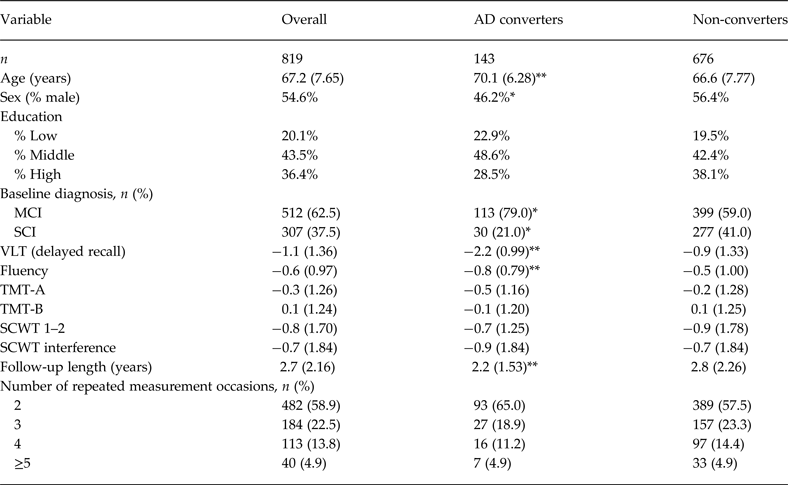
Characteristics of the patients at study entry, according to dementia status at follow-up and for the total group, are listed in Table 1. Subjects who developed AD dementia were about 3.5 years older at their first visit to the memory clinic and had significantly lower scores on the VLT and verbal fluency compared to subjects who did not convert to AD dementia. The baseline diagnosis of the converter group was mainly MCI (n = 113, 79%), while baseline diagnosis in the non-converters was more equally divided between MCI and SCI (MCI: n = 399, 59%; SCI: n = 277, 41%).
Characteristics of patients at first visit to the memory clinic
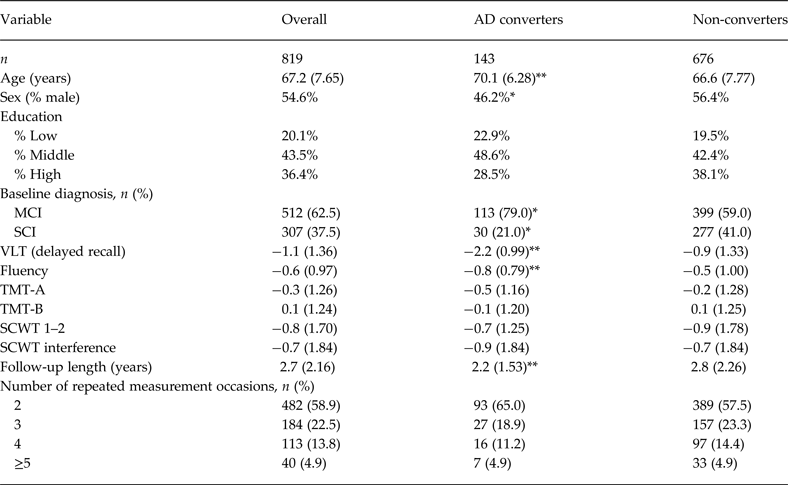
MCI, Mild Cognitive Impairment; SCI, Subjective Cognitive Impairment; SCWT 1–2, average of Stroop Color Word Test 1 + 2; SCWT interference, Stroop Color Word Test interference index; TMT-A, Trail Making Test part A; TMT-B, Trail Making Test part B; VLT, Verbal Learning Test.
Data are mean (s.d.), unless otherwise specified. Group size is different for cognitive tests.
* p < 0.05 compared to non-converters.
** p < 0.01 compared to non-converters.
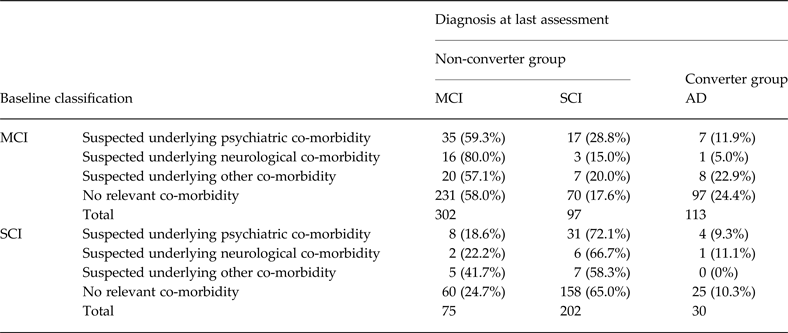
For the non-converters, the suspected underlying cause of the cognitive complaints was classified as follows: 91 (13.5%) subjects were classified as ‘suspected underlying psychiatric co-morbidity’, 27 (4.0%) subjects were classified as ‘suspected underlying neurological co-morbidity’ and 39 (5.8%) subjects were classified as ‘suspected underlying other co-morbidity’. The remaining 519 (76.8%) subjects had no relevant co-morbidity.
Of the subjects with suspected underlying psychiatric co-morbidity only 11 (10.8%) patients converted to AD dementia at follow-up, and of the subjects with suspected underlying neurological co-morbidity only two (6.9%) converted to AD dementia at follow-up. Further, for the groups with suspected underlying other co-morbidity or no relevant co-morbidity, respectively, eight (17%) and 122 (19%) patients converted to AD dementia. More extensive information on baseline diagnosis and suspected underlying aetiology for the two groups can be found in Table 2.
Groups at final assessment stratified by baseline diagnosis and suspected baseline aetiology
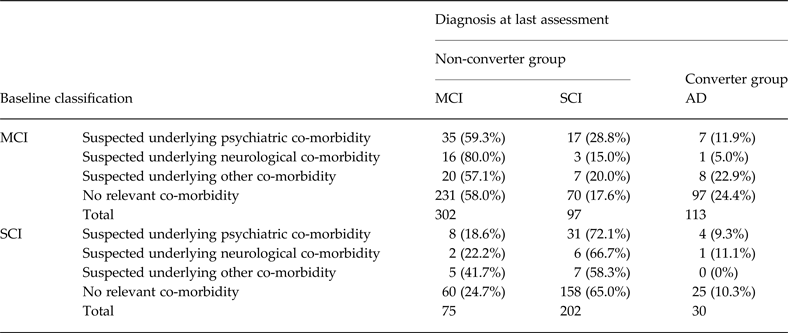
AD, Alzheimer's Disease dementia; MCI, Mild Cognitive Impairment; SCI, Subjective Cognitive Impairment.
Rate and pattern of cognitive decline
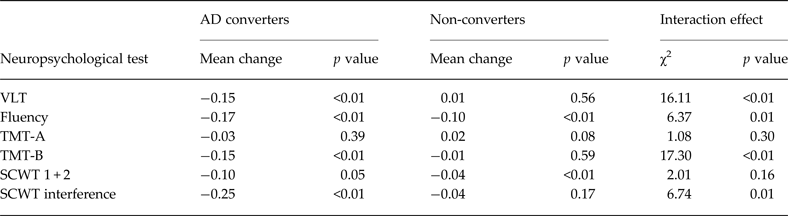
Random-effects models compared the slope of cognitive decline between non-converters and converters to AD dementia. A significant group × time interaction effect suggested that the mean annual rates of decline of the two groups differed significantly for the VLT, TMT-B, Stroop interference index and verbal fluency, but not for TMT-A and the averaged Stroop 1 + 2 (see Table 3). AD converters declined significantly on most tests (i.e. VLT, TMT-B, Stroop interference index and verbal fluency), but showed no change over time on TMT-A and the averaged Stroop 1 + 2. By contrast, non-converters remained generally stable in all domains, except for a modest decline on verbal fluency and a marginal decline on the averaged Stroop 1 + 2 (see Table 3).
Mean annual rate of change per neuropsychological test for Alzheimer’s disease dementia (AD) converters and non-converters, and the corresponding values for a group × time interaction effect
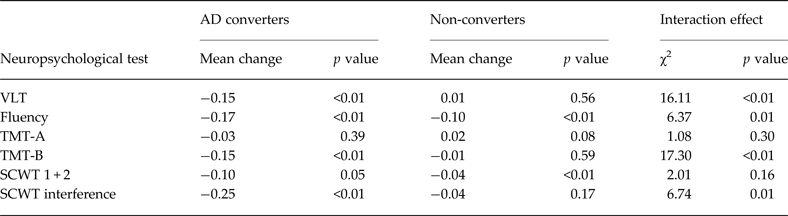
SCWT 1–2, average of Stroop Color Word Test 1 + 2; SCWT interference, Stroop Color Word Test interference index; TMT-A, Trail Making Test part A; TMT-B, Trail Making Test part B; VLT, Verbal Learning Test;
Next, we studied potential deviations from a linear trend over time by including the quadratic term for time in the above analyses. A quadratic curvature best described the trajectory in verbal fluency (beta of time as a quadratic term = −0.01, p = 0.001). For the other domains adding a quadratic term did not improve the model.
The trajectories for the different cognitive domains were plotted using model-based estimates and are shown in Fig. 1.
Average cognitive decline with 95% CI for converters to Alzheimer’s diseaser dementia (AD, black diamonds) and non-converters (grey circles) per cognitive test. Time axis is inverted and shows years before end of study (i.e. date of dementia diagnosis for converters or last follow-up assessment for non-converters). VLT, Verbal Learning Test; TMT-A, Trail Making Test part A; TMT-B, Trail Making Test part B; SCWT 1–2, average of Stroop Color Word Test 1 + 2; SCWT interference, Stroop Color Word Test interference index; *, point of first differentiation between groups.

Onset of decline
We then computed at which time-point during the pre-dementia phase, significant differences in cognitive performance of AD converters and non-converters could be established for the first time looking backwards from the point of diagnosis. Segmenting follow-up time by 1-year time bands and calculating model-based estimates per year, this distinction could be made 7 years prior to diagnosis for the VLT. For non-memory tests, the point of differentiation occurred several years later, 3 years before diagnosis for TMT-B and verbal fluency and 2 years prior to diagnosis for the Stroop interference index. Before these time-points, the cognitive performances of the two groups were not distinguishable, which is also indicated in Fig. 1 by the curves (representing cognition slopes) showing overlapping 95% confidence intervals (CIs) (see Fig. 1). Since the plotted curves are based on linear prediction models, for some tests (i.e. Stroop interference, TMT-B) index curves seem to start to differ between groups again, several years before the point of differentiation, but this is purely due to the linear prediction and does not represent the actual data (see Fig. 1).
When we repeated our analyses using only data from patients who were followed for ≥3 years, results did not essentially change. Yet, for the TMT-B, the point of differentiation could be established even earlier in time (i.e. 6 years prior to AD dementia diagnosis).
Discussion
To the best of our knowledge, the present study is the first large multicentre longitudinal study that is explicitly aimed at describing the trajectories of various cognitive functions in converters to AD dementia and non-converters in a memory clinic setting. Our main finding is that differences in cognitive performance between converters to AD dementia and non-converters already exist seven (episodic memory) to three (executive functioning and verbal fluency) years prior to diagnosis. Furthermore, we found profound differences in cognitive trajectories between the two groups for these domains, with pre-demented subjects showing marked decline while non-converters remained generally stable. For information processing speed/attention both groups did not decline substantially and hence there was no difference between groups.
Our established differences in cognitive performance between converters and non-converters several years before dementia diagnosis corroborate findings of population-based studies, although follow-up of these studies was generally shorter (1.5–3.6 years). As in our memory clinic-based study, differences were found for the domains of episodic memory (Chen et al. Reference Chen, Ratcliff, Belle, Cauley, DeKosky and Ganguli2000; Albert et al. Reference Albert, Moss, Tanzi and Jones2001; Amieva et al. Reference Amieva, Jacqmin-Gadda, Orgogozo, Le Carret, Helmer, Letenneur, Barberger-Gateau, Fabrigoule and Dartigues2005), executive functioning (Hanninen et al. Reference Hanninen, Hallikainen, Koivisto, Helkala, Reinikainen, Soininen, Mykkanen, Laakso, Pyorala and Riekkinen1995; Chen et al. Reference Chen, Ratcliff, Belle, Cauley, DeKosky and Ganguli2000; Albert et al. Reference Albert, Moss, Tanzi and Jones2001) and verbal fluency (Chen et al. Reference Chen, Ratcliff, Belle, Cauley, DeKosky and Ganguli2000; Raoux et al. Reference Raoux, Amieva, Le Goff, Auriacombe, Carcaillon, Letenneur and Dartigues2008; Clark et al. Reference Clark, Gatz, Zheng, Chen, McCleary and Mack2009). Studies with longer follow-up reported differences in episodic memory, verbal fluency and abstract thinking (a part of executive functioning) nine (Amieva et al. Reference Amieva, Jacqmin-Gadda, Orgogozo, Le Carret, Helmer, Letenneur, Barberger-Gateau, Fabrigoule and Dartigues2005) to five (only verbal fluency reported) (Clark et al. Reference Clark, Gatz, Zheng, Chen, McCleary and Mack2009) years prior to AD dementia diagnosis. This is roughly comparable to our established points of distinction, although differences in verbal fluency and abstract thinking in one study are reported several years earlier than we found. Yet, when we repeated our analysis for a subgroup of our population, including only patients who were followed for ≥3 years, our point of differentiation for concept shifting (a part of executive functioning) proved to be 6 years prior to AD dementia diagnosis, which matches previous findings even better. The differences between our main results and the results of these previous studies are likely to be affected by differences in study population, which consisted of healthy subjects from the general population, while we investigated subjects who presented with cognitive complaints at a memory clinic and thus our non-converters are likely to perform on a lower level than healthy population-based control subjects.
We observed differences between groups in the rate of decline, which was most profound for the domains of episodic memory and executive functioning, mirroring findings in non-clinical samples (Chen et al. Reference Chen, Ratcliff, Belle, Cauley, DeKosky and Ganguli2001; Grober et al. Reference Grober, Hall, Lipton, Zonderman, Resnick and Kawas2008; Johnson et al. Reference Johnson, Storandt, Morris and Galvin2009; Mungas et al. Reference Mungas, Beckett, Harvey, Farias, Reed, Carmichael, Olichney, Miller and DeCarli2010) and a clinical sample (van Harten et al. Reference van Harten, Smits, Teunissen, Visser, Koene, Blankenstein, Scheltens and van der Flier2013). Although one population-based study found differences only for decline in episodic memory but not in executive functioning (Albert et al. Reference Albert, Blacker, Moss, Tanzi and McArdle2007) (although differences in executive functioning almost reached significance) and one negative study reported similar rates of decline for the two groups in episodic memory (Backman et al. Reference Backman, Small and Fratiglioni2001). However, it must be noted that this last study was restricted to decline from 6 years to 3 years prior to diagnosis, which does not correspond to the time-frame used in most studies (i.e. immediately preceding diagnosis). Our results further correspond with the observation that the earliest pathological changes in AD usually occur in the medial temporal lobe regions, which are known to be critical for episodic memory functioning (Ridha et al. Reference Ridha, Barnes, Bartlett, Godbolt, Pepple, Rossor and Fox2006; Sluimer et al. Reference Sluimer, van der Flier, Karas, van Schijndel, Barnes, Boyes, Cover, Olabarriaga, Fox, Scheltens, Vrenken and Barkhof2009). Moreover, our established multi-domain decline in pre-demented subjects also matches findings of spread pathology before AD diagnosis, indicating that multiple brains structures, like the parietal (Jacobs et al. Reference Jacobs, Van Boxtel, Uylings, Gronenschild, Verhey and Jolles2011), and frontal cortex (Burgmans et al. Reference Burgmans, van Boxtel, Smeets, Vuurman, Gronenschild, Verhey, Uylings and Jolles2009) are affected.
Our findings further indicated decline in verbal fluency for both groups, which is also reported by a population-based study (Clark et al. Reference Clark, Gatz, Zheng, Chen, McCleary and Mack2009). Moreover, significant decline on fluency measures prior to AD dementia diagnosis is reported by multiple population-based studies (Grober et al. Reference Grober, Hall, Lipton, Zonderman, Resnick and Kawas2008; Raoux et al. Reference Raoux, Amieva, Le Goff, Auriacombe, Carcaillon, Letenneur and Dartigues2008; Laukka et al. Reference Laukka, Macdonald, Fratiglioni and Backman2012). Our established decline for non-converters might be due to an underlying ageing process, which is reported for verbal fluency by other studies (Crossley et al. Reference Crossley, D'Arcy and Rawson1997; Auriacombe et al. Reference Auriacombe, Fabrigoule, Lafont, Jacqmin-Gadda and Dartigues2001).
For information processing speed/attention we did not find differences between groups. While our findings are supported by several previous population-based studies (Fox et al. Reference Fox, Warrington, Seiffer, Agnew and Rossor1998; Cerhan et al. Reference Cerhan, Ivnik, Smith, Machulda, Boeve, Knopman, Petersen and Tangalos2007), others have reported significant differences between groups in this domain (Chen et al. Reference Chen, Ratcliff, Belle, Cauley, DeKosky and Ganguli2000; Galvin et al. Reference Galvin, Powlishta, Wilkins, McKeel, Xiong, Grant, Storandt and Morris2005). Differences in study design, study sample and definition of this cognitive domain might explain part of these inconsistencies. For instance the study by Galvin et al. (Reference Galvin, Powlishta, Wilkins, McKeel, Xiong, Grant, Storandt and Morris2005) followed subjects that converted to both AD and non-AD dementias, with the latter being more likely to exhibit attention/speed deficits early in the course of decline, e.g. due to evolving vascular cognitive impairment (O'Brien et al. Reference O'Brien, Erkinjuntti, Reisberg, Roman, Sawada, Pantoni, Bowler, Ballard, DeCarli, Gorelick, Rockwood, Burns, Gauthier and DeKosky2003). Another population-based study reported significant decline for speed/attention measures in both converters and non-converters (Wilson et al. Reference Wilson, Leurgans, Boyle and Bennett2011). This seems to be in accordance with our (borderline) significant decline on the SCWT 1–2 for both groups. Since the decline is found for both groups, at least part of it might be due to a common underlying ageing process. Indeed attention seems to be a poor discriminator between converters to AD dementia and non-converters (Albert et al. Reference Albert, Moss, Tanzi and Jones2001) Interestingly, when we repeated our analyses including data that were gathered after the dementia diagnosis was made, information processing speed/attention did show significant cognitive decline in converters (results not shown). This implies that decline in information processing speed attention is still subtle in the pre-dementia phase and starts widening as underlying pathology progresses. More importantly, since pathological decline in information processing speed/attention is absent in the pre-dementia phase of AD, the determined decline in executive functioning can be considered as a pure executive problem, because no underlying attention or speed problems are found.
In the present study, non-converters remained stable in general. The absence of cognitive decline in subjects remaining cognitively healthy is well established in other studies (Rubin et al. Reference Rubin, Storandt, Miller, Kinscherf, Grant, Morris and Berg1998; Wilson et al. Reference Wilson, Beckett, Bennett, Albert and Evans1999; Chen et al. Reference Chen, Ratcliff, Belle, Cauley, DeKosky and Ganguli2001; Galvin et al. Reference Galvin, Powlishta, Wilkins, McKeel, Xiong, Grant, Storandt and Morris2005). The absence of decline over time in this ageing population might be due to learning and habituation effects, which are well documented in healthy elderly populations (Mitrushina & Satz, Reference Mitrushina and Satz1991; Ferrer et al. Reference Ferrer, Salthouse, Stewart and Schwartz2004; Machulda et al. Reference Machulda, Pankratz, Christianson, Ivnik, Mielke, Roberts, Knopman, Boeve and Petersen2013). An alternative explanation for the absence of decline in non-converters might be that subjects experiencing subjective cognitive complaints feel reassured after their visit to the memory clinic. The relief of feelings of stress, anxiety or worry could lead to improvement in their performance over time, since it is known that feelings of depression and anxiety are associated with poorer cognitive performance (Bunce et al. Reference Bunce, Batterham, Mackinnon and Christensen2012).
Our findings might have implications for designing optimal neuropsychological test batteries aiming at detecting dementia at an early stage. Episodic memory and executive functioning showed the largest differences in decline between groups, and hence the trajectories on these measures might be the most indicative of future dementia. The stated decline in executive functioning, urges the need to focus not solely on episodic memory tests in the current neuropsychological assessment, but give equal importance to executive functioning measures.
The present study has its own strengths and limitations. Major strengths of this study include the large sample size and a relatively long follow-up period of up to 10 years. This allowed for the inclusion of a considerable number of dementia converters with several assessment points, leading to stable estimates in well-powered random-effect analyses. Furthermore, we tried to maximize generalizability by (a) using data that were not locally restricted to a single centre, and (b) applying broad inclusion criteria in which most co-morbidities were not excluded. In addition, the statistical analyses made maximal use of all available data from the repeated measures design. However, the use of routine clinical data might have impact on data quality and lead to missing observations on several relevant neuropsychological tests; although, a considerable number of patients also participate in ongoing research, wherefore the standard assessment protocol contains all cognitive tests specified here. Hence, most patients had full information on these measures. Moreover, some neuropsychological domains were not routinely assessed, like visuospatial functions. However, these functions are often regarded as less discriminative between future AD converters and non-converters (Rubin et al. Reference Rubin, Storandt, Miller, Kinscherf, Grant, Morris and Berg1998; Albert et al. Reference Albert, Moss, Tanzi and Jones2001). Next, some non-converters might have been misclassified at their latest follow-up assessment because they will convert to dementia in the future, thereby diluting the effect. However, when we compare our conversion rate (21.3% over a mean period of 2.7 years) with the established conversion estimates in a systematic review (6.5%/year) (Mitchell & Shiri-Feshki, Reference Mitchell and Shiri-Feshki2009) our ratio corresponds to the established estimates. In addition, it should be noted that conversion rates are known to diminish over time, with cumulative numbers averaging 22.9% in studies with long-term follow-up (Mitchell & Shiri-Feshki, Reference Mitchell and Shiri-Feshki2009).
Further, some non-converters did not return for further follow-up assessment, leading to selection bias. Unfortunately, we do not have information about specific reasons of attrition due to the naturalistic setting of this cohort. However, again, this selection bias most likely would have led to an underestimation of the differences between groups, as non-converters with intact cognition might be inclined to get lost to follow-up in this clinical setting.
In conclusion, the present study shows that differences in cognitive performance between converters to AD dementia and non-converters can be established 7 years prior to diagnosis for episodic memory, with verbal fluency and executive functioning following several years later. Additionally, we found profound differences between the two groups in the cognitive trajectories of these domains, although not for information processing speed/attention. Next to accelerated decline in episodic memory, decline in executive functions may flag future dementia converters and should be given equal weight as memory decline in the diagnostic process.
Acknowledgements
The 4C-MCI study is funded by Alzheimer Nederland (grant number: 20083494). We thank Nico Rozendaal (MUMC) for database management, and all students, research assistants, and clinical staff for continuous data collection over the years. Research of the VUmc Alzheimer Centre is part of the neurodegeneration research programme of the Neuroscience Campus Amsterdam. The VUmc Alzheimer Center is supported by Alzheimer Nederland and Stichting VUmc fonds. The clinical database structure was developed with funding from Stichting Dioraphte.
Declaration of Interest
None.