Implications
Livestock production is the mainstay of livelihoods for resource-poor farmers in developing regions. However, the productivity of indigenous animals is low, as they are not effectively selected for increased productivity. Designing selective breeding schemes suitable for smallholder farmers in developing regions has been a challenge so far. Previously suggested schemes either do not address farmers’ breeding goals fully (station-based schemes) or yield slow genetic progress (village-based schemes). Here, a new station-cum-village-based breeding scheme is presented. The information presented contributes to designing breeding programs that address farmers’ preferences, speed up genetic progress and conserve indigenous animals, thereby improving the livelihoods of farmers.
Introduction
Livestock production is the mainstay of livelihoods for the resource-poor farmers in developing regions, particularly in marginal areas like the subalpine Menz region of Ethiopia where crop production is unreliable. However, livestock productivity in developing regions is low as the indigenous breeds have developed through natural selection to adapt to the marginal production environment and are not effectively selected for increased productivity. Selective breeding is an indigenous livestock breed improvement practice among most communities in developing regions (Perezgrovas, Reference Perezgrovas1995; Tano et al., Reference Tano, Kamuanga, Faminow and Swallow2003; Ndumu et al., Reference Ndumu, Baumung, Wurzinger, Drucker, Okeyo, Semambo and Sölkner2008), and is characterized by diverse and multiple farmer breeding objectives/selection criteria and lack of genetic progress in productivity.
Livestock breeding schemes designed to suit the breeding structures in developing regions broadly include village (or community-based) breeding schemes (Sölkner et al., Reference Sölkner, Nakimbugwe and Valle Zarate1998; Gizaw et al., Reference Gizaw, Komen and van Arendonk2009; Duguma et al., Reference Duguma, Mirkena, Haile, Iñiguez, Okeyo, Tibbo, Rischkowsky, Sölkner and Wurzinger2010) and station-based centralized nucleus breeding schemes (Ponzoni, Reference Ponzoni1992; Kosgey, Reference Kosgey2004). Both schemes have their merits and demerits (Gizaw et al., Reference Gizaw, Komen and van Arendonk2009). Genetic progress could be slow under village programs because of inaccurate genetic evaluation due to difficulties in implementing advanced selection tools such as best linear unbiased prediction (BLUP) selection and inefficient utilization of selected animals due to uncontrolled village breeding practices. However, nucleus breeding programs entail overhead selection costs in nucleus flocks to fulfill the continuous supply of improved rams to village flocks. Besides, farmers’ breeding objectives may not be fully addressed by breeding objectives and selection criteria defined by project experts in nucleus centers. This has great implications in the success of livestock projects, as breeding strategies that are based on farmers’ indigenous knowledge and preferences are more suitable and sustainable than exotic technologies.
A Menz sheep selection project has been going on since 1998 in a closed nucleus flock at the Debre Birhan Agricultural Research Center, Ethiopia. An elite Menz sheep flock has been established and results show that there has been a tremendous genetic improvement in the flock (Gizaw et al., Reference Gizaw, Lemma, Komen and van Arendonk2007). However, the genetic gain attained in the nucleus flock has yet to be disseminated to the village flocks in the Menz region. Dissemination of genetic gain and improvement of the traditional village selective breeding practices require the design of suitable breeding schemes.
A new pilot station-cum-village-based Menz sheep breeding scheme has been designed and implemented since 2009. The design integrates the merits of station-based and village-based breeding schemes. In this study, we assess whether conventional selection of breeding rams based on estimated breeding values (EBV) for production traits in nucleus centers meets farmers’ breeding objectives and selection criteria. We also elicit determinants of farmers’ ram choice and show how farmers’ ram selection criteria can be accommodated in a conventional nucleus breeding program.
Material and methods
Design of breeding program
The data for this study were obtained from a Menz sheep selection program in Ethiopia. The breeding program was initially designed following the conventional hierarchical breeding structure (Ponzoni, Reference Ponzoni1992) with no involvement of the end-user farmers in the breeding activity in a central station nucleus flock located at the Debre Birhan Agricultural Research Center. The breeding program was revised later on and a new station-cum-village breeding scheme was designed with due consideration to farmers’ participation in the selection process. The design involved two linked components: a nucleus selection and a village-based selection component.
A two-stage participatory selection procedure was followed in the nucleus flock. First, rams were selected based on BLUP of breeding values for yearling weight. Farmers’ preferences for traits were accommodated in the second stage. At this stage, farmers were presented with the top 20% of the candidate rams and selected the best rams based on their selection criteria for use in their flocks. Dissemination of genetic gain from the nucleus to village flocks took a different approach from the conventional closed- or open-nucleus schemes in which replacement rams are continually supplied to villages. In our design, improved rams were supplied to villages only once to jumpstart the village-based selection phase and speed up genetic progress.
A fully participatory village-based selection activity commenced in 2009 to sustain genetic gains transferred from the nucleus flock and produce replacement rams for the village flocks. A conceptual framework designed for a village breeding scheme in the Menz region (Gizaw et al., Reference Gizaw, Komen and van Arendonk2009) was applied in the village-based selection. A model cooperative village breeding program was established in two villages. The villages are found in a community-based Guassa Ecosystem Conservation Area maintained by the Afro-alpine Ecosystem Conservation Project (www.fzs.org). The area is subalpine (2800 to 3200 m above sea level). The temperature varies from −4°C to +18°C and frost is common between October and November.
Eliciting farmers’ preferences
A total of 45 Menz rams from the central nucleus were presented to 30 farmers. The farmers were asked to rank the rams for selection. Two phenotypic ranking methods were used: individual farmer ranking adopting a phenotypic ranking approach by Ndumu et al. (Reference Ndumu, Baumung, Wurzinger, Drucker, Okeyo, Semambo and Sölkner2008) and a group ranking. In the individual ranking approach, the rams were randomly divided into nine groups of five rams each. These groupings were repeated three times, each time with a fresh randomization. A total of 10 farmers participated in each randomization in which each farmer was asked to rank the rams in each group from one to five based on his preferences for a breeding ram. In order to elicit the determinants of farmers’ breeding ram choice, farmers were asked to list the preferred attributes of the first ranking rams in each group. In the direct group ranking, farmers ranked the rams through consensus. The farmers were first asked to group the 45 rams into three groups as their first, second and third choice of rams, and then rank the rams within each group.
Statistical analysis
EBV
BLUP of breeding values for yearling, 6-month and weaning weight was obtained from the solutions for the random animal genetic effect in a multitrait individual animal model analysis. The data were analyzed using WOMBAT (Meyer, Reference Meyer2009). The following model was fitted to the data:

where Yi is a vector of observations for trait i, bi denotes a vector of fixed effects for trait i (sex and year as class variables and age of the dam as a covariate), ai is a vector of random animal effects for trait i, ei is a vector of random residual effects for trait i and Xi and Zi are incidence matrices relating records for trait i to fixed effects and random animal effect, respectively.
Correlation analyses
Consistency of farmers’ ranking of rams was assessed by calculating repeatability estimates using the VARCOMP procedure in Statistical analysis software (SAS Institute Inc., Cary, NC, USA, 2002). Congruence between rankings was evaluated using correlation analyses. Each ram in each group of five was assigned three ranks based on average ranks given by farmers, its EBV and body weight (BW). Correlations between the three ranks were estimated using Spearman's rank correlation. Spearman's correlation analysis is based on the ranks of the data rather than the actual values.
Multinomial logistic regression analysis
Farmers’ ranking of rams was taken as a response variable. The response variable appears to have an ordered structure. Such data are best analyzed with the proportional odds (cumulative logit) model. However, the score test (SAS, 2002) showed that the proportional odds assumptions were not met (χ 2 = 157.8; P = 0.0001). For unordered response data, conditional and generalized logit models can be fitted. In a conditional logit model, a choice among alternatives is treated as a function of the characteristics of the alternatives, whereas in a generalized logit model, the choice is a function of the characteristics of the individual making the choice. Thus, a generalized logit model was fitted to analyze farmers’ ram choice criteria using procedure logistics with a glogit link in SAS (2002). Rank was defined as a dependent variable with rank 5 denoted as the reference category. The dependent explanatory variables included horn and color as class variables and tail circumference, withers height, pelvic width, body length, BW and body condition score as continuous variables. The generalized logit model was formulated as:

where Pr is probability and Y is the response (dependent) variable with categories 1, …, r and k are denoted as the reference category; x is the explanatory (dependent) variable. β is a vector of the regression coefficients for the jth logit.
Results
EBV
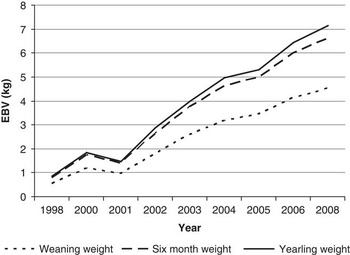
EBV for yearling, 6-month and weaning weight in the nucleus flock are shown in Figure 1. Selection for yearling weight resulted in an increasing genetic trend for all traits. Average EBV of 7.2, 6.6 and 4.5 kg were achieved by 2008 for yearling, 6-month and weaning weight, respectively.
Average estimated breeding values (EBV) attained from genetic selection for yearling weight in Menz sheep.

Congruence between rankings
Table 1 presents the correlations between ranks of rams in three randomization groups and by two methods of ranking (individual ranking and direct group ranking). The correlations between rankings of rams in the three randomization groups were highly significant. The two methods of ranking gave highly similar rankings of rams. Farmers’ rankings of breeding rams within randomization groups were fairly consistent with a repeatability estimate of 0.59.
Correlations between rankings of rams in different randomization groups and between individual ranking and direct group ranking

aMean of ranks given by individual farmers across all and in each randomization group. In each randomization group, each ram is evaluated with a random group of four rams and by a different group of 10 farmers individually.
***Correlation estimates are statistically significant at P = 0.001.
Table 2 presents correlation estimates between the ranking of breeding rams based on conventional and farmers’ ram selection criteria. Low but significant correlations were found between rankings of rams based on farmers’ selection criteria, EBV and BW.
Correlations between rankings of breeding rams based on EBV, BW and farmers’ ram choice criteria

EBV = estimated breeding values.
**,*Correlation is significant at the 0.01 and 0.05 levels, respectively.
Determinants of farmers’ ram choice
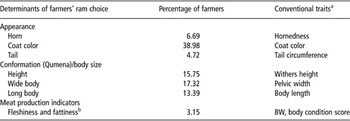
Determinants of farmers’ ram choice included appearance, conformation (and/or body size) as well as productive characteristics. Table 3 shows the percentage of farmers reporting the different characteristics of the rams as their preferred attributes for their choice of first-ranking rams, and the corresponding conventional animal breeding traits identified by the research team. The results indicate that coat color is the most important appearance trait for Menz farmers.
Preferred attributes of first ranking rams as stated by farmers

aConventional animal breeding traits corresponding to determinants of farmers choice were identified by the research team.
bFarmers assessed meat production and fattening ability of rams by palpating the dorsal pelvic region.
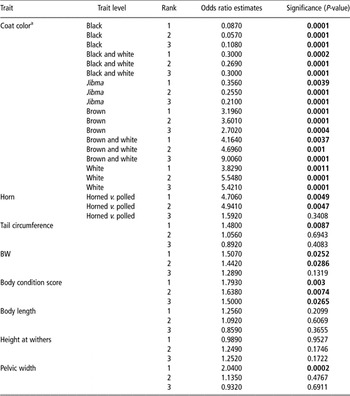
Table 4 presents estimates of odds ratios for the different traits and trait levels. All appearance traits and meat production traits significantly determined farmers’ breeding ram choice. However, only pelvic width among conformation/body size traits showed a significant effect on farmers’ choice. Farmers expressed significantly more preferences for brown, brown and white, and white sheep. Farmers also preferred horned and large/fat-tailed sheep. The results indicate that a unit increase in pelvic width will double the chance of a ram's being ranked first compared with a ram least preferred (5th rank).
The odds (likelihood) of a farmer ranking rams with a given trait level (for categorical traits) or with a higher trait value (for continuous traits) as most preferred (1st, 2nd or 3rd rank) compared with the least preferred (5th rank)

Pseudo R 2 = 0.41.
aThe reference trait level for coat color was white and brown (i.e. all color types were compared v. white and brown).
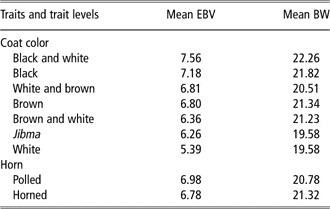
Table 5 shows the mean estimated EBV by levels of appearance traits. There is a tendency for black, black and white, and polled sheep to have higher mean EBV and BW. White sheep appear to be poor in performance traits. Moderate and significant correlations (except pelvic width) were obtained between EBV and tail circumference (r = 0.35; P < 0.05), withers height (r = 0.32; P < 0.05), body length (r = 0.40; P < 0.01) and pelvic width (r = 0.26; P = 0.09).
Mean EBV by levels of appearance traits

EBV = estimated breeding values.
Discussion
A station-cum-village-based breeding scheme has been designed and implemented for genetic improvement of Menz sheep through selective breeding. In this study, we evaluated the scheme in terms of organization of the breeding structure and accommodation of farmers’ preferences for breeding stock. The conventional hierarchical breeding structure with a central nucleus flock has been adopted as the best option for developing countries where within-flock genetic improvement cannot be implemented because of small individual flock sizes. However, such nucleus breeding programs are difficult to establish because of the unaffordable large nucleus size (5% to 10% of base population Ponzoni, Reference Ponzoni1992; Kosgey, Reference Kosgey2004) required to continually supply improved rams to the whole base population (e.g. a nucleus of ∼25 000 to 50 000 ewes for Menz sheep). The Menz sheep breeding design described here requires a far smaller nucleus size. This is because it involves only a one-time supply of rams and a follow-up village-based selection to maintain genetic gain transferred from the nucleus. Furthermore, it involves strategically selected limited villages that will be developed into ram sources for other villages, which are not addressed by the breeding program. This will evolve the current central nucleus breeding structure into a dispersed nucleus structure with village-based nuclei resulting in the phasing out of the central nucleus.
Conventionally, livestock genetic improvement programs are designed based on expert-derived breeding objectives and selection criteria. The main emphasis in such conventional nucleus breeding programs is on productive traits and selection of breeding stock, which are based on their breeding values (e.g. Gizaw et al., Reference Gizaw, Lemma, Komen and van Arendonk2007). However, eliciting farmers’ ram choice criteria in the current and previous studies (Ndumu et al., Reference Ndumu, Baumung, Wurzinger, Drucker, Okeyo, Semambo and Sölkner2008; Duguma et al., Reference Duguma, Mirkena, Haile, Iñiguez, Okeyo, Tibbo, Rischkowsky, Sölkner and Wurzinger2010; Gizaw et al., Reference Gizaw, Komen and van Arendonk2010) revealed that appearance/conformation traits are important criteria of selection under traditional livestock breeding practices. Among Menz sheep farmers, the presence of a horn, white and brown coat color and large fat tail confers high value on animals. This is because appearance and conformation heavily determine live animal prices in traditional livestock markets. Hedonic price analysis showed that coat color is a significant determinant of sheep prices in rural markets in the Menz region with brown (red), white and cream-white colors having a positive price premium and black coat color exhibiting the lowest value (Tadesse, Reference Tadesse2009). Thus, conventional selection based solely on EBV for production traits in nucleus flocks does not address farmers’ preferences fully, but only partially, as shown by the low correlations between ranks of rams based on breeding values (EBV) for yearling weight and farmers’ phenotypic ranking in this study. However, there is evidence of some congruence of farmers’ visual rankings with EBV rankings (r = 0.20; P < 0.05) in this study. Results of the current study and a previous study in which BW was found to be a significant selection criterion (Ndumu et al., Reference Ndumu, Baumung, Wurzinger, Drucker, Okeyo, Semambo and Sölkner2008) indicate that both production and appearance traits need to be considered in designing breeding programs.
The revised Menz sheep breeding design (see ‘Material and methods’ section) gives faster genetic improvement in productivity. This is because the design allows selection on BLUP breeding values, which is more efficient than village-based phenotypic selection (Gizaw et al., Reference Gizaw, Komen and van Arendonk2009) and jumpstarts and maintains genetic progress in the village-based selection phase. The design also fully accommodates farmers’ trait preferences as it allows farmers to select breeding stocks based on their preferences regardless of the breeding values of the rams presented to them for selection. However, our results showed that farmers’ selection was not exclusive of rams with high EBV as the mean and range of EBV of the rams selected by farmers (5.9 and 3.6 to 9.2 kg) were comparable with those of the candidate rams presented to the farmers for selection (5.7 and 2.3 to 9.2 kg). This indicates that it is possible to breed rams that combine both high EBV and farmers’ desired traits by using a two-stage selection procedure suggested here, that is, a combined selection of breeding stock based on BLUP and farmers’ preferences.
There are important considerations to be made in ensuring accommodation of farmers’ preferences fully. In the two-stage selection procedure, it should be emphasized that farmers’ choices of breeding rams should not be restricted. Restriction of choices could happen if most of the rams presented to farmers lack the traits desired by farmers (e.g. appearance traits). This results in failure to accommodate farmers’ preferences fully and even rejection of most of the rams by farmers. Restrictions can happen when very few rams are presented to farmers or if the traits desired by farmers are negatively correlated with the traits selected based on breeding values. We emphasize that a wider choice of rams be provided to farmers. In this study, the rams presented to the farmers had one or more of the major traits desired by Menz farmers (colors, horned/polled, tail type, etc.), which is to be expected when a fairly large sample size is considered.
Improvements to the proposed breeding design with regard to the level of farmers’ participation can also be considered. To ensure full accommodation of farmers’ preferences in a conventional nucleus breeding program, farmers’ preferences on appearance traits could be considered before selection on EBV in the nucleus flock. This can be done by research staff in the nucleus center through independent culling of rams with undesired attributes. This requires that farmers’ preferences be known a priori through surveys. For instance, Menz farmers’ preferences are already well established (Getachew, Reference Getachew2008; Gizaw et al., Reference Gizaw, Komen and van Arendonk2010). Alternatively, farmers can be directly involved in the selection process in the nucleus flock in which they select candidate rams based on their criteria followed by selection on EBV among the pre-selected rams. This reverses the order of accommodating farmers’ preferences followed in our study. However, the order of accommodating farmers’ preferences may not be of great consequence as long as farmers are provided with a wide choice of rams as discussed above in the Discussion section. Operational feasibility of the above alternatives in the context of developing regions needs to be considered.
Improvements on the current selection scheme (selection pathways and sources of information) also need consideration. The selection pathway in the Menz sheep breeding program has been only on the male side, whereas 98.1% of Menz farmers practice selection of replacement ewes (Gizaw et al., Reference Gizaw, Komen and van Arendonk2009). However, breeding programs need to build on farmers’ traditional breeding practices and introducing selection on the female side, as well as speeding up genetic progress. The source of information for selection of rams by farmers in the Menz program was through farmers’ visual assessment based on the rams’ own performance and appearance. This is in conformity with Menz farmers’ practice in which only 7.6% of the farmers utilize dam information for selecting breeding rams (Gizaw et al., Reference Gizaw, Komen and van Arendonk2009). Inclusion of information on dam and sire performance (including fertility, mothering ability and survival) in ram selection criteria enables selection on more traits, but the practicability of such a selection scheme under village conditions needs to be considered.
Conclusions
Conventional selection criteria based solely on EBV for production traits do not address farmers’ trait preferences fully, but only partially. Farmers consider both production and appearance traits in selecting breeding stocks. Thus, a two-stage selection procedure involving selection on breeding values in nucleus centers followed by farmers’ selection among top-ranking candidate rams is recommended. This approach accommodates farmers’ preferences and speeds up genetic progress in village-based selection. The Menz sheep breeding scheme could be applied to transform conventional station-based nucleus breeding programs into participatory programs in smallholder traditional breeding systems in developing regions with due consideration to local conditions. Improvements to the proposed breeding design can be considered with due consideration to ensuring full accommodation of farmers’ preferences and acceptable genetic progress in production traits.
Future breeding directions in Menz sheep could include development of a black breeding line or population through selection of black color in nucleus flocks. There is a tendency for black sheep to have higher mean EBV and BW. Black sheep have less market value, but niche markets where black color is not discriminated against (such as big cities and hotels) could be targeted. Furthermore, the breeding program needs to be optimized. Genetic trends in adaptive traits (fertility and survival) in the nucleus flock as affected by selection on BW need to be evaluated.
Acknowledgments
We sincerely thank the farmers who spared their free time for this study. The contributions of the staff at the Debre Birhan Agricultural Research Centre including Sisay Lemma, Ayele Abebe, Asfaw Bisrat, Tesfaye Chaka and Beneberu Tefera are gratefully acknowledged.