


The COVID years of 2020–2021 brought a potentially pivotal development to domestic Taiwanese politics and to cross-Strait relations. Heeding the call of newly reelected Democratic Progressive Party (DPP) President Tsai Ing-wen, the Taiwan legislature agreed, in September 2020, to establish a constitutional amendment committee which would consider lowering the voting age from 20 to 18 and transforming the functions of the Control Yuan and Examination Yuan. These particular reforms might sound innocuous, but “some experts are urging that the constitutional amendment threshold [also] be lowered” so that it would be easier in the future to revise the charter even more fundamentally, including in ways that might cross People's Republic of China (PRC) red lines (Teng Reference Teng2020). Formation of the constitutional amendment committee led to quick condemnation from Beijing (Xie and Wu Reference Xie and Wei2020), but in February 2021, a group of DPP legislators nevertheless proposed “changing the Constitution to remove references to unification with China. They described the current Constitution as ‘out-of-date,’ as it was written to reflect a Greater China mentality” (Taiwan News 2021).
What is it, exactly, that motivates Taiwanese on the “Green” (independence-supporting) side of the political spectrum—including the governing DPP—to continue resisting incorporation into the powerful PRC even at the risk of war?Footnote 1 Too much of the otherwise powerfully illuminating specialist literature ignores this fundamental question, evidently presuming that any de facto state operating under similar conditions as those faced by Taiwan would behave in an analogous fashion. We find such a rationalist assumption productive of useful but incomplete explanations (see, for example, Wu and Chen Reference Wu and Chen2020; and Lim Reference Lim2018). In the most extreme scenario, Taiwanese resistance to unification courts cataclysm, but even short of ultimate disaster, the economic costs that result from Taiwan not surrendering to Beijing's will are enormous, as are the costs associated with being isolated from much of the international community. The situation is one that demands a fuller explanation. We know that Taiwanese are motivated to maintain the ROC's political autonomy and to protect the island from military assault. But what are the conceptual wellsprings nourishing the idea that Taiwan independence is such a highly desirable condition that even great risks should be taken to consolidate it?
We posit that Taiwan's Green political movement is motivated fundamentally to realize the abstract status which Green intellectual and political elites term “Taiwan subjectivity” (Taiwan zhutixing), or Taiwan's status as an autonomous actor in world history and contemporary international (including cross-Strait) relations. We develop a Structural Topic Model (STM, www.structuraltopicmodel.com/) based on commentary articles in the leading Green Liberty Times (LT) newspaper to unpack the specific meanings associated with subjectivity. We find that what most occasions discussion of subjectivity in the pages of the LT is not a concern that Taiwan will be extinguished militarily through a PRC assault. The focus of concern is instead that the idea of Taiwan as an autonomous subject, paired with the reality of Taiwan as a modern democratic polity, will be crushed by a rising China or else subverted by people in Taiwan itself suspected (rightly or wrongly) of working on China's behalf.
Consequently, the most prevalent STM topics concerning subjectivity are to be found in the political and socio-cultural security sectors rather than the military-diplomatic sector.Footnote 2 In the pages below, we detail a subset of five of the most prevalent subjectivity topics in these sectors since 2015: four topics in the political sector (Intrinsically Subversive Constitution, Chinese Electoral Manipulation, Pro-China Interest Group Network, and Incipient Hongkongization) and one topic in the socio-cultural sector (Sinification of Taiwanese History). We then turn briefly to the opposition Kuomintang's (KMT's) take(s) on Taiwan subjectivity: a conundrum for the KMT because of the party's formal commitment to the “one China principle.” We conclude by suggesting that the Taiwan Greens’ drive to realize subjectivity, whatever its intrinsic merits, reinforces the expectation of certain leading Taiwan specialists that cross-Strait tensions will rise dangerously during the 2020s, given a context in which the Chinese Communist Party (CCP) remains committed to annexing Taiwan as a PRC special administrative region similar to Hong Kong.
Concepts and Method
The term Taiwan subjectivity results from contracting the Chinese-language phrase “taking Taiwan as the subject” or “main body” (yi Taiwan wei zhuti). Subjectivity emphasizes Taiwan's autonomous actorhood within international and cross-Strait relations, presenting the world from a Taiwan-centric perspective. The contrast is with the alternative of adopting a China-centric perspective that takes China as the subject and Taiwan as a peripheral appendage of either the PRC or the ROC.Footnote 3 Abandoning the effort to realize subjectivity and instead accept unification with the PRC would, to the Green side of Taiwan's political spectrum (the majority side since the mid-2010s), be unthinkable, even though the ruling (since 2016) DPP recognizes the impossibility of pursuing the complete subjectivity agenda under current international conditions.Footnote 4
Our task in this article is to extract the contemporary meanings and manifestations of the Taiwan subjectivity concept from the commentary pages of the LT during the years 2008–2020. Founded in 1980, the LT is the senior sister to the English-language Taipei Times, founded in 1999. According to Nielsen data, the LT “had an average daily readership of 2.55 million in 2014, followed by Apple Daily with 2.45 million, the United Daily News with 993,000, and the China Times with 692,000” (Rickards Reference Rickards2016). Consequently, the LT might be considered Taiwan's most popular newspaper. But popularity is not the only consideration in this context. We use the LT primarily because this is the periodical in which subjectivity is most likely to be analyzed intelligently and related to day-to-day political developments for a general audience.
We begin by simply counting the number of LT commentary articles in which the terms Taiwan and zhuti (subject) both appear in each year from May 2008 through March 2020. There are 1,033 such articles. Plotting the number of articles by year yields the pattern presented in Figure 1.
Commentary articles in the Liberty Times using Taiwan and zhuti (May 2009–March 2020

This is a striking pattern. It demonstrates that subjectivity is more likely to be discussed when the KMT is in power (2008–2016) than the DPP (2016–2020). Subjectivity received most attention during KMT President Ma Ying-jeou's second term in office (2012–2016). The number of articles in which the words Taiwan and zhuti both appear peaks at 153 in 2015 but then slides down to 71 in 2019, the last full year for which data are available. Still, 71 is a higher count than the annual totals during 2008–2011. The subjectivity concept is a persistent focal point for LT discussion and analysis.
To discover the actual content of the 1,033 LT articles—the systematic patterns in the discourse—we developed a structural topic model. The special power of an STM is that it can extract from a large corpus of texts accumulated over a sustained period of time discursive structures, or topics, that persist throughout the period under investigation, and probably—as a consequence of their persistence—continue to structure thinking and debate into the future. For this study, we used the R-package statistical software program “STM” to generate a 14-topic model from among the 1,033 LT commentary articles.Footnote 5
STM topics do not initially come with names attached, only numbers, along with a handful of rough indicators that suggest what the contents might be, such as the “top words” of each topic. The only way to discover what exactly the topics concern is to carefully read the (in this case) LT articles most closely associated with each. By “most closely associated,” we mean the articles in which particular topics are most prevalent. Topics are not coterminous with individual news articles. Instead, topics interpenetrate articles (they will be present in multiple articles), while individual articles may contain more than one topic. But some articles are more closely associated with some topics than others. In those articles, the topics in question will be more prevalent.
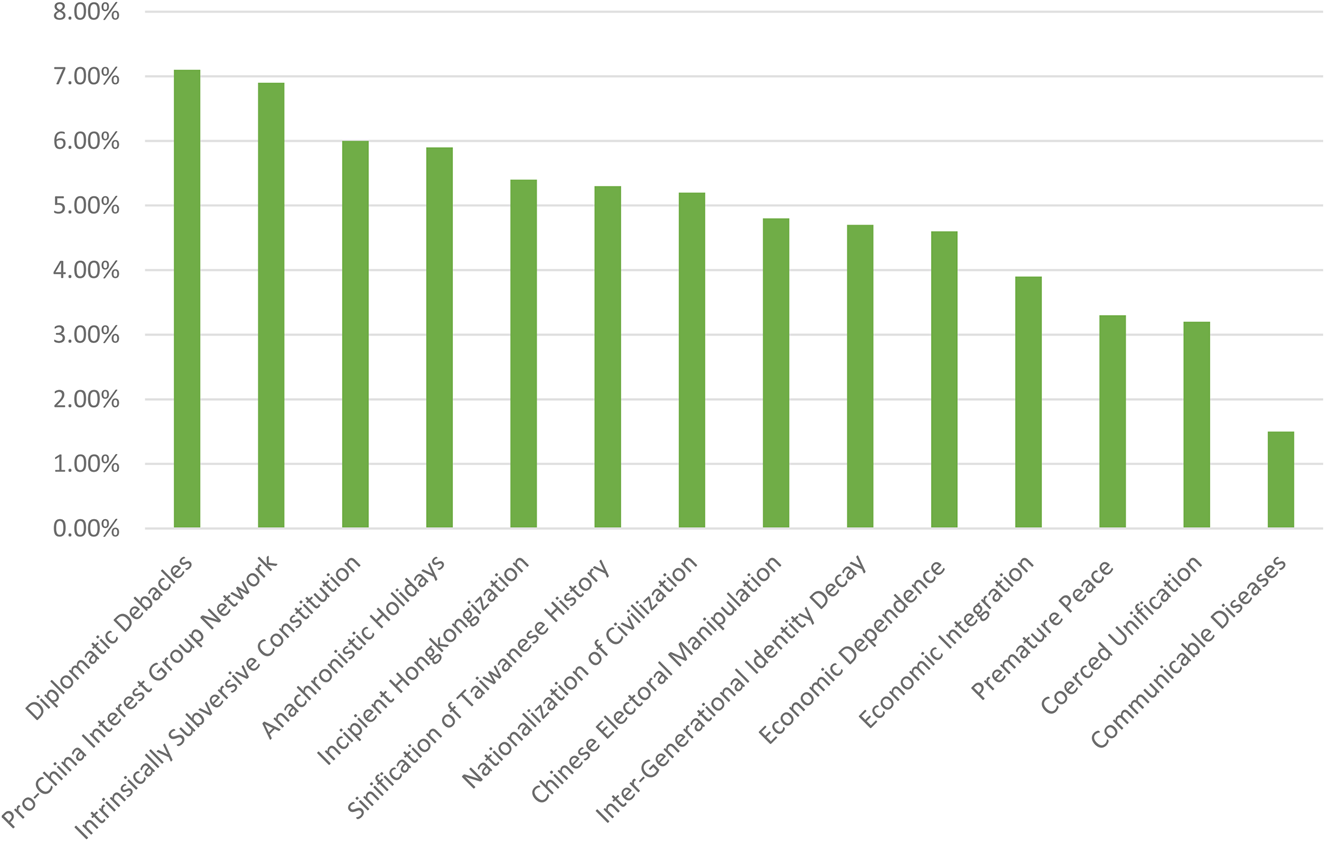
So that we could develop a nuanced understanding of the meaning of each of the topics, we therefore generated lists of the top 15 articles in which each topic was most prevalent. We then read those articles (210 in all) carefully. Having done that, we could next label the topics. Those labels are presented in Figure 2. Here, prevalence is used in a different way. Prevalence in Figure 2 refers to the summed prevalence of each of our model's topics (relative to the prevalence of the other topics, including jettisoned topics) in all of the LT articles containing Taiwan and zhuti over the entire period of May 2008 through March 2020.
Summed prevalence of 14 subjectivity topics, Liberty Times, 2008–2020

The most prevalent topic throughout the series, Diplomatic Debacles, refers generally to the ROC's travails in holding onto its diplomatic allies (the states that recognize it) and otherwise countering PRC diplomatic victories. Moving to the right of Figure 2, Anachronistic Holidays refers to something quite different, namely the persistence of China-centric public holidays in the ROC—a legacy of KMT authoritarianism—which, to the consternation of the Greens, continually suggest to Taiwanese that Taiwan's history is ultimately a part of China's history. At the far right of Figure 2 is Communicable Diseases (originating in China). This includes not only COVID-19, which appears suddenly at the end of the survey period, but also avian flu and the original Severe Acute Respiratory Syndrome (SARS), both of which also originated in China in earlier years and received occasional attention in the LT as having harmed or threatened to harm Taiwanese public health in ways challenging to counter.
When we categorize the topics by security sector (Table 1), we find strikingly that more than half of them fall in the political and socio-cultural sectors. There are only three topics in the military-diplomatic sector, and only one of these (Coerced Unification) concerns purely military threats. This alone suggests the centrality of political and socio-cultural concerns to the subjectivity concept. When we next plot the changing prevalence of topics (as grouped into sectors) over time (Figure 3), we find additional evidence for this centrality: political and socio-cultural topics dominate not only in number, but also in prevalence from 2012 through to almost the end of the series (the 2020 comparison is distorted by the sudden appearance of COVID).
Changing sectoral prevalence trends

Subjectivity Topics Classified by Security Sector

Our task, then, is to choose from among these discursively dominant political and socio-cultural topics a subset of topics to analyze closely. This will allow us to fulfill the objective of the research to illustrate how the abstract concept of subjectivity is instantiated in the real world of cross-Strait and international relations. Arrayed by changing prevalence, Figure 4 presents four such topics (Intrinsically Subversive Constitution, Chinese Electoral Manipulation, Pro-China Interest Group Network, and Incipient Hongkongization) in the political sector and one (Sinification of Taiwanese History) in the socio-cultural sector. For comparative purposes, we also include in Figure 4 the sole purely military topic (Coerced Unification). Note that the selected political topics together account for 35-40 percent of topic prevalence during DPP President Tsai's first term in office (2016–2020). These are dominant topics. The single socio-cultural topic (Sinification of Taiwanese History) is hugely prevalent from 2014 to 2017 but then rapidly fades. The military topic Coerced Unification is dwarfed by discussion of the other threats to subjectivity, although Coerced Unification does increase in prevalence during 2019–2020, evidently a reflection of the intensifying PRC military menace as suggested by military exercises and other aggressive moves.
Selected military-diplomatic, political, and socio-cultural topics

Intrinsically Subversive Constitution (Political Sector)
Let us now turn to analyzing the selected political and socio-cultural topics in greater detail. Intrinsically Subversive Constitution concerns what some perceive to be a critical loophole in the ROC constitution itself, obviously a pillar—even the pillar—of the political system. To allow legally for the direct election of the ROC president, a critical stage in the democratization process, the KMT government consulted widely and in 1991 issued “Additional Articles” to the ROC constitution, which, among other things, specified foundationally that the ROC's territory consists of both “the free area” and “the Mainland area,” even though the ROC controls only Taiwan, the P'eng-hu archipelago, Kinmen, Matsu, and assorted smaller islands (Office of the President 2005). Paradoxically, the 1991 constitutional revisions also specified that only the 23 million people living under the ROC's authority could vote on measures to further revise the constitution or otherwise change the country's national territory (add to or subtract from it) and thus define Taiwan's future. In the assessment of Academia Sinica Legal Studies Research Professor Chiou Wen-Tsong, this second specification was unavoidable. It was “the logical outcome of the need for those revising the constitution to come to terms with the reality of Taiwan subjectivity,” insofar as the democratizing ROC state could only be the vehicle, with the drivers being (ultimately) the Taiwan people (Chiou Reference Chiou2014). Consequently, when the KMT's Ma Ying-jeou announced upon his ascension to power in 2008 that “Taiwan's future will be decided collectively by Taiwan's 23 million people, under the framework of the ROC constitution,” it sounded superficially like there should be no problem for the subjectivity project.
But according to Chiou, there was a very big problem indeed, stemming from a contradiction that the architects of the 1991 constitutional revisions only finessed, but did not resolve. According to the constitution, the definition of the ROC is that it is a sovereign state which properly includes not only the “Mainland area” but also the Mainland area's people. As a result, insisting that the determination of Taiwan's future must be carried out within/under the framework of the ROC constitution is, in the assessment of Chiou, a trap—because it opens the door to participation by people and organizations (read: the CCP) on the Chinese Mainland playing a role in deciding Taiwan's future. If Taiwan's future is to be determined under the framework of the ROC constitution, Taiwan's people cannot exercise their subjectivity because the now “dormant” component of the citizenry on the Mainland would, once presented with the option, certainly decide to unify Taiwan with the PRC (Chiou Reference Chiou2014). The ROC constitution itself, even when amended to make way for democratization, thus contains elements that could be exploited by the enemies of Taiwan subjectivity. In other words, the very foundation of the Taiwan political system is viewed by some analysts as intrinsically threatening to realization of the subjectivity project. Little wonder, then, that a PRC Taiwan specialist would criticize the governing DPP's moves to make constitutional revisions easier, even if the initial revisions proposed in 2020 were relatively innocuous.
Not long after Tsai was first elected president and the DPP won control of the legislature (January 2016), the CCP tried, apparently, to exploit the constitutional loophole identified by Chiou to constrain Taiwan's maneuverability. PRC Foreign Minister Wang Yi paid a visit to Washington, DC, in February 2016 and issued a statement saying that Taiwan's new leaders should act in accordance with “their own constitution” (Reuters 2016). This may well have sounded reasonable to Taiwan's supporters in Washington, but it was actually a potentially loaded formulation readily perceived in Taipei as threatening.
Two Taiwanese scholars who strongly support the subjectivity project tried to parry this PRC thrust in an April 2016 LT op-ed in which they contended that the “latent democratic potential” of the ROC constitution actually “far surpasses in importance” the otherwise foundational principle establishing that the people of the free area and the Mainland area both belong to one China. The Academia Sinica's Huang Cheng-Yi, of the Institutum Iurisprudentiae, and Wu Jieh-min, of the Institute of Sociology, argued that this must be true because the only people within this imagined one China who can exercise sovereignty through elections and referenda are those living in the free area, the citizens of the ROC. On this point, the constitution is clear, according to Huang and Wu: “Only citizens of the Republic of China can constitute the subject of ROC sovereignty” and exercise that sovereignty as subjects (Huang and Wu Reference Huang and Jieh-min2016). “The so-called ‘people of the Mainland area’ do not possess ROC nationality, and are not citizens of the ROC; thus, there is no way for them to exercise citizens’ rights. Only people who live in Taiwan, … under the order of free and democratic constitutional governance, can be the custodians of the citizenry's sovereignty” (Huang and Wu Reference Huang and Jieh-min2016).
Chinese Electoral Manipulation (Political Sector)
The next topic concerns weaknesses which allow the PRC to exploit the functioning of Taiwan's democracy, which like the ROC constitution is a pillar of the political system but also is a central component of contemporary Taiwanese identity. To undermine Taiwanese democracy would deal devasting blows to Taiwan in both the political and socio-cultural spheres, and this is precisely what many contributors to the LT perceived the PRC to be attempting, particularly in more recent years.
For example, the ROC Ministry of Justice Investigation Bureau announced in October 2018 that it had uncovered evidence of large-scale Chinese interference in the local election campaigns then underway as candidates vied to fill the positions of mayor in six large cities and numerous other local leadership posts in 16 cities and counties. The Bureau charged that PRC operatives were both directly giving money to preferred (KMT) candidates and, less directly, “mobilizing dark forces on the Internet to raise certain candidates’ profiles” (Liberty Times 2018). The election would be held on November 24, 2018. The most surprising result—in an election that went terribly for the DPP (it lost 12 out of 18 cities and counties to the KMT)—was the victory of Han Kuo-yu, who had previously been an obscure KMT legislator and bureaucrat, in the race to become mayor of the traditionally Green stronghold of Kaohsiung, Taiwan's second largest city (Templeman Reference Templeman2020).
As Paul Huang finds, “Han's rise from obscurity to superstardom had a little help: a campaign of social media manipulation orchestrated by a mysterious, seemingly professional cybergroup from China” (P. Huang Reference Huang2019). Rather than “a little help,” the LT pronounced this manipulation “a god-concocting movement,” which propelled the unlikely-to-succeed Han—a quasi-populist and enthusiastic promoter of cross-Strait economic integration—to the Kaohsiung mayorship, from which position he would next decide to contest the DPP's Tsai for president in January 2020 (Liberty Times 2019a). Han's campaign emphasized not only throwing open the doors to economic exchanges with the PRC, but also revitalizing pre-democratization ROC cultural and political symbols and trappings: almost literally “making the ROC great again” at what DPP supporters perceived to be the expense of Taiwan subjectivity.
Constituting the ROC government through democratic processes is considered to be the foundation for legitimately exercising Taiwan subjectivity. Any tampering with the processes by which the ROC state's leadership positions are filled would ipso facto be considered a direct assault on subjectivity itself. There can be no effective Taiwan subjectivity if the ROC government falls under the control of people acting on behalf of the neighboring great power seeking to extinguish that subjectivity. PRC interference in Taiwan's elections thus emerged in 2018 as a perceived mortal threat. This threat came not only through the avenues of social media. “Pro-China politicians and [mass] media, wrapping themselves in the cloaks of free speech and democracy, in reality are the reservoirs of infection from the Chinese [political] virus—even to the point that they become accessories in the subversion of Taiwanese democracy and sovereignty” (Liberty Times 2018).
Fake news circulation and domestic media manipulation also threatened Taiwan subjectivity indirectly by corroding the country's status as a bastion of free speech in Asia. Promoters of the subjectivity project take pride in this status; thus, the LT celebrated when Freedom House gave Taiwan a score of 93 out of 100 on its combined total freedom scale in both 2018 and 2019, and 4 out of 4 in both years on press freedom (Liberty Times 2019b). The special significance of rankings such as these, bestowed by Western NGOs, is that they affirm Taiwan's status as a shining star in the galaxy of world democracies, which is critical both for affirming Taiwan's distinctive identity from China and for consolidating the geopolitical support of Western and other democracies. Taiwan, argues the LT, is “a pivotal player” within “the axis of conflict in Northeast Asia … in protecting democracy and free markets. We must shoulder this great responsibility of helping to guard the sanctity of universal [liberal] values” (Liberty Times 2018). This is what many Taiwanese consider to be Taiwan's exalted global status, which reflects an articulation of domestic identity formation (the expression of subjectivity) with the allocation of respected global roles by international and world societies (see Reus-Smit Reference Reus-Smit2017).
In the LT's assessment, during 2018–2020, PRC media infiltration was threatening to undermine Taiwan's global status by subverting the country's democracy. “We should worry that while Taiwan's democracy guarantees freedom of speech and freedom of the press, it also provides the CCP with a pathway through which it can penetrate and subvert, scheming to use its sharp power to manipulate Taiwan's political and economic development … [A]nnexing Taiwan has become an indispensable component of ‘the China Dream’” (Liberty Times 2019b).
The LT perceives that under Xi Jinping, the PRC intensified its efforts to liquidate Taiwan's subjectivity, using not only military/diplomatic pressure but also “discourse power.” The paper reports a study in the spring of 2019 that found Taiwan had suffered “the most fake news attacks by a foreign country” of any other state in the international system. The attacks were designed to increase electoral support for the KMT, which the LT portrays as acting as a surrogate for China. Consequently, all of the fake news and rumor-mongering and character-maligning in the fall of 2018 (which would be repeated in advance of the January 2020 presidential and legislative elections) “did great damage to Taiwan's democracy and subjectivity, like a pestilence … [P]laying the decisive role in creating the false information were, obviously, China and its representatives” (Liberty Times 2019c). Chinese fake news “is a new kind of weapon, a weapon that injures invisibly, a weapon that achieves mass destruction imperceptibly just as hot water boils a frog” (Liberty Times 2019c). It is also—yet again—a virus: “The Taiwan Consensus [agreeing on subjectivity as the point and purpose of the state] is our strongest source of immune power in resisting the Chinese virus” (Liberty Times 2019d). Should resistance fail, “the Taiwanese people's fate will become like that of the Xinjiang Uighurs, as we slide into the catastrophe of having our country annihilated and our genes exterminated” (Liberty Times 2019d).Footnote 6
Pro-China Interest Group Network (Political Sector)
“The biggest Achilles’ heel for Taiwan democracy,” which is the foundation for Taiwan subjectivity, is, according to the LT, “the differences among Taiwan's people on the question of national identity … [T]here are still quite a few people who don't identify with Taiwan, and who take China as their ancestral home. These people eat Taiwanese rice and drink Taiwanese water, but in the deepest recesses of their souls, they are still purely Chinese” (Liberty Times 2018). The LT is here talking darkly about some members of the KMT, the vast majority of whom now identify with Taiwan, the paper concedes, but many of whom still often work in jobs that require them to support or at least not energetically oppose Chinese ambitions. In the assessment of the LT, Taiwanese working for the KMT—some for many decades or multiple generations—are still not “taking Taiwan as the subject.” Instead, they are taking the KMT as the subject, which is conceptually possible because the KMT identified itself fully with the (ROC) Chinese nation-state in the past (Liberty Times 2015). The parents or grandparents of these “bigwig” local elites were often born in China and migrated to Taiwan only in the late 1940s.
Proponents of the subjectivity project often charge that such people are security threats because the CCP can draw upon the residual identification of some of them with China and the material self-interest of others to mobilize a constellation of Taiwanese opinion leaders, deeply entrenched in some local areas, both to amplify the propaganda messages and fake news originating in Beijing and disseminated through social media as well as to agitate directly for PRC interests and mobilize votes for KMT candidates. The pro-China interest groups include not only (some) wealthy people. The CCP's “penetration of Taiwan is everywhere. The CCP will go to any lengths, and stop at nothing. It will especially use its united front powers by mobilizing temples and shrines, gangsters, and certain civil society groups. The red shadow has advanced into almost every corner of Taiwan” (Liberty Times 2019e). Even otherwise DPP-supporting Taiwanese businesspeople cannot fully be trusted, some subjectivity proponents argue, because “they always follow the situation, and wherever there's money to be made, that's the direction in which they go” (Tsou Reference Tsou2012). They are not constrained by ideology or identity or the ROC's (or Taiwan's) national interest.
Some segments of the Green political movement particularly view the so-called bentu (local, Taiwanese) faction of the KMT with suspicion. Led for many decades by the venerable Wang Jin-pyng, speaker of the legislature from 1999 to 2016, the bentu faction was dismissed harshly in a February 2016 LT editorial as “the beggars’ gang”—what the LT considered to be a group of opportunistic “attendants” or “retainers” willing to work as collaborators with the “political power originating abroad” (Liberty Times 2016). Ultimately despised, the LT claims, by the KMT's Mainlander elite, members of the bentu faction could never have ascended to the heights of power, the paper argues. They could never have been anything other than servants of the KMT state, which in turn had come to serve the CCP. Yet they were dangerous to the subjectivity project because, being Taiwanese, they could pose credibly as project supporters. In this respect, they were even more dangerous than Mainlanders such as Ma Ying-jeou, whose ultimate sympathies were long suspected. Indeed, many Taiwanese rallied to Wang's support when Ma tried unsuccessfully to expel him from the KMT in 2013. But with the DPP now fully in charge of the legislature in 2016, the time had come, the LT contended, to push the bentu KMT politicians aside and “consolidate the democratic protective mechanism” to ensure the security of the subjectivity project (Liberty Times 2016).
This was not something the DPP had the power to do, even if its leaders had been inclined to take up the LT's charge (there is no evidence they were so inclined). But CCP penetration of the political system certainly was a DPP concern. To address this threat, the Tsai government and DPP-controlled legislature both began moving in the summer of 2019 to crack down on such subversion by revising the ROC Foreign Agents Registration Act, a move thought likely to narrow one major channel of support for KMT politicians. The DPP was influenced in this initiative by similar policy actions taken in the US and Australia. “We can see that passing laws to ward off damage and penetration from Chinese power has become a globe-wide trend” (Liberty Times 2019g).
Incipient Hongkongization (Political Sector)
Interrelated with almost all of the Taiwanese Greens’ other concerns is the CCP's explicit positing of Hong Kong's political evolution as the model for future Taiwan. In a January 2, 2019, speech commemorating the fortieth anniversary of a landmark CCP “Message to Taiwan Compatriots,” Xi Jinping declared that unification was inevitable (it “could not be dragged on, generation after generation”) and would result in Taiwan following Hong Kong's trajectory; indeed, the very “introduction of one country, two systems was originally for taking care of the conditions of Taiwan and protecting the interests and benefits of Taiwan compatriots” (Xinhua 2019). When asked in a March 2019 poll whether they approve or disapprove of one country two systems as a solution to the cross-Strait imbroglio, 79 percent of Taiwanese respondents said they disapproved; 10.4 percent said they approved; and 10.5 percent said they do not know or had no opinion (Mainland Affairs Council 2019). Within this context, the KMT and its political candidates—even Han Kuo-yu—have always rejected one country two systems as a model, even as they always championed the 1992 Consensus.
What Hong Kong demonstrates more than anything else to supporters of Taiwan subjectivity is the importance of safeguarding de facto state sovereignty. As early as 2014, during the height of Hong Kong's pro-democracy Umbrella Movement protests, sociologist Wu Jieh-min of Taiwan's Academic Sinica warned that the lesson Taiwan should learn from the Movement was that “whether or not the polity has sovereignty is the most critical factor,” whereas Taiwan's “sovereign status is dripping away and being lost every day” (Wu J. Reference Wu2014). The primary reason for this hemorrhaging, Wu argued, was President Ma's embrace of the 1992 Consensus. “If Taiwan's national status gets trapped in the ‘one China structure,’ then we will soon find ourselves facing the same fate as Hong Kong,” which, Wu thought, was already in 2014 in the process of transforming into “a Shenzhen whose people can go online freely” (i.e., an authoritarian city in which a docile citizenry can enjoy certain trivial liberties) (Wu Reference Wu2014). This would mean the end of Taiwan subjectivity, which can only flourish when Taiwan people can autonomously express their collective will through a democratic political structure. No political entity controlled by the CCP could ever be democratic. Yet the KMT, Wu charged, continues to promote the one China concept while tacitly accepting PRC help in elections. “Even though we still have comparatively free elections, the CCP comprehensively interferes … Beijing can in this way skirt Taiwan's de facto sovereignty and achieve its objective of controlling the political agenda” (Wu Reference Wu2014). Rejecting the one China principle to emphasize Taiwan's sovereignty is a necessary precondition to securing subjectivity, Wu contends.
Hong Kong's dramatic 2019 protest movement began on June 9, when an estimated one million residents took to the streets in a day- and night-long demonstration broadcast on television screens worldwide, including in Taiwan. Yet when asked by reporters for his reaction to the protests, KMT presidential candidate Han Kuo-yu claimed implausibly: “I don't know about the Hong Kong parade. I don't know, I'm not aware” (quoted in Everington Reference Everington2019). But Han was certainly knowledgeable about Hong Kong in other respects, because he had just visited the city three months earlier to hold meetings with the PRC's top official stationed in the special administrative region and confer with Chief Executive Carrie Lam (Cheung Reference Cheung2019). These controversial moves came in the immediate aftermath of Xi's January 2019 vow to unify Taiwan under the one country, two systems formula. Given that Han had just won the mayorship of Kaohsiung in November 2018 with significant help from (apparently) Chinese trolls and disseminators of fake news, the LT was alarmed. What if Han had gone to Hong Kong expressly for the purpose of pledging to accept a Hong-Kong-like solution for Taiwan's future in exchange for Chinese help in the presidential election of January 2020?
There is no evidence that Han offered such a deal, and he later denounced one country two systems. But still, the Greens were alarmed. As the LT editorialized, “There cannot be two systems—there can only be one country”; consequently, if Taiwanese appreciate the democracy and other institutions they currently have but which people in China (including Hong Kong) do not have, they should nurture and protect their subjectivity by choosing leaders who understand the dangers involved in even flirting with the possibility of going down the Hong Kong route (Liberty Times 2019f).
The capacity to exercise de facto state sovereignty, the LT argued, is the single most important difference between Taiwan and Hong Kong, and it is a critical difference. This is because in other key respects—especially economically—Taiwan is already deeply dependent on China, just as Hong Kong is. This dependence is linked to the network of China-supporting interest groups in Taiwan, which play such havoc with the subjectivity project. Becoming economically dependent on China during precisely the same decades as democracy was being consolidated “led to the enemy owning a preponderance of the chips to play domestically in united front moves against our country's media, politicians, civic groups, religious institutions, and students” (Liberty Times 2019f). Through the manipulation of such institutions and the circulation of disinformation, China “is in the process of using Taiwan's democracy to subvert Taiwanese sovereignty.” Han Kuo-yu's presidential candidacy represented the potential zenith. “If we elect a pro-China leader, there is certainly a possibility that Taiwan will become a second Hong Kong. Consequently, to support Hong Kong people in their struggle is not only for the purpose of upholding universal values but is even more to guarantee and protect Taiwan's democracy and sovereignty” (Liberty Times 2019f). Because he claimed “I don't know about the Hong Kong parade,” Han Kuo-yu failed this test, the LT decided, and Han looked exceedingly unlikely to secure Taiwan subjectivity should he be elected president. In the event, Han received only 38.6 percent of the January 11, 2020 vote compared to 57.1 percent for the DPP's Tsai Ing-wen, who was thus elected to a second term (Rigger Reference Rigger2020).
Sinification of Taiwanese History (Socio-Cultural Sector)
Shaping the content of the history conveyed to citizens through the media and in the classrooms has always been a cardinal concern of both the CCP and (especially in decades past) the KMT. Taiwanese proponents of subjectivity succeeded during the administrations of reformist KMT president Lee Teng-hui (r. 1988 to 2000) and his DPP successor Chen Shui-bian (r. 2000–2008) in launching revisions to the high school history curriculum designed to impart a more Taiwan-centric view of Taiwanese history (Hsueh Reference Hsueh, Yen-hsien and Wen-t'ang2014). From 1997 to 2001, Taiwan's history was, for the first time, taught as a separate subject in ROC high schools, although it was still presented as a subcomponent of Chinese history (Hsueh Reference Hsueh, Yen-hsien and Wen-t'ang2014). From 2001 to 2006, Taiwan's history was taught separately and treated as distinct from Chinese history, but nevertheless used as a gateway to teaching Chinese history and world history, with each of those subjects accorded equal weight (thus having the effect of elevating China in importance). Even this modest move in the direction of Taiwan-centrism aroused the anger of some figures in the KMT and certain smaller opposition parties, but the DPP government persisted, even issuing an order in 2007 to replace certain Sino-centric terminology in textbooks with more neutral language. (For example, Sun Yat-sen lost the moniker “Father of the Country” and became known simply as “Mr. Sun.”) The KMT reacted angrily to such moves, charging that the DPP was scheming to “de-Sinify” the ROC. The KMT vowed to reverse course if voters returned it to power in the 2008 elections (Hsueh Reference Hsueh, Yen-hsien and Wen-t'ang2014, 25–28).
The voters did just that, evidently deciding that Taiwan's security and prosperity at the time were best served by stabilizing cross-Strait relations through the deepened economic engagement that KMT presidential candidate Ma Ying-jeou promised during the campaign. While concentrating on his mandate to strengthen political and economic relations with the PRC, Ma also launched a process to begin re-Sinifying the high school history curriculum. Ma's moves quickly generated controversy. One of the founders of the subjectivity project, historian Chang Yen-hsien (Curator of Academia Historica from 2000 to 2008), charged in a 2010 LT interview that Ma's government was brutalizing the teaching of Taiwan's history by restoring a special place in it to China. Countered Chang: “In the future, we should put Chinese history in with world history—it's the only way to get it right” (quoted in Tsou Reference Tsou2010). Sinification of the history curriculum is an obvious, direct threat to Taiwan subjectivity, Chang argued, simply because it posits (or presumes) that Taiwan is not a subject. Taiwan subjectivity is thus annihilated in such history-writing, as it also is in CCP history-writing.
The curricular changes were not yet implemented when Ma won re-election to a second term in January 2012. The KMT now redoubled its efforts to re-Sinify the curriculum, evidently mindful that the battle was over nothing less than the collective identity of the ROC's citizens. To steer the revisions through to completion, Ma appointed a committee consisting mostly of people who were also members of the China Unification Alliance and the Cross-Strait Unification Study Group, two civil society groups staunchly opposed to Taiwan subjectivity. The committee chairman traveled to Beijing in 2012 for a quasi-academic conference; there, he saluted China as the fatherland (zuguo) of the nation. He also vowed that the KMT “had the resolve to work hard on rectifying Taiwan's history curriculum” (quoted in Wang Reference Wang2015). These moves were deeply alarming to Green-leaning public intellectuals such as Wang Mei-hsiu. Writing in the LT in 2015, just as the Ma government was about to put the new curriculum in place—speeding up the timetable in anticipation that the DPP would win the 2016 elections (which it eventually did)—Wang charged that “the Ma government's taking Chinese history and the KMT's party history as the nation's history and then forcing this history on Taiwanese people is a kind of state violence that must be denounced. The same kind of state violence has already been used to bully Taiwanese people for more than half a century. Are we supposed to just continue taking the punishment indefinitely into the future?” (Wang Reference Wang2015).
In Wang's assessment, what was needed instead was “a history that takes Taiwan as the subject,” focusing on the activities of the people in that space—the space of Taiwan—in the past, going back more than 1,000 years, or in other words well before the first Han Chinese settlers arrived in the 1600s. But instead of such a Taiwan-centric history, the KMT's Ma and his lieutenants were “scheming to thoroughly uproot the Taiwan-as-subject sentiments, memories, and living historical experiences of these people in this land, then plant in the minds of Taiwan's younger generations a China-centric historical imagination centered on an ideology in which the KMT and the ROC become one and the same. In other words, what Ma wants to do is “‘wash your brain to make you into a Chinese person’ and ‘wash your brain to consolidate my political power,’ with the consequence that the KMT's authoritarian system would revive and then rule Taiwan forever” (Wang Reference Wang2015).
In the end, the Ma government overplayed its hand. Having been forced by the student-led Sunflower Movement of spring 2014 to back down from pursuing a free trade agreement with China in services (Ho Reference Ho2018)—and then losing by large margins in the November 2014 local elections—the party nevertheless persisted and announced that it would go ahead and start implementing the re-Sinified high-school history curriculum in August 2015, three years ahead of schedule. This led to a small-scale uprising in the summer of 2015. “Scholars, high school teachers, NGOs, and high school students all combined forces to resist the curriculum adjustments, writing essays to criticize re-Sinification, issuing declarations on street corners, and surrounding the Ministry of Education and National Education Commission” to intensify the pressure (Chou Reference Chou2015). On July 23, 2015, high school students occupied the Ministry of Education. The KMT was thereupon compelled to back down. It would finally be voted from power in the January 2016 elections.
The KMT's Position on Subjectivity
The KMT has to walk a fine line between accepting the increasingly popular pursuit of Taiwan subjectivity and accepting the one China principle of the 1992 Consensus. Ma Ying-jeou's position when he was running for president in 2007–2008 was that “Taiwan subjectivity should receive respect” (Shao Reference Shao2008). This is very different from saying that it should be accepted, or indeed considered the cornerstone of a political worldview. Ma's position was that those who champion Taiwan subjectivity should not be treated with ridicule or contempt. At the same time, however, Ma eagerly championed the 1992 consensus. As long as Taiwan is defined as being a part of China, it cannot be a subject.
In June 2007, shortly before Ma formally announced his first run for president, the KMT (with Ma as party chair) added a brief phrase to Article 2 of its party charter: “while holding firm in our conviction that ‘giving priority to Taiwan will bring benefit to the people.’” The article thus now reads:
The Party unites as party members all who believe in the Three Principles of the People, both at home and overseas. It abides by the teachings of late National President [Sun Yat-sen], the late Director-General [Chiang Kai-shek], and the late Chairman Chiang Ching-kuo in its wish to bring about ethnic integration, unite the people, revive Chinese culture, practice democratic constitutional government, oppose communism, and oppose separatism. Moreover, while holding firm in our conviction that ‘giving priority to Taiwan will bring benefit to the people,' the Party and party members collectively strive to realize the interests of the Chinese nation (Zhongguo Guomindang Dang Gang, www.kmt.org.tw/2017/09/blog-post_79.html).Footnote 7
“Giving priority to Taiwan” is our own translation of the KMT's “yi Taiwan wei zhu.” Note that the KMT chose not to use the phrase “yi Taiwan wei zhuti,” which would translate as “taking Taiwan as the subject.” Zhu is very different in this context from zhuti. Clearly, the KMT under Ma's leadership was sending a signal to supporters of the Taiwan subjectivity concept that he respected them and wanted to meet them partway. But as the rest of Article 2 makes clear, the party remained in 2007—and remains to this day—committed to the concept of Taiwan ultimately being a part of China. Indeed, a KMT figure responded to reporters’ questions about the charter change at the time by insisting that “the basic principle of opposing independence for Taiwan remains the same” (quoted in Mo, Loa, and Shih Reference Mo, Iok-sin and Hsiu-chuan2007).
Ma consequently finessed the subjectivity issue while pursuing deepened cross-Strait economic and cultural integration. Fast forward to the January 2020 presidential race and KMT candidate Han Kuo-yu declared flatly that not only would he promote the 1992 Consensus if elected, but he would also “concretely strengthen Republic of China subjectivity,” by which he meant refusing to yield completely to the PRC on every issue even as he enthusiastically expanded ties across the Strait (Yang Reference Yang2018). Han's concern was that the ROC was, in general, losing its subjectivity not only to the PRC but also to the Taiwanese Greens. This was one of the reasons he strove to restore ROC political-cultural symbols in public spaces as mayor of Kaohsiung. Han was to this extent diametrically opposed to Taiwan subjectivity, although he did—in line with decades of KMT policy—champion the subjectivity of the political entity governing Taiwan vis-à-vis the PRC.
The KMT's conundrum on this issue is probably best captured in a September 2020 op-ed by Zhanliang Wu (this is how he Romanizes his name), a professor of history at National Taiwan University, in the deep Blue United Daily News. Wu contends that a new ROC high school history textbook then being considered for adoption
is no longer a ‘Chinese history’ textbook at all, but instead is nothing more than an “East Asian history” textbook which takes the Chinese regional space as the axis. What is more, this East Asian history focuses on nations, cultures, commerce, and international interactions [rather than, for example, Chinese dynastic successions]. In other words, the new curriculum directly deconstructs China as China. It only emphasizes regional interactions in East Asia … and focuses on the Ming-Qing period and afterward, principally because this period is more relevant to Taiwan (Wu Reference Wu2020).
The new curriculum “intensively highlights Taiwan subjectivity” (Wu Reference Wu2020). “This is not a Republic of China history textbook” (Wu Reference Wu2020). “No country would … destroy the primacy and integrity of its own history” in history textbooks. “Only when a country's identity has changed, which in this case means no longer identifying with China, but only identifying with Taiwan, would the history textbooks change into what they look like today” (Wu Reference Wu2020). Wu suggests as an alternative “the ROC-on-Taiwan's subjectivity,” since “our country is still called the Republic of China, and [maintaining] this national name is decisively important for Taiwan's security and prosperity” (Wu Reference Wu2020).
Conclusion
Taiwan subjectivity is a powerful discourse with (by now) deep roots in Taiwan's democratization movement. As a discourse, subjectivity is a kind of political-cultural structure that socializes new generations of Taiwanese into certain ways of thinking about Taiwan and its relations with China and the world while precluding certain other ways of thinking. Our topic model covers the period of May 2008 through March 2020. The core themes would not change substantially if we were to extend the model back a few more years. Nor would it likely change much if we could extend it into the future. Subjectivity thinking is not ephemeral—it is not going away. Even the KMT seems to recognize this reality as it struggles to balance Taiwan subjectivity with the party's foundational commitment to the one China principle.
The answers that Taiwanese respondents give in public opinion polls to questions about their identities and hopes for Taiwan's future all suggest a high degree of (though not unanimous) support for realizing at least some of the subjectivity agenda's objectives. Even many people who support the so-called “status quo” (which is actually a high degree of Taiwan subjectivity) would instead favor juridical independence if Taiwan could achieve that status without inviting a PRC military attack (see note 1). Subjectivity's popularity provides a powerful electoral incentive for the DPP to continue pursuing the agenda even at the risk of roiling cross-Strait relations. The same incentives confront a vexed KMT.
Specialists on cross-Strait relations have been warning since the mid-2010s that China–Taiwan tensions could mount dangerously during the 2020s. Yu-Shan Wu and Kuan-Wu Chen (Reference Wu and Chen2020) find that ROC presidents are most likely to take a tough stand on relations with the PRC in their second terms, especially the final two years of their second terms, which for DPP president Tsai would be May 2022–May 2024. “This typically means a staunchly defiant gesture toward Beijing by a second-term president, an effect more pronounced for the pro-independence camp” (Wu and Chen Reference Wu and Chen2020, 172). Meanwhile, Yves-Heng Lim (Reference Lim2018) argues that the Beijing-accommodating KMT president Ma “left a paradoxical legacy as China is likely [as a consequence of Ma's policies] to be today more risk-acceptant on a comparatively wider range of cross-Strait outcomes, making cross-Strait relations [even] more crisis-prone than they have ever been (Lim, Reference Lim2018, 318). Lim uses the logic of prospect theory to warn that Tsai's abandonment of Ma's appeasement policies could engender “the adoption of risk-seeking strategies by Beijing, as Ma, through his concessions, had shifted Beijing's domain of loss to the right” (making it more capacious)—and prospect theory holds that actors become more risk-acceptant when operating in the domain of loss (Lim Reference Lim2018, 325).
The PRC under Xi Jinping seems exceedingly unlikely to accept Taiwan subjectivity, ever. The differences across the Strait could therefore hardly be more irreconcilable. These differences are not amenable to resolution by negotiation because subjectivity is, by definition, indivisible. The 2020s therefore seem likely to be an exceptionally dangerous decade in cross-Strait relations. The closer Taiwan subjectivity comes to full realization, the more the CCP seems determined to crush it. Crushing subjectivity would entail not only vanquishing Taiwan militarily but also destroying Taiwan's democratic political system and erasing from people's minds the very idea of Taiwan as an autonomous actor in world history and international relations. These may seem gargantuan tasks requiring enormous destructive force, but the Chinese leadership has vowed to pursue them, and to succeed sooner rather than later.
Acknowledgements
The authors would like to thank their supportive staff colleagues at the City University of Hong Kong and at National Sun Yat-sen University in Kaohsiung for their warm collegiality and wise counsel. Funding for this research was provided by the Hong Kong Research Grants Council General Research Fund, project number 11609118.
Conflict of Interests
The authors declare none.
Appendix A: Sources and Methodology
This study uses Structural Topic Modelling (STM) to analyze news articles appearing between 20 May 2008 and 15 March 2020 on the subject of “Taiwan subjectivity” in the commentary section of the Taiwanese newspaper Liberty Times.
STM is a statistical modeling technique frequently used in social science to extract data from natural language texts in order to create topic models of discourse.Footnote 8 This requires data pre-processing, including data format conversion, word segmentation, and stop-word removal. For this study, the R package ‘jibes’ was used. The processed data were then analyzed using the R package ‘STM’ (version 1.3.5) to generate candidate topic models.
The news articles used in our analysis were collected from WiseNews, a digital database of Chinese-language newspapers. We conducted a search on the Chinese phrases “Taiwan” (Taiwan) and “Subject/subjectivity” (zhuti). The search was limited to the editorial and commentary pages. The total sample for our STM analysis consisted of 1,033 articles.
There is no “gold standard” for obtaining a “best fit” model in STM (Grimmer and Stewart Reference Grimmer and Stewart2013, 19–20). In constructing our own model, we based our fit decisions on the work of Quinn et al. (Reference Quinn, Monroe, Colaresi, Crespin and Rader2010, 215–216) and Lucas et al. (2015, 264). The number of topics was first examined in 5-topic increments, ranging from 5-topic to 40-topic, then repeated in steps ranging from 5-topic to 15-topic. We did this in accordance with model diagnostic scores, including “exclusivity” and “semantic coherence” (Roberts et al. Reference Roberts, Stewart, Tingley, Lucas, Leder-Luis, Gadarian, Albertson and Rand2014, 1069; Lucas et al. Reference Lucas, Nielsen, Roberts, Stewart, Storer and Tingley2015: 264; Roberts, Stewart, and Tingley Reference Roberts, Stewart and Tingley2019, 12). As a result, we developed three candidate models: 25-topic, 26-topic, and 27-topic models.
To validate the candidate models, we performed a close reading of the texts of the 15 top-ranked articles and the top words in each topic from the candidate models. In the end, we selected a 26-topic model. However, 12 of the 26 topics proved artifactual or otherwise off-the-mark for the subject matter of this article; for example, “Taiwan Fiction” and “Local Cuisine.” We consequently then reduced the topics to the 14 most directly relevant to the focus of this study, and then chose 5 of the 14 topics for analysis in this article on the basis of their relative salience.
Daniel C. Lynch is Professor of Asian and International Studies at the City University of Hong Kong. Before he moved to Hong Kong in 2017, Lynch taught for twenty-one years at the University of Southern California, in the School of International Relations. Lynch is the author of numerous articles and three books, including China's Futures: PRC Elites Debate Economics, Politics, and Foreign Policy (Stanford, 2015).
Cody Wai-kwok Yau is a Postdoctoral Fellow in the Academia Sinica Institute of Politics, in Taipei, Taiwan. In 2019, Yau completed his Ph.D. in Political Science at National Sun Yat-sen University in Kaohsiung, Taiwan. A specialist on securitization theory and structural topic modeling, Yau spent most of 2019–2021 as a postdoctoral fellow at the City University of Hong Kong.