

Introduction
The world’s population is at-risk of emergencies and disasters every day, which can lead to many injuries and health impacts. Mortality due to injuries is increasingly turning into a world-wide public health epidemic. In total each day, 15,000 people die of various injuries around the world.Reference Safarpour and Khorasani-Zavareh1 One of the major differences between daily incidents and injuries with mass casualty is the occurrence of a large number of injuries and their recurrent visits to health centers that outstrip the resources and facilities available to manage their treatment and health needs, resulting in normal treatment systems that cannot respond to and treat all injuries during a short time.Reference Jenkins, McCarthy and Sauer2,Reference Iserson and Moskop3 Moreover, due to the large number of injuries and damages, the normal treatment of all of them is not feasible, and therefore, it is essential to adopt management approaches.Reference Iserson and Moskop3 In emergencies and disasters, the great number of injured patients, the limited resources and medical personnel for treatment, the short time to provide medical care, and the delay in treatment can endanger the lives of the injured patients.Reference Moskop and Iserson4 Considering the above mentioned problems, it is necessary to adopt principles and criteria for managing the injured people. Accordingly, measures such as the initial rapid assessment of the situation and the careful treatment of the injured persons in the shortest time are given priority, so that individuals are categorized and receive appropriate therapeutic measures in a short time according to the level of injury.Reference Frykberg5,Reference Gagnon, Aboutanos, Malhotra, Dompkowski, Duane and Ivatury6 Furthermore, in emergencies and disasters, the focus is not on individuals but is on populations, and the standard goal of these approaches is to provide optimal services for the largest number of people.Reference Hodge and Anderson7 Triage systems are one of the approaches used to manage resources and provide medical services to injured people in emergencies and disasters.Reference Vassallo, Beavis, Smith and Wallis8 Triage can be defined as the process of categorization, classification, or separation, and in practice, it refers to the categorization and classification of patients and injured people and prioritization of them based on the need for treatment.Reference Robertson-Steel9–Reference Bazyar, Farrokhi and Khankeh11 Today, in different parts of the world, different systems of triage are used not only in disasters, but also in the provision of hospital services to patients in normal conditions.
Although these systems have little differences, they share basic principles, and they are aimed at preserving the lives and health of the injured people.Reference Jenkins, McCarthy and Sauer2,Reference Arbon, Zeitz, Ranse, Wren, Elliott and Driscoll12 Some of the main indicators of triage principles include prioritizing the injured people, the duration of triage, the accuracy of triage, and the factors causing injuries, which have been considered in different systems of triage world-wide. Compliance with these principles helps patients and injured individuals to receive the most desirable medical care and maintain their life by spending less time and resources.Reference Sztajnkrycer, Madsen and Báez13,Reference Berge14 According to the above-mentioned clarifications, it is necessary to be aware of the principles and criteria of triage and their use, both in the effective response to disasters and in proposing new triage systems. Hence, the present study as a systematic review was carried out to investigate the principles of triage in disasters and mass-casualty incidents (MCIs) at the international level.
Methods
The present study reviews the principles of triage systems used in the world. The results of this study are based on articles published in English-language journals. In this research, all papers published from January 2000 through May 2019 were selected through the Web of Science (Thomson Reuters; New York, New York USA); PubMed (National Center for Biotechnology Information, National Institutes of Health; Bethesda, Maryland USA); Cochrane Library (The Cochrane Collaboration; London, United Kingdom); Scopus (Elsevier; Amsterdam, Netherlands); and Google Scholar (Google Inc.; Mountain View, California USA) databases. Searching for the articles was based on several keywords, including: Triage, Triage Systems, Principles of Triage, Triage Accuracy, Triage Tool, Medicine, Mass-Casualty Triage, Disaster, Human Health, Efficient Use of Resources, and Human Life, in isolation or combination using conjunctions AND/OR.
Accordingly, all articles related to the notion of triage were first collected, and after the completion of the search, a list of abstracts was prepared. After hiding the profile of the articles, such as the name of the author and the name of the journal, the full-text of the articles was given to two trained and skillful researchers. Each article was reviewed by two individuals independently. If the articles were rejected by the two reviewers, the reason was mentioned and in case of disagreement between them, the article was judged by a third reviewer. To study the quality of the articles, the Strengthening the Reporting of Observational Studies in Epidemiology (STROBE) checklist was used.Reference Bazyar, Pourvakhshoori, Khankeh, Farrokhi, Delshad and Rajabi15,Reference Daliri, Safarpour, Bazyar, Sayehmiri, Karimi and Anvary16 This checklist consists of 22 parts and scoring is based on the importance of each part according to the present study. The final score of the check list is 33, with a minimum score of 20.Reference Daliri, Sayehmiri, Asadollahi, Rezaei, Saroukhani and Karimi17 All English-language articles in the world that were about triage, mentioned the principles of triage, and having high-quality according to the STROBE checklist were included in the study. Accordingly, low-quality studies, those which discussed triage but did not provide access to the triage principles, interventional studies, case series, or case reports were excluded from the study.
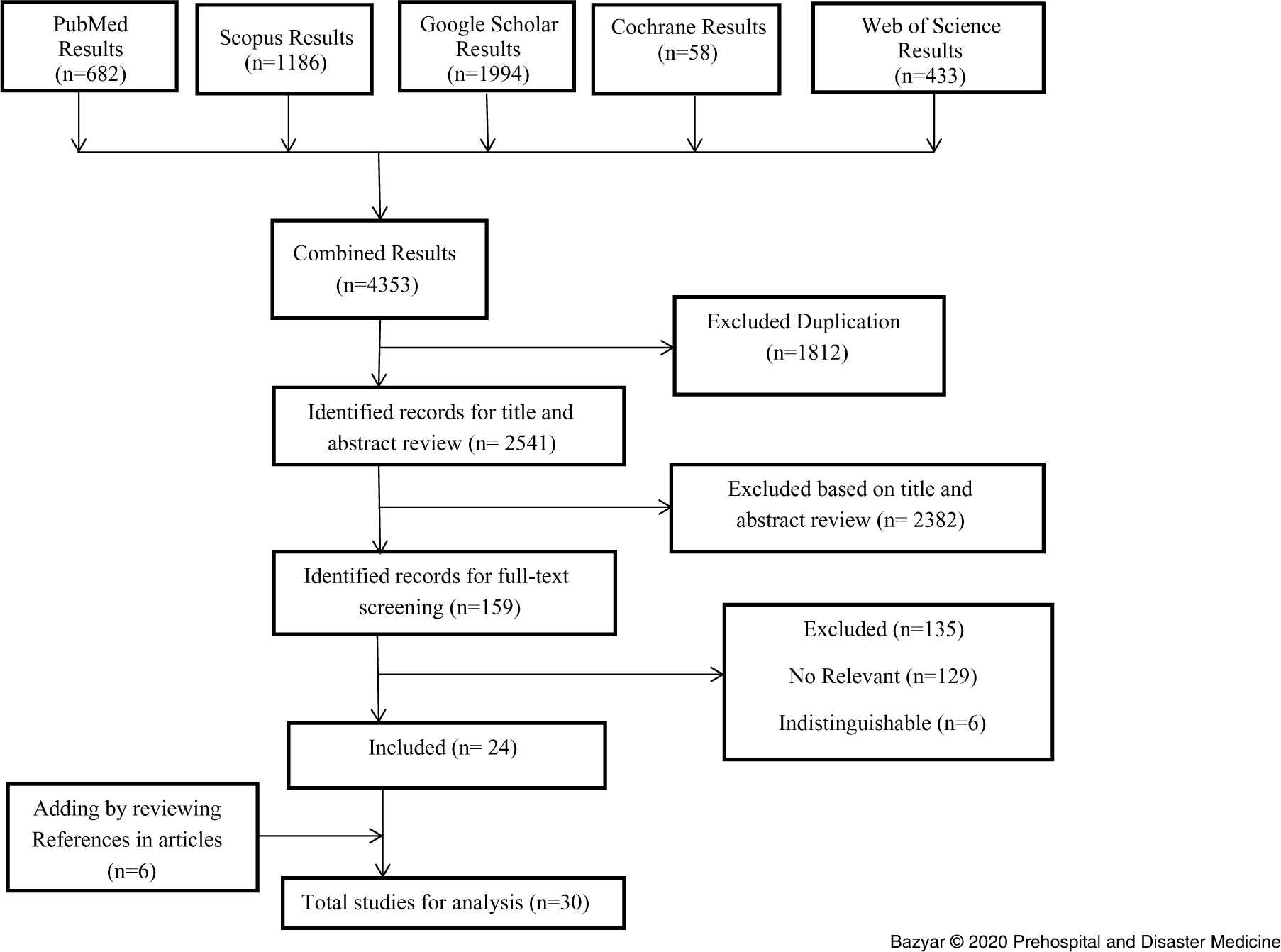
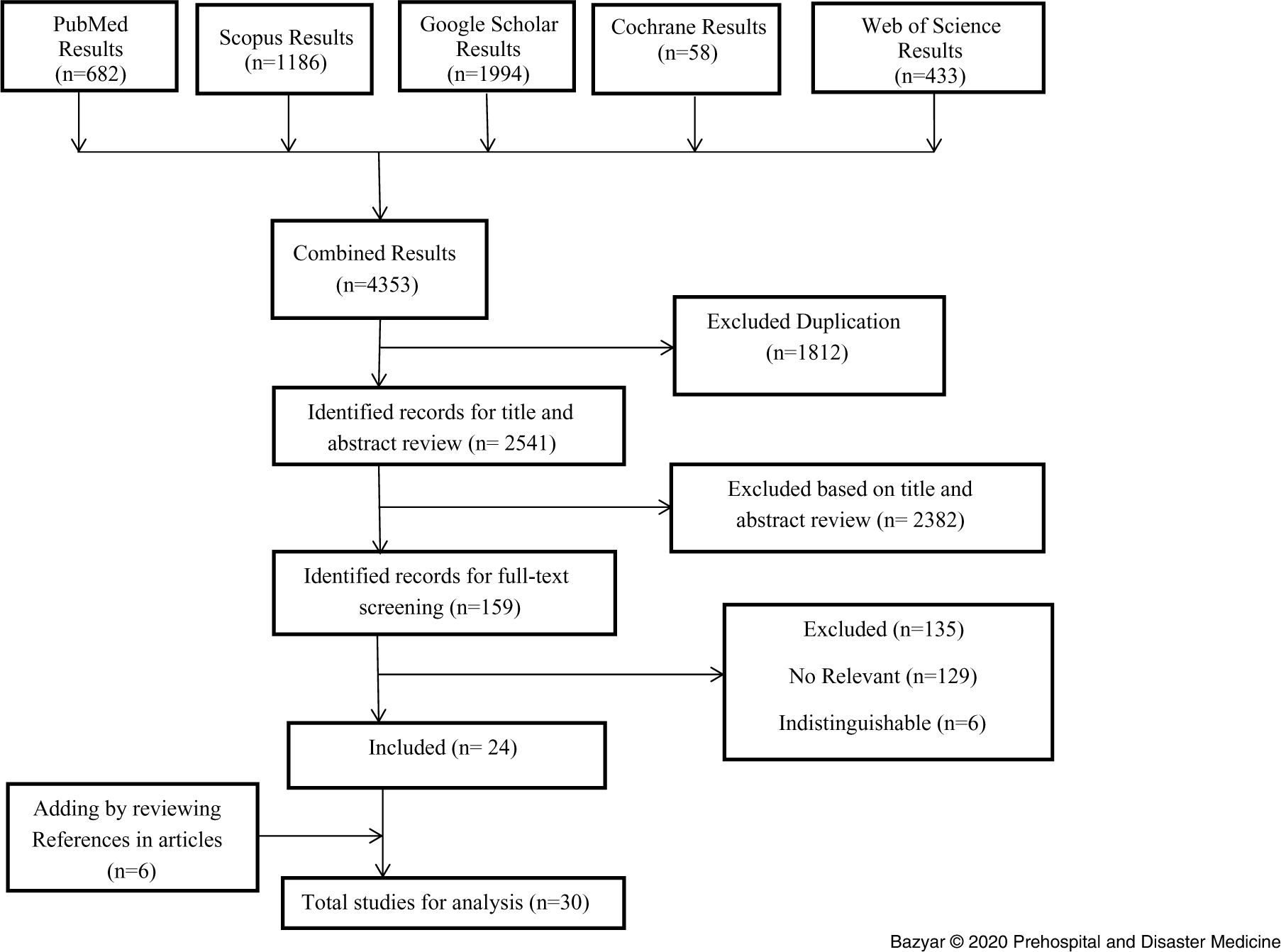
There were 4,353 articles related to triage systems, of which 1,812 and 2,382 were excluded due to repetitiveness and non-relevance to the current study, respectively. After reviewing the abstracts of the articles, 135 articles that did not have the required information were further excluded from the study. Ultimately, 30 articles met the inclusion criteria and were included in the study (Figure 1). Characteristics and details of the articles are presented in Table 1.Reference Jenkins, McCarthy and Sauer2–Reference Frykberg5,Reference Bazyar, Farrokhi and Khankeh11,Reference Sztajnkrycer, Madsen and Báez13,Reference Bhalla, Frey, Rider, Nord and Hegerhorst18–Reference Cone, MacMillan, Parwani and Van Gelder41
Results of PRISMA Flow of the Systematic Literature.
Characteristics and Appraisal of Included Articles (n = 30)
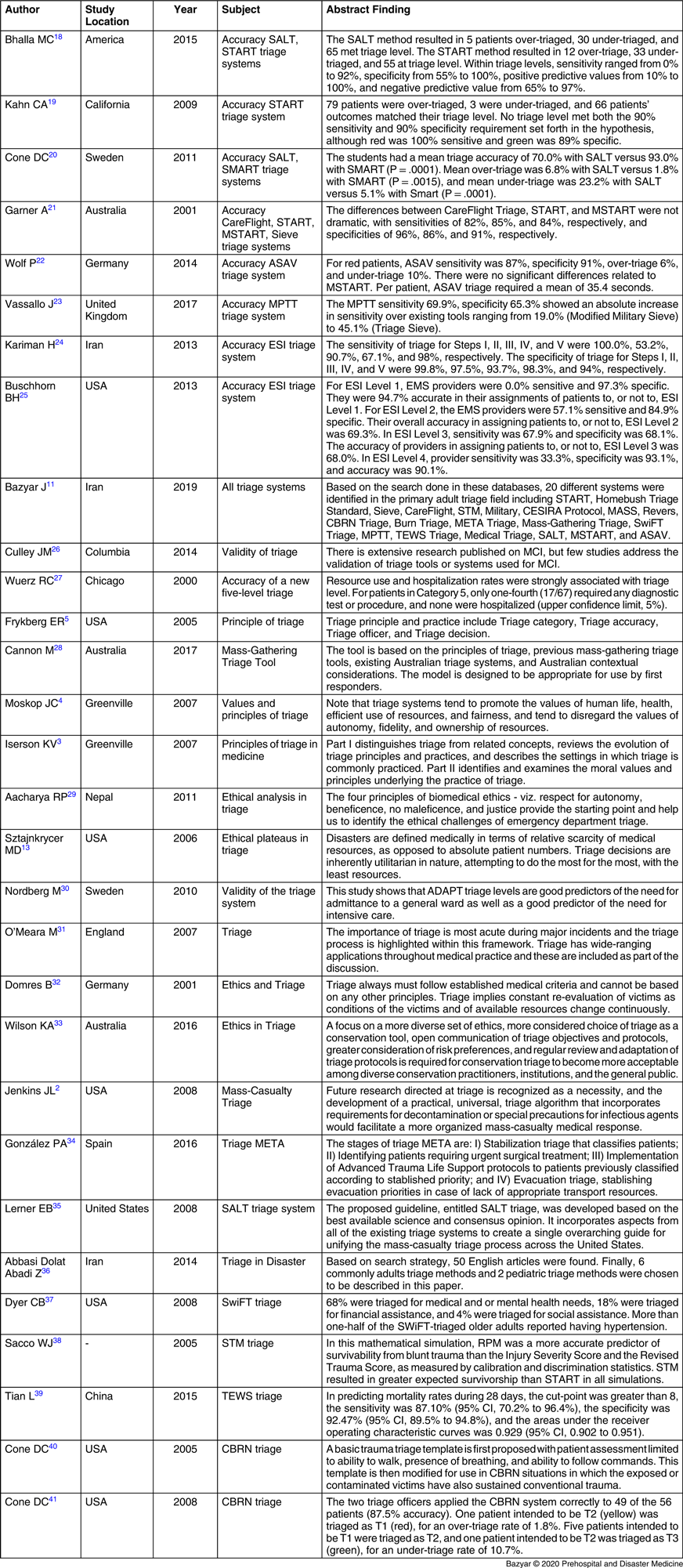
Abbreviations: ADAPT, adaptive process triage; ASAV, Amberg –Schwandorf Algorithm for Primary Triage; CBRN, chemical, biological, radiological, nuclear; CESIRA, Consciousness, External profuse bleeding, Shock, Insufficiency of respiration, Rupture of bones, Another pathology; EMS, Emergency Medical Services; ESI, Emergency Severity Index; MASS, Move, Assess, Sort, Send; MCI, mass-casualty incident; META, Spanish Prehospital Advanced Triage Method; MPTT, Modified Physiological Triage Tool; MSTART, Modified Simple Triage and Rapid Treatment/Transport; RPM, Respirations, Perfusion, Mental status; SALT, Sort, Assess, Life-saving intervention, Treatment/Transport; START, Simple Triage and Rapid Treatment/Transport; STM, Sacco Triage Method; SwiFT, Seniors Without Families Triage; TEWS, Triage Early Warning Score.
Results
Thirty articles published from 2000 through 2019 in the field of triage systems in the world were included in this study, in which the principles and criteria of triage systems were investigated. In this study, the principles of triage had been assessed in terms of classification and labeling of injured people in triage systems, accuracy of triage systems, duration of triage, ethics in triage systems, and principles of triage in special events (chemical, biological, radiological, nuclear [CBRN]).
The Principle of Classification and Labeling
Color labeling is used in triage systems to categorize and prioritize injured people. In color labeling, according to the severity of the injury, individuals are assigned different colors, including white, green, yellow, red, and black, through which patients are placed in specific classes based on anatomical, physiological, functional, and vital signs. In this categorization, injured people who are able to walk and have very mild injuries are placed in the green group (out-patient treatment); injured people suffering from moderate injuries whose treatment can be delayed for two to 12 hours are placed in the yellow group (delayed treatment); injured individuals suffering from serious and severe injuries that require rescue measures and, if left untreated, will die within two hours, are placed in the red group (immediate treatment); and finally, injured people without spontaneous breathing and still cannot breathe after opening the airway are classified in the black group (dead).Reference Iserson and Moskop3,Reference Moskop and Iserson4,Reference Bazyar, Farrokhi and Khankeh11,Reference O’Meara, Porter and Greaves31
Triage models have two main approaches including algorithmic and number-based. In the former approach, the injured person is evaluated by each criterion and placed in a particular class accordingly, and if the examined criterion is normal, the next criterion of the model will be evaluated. The main color labels of the triage model are red, yellow, green, and black. In Simple Triage and Rapid Treatment/Transport (START); Sort, Assess, Life-saving intervention, Treatment/Transport (SALT); Modified START (MSTART); SMART; CareFlight; Amberg –Schwandorf Algorithm for Primary Triage (ASAV); Modified Physiological Triage Tool (MPTT); Sieve; Move, Assess, Sort, Send (MASS); Tactical; JumpSTART; and Pediatric Triage Tape triage systems, color labeling is done using green, yellow, red, and black colors. In the Mass-Gathering Triage system, individuals are categorized into four groups: resuscitation, urgent, minor, and self-help.Reference Jenkins, McCarthy and Sauer2,Reference Vassallo, Beavis, Smith and Wallis8,Reference Cone, Serra and Kurland20,Reference Cannon, Roitman, Ranse and Morphet28,Reference Lerner, Schwartz, Coule, Weinstein, Cone and Hunt35,Reference Coule and Horner42–Reference Wolf, Bigalke, Graf, Birkholz and Dittmar44 In the Homeboush triage system, in addition to the four colors, injured people who have a pulse but lack breathing (in the dying state) will be labeled through a white color code. These patients will be given medical services if medical facilities are available. Patients labeled with this color have more severe injures compared with those categorized as the red group, and on the other hand, since they still have signs of life, they are not to be placed in the black group. In this model, other codes such as ALPHA (equivalent to red), BRAVO (equivalent to yellow), CHARLIE (equivalent to green), DELTA (equivalent to white), and ECHO (equivalent to black) are used.Reference Nordberg, Lethvall and Castrén30 In the Burn Triage systems, the Consciousness, External profuse bleeding, Shock, Insufficiency of respiration, Rupture of bones, Another pathology (CESIRA) Protocol; the Spanish Prehospital Advanced Triage Method (META) Triage; and the Medical Triage Protocol, the classification of the injured individuals is done using three colors: green, yellow, and red. In other words, especially in the CESIRA model, since the definitive diagnosis of death is only determined by the physician and is out of the responsibility of the technician, the black color does not exist in these models, and all the injured people with the black color conditions will be placed in the red group.Reference González, Delgado and Alvarez34,Reference Lerner, Schwartz, Coule, Weinstein, Cone and Hunt35,Reference Dyer, Regev, Burnett, Festa and Cloyd37 In five-level triage systems, including Canadian, Manchester, Australian, and Emergency Severity Index (ESI) triage systems, injured people are ranked from Level 1 to Level 5 rather than color-labeled. In ESI, patients are leveled according to severity of injuries and diagnostic resources. Initially, the triage expert analyzes only the patient’s severity level and, if the patient does not have a high ESI level (ie, Level 1 or Level 2), then the nurse will evaluate the potential diagnostic and therapeutic resources needed for the patient, and ultimately the patient will be ranked at Level 3, Level 4, or Level 5. Level 1 is associated with the patients with unstable vital signs, Level 2 is related to the patients with persistent vital signs, Level 3 and Level 4 are associated with the patients requiring para-clinic and radiologic measures, and Level 5 is specified for the injured people needing out-patient treatments.Reference Durani, Brecher, Walmsley, Attia and Loiselle45–Reference Bottrill, Joseph and Carwardine47 Although the ESI is the most commonly used method for routine triage, this method is based both on acuity and resource needs, and could theoretically be used in MCI situations to prioritize patients for placement in the hospital.48
In the number-based approach used in triage systems, numbers are used for the classification of the injured people. Accordingly, after the assessment of each criterion, a certain number is specified and after evaluating all the criteria, ultimately, a total number is given to the injured person. Based on this final score, the injured person will be placed in a particular class according to specific colors. Among the triage systems in which the classification of injured people is based on scoring and numbers, included are: Sacco Triage Method (STM); Triage Early Warning Score (TEWS); Sort; and Circulation, Respirations, Abdomen, Motor, Speech (CRAMS) triage systems. In the Sort and CRAMS models, the injured people are categorized in green, yellow, and red groups based on the obtained scores. In the STM model, injured people are categorized in four groups of green, yellow, red, and black. The first group includes injured people with a score of zero to four, is equal to the last black group in the START triage (dead or waiting group), and their survival probability is less than 35%. The second group consists of the injured individuals with a score of five to eight who are likely to survive with interventions. The third group has a score of nine to 12, with the survival probability of more than 90%. In the TEWS model, the injured people are classified in five classes including red (seven or more than 17), orange (five to six), yellow (three to four), green (score zero to two), and blue. The blue color in this model is equal to black color (or dead).Reference Bazyar, Pourvakhshoori, Khankeh, Farrokhi, Delshad and Rajabi15,Reference Sacco, Navin, Fiedler, Waddell, Long and Buckman38,Reference Tian, Fang, Xiao, Li and Li39,Reference Abbasi Dolat Abadi, Hosseini, Atighechian, Pour-Sheikhian and Delkhosh49,Reference Kelen, Kraus and McCarthy50
The Principle of Runtime
Since time is critical to the survival of the injured patients who need immediate action, the duration of the triage is of particular importance in the classification of the injured individuals. Furthermore, the shorter the time period, the shorter the number of injured patients, and the faster the delivery of medical services will be. However, along with the short duration of triage, triage accuracy is also important. In other words, if the accuracy of the triage is decreased by reducing the duration of the triage, the classification of the injured people will be problematic, and subsequently, the provision of services is not done according to the need of the injured people. The duration of triage in divergent systems is different, but usually this is a short time and less than 60 seconds. In the previous studies conducted so far, the average duration of triage has been reported to be approximately 30 to 60 seconds in START, 60 seconds in MSTART, 34.5 seconds in ASAV, 15 seconds in Care Flight, and 15 to 25 seconds in JumpSTART triage systems.Reference Frykberg5,Reference Kahn, Schultz and Miller19,Reference Cannon, Roitman, Ranse and Morphet28,Reference O’Meara, Porter and Greaves31,Reference Wolf, Bigalke, Graf, Birkholz and Dittmar44
Principle of Accuracy
Another important factor in conducting triage is the correctness or accuracy of the triage systems. The correctness or accuracy of the triage system indicates the correct classification of the injured people, according to the severity of the injury, to receive medical services. So that if an injured person is placed in the wrong category, it can lead to waste of resources or disrupt the access to the services required to maintain his or her life. In order to estimate the correctness and accuracy of the triage systems, several factors including sensitivity, specificity, positive/negative predictive value, and over-triage/under-triage are used. The sensitivity and specificity indicators show the correct classification of the injured person and the predictive value indicates the power of the triage method in the correct classification of these individuals. Over-triage and under-triage mistakenly place the injured people in the higher and lower groups, respectively, compared to their real level of severity. Accordingly, if the sensitivity and specificity levels of the triage system are not optimal, injured people will fall into wrong groups causing an increase in the over-triage or under-triage of the patients. If over-triage has occurred for a patient, he or she will be provided with a service that is not needed (or at least currently is not required), which causes a waste of time and resources. On the contrary, if under-triage has occurred for an injured person, he or she will be provided with a service which is lower than the person’s real needs and can endanger the life of the individual. As a result, in triage systems, attempts are made to reduce the amount of over-triage and under-triage by meeting the triage criteria and principles in the classification of the injured people. Although according to the previous studies, the over-triage and under-triage rates of up to 50% and five percent, respectively, are plausible, it is more ideal when the accuracy rate of the triage systems is closer to 100% and the amount of over-triage and especially under-triage is closer to zero.Reference Vassallo, Beavis, Smith and Wallis8,Reference Bhalla, Frey, Rider, Nord and Hegerhorst18–Reference Cone, Serra and Kurland20,Reference Kariman, Joorabian, Shahrami, Alimohammadi, Noori and Safari24,Reference Wolf, Bigalke, Graf, Birkholz and Dittmar44,Reference Challen and Walter51
Principle Values in Triage
Such values as “human life” are important in triage. Indeed, the priority in performing triage is to help those people whose lives are at a high risk. Accordingly, these injured people who are placed in the red group (first priority) and require rescue actions will receive the available resources and facilities earlier than other groups. Another value is “human health,” which states that although the triage gives the highest priority to patients at higher risk of death, it also cares for the health of the injured people with less immediate needs and does not neglect them. As another value, “efficient use of resources,” which was explained above, is based on the management and categorization of needs in response to resource and service constraints. It is worth mentioning that “fairness” is another value, which seeks to ensure that no action is taken contrary to the accepted standards and principles of justice in triage.Reference Culley and Svendsen26
Principles Not Considered in Triage
The principles which are neither considered nor observed in triage include “autonomy,”Reference Wuerz, Milne, Eitel, Travers and Gilboy27,Reference Cannon, Roitman, Ranse and Morphet28 or self-determination, based on which the right to decide on the state of health and services is given to the patient, which does not matter in the triage and will not be considered. What is important in triage is saving that person, even if the patient’s satisfaction has not been obtained; another value is “fidelity,”Reference Wuerz, Milne, Eitel, Travers and Gilboy27 based on which the patient’s benefit is considered in every situation and the benefit of the people who need more help at the time of triage is preferred over the benefit of other patients; the last value which is not considered in triage is the “property ownership of resources,”Reference Culley and Svendsen26 which decides to provide transportation and service systems to the injured people. As they may interfere with the service provision process, the aforementioned values are often ignored in the triage process and are unimportant in MCIs.
Principles of Triage in Certain Situations
Triage systems are designed primarily for traumatic incidents and usually do not fit into CBRN incidents. Chemicals or hazardous substances can pose particular challenges to hospital personnel, including exposure to toxins or creating physiological effects on the personnel who take care of the casualties. Therefore, all hospitals need to design a system for triage in specific conditions and decontamination after the arrival of contaminated injured individuals.Reference Cone and Koenig40 Triage is performed in special conditions in three areas in the field:Reference Sidell, William and Dashiel52
Hot Zone: In this area, rescue measures are taken to stabilize the conditions for the injured person, including opening the airway, controlling bleeding, and injections of antidotes. In this area, triage staff should wear appropriate personal protective equipment.
Warm Zone: The distance of this place is at least 300 feet from the hot zone. The fast triage is performed to categorize and prioritize the injured on a vital, immediate, and delayed basis. Here the decontamination of the injured individuals is done. Moreover, the wearing of appropriate personal protective equipment is necessary in this place. And,
Cold Zone: In this area, injured patients are again assessed for secondary injuries and receive the necessary health care services based on the severity of injuries.
Triage in Special Circumstances in the Hospital
As soon as the injured individuals arrive to a hospital in the dirty area, life-stabilizing measures, injections of the antidotes, and separation of the injured people in terms of walking ability/inability, as well as the need for the diagnosis of the contaminated injured people, will be done in this area. Contaminated clothes and accessories of the injured individuals will be taken out, and the triage personnel are required to wear appropriate personal protective equipment. In the warm region, decontamination is usually carried out with soap and water, and in the clean area, injured people are dried, covered with clean clothes, and again prioritized according to the triage protocol after the decontamination. Then they will be accepted and receive the necessary health care in the hospital, based on the priority type and color labels that they receive.
Discussion
In the present study, the classification of the injured people in triage systems was investigated, and based on the policies adopted for the available triage systems in the world, the injured patients are categorized in three, four, or five groups, and according to the category assigned, the patient will be provided with certain medical services. It is worth noting that today in many countries of the world, with the presence of advanced diagnostic and therapeutic facilities in hospitals and health centers, in order to provide more favorable services in addition to the initial triage at the accident site, a secondary triage is also done after the transfer of the injured people to these places to provide the services needed for the injured individuals with a more accurate diagnosis. Generally, in triage systems, the classification of the injured people is of particular importance since the health care services provided to the injured person are based on the class in which he or she is placed. Consequently, if the injured person is mistakenly placed in another group, he may not receive the required services, the matter which can threaten the life of the patient.Reference Frykberg5,Reference Kahn, Schultz and Miller19,Reference Cannon, Roitman, Ranse and Morphet28,Reference Durani, Brecher, Walmsley, Attia and Loiselle45–Reference Bottrill, Joseph and Carwardine47,Reference Challen and Walter51 Furthermore, the duration of the triage is very important because during the disaster, a large number of casualties are encountered, many of which have serious injuries and delays in the provision of medical services can lead to life-threatening outcomes. Thus, the short duration of triage can lead to the survival of more casualties. Based on this, it can be stated that in triage systems, the classification of the casualties, the accuracy, and the duration of the triage are of paramount importance, but this importance is subject to the simultaneous observance of all three principles. In various studies conducted in the world, divergent factors have been assumed to affect the accuracy and duration of the triage. Based on the results of previous studies on the duration of triage, factors such as the training of triage personnel and their experience, the availability of advanced medical facilities and equipment for the triage of injured people, the location and type of incident, and the access to injured patients have been effective in the duration of the triage. For example, when triage experts do not have the necessary training background and the practical experience of triage, the duration of the triage can increase. Also, the availability of advanced diagnostic equipment can shorten the duration of triage.Reference Frykberg5,Reference Durani, Brecher, Walmsley, Attia and Loiselle45,Reference Shelton53
The accuracy of triage systems plays an effective role in the optimal use of the existing resources and the survival of the injured people. In the previous studies on the accuracy of the triage systems, over-triage and under-triage have been more investigated. As mentioned in the present study, over-triage causes resource waste and under-triage endangers the lives of patients. It should be mentioned that many factors can affect over-triage and under-triage, which will be elucidated below. One of the factors influencing the amount of over-triage and under-triage is the level of triage experts’ experience. In fact, if the triage performers do not have the necessary training background and experience, the injured people will fall into wrong categories and therefore, over-triage and under-triage will increase. Other factors affecting the level of over-triage and under-triage include the type of incident, the type of injury, and the location of the incident. As for the type of incident, the mechanism of the incident is effective in the severity of injuries. As a result, if the incident causes serious injuries to people (such as suicide operations), injured people are usually severely damaged and placed in the immediate or dead category, resulting in a decrease in over-triage and under-triage. As for the type of injury, if the incident causes internal damage (such as internal bleeding and liver or spleen rupture in chemical or toxic events), it may not be possible to detect these injuries by using anatomical or physiological findings, and the injured person is placed in the wrong category, which eventually results in an increase in over-triage or under-triage. The location of the incident is also associated with the amount of over-triage and under-triage; if the incident occurs in a city, due to the availability of advanced equipment for detecting injuries, over-triage and under-triage decrease, but in rural and remote places, due to lack of access to such equipment, over-triage and under-triage increase. Finally, it can be stated that a triage system cannot have a good performance unless it is fast, has a high precision, and the lowest level of over-triage and under-triage. One of the steps that can be taken to increase the accuracy of triage systems is to increase the number of re-triage steps. Increasing the number of re-triage steps can reduce over-triage and subsequently increase the triage accuracy, but conversely can increase under-triage and increase the duration of the triage.Reference Frykberg5,Reference Kahn, Schultz and Miller19,Reference Culley and Svendsen26,Reference Wuerz, Milne, Eitel, Travers and Gilboy27,Reference Nordberg, Lethvall and Castrén30,Reference Beach54,Reference Antonacci, Lam, Lavarias, Homel and Eavey55
In the present study, indicators such as human life preservation, human health preservation, optimal use of resources, and justice were investigated in the context of human values and observance of ethical principles in triage. It is worth noting that the mission of health and medical systems has been the preservation of human health and life, so that the goal of all scientific advances and medical equipment is specified in this direction. As a result, the triage system is not an exception to this objective, which aims at giving health to all injured people. However, as noted earlier, during disasters, there is a large number of casualties and a limited amount of available resources, which necessitates the classification of the patients in categories to receive due medical services. If the resources and equipment are available, there is no reason to refuse to provide the services to patients and all the injured people will be treated efficiently. Generally, triage systems aim to maintain the health and well-being of a larger number of injured people with limited resources. Consequently, based on the principles of triage, if the survival of an injured person leads to waste of resources and time, and simultaneously endangers the lives of several injured patients, justice prescribes that the life of several injured be maintained and this is not contrary to justice.Reference Wilson and Law33,Reference Hagerman and Satterfield46,Reference Jachowski and Kesler56–Reference O’Mathúna, Gordijn and Clarke58
Limitations
This research had some limitations: (1) The reviewed studies were done in different years; (2) The studies were not homogeneous, as they have examined populations with different age groups; (3) They have been conducted in people exposed to various incidents; (4) The studies have not compared all the indicators of triage principles in a single research; and (5) They have failed to conduct studies in accuracy and runtime in real disaster situations, as they are tested in scenario-based incidents.
Conclusion
There are a variety of triage systems in the world aimed at responding to emergencies and disasters and managing patients in MCIs. Each of these systems has certain principles and criteria for treating injured people, in which attempts have been made to classify injured persons with the maximum accuracy and in the least amount of time to reach the most desirable level of health. But in order to use these principles, there is a need for training courses and practical programs through which the triage personnel can achieve enough experience and ability to correctly classify the injured patients. Needless to say, failure to observe any of the principles of triage can endanger the lives and health of the injured people. Moreover, conducting studies on the functioning of triage systems is essential and can improve the performance of triage systems. It is suggested that all countries adopt a suitable context-bond triage model in accordance with all the mentioned principles, or propose a new triage model, particularly for the hospital triage in emergencies and disasters.
Conflicts of interest
none