Introduction
Cannabis ranks first among illicit drug use in patients with schizophrenia (Martins & Gorelick, Reference Martins and Gorelick2011). In a review of more than 50 studies of cannabis misuse in patients with psychosis, Green et al. (Reference Green, Young and Kavanagh2005) found combined prevalence rates of 42.2% for lifetime cannabis use and 22.5% for lifetime cannabis misuse. Given the high rates of lifetime cannabis use in populations with psychosis, many studies have examined the effects of cannabis use and misuse on symptom manifestation, course of illness and outcome. Several studies have found that cannabis using (or abusing) patients with psychosis or schizophrenia have increased positive symptoms of psychosis (Negrete et al. Reference Negrete, Knapp, Douglas and Smith1986; Allebeck et al. Reference Allebeck, Adamsson, Engstrom and Rydberg1993; Caspari, Reference Caspari1999; Bersani et al. Reference Bersani, Orlandi, Kotzalidis and Pancheri2002; Grech et al. Reference Grech, van Os, Jones, Lewis and Murray2005; Stirling et al. Reference Stirling, Lewis, Hopkins and White2005; Mauri et al. Reference Mauri, Volonteri, De Gaspari, Colasanti, Brambilla and Cerruti2006; Addington & Addington, Reference Addington and Addington2007; Henquet et al. Reference Henquet, van Os, Kuepper, Delespaul, Smits, Campo and Myin-Germeys2010) and fewer negative symptoms (Bersani et al. Reference Bersani, Orlandi, Kotzalidis and Pancheri2002; Dubertret et al. Reference Dubertret, Bidard, Ades and Gorwood2006; Compton et al. Reference Compton, Whicker and Hochman2007) or, in some studies, no difference in negative symptoms (Allebeck et al. Reference Allebeck, Adamsson, Engstrom and Rydberg1993; Caspari, Reference Caspari1999; Grech et al. Reference Grech, van Os, Jones, Lewis and Murray2005; Stirling et al. Reference Stirling, Lewis, Hopkins and White2005; Addington & Addington Reference Addington and Addington2007) compared to non-users. In some studies, cannabis-using patients were more likely to have a younger age of onset of psychosis (Bersani et al. Reference Bersani, Orlandi, Kotzalidis and Pancheri2002; van Mastrigt et al. Reference van Mastrigt, Addington and Addington2004; Veen et al. Reference Veen, Selten, van der Tweel, Feller, Hoek and Kahn2004; Barnes et al. Reference Barnes, Mutsatsa, Hutton, Watt and Joyce2006; Mauri et al. Reference Mauri, Volonteri, De Gaspari, Colasanti, Brambilla and Cerruti2006; Large et al. Reference Large, Sharma, Compton, Slade and Nielssen2011), experience more psychotic relapses (Linszen et al. Reference Linszen, Dingemans and Lenior1994, Reference Linszen, Dingemans, Nugter, Van der Does, Scholte and Lenior1997; Martinez-Arevalo et al. Reference Martinez-Arevalo, Calcedo-Ordonez and Varo-Prieto1994; Hides et al. Reference Hides, Dawe, Kavanagh and Young2006) and have more hospital visits (Negrete et al. Reference Negrete, Knapp, Douglas and Smith1986; Caspari, Reference Caspari1999) than their counterparts who do not use cannabis.
Epidemiological studies have also supported an association between cannabis use and psychosis. Moore et al. (Reference Moore, Zammit, Lingford-Hughes, Barnes, Jones, Burke and Lewis2007) conducted a meta-analysis of 11 population-based longitudinal studies from seven countries and found that cannabis users had an increased risk of psychotic symptoms [odds ratio (OR) 1.41, 95% confidence interval (CI) 1.20–1.65] and psychotic disorders (OR 2.58, 95% CI 1.08–6.13) compared to non-users. This relationship was noted to be dose dependent, with a twofold increase in risk for high-frequency users (OR 2.09, 95% CI 1.54–2.84), and subclinical psychotic experiences further modified the risk for psychosis in the context of cannabis use (Arseneault et al. Reference Arseneault, Cannon, Poulton, Murray, Caspi and Moffitt2002; Henquet et al. Reference Henquet, Krabbendam, Spauwen, Kaplan, Lieb, Wittchen and van Os2005). These findings were confirmed in a more recent epidemiologic sample of 1923 subjects aged 14–23 years in whom both incident cannabis use and continued cannabis use were associated with incident or persistent psychotic experiences (Kuepper et al. Reference Kuepper, van Os, Lieb, Wittchen, Höfler and Henquet2011). Based on these findings, several authors (e.g. Hall & Degenhardt, Reference Hall and Degenhardt2006; Moore et al. Reference Moore, Zammit, Lingford-Hughes, Barnes, Jones, Burke and Lewis2007; Kuepper et al. Reference Kuepper, van Os, Lieb, Wittchen, Höfler and Henquet2011; Large et al. Reference Large, Sharma, Compton, Slade and Nielssen2011) suggested that the results are strong enough to support public education on the risks of cannabis use and accompanying policy changes, even though the gold standard for testing causality was not used in these studies.
Given suggestions that cannabis use is associated with psychosis onset, examining cannabis use in individuals who are at clinical high risk (CHR) for developing psychosis has become of great interest. CHR youth, who are characterized by attenuated positive symptoms of psychosis that are just emerging and by conversion rates to psychosis of approximately 20–30% (Cannon et al. Reference Cannon, Cadenhead, Cornblatt, Woods, Addington, Walker, Seidman, Perkins, Tsuang, McGlashan and Heinssen2008; Ruhrmann et al. Reference Ruhrmann, Schultze-Lutter, Salokangas, Heinimaa, Linszen, Dingemans, Birchwood, Patterson, Juckel, Heinz, Morrison, Lewis, von Reventlow and Klosterkötter2010), represent a unique sample for examining the causal relationship between cannabis use and subsequent development of psychosis.
Phillips et al. (Reference Phillips, Curry, Yung, Yuen, Adlard and McGorry2002) in Melbourne, Australia were the first to explore the connection between cannabis use and psychosis in their sample of 100 ‘ultra high-risk’ subjects. They did not find a significant association between self-reported cannabis use or dependence in the year prior to study entry and risk for conversion to psychosis at a 12-month follow-up (37% conversion rate for cannabis use versus 29% for no use; 39% conversion rate for cannabis dependence versus 31% for no dependence). Cannabis use and dependence were included in a follow-up article on risk factors for psychosis, again with non-significant results (Yung et al. Reference Yung, Phillips, Yuen and McGorry2004).
A later study by Kristensen & Cadenhead (Reference Kristensen and Cadenhead2007) in California did find a significant relationship between cannabis use and conversion at a 1-year follow-up but the sample size was very small: one subject (3.1%) with no/low cannabis converted versus five subjects (31.3%) with lifetime abuse/dependence (p = 0.012). Alcohol or other illicit drug misuse was not found to be associated with conversion to psychosis, although a positive association was found between nicotine use and conversion in this sample.
A study by Corcoran et al. (Reference Corcoran, Kimhy, Stanford, Khan, Walsh, Thompson, Schobel, Harkavy-Friedman, Goetz, Colibazzi, Cressman and Malaspina2008) focused on the temporal patterns of cannabis use and prodromal symptoms in a sample of high-risk subjects in an urban area of New York City. Of the 32 participants, 13 were characterized as cannabis users/abusers. The authors reported that users and non-users did not differ significantly on positive and negative prodromal symptoms, affective symptoms and level of functional impairment at baseline or rates of conversion to psychosis. Cannabis use was found to be temporally related to perceptual disturbances but to no other positive symptoms or total positive symptoms.
In a large prospective study of a clinical risk cohort for psychosis by the North American Prodrome Longitudinal Study (NAPLS) group, substance abuse in general was associated with conversion to psychosis (Cannon et al. Reference Cannon, Cadenhead, Cornblatt, Woods, Addington, Walker, Seidman, Perkins, Tsuang, McGlashan and Heinssen2008) but cannabis abuse was not mentioned. By contrast, in another large, European sample, alcohol or any substance abuse was not predictive of conversion to psychosis (Ruhrmann et al. Reference Ruhrmann, Schultze-Lutter, Salokangas, Heinimaa, Linszen, Dingemans, Birchwood, Patterson, Juckel, Heinz, Morrison, Lewis, von Reventlow and Klosterkötter2010) but, again, cannabis abuse does not seem to have been investigated separately.
In light of suggestive findings in the general population and in psychotic individuals but negative or mixed findings in clinical at-risk subjects, further clarification of the potentially mediating effects of cannabis on psychosis development in people considered to be prodromal for psychosis is needed. Thus, the current study aimed to explore the relationship between cannabis use and abuse and the development of psychosis and to clarify previous discrepant results through examination of a CHR longitudinal sample enrolled in the Recognition and Prevention (RAP) program in New York. The present study differed from the previous studies of the specific effects of cannabis on psychosis development in high-risk subjects in that it used a large sample and patients were followed for a longer period of time. The specific aims of the current study were to (1) characterize substance use rates, including cannabis use, in this high-risk sample, (2) determine whether lifetime cannabis use (or abuse) in high-risk subjects is associated with increased prodromal symptoms at baseline and problems in functioning at baseline and follow-up, and (3) determine whether lifetime cannabis use (or abuse) is significantly related to psychosis conversion in this high-risk sample.
Method
Participants
Participants in this study were selected from the larger RAP research program at The Zucker Hillside Hospital (ZHH) of the North Shore–Long Island Jewish Health System (NSLIJHS) in Glen Oaks, NY. Participants include subjects from Phase I of the project (2000 to 2006). Participants were referred to the program's research clinic primarily from the in- and out-patient divisions of ZHH; in addition, referrals were received from community providers, school personnel and participants' family members. Healthy controls (HC) were recruited from the community through advertisements. All procedures were approved by the Institutional Review Board for ZHH. Written informed consent (with assent from participants aged <18 years) was obtained from all participants.
Subjects included 101 CHR adolescents and young adults between the ages of 12 and 22 years with positive symptoms of psychosis (CHR+). High-risk status was defined by ratings on the positive symptom subscale of the Scale of Prodromal Symptoms (SOPS; Miller et al. Reference Miller, McGlashan, Woods, Stein, Briesen, Corcoran, Hoffman and Davidson1999; McGlashan et al. Reference McGlashan, Miller, Woods, Hoffman, Davidson, Miller, Mednick, McGlashan, Libiger and Johannessen2001). The five positive symptom items (unusual ideas, suspiciousness, grandiosity, perceptual abnormalities, and disorganized communication) are rated on a seven-point scale (0 = not present to 6 = psychotic). A score of a 3 (moderate) to 5 (severe) on any of these attenuated positive symptoms is required for inclusion in the CHR+ group. The mean total positive score was 8.75 (s.d. = 4.0, range 3–21). The CHR+ group is closely aligned with the Attenuated Positive Syndrome group described in Miller et al. (Reference Miller, McGlashan, Woods, Stein, Briesen, Corcoran, Hoffman and Davidson1999) and used by many other high-risk programs. Further details on the CHR+ group and the RAP program working model have been described in previous publications (Cornblatt et al. Reference Cornblatt, Lencz, Smith, Correll, Auther and Nakayama2003; Cornblatt & Auther, Reference Cornblatt and Auther2005). Conversion to psychosis is based on the development of a six-level (psychotic) severity on any positive symptom item of the SOPS. The SOPS negative symptom subscale contains six items (social anhedonia, avolition, decreased expression of emotion, decreased experience of emotion, decreased ideational richness, and decline in occupational functioning) that are rated on a similar seven-point scale (0 = not present to 6 = extreme). Although there is no negative symptom score requirement for inclusion in the CHR+ group, the mean total negative score is 11.66 (s.d. = 5.2, range 0–27).
The CHR+ participants were compared to 59 age-matched HC. Exclusionary criteria in the current study for both groups include DSM-IV (APA, 1994) Axis I diagnoses of any psychotic disorder. Additional exclusion criteria for both groups included a history of neurological, neuroendocrine or medical conditions known to affect brain functioning, an IQ <70, any current substance dependence (but not substance abuse) and lack of fluency in English.
Measures
Estimated IQ was obtained by administering the Vocabulary and Block Design subtests of the Wechsler Intelligence Scale for Children, 3rd edition (WISC-III; Wechsler, Reference Wechsler1991) for subjects aged <16 years and the Wechsler Adult Intelligence Scale, Revised (WAIS-R; Wechsler, Reference Wechsler1981) for those aged ⩾16 years. The last subject enrolled also received the Wechsler Abbreviated Scale for Intelligence (WASI; Wechsler, Reference Wechsler1999). Parental socio-economic status (SES) was calculated according to the Hollingshead & Redlich (Reference Hollingshead and Redlich1958) two-factor classification system derived from highest parental education and occupation.
The Kiddie Schedule for Affective Disorders and Schizophrenia – Epidemiologic Version (KSADS-E; Orvaschel & Puig-Antich, Reference Orvaschel and Puig-Antich1994) was used to record lifetime alcohol and tobacco use, frequency and quantity. For cannabis and other illicit substances, the KSADS-E asks about lifetime use, use in the 6 months prior to baseline and frequency of lifetime use. This measure was also used to screen for lifetime substance use disorders (any dependency was exclusionary), to screen for psychotic disorders at baseline (also exclusionary) and to confirm psychosis conversion diagnoses at follow-up after a participant reached a six-level (psychotic) positive symptom on the SOPS.
Two scales, one measuring social functioning and the other role functioning, that were developed for the National Institute of Mental Health (NIMH)-funded multi-site NAPLS project (Cornblatt et al. Reference Cornblatt, Auther, Niendam, Smith, Zinberg, Bearden and Cannon2007) were used in the current study as additional outcome measures. The Global Functioning: Social Scale (GF:Social; Auther et al. Reference Auther, Smith and Cornblatt2006) is a 10-point scale (10 = superior functioning to 1 = extreme dysfunction) with anchors taking into account contact with friends, family and age-appropriate intimate relationships. The Global Functioning: Role Scale (GF:Role; Niendam et al. Reference Niendam, Bearden, Johnson and Cannon2006) is rated on a similar 10-point scale taking into account type and quality of the role (generally school or work), amount of support needed and the participant's performance in the role.
Procedures
All assessments were conducted by trained masters- or doctoral-level psychologists or clinicians. The KSADS-E, SOPS, GF:Social and GF:Role measures were administered at baseline and follow-up. For the current analyses only follow-up data on functioning (based on the GF Scales) and conversion (based on the SOPS) are presented. Follow-up assessments were conducted at 6-month intervals or at any time when a conversion was thought to have occurred. A parent/guardian informant was interviewed about the patient on the clinical and functioning measures and the clinician conducted a separate interview with the patient and then determined a composite rating. Consensus was obtained by review of all SOPS ratings and KSADS-E diagnoses by a senior clinician (currently A.A.) and at the weekly RAP team meeting. High inter-rater reliability for individual SOPS items and prodromal diagnosis has been reported previously (Lencz et al. Reference Lencz, Smith, Auther, Correll and Cornblatt2004) for RAP interviewers.
Statistical methods
All analyses were conducted using SPSS version 16.0 (SPSS Inc., USA). For demographic data and substance use rate comparisons between CHR+ and HC subjects, categorical variables were analyzed using Pearson's χ2 tests and continuous variables were analyzed using ANOVAs. Comparisons between CHR+ participants with and without lifetime cannabis use (and abuse) on the SOPS and GF Scales were analyzed using ANOVAs. Significance was set at p = 0.01 for all of these comparison analyses.
Repeated-measures ANOVAs were conducted to determine the impact of cannabis use (and abuse) on functioning over time (baseline to follow-up), with cannabis use (or abuse) as the between-subjects factor and social and role functioning as within-subject factors. Given that the length of follow-up differed significantly between cannabis users and non-user, this variable was added as a covariate. Significance was set at p = 0.05 for these analyses.
Logistic regression analysis was used to examine the impact of lifetime cannabis use/abuse on conversion to psychosis, after adjustment for potential confounding variables. A binomial logistic regression model (forced entry) was built with lifetime cannabis use as an independent variable and conversion to psychosis as a dependent variable, adjusting for age at baseline, SOPS total positive symptoms and SOPS total negative symptoms. An identical model was also built using cannabis abuse as the independent variable. The variables entered into the logistic regression models as confounders were those that were significantly associated with conversion at the p < 0.05 level in univariate logistic regression analyses. Other explanatory or confounding variables that did not meet the univariate criteria for inclusion in the adjusted models were gender, race, parental SES, estimated IQ and GF:Social and GF:Role scores. ORs and corresponding 95% CIs are reported. Statistical significance was set at p < 0.05 for the lifetime cannabis use and abuse models.
Results
Demographics
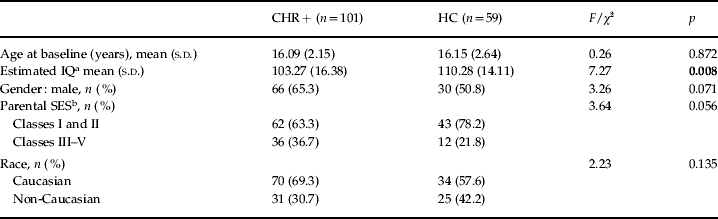
There were no significant differences between the CHR+ and HC participants on age at baseline, gender, parental SES or race (Table 1). HC participants had significantly higher estimated IQ scores than CHR+ participants.
Demographic characteristics
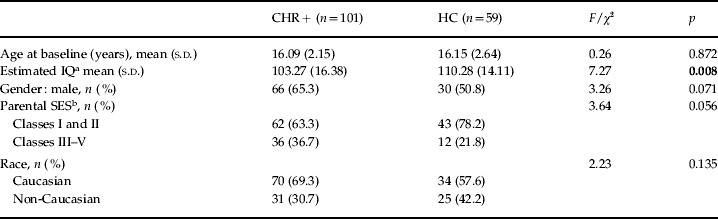
CHR + , Clinical high-risk subjects with attenuated positive symptoms of psychosis; HC, healthy controls; SES, socio-economic status; s.d., standard deviation.
a Six subjects missing IQ estimates (four CHR+ and two HC); WISC-III (47 CHR + , 30 HC), WAIS-R (49 CHR + , 27 HC) and WASI (one CHR+).
b Seven subjects missing parental SES (three CHR+ and four HC). Parental SES classifications: Class I represents the highest level and Class V the lowest level (Hollingshead & Redlich, Reference Hollingshead and Redlich1958).
Rates and frequency of substance use
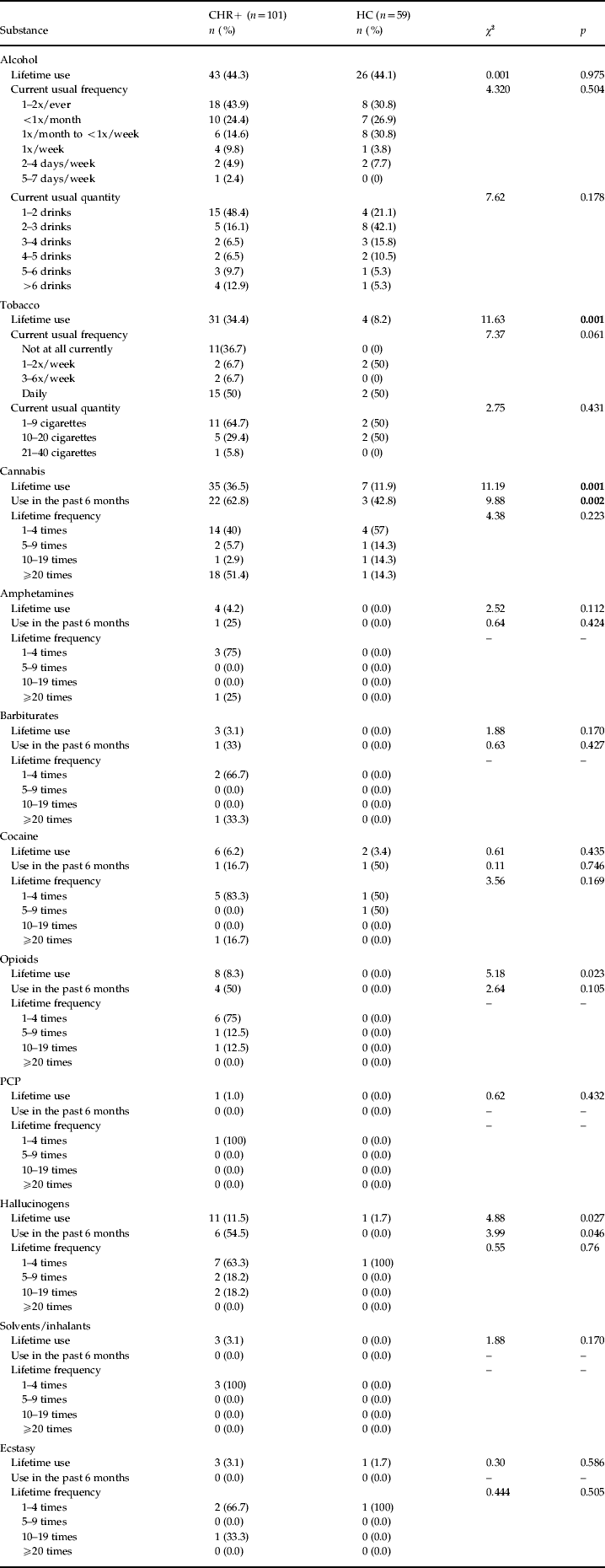
Alcohol was the most frequently reported substance used in both groups (see Table 2). CHR+ and HC participants showed comparable lifetime alcohol usage (44% in each group) and the two groups did not differ significantly on rates of current alcohol use frequency and quantity. There was a low rate of lifetime tobacco use in the HC group, and this rate differed significantly from that of the CHR+ group (p = 0.001). There was no difference between groups on current usual frequency or quantity of tobacco use. Half of the subjects in each group who reported lifetime tobacco use reported current daily use at baseline.
Rates of lifetime and current substance use reported on KSADS-E interview at baseline
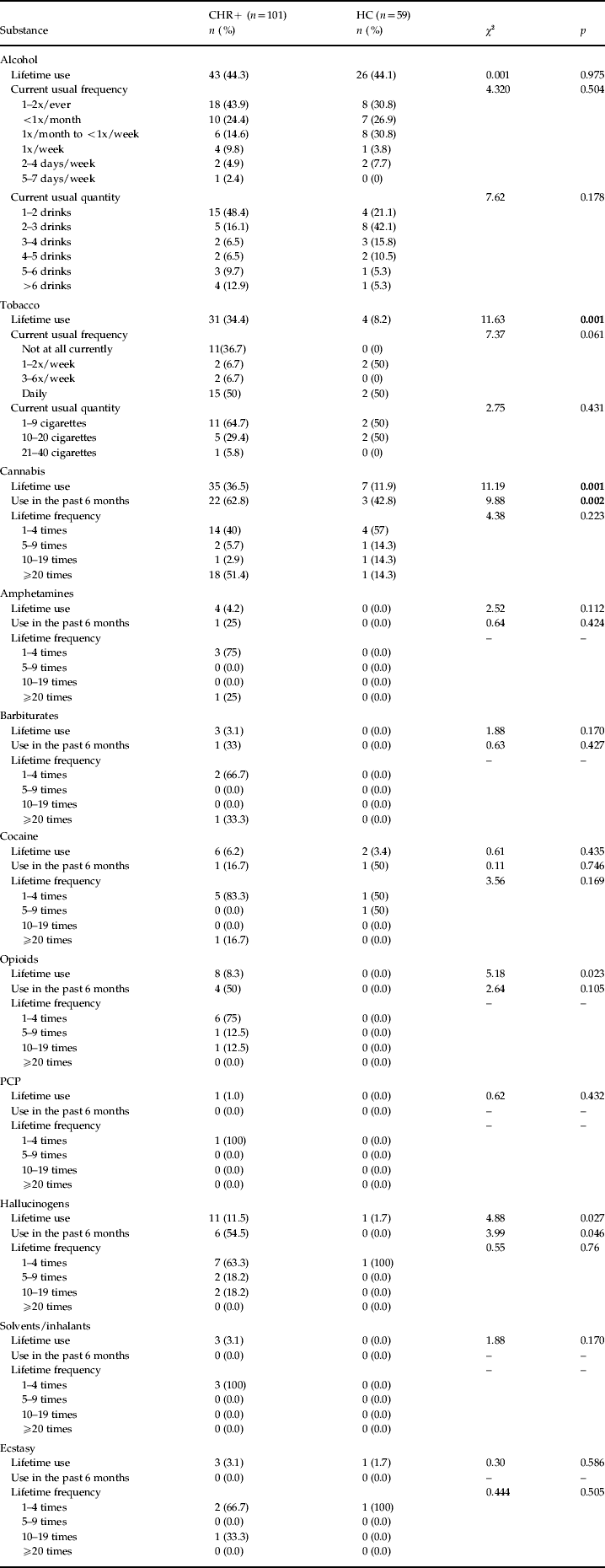
KSADS-E, The Kiddie Schedule for Affective Disorders and Schizophrenia – Epidemiologic Version; CHR + , Clinical high-risk subjects with attenuated positive symptoms of psychosis; HC, healthy controls; PCP, phencyclidine.
Alcohol: four CHR+ missing lifetime data; two CHR+ alcohol users missing frequency; 10 CHR+ and seven HC alcohol users missing quantity. Tobacco: 11 CHR+ and 10 HC missing lifetime data; one CHR+ smoker missing current frequency; two CHR+ smokers missing current quantity. Drugs: five CHR+ subjects missing data on drug use.
In terms of illicit substances, cannabis was the most widely used drug in this sample and all participants who reported drug use, with one exception, also reported cannabis use. CHR+ participants reported significantly higher rates of lifetime cannabis use than HC (p = 0.001) and were also more likely to have used cannabis in the past 6 months (p = 0.002). CHR+ participants who reported lifetime cannabis use (n = 35) were more likely to be Caucasian (88.6% v. 59.0%, χ2 = 9.21, p = 0.002) and older at baseline (16.74 ± 1.96 v. 15.65 ± 2.12, F 1,95 = 6.18, p = 0.015, trend) than CHR+ participants who did not report lifetime cannabis use. There were no differences between CHR+ subjects with or without lifetime cannabis use on gender, parental SES or estimated IQ. Of the 35 CHR+ lifetime cannabis users, 17 (48.6%) could be characterized as low lifetime users (1–19 times) and 18 (51.4%) as high lifetime users (⩾20 times). There was no difference in lifetime frequency of cannabis use between the CHR+ and HC groups (see Table 2).
Rates of lifetime drug use other than cannabis were minimal in the CHR+ subjects and often absent in the HC subjects, limiting further analysis. However, CHR+ participants evidenced higher rates of lifetime opioid use (χ2 = 5.18, p = 0.023, trend) and lifetime hallucinogen use (χ2 = 4.88, p = 0.027, trend) compared to HC subjects.
Clinical characteristics and functioning in cannabis users
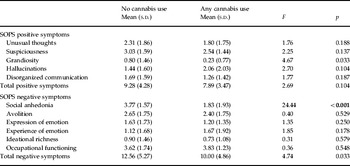
As shown in Table 3, CHR+ participants who reported lifetime cannabis use (n = 35) were significantly less socially anhedonic (p < 0.001) and had lower SOPS total negative symptom scores (p = 0.033, trend level) than those who did not report lifetime cannabis use (n = 61). Lifetime cannabis users had trend-level lower scores on grandiosity although the means for both groups were very low and not clinically meaningful. There was no difference between users and non-users on other SOPS positive symptoms or total positive symptoms score.
Baseline prodromal symptoms for CHR+ subjects with cannabis use (n = 35) versus CHR+ subjects without cannabis use (n = 61)

CHR + , Clinical high-risk subjects with attenuated positive symptoms of psychosis; HC, healthy controls; SOPS, Scale of Prodromal Symptoms; s.d., standard deviation.
Fourteen subjects (five cannabis users) missing all individual negative symptom ratings and total negative score; one subject (non-cannabis user) missing only experience of emotion.
In terms of functioning, CHR+ lifetime cannabis users had significantly higher GF:Social scores at baseline than CHR+ subjects who never used cannabis (6.91 ± 1.40 v. 5.51 ± 1.21, F 1,95 = 26.84, p < 0.001), although there was not a significant difference for GF:Role scores (5.49 ± 1.82 v. 5.62 ± 2.13, p = 0.75).
Out of the 101 CHR+ participants, 92 (91.1%) had at least one follow-up. The mean follow-up period was 2.97 years (s.d. = 1.63, range 0.11–7.19). Participants who were not followed up did not differ significantly from those who were, in terms of demographic variables or rates of lifetime cannabis use or abuse at baseline. However, length of follow-up differed significantly for lifetime cannabis users versus non-users (F 1,88 = 6.64, p = 0.012) and cannabis abusers versus non-abusers (F 1,88 = 3.85, p = 0.053).
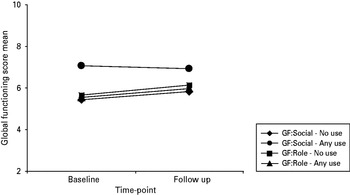
Of the 92 CHR+ subjects who had at least one follow-up, 86 subjects had GF:Social and GF:Role scores at both baseline and follow-up. For GF:Social, baseline and follow-up scores did not differ significantly, although there was a significant difference between groups, in that lifetime cannabis users had significantly higher social functioning at both baseline and follow-up than non-users (F 1,83 = 26.48, p < 0.001; see Fig. 1). The time × group interaction was not significant for the GF:Social scale. Length of follow-up was a significant covariate (F 1,83 = 5.32, p = 0.024), with lifetime cannabis users having an approximately 1 year shorter follow-up than non-users (2.44 ± 1.45 v. 3.34 ± 1.64 years). For GF:Role scores and lifetime cannabis use, there were no significant differences for time, group or the time × group interaction. Length of follow-up was not a significant covariate for GF:Role.
Cannabis use and functional outcome from baseline to follow-up in CHR+ subjects (n = 86). GF:Social – no use: n = 55, baseline: mean = 5.45 (s.d. = 1.25); follow-up: mean = 5.82 (s.d. = 1.45). GF:Social – any use: n = 31, baseline: mean = 7.06 (s.d. = 1.34); follow-up: mean = 6.94 (s.d. = 1.59). GF:Role – no use: n = 55, baseline: mean = 5.65 (s.d. = 2.21); follow-up: mean = 6.15 (s.d. = 2.42). GF:Role – any use: n = 31, baseline: mean = 5.55 (s.d. = 1.71); follow-up: mean = 5.97 (s.d. = 2.52).

Clinical characteristics and functioning in cannabis abusers
A small sample of 10 CHR+ subjects (10.4%) met the full DSM-IV criteria for cannabis abuse at baseline according to the KSADS-E interview. These subgroups (cannabis use and cannabis abuse) were analyzed separately to determine any dose–response effects. Consistent with the findings reported above for users, CHR+ subjects with cannabis abuse were significantly older at baseline (17.70 ± 1.60 v. 15.86 ± 2.09, F 1,95 = 7.26, p = 0.008) and had higher estimated IQ scores (115.60 ± 19.0 v. 102.00 ± 15.82, F 1,91 = 6.31, p = 0.014, trend) than CHR+ subjects who were not cannabis abusers. There were no significant gender, race or parental SES differences between the two groups.
CHR+ participants who met the criteria for cannabis abuse (n = 10) were less socially anhedonic (F 1,81 = 5.95, p = 0.017, trend) than non-abusers but there were no differences in terms of other SOPS symptoms or SOPS total positive and negative symptoms.
In terms of functioning, CHR+ lifetime cannabis abusers had significantly higher GF:Social scores at baseline than CHR+ subjects who never abused cannabis (7.20 ± 1.48 v. 5.88 ± 1.38, F 1,95 = 7.99, p = 0.006), although there was not a significant difference for GF:Role scores (5.60 ± 1.96 v. 5.57 ± 2.03).
When examining functioning over time, baseline and follow-up scores did not differ significantly for the GF:Social scale, although there was a significant main effect for group (F 1,83 = 4.44, p = 0.04), with abusers displaying better social functioning at both baseline and follow-up assessments (7.20 ± 1.48 v. 5.88 ± 1.43 at baseline and 6.80 ± 1.75 v. 6.14 ± 1.56 at follow-up). There was no time × group interaction. Length of follow-up was a significant covariate (F 1,83 = 5.65, p = 0.02), with cannabis abusers having an approximately 1 year shorter follow-up than non-abusers (2.02 ± 1.21 v. 3.15 ± 1.63 years). For GF:Role and cannabis abuse, there were no significant main effects for time or group or time × group interactions. Length of follow-up was not a significant covariate for GF:Role.
Cannabis use/abuse and conversion to psychosis
Logistic regression was used to examine the impact of lifetime cannabis use/abuse on conversion to psychosis. In univariate regression analyses, lifetime cannabis use (OR 0.56, 95% CI 0.16–1.94, p = 0.36) and cannabis abuse (OR 1.27, 95% CI 0.24–6.67, p = 0.78) were not significant predictors of conversion.
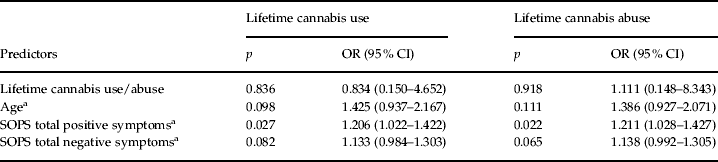
The lack of association between cannabis use and cannabis abuse and conversion to psychosis was confirmed after adjusting for age at baseline, SOPS total positive symptoms and SOPS total negative symptoms (Table 4). The only variable that was significantly related to conversion in the cannabis use and abuse adjusted models (p < 0.05) was SOPS total positive symptoms score, with higher scores representing increased risk of conversion. Age at baseline and SOPS total negative symptoms score were not significant predictors of conversion.
Adjusted odds ratios (ORs) for prediction of psychosis in high-risk participants with cannabis use or cannabis abuse
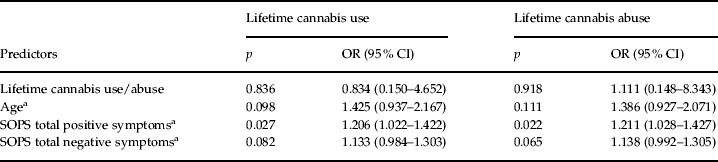
SOPS, Scale of Prodromal Symptoms; CI, confidence interval.
a Variables adjusted for in the models were significant at the univariate level (p < 0.05).
For both models, n = 77 due to missing data. For categorical predictors: lifetime cannabis use (0 = no use or 1 = use); lifetime cannabis abuse (0 = no abuse or 1 = abuse); for categorical outcome: conversion (0 = no conversion or 1 = conversion).
Discussion
Cannabis and prodromal symptoms/conversion
The major finding of this study is that neither lifetime cannabis use nor abuse in this sizable sample of high-risk adolescents predicted conversion to psychosis. In addition, lifetime cannabis use was not associated with increased attenuated positive symptoms of psychosis at baseline in high-risk subjects. These results are in accordance with the Phillips et al. (Reference Phillips, Curry, Yung, Yuen, Adlard and McGorry2002) and Corcoran et al. (Reference Corcoran, Kimhy, Stanford, Khan, Walsh, Thompson, Schobel, Harkavy-Friedman, Goetz, Colibazzi, Cressman and Malaspina2008) findings, where cannabis use or abuse was not related to psychotic conversion. This suggests that cannabis may not be a significant risk factor for conversion to psychosis in help-seeking high-risk samples. However, these findings are discrepant with the study by Kristensen & Cadenhead (Reference Kristensen and Cadenhead2007), which targeted similar patients and did find a relationship between cannabis and psychosis conversion. The small sample size and difference in use patterns in that study may explain the discrepant results. The current high-risk subjects and Phillips et al. (Reference Phillips, Curry, Yung, Yuen, Adlard and McGorry2002) participants evidenced relatively low rates of cannabis abuse, unlike the Kristensen & Cadenhead (Reference Kristensen and Cadenhead2007) sample, where 33% of participants had cannabis abuse/dependence. It is possible that a dose-dependent relationship influenced the current results where participants may not have reached a certain required threshold. The discrepancy may also be related to the higher mean age of participants in the Kristensen & Cadenhead program (18.6 years) versus the current study (16 years). However, the Phillips et al. (Reference Phillips, Curry, Yung, Yuen, Adlard and McGorry2002) and Corcoran et al. (Reference Corcoran, Kimhy, Stanford, Khan, Walsh, Thompson, Schobel, Harkavy-Friedman, Goetz, Colibazzi, Cressman and Malaspina2008) participants were also older on average (19.3 and 20.9 years respectively) but similar negative results were found.
The current finding seems to be at odds with clinical and epidemiologic studies showing an increased risk of psychotic symptoms and psychotic disorders in subjects who report cannabis use (Linszen et al. Reference Linszen, Dingemans, Nugter, Van der Does, Scholte and Lenior1997; Semple et al. Reference Semple, McIntosh and Lawrie2005). These relationships were noted to be dose related (Andreasson et al. Reference Andreasson, Allebeck, Engstrom and Rydberg1988; van Os et al. Reference van Os, Bak, Hanssen, Bijl, de Graaf and Verdoux2002; Zammit et al. Reference Zammit, Allebeck, Andreasson, Lundberg and Lewis2002; Henquet et al. Reference Henquet, Krabbendam, Spauwen, Kaplan, Lieb, Wittchen and van Os2005). However, one study (Arseneault et al. Reference Arseneault, Cannon, Poulton, Murray, Caspi and Moffitt2002) showed that using cannabis just three or more times during the teenage years was associated with increased psychotic symptoms at follow-up a decade or more later, although those who used cannabis by age 15 continued use at age 18, suggesting more frequent and longer duration of use. In the high-risk participants in the current study, lifetime frequency of use was almost evenly split between those who rarely used cannabis and those with frequent use. It is possible that the risk associated with asymptomatic persons who use cannabis and later develop psychosis is different from the risk of help-seeking individuals with attenuated symptoms moving to full psychosis. For example, patients followed at specialized prodromal clinics might have additional risk factors that overpower any potential, residual risk that might be operant in general population samples (Arseneault et al. Reference Arseneault, Cannon, Poulton, Murray, Caspi and Moffitt2002; Henquet et al. Reference Henquet, Krabbendam, Spauwen, Kaplan, Lieb, Wittchen and van Os2005; Kuepper et al. Reference Kuepper, van Os, Lieb, Wittchen, Höfler and Henquet2011). In our analyses, the contribution of cannabis use was inconsequential compared to the direct association of emerging positive symptoms to the onset of psychosis. In other populations there may be a small subgroup of individuals who have a particularly high predisposition (e.g. COMT Val/Val genotype; Caspi et al. Reference Caspi, Moffitt, Cannon, McClay, Murray, Harrington, Taylor, Arseneault, Williams, Braithwaite, Poulton and Craig2005) and in whom cannabis use does impact psychosis onset. However, for the more general population of adolescents participating in this study, who are being treated for subtle (i.e. attenuated) positive symptoms, there is no evidence to suggest that cannabis use, frequent or infrequent, is causally related to the onset of psychosis.
Cannabis use and social and role functioning
CHR+ lifetime cannabis users and abusers demonstrated higher social functioning at baseline and at follow-up in comparison to non-users/non-abusers and these scores were stable across time. Additionally, CHR+ lifetime cannabis users had lower scores on social anhedonia and total negative symptoms on the SOPS, both of which may be seen as proxies for better social functioning. Higher social functioning is indicative of having better social skills and may lead to more exposure to substances and peer group influences for this behavior. However, it was not possible to determine from the existing data the rates of cannabis use in social groups versus those who used alone. One interpretation of the current findings is that cannabis-using subjects with good social integration might represent a higher functioning group in general that is less likely to have adverse outcomes such as psychosis conversion.
To our knowledge no other study of high-risk patients has examined the issue of social functioning in relation to cannabis use. The current finding of better social functioning in lifetime cannabis users and abusers is consistent with literature involving substance-abusing chronic and first-episode patients with schizophrenia-spectrum disorders, although the comparison is hampered by some studies not isolating cannabis abusers from those who also abuse alcohol or other substances. Nevertheless, these studies have generally found that substance-abusing patients have better social functioning (Salyers & Mueser, Reference Salyers and Mueser2001; Larsen et al. Reference Larsen, Melle, Auestad, Friis, Haahr, Johannessen, Opjordsmoen, Rund, Simonsen, Vaglum and McGlashan2006) and fewer negative symptoms (e.g. anhedonia, avolition; Salyers & Mueser, Reference Salyers and Mueser2001; Bersani et al. Reference Bersani, Orlandi, Kotzalidis and Pancheri2002; Joyal et al. Reference Joyal, Halle, Lapierre and Hodgins2003; Dubertret et al. Reference Dubertret, Bidard, Ades and Gorwood2006; Compton et al. Reference Compton, Whicker and Hochman2007), although not all studies have found these relationships (Carey et al. Reference Carey, Carey and Simons2003; van Mastrigt et al. Reference van Mastrigt, Addington and Addington2004; Barnes et al. Reference Barnes, Mutsatsa, Hutton, Watt and Joyce2006; Mauri et al. Reference Mauri, Volonteri, De Gaspari, Colasanti, Brambilla and Cerruti2006; Addington & Addington, Reference Addington and Addington2007).
An association between cannabis use and role (primarily academic) functioning was not evident in this high-risk sample. The results show that cannabis users have academic problems in the seriously impaired range at baseline and display modest but non-significant improvement at follow-up. Birth cohort studies have demonstrated that regular cannabis use early in adolescence confers a five times greater risk of dropping out of secondary school prematurely (Fergusson et al. Reference Fergusson, Horwood and Beautrais2003; Lynskey et al. Reference Lynskey, Coffey, Degenhardt, Carlin and Patton2003). Although cannabis use did not seem to confer a greater risk of role functioning problems in this sample, CHR status itself was associated with poor role functioning.
Study limitations
The sample size of the current study is large in comparison to previous reports that focused specifically on the relationship between cannabis use and psychosis in help-seeking, high-risk subjects. However, the overall rates of lifetime cannabis use (36.5%) and abuse (10.4%) are not as high as in the other high-risk samples mentioned. Nonetheless, compared to a larger population sample, the rates of cannabis use in the current study are representative of use patterns of high school students across the USA (Johnston et al. Reference Johnston, O'Malley, Bachman and Schulenberg2010). Thus, these results may be most applicable to adolescents with typical patterns of use rather than to adolescents displaying aberrant or excessive use. In addition, participants with substance dependence (including cannabis dependence) that was current at baseline were excluded from the study, limiting the sample to those with less severe use. Furthermore, this study focuses on lifetime cannabis use rather than current or continued use over follow-up, which may affect outcomes differentially (Kuepper et al. Reference Kuepper, van Os, Lieb, Wittchen, Höfler and Henquet2011; Yucel et al. Reference Yucel, Bora, Lubman, Solowij, Brewer, Cotton, Conus, Takagi, Fornito, Wood, McGorry and Pantelis2012). A related limitation is the lack of data on the quantity and type of cannabis used by subjects. For example, a recent study has suggested that varying potencies of delta 9-tetrahydrocannabinol (THC) can have significant psychotogenic effects (Bhattacharyya et al. Reference Bhattacharyya, Morrison, Fusar-Poli, Martin-Santos, Borgwardt, Winton-Brown, Nosarti, O'Carroll, Seal, Allen, Mehta, Stone, Tunstall, Giampietro, Kapur, Murray, Zuardi, Crippa, Atakan and McGuire2010).
Despite these limitations, this is one of the largest and the longest study to date that prospectively examined the specific relationship between lifetime cannabis use and prodromal symptoms, psychosis conversion and social and role functioning. Lifetime cannabis use was not associated with higher attenuated positive or negative symptoms at baseline or with conversion to psychosis in this carefully characterized and prospectively followed high-risk sample that demonstrated average rates of lifetime cannabis use.
Acknowledgements
This work was supported by a Young Investigator Award from the National Alliance for Research on Schizophrenia and Depression (A.A.) and by the National Institute of Mental Health (NIMH grant no. R01 MH061523 to B.C.). We gratefully acknowledge the assistance of R. Olsen in formatting this manuscript.
Declaration of Interest
Dr Correll has been a consultant and/or advisor to or has received honoraria from: Actelion, Alexza, American Academy of Child and Adolescent Psychiatry, AstraZeneca, Biotis, Bristol-Myers Squibb, Cephalon, Desitin, Eli Lilly, Gerson Lehrman Group, GSK, IntraCellular Therapies, Lundbeck, Medavante, Medscape, Merck, NIMH, Novartis, Ortho-McNeill/Janssen/J&J, Otsuka, Pfizer, ProPhase, Sunovion, Takeda and Teva. He has received grant support from BMS, Feinstein Institute for Medical Research, Janssen/J&J, NIMH, National Alliance for Research in Schizophrenia and Depression (NARSAD) and Otsuka.