INTRODUCTION
What leads clergy to take public stances on, or to refrain from, politics? Recent work suggests four broad sets of explanations. Some of the most prominent and readily apparent answers relate to theology; religious doctrine might affect both policy and process preferences. Two other approaches, however, argue that ostensibly theological motivations are often rooted in institutional interests; that is, theology is often endogenous to material and institutional concerns. The religious economy approach focuses on competition between churches for bodies in the pews, exploring the ways in which religious institutions and leaders innovate in response to competitive threat. In Latin American politics, this explanation has been developed most fully in attempts to explain the Catholic Church's response to growing competition from Protestant groups (Chesnut Reference Chesnut2003; Gill Reference Gill1994; Reference Gill1995; Reference Gill1998; Trejo Reference Trejo2009; Reference Trejo2014). A related and often complementary set of explanations deals with changing state-church relations. Religious institutions and leaders may adapt their political behavior to the opportunity structure provided by and threats perceived from the state, at times taking oppositional stances and at others currying favor, all in the pursuit of organizational interests. Finally, the forces of modernization and secularization might lead religion's role in politics gradually to shrink.
In this article, I explore the extent to which these four sets of theories explain Brazilian clergy's political activism and public speech during the 2014 presidential election. This study pushes forward research on clergy activism by applying diverse theoretical perspectives to Christian clergy from very different institutional and theological traditions. Prior work within Latin America has tended to focus on micro-level explanations of the political behavior either of Catholic or of Protestant clergy, but rarely has compared their motivations and behaviors within a single study. Though scholars have aimed to develop broad and generally applicable theories, some approaches have more frequently been applied to the behavior of Catholics, and others to Protestants. In this study, then, I seek to understand how varying approaches “travel” outside the institutional contexts in which they were formulated. In the conclusion, I begin to sketch the outline of a broader theory of clergy political behavior that may better travel across varying institutional and theological traditions.
The empirical evidence draws on a quantitative survey of clergy as well as qualitative data based on three months of fieldwork in Brazil during the 2014 election campaign. Embedded within the survey were an experiment and a quasi-experiment priming two different threats: first, competition for members; and second, elected politicians as threats to the religious group. An important and rapidly growing body of work (as evidenced by this special edition of this journal) applies experimental methods to core questions in religion and politics, helping to tease apart potential causal mechanisms for observed correlations, and at the same time to improve causal inferences.Footnote 1 To date, however, such work has largely been applied to examining elite messages’ impacts on citizens. The present study is the first of which I am aware to apply survey experimental methods instead to study religious elites. Experimental methods may be especially revealing in studying religious elites because clergy are particularly likely to self-censor, given that their public leadership roles entail moral suasion and mobilization. For instance, though very few clergy in the study openly admitted to declining membership or to worrying that other churches might attract their members, the competition threat prime nonetheless affected responses to subsequent questions. Thus, survey experimental methods in studies of religious elites enable better tests of the micro-level mechanisms shaping clergy religious engagement.
This study shows, first, that Catholic and Protestant clergy perceive different threats to their institutions. Catholics evince somewhat greater concern about membership; though clergy members almost universally report sunny outlooks for their congregations, gradations in the sunniness of the reports are evident. By contrast, Protestants are much more likely to perceive that the existing political order and elected politicians pose a threat to their group interests. No doubt in part as a consequence of these differing perceptions, Catholics and Protestants respond differently to the experimental primes. Catholic clergy respond to reminders of the threat of membership loss by reporting stronger intentions to sermonize on ministry to the poor, yet easing up on issues of personal morality; Protestants respond to the religious competition threat prime only by increasing political activism. However, Protestants do respond very strongly to reminders that current elected officials and the political system in general threaten their group interests.
RELIGIOUS DIVERSITY AND POLITICAL ACTIVISM IN BRAZIL: CONTEXT AND THEORY
Over the past four decades, Brazil's religious marketplace has become increasingly diverse and competitive (Chesnut Reference Chesnut2003; Reference Chesnut, Penyak and Petry2009). While Protestant groups in Brazil date to the 19th century and the Brazilian state was officially separated from the Catholic Church in the first republican constitution of 1889, the Church retained a near-monopoly of the religious market through most of the 20th century (Mendonça Reference Mendonça, Teixeira and Menezes2006; Oro Reference Oro and Ari Pedro2006).Footnote 2 The earliest Protestant missionaries were non-Pentecostal revivalists and evangelicals. Much of Protestantism's growth in the 20th century, though, came from Pentecostalism — pneumocentric denominations emphasizing the immediate presence of the Third Person of the Christian Trinity within worship, and the importance of spiritual “gifts” such as healing and speaking in tongues for personal salvation (Chesnut Reference Chesnut2003; Gaskill Reference Gaskill2002; Steigenga and Cleary Reference Steigenga and Cleary2007). Two early waves of Pentecostal conversions in the early and mid-20th century were associated with relatively slow growth (Anderson Reference Anderson2004). Beginning in the 1970s, neo-Pentecostal denominations such as the Universal Church of the Kingdom of God began to spread rapidly. In the 1980 census, the percentage identifying as Catholic fell below 90% for the first time. By the mid-1990s, one source claimed the Brazilian Catholic Church was losing ten thousand members a day (Stockwell Reference Stockwell1995). In the 2010 Census, 64% of Brazilians identified as Catholic, and 22% as Protestant.
As a sign of Pentecostalism's impact, many non-Pentecostal Protestant denominations have become “Pentecostalized,” increasingly adhering to Pentecostal worship styles (Chesnut Reference Chesnut1997; author's interviews). Most Brazilian Protestants, both Pentecostal and not, can be classified as evangelical, in the sense of adherence to biblicism, crucicentrism, conversionism, and activism (Bebbington Reference Bebbington1989). Moreover, Brazilian Protestant churches of varying stripes tend to promote conservative moral codes of personal behavior and sexuality, to emphasize supernaturalist aspects of Christian faith, and to envision the divine as an agentic, interventionist presence in society (Bohn Reference Bohn2004; Mariz and Machado Reference Mariz, Campos Machado, Cleary and Stewart-Gambino1997; Mora Reference Mora2008; Pew Research Center 2006).
Brazil's Protestants have historically been viewed as apolitical, upholding clientelistic politics and a conservative, inegalitarian status quo (Burdick Reference Burdick, Garrard-Burnett and Stoll1993; Chesnut Reference Chesnut1999; Corten Reference Corten1999; Garrard-Burnett Reference Garrard-Burnett, Penyak and Petry2009; Santos Reference Santos2009). However, their political orientations are more diverse than stereotypes suggest. A number of leftist Protestant social movements and politicians have arisen (Burdick Reference Burdick2005; Fonseca Reference Fonseca and Freston2008; Freston Reference Freston, Garrard-Burnett and Stoll1993; Ireland Reference Ireland1991; Reference Ireland, Garrard-Burnett and Stoll1993; Reference Ireland1995). With the exception of issues related to sexuality, Protestants’ policy attitudes and ideological vote choices align with the Catholic majority, and they are far to the left of their evangelical counterparts in the United States on poverty policy and social insurance (Boas and Smith Reference Boas, Smith, Carlin, Singer and Zechmeister2015; Gill Reference Gill2004; McAdams and Lance Reference McAdams and Lance2013; Nishimura Reference Nishimura2004; Pew Research Center 2006).Footnote 3 Protestants have become an important electoral force in the past three decades, mobilizing to support Protestant and non-Protestant politicians on the right and left (Bohn Reference Bohn2007; Freston Reference Freston, Garrard-Burnett and Stoll1993; Oro Reference Oro and Ari Pedro2006). Still, this activism is not necessarily a sign of Tocquevillean empowerment (Reference Tocqueville2000 [1840]). At the elite level, Protestant politics has often been driven by leaders’ business interests; at the mass level it has often been driven by charismatic elites, including clergy who run for office (Ames Reference Ames2001; Boas Reference Boas2014; Freston Reference Freston, Garrard-Burnett and Stoll1993; Gaskill Reference Gaskill2002; Reich and dos Santos Reference Reich and Santos2013). Novaes (Reference Novaes and Fridman2002) describes this Protestant style of activism as “religious clientelism.” As discussed below, though, Protestant involvement in campaigns has begun to acquire a more ideological flavor in the past decade, and particularly in the past five years (Souza Reference Souza2013; Reference Souza2014).
Catholicism has responded to the Protestant challenge (Bruneau Reference Bruneau1982; Chesnut Reference Chesnut2003; Cleary Reference Cleary2009; Cleary and Stewart-Gambino Reference Cleary and Stewart-Gambino1992). Scholars argue that Catholicism's leftward turn in Brazil and some other Latin American countries beginning in the 1960s was stimulated by competitive pressures (Gill Reference Gill1994; Reference Gill1998; Hagopian Reference Hagopian2008; Reference Hagopian2009; Trejo Reference Trejo2009; Reference Trejo2014). Observers also suggest that the Church's shift away from those strategies beginning in the 1980s was a reaction to Pentecostalism's threat. Adopting economic language, the former monopoly power may have responded by improving offerings to religious consumers and at the same time seeking state protection (Berger Reference Berger1967; Chesnut Reference Chesnut2003; Gill Reference Gill1995). The Catholic Charismatic Renewal constituted the Church's most successful new product in response to the pneumocentric turn in Latin American religion. By the turn of the century, Chesnut (Reference Chesnut, Penyak and Petry2009) estimated that more than half of practicing Catholics were charismatics, and the movement was responsible for almost all of the Church's rapidly expanded media presence (Carranza Reference Carranza, Faustino and Menezes2006; Mariz Reference Mariz, Faustino and Menezes2006). The Church's increasing docility with respect to Latin America's elected governments may also have been in an effort to lobby for protection against competition (Gill Reference Gill1995; Reference Gill1998).
Politically, then, Catholic leaders today tend to avoid public stances on overtly partisan politics. Strong norms enforced from the Vatican downward through the Church hierarchy prohibit clergy from running for office and discourage explicit politicking during campaigns, though the Church does take positions on specific policy issues, and pastoral letters in Brazil commonly promote nonpartisan civic norms such as turnout and informed voting. Among lay Catholics, the increasing focus on “internal liberation” from demons causing mental, spiritual, and physical illness is likely to discourage leftist political movements seeking material liberation (Chesnut Reference Chesnut, Penyak and Petry2009). Recent surveys show that both religious Catholics and Protestants are located ideologically to the right of secular voters (Boas and Smith Reference Boas, Smith, Carlin, Singer and Zechmeister2015; Nishimura Reference Nishimura2004).
The ideological congruence but divergent institutional interests of Catholics and Protestants has led the groups at times to act as political allies and at others as opponents (Souza Reference Souza2013; Smith Reference Smith1998). In the 2010 presidential elections, the groups mobilized around issues of sexual morality in a coalition of religious versus secular forces reminiscent of contemporary American politics. During the final months of the campaign, a late surge of mobilization focusing on front runner Dilma Rousseff's stances on gay rights and abortion arose via Protestant and Catholic media, sermons, digital video discs distributed in churches, chain emails, and YouTube videos (Lisboa Reference Lisboa2010; Moraes Reference Moraes2010; Souza Reference Souza2010). In violation of Catholic norms, some priests made public their opposition to Rousseff (Abril.com 2010; Borges Reference Borges2010). The Pope weighed in late in the campaign, cautioning voters carefully to consider candidates’ stances on abortion (Lisboa Reference Lisboa2010). This mobilization may have sent the election to a surprise second-round, forcing the candidate to make a public pledge not to legalize abortion (Sant'Anna Reference Sant'Anna2010).
The 2014 presidential and legislative campaign was also marked by Protestant activism, but not by a similar coalition of the religious. The late entry of Protestant presidential candidate Marina Silva, who replaced her running mate at the head of the ticket after he died in a tragic plane crash, led to a sudden surge in churches’ mobilization (Mali Reference Mali2014). Still, Protestants were far from united; a number of Protestant leaders endorsed center-left front-runner Dilma Rousseff, and others the center-right Aécio Neves. Further, there was a 47% rise over 2010 in Protestant religious leaders running as candidates in legislative races (Tavares Reference Tavares2014). During the campaign, Protestant organizers and clergy highlighted the need to elect coreligionists and to engage in legislative activism to combat legislative initiatives involving gay and transgender rights threatening the traditional family (Smith Reference Smith2015; Souza Reference Souza2014; author's field notes).
Thus, there are several ways Catholic and Protestant clergy have engaged in politics in recent years. Most obvious is activism in campaigns — promoting turnout and supporting specific candidates. Protestant and Catholic clergy may also seek to affect policy through legislative and social movement activism. Finally, public speech in sermons can shape and prime attitudes on key political issues (Djupe and Gilbert Reference Djupe and Gilbert2002; Reference Djupe and Gilbert2003; Djupe and Calfano Reference Djupe and Calfano2014). What motivates the political speech and activism of Catholic and Protestant clergy? The preceding discussion has referenced varying frames and interpretations advanced by observers. Can we more systematically theorize and measure clergy motivations? In the paragraphs that follow, I discuss the extent to which explanations based on theology, religious competition, state-society relations, and secularization may help us understand this case.
First, theology and doctrine would ostensibly play a major role in these stories, affecting both policy and process preferences. A straightforward interpretation of Protestant public speech indicates that attitudes on policies related to sexuality are affected by belief in Biblical literalism, the importance of human obedience to an interventionist God, and the risk of supernatural punishment of disobedient individuals and nations (Froese Reference Froese2014; Smilde Reference Smilde1998). On the Catholic side, many scholars have pointed out that the Church's conservative positions on sexuality and the family yet pro-poor positions on social issues help explain variation across time and space in the Church's political stances (Cleary and Steigenga Reference Cleary and Steigenga2004; Fleet and Smith Reference Fleet and Smith1997; Hagopian Reference Hagopian2008; Reference Hagopian2009; Mainwaring Reference Mainwaring1986; Mainwaring and Wilde Reference Mainwaring and Alexander1989; Smith Reference Smith1998). Most recently, Pope Francis could influence clergy to emphasize social justice positions.
With respect to process, political theology might lead clergy to encourage or discourage political activism (Philpott Reference Philpott2007; Toft, Philpott, and Shah Reference Toft, Philpott and Shah2011). Supernaturalism may have led Protestant clergy in an earlier era to teach that “believers don't mess with politics” (Gaskill Reference Gaskill2002; Martin Reference Martin1995). However, others argue that church attendance (Gill Reference Gill2004) and Protestantism in particular encourage civic and political activism (Burdick Reference Burdick, Garrard-Burnett and Stoll1993; Lam Reference Lam2006; Lehmann Reference Lehmann1996; Martin Reference Martin1993; Tusalem Reference Tusalem2009; Woodberry Reference Woodberry2012; Woodberry and Shah Reference Woodberry and Shah2004). Indeed, policy preferences should lead clergy to encourage turnout. Furthermore, supernaturalism and Biblical literalism may lead to deference to leaders’ political views in conservative Protestant churches, encouraging clergy activism (Gaskill Reference Gaskill2002; Barker and Carman Reference Barker and Carman2012).
A series of studies of the Catholic Church in Latin America have rejected the emphasis on theology, however, arguing that doctrine from Rome cannot explain geographic variation in individual priests’ and national churches’ political positions at a single point in time (Trejo Reference Trejo2009; Reference Trejo2014). Adopting “religious economy” approaches (e.g., Berger Reference Berger1967; Chesnut Reference Chesnut2003; Stark and Finke Reference Stark and Finke2000), they argue that Catholic leaders’ varying levels and types of political activism have been motivated by local religious market conditions. When threatened by competition and membership loss, Catholic leaders try to woo “customers” by adopting appealing political platforms, challenging authoritarian regimes, and promoting pro-poor movements (Gill Reference Gill1994; Reference Gill1995; Trejo Reference Trejo2009; Reference Trejo2014). Yet in the very different context of the United States, scholars argue that threats of membership loss make Catholic and Protestant clergy more circumspect about political speech (e.g., Calfano, Oldmixon, and Gray Reference Calfano, Oldmixon and Gray2014; Djupe and Gilbert Reference Djupe and Gilbert2009; Putnam and Campbell Reference Putnam and Campbell2011; Smith Reference Smith2008; Woolfalk Reference Woolfalk2013). In Brazil, where religious trends continue to pose a threat to Catholic parishes’ membership roles, we might find both dynamics: clergy hesitance to turn-off congregants with overtly partisan speech (Smith Reference Smith2015); yet tailoring of subtly political messages to suit demand.
However, it is hard to envision competition stimulating doctrinal changes among Protestants. Constant membership growth is key to the evangelical mission, deeply entwined in a theology of publicity and conversionism. Theories building on Mancur Olson's (Reference Olson1971) insights related to groups’ provision of collective goods show strict religions can succeed (Grzymala-Busse Reference Grzymala-Busse2014; Iannaccone Reference Iannaccone1994; Olson and Perl Reference Olson and Perl2001). While we can imagine that a prolonged period of failure to grow might stimulate Protestant clergy to soul-searching, absent such negative feedback Protestants’ theology dictates their competitive strategies. Indeed, a recent study finds that Pentecostal religious supply is not responsive to competitive conditions in the religious market (Blake Reference Blake2014).Footnote 4 As Bellin (Reference Bellin2008, 326–327) asks in a recent review article,
Clearly certain qualities set the Catholic church [sic] apart and these might lead to its exceptional prioritization of organizational concerns and firmlike behavior over fidelity to ideological prescripts….One wonders whether a less centralized, less bureaucratized, less dominant, more upstart…religious institution would have the same incentives to be firmlike. Might…Pentacostals [sic] in Latin America be more attentive to religious prescripts in an effort to win adherents with their religious uprightness?
Third, related explanations focus on state regulation of the religious market. Some scholars emphasize the role of deregulation; others examine the ways religious institutions seek state favoritism. Supply side theorists maintain that religious production is maximized when religious markets are free (Finke and Stark Reference Finke and Stark1988; Reference Finke and Stark2005). Similarly, Philpott (Reference Philpott2007) and coauthors (Toft, Philpott, and Shah Reference Toft, Philpott and Shah2011) argue that autonomy from the state enables religious groups to engage in democratic politics. In Brazil, low regulation of the religious market arguably facilitates both competition and activism. Constitutional disestablishment and rights to free exercise date to 1891, and practical respect for civil liberties has become consolidated since the return to democracy in the mid-1980s. Electoral law actually regulates church-based political speech to a lesser degree than does Internal Revenue Service tax law in the United States. Still, as both the state and Protestant churches have become stronger, churches may actually have become more dependent on state bureaucracy — for instance, contracting to provide social services, and applying for building permits and radio concessions (Gaskill Reference Gaskill2002).
Deregulation may stimulate supply, but this does not mean religious institutions want it. Case studies from Latin America (Camp Reference Camp1997; Gill Reference Gill1994; Hagopian Reference Hagopian2008; Reference Hagopian2009) and Europe and North America (Grzymala-Busse Reference Grzymala-Busse2015; Kalyvas Reference Kalyvas1996) illustrate the strategic efforts the Catholic Church and other churches put into developing allies in the state. Grzymala-Busse (Reference Grzymala-Busse2015) argues that churches with such allies are much more effective at crafting policy than autonomous ones. In contemporary Brazil, the Catholic Church's capacity for such alliances has shrunk, though it continues to hold moral authority and many ties to state actors (Gill Reference Gill1995; Mir Reference Mir2007). In part due to cognitive biases leading them not to notice such minor favoritism, I expect parish priests will perceive the state as neither threatening nor favoring their institution. By contrast, I expect Protestant clergy will perceive the state as threatening and react accordingly. This is due in part to uncertainty in their interactions with state bureaucracy, but more importantly to a heightened awareness of minor societal favoritism toward Catholicism, and to a universalistic theology that increasingly frames policy as affecting individuals’ and nations’ relationships with the divine.
Fourth, secularization theory might predict that modernization and rising human security would lead to the gradual fading of religious groups’ engagement in politics, just as demand for religion gradually shrank in society generally (Botero et al. Reference Botero, Gardner, Kirby, Bulbulia, Gavin and Gray2014; Bruce Reference Bruce2011; Norris and Inglehart Reference Norris and Inglehart2004). Within one country, we would expect to find lower activism in churches serving a higher status (and hence more secure) clientele. Still, it is not clear that development or security actually predict varying religious engagement in politics across or within societies (see Bellin Reference Bellin2008; Toft, Philpott, and Shah Reference Toft, Philpott and Shah2011). Brazil's very high inequality might also matter; Karakoç and Başkan (Reference Karakoç and Başkan2012) argue that inequality diminishes the relationship between development and secularization. Hence, I control for social class but am agnostic as to expectations.
THE STUDY
I draw on a survey of 425 Catholic and Protestant clergy members conducted in Brazil between August and October, during the 2014 election campaign.Footnote 5 These surveys were conducted in churches in the cities of Juiz de Fora and Rio de Janeiro in the Southeast region of the country; and at a conference of Protestant clergy in Fortaleza, in the Northeast region, in late August. For the purposes of contacting Catholic priests, both Rio de Janeiro and Juiz de Fora were stratified into regions based on geography and socio-economic status, and research assistants attempted to contact clergy within each region.Footnote 6 For the purposes of contacting Protestant clergy, we relied on lists of clergy members from clergy associations and clergy contacted at association meetings. While the research team attempted to contact both male and female clergy from congregations of varying socio-economic status, geographically distributed across the two cities, obtaining clergy interviews is difficult. The sample was opt-in and relied on substantial networking through the clergy association officials.
The conference of Protestant clergy in the Northeast region of the country provided an opportunity to improve the geographic scope of the sample substantially, and to interview a large number of clergy in one place. The conference, organized by the Apostolic Discipleship Movement (Movimento do Discipulado Apostólico MDA), was a professional development seminar on a church growth strategy involving methods of discipleship and ministry in cell groups.Footnote 7 Interviews were conducted on the second and third days of the conference. Interviewers were instructed randomly to approach every other clergy member in line near the food court and book sales table. They were given a quota of a minimum of one-third female clergy and were instructed to interview only pastors with nametags identifying them as being from the Northeast region.
The non-traditional sample design has obvious drawbacks, in that it is not clear the extent to which the clergy interviewed are representative of all clergy in Brazil. For that matter, we lack a sampling frame or basis of comparison. Nonetheless, this is, to the best of my knowledge, the first study to examine the political attitudes and behavior of Brazilian clergy. Apart from the fact that clergy attending a professional development conference are likely somewhat more resourceful and motivated than average in the Brazilian context of small, upstart Protestant churches, I am unaware of reasons this sample would deviate from the population of Brazilian clergy. Analysis includes fixed effects for the component of the sample (Rio, Juiz de Fora, or Fortaleza conference).
A survey experiment was embedded in the questionnaires. In all three cities, a question order experiment involved alternating versions. In the treatment version (call it Version A), clergy members were asked if in the past two years membership had risen, declined or remained the same; and then if they ever worried that other churches were trying to recruit their members.Footnote 8 Immediately after the “membership threat treatment,” clergy respondents were asked about their priorities for future church activities and activism. In the control version (Version B), by contrast, the “membership threat treatment” was administered at the end of the questionnaire.
In addition, in Fortaleza a quasi-experiment was fielded. After a day of interviewing, it became clear that the face-to-face survey interview was too long for administration within a conference (about 12 minutes). Overnight, a reduced-length questionnaire was developed (Version C) including only the 12 most theoretically important survey items. In Version C, two questions on political grievances included at the bottom of Version A and directly above the “membership threat” treatment in Version B were moved to the top of the questionnaire, directly prior to questions on political activities. These questions were the following: “Thinking about your religious group, do you think the laws of this country help your group, hurt your group, or neither help nor hurt it? And the current president, does she help your group, hurt it, or neither?” This “political threat” treatment in Version C is not exactly an experiment, since it was administered on a single day of interviewing, and administration did not randomize between Versions C and Versions A and B. Differences in responses between Version C and Versions A and B might be the result of some other shock to political attitudes on the third day of the conference, perhaps a politically motivating talk. Nonetheless, I am not aware of any such shock that could explain differences in effects.
There are several dependent variables. First, clergy members were asked about the extent to which they agreed, on a five-point scale, that “churches such as yours” should “support social movements to help the poor,” and “support legislation in line with the church's values.” They were then asked about various topics of preaching in their churches, emphasizing both social justice and personal/sexual morality issues (again on a five-point scale). Based on results from factor analysis that show that many topics of preaching related to personal morality were tightly associated (and strongly related to Protestantism), I create a single index of personal morality preaching.Footnote 9 Last, I take two dependent variables from a battery asking about the likelihood of certain campaign activities happening in the clergy member's church during the election campaign: the probability (from “very unlikely” to “certain”) that church leaders will encourage members to go vote, and the probability that church leaders will support a candidate for office. Finally, regression analysis controls for the congregation's social class on a five point scale (in Brazilian terms, from Class A to Class E). To facilitate interpretation of results, all independent and dependent variables are coded to run from 0 to 1.
RESULTS
To begin, I examine in Figure 1 the levels of threat clergy in each group reported. Membership threat is coded using the question on changes in attendance. A drop in attendance is coded as a “1,” stability as “0.5,” and an increase as “0.” Just as all children in Lake Wobegon are above average, the majority of churches in all denominations report they are growing. Only seven respondents reported a recent membership loss; 107 reported stability; and 276 reported growth. Still, gradations are evident; to the extent that any denomination could feel threatened given such impressive self-reported growth, it would be Catholic Church.
Responses to threat questions, by denomination.

Next, political threat is coded as the mean of the two political threat variables. Those who say the laws and the current president threaten their group are coded as a “1”; those who say they are neither helped nor hurt are coded as “0.5”; and those who say their group is helped are coded as a “0.” In Figure 1, we find that responses cluster fairly tightly around the midpoint. Nonetheless, there are statistically significant differences, such that Catholic clergy members on average believe the system helps them, and Pentecostal clergy on average believe they are hurt.
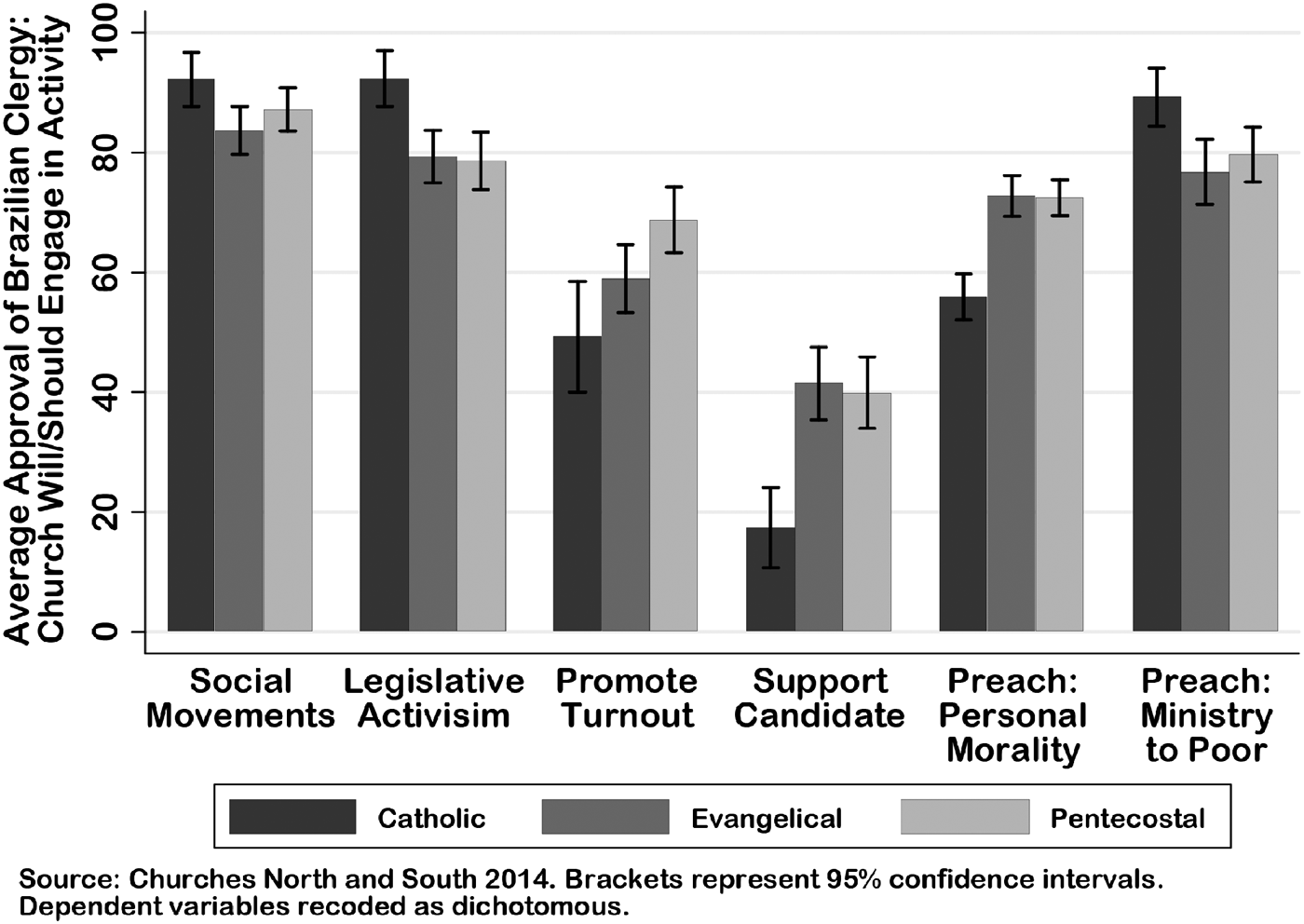
In Figure 2, I present the reported agreement with the six political activities, by the clergy member's denomination. First, nearly everyone agrees with supporting social movements and legislative activism, though Catholics are somewhat more likely to support these two. Second, non-Pentecostal Protestants and Pentecostals are more likely both to encourage turnout and to support candidates, with a larger gap between denominations in candidate support than in encouraging turnout. Indeed, field work indicates that Catholic clergy believe encouraging turnout is a normatively appropriate role for the Church, while engagement in “partisan” electoral politics is inappropriate. These normative standards are handed down from the Vatican, through the National Council of Brazilian Bishops. Last, Pentecostals and non-Pentecostal Protestants are more likely than Catholics to preach on personal morality topics, while Catholics are more likely than Pentecostals and Protestants to preach on ministry to the poor.
Political activities among Brazilian clergy, by affiliation.

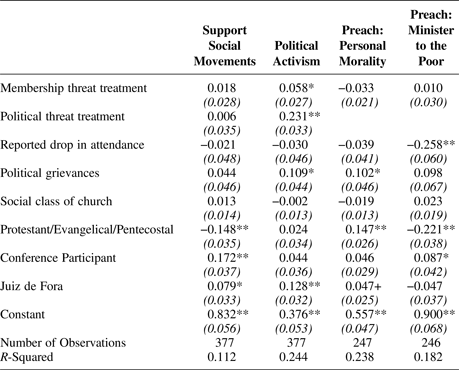
What drives these differences across groups? In Table 1, I assess determinants of supporting social movements; of an index of political activism (the mean of supporting legislation, promoting turnout, and supporting candidates); and of two topics of preaching, related to personal morality and ministering to the poor. I assess how these dependent variables are related to the questionnaire treatment version; to the actual survey measures of threat (attendance drop and political grievances); to social class of the congregation; to participation in the evangelical conference in Fortaleza; and to religious affiliation.
Religious competition and political threats as determinants of clergy political activities.

Note: Questions on topics of preaching were not asked in the questionnaires using the political threat treatment. All models use Ordinary Least Squares. Standard errors in parentheses. Coefficients are statistically significant at +p < 0.10, *p < 0.05, **p < 0.01.
Table 1 presents results among both Catholic and Protestant clergy. Combining both groups, the religious competition treatment was positively related to political activism, and negatively related to emphasis on personal morality. The actual measure of attendance drop was, unexpectedly, negatively related to preaching about ministry to the poor, though it is quite possible that the causality is reversed (that is, that churches become unpopular if they fail to preach about ministry to the poor).
The political threat treatment is more strongly related to the index of political activism, though because of the irregular nature of the treatment (administered to only part of the sample) I am less confident in the results. At the same time, the actual measures of political grievances are strongly related both to political activism and to preaching about personal morality. In the latter instance, causality very probably works in the opposite direction: those who are more focused on issues of personal/sexual morality are much less satisfied with the incumbent administration, which is seen as too supportive of gay rights. Once grievances are controlled, Protestantism is no longer a significant predictor of political activism; that is, the higher level of political activism among Protestants in 2014 was a result of higher levels of grievances.
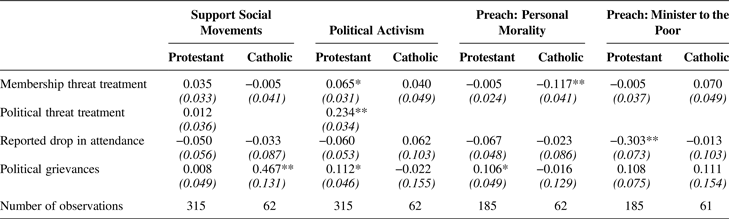
Do different kinds of threat matter differently to clergy from different denominations? In Figure 3, I present coefficients from interactive models that test how effects differ between Catholics and Protestants, grouping non-Pentecostals and Pentecostals together (see individual models in Table A1). I find a number of interesting results. Among Catholic priests, the religious competition threat treatment substantially reduced support for “personal morality” preaching, and it had a nearly statistically significant impact on increasing preaching on ministry to the poor. However, it had no statistically significant impact on support for political activism or social movements. Among Protestant clergy, the religious competition threat had no impact on topics of preaching but was associated with a rise in political activism, though a much smaller effect than from the political threat treatment. In addition, a recent drop in attendance was associated with lower support for preaching about ministry to the poor only among Protestants.
The association between threat and political activities, by affiliation.

Unfortunately, it is only possible to assess the effect of the political threat treatment among Protestants. However, there is evidence that Catholic and Protestant clergy also respond differently to political grievances. While grievances are associated with a large increase in support for social movement activism among Catholic priests, they are not among Protestants. However, only among Protestants are grievances associated with higher political activism and an increase in personal morality preaching.
DISCUSSION AND CONCLUSION
Rational choice, religious economy explanations of clergy behavior in Latin America have typically focused on the motivations of Catholic and Protestant clergy separately. Bringing these denominations together into a single study, we find that Catholics and Protestants perceive different threats and opportunities. Moreover, they respond differently to the threats and opportunities they do perceive. Scholars have posited that clergy modify their political teachings when facing threat of membership loss, yet it turns out that only Catholics do so. Protestants, meanwhile, are much more likely to respond to perceived threats by seeking to impact the political system and elect ideologically compatible officials.
Taking a step back, we can evaluate the promise of theological versus religious economic explanations. The axiom that religious leaders are rational actors maximizing perceived benefits and minimizing perceived costs (e.g., Gaskill Reference Gaskill2002, following Stark and Bainbridge Reference Stark and Bainbridge1996) in itself constitutes an important contribution to theorizing clergy behavior. However, common assumptions about the benefits maximized appear overly restrictive. An explanation of Protestant political theology based on maximizing membership is implausible and is not substantiated by these results. An explanation based on maximizing policy influence is more appropriate, but makes most sense if we assume Protestants have real, theologically based policy preferences. Other case studies of churches’ lobbying efforts also assume churches have ideological preferences (Hagopian Reference Hagopian2008; Reference Hagopian2009; Grzymala-Busse Reference Grzymala-Busse2015; Kalyvas Reference Kalyvas1996).
Recent work argues for recognizing theology's independent role as a motivator of boundedly rational clergy action (Gaskill Reference Gaskill2002; Grzymala-Busse Reference Grzymala-Busse2012; Kuru Reference Kuru2009; Toft et al. Reference Toft, Philpott and Shah2011). Theological changes within the Catholic Church in the 1960s, 1970s, and 1980s did not wholly determine clergy behavior; this does not mean, however, that theology was simply endogenous to local interests and parishioner demand. Catholic doctrine does not line up well with traditional left-right divides, giving clergy and bishops greater latitude as agents of the Church (Hagopian Reference Hagopian2008; Reference Hagopian2009; Smith Reference Smith2008). An Argentine bishop in the 1980s might have chosen whether to devote a pastoral letter to the sins of abortion or of poverty based on his personal convictions and his perception of what the “customer” wanted. It is unlikely he would have gotten away with endorsing abortion, though, regardless of how popular he thought such a position would be locally. In other words, theology provides a loose constraint on clergy action, establishing the bounds of possible actions.
There is a further concern with the notion that, as a review of Trejo's (Reference Trejo2009) study put it, “The parishioner is always right” (Wilson Quarterly 2010, 76). Sherkat and Wilson (Reference Sherkat and Wilson1995) have noted that religious products are “cultural goods” whose value is itself evaluated in social interaction. That is, citizens are not simply voluntaristic, atomistic consumers making rational choices free of social constraints; clergy and religious communities themselves tell religious consumers what they should value in the religious teachings they have received. Thus, successful Protestant clergy may respond to the threat of membership loss not by changing their doctrine but rather by redoubling contact with members in an effort to constrain choices through social processes (Gaskill Reference Gaskill2002).
This study has pointed the way toward both new research questions and new tools. Methodologically, it is evident that threat priming can reveal a great deal about clergy members’ decision-making processes; subsequent work should improve this method. Theoretically, future work should explore a number of questions. First, when and how do Catholic clergy adjust religious teachings? How do they determine which teachings will be most appealing? And are there conditions under which they are unwilling to adjust teachings? Second, turning to Protestants, which kinds of threats are most salient for political behavior? Further, how are Protestants’ choices of political strategies determined through social processes within evangelical communities?
APPENDIX
Impacts of threats, by denomination