


Introduction
Conventional agriculture strongly impacts the environment. Massive use of pesticides, herbicides and fertilizers is responsible of air, water and soil pollution (Tilman et al., Reference Tilman, Cassman, Matson, Naylor and Polasky2002; Foley et al., Reference Foley, Ramankutty, Brauman, Cassidy, Gerber, Johnston, Mueller, O'Connell, Ray and West2011) and the reduction of agricultural inputs is a primary goal of sustainable agriculture (Tilman et al., Reference Tilman, Cassman, Matson, Naylor and Polasky2002). Since 1958, Elton theorized and argued that simplified agroecosystems are more vulnerable to pest insect infestations than complex communities. Agricultural intensification, including monoculture, intense use of inputs, conventional tillage and low species diversity can lead to outbreaks of pests that cause heavy damage to crops (Hooks et al., Reference Hooks, Valenzuela and Defrank1998; Altieri, Reference Altieri1999; Altieri and Nicholls, Reference Altieri and Nicholls2004). Non-renewable agricultural inputs should be reduced to preserve ecosystems and biodiversity in order to promote sustainable agriculture (Horrigan et al., Reference Horrigan, Lawrence and Walker2002).
A basic contribution in this direction has been obtained by means of habitat manipulation, including the introduction in the rotation of crops not aimed to yield rather to provide agro-ecological services (Altieri, Reference Altieri1999; Bianchi et al., Reference Bianchi, Schellhorn and Cunningham2013). Different terms have been used so far to indicate the crops having an environmental and or an agronomic role [i.e., catch crops, cover crops, complementary crops and green manure (GM)]. However, these names were often connected with a specific purpose or with a specific position in the rotation and they have not always been considered completely appropriate in any situation or broad enough to encompass all the crops having agro-environmental functions. Therefore, the new terminology of Agro-ecological Service Crops (ASC) was recently introduced to overcome this issue (Canali et al., Reference Canali, Diacono, Campanelli and Montemurro2015).
ASC may provide important benefits to natural enemies, by increasing the structural and vegetation complexity within agroecosystems (Johnson et al., Reference Johnson, Hough-Goldstein and Vangessel2004; Bryant et al., Reference Bryant, Brainard, Haramoto and Szendrei2013). Beside the selection of the plant species complex, the potential benefits of ASC may be influenced by several factors, including method and timing of termination. Among the available techniques to kill ASC, no-till roller crimper (RC) approach was suggested as an effective solution to control weeds, reduce soil erosion and diminish fuel and energy consumption (Ashford and Reeves, Reference Ashford and Reeves2003; Altieri et al., Reference Altieri, Lana, Bittencourt, Kieling, Comin and Lovato2011; Luna et al., Reference Luna, Mitchell and Shrestha2012). The main agronomic questions related to this technique are: (a) the right optimum of ASC biomass before rolling, (b) the nitrogen (N) immobilization and (c) the re-growth of ASC during the subsequent cash crop cycle. Canali et al. (Reference Canali, Campanelli, Ciaccia, Leteo, Testani and Montemurro2013) proposed for vegetable crops an innovative RC that flattens the ASC while simultaneously creating a transplanting furrow (in line till/RC).
In spite of some promising results that demonstrate the positive effects of cover crops on natural enemies (Carmona and Landis, Reference Carmona and Landis1999; Schmidt et al., Reference Schmidt, Thewes, Thies and Tscharntke2004; Pullaro et al., Reference Pullaro, Marino, Jackson, Harrison and Keinath2006; Larentzaki et al., Reference Larentzaki, Plate, Nault and Shelton2008; Rodríguez et al., Reference Rodríguez, González and Campos2012), the role of ASC on insect dynamics has not yet been tested exhaustively. A better knowledge of the relations among ‘ASCs-agronomic techniques-arthropod fauna’ might lead to a strategic use ASC for pest management and beneficial insect conservation.
The objective of this study was to evaluate the impact of two different ASC terminations (green manuring versus in line till/roller crimping) on pest and beneficial dynamics, in an organic vegetable system. The new RC technology (Canali et al., Reference Canali, Campanelli, Ciaccia, Leteo, Testani and Montemurro2013) was compared with the GM technique for ASC management. A synthetic biodegradable film cover, which is the conventional mulching technique used in many vegetable crops, was used as control. Concerning pest dynamics, particular attention was given to the melon or cotton aphid, Aphis gossypii Glover (Rhynchota: Aphididae), which is considered the key pest on zucchini (Cucurbita pepo L.). The plant was selected as cash crop in this study because of its economic importance This aphid causes damages on leaves, transmitting viruses and reducing the commercial value of fruits as a result of honeydew production (Ebert and Cartwright, Reference Ebert and Cartwright1997). For this reason, trophic webs related to A. gossypii were monitored, including predator and parasitoid species.
Materials and Methods
Site, experiment and treatments
Field experiments were conducted at CREA Horticulture Research Unit of Monsampolo del Tronto (Central Italy) in an organic zucchini field (21 × 24 m2). The tested treatments were: (i) in line till/RC and (ii) GM. The two ASC termination techniques were compared with synthetic biodegradable film covering (Mater-Bi, MB), a common technique used to control weeds in Italy in many vegetable systems. Three plots per treatment were replicated and the whole experiment design was repeated for two consecutive seasons (2014 and 2015), by changing the spatial distribution of the treatments in the zucchini field.
The ASC crop, barley (Hordeum vulgare L.), was sown on October 31, 2013 and on October 21, 2014 with a sown density of 200 kg ha−1 in both years. Zucchini plants (cultivar ‘Zuboda’) were transplanted after ASC termination techniques, for a total of 0.83 plants m−2. This cultivar, supplied by Arcoiris srl (Modena, Italy) was selected for the study because it lacks resistance genes against the main biotic stresses. Transplanting was carried out on May 7, 2014 and on May 6, 2015. No insecticides and herbicides were used during the two growing seasons. The fertilization was the same in each treatment during the two years: N (50 kg ha−1), P2O5 (13 kg ha−1) and K2O (21 kg ha−1).
Yield assessment
In 2014, the harvest started on June 10 and ended on August 13, the whole cropping cycle lasting 64 days. In 2015, the harvest started on June 5 and ended on August 3, the whole cropping cycle lasted 59 days. The harvest was made according to fruit ripening by collecting fruits three times per week along the whole harvest period. Zucchini yield was evaluated according to the local market standards within 24 h from the harvest.
Pest and beneficial insect sampling
Pest and beneficial insects were monitored fortnightly, from June till the beginning of August, by visual sampling. In each plot, 10–15 plants were sampled by observing three randomly selected leaves for each plant. In particular, ten plants per plot were sampled during the first and last sampling date in 2014 season; the same sampling size was used during the first date in 2015 season.
A. gossypii was the predominant pest collected by samplings. This species is the key pest on cucurbits in open and protected crops in Mediterranean countries (Ebert and Cartwright, Reference Ebert and Cartwright1997). Aphid colonies were ranked by visual sampling into four different infestation classes: 0 (no aphids), 1 (few scattered aphids), 2 (small aphid colonies) and 3 (extended colonies or leaf surface almost covered by aphids).
All the beneficial insects found on the leaves, including parasitoid mummies, were counted during the visual sampling.
Chlorophyll measurement
The quantity of chlorophyll was analyzed twice a year at 68 and 85 days after transplanting (DAT) in 2014, and at 55 and 65 DAT in 2015. Data were obtained with a hand held chlorophyll meter (CCM 200, Opti-Sciences, Tyngsboro, Massachusetts, USA). This instrument allows calculating the chlorophyll content index (CCI) based on absorbance measurements at 653 and 931 nm. The claimed accuracy of the CCM-200 is ±1.0 CCI units. Three leaves from nine randomly selected plants were analyzed from each plot. The measure was repeated twice on each leaf. The CCI results were utilized to calculate the Soil and Plant Analysis Development (SPAD) index, an indirect measure of N within plant tissues.
Soil temperature measurement
HD 207-1 data loggers (Delta Ohm, Caselle di Selvazzano, Padua, Italy) were used to measure soil temperature (0–10 cm depth). Data were recorded every 30 minutes from May 14 to 13 August in 2014 and from June 5 to 7 August in 2015. Data were analyzed by DeltaLog2 dedicated software.
Data analysis
Aphid infestation was evaluated using the Townsend-Heuberger's formula:
 $$P\, (\% \hbox{ of infestation}) = \displaystyle{{\sum\nolimits_{\rm v} {N_{\rm v} \times v}} \over {(n - 1) \times N_{\rm T}}} \times 100$$
where n, number of infestation classes; N v, number of leaves in each class of infestation; v, value of the different classes of infestation (from 0 to 3); N T, total number of sampled leaves. Mean number of natural enemies per leaf was also calculated for each sampling date.
The correlation between natural enemies (predators and parasitoids), and infestations of A. gossypii were analyzed by Spearman's rank method.
Log linear analysis (Haberman et al., Reference Haberman, Bishop, Fienberg and Holland1976) was used to test the interaction between design variables (treatment-sampling date-year) and response variables (weighted aphid infestation), by a multi-way contingency table. The obtained matrix was based on the frequency of leaves belonging to the four infestation classes. By means of log linear analysis, only the associations involving the response variable were selected.
The significant interactions revealed by log linear analysis were further analyzed with a χ2 test for independence; this test was used to understand any association between different categorical variables with more than two levels (Beasley and Schumacker, Reference Beasley and Schumacker1995; Garcia-Perez and Núñez-Antón, Reference Garcia-Perez and Núñez-Antón2003; Sharpe, Reference Sharpe2015).
Data analyses were performed using Statistica ver. 7.0 (Statsoft Italia) and SPSS ver.13.0 (Statistical Package for Social Science, USA).
Results
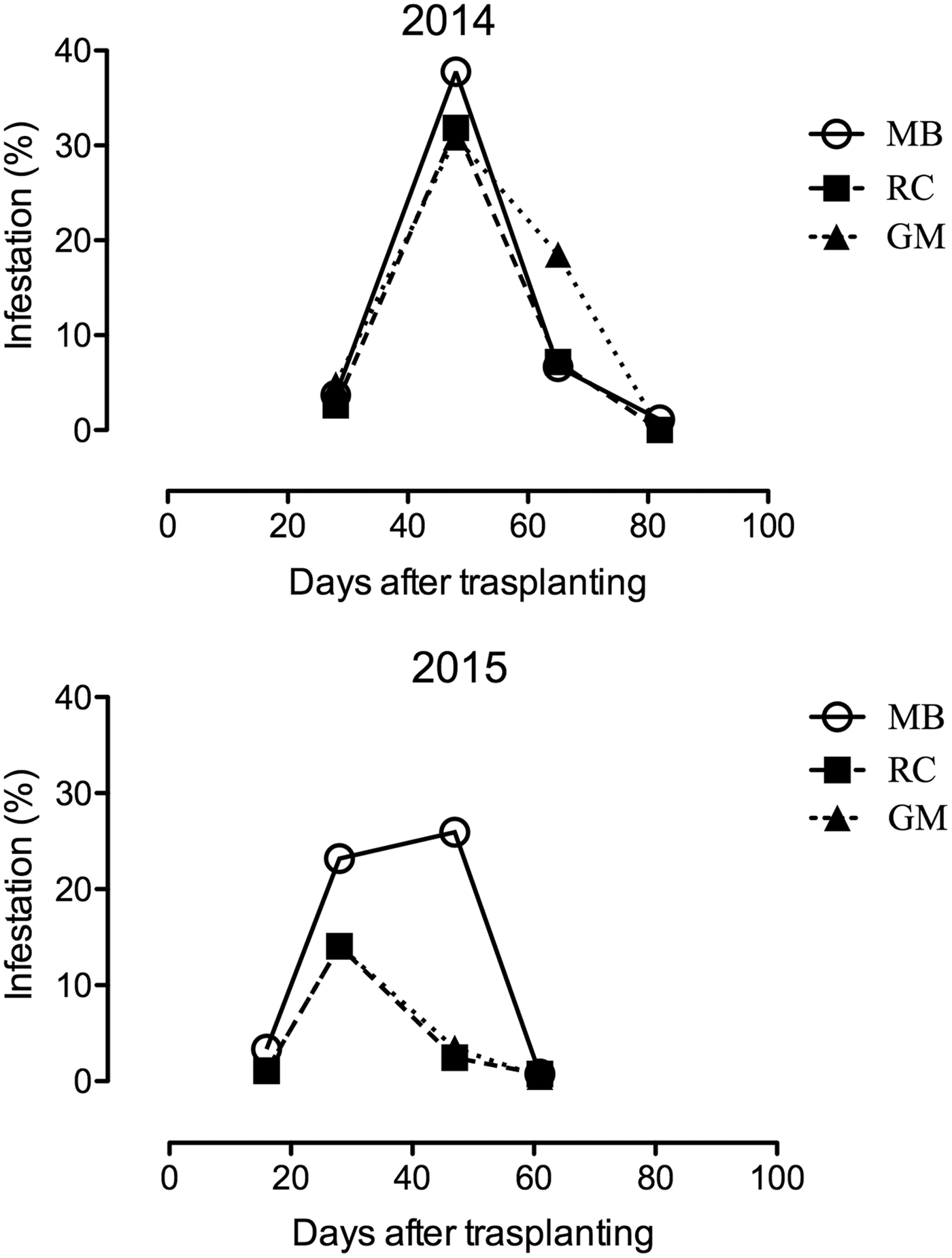
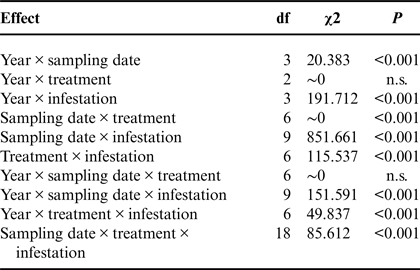
Log linear analysis (Table 1) showed significant interactions of aphid infestation with: (i) year (P < 0.001), (ii) sampling dates (P < 0.001) and (iii) treatment (P < 0.001). Infestation of A .gossypii (Fig. 1) was higher in 2014 than in 2015, in all the treatments (significant interaction ‘treatment × infestation’, χ2 = 65.66; d.f. = 6; P < 0.001). In MB treatment, higher infestations of A. gossypii were detected in comparison with those observed in the treatments based on ASC (Fig 1; Table 1); it is remarkable that this trend was observed in both seasons. Heavily infested leaves belonging to class 2 and 3 were found only in MB treatment; the only exception was observed in GM during the second sampling date in 2015 (28 DAT), when only one leaf was scored as ‘class 2’ of infestation (Supplementary material N° 1). In MB plots, class 3 of infestations were recorded in 2014 at 48 DAT (37.78%) and in 2015 at 47 DAT (25.93%), causing the significant interaction among ‘sampling date × treatment × infestation’ (χ2 = 85.6; d.f. = 18; P < 0.001).
Trends of aphid infestations (expressed as weighted percentage (%) in each treatment during the two sampling seasons. MB, synthetic biodegradable film covering; RC, roller crimper; GM, green manure.

Results of the Log linear analysis that show the interactions between the design variables (treatment-sampling date-year) and the response variables (aphid infestation).

Aphid occurrence and peak of infestation were recorded earlier in 2015 than in 2014, in all the treatments (significant interaction ‘year × sampling date × infestation’, χ2 = 151.5, d.f. = 9, P < 0.001). Also, temporal pattern of infestation in MB was different in comparison with that of GM and RC (explained by the significant ‘year × treatment × infestation’ interaction, χ2 = 49.8, d.f. = 6, P < 0.001).
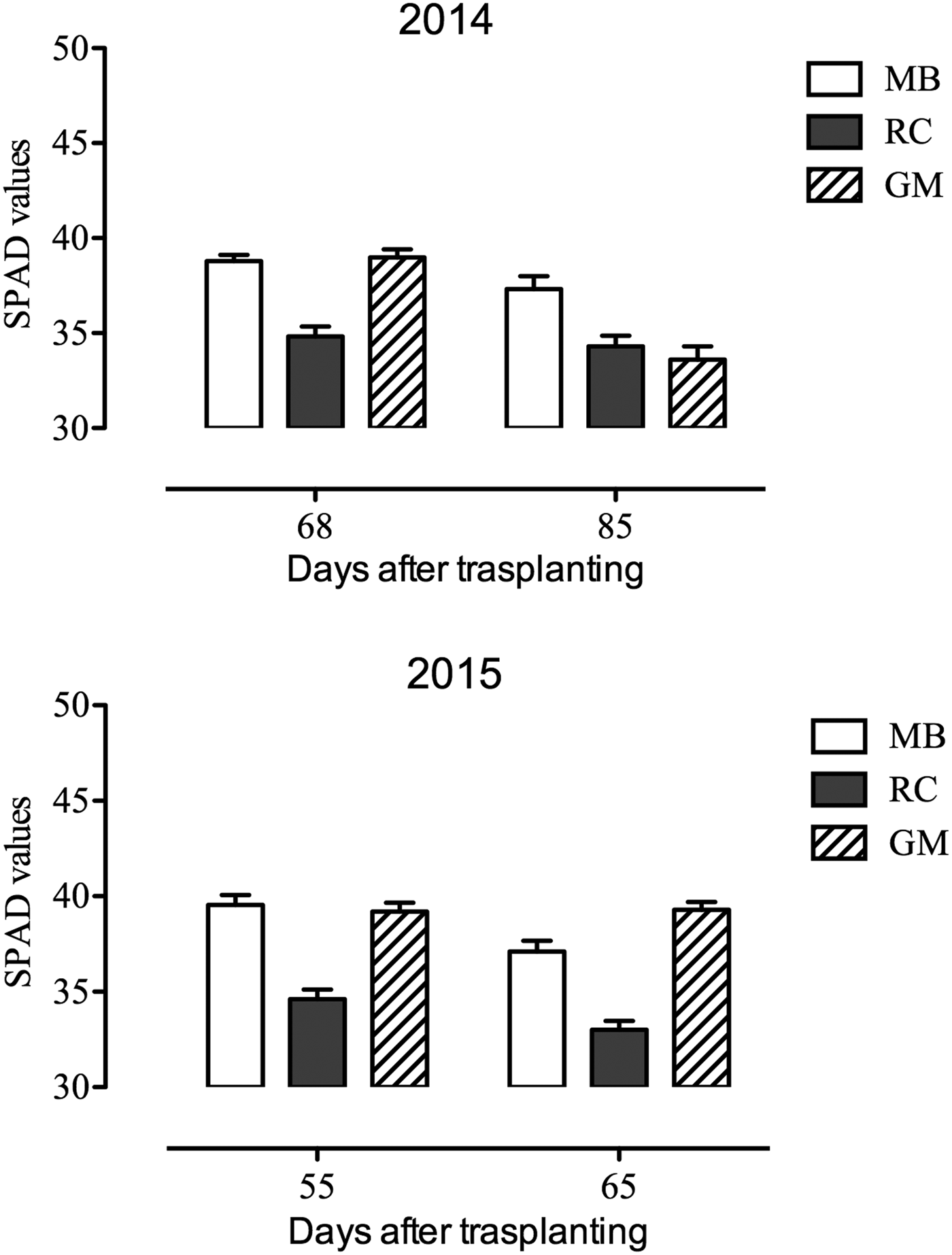
RC resulted in lower SPAD index in all surveys, with the exception of the values obtained at 85 DAT in GM (Fig. 2).
SPAD (Soil and Plant Analyzer Development index) values during 2014–15, an indirect measure of nitrogen within plant tissues. MB, synthetic biodegradable film covering, RC, roller crimper; GM, green manure.

In both years, soil temperature was higher in MB plots in comparison with the other treatments (see Supplementary material N° 2); GM plots registered intermediate temperature values between MB and RC, although they were close to MB in 2015. The average soil temperature of RC plots was 21.7–22.9 °C (2014–15), while those registered in GM and MB were 22.5–25.1 and 24.1–25.8 °C.
Responses of predators and parasitoids were density-dependent and their abundance was positively correlated with A. gossypii infestations (Spearman's rank correlation; R = 0.61, P < 0.01 and R = 0.44, P < 0.05, for predators and parasitoids, respectively).
Beneficials were more abundant on the MB treatment, which was characterized by higher pest density. The predators belonged to the families: Coccinellidae, Anthocoridae, Syrphidae, Chrysopidae, Miridae and Cecidomidae. Overall, seven coccinellid species were found; the most abundant species was Hippodamia variegata Goeze (64.81%) followed by Coccinella septempunctata L. (9.26%) and Propylea quatuordecimpunctata (L.) (5.56%). Harmonia axyridis Pallas (1.85%) and Ceratomegilla undecimnotata Schneider (0.93%) were found only occasionally. Two phytophagous coccinellid species, Psyllobora vigintiduopunctata (L) (0.93%) and Henosepilachna elaterii (Rossi) (0.93%) were found, but not considered among predators. Scymninae accounted for the remaining 15.74% of the total coccinellids. Macrolophus pygmaeus (Rambur) was the most abundant Miridae found in all sampling dates.
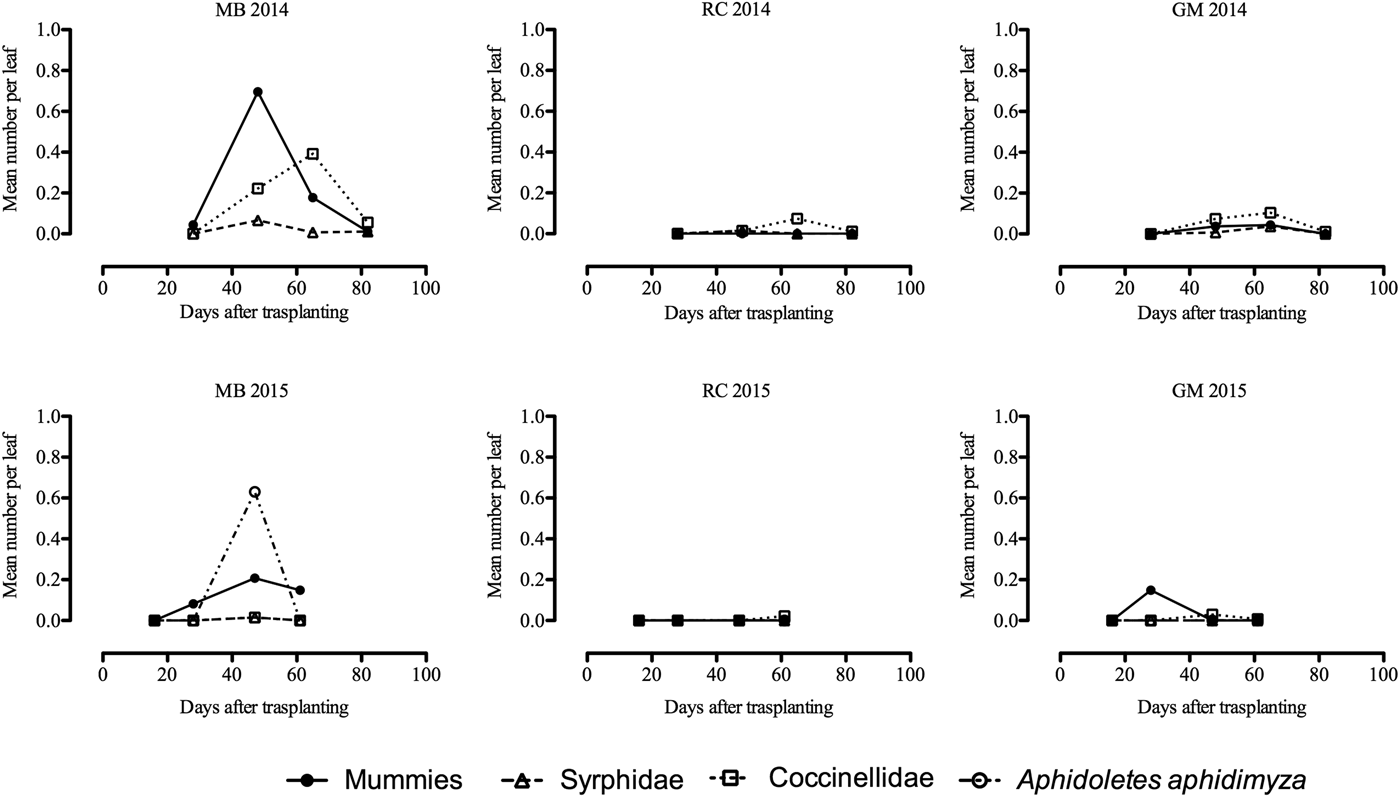
Predator's density peaks were recorded on the third sampling date (65 DAT), showing a delay respect to the peak of aphid infestation (Fig. 3). Aphidoletes aphydymiza (Rondani) was the dominant predator in 2015 showing a peak density of 0.7 larvae per leaf in MB plot (in one leaf a total of 23 A. aphidimyza larvae was found on a aphid colony). Other predators, like syrphids and coccinellids, were less abundant in 2015 in comparison with 2014 (Fig. 3).
Individual per leaf of natural enemies in 2014 and 2015. Only the aphidophagous instar of Syrphdae (larvae) and Coccinellidae (adults and larvae) were considered in this graph. MB, synthetic biodegradable film covering; RC, roller crimper; GM, green manure.

Aphid parasitoids were recorded on aphid colonies with a higher mean number of mummies in 2014 than in 2015. Furthermore, only in 2014 the peak of mummy density was registered on the second sampling date (48 DAT), showing an early appearance of parasitoids in comparison with predators. On the other hand, in 2015 the highest density of mummies was concomitant with the peak of predators (48 DAT). Finally, the yield mean value (kg per plant) during 2014 was: 3.75 in MB, 1.38 in GM and 1.03 in RC. A similar trend was observed in 2015: 4.23 in MB, 2.70 in GM and 1.04 in RC.
Discussion and Conclusions
A. gossypii was the only relevant pest in our study. The lower aphid infestations were observed in the two ASC termination techniques (GM and RC) and it might be related to the lower vegetative growth. Our experiment demonstrates that the biofilm utilized in MB for weed control, strongly affected the vegetative development of plants. The most abundant vegetative growth and yield in MB plot could be explained considering the higher N nutritional status of the plants and the N content within plant tissue of this treatment, as evidenced by the indirect measure obtained from the chlorophyll content of leaves (SPAD index, data shown in Fig. 2). The lower yield mean value measured in the GM and RC treatments might be influenced by the poor adaptability of the cultivar ‘zuboda’ to grow in low N availability conditions, as those generally occurring in soils after the cultivation of a non-lugume ASC (Thorup-Kristensen, Reference Thorup-Kristensen1993).
The higher leaf N concentration of MB plots, combined with the soil temperatures, could be the reason of the more abundant vegetative growth in this plot, resulting in higher aphid infestation in comparison with those of the ASC termination techniques (RC and GM). These results (see Supplementary material N° 1 and N° 2) are in accordance with the literature (Truax and Gagnon, Reference Truax and Gagnon1993; Teasdale and Abdul-Baki, Reference Teasdale and Abdul-Baki1995), indicating that the temperature lower in soil characterized by conservation techniques leads to slower growth and the lower vegetative vigor in GM and RC plots can be correlated to the lower aphid suitability of the plants belonging to these treatments.
Beneficial abundance was higher in the more infested MB plots, likely contributing to the control of aphid infestation. During the 2014 season, high densities of hymenopteran parasitoids were counted in MB in correspondence of peaks of aphid infestation, showing a good synchronization of the parasitoids with the aphids. In 2015, A. aphidimyza was the most abundant predator in MB plots; a strong density dependent numerical response of this predator against its prey was observed. Adult emergence represents a very sensitive phase in the life cycle of A. aphidimyza. In particular meteorological condition, like dry weather, can strongly affect their possibilities to survive (Havelka and Zemek, Reference Havelka and Zemek1988; Vacante and Benuzzi, Reference Vacante and Benuzzi2007). These factors could explain the variability between years in the occurrence of this predator. Also predators like Coccinellidae, Anthocoridae, Syrphidae, Chrysopidae and Miridae could have concurred to control aphid infestations.
Our study was finalized to a practical evaluation of conservation biological control in an organic farm, which was not subjected to any sprays. From our experiment, a positive correlation between density of natural enemies and aphid infestation was shown; moreover no plant was seriously damaged by A. gossypii.
Overall, our results are consistent with other studies focused on the role of natural enemies against A. gossypii (Turchin and Kareiva, Reference Turchin and Kareiva1989; Burgio et al., Reference Burgio, Ferrari and Antoniacci1994; Ferrari and Burgio, Reference Ferrari and Burgio1996; Al Hassan et al., Reference Al Hassan, Parisey, Burel, Plantegenest, Kindlmann and Butet2012; Iguchi et al., Reference Iguchi, Fukushima and Miura2012).
In conclusion, MB treatment increased aphid infestation in comparison with both the ASC termination techniques (RC and GM). For this reason, the techniques tested in this experiment, and in particular RC system, may be suggested as a tool to mitigate aphid infestation.
Further study should be done in organic vegetable cropping systems in order to better understand the interactions between the agronomic variables and ASC termination techniques and their effects on pest and beneficial insect dynamics. Yield, weed control, microorganisms and other aspects related to ASC management and terminations were also considered during this study, but they will be discussed in subsequent articles. Aspects related to microbial community were reported in (Manici et al., Reference Manici, Caputo, Nicoletti, Leteo and Campanelli2016).
Supplementary Material
The supplementary material for this article can be found at https://doi.org/10.1017/S1742170517000175
Acknowledgements
Research funded by the Organic Farming office of the Ministero delle Politiche Agricole Alimentari e Forestali within the project ORTOSUP (Gestione agro-ecologica per la difesa delle colture orticole in biologico). Special acknowledgement to Dr Luisa Manici for scientific coordination of the ORTOSUP research project.