

Introduction
There is consistent evidence from epidemiological (Egede, Reference Egede2007; Moussavi et al. Reference Moussavi, Chatterji, Verdes, Tandon, Patel and Ustun2007; Scott et al. Reference Scott, Bruffaerts, Tsang, Ormel, Alonso, Angermeyer, Benjet, Bromet, De Girolamo and De Graaf2007; Stegmann et al. Reference Stegmann, Ormel, de Graaf, Haro, de Girolamo, Demyttenaere, Kovess, Matschinger, Vilagut and Alonso2010; Teesson et al. Reference Teesson, Mitchell, Deady, Memedovic, Slade and Baillie2011; Patten et al. Reference Patten, Williams, Lavorato, Wang, Jetté, Sajobi, Fiest and Bulloch2016) and primary care studies (Kroenke et al. Reference Kroenke, Spitzer, Williams, Linzer, Hahn, de Gruy and Brody1994; Kroenke et al. Reference Kroenke, Jackson and Chamberlin1997; Lyness et al. Reference Lyness, Niculescu, Tu, Reynolds and Caine2006; Pieper et al. Reference Pieper, Schulz, Klotsche, Eichler and Wittchen2008; Gili et al. Reference Gili, Comas, García-García, Monzón, Antoni and Roca2010; Østergaard & Foldager, Reference Østergaard and Foldager2011) that somatic diseases are associated with depression and that these associations increase with higher severity, chronicity and comorbidity of somatic diseases (Østergaard & Foldager, Reference Østergaard and Foldager2011; Merikangas et al. Reference Merikangas, Calkins, Burstein, He, Chiavacci, Lateef, Ruparel, Gur, Lehner and Hakonarson2015). However, depression in primary care patients is often not accurately recognised, diagnosed and adequately treated so far (Wittchen & Pittrow, Reference Wittchen and Pittrow2002; Mitchell et al. Reference Mitchell, Vaze and Rao2009). Additional research efforts are thus necessary to further specify patients at increased risk for depression as well as to improve an early recognition and treatment.
To date, it remains unresolved whether the associations between different somatic diseases and depression vary by gender: Respective findings were inconclusive ranging from evidence for no significant gender differences (Patten, Reference Patten2001; Patten et al. Reference Patten, Beck, Kassam and Williams2005; Engum, Reference Engum2007; Frasure-Smith & Lesperance, Reference Frasure-Smith and Lesperance2008; Gerrits et al. Reference Gerrits, van Oppen, van Marwijk, Penninx and van der Horst2014) to evidence for more pronounced associations between somatic symptoms/diseases and depression in males (Patten et al. Reference Patten, Beck, Kassam and Williams2005) or females (Carnethon et al. Reference Carnethon, Kinder, Fair, Stafford and Fortmann2003; Beesdo et al. Reference Beesdo, Jacobi, Hoyer, Low, Höfler and Wittchen2010). For instance, while diabetes and unexplained pain symptomatology were associated more strongly with depression in females (Carnethon et al. Reference Carnethon, Kinder, Fair, Stafford and Fortmann2003; Beesdo et al. Reference Beesdo, Jacobi, Hoyer, Low, Höfler and Wittchen2010), food allergies and chemical sensitivities were associated more strongly with depression in males (Patten et al. Reference Patten, Beck, Kassam and Williams2005). Additional studies are therefore needed to examine gender-specific differences in associations between a variety of somatic diseases and depression. Because females per se are at considerably increased risk for depression (Kessler et al. Reference Kessler, Berglund, Demler, Jin, Koretz, Merikangas, Rush, Walters and Wang2003; Kessler et al. Reference Kessler, Chiu, Demler and Walters2005; Jacobi et al. Reference Jacobi, Höfler, Siegert, Mack, Gerschler, Scholl, Busch, Hapke, Maske and Seiffert2014), the probability of depression might increase less strongly with somatic diseases in females v. males.
Moreover, only a minority of studies in the field considered the role of comorbid anxiety. Depression and anxiety frequently co-occur, with comorbidity being associated with higher severity and impairment (Kessler et al. Reference Kessler, Berglund, Demler, Jin, Koretz, Merikangas, Rush, Walters and Wang2003; Kessler et al. Reference Kessler, Chiu, Demler and Walters2005; Jacobi et al. Reference Jacobi, Höfler, Siegert, Mack, Gerschler, Scholl, Busch, Hapke, Maske and Seiffert2014); also, both conditions are associated with somatic diseases (Scott et al. Reference Scott, Bruffaerts, Tsang, Ormel, Alonso, Angermeyer, Benjet, Bromet, De Girolamo and De Graaf2007; Gili et al. Reference Gili, Comas, García-García, Monzón, Antoni and Roca2010; Bhattacharya et al. Reference Bhattacharya, Shen and Sambamoorthi2014; Bekhuis et al. Reference Bekhuis, Boschloo, Rosmalen and Schoevers2015). A consideration of comorbid anxiety is thus particularly important. Previous research demonstrated that most of the associations between somatic symptoms/diseases and depression remained similar when accounting for anxiety disorders; some associations, however, were attenuated to non-significance (Strik et al. Reference Strik, Denollet, Lousberg and Honig2003; Beesdo et al. Reference Beesdo, Jacobi, Hoyer, Low, Höfler and Wittchen2010; Chou et al. Reference Chou, Huang, Goldstein and Grant2013; Bekhuis et al. Reference Bekhuis, Boschloo, Rosmalen and Schoevers2015; Kahl et al. Reference Kahl, Schweiger, Correll, Müller, Busch, Bauer and Schwarz2015; Niles et al. Reference Niles, Dour, Stanton, Roy-Byrne, Stein, Sullivan, Sherbourne, Rose and Craske2015). Further studies distinguished between pure depression, pure anxiety and their comorbidity and evidenced that somatic diseases were particularly associated with comorbid depressive and anxiety disorders (Scott et al. Reference Scott, Bruffaerts, Tsang, Ormel, Alonso, Angermeyer, Benjet, Bromet, De Girolamo and De Graaf2007; Bhattacharya et al. Reference Bhattacharya, Shen and Sambamoorthi2014). Additional research, however, is necessary to resolve whether the associations between various somatic diseases and depression (a) remain stable after taking into account anxiety disorders and/or (b) differ in patients with and without anxiety disorders. The fact that anxiety disorders substantially increase the risk for depression (Kessler et al. Reference Kessler, Berglund, Demler, Jin, Koretz, Merikangas, Rush, Walters and Wang2003; Kessler et al. Reference Kessler, Chiu, Demler and Walters2005; Jacobi et al. Reference Jacobi, Höfler, Siegert, Mack, Gerschler, Scholl, Busch, Hapke, Maske and Seiffert2014) suggests that somatic comorbidities in those with anxiety disorders might add little in risk. In other words, the probability of depression might increase less strongly with somatic diseases in patients with v. without anxiety disorders.
Using combined data from three epidemiological studies in primary care (n = 83 737 patients), we aim to examine associations between various somatic diseases (cardiovascular diseases, arterial hypertension, endocrine diseases, diabetes mellitus, gastrointestinal diseases and neurological diseases) and depression, taking into account the role of gender, anxiety disorders and somatic comorbidity. Because previous research revealed that self-reported depression (assessed via interview/questionnaire) and depression as diagnosed by primary care physicians (clinical appraisal) often disagree (Wittchen et al. Reference Wittchen, Höfler and Meister2001; Wittchen et al. Reference Wittchen, Kessler, Beesdo, Krause, Höfler and Hoyer2002), both self-reported and physician-diagnosed depression will be considered as outcomes. The following hypotheses will be investigated:
1. Each somatic disease is associated with depression, even after taking into account not only gender, age and study, but also the presence of anxiety disorders and somatic comorbidity. The associations with depression increase with a higher number of somatic diseases.
2. Anxiety disorders are associated with depression, even after taking into account not only gender, age and study, but also the presence of somatic comorbidity.
3. Somatic diseases interact with gender and anxiety disorders in the association with depression. That is, because females and patients with anxiety disorders per se are at considerably increased risk for depression, the associations between somatic diseases and depression are less pronounced in females v. males as well as in patients with v. without anxiety disorders.
Method
Design
Data from three independent large-scaled epidemiological studies in primary care settings in Germany were combined (total n = 83 737 patients). Detailed information on these studies, namely DETECT (Diabetes Cardiovascular Risk Evaluation: Targets and Essential Data for Commitment of Treatment) (Wittchen et al. Reference Wittchen, Glaesmer, März, Stalla, Lehnert, Zeiher, Silber, Koch, Böhler, Pittrow and Ruf2005), Depression 2000 (Wittchen & Pittrow, Reference Wittchen and Pittrow2002) and Generalized Anxiety and Depression in Primary Care (GAD-P) (Wittchen et al. Reference Wittchen, Kessler, Beesdo, Krause, Höfler and Hoyer2002) has been previously presented and is summarised briefly here.
DETECT was conducted in Germany from 09/2003 until 12/2004. The study sample was drawn randomly from a nationwide database of primary care physicians. The cross-sectional main study (data used herein) was conducted among n = 3188 primary care physicians and their primary care attendees on two specific target days in September 2003.
In Depression 2000, n = 510 physicians were selected out of an approximate total of n = 56 000 primary care physicians in Germany. n = 412 physicians (81%) were willing to participate. Physicians and their primary care attendees were assessed on a specific target day in April 2000.
In GAD-P, n = 628 physicians were selected out of an approximate total of n = 56 000 primary care physicians in Germany. A total of n = 558 (89%) physicians were willing to participate. Physicians and their primary care attendees were assessed on a specific target day in September 2000.
In all three studies, information on physical and mental health was assessed from patients and their treating physicians using standardised self-report questionnaires and clinical appraisal forms. Complete information on gender, age, self-reported depression and physician-diagnosed depression, anxiety disorders and somatic diseases was available for n = 51 206 patients in DETECT, for n = 14 664 patients in Depression 2000 and for n = 17 867 patients in GAD-P.
Diagnostic assessment of depression and anxiety disorders
Depressive symptoms during the past 2 weeks were assessed via self-report in patients using the Depression Screening Questionnaire (DSQ) (Wittchen & Perkonigg, Reference Wittchen and Perkonigg1997). The DSQ assessed ten symptoms of depression with three-point scaled items labelled 0 = never, 1 = on some days and 2 = on the majority of days; in GAD-P, however, a slightly modified response format was used (0 = seldom/never, 1 = often and 2 = on the majority of days). The DSQ is well established and has been used in epidemiological studies in primary care in various countries (Munk-Jorgenson et al. Reference Munk-Jorgenson, Allgulander, Dahl, Foldager, Holm, Rasmussen, Virta, Huuhtanen and Wittchen2006). Test–retest reliability and convergent validity [diagnosis of major depression based on the DSQ as compared with the Composite International Diagnostic Interview (Wittchen & Pfister, Reference Wittchen and Pfister1997)] have been shown to be high (Wittchen & Perkonigg, Reference Wittchen and Perkonigg1997). Due to the diverging response format in GAD-P, depression according to the International Classification of Diseases, Tenth Edition (ICD-10) herein is defined slightly more stringent than in previous studies (Winter et al. Reference Winter, Wittchen, Höfler, Spiegel, Ormel, Müller and Pfister2000; Pieper et al. Reference Pieper, Schulz, Klotsche, Eichler and Wittchen2008; Pieper et al. Reference Pieper, Dirmaier, Klotsche, Thurau, Pittrow, Lehnert, Maerz, Koch and Wittchen2011), namely as present when at least four items were answered with 2 = on the majority of days.
Moreover, physician diagnoses of depression and anxiety disorders were assessed with standardised clinical appraisal forms. In each study, physicians were asked to indicate the presence of depression and anxiety disorders out of a list with different mental disorders (and somatic diseases in DETECT). In GAD-P, panic disorder, generalised anxiety disorder and other anxiety disorders were assessed separately. In Depression 2000 and GAD-P, physicians were additionally asked to rate whether individual diagnoses were certain, subthreshold or questionable. Only diagnoses of depression judged as certainly present are included herein.
Diagnostic assessment of somatic diseases
Information on somatic diseases was assessed from physicians using standardised clinical appraisal forms. In Depression 2000 and GAD-P, physicians were asked to indicate the presence of different somatic diseases out of a list with 11 or ten response categories, respectively. In DETECT, somatic diseases including additional laboratory parameters were assessed in further detail. Cardiovascular diseases, arterial hypertension, endocrine diseases, diabetes mellitus, gastrointestinal diseases and neurological diseases or (acute) diseases of the nervous system were assessed in each study; thus, these somatic diseases are considered herein. It has to be noted that in DETECT, cardiovascular, endocrine and neurological diseases were not assessed as general categories. Instead, the following diseases were separately assessed: (1) left ventricular hypertrophy, atrial fibrillation and cardiac insufficiency (cardiovascular diseases); (2) neuropathy, cerebral insult, transient ischaemic attack and carotid stenosis (neurological diseases); and (3) thyroid diseases (endocrine diseases). Other somatic diseases were inconsistently assessed across studies and therefore are not considered in this paper (e.g. respiratory diseases were only assessed in Depression 2000 and GAD-P, but not in DETECT).
Statistical analyses
Combined data from DETECT, Depression 2000 and GAD-P were used. Only cases with complete data on gender, age and self-reported depression as well as diagnostic information from physicians on depression, anxiety disorders and somatic diseases were included, resulting in a total of n = 83 737 patients. Additional information respecting the sample composition by study, gender and age group is presented in online Supplementary Table S1. Statistical analyses were conducted using Stata 14.1 (StataCorp, 2015).
First, logistic regressions adjusted for age group and study (DETECT, Depression 2000 and GAD-P) were used to estimate associations (odds ratio, OR) of gender with depression, anxiety disorders and somatic diseases. Multinomial logistic regressions adjusted for gender, age group and study were applied to calculate associations between sample/clinical characteristics and depression status (no depression, self-reported depression only, physician-diagnosed depression only, self-reported and physician-diagnosed depression). Outcome groups were pairwise compared, i.e. no depression, self-reported depression only or physician-diagnosed depression only were used as reference group.
Second, we examined main effects of somatic diseases in predicting self-reported as well as physician-diagnosed depression. That is, logistic regressions adjusted for gender, age group and study (model 1) were used to estimate associations of individual somatic diseases with self-reported and physician-diagnosed depression. These analyses were repeated and adjusted for (a) anxiety disorders (model 2) or (b) anxiety disorders and other somatic diseases (model 3).
Third, logistic regressions were used to test whether the associations between somatic diseases and depression increased with a higher number of somatic diseases (model 1: adjusted for gender, age group and study; model 2: adjusted for gender, age group, study and anxiety disorders). Because only few patients were affected by more than three disease categories, a dummy variable was generated to compare (a) cases with one, two or more than two disease(s), respectively, to cases without disease as well as (b) cases with two or more than two diseases, respectively, to cases with one disease in terms of depression risk.
Fourth, associations between anxiety disorders and depression were estimated using logistic regressions (model 1: adjusted for gender, age group and study; model 2: adjusted for gender, age group, study and somatic diseases).
Fifth, logistic regressions with interaction terms were applied to test whether somatic diseases interacted with gender in the association with depression (model 1: adjusted for age group and study; model 2: adjusted for age group, study and anxiety disorders; model 3: adjusted for age group, study, anxiety disorders and other somatic diseases). Moreover, we assessed separate associations between somatic diseases and depression in males and females.
Sixth, logistic regressions with interaction terms were applied to test whether somatic diseases interacted with anxiety disorders in the association with depression (model 1: adjusted for gender, age group and study; model 2: adjusted for gender, age group, study and other somatic diseases). Besides, we tested separate associations between somatic diseases and depression in patients with anxiety disorders and patients without anxiety disorders.
We note that the ORs from interaction terms must be seen on a multiplicative scale: an OR <1 means that the combined effect of the respective somatic disease and gender/anxiety disorder is less than the product of the ORs for both individual (simple) effects. For instance, obtaining an OR <1 for the interaction term cardiovascular disease × gender would mean that the association between cardiovascular diseases and depression is less pronounced in females (coded as 1) v. males (coded as 0).
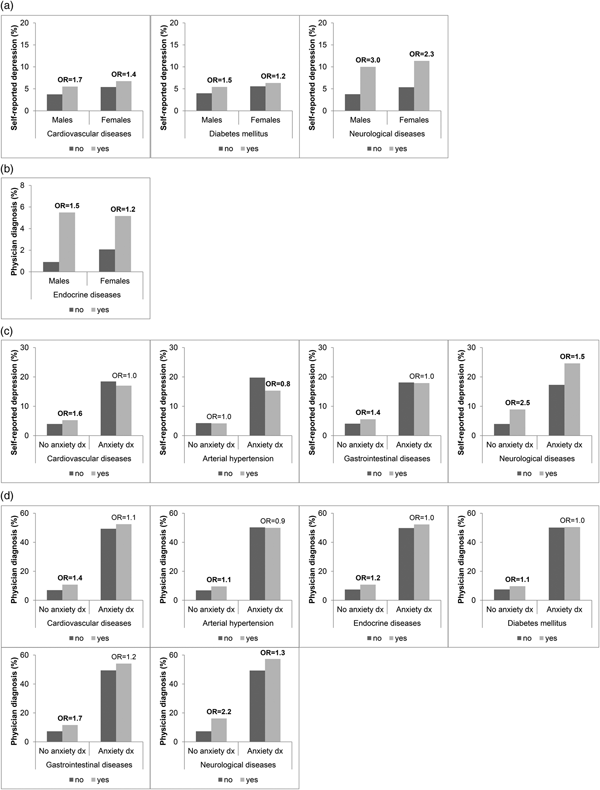
Each significant interaction was decomposed and visualised in an interaction graph. Absolute risk differences for depression (a) in males and females with and without respective somatic disease as well as (b) in patients with and without anxiety disorders with and without respective somatic disease can be visually assessed from these graphs (Fig. 1).
(a) Interactions of cardiovascular diseases, diabetes mellitus and neurological diseases with gender in the association with self-reported depression; (b) interactions of endocrine diseases with gender in the association with physician-diagnosed depression; (c) interactions of cardiovascular diseases, arterial hypertension, gastrointestinal diseases and neurological diseases with anxiety disorders in the association with self-reported depression; (d) interactions of cardiovascular diseases, arterial hypertension, endocrine diseases, diabetes mellitus, gastrointestinal diseases and neurological diseases with anxiety disorders in the association with physician-diagnosed depression. Note: OR: odds ratios; dx: disorder; statistically significant associations (with p-values <0.05) are presented in bold.

Results
Prevalence of depression, anxiety disorders and somatic diseases
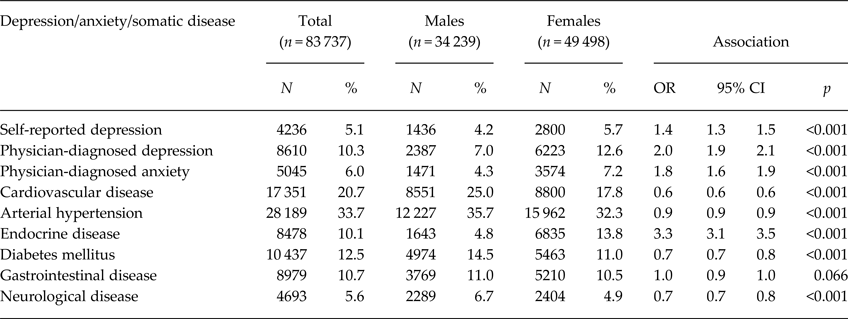
Prevalences for depression, anxiety disorders and somatic diseases in the total sample as well as by gender are shown in Table 1. Depression, anxiety and endocrine diseases were more prevalent among women (OR 1.4–3.3), while cardiovascular diseases, arterial hypertension, diabetes mellitus and neurological diseases were more prevalent among men (OR 0.6–0.9). There were n = 2528 (3.0%) patients with self-reported depression only, n = 6902 (8.2%) with physician-diagnosed depression only and n = 1708 (2.0%) with both self-reported and physician-diagnosed depression. Sensitivity of physician-diagnosed v. self-reported depression was higher in woman than in men (43.3% v. 34.5%); however, specificity was lower in woman than in men (89.3% v. 94.2%). Sample and clinical characteristics (age, gender, number of somatic diseases, number of visits during the past 12 months and physician-diagnosed anxiety disorders) partially differed by depression status. Respective findings are presented in online Supplementary Table S2.
Prevalences of depression, anxiety disorders and somatic diseases in the total sample, males and females (n = 83 737)

OR, odds ratios from logistic regressions with gender (0 = male, 1 = female) as predictor and depression, anxiety or somatic disease as outcome, adjusted for study and age group; CI, confidence interval.
Associations between somatic diseases and depression
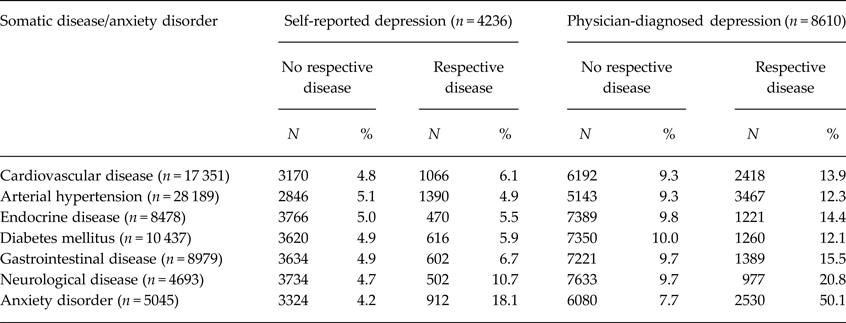
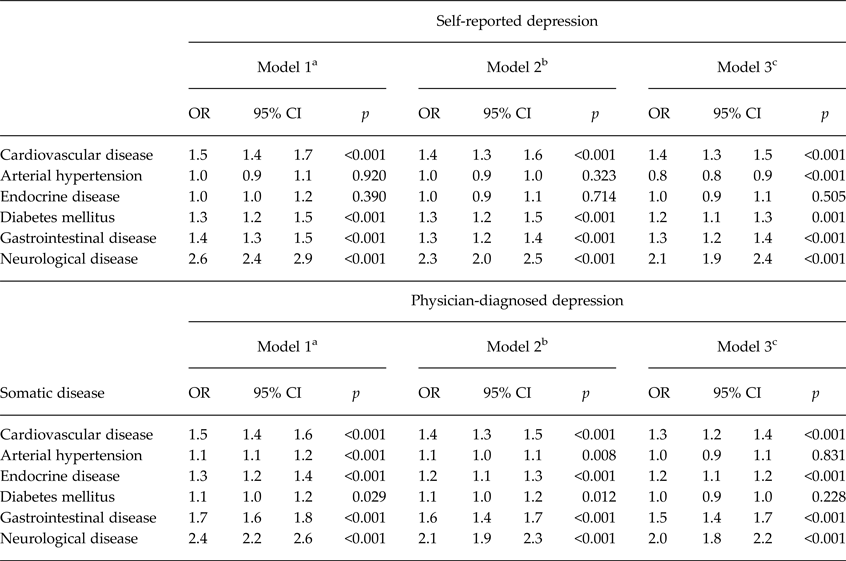
Prevalences of depression in patients with v. without somatic diseases are presented in Table 2 (upper part). Associations between somatic diseases and depression are shown in Table 3. Except for arterial hypertension and endocrine diseases, all somatic diseases were positively associated with self-reported depression in model 1 (adjusted for gender, age group and study; OR 1.3–2.6), model 2 (adjusted for gender, age group, study and anxiety disorders; OR 1.3–2.3) and model 3 (adjusted for gender, age group, study, anxiety disorders and other somatic diseases; OR 1.2–2.1). Arterial hypertension was negatively associated with self-reported depression in model 3 (OR 0.8).
Prevalences of depression in patients with and without somatic disease or anxiety disorder (n = 83 737)

Associations between somatic diseases and depression (n = 83 737)

OR, odds ratios from logistic regressions with respective somatic disease as predictor and depression as outcome; CI, confidence interval.
a Adjusted for gender, age group and study.
b Adjusted for gender, age group, study and anxiety disorders.
c Adjusted for gender, age group, study, anxiety disorders and other somatic diseases.
Moreover, all somatic diseases were positively associated with physician-diagnosed depression in model 1 (OR 1.1–2.4), model 2 (OR 1.1–2.1) and model 3 (OR 1.2–2.0), except for arterial hypertension and diabetes mellitus not being associated with physician-diagnosed depression in model 3.
Associations with depression increased with a higher number of somatic diseases (online Supplementary Table S3). More specifically, increasing ORs were obtained for (a) one (self-report: OR 1.1; physician diagnosis: OR 1.2), two (self-report: OR 1.3; physician diagnosis: OR 1.5) and more than two disease(s) (self-report: OR 2.1; physician diagnosis: OR 2.2) v. no disease as well as for (b) two (self-report: OR 1.2; physician diagnosis: OR 1.3) and more than two (self-report: OR 1.9; physician diagnosis: OR 1.9) diseases v. one disease (model 1). Findings remained similar after additionally adjusting for anxiety disorders (model 2), except that one v. no disease no longer predicted self-reported depression.
Associations between anxiety disorders and depression
Prevalences of depression in patients with v. without anxiety disorders are presented in Table 2 (lower part). Anxiety disorders were associated with self-reported depression (OR 5.0, CI 4.6–5.4; p < 0.001) and physician-diagnosed depression (OR 11.5, CI 10.6–12.6; p < 0.001) (model 1). These associations remained similar when additionally adjusting for somatic diseases (self-report: OR 4.6, CI 4.3–5.1; p < 0.001; physician diagnosis: OR 10.9, CI 10.0–11.8; p < 0.001) (model 2).
Interactions between somatic diseases and gender in the association with depression
Interactions between somatic diseases and gender (reference group: males) in the association with depression are presented in online Supplementary Table S4a: cardiovascular diseases (OR 0.8), diabetes mellitus (OR 0.8) and neurological diseases (OR 0.8) interacted with gender in the association with self-reported depression, while endocrine diseases (OR 0.8) interacted with gender in the association with physician-diagnosed depression (model 1). That is, the associations between respective somatic diseases and depression were less pronounced in females v. males (Fig. 1a and 1b).
Similar findings were obtained in models 2 and 3, except that in model 3, diabetes mellitus no longer interacted with gender in the association with self-reported depression, while arterial hypertension interacted with gender in the association with physician-diagnosed depression (OR 1.2). That is, in model 3, the association between hypertension and physician-diagnosed depression was more pronounced in females v. males.
Separate associations between somatic diseases and depression in males and females are presented in online Supplementary Tables S4b and S4c.
Interactions between somatic diseases and anxiety disorders in the association with depression
Interactions between somatic diseases and anxiety in the association with depression are presented in online Supplementary Table S5a: cardiovascular diseases (OR 0.7), arterial hypertension (OR 0.8), gastrointestinal diseases (OR 0.7) and neurological diseases (OR 0.6) interacted with anxiety disorders in the association with self-reported depression, and each somatic disease interacted with anxiety disorders in the association with physician-diagnosed depression (OR 0.6–0.8) (model 1). That is, the associations between respective somatic diseases and depression were less pronounced in patients with v. without anxiety disorders; arterial hypertension was negatively associated with self-reported depression only in patients with anxiety disorders, but not in patients without anxiety disorders (Fig. 1c and 1d).
Interactions remained similar when additionally adjusting for other somatic diseases (model 2), except that cardiovascular diseases no longer interacted with anxiety disorders in the association with physician-diagnosed depression.
Separate associations between somatic diseases and depression in patients without anxiety disorders and patients with anxiety disorders are presented in online Supplementary Tables S5b and S5c.
Discussion
Main findings from this large combined epidemiological study among n = 83 737 patients are that (1) most somatic diseases were associated with both self-reported and physician-diagnosed depression, even after taking into account not only the role of gender, age and study, but also the role of anxiety disorders and somatic comorbidity. The associations with depression increased with higher co-/multimorbidity of somatic diseases. (2) Anxiety disorders were associated with both depression outcomes, over and above the effects of gender, age and study as well as somatic comorbidity. (3) Some somatic diseases interacted with gender and nearly all somatic diseases interacted with anxiety disorders in the association with self-reported and/or physician-diagnosed depression: the associations between respective somatic diseases and depression were less pronounced in females v. males as well as in patients with v. without anxiety disorders.
First, in line with previous research (Kroenke et al. Reference Kroenke, Spitzer, Williams, Linzer, Hahn, de Gruy and Brody1994; Kroenke et al. Reference Kroenke, Jackson and Chamberlin1997; Lyness et al. Reference Lyness, Niculescu, Tu, Reynolds and Caine2006; Egede, Reference Egede2007; Moussavi et al. Reference Moussavi, Chatterji, Verdes, Tandon, Patel and Ustun2007; Scott et al. Reference Scott, Bruffaerts, Tsang, Ormel, Alonso, Angermeyer, Benjet, Bromet, De Girolamo and De Graaf2007; Pieper et al. Reference Pieper, Schulz, Klotsche, Eichler and Wittchen2008; Gili et al. Reference Gili, Comas, García-García, Monzón, Antoni and Roca2010; Stegmann et al. Reference Stegmann, Ormel, de Graaf, Haro, de Girolamo, Demyttenaere, Kovess, Matschinger, Vilagut and Alonso2010; Østergaard & Foldager, Reference Østergaard and Foldager2011; Teesson et al. Reference Teesson, Mitchell, Deady, Memedovic, Slade and Baillie2011; Merikangas et al. Reference Merikangas, Calkins, Burstein, He, Chiavacci, Lateef, Ruparel, Gur, Lehner and Hakonarson2015), we could demonstrate that nearly all somatic diseases were associated with depression and that the associations with depression increased with higher co-/multimorbidity of somatic diseases. However, consistent with earlier findings (Lyness et al. Reference Lyness, Niculescu, Tu, Reynolds and Caine2006; Pieper et al. Reference Pieper, Schulz, Klotsche, Eichler and Wittchen2008; Pfaff et al. Reference Pfaff, Draper, Pirkis, Stocks, Snowdon, Sim, Byrne, Lautenschlager, Flicker and Kerse2009) we also found that in some models arterial hypertension and endocrine diseases were not significantly or even negatively associated with depression. Associations between these somatic diseases and depression have been found to be particularly complex and affected by a variety of variables such as age, comorbidity and specific medication, which may explain our findings (Roberts et al. Reference Roberts, Pattison, Roalfe, Franklyn, Wilson, Hobbs and Parle2006; Licht et al. Reference Licht, De Geus, Seldenrijk, Van Hout, Zitman, Van Dyck and Penninx2009). However, additional research is needed to further examine the role of arterial hypertension and endocrine diseases for depression onset and course.
Second, anxiety disorders were strongly associated with both depression outcomes, which is consistent with previous evidence that anxiety and depression often co-occur (Kessler et al. Reference Kessler, Berglund, Demler, Jin, Koretz, Merikangas, Rush, Walters and Wang2003; Kessler et al. Reference Kessler, Chiu, Demler and Walters2005; Jacobi et al. Reference Jacobi, Höfler, Siegert, Mack, Gerschler, Scholl, Busch, Hapke, Maske and Seiffert2014).
Third, investigating interactive effects between somatic diseases and gender revealed that the associations between individual somatic diseases and self-reported and/or physician-diagnosed depression were less pronounced in females v. males. Interaction graphs indicated that this was because females per se were at increased risk for depression that changed less in the presence of somatic diseases. One might speculate whether males with somatic diseases experienced higher role impairment and disability as compared with females – for instance, because physical illness specifically conflicts with male gender stereotypes such as masculinity, power and strength. Males with somatic diseases might have also engaged less often in health-promoting behaviours, thus fostering subjective feelings of illness and associated secondary complications such as depression (Courtenay, Reference Courtenay2000). Our findings are particularly noteworthy as previous research on gender-specific association between somatic diseases and depression was often restricted to individual symptoms/diseases and characterised by inconsistent findings (Patten, Reference Patten2001; Carnethon et al. Reference Carnethon, Kinder, Fair, Stafford and Fortmann2003; Patten et al. Reference Patten, Beck, Kassam and Williams2005; Engum, Reference Engum2007; Frasure-Smith & Lesperance, Reference Frasure-Smith and Lesperance2008; Beesdo et al. Reference Beesdo, Jacobi, Hoyer, Low, Höfler and Wittchen2010; Gerrits et al. Reference Gerrits, van Oppen, van Marwijk, Penninx and van der Horst2014).
Investigating interactive effects between somatic diseases and anxiety disorders showed that the associations between nearly all of the examined somatic diseases and self-reported as well as physician-diagnosed depression were less pronounced in patients with v. without anxiety disorders. As visualised in Fig. 1, this was because patients with anxiety disorders per se were at considerably increased risk for depression that was nearly unaffected by somatic comorbidity (ceiling effect). Therefore, it has to be noted that – although somatic diseases were less strongly associated with depression in patients with anxiety disorders – depression prevalences in those with anxiety disorders (with and without somatic diseases) were considerably higher as compared with those without anxiety disorders. Our findings might be explained by the possibility that anxiety disorders were associated with significant burden and impairment (Wittchen et al. Reference Wittchen, Kessler, Pfister, Höfler and Lieb2000; Bittner et al. Reference Bittner, Goodwin, Wittchen, Beesdo, Hofler and Lieb2004), thus leading to an increased risk for depression irrespective of whether additional somatic diseases were present or not. Our findings are remarkable given that no prior epidemiological primary care study examined differences in associations between a wide variety of somatic diseases and depression in patients with v. without anxiety disorders.
Strengths and limitations
We investigated associations between a wide variety of somatic diseases and depression. We considered both self-reported and physician-diagnosed depression as outcome and investigated the role of gender, anxiety disorders and somatic comorbidity. Data from three large-scaled epidemiological studies among primary care patients were combined.
However, our study is not without limitations:
First, self-reported depression was assessed using an established screening questionnaire [DSQ (Wittchen & Perkonigg, Reference Wittchen and Perkonigg1997)], but full diagnostic information on depressive disorders, e.g. by standardised interview, was not assessed.
Second, no self-reported anxiety symptoms were assessed in DETECT and Depression 2000. Therefore, only physician-diagnosed anxiety disorders were considered herein.
Third, our study was based on combined data of three large-scaled epidemiological studies that, however, slightly differed respecting the assessment of individual somatic diseases.
Fourth, our cross-sectional findings do not allow any temporal or causal conclusions. Previous (prospective) evidence suggests that complex bidirectional associations exist between psychological distress and somatic morbidity. That is, somatic diseases might lead to depression (e.g. due to functional impairment and burden, leading to increasing demoralisation), but also depression might lead to physical health impairments (e.g. due to altered functioning of the hypothalamic-pituitary-adrenal axis and inflammatory processes) (Pan et al. Reference Pan, Sun, Okereke, Rexrode and Hu2011; Nemeroff & Goldschmidt-Clermont, Reference Nemeroff and Goldschmidt-Clermont2012; Russ et al. Reference Russ, Stamatakis, Hamer, Starr, Kivimäki and Batty2012; Ferro et al. Reference Ferro, Caeiro and Figueira2016; Shen et al. Reference Shen, Lin, Liao, Wei, Sung and Kao2016). It is also possible that individual somatic diseases in our cross-sectional study were associated particularly with more unfavourable course characteristics (rather than first onset) of depression.
Fifth, our epidemiological study among primary care patients might be affected by selection biases (e.g. especially individuals with depressive symptoms might have tended to seek help from a physician due to somatic complaints), limiting the generalisability of our findings to the general population.
Conclusions
Primary care physicians should be aware that not only females and patients with anxiety disorders, but also males and patients without anxiety disorders (per se rather considered low-risk groups for depression) affected by somatic diseases are at increased risk for depression. Because comorbid depression might lead to further complications and negatively affect treatment of somatic diseases (DiMatteo et al. Reference DiMatteo, Lepper and Croghan2000; Moussavi et al. Reference Moussavi, Chatterji, Verdes, Tandon, Patel and Ustun2007), an early recognition and treatment of depression is crucial. Furthermore, patients with somatic diseases might profit from targeted early interventions supporting them to successfully cope with disease-associated burden and impairment to potentially prevent depression.
However, prospective-longitudinal studies among primary care and general population samples are needed to replicate our findings as well as to disentangle temporal and potentially causal relationships. The role of additional factors such as age should also be examined. Age was shown to alter the link between somatic diseases and depression in a complex way and might thus be particularly important (Patten et al. Reference Patten, Williams, Lavorato, Wang, Jetté, Sajobi, Fiest and Bulloch2016). Moreover, the role of somatic diseases as a risk factor for first onset v. more unfavourable course characteristics (e.g. persistence, risk of recurrence) of depression requires further investigation.
Financial Support
DETECT was supported by an unrestricted educational grant of Pfizer GmbH, Karlsruhe, Germany. Depression 2000 was funded by an unrestricted educational grant from Organon, Oberschleißheim, Germany and the Technical University of Dresden, Germany.
GAD-P was funded by an unrestricted educational grant from Wyeth Pharma, Münster, Germany and the Technische Universität Dresden, Germany.
The combined data analysis was conducted within a project funded by the German Federal Ministry of Education and Research (BMBF; 01ER1303).
Conflict of Interest
Dr Hans-Ulrich Wittchen reports the following items that might be perceived as a potential conflict of interest: Dr Hans-Ulrich Wittchen is on the advisory board and has received grant support to his institution by Lundbeck. All other authors declare that they have no financial relationships that might be perceived as a potential conflict of interest.
Ethical Standards
All three studies were carried out in accordance with the Helsinki Declaration of 1975 (as revised in 2013) and were approved by the Ethics Committee of the Medical Faculty of the Technische Universität Dresden.
Availability of data and materials
Data are available at the Center for Clinical Epidemiology and Longitudinal Studies (CELOS) for re- or further analyses. Access can be granted by the senior author (KBB).
Supplementary material
The supplementary material for this article can be found at https://doi.org/10.1017/S2045796017000567.