INTRODUCTION
Mild traumatic brain injuries (TBI) are common in children and adolescents. Annually, as many as 500,000 youth under the age of 15 sustain TBI that require hospital-based medical care in the United States, and the large majority of these injuries are mild in severity (Bazarian, McClung, Shah, Cheng, Flesher, & Kraus, Reference Bazarian, McClung, Shah, Cheng, Flesher and Kraus2005; Kraus, Reference Kraus, Broman and Michel1995). Even if only a small proportion of children with mild TBI suffer persistent negative outcomes, then mild TBI is a serious public health problem.
Over a decade ago, additional research on mild TBI was identified as a pressing need in national consensus conferences in the United States (NIH Consensus Panel on Rehabilitation of Persons with Traumatic Brain Injury, 1999; Seidel et al., Reference Seidel, Henderson, Tittle and Jaffe1999). The need for additional research is particularly acute given the decreasing rate of hospitalization for children with mild TBI (Bowman, Bird, Aitken, & Tilford, Reference Bowman, Bird, Aitken and Tilford2008). This trend places a burden on health care providers in emergency medicine and outpatient care settings to make informed decisions regarding the management of mild TBI in children and adolescents (Kamerling, Lutz, Posner, & Vanore, Reference Kamerling, Lutz, Posner and Vanore2003).
This review summarizes the existing literature regarding the neurobehavioral outcomes of mild TBI in children and adolescents, focusing on the longstanding debate regarding postconcussive symptoms. Conceptual and methodological issues that arise in research on the outcomes of mild TBI are discussed, and the review concludes with suggestions for future research directions.
What’s in a Name?
Many different terms have been used to refer to mild TBI, including minor closed-head injury (American Academy of Pediatrics, 1999), mild traumatic brain injury (American Congress of Rehabilitation Medicine, 1993), and concussion (McCrory et al., Reference McCrory, Meeuwisse, Johnston, Dvorak, Aubry and Molloy2009). Differences in terminology are a frequent cause of confusion and hamper comparisons of findings across research studies (Bodin, Yeates, & Klamar, in press). Recently, the World Health Organization (WHO) Collaborating Centre Task Force on Mild Traumatic Brain Injury (Carroll, Cassidy, Holm, Kraus, & Coronado, Reference Carroll, Cassidy, Holm, Kraus and Coronado2004) offered the following definition of mild TBI:
“MTBI is an acute brain injury resulting from mechanical energy to the head from external physical forces. Operational criteria for clinical identification include the following: (i) 1 or more of the following: confusion or disorientation, loss of consciousness for 30 minutes or less, post-traumatic amnesia for less than 24 hours, and/or other transient neurological abnormalities such as focal signs, seizure, and intracranial lesion not requiring surgery; (ii) Glasgow Coma Scale score of 13–15 after 30 minutes post-injury or later upon presentation for healthcare.”
Notably, this definition includes injuries ranging from mild concussions presenting with brief alterations in mental status to so-called “complicated” mild TBI (i.e., those with trauma-related lesions on neuroimaging not requiring surgery).
The variability in terminology and associated criteria hampers the accurate identification and diagnosis of children with mild TBI (Powell, Ferraro, Dikmen, Temkin, & Bell, Reference Powell, Ferraro, Dikmen, Temkin and Bell2008). Epidemiological studies of mild TBI are also hindered by the use of International Classification of Diseases (ICD; World Health Organization, 1992) diagnostic codes used in most clinical settings (National Center for Injury Prevention and Control, 2003). The ICD includes multiple codes that are potentially applicable to mild TBI, but most are not limited to injuries that are exclusively mild in severity. Obviously, inaccuracies and inconsistencies in diagnostic criteria and classification will impede research on the outcomes of mild TBI.
NEUROBEHAVIORAL OUTCOMES OF MILD TBI
The outcomes of mild TBI in children and adolescents are controversial (McKinlay, Reference McKinlay2009). Most previous studies have assessed outcomes in one of two ways, using performance-based tests of cognitive abilities or broad-based ratings of behavioral adjustment. Cognitive tests tend to be sensitive to mild TBI only acutely (Satz, Reference Satz2001; Satz, Zaucha, McCleary, Light, & Asarnow, Reference Satz, Zaucha, McCleary, Light and Asarnow1997). Both epidemiological and clinical studies provide little evidence of persistent cognitive deficits resulting from mild TBI, especially in studies that are methodologically rigorous (e.g., Asarnow, Satz, Light, Zaucha, Lewis, & McCleary, Reference Asarnow, Satz, Light, Zaucha, Lewis, McCleary, Michel and Broman1995; Babikian & Asarnow, Reference Babikian and Asarnow2009; Bijur & Haslum, Reference Bijur, Haslum, Broman and Michel1995; Fay et al., Reference Fay, Jaffe, Polissar, Liao, Martin and Shurtleff1993). Similar results have been obtained using broad-based measures of adjustment. However, the latter measures focus predominantly on emotional and behavioral problems and hence tend not to be sensitive to medical disorders such as mild TBI (Drotar, Stein, & Perrin, Reference Drotar, Stein and Perrin1995).
Relatively few studies of mild TBI in children have focused specifically on what are commonly referred to as “postconcussive symptoms.” Postconcussive symptoms are complaints that tend to occur more often following TBI and include a range of somatic (e.g., headache, fatigue), cognitive (e.g., inattention, forgetfulness, slowed processing), and affective symptoms (e.g., irritability, disinhibition; Yeates, Luria, Bartkowski, Rusin, Martin, & Bigler, Reference Yeates, Luria, Bartkowski, Rusin, Martin and Bigler1999; Yeates, Taylor, Barry, Drotar, Wade, & Stancin, Reference Yeates, Taylor, Barry, Drotar, Wade and Stancin2001). Although not specific to mild TBI, postconcussive symptoms are more common and severe in children with mild TBI than in children with injuries not involving the head or in healthy children matched for demographics (Barlow, Crawford, Stevenson, Sandhu, Belanger, & Dewey, Reference Barlow, Crawford, Stevenson, Sandhu, Belanger and Dewey2010; Hawley, Reference Hawley2003; Mittenberg, Wittner, & Miller, Reference Mittenberg, Wittner and Miller1997; Ponsford et al., Reference Ponsford, Willmott, Rothwell, Cameron, Ayton and Nelms1999; Taylor et al., Reference Taylor, Dietrich, Nuss, Wright, Rusin and Bangert2010; Yeates et al., Reference Yeates, Luria, Bartkowski, Rusin, Martin and Bigler1999, Reference Yeates, Taylor, Rusin, Bangert, Dietrich and Nuss2009). Postconcussive symptoms tend to be most pronounced shortly after injury and to resolve over time (Barlow et al., Reference Barlow, Crawford, Stevenson, Sandhu, Belanger and Dewey2010; Nacajauskaite, Endziniene, Jureniene, & Schrader, Reference Nacajauskaite, Endziniene, Jureniene and Schrader2006; Ponsford et al., Reference Ponsford, Willmott, Rothwell, Cameron, Ayton and Nelms1999; Taylor et al., Reference Taylor, Dietrich, Nuss, Wright, Rusin and Bangert2010), but some children with mild TBI experience persistent symptoms, with potentially negative consequences for long-term psychosocial functioning (McKinlay, Dalrymple-Alford, Horwood, Fergusson, & MacFarlane, Reference McKinlay, Dalrymple-Alford, Horwood and Fergusson2002; Overweg-Plandsoen et al., Reference Overweg-Plandsoen, Kodde, van Straaten, van der Linden, Neyens and Aldenkamp1999; Yeates et al., Reference Yeates, Taylor, Rusin, Bangert, Dietrich and Nuss2009).
The persistent postconcussive symptoms that sometimes occur following mild TBI may constitute a coherent syndrome or disorder (Brown, Fann, & Grant, Reference Brown, Fann and Grant1994). The diagnosis of post-concussion syndrome is included in the ICD-10 (World Health Organization, 1992) and research criteria for post-concussional disorder are contained in the fourth edition of the Diagnostic and Statistical Manual of Mental Disorders (DSM-IV; American Psychiatric Association, 1994). However, the DSM-IV and ICD-10 have different diagnostic criteria, which make different underlying assumptions about the etiology of PCS, result in different incidence estimates, yield limited diagnostic agreement, and may not be specific to TBI (Boake et al., Reference Boake, McCauley, Levin, Contant, Song and Brown2004, Reference Boake, McCauley, Levin, Pedroza, Contant and Song2005; Yeates & Taylor, Reference Yeates and Taylor2005). Recent research has shown that postconcussive symptoms form reliable and stable dimensions in children with mild TBI (Ayr, Yeates, Taylor, & Browne, Reference Ayr, Yeates, Taylor and Browne2009), suggesting a potential basis for refining the symptom criteria for postconcussive syndrome in both the ICD and DSM-IV.
Postconcussive symptoms often occur in the absence of objective evidence of brain injury. This has engendered disputes in the adult literature about whether the etiology of PCS reflects “psychogenesis” or “physiogenesis” (Alexander, Reference Alexander1997; Bigler, Reference Bigler2008; Lishman, Reference Lishman1988). Proponents of “psychogenesis” argue that postconcussive symptoms reflect premorbid differences, post-injury psychological factors, or malingering, rather than any alteration in brain function (Binder, Reference Binder1986). In contrast, proponents of “physiogenesis” point to experimental studies of non-human animals and clinical research with humans suggesting that mild TBI can result in acute neuropathology and other abnormalities in brain function (Giza & Hovda, Reference Giza and Hovda2001). They also cite studies showing that postconcussive symptoms can be associated with deficits on standardized cognitive testing and abnormalities on neuroimaging (Levin et al., Reference Levin, Hanten, Roberson, Li, Ewing-Cobbs and Dennis2008; Wilde et al., Reference Wilde, McCauley, Hunger, Bigler, Chu and Wang2008). Of course, these explanations are not mutually exclusive. Indeed, research with adults shows that both injury characteristics and non-injury related variables help account for the outcomes of mild TBI (Kashluba, Paniak, & Casey, Reference Kashluba, Paniak and Casey2008; Luis, Vanderploeg, & Curtiss, Reference Luis, Vanderploeg and Curtiss2003; Ponsford et al., Reference Ponsford, Willmott, Rothwell, Cameron, Kelly and Nelms2000). This debate has readily extended to pediatric populations. Research is needed to identify both injury and non-injury related factors that predict persistent postconcussive symptoms in children and adolescents (Satz, Reference Satz2001; Yeates & Taylor, Reference Yeates and Taylor2005).
CONCEPTUAL AND METHODOLOGICAL ISSUES IN RESEARCH
Definition of Mild TBI
The existing research on mild TBI suffers from a variety of methodological shortcomings (Dikmen & Levin, Reference Dikmen and Levin1993). One major limitation involves the definition of mild TBI, which has varied substantially across studies, along with associated inclusion/exclusion criteria (Williams, Levin, & Eisenberg, Reference Williams, Levin and Eisenberg1990). Most studies have defined mild TBI based on Glasgow Coma Scale (Teasdale & Jennett, Reference Teasdale and Jennett1974) scores ranging from 13 to 15, but they have been inconsistent in applying other criteria, such as presence or duration of unconsciousness or post-traumatic amnesia. Studies can often be criticized for not defining both the lower and upper limits of severity of mild TBI, which can range from brief alterations in mental status without loss of consciousness to more severe signs and symptoms, including loss of consciousness, post-traumatic amnesia, transient neurological abnormalities, and positive neuroimaging findings. Some studies have defined mild TBI based on later PCS, but this confounds the injury itself with its outcomes. Issues of definition and classification are especially problematic in studies of infants and younger children, for whom traditional measures of injury severity such as the Glasgow Coma Scale may not be valid (Durham et al., Reference Durham, Clancy, Leuthardt, Sun, Kamerling and Dominquez2000).
Some previous studies have included children who sustained a head trauma without any acute signs or symptoms of concussion, and excluded children with more severe injuries. These practices have engendered potentially erroneous conclusions about the outcomes of mild TBI. The WHO Collaborating Centre Task Force on Mild Traumatic Brain Injury reviewed the prognosis of mild TBI (Carroll, Cassidy, Peloso, et al., Reference Carroll, Cassidy, Holm, Kraus and Coronado2004) and cited two studies to justify their conclusion that PCS in children “...are usually transient in nature” (p. 88) and “...appear to be largely resolved within 2–3 months of the injury” (p. 85). However, both of the cited studies excluded children with neuroimaging abnormalities, despite the inclusion of such abnormalities in the Task Force’s operational definition of mild TBI. Studies including children with more severe injuries have found more pronounced and persistent postconcussive symptoms as compared to children with orthopedic injuries or healthy children (Barlow et al., Reference Barlow, Crawford, Stevenson, Sandhu, Belanger and Dewey2010; Fay et al., Reference Fay, Yeates, Taylor, Bangert, Dietrich and Nuss2009; Mittenberg, Wittner, & Miller, Reference Mittenberg, Wittner and Miller1997; Taylor et al., Reference Taylor, Dietrich, Nuss, Wright, Rusin and Bangert2010; Yeates et al., Reference Yeates, Taylor, Rusin, Bangert, Dietrich and Nuss2009).
Comparison Groups
Previous studies can be criticized for the absence of appropriate comparison groups (Dikmen & Levin, Reference Dikmen and Levin1993). Many early studies did not include comparison groups, relying on normative data to determine the effects of mild TBI. More recently, non-injured children matched on demographic variables have been used as a comparison group (e.g., Fay et al., Reference Fay, Jaffe, Polissar, Liao, Martin and Shurtleff1993). However, non-injured children are not equated to children with mild TBI in terms of the experience of a traumatic injury or ensuing medical treatment. Research also suggests that children who sustain traumatic injuries are more likely to display premorbid behavioral disorders and differ in other ways from non-injured children (Gerring et al., Reference Gerring, Brady, Chen, Vasa, Grados and Bandeen-Roche1998; McKinlay, Kyonka, Grace, Horwood, Fergusson, & MacFarlane, Reference McKinlay, Kyonka, Grace, Horwood, Fergusson and MacFarlane2010).
In one of the larger studies of mild TBI (Asarnow et al., Reference Asarnow, Satz, Light, Zaucha, Lewis, McCleary, Michel and Broman1995; Light, Asarnow, Satz, Zucha, McCleary, & Lewis, Reference Light, Asarnow, Satz, Zucha, McCleary and Lewis1998), the cognitive test performance of children with mild TBI was worse than that of children who were matched demographically but not injured. In contrast, the cognitive and behavioral functioning of children with mild TBI did not differ from that of children with injuries not involving the head. Comparison groups comprised of children who have sustained mild injuries not involving the head and undergone acute medical treatment are desirable in research on mild TBI.
Outcome Measurement
The measurement of postconcussive symptoms has typically been limited to questionnaires and rating scales, usually completed only by parents. Parent-child agreement regarding postconcussive symptoms is significant but modest (Gioia, Schneider, Vaughan, & Isquith, Reference Gioia, Schneider, Vaughan and Isquith2009; Hajek et al., in press), suggesting that both child and parents reports should be explored in studies of mild TBI. Of course, in infants and younger children, only parent ratings may be available, but the validity of ratings in that age range warrants further investigation. The reporting of postconcussive symptoms may also depend on the format for symptom reporting. For example, in adults, rating scales elicit reports of more symptoms than do open-ended structured interviews (Iverson, Brooks, Ashton, & Lange, Reference Iverson, Brooks, Ashton and Lange2010; Nolin, Villemure, & Heroux, Reference Nolin, Villemure and Heroux2006).
Previous research has also treated postconcussive symptoms as if they occur along a single dimension. However, research indicates that postconcussive symptoms are multidimensional, with a clear distinction being drawn between somatic and cognitive symptoms (Ayr et al., Reference Ayr, Yeates, Taylor and Browne2009). The dimensions not only can be distinguished psychometrically, but also follow distinct trajectories following mild TBI (Taylor et al., Reference Taylor, Dietrich, Nuss, Wright, Rusin and Bangert2010). They also appear to be distinct from other kinds of symptom dimensions, such as post-traumatic stress ratings (Bryant & Harvey, Reference Bryant and Harvey1999; Hajek et al., Reference Hajek, Yeates, Taylor, Bangert, Dietrich and Nuss2010).
Assessment of Risk Factors
The assessment of risk factors that predict outcomes following mild TBI has been problematic. Most studies have not adequately characterized the severity of children’s injuries. Children with mild TBI are often treated as a homogenous group, without regard to whether factors such as loss of consciousness or abnormalities on neuroimaging increase the risk of negative outcomes. Few studies have explored existing schemes for grading mild TBI, such as those set forth by the American Academy of Neurology (1997) for the management of sports concussions.
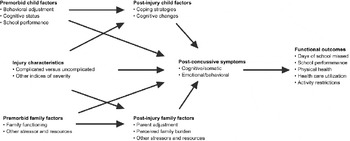
Research also needs to incorporate measures of non-injury related risk factors as possible predictors. In many cases, children with premorbid learning or behavior problems are omitted from studies, although they may be at particular risk for persistent postconcussive symptoms. We recently showed that children’s premorbid cognitive ability moderates the outcomes of mild TBI (Fay et al., Reference Fay, Yeates, Taylor, Bangert, Dietrich and Nuss2009). Parent and family functioning also can be affected by mild TBI (Ganesalingam et al., Reference Ganesalingam, Yeates, Ginn, Taylor, Dietrich and Nuss2008), and may moderate outcomes, as it does in children with more severe TBI (Yeates et al., Reference Yeates, Taylor, Drotar, Wade, Klein and Stancin1997). In the long run, models are needed that capture the interplay of injury-related and non-injury related child and family factors in predicting post-concussive symptoms (see Figure 1).
Model for study of postconcussive symptoms in children with mild traumatic brain injury. Reprinted with permission from Yeates & Taylor, Reference Yeates and Taylor2005, Pediatric Rehabilitation, Vol. 8, p. 12. © 2005 by Informa Medical and Pharmaceutical Science Journals.

Timing of Assessment
Research on mild TBI has often been cross-sectional and focused on relatively short-term outcomes. This problem is compounded in some studies by retrospective recruitment of participants from among clinical referrals, creating a significant ascertainment bias. Prospective and longitudinal studies of unselected samples are needed to examine the sequelae of mild TBI over time, as well as how the relationship of risk factors to post-concussive symptoms varies post-injury (Ponsford et al., Reference Ponsford, Willmott, Rothwell, Cameron, Ayton and Nelms1999).
In longitudinal studies, decisions regarding the timing of assessments are critical (Taylor & Alden, Reference Taylor and Alden1997). Acute post-injury assessments are often desirable, not only to document the acute effects of mild TBI, but also to obtain retrospective measures of children’s premorbid functioning as soon after the injury as possible, and thereby increase the validity of parent recall. The timing of subsequent assessments will be based in part on the expected course of outcomes following mild TBI. The DSM-IV criteria for postconcussive syndrome, for instance, require that symptoms persist for at least 3 months, so an assessment at that time is often desirable (American Psychiatric Association, 1994). However, even longer-term assessments may be needed to determine whether mild TBI results in significant impairment in children’s social or academic functioning.
Prediction of Individual Outcomes
Studies of mild TBI have focused on group outcomes, in part because most common statistical techniques yield results that are based on group data. Thus, most analyses are variable-centered. In clinical practice, however, we want to know whether the occurrence of mild TBI accounts for postconcussive symptoms in a particular patient, because we recognize that the importance of risk factors is likely to vary across individuals. Research on mild TBI should examine individual variations in the outcomes of mild TBI in relation to specific risk factors, by incorporating alternative statistical methods that reflect a person-centered approach (Laursen & Hoff, Reference Laursen and Hoff2006). A person-centered approach can facilitate the identification of individual children most likely to display persistent post-concussive symptoms.
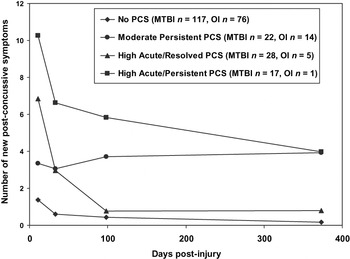
Growth curve modeling, for example, permits the investigation of change at an individual level (Francis, Fletcher, Stuebing, Davidson, & Thompson, Reference Francis, Fletcher, Stuebing, Davidson and Thompson1991; Taylor et al., Reference Taylor, Dietrich, Nuss, Wright, Rusin and Bangert2010). Mixture modeling also can be used to examine intraindividual change, by empirically identifying latent classes of individuals based on different developmental trajectories (Nagin, Reference Nagin2005). Figure 2 provides an example of this approach; it shows developmental trajectories of post-concussive symptoms in children with mild TBI and orthopedic injuries (Yeates et al., Reference Yeates, Taylor, Rusin, Bangert, Dietrich and Nuss2009). In this study, children with mild TBI were more likely than those with orthopedic injuries to demonstrate trajectories involving high acute levels of symptoms. Moreover, children with mild TBI whose acute clinical presentation reflected more severe injury were especially likely to demonstrate such trajectories, in contrast to those with mild TBI with less severe acute presentations. Finally, analyses of reliable change also can be used to identify individual children who display unusually large increases in postconcussive symptoms and to study the risk factors associated with such increases (McCrea et al., Reference McCrea, Barr, Guskiewicz, Randolph, Marshall and Cantu2005).
Illustration of developmental trajectory analysis of postconcussive symptoms in children with mild traumatic brain injury (MTBI) or orthopedic injuries (OI). Four latent groups were identified on the basis of the number of new postconcussive symptoms reported at four occasions post-injury, irrespective of whether participants were in the MTBI or OI group. Modified with permission from Yeates et al., Reference Yeates, Taylor, Rusin, Bangert, Dietrich and Nuss2009, from Pediatrics, Vol. 123, p. 738. © 2009 by American Academy of Pediatrics.

FUTURE RESEARCH DIRECTIONS
Unfortunately, no comprehensive theories are available to guide research on the outcomes of mild TBI at this time. However, future research on mild TBI in children should reflect advances in our understanding of biological, psychological, and social factors that are likely to affect outcomes. At the biological level, genetic factors may help explain variability in outcomes. The apolipoprotetin E gene has not been found to predict outcomes of mild TBI in children (Moran et al., Reference Moran, Taylor, Ganesalingam, Gastier-Foster, Frick and Bangert2009), but many other candidate genes should be examined (Jordan, Reference Jordan2007). Research at a biological level also is likely to yield more sensitive measures of brain injury. For instance, various biomarkers are under study as possible indicators of underlying brain injury in mild TBI (Berger, Hayes, Wang, & Kochanek, Reference Berger, Hayes, Wang, Kochanek, Anderson and Yeates2010). Advanced neuroimaging techniques, such as susceptibility-weighted and diffusion tensor imaging, may also provide a more sensitive assessment of injury severity in mild TBI (Ashwal, Tong, Obenaus, & Holshouser, Reference Ashwal, Tong, Obenaus, Holshouser, Anderson and Yeates2010).
At the psychological level, future research may offer more refined and sensitive measures of cognitive functioning in mild TBI. Computerized testing has the advantage of being able to assess reaction time, which has been shown to be sensitive to concussion (Iverson, Brooks, Collins, & Lovell, Reference Iverson, Brooks, Collins and Lovell2006). Existing measures of postconcussive symptoms are also in need of additional refinement, so that they accurately reflect underlying dimensions of symptom type (Ayr et al., Reference Ayr, Yeates, Taylor and Browne2009). Ideally, screening instruments could be developed that physicians in emergency department and outpatient settings can use to assess children with mild TBI to determine whether to refer for more extensive neuropsychological evaluation (Gioia, Collins, & Isquith, Reference Gioia, Collins and Isquith2008).
Finally, at a social level, research is needed to clarify which aspects of the family and broader social environment influence outcomes and to delineate the mechanisms by which they do so (Rutter, Reference Rutter1999). Recent studies have shown that the family and social environment are related to children’s functioning following TBI (Yeates et al., Reference Yeates, Taylor, Drotar, Wade, Klein and Stancin1997). Future research will benefit from the consideration of more sophisticated models of the relationship between contextual factors and developmental outcomes (Steinberg & Avenevoli, Reference Steinberg and Avenevoli2000).
A key long-term goal for research on the outcomes of mild TBI should be to develop a biopsychosocial model that incorporates developmental considerations and allows for individual variability in the importance of different risk factors. A comprehensive, integrated model should provide a clearer picture of risk and resiliency in children with mild TBI, and thereby foster more effective clinical management (Kirkwood, Yeates, Taylor, Randolph, McCrea, & Anderson, Reference Kirkwood, Yeates, Taylor, Randolph, McCrea and Anderson2008). For instance, the provision of anticipatory guidance can prevent the onset of postconcussive symptoms (Ponsford et al., Reference Ponsford, Willmott, Rothwell, Cameron, Ayton and Nelms2001) and active rehabilitation can ameliorate symptoms when they do occur (Gagnon, Galli, Friedman, Grilli, & Iverson, Reference Gagnon, Galli, Friedman, Grilli and Iverson2009). Future research will enable health care providers to provide parents and children with evidence-based information regarding the effects of mild TBI and to identify those children who are most at risk for demonstrating negative outcomes. Health care providers can then target at-risk children and their families for appropriate management.