Introduction
Relatively little is currently known about adaptive and socio-emotional outcomes following childhood traumatic brain injury (TBI), despite the important implications for psychological adjustment and quality of life (Ganesalingham, Sanson, Anderson, & Yeates, Reference Ganesalingham, Sanson, Anderson and Yeates2006; Gouick & Gentleman, Reference Gouick and Gentleman2004; Spell & Frank, Reference Spell and Frank2000; Yeates et al., Reference Yeates, Bigler, Dennis, Gerhardt, Rubin, Stancin and Vannatta2007). Children with TBI tend to be more impulsive, have reduced emotion regulation and social problem-solving abilities, and increased externalizing behavior problems (Chapman et al., Reference Chapman, Wade, Walz, Taylor, Stancin and Yeates2010; Hanten et al., Reference Hanten, Wilde, Menefee, Li, Lane, Vasquez and Levin2008; Yeates et al., Reference Yeates, Swift, Taylor, Wade, Drotar, Stancin and Minich2004, Reference Yeates, Bigler, Dennis, Gerhardt, Rubin, Stancin and Vannatta2007). Changes in socio-emotional functioning and behavior after TBI can lead to adjustment difficulties and tend to be more persistent and cause greater distress for the patient and their families than acquired cognitive deficits (Milders, Ietswaart, Crawford, & Currie, Reference Milders, Ietswaart, Crawford and Currie2008). Studies to date have documented little evidence for recovery of socio-emotional function after TBI, and frequently outcomes worsen over time (Bornhofen & McDonald, Reference Bornhofen and McDonald2008; Ganesalingham et al., Reference Ganesalingham, Sanson, Anderson and Yeates2006; Yeates et al., Reference Yeates, Swift, Taylor, Wade, Drotar, Stancin and Minich2004). This may be particularly true for children who sustain a brain injury during early childhood, as recent studies have shown that children who sustain TBI at early ages may actually be more vulnerable to long-term deficits (Anderson et al., Reference Anderson, Morse, Catroppa, Haritou and Rosenfeld2004, Reference Anderson, Catroppa, Dudgeon, Morse, Haritou and Rosenfeld2006; Catroppa et al., Reference Catroppa, Anderson, Morse, Haritou and Rosenfeld2008; Chapman & McKinnon, Reference Chapman and McKinnon2000; Weatherington & Hooper, Reference Weatherington and Hooper2006).
Recent conceptual models of socio-emotional functioning (Yeates et al., Reference Yeates, Bigler, Dennis, Gerhardt, Rubin, Stancin and Vannatta2007; Beauchamp & Anderson, Reference Beauchamp and Anderson2010) propose a complex relationship between cognitive-executive processes, social-emotional processes, social problem solving, and social adjustment after childhood brain injury, with outcomes being predicted by injury-related, child, and environmental factors (Yeates et al., Reference Yeates, Bigler, Dennis, Gerhardt, Rubin, Stancin and Vannatta2007). Understanding facial expressions is an important skill that contributes to accuracy in making emotion judgments and interpersonal effectiveness (Denham et al., Reference Denham, Blair, DeMulder, Levitas, Sawyer, Auerbach-Major and Queenan2003). Development of emotion recognition abilities for core emotions occurs throughout infancy and early childhood. In typically developing children, recognition of positive emotions (e.g., happy) develops first, followed by negative emotions (e.g., sad, angry, and fearful). A link between socio-emotional functioning and emotion knowledge, including facial emotion recognition, has been established in typically developing children (e.g., Herba & Phillips, Reference Herba and Phillips2004; Saarni, Campos, Camras, & Witherington, Reference Saarni, Campos, Camras and Witherington2006). Emotion production and emotion regulation processes, in addition to emotion recognition, seem to be important for the prediction of socio-emotional functioning (Leerkes, Paradise, O'Brien, Calkins, & Lange, Reference Leerkes, Paradise, O'Brien, Calkins and Lange2008).
The social–cognitive neural network (e.g., Adolphs, Reference Adolphs2001; Frith & Frith, Reference Frith and Frith2001) involves the ventromedial, orbitofrontal, and dorsolateral regions of the prefrontal cortex, the superior temporal sulcus and temporal–parietal junction, inferior parietal cortex, the fusiform gyrus, anterior cingulate cortex, insula, and the amygdala. During typical development, many of these regions undergo protracted maturation and gradually develop connections, such that the network becomes increasingly integrated. Disruption at an early age would be expected to interfere with this integration. For example, emotion processing develops relatively earlier during development and is supported by a network involving the amygdala, insula, and ventral striatum, whereas higher-order emotion regulation and social cognitive processes emerge later on and rely more heavily on the frontal and temporal regions (Beauchamp & Anderson, Reference Beauchamp and Anderson2010).
The neural network underlying social-cognitive and affective processes may be particularly vulnerable to the effects of TBI. TBI is associated with both focal and diffuse injury. Focal injuries often involve anterior brain regions (Wilde et al., Reference Wilde, Hunter, Newsome, Scheibel, Bigler, Johnson and Levin.2005), many of which are implicated in social cognition. The diffuse injury in TBI usually involves traumatic axonal injury (TAI), which can have widespread impact on brain development and growth. TAI disrupts the formation of white matter connections between regions (Wilde et al., Reference Wilde, Bigler, Haider, Zili, Levin and Li2006), potentially affecting brain regions important for socio-emotional functioning, but located far downstream from the actual injury.
Several recent studies in adult populations have documented evidence for deficits in emotion recognition ability after TBI (e.g., Bornhofen & McDonald, 2008; Croker & McDonald, Reference Croker and McDonald2005; Spell & Frank, Reference Spell and Frank2000). Although the exact nature of these deficits remains unclear, the general consensus is that emotion recognition is impaired shortly after TBI and at long-term follow-up (Ietswaart, Milders, Crawford, Currie, & Scott, Reference Ietswaart, Milders, Crawford, Currie and Scott2008; Green, Turner, & Thompson, Reference Green, Turner and Thompson2004). Generally, negative emotions such as anger, sadness, and fearfulness are more affected than positive emotions such as happiness (Croker & McDonald, Reference Croker and McDonald2005; Green et al., Reference Green, Turner and Thompson2004). Poor emotion recognition and inaccurate interpretation of socio-emotional cues have been associated with poor social skills across a variety of disorders, including autism, schizophrenia, ADHD, and severe behavior problems (Bornhofen & McDonald, Reference Bornhofen and McDonald2008; Herba & Phillips, Reference Herba and Phillips2004; Nowicki & Duke, Reference Nowicki and Duke1994). However, very few studies have investigated direct effects of emotion recognition ability on socio-emotional outcomes after TBI. Croker and McDonald (Reference Croker and McDonald2005) found that poor facial emotion matching ability was related to reduced subjective experience of emotions in adults, particularly negative emotions of sadness and fear, but did not examine socio-emotional behavior. Milders and colleagues (2008) found no relationship between emotion recognition and socio-emotional functioning in adults.
Little research has examined social cognition skills, including emotion recognition, and their relationship to socio-emotional outcomes following pediatric TBI. Schmidt, Hanten, Li, Orsten, and Levin (Reference Schmidt, Hanten, Li, Orsten and Levin2010) found evidence of deficits in processing emotional prosody, as well as in recognition of facial emotion, among children who sustained a TBI between age 7 and 17 years, but did not examine the relationship of emotion recognition to behavior. In a sample of 18 children with diverse brain insults, Tonks, Williams, Frampton, Yates, and Slater (Reference Tonks, Williams, Frampton, Yates and Slater2007) also demonstrated emotion processing deficits in children with brain injury, but found limited evidence that facial emotion recognition deficits were related to socio-emotional outcomes.
The primary goal of the current study was to investigate acute and long-term emotion recognition and labeling ability in young children following TBI, as compared to children with orthopedic injuries (OI). We hypothesized that children with TBI would show deficits in emotion labeling (EL), particularly for negative emotions, as compared to children with OI because (1) studies of adults with TBI have shown specific emotion recognition deficits for negative emotions, and (2) because recognition of negative emotions develops later than positive emotions in typically developing children. Furthermore, the severity of TBI was expected to relate to the extent of EL deficits, with more severe TBI associated with poorer EL performance and less development over time. A secondary aim was to explore the relationship between EL and socio-emotional outcomes. Poor emotion-labeling performance was hypothesized to predict parent-rated socio-emotional maladjustment. We also explored the moderating effects of emotion recognition and injury severity on group differences in socio-emotional outcomes.
Methods
Participants
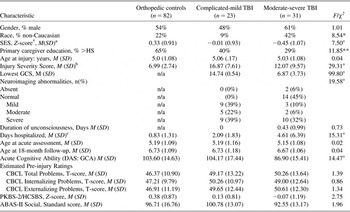
Eighty-seven children with a confirmed TBI were recruited from four tertiary care children's hospitals. Children were between 36 and 84 months of age and hospitalized overnight with either a) a Glasgow Coma Scale (GCS; Teasdale & Jennett, Reference Teasdale and Jennett1974) less than 12 or b) a GCS from 13 to 15 with trauma-related abnormalities on neuroimaging (i.e., computed tomography [CT] or magnetic resonance imaging [MRI] scans). The lowest GCS score recorded for each child was used for injury classification. Children were classified with a moderate to severe TBI based on a GCS score of 12 or less. Children with a GCS score of 13–15 and evidence of abnormality on neuroimaging were classified as having a complicated mild TBI (Williams, Levin, & Eisenberg, Reference Williams, Levin and Eisenberg1990). Imaging abnormalities were coded by study neuropsychologists using available radiology reports to provide more descriptive information on the nature of the imaging. Imaging was coded as follows: “Mild” injury is characterized by presence of a single contusion or hemorrhage; “Moderate” injury by the presence of multifocal lesions without diffuse abnormality; “Severe” injury by the presence of any diffuse abnormality (i.e., edema, swelling, volume loss, and/or diffuse axonal injury), with or without lesions (see Table 1).
Demographic and Injury Characteristics
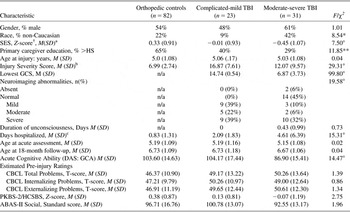
†SES Z-score represents the mean of combined Z-scores for census tract income and primary caregiver education.
*p < 0.05; **p < 0.01; °p < 0.001.
aSevere TBI < OI.
bSevere TBI, Moderate TBI, Complicated Mild TBI > OI.
cOI, Complicated Mild TBI, Moderate TBI<Severe TBI.
dOI, Complicated Mild TBI > Severe TBI.
A control group of 119 children with OI involving a documented bone fracture requiring an overnight hospital stay was also recruited. Children with skull fractures, alterations in consciousness, or other indication of possible brain trauma were excluded. An OI comparison group was selected to control for risk for injury and the experience of hospitalization (McKinlay et al., Reference McKinlay, Kyonka, Grace, Horwood, Fergusson and MacFarlane2010). Additional inclusion criteria for both groups included (a) English as the primary language spoken in the home, (b) no history of child abuse, and (c) absence of diagnosed developmental disability. This study was approved the Institutional Review Board.
Of the 206 children that completed baseline assessments, 157 also completed the 18-month assessment. Only those participants with EL data from both assessments were included in analyses. Two children with TBI and two children with OI were unable to complete the task at baseline due to lack of comprehension, cooperation, or technical problems. Twelve children with TBI and one with OI did not contribute emotion-labeling data at the 18-month assessment due to technical difficulties and two additional children had missing data. One child with TBI and one with OI were excluded because they performed below chance levels on overall EL accuracy at baseline. This resulted in a final sample of 136 children (82 with OI; 54 with TBI).
Attrition rates were similar across groups, with the highest retention in the moderate–severe TBI group (69% OI, 53% Complicated–Mild TBI, and 70% Moderate–Severe TBI). No significant differences were found between children who completed the study and those who did not on injury severity indices, socioeconomic status (SES, defined by the mean of sample Z-scores for census tract median income and primary caregiver education), or pre-injury socio-emotional functioning. However, children who completed the study were more likely to have primary caregivers with a post-high school education (p = .04) and to be female (p = .05).
Procedure
Data were collected during assessments conducted 1–2 months post-injury, as soon as the child was capable of participating, and again at approximately 18 months post-injury. The time between injury and acute assessment was longer for the children with TBI (M = 46.31 days; SD = 23.21) than for children with OI (M = 34.90 days; SD = 14.78; t(144) = 3.61; p < .001. This difference is likely due to longer hospital stays and initial inability to complete testing for the TBI group.
Measures
Emotion labeling (EL)
The Child Faces subtest of the Diagnostic Assessment of NonVerbal Accuracy test (DANVA-2, Nowicki & Duke, Reference Nowicki and Duke1994; Nowicki, Reference Nowicki2003) was used to assess children's ability to recognize and correctly label facial expressions of four basic “core” emotions, including happy, sad, fearful, and angry. The subtest consists of 24 photographs of children displaying emotional expressions (6 photographs for each of the 4 emotions), half low-intensity and half high-intensity. Overall EL accuracy (total correct, collapsed across all conditions) provided a general measure of emotion recognition. To investigate differential labeling ability for specific emotions, total correct for each of the four emotions was also examined. Additionally, mislabeling errors for each of the four emotions were calculated. A mislabeling error was counted when children mislabeled a facial expression as one emotion when it actually displayed one of the other three emotions (e.g., if the child mislabeled a sad face as fearful, this would represent an error for mislabeling as fear). The DANVA-2 has adequate internal consistency and test–retest reliability for individuals age 3 years and above (Nowicki & Duke, Reference Nowicki and Duke1994; Nowicki, Reference Nowicki2003), and demonstrates sufficient variability across the age ranges assessed in the current study, without ceiling or floor effects (3-year-olds M Errors = 11.7; SD = 4.3; 6-year-olds M Errors = 6.2; SD = 3.4).
General cognitive ability (GCA)
The General Conceptual Ability index from the Differential Abilities Scale (DAS; Elliott, Reference Elliott1990) was used at the baseline assessment only to characterize the sample with respect to overall cognitive ability. The GCA is a composite standard score (M = 100; SD = 15) derived from four or six core subtests, depending on the age of the child. These subtests measure early basic cognitive abilities such as verbal knowledge, visual-spatial construction, and early number concepts. The DAS is a well normed and standardized measure, and has established reliability and validity for use with children as young as 2 years, 6 months.
Socio-emotional Measures
Because the term socio-emotional functioning encompasses a wide range of social behaviors, five indices (including measures of behavioral problems, social competence, and adaptive social behaviors, all of which may be expected to be related to EL; see Crick & Dodge, Reference Crick and Dodge1996; Saarni et al., Reference Saarni, Campos, Camras and Witherington2006) were used to assess outcomes. Pre-injury estimates of socio-emotional functioning were obtained at the acute assessment by asking caregivers to rate their child based on their recall of the child's pre-injury functioning. The interval in days from injury to acute assessment did not show a relationship with pre-injury ratings for the OI and complicated-mild TBI groups; however, increasing time since injury predicted lower ratings on the CBCL Total Problems (r = −0.36) and CBCL Externalizing Problems scales (r = −0.45) for the moderate-severe TBI group. Thus, the interval was included as a covariate in regression analyses using the pre-injury ratings as predictors.
Behavior problems
The Child Behavior Checklist (CBCL) parent report form was used to assess behavior problems. The Preschool form (Achenbach & Rescorla, Reference Achenbach and Rescorla2000) was administered for children aged 3–5 years, and the School-Age form (Achenbach & Rescorla, Reference Achenbach and Rescorla2001) for children 6 years or older. Composite scores for the Total, Internalizing, and Externalizing Problem Scales (T-scores, M = 50; SD = 10) were used for analyses for both forms. Higher scores indicate a greater level of problem behaviors.
Social competence rating
To assess social competence, the Social Skills subscale of the Preschool and Kindergarten Behavior Scales (PKBS-2; Merrell, Reference Merrell2002) parent report form was administered for children under age 5 years, while the analogous Social Competence subscale of the Home and Community Social Behavior Scales (HCSBS; Merrell & Caldarella, Reference Merrell and Caldarella2002) was administered for children age 5 years or older. These scales were developed separately but in conjunction to reflect the unique abilities and needs of the different age ranges, rather than simply extending the age range of an established scale. Both scales have been validated in relation to other measures of social behavior and have good reliability (Merrell, Reference Merrell2002; Merrell & Caldarella, Reference Merrell and Caldarella2002). Although the forms are very similar, they produce different standardized scores (PKBS-2 generates standard scores, M = 100, SD = 15; HCSBS generates T-scores, M = 50; SD = 10). To enable direct comparison between the different forms, standardized scores on both measures were converted into Z-scores for analyses, with higher scores reflecting greater social competence. The two sets of Z-scores demonstrated correlations across time that were largely similar in magnitude to the correlations for repeated administrations of the same measure, supporting the assumption that they provide equivalent measures of social competence. In the OI group, correlations for repeated administrations of the PKBS ranged from .55 to .73, correlations for repeated administrations of the HCSBS ranged from .49 to .68, and correlations between the PKBS and HCSBS over time ranged from .50 to .87. In the TBI group, correlations for repeated administrations of the PKBS ranged from .60 to .76, correlations for repeated administrations of the HCSBS ranged from .75 to .86, and correlations between the PKBS and HCSBS over time ranged from .17 to .91.
Adaptive behaviors
The Social subscale of the Adaptive Behavior Assessment System (ABAS-II; Harrison & Oakland, Reference Harrison and Oakland2003) parent rating forms (Infant and Preschool form for ages 3–5 years; School age form for ages 5 years and above) was used as a measure of social adjustment and age-appropriate socialization. The Social composite score is composed of items related to social (e.g., “smiles when he/she sees parent;” “shows sympathy for others when they are sad or upset”) and leisure (e.g., “plays simple games like ‘peek-a-boo’ or rolls a ball to others;” “invites others to join him/her in playing games and other fun activities”) skills, and converted to a standard score (M = 100; SD = 15). The scales have demonstrated validity and reliability, with higher scores indicating greater social adaptive abilities.
Statistical Analyses
The OI, complicated–mild, and moderate–severe TBI groups were compared on injury characteristics and pre-injury demographic and socio-emotional measures using analysis of variance (ANOVA) and χ2 analyses to identify group differences that might influence post-injury EL performance and socio-emotional outcomes. Repeated measures analyses of covariance (ANCOVAs) were performed to explore the course of EL as a function of time since injury. Age at injury, race, SES, and GCA were included as covariates, as age is correlated with the dependent variable of interest and race and SES have been shown to be related to outcomes in previous research (e.g., Yeates et al., Reference Yeates, Taylor, Wade, Drotar, Stancin and Minich2002). Separate analyses were conducted for overall labeling accuracy and accuracy for each of the four emotions.
Group differences on socio-emotional outcome measures were examined using ANCOVA, again controlling for age at injury, GCA, and SES, as well as for pre-injury functioning and interval between injury and acute assessment. Hierarchical linear regression analyses were then conducted to examine the associations between EL at the 18-month follow-up and the change from pre-injury socio-emotional functioning to functioning at 18 months post-injury. Separate regressions were run for each of the five socio-emotional outcome indices. In the first step, predictors included injury group membership (captured using two dummy variables), age at injury, race, SES, and GCA. Because of evidence that long-term socio-emotional functioning is related to pre-injury status (Anderson et al., Reference Anderson, Catroppa, Dudgeon, Morse, Haritou and Rosenfeld2006; Catroppa et al., Reference Catroppa, Anderson, Morse, Haritou and Rosenfeld2008), as well as our interest in predicting post-injury changes in these outcomes, the corresponding pre-injury socio-emotional rating was also included as a covariate. In the second step of the regression models, DANVA-2 EL accuracy at 18-month assessment (overall total correct) was entered as a predictor. To examine the possibility that EL abilities moderated the relationship between injury severity and socio-emotional outcomes, interactions of group contrasts with emotional labeling accuracy were entered as a third step in the models. A second set of hierarchical regressions were conducted in which accuracy for each of the four types of EL were entered into the models in place of the total labeling score to test if labeling accuracy for specific emotions predicted functioning. Power for the statistical analyses was adequate to detect small to medium effect sizes.
Results
Participant Characteristics
Sample characteristics are presented in Table 1. Children with TBI had more serious injuries, and were hospitalized longer than children with OI. The complicated mild TBI group had fewer minority participants than the other groups (p < .05). The groups differed on overall SES (p < .01), with lower SES scores for the moderate–severe TBI group than for the OI group. Significant group differences were also found in acute GCA, F(3,132) = 10.53; p < .001, with lower scores for the moderate–severe TBI group than for the complicated–mild and OI groups.
Group Differences in Emotion Labeling Ability
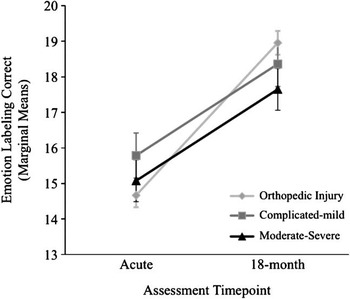
Repeated measures analyses for overall EL accuracy, controlling for age at injury, race, SES, and acute GCA, revealed a significant group × time interaction, F(2,128) = 3.26; p < .05, indicating that groups did not improve at the same rate (see Figure 1). Post hoc pairwise comparisons failed to reveal group differences at baseline; however, at 18 months, the moderate–severe TBI group had lower scores than the OI group (p = .002).
Estimated marginal means, correcting for age at injury, race, SES, and acute GCA for overall emotion labeling accuracy (total correct, out of 24) at acute and 18-month assessments.
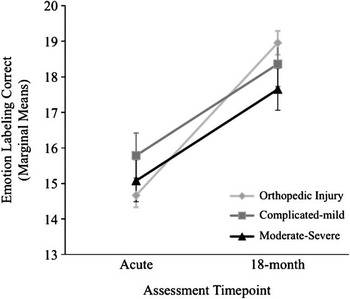
Separate analyses were conducted for correct responses for each emotion. A significant main effect for time was evident for happy faces, F(1,128) = 16.32, p < .01, and sad faces, F(1,128) = 4.38, p < .05, with improved performance at the 18-month assessment. A time effect was not observed for angry (p = .66) or fearful faces (p = .21). Findings also revealed a group x time interaction for fearful faces, F(2,128) = 4.85, p < .01. Post hoc pairwise comparisons indicated that the complicated–mild TBI group was more accurate in identifying fearful faces than the OI and moderate–severe TBI groups at baseline (p < .01). At 18 months, however, the OI group performed significantly better than the moderate–severe group (p < .05).
Separate repeated measures analyses of mislabeling errors for each of the four emotions indicated a significant main effect for time for mislabeling faces as fearful, F(1,128) = 14.15, p < .001, such that all groups made fewer fearful mislabeling errors at 18 months. There were no significant main effects or interactions for mislabeling errors for any of the other emotions.
Socio-emotional Outcomes
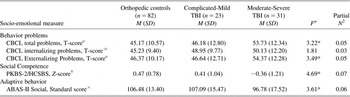
After controlling for pre-injury functioning, significant group differences were found at the 18-month assessment on all socio-emotional measures except for CBCL Internalizing Problems. In general, children with moderate–severe TBI had the poorest outcomes (see Table 2). Rates of scores within the clinically significant range (1.5 SD above or below the mean, depending on the nature of the measure) were significantly higher in the moderate–severe group than in the OI group for CBCL Total Problems (22.6% vs. 4.9%; χ2 = 7.88; p < .01), CBCL Externalizing Problems, (19.4% vs. 4.9%; χ2 = 5.73; p < .05), CBCL Internalizing Problems (19.4% vs. 3.7%; χ2 = 7.43; p < .01), PKBS/HCSBS (16.1% vs. 1.2%; χ2 = 9.81; p < .01) and ABAS Social (14.3% vs. 0%; χ2 = 11.87; p < .01).
Group differences on parent-rated measures of socio-emotional functioning at 18-month post-injury, controlling for pre-injury level of functioning
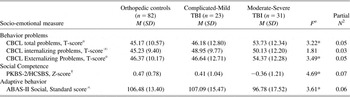
Note. *p < .05; **p < .01.
DANVA-2 = Diagnostic Assessment of Nonverbal Accuracy; CBCL = Child Behavior Checklist; PKBS-2/HCSBS = composite score of Preschool and Kindergarten Behavior Scales and Home and Community Social Behavior Scales; ABAS-II = Adaptive Behavior Assessment System. CBCL: higher scores indicate poorer functioning; PKBS-2/HCSBS and ABAS-II: lower scores indicate poorer functioning.
aCovarying for pre-injury score, time between injury and baseline, age at injury, race, SES, and GCA.
*Groups significantly different at p < .05.
**Groups significantly different at p < .01.
°Mod-Severe TBI > OI, p < .05, Mod-Severe TBI > Compl-Mild TBI, p < .05.
†OI > Severe TBI, p < .05, Compl-Mild TBI > Mod-Severe TBI, p < .05.
∧OI > Mod-Severe TBI, p < .05.
Relationship Between Emotion Labeling and Socio-emotional Outcomes
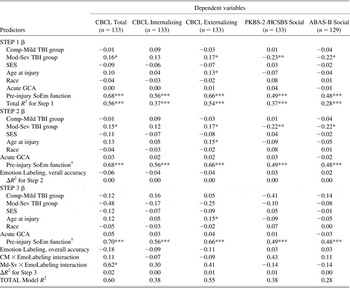
The results of hierarchical linear regression analyses examining the contribution of EL ability at 18 months to the prediction of concurrent socio-emotional outcomes are summarized in Table 3. Pre-injury socio-emotional functioning was the strongest predictor of 18-month socio-emotional outcomes (see Table 3). Controlling for pre-injury functioning, outcome scores were significantly worse for the moderate–severe TBI group than OI group for CBCL Total Problems (β = 0.16; p < .05), CBCL Externalizing Problems (β = 0.17; p < 0.05), PKBS-2/HCSBS (β = −0.23; p < .01), and ABAS Social scales (β = −0.22; p < .05). Age at injury was also associated with the CBCL Externalizing subscale (β = 0.13; p < .05). Although overall EL accuracy failed to account for significant variance in the prediction of any of the outcome measures, analysis revealed a moderate–severe versus OI group contrast x EL interaction for the CBCL Total Score, β = 0.62, p < .05. Examination of this interaction revealed that individuals within the OI and complicated-mild TBI groups showed the expected trend of lower total problem behaviors associated with higher overall EL performance, whereas individuals within the moderate–severe TBI group did not show this pattern. Acute GCA, SES, and race also failed to account for significant variance in the prediction of any of the outcome measures.
Summary of hierarchical linear regression analyses predicting parent-rated socio-emotional outcome from DANVA-2 emotion labeling ability
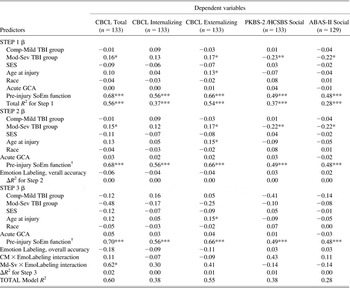
Note. GCA = General Cognitive Ability (Differential Abilities Scale, General Conceptual Ability index); DANVA-2 = Diagnostic Assessment of Nonverbal Accuracy; CBCL = Child Behavior Checklist; PKBS-2/HCSBS = composite score of Preschool and Kindergarten Behavior Scales and Home and Community Social Behavior Scales; ABAS-II = Adaptive Behavior Assessment System. SoEm = Socio-emotional.
†Pre-injury SoEm function refers to the corresponding pre-injury measure (e.g., post-acute CBCL-Total T-score for the 18-month CBCL-Total analysis).
*Significant at p < 0.05; ** Significant at p < 0.01; *** Significant at p < 0.001.
Results from the second set of regression models, in which scores for each of the four emotional expressions were entered in the second step of analysis, were similar to those from the first set of models. These analyses also failed to reveal associations of scores on any of the EL tasks with measures of socio-emotional functioning.
Discussion
The results of the current study are generally consistent with previous research (Schmidt et al., Reference Schmidt, Hanten, Li, Orsten and Levin2010; Tonks et al., Reference Tonks, Williams, Frampton, Yates and Slater2007) and provide partial support for the primary hypothesis that young children with TBI show deficits of EL. Although all groups showed improvements in EL ability between the acute and 18-month assessments after controlling for age, race, SES, and GCA, the moderate–severe TBI group demonstrated less improvement over time and performed more poorly than the OI group at 18 months. These results suggest increasing disparities between children with OI and moderate–severe TBI over time, possibly representing a failure to develop EL skills at an age-appropriate rate. This apparent emergence of EL difficulties is consistent with recent research indicating that the extent of impairments after TBI in young children may not be evident initially, and that children with moderate–severe TBI may “grow into” their deficits in some domains (Anderson et al., Reference Anderson, Morse, Catroppa, Haritou and Rosenfeld2004; Reference Anderson, Catroppa, Dudgeon, Morse, Haritou and Rosenfeld2006; Anderson, Catroppa, Morse, Haritou, & Rosenfeld, Reference Anderson, Catroppa, Morse, Haritou and Rosenfeld2005).
These findings may reflect both the gradual development of EL skills as well as the immaturity of young children's brains at the time of injury. Emotion recognition improves throughout childhood, from infancy through mid- to late childhood (Herba & Phillips, Reference Herba and Phillips2004; Tonks et al., Reference Tonks, Slater, Frampton, Wall, Yates and Williams2008a, Reference Tonks, Williams, Frampton, Yates, Wall and Slater2008b). Preschool-age children rely most on facial expression to read others’ emotions, while older children are better able to also incorporate situational cues to determine the appropriate emotion label (Herba & Phillips, Reference Herba and Phillips2004; Saarni et al., Reference Saarni, Campos, Camras and Witherington2006). Young children display substantial variability in EL performance during the preschool years (Nowicki & Duke, Reference Nowicki and Duke1994), reflecting incompletely developed abilities, individual differences with regard to developmental trajectories, varying timing of skill acquisition and skill level, as well as other cognitive abilities (e.g., language), and exposure to or education about emotional labels (Herba & Phillips, Reference Herba and Phillips2004). This normal variability may mask impairments shortly after injury. However, with further brain maturation and increasing social experience over the early elementary school years, greater disparities may become evident between typically developing children and children with disruptions to the social-cognitive neural network from TBI.
The development of emotion recognition also proceeds at different rates for various emotions. Typically developing children tend to accurately recognize happy facial expressions earliest, followed by improved accuracy in identification of sad and angry faces. Preschool-aged children have more difficulty recognizing fearful faces (Herba & Phillips Reference Herba and Phillips2004). The current results are consistent with these previous observations, such that all groups showed improved labeling for happy and sad faces at the 18-month assessment, but not for angry and fearful faces. Studies of emotion recognition after TBI in adults and children alike have consistently identified a relative difficulty in processing of negative emotions (e.g., Croker & McDonald, Reference Croker and McDonald2005; Tonks et al., Reference Tonks, Williams, Frampton, Yates and Slater2007). The current study also found that emerging EL deficits in the moderate–severe TBI group were the most prominent for faces showing fear. Studies of aggressive children (without TBI) have consistently revealed a negative or hostile attribution bias (Crick & Dodge, Reference Crick and Dodge1996), which may lead to mislabeling of emotional expressions as angry. In the current study, children with moderate–severe TBI demonstrated increased externalizing problems, but did not show a negative emotion attribution bias. This finding suggests that the EL deficits following TBI are related to a developmental lag in emotion recognition skills rather than a cognitive bias (i.e., a negative world view). Further exploration of this possibility could have implications for intervention approaches, such that children with TBI may need direct training on labels for negative emotions rather than interventions geared toward changing cognitive biases.
Emotion Labeling and Socio-emotional Functioning
Consistent with prior reports, children with moderate to severe TBI showed greater socio-emotional and behavioral disturbances at 18 months post-injury than children with OI (e.g., Anderson et al., Reference Anderson, Catroppa, Dudgeon, Morse, Haritou and Rosenfeld2006; Yeates et al., Reference Yeates, Swift, Taylor, Wade, Drotar, Stancin and Minich2004). Although mean scores on the socio-emotional indices fell within the average range for all groups, previous research has shown that the proportions of children with clinically significant deficits were higher among children with severe TBI (Chapman et al., Reference Chapman, Wade, Walz, Taylor, Stancin and Yeates2010). Similarly, in the current sample, there were higher proportions of participants within the moderate–severe TBI group than the OI group with scores in the clinically significant ranges across all outcome measures. Despite group differences in outcomes, the results did not support the hypothesis that EL ability contributes to socio-emotional functioning or to post-injury changes in these outcomes. The hypothesis that EL moderated the relationship between injury severity and socio-emotional outcomes also received only limited support. Specifically, better EL performance was associated with fewer behavior problems following OI and complicated mild TBI, but not moderate–severe TBI. These findings raise the possibility that effects of more severe TBI on other cognitive abilities may obscure associations between EL and behavior. This would be expected, for example, if cognitive deficits in this group contributed to difficulties on the emotional labeling task, thereby diminishing the sensitivity of this task to differences in socio-emotional processing skills. However, analyses to test this hypothesis by including measures of GCA in regression analyses did not support this hypothesis. This finding must be interpreted with caution given that only one of five tested interactions was statistically significant and it was counter to hypotheses.
The lack of associations between EL ability and socio-emotional outcomes in the current study may have been at least partially related to the nature of the task used to measure EL. The DANVA-2 Faces subtest has been shown to be related to measures of social competence, such as teacher ratings in preschool and school-aged children (Nowicki, Reference Nowicki2003). However, the DANVA-2 uses static images of facial expressions that lack social context. Static emotion recognition tasks have less ecological validity that dynamic ones (Kilts, Egan, Gideon, Ely, & Hoffman, Reference Kilts, Egan, Gideon, Ely and Hoffman2003). Additionally, recognition of facial expression does not ensure the capacity to apply this knowledge in a social context (Bornhofen & McDonald, Reference Bornhofen and McDonald2008). Research in emotional and social information processing has suggested that factors such as social problem-solving, effortful control, impulsivity, and emotion regulation ability may be particularly important for predicting socio-emotional functioning (e.g., Eisenberg, et al., Reference Eisenberg, Valiente, Spinrad, Cumberland, Liew, Reiser and Losoya2009; Janusz, Kirkwood, Yeates, & Taylor, Reference Janusz, Kirkwood, Yeates and Taylor2002; Leerkes et al., Reference Leerkes, Paradise, O'Brien, Calkins and Lange2008; Lemerise & Arsenio, Reference Lemerise and Arsenio2000). More complex models may be needed that integrate emotion processing as only one aspect of socio-emotional outcomes (see Beauchamp & Anderson, Reference Beauchamp and Anderson2010; Yeates et al., Reference Yeates, Bigler, Dennis, Gerhardt, Rubin, Stancin and Vannatta2007).
The limited number of studies that have examined EL and its relationship to socio-emotional outcomes after TBI have produced mixed results. Environmental factors such as age, SES, and verbal abilities have all been shown to affect emotion recognition abilities (Herba & Phillips, Reference Herba and Phillips2004; Schmidt et al., Reference Schmidt, Hanten, Li, Orsten and Levin2010). Milders and colleagues (2008) failed to find evidence that impairments in emotion and ToM predicted behavioral problems in adults one 1 year post-TBI. Similarly, Tonks and colleagues (2007) found evidence of emotion processing deficits in children with brain injury, but those deficits were not related to behavioral outcomes. Ganesalingham and colleagues (2006) found that school-aged children with TBI showed an association between measures of emotional, cognitive, and behavioral self-regulation and social and behavioral function at 2 to 5 years post-injury. These studies suggest a need for further research into the dynamic interplay between cognitive impairments, particularly executive ability, and affective and social-cognitive processes, such as emotion recognition, theory of mind, and self-regulation, that contribute to social and behavioral outcomes after TBI.
The current study has several limitations. Measurement issues may have impacted the findings. The small number of pictures on the DANVA-2 Faces subtest that depict each emotional expression may have made it difficult to detect group differences. Furthermore, it involves the presentation of faces for only approximately 2 seconds each, a presentation rate that may pose a challenge for preschool-aged children, particularly those with TBI. Deficits in other abilities affected by TBI such as attention, processing speed, working memory, and language could also affect emotional labeling performance. A task with more trials, longer exposure times, and the use of more dynamic stimuli may have yielded more significant findings. Additionally, the retrospective nature of parental reports of pre-injury socio-emotional functioning is not ideal, and the length of time between injury and initial assessment may have affected parent ratings of pre-injury externalizing behaviors for children within the moderate–severe TBI group. Another limitation of the current study is the lack of detail regarding brain lesions in the children with TBI. Research has identified relationships between emotion recognition ability and focal lesions in the prefrontal cortex (Hanten et al., Reference Hanten, Wilde, Menefee, Li, Lane, Vasquez and Levin2008) and right posterior cortex (Green et al., Reference Green, Turner and Thompson2004) in adults with TBI. TAI, even in the absence of focal lesion, can also produce emotion recognition deficits (Green et al., Reference Green, Turner and Thompson2004). Although very young children often have more diffuse injuries than adults, focal lesions can still occur and may produce very specific types of impairments. The imaging data in the current study are not sensitive enough to make inferences based on lesion type, location, or TAI. More specific information about injury severity, combined with neuroimaging, may provide additional insights into emotion processing and socio-emotional outcomes in young children with TBI.
The results of the current study suggest that moderate to severe TBI in young children alters the developmental trajectory of EL and socio-emotional regulation abilities, resulting in increasing functional problems compared with same age peers over time. This may be due to their failure to develop abilities at a comparable rate to their peers, or because children with moderate and severe TBI may recover at a slower rate than those with milder injuries. The latter possibility would suggest that group differences may eventually diminish with increasing time post-injury. Longer-term follow-up is needed to determine whether these children are able to catch up with their same-age peers or whether their impairments reflect more permanent deficits and a true failure to develop appropriate abilities. Longer-term follow-up is also needed to more fully elucidate the relation between emotion recognition and socio-emotional outcomes after early childhood TBI.
Acknowledgments
This work is supported by grant R01 HD42729 from NICHD and by Trauma Research grants from the State of Ohio Emergency Medical Services. This publication was also supported by an Institutional Clinical and Translational Science Award, NIH/NCRR Grant Number 1UL1RR026314. Its contents are solely the responsibility of the authors and do not necessarily represent the official views of the NIH. Portions of this work have been presented at the 8th World Congress on Brain Injury in Washington, DC (March 2010). The information in this manuscript is an original contribution to the literature and has not previously been published, electronically or in print. The authors certify that we know of no conflict of interest, and we adhere to the ethical guidelines of the Helsinki Declaration.
The authors acknowledge the contributions of Christine Abraham, Andrea Beebe, Lori Bernard, Anne Birnbaum, Beth Bishop, Tammy Matecun, Karen Oberjohn, Elizabeth Roth, and Maegan Swarthout in data collection and coding. The Cincinnati Children's Medical Center Trauma Registry, Rainbow Pediatric Trauma Center, Rainbow Babies & Children's Hospital, Columbus Children's Hospital Trauma Program, and MetroHealth Center Department of Pediatrics and Trauma Registry provided assistance with recruitment. We thank three anonymous reviewers for providing numerous helpful comments and suggestions for improving the manuscript.