INTRODUCTION
Turbot, Scophthalmus maximus, is one of the most important farmed fish in Europe. According to the Food and Agriculture Organization production of turbot has doubled in Europe in the last decade reaching 8396 t in 2010 (FAO, 2010). A significant increase in losses, caused by pathogens, in cultured turbot has been closely associated with the fast growth of the aquacultured turbot worldwide. Diseases limit the productive potential and the quality of the aquaculture industry. Bacterial, viral and parasitological pathologies produce significant losses in aquaculture, not only by causing elevated mortalities, but also by producing physical abnormalities in the fish that might lead to unmarketable products.
Distinguished, by importance, among parasites that affect cultured turbot are those that are produced by ciliates (Uronema marinum, U. nigricans, Philasterides dicentrarchi) (Sterud et al. Reference Sterud, Hansen and Mo2000; Padros et al. Reference Padros, Zarza and Crespo2001), by mixosporidians (Enteromyxum scophthalmi) (Branson et al. Reference Branson, Riaza and Alvarez-Pellitero1999) and by microsporidians. Microsporidians are probably the parasites that provoke the biggest losses in farmed turbot (Person-Le, Reference Person-Le and Barnabé1990; Estevez et al. Reference Estevez, Iglesias, Leiro, Ubeira and Sanmartin1992; Figueras et al. Reference Figueras, Novoa, Santarem, Martinez, Alvarez, Toranzo and Dykova1992; Lom and Dykova, Reference Lom and Dykova1992). Within the microsporidia, Tetramicra brevifilum should be considered a major threat to the culture of turbot (Estevez et al. Reference Estevez, Iglesias, Leiro, Ubeira and Sanmartin1992; Figueras et al. Reference Figueras, Novoa, Santarem, Martinez, Alvarez, Toranzo and Dykova1992). It causes big losses in the number of fish, reduces the growth rate of turbot when it progresses to the disease and when the infection is of high intensity it may lead to unmarketable fish due to the liquefaction of the skeletal muscles (Figueras et al. Reference Figueras, Novoa, Santarem, Martinez, Alvarez, Toranzo and Dykova1992).
This parasite infects the connective tissue of the muscle (Matthews and Matthews, Reference Matthews and Matthews1980), and may also infect the liver and intestine (Estevez et al. Reference Estevez, Iglesias, Leiro, Ubeira and Sanmartin1992). Affected fish show erratic swimming behaviour, swelling of different parts of the body, darkening of the dorsal surface and overproduction of mucus. Heavily infected fish present jelly-like muscles (Figueras et al. Reference Figueras, Novoa, Santarem, Martinez, Alvarez, Toranzo and Dykova1992). Infections by microsporidians are usually difficult to control because of the longevity of the spores and by its direct transmission.
Diseases caused by parasites are difficult to diagnose, and a delayed histological diagnosis could aggravate the infection in the culturing tanks (Alvarez-Pellitero et al. Reference Alvarez-Pellitero, Quiroga, Sitja-Bobadilla, Redondo, Palenzuela, Padros, Vazquez and Nieto2004; Feist and Longshaw, Reference Feist and Longshaw2008). Furthermore, the most commonly used treatments currently involve massive application of chemicals and antibiotics (Harikrishnan et al. Reference Harikrishnan, Jin, Kim, Kim, Balasundaram and Heo2010), and the use of vaccines (Lamas et al. Reference Lamas, Sanmartin, Parama, Castro, Cabaleiro, de Ocenda, Barja and Leiro2008; Sanmartin et al. Reference Sanmartin, Parama, Castro, Cabaleiro, Leiro, Lamas and Barja2008) that do not always exist for all cases. Therefore, it is necessary to develop methodologies that can be used for routine checks and early detection of pathogens in order to prevent the establishment and the spreading of the disease. Hence, the method will reduce the overuse of chemicals and antibiotics.
Up to date, the diagnosis of the infection caused by T. brevifilum in turbot was based almost exclusively on histological and ultrastructural studies (Matthews and Matthews, Reference Matthews and Matthews1980; Estevez et al. Reference Estevez, Iglesias, Leiro, Ubeira and Sanmartin1992; Figueras et al. Reference Figueras, Novoa, Santarem, Martinez, Alvarez, Toranzo and Dykova1992). Other techniques such as immunological ones, may have limited value for the use on parasites like microsporidians that have various life-cycle stages, since antigen composition or morphology may vary among different life-cycle stages (Bartholomew et al. Reference Bartholomew, Smith, Rohovec and Fryer1989). In contrast, molecular methods do not depend on morphological characteristics and on the life-cycle stages (Bartholomew et al. Reference Bartholomew, Rodriguez and Aradawa1995). One of the principal advantages of Polymerase Chain Reaction (PCR) compared to microscopical methods is the capacity of detecting early infections (Andree et al. Reference Andree, MacConnell and Hedrick1998). In recent years, PCR techniques have been developed for the detection of different species of microsporidia. The study carried out by Leiro et al. (Reference Leiro, Iglesias, Parama, Aragort and Sanmartin2002) is worthy of note, in which T. brevifilum was detected by conventional PCR using ribosomal DNA.
The relevance of the present study is the development of a molecular technique for rapid detection of T. brevifilum readily applicable in the aquaculture industry. This technique is based on Real-Time PCR and is of easy implementation in fish farms. Furthermore, this methodology is characterized by its high specificity and sensitivity. The method is a fast and effective tool that can be used at any stage of the life cycle of fish, regardless of the life-cycle stage of the parasite or the infection intensity.
MATERIALS AND METHODS
Sample collection, storage and DNA extraction
Juvenile turbot, Scophthalmus maximus (50–100 g) infected with Tetramicra brevifilum were provided from a local farm in the north of Galicia (Insuíña S.L, Spain). The parasite was previously identified by ultrastructural studies by experts at the farm. The infected fish were preserved and transported whole under refrigerated conditions until isolation of the parasite at the laboratory. Microsporidian spores were aseptically isolated from infected turbot by scraping xenomas (spore aggregates) from gills and fins. DNA extraction from xenomas was performed according to the protocol described by Herrero et al. (Reference Herrero, Vieites and Espiñeira2011). The quality and quantity of the DNA extractions have been determined by measuring the absorbance at 260 nm and the 260/280 and 234/260 ratios using a NanoDrop™ ND-1000 spectrophotometer (Thermo Scientific) (Winfrey et al. Reference Winfrey, Rott and Wortman1997). DNA extractions were appropriately labelled and stored at −80 °C for subsequent tasks.
Design of a specific real-time PCR method to detect Tetramicra brevifilum
From ssrRNA (18S rRNA) sequences obtained from the NCBI database (AF364303 and EF126038) two internal primers and a probe set specific for T. brevifilum were designed: Parasit_Scopht F (5′-CTG AGA RAC GGC TAC CA-3′), Parasit_Scopht R (5′ TGG AGC TGG WAT TAC CG-3′); and a labelled probe, TETRAMICRA PROBE (5′-6-FAM-CAC CAG CCT TGA CCT CCA GTT ACC-BHQ1-3′). The same region was selected for use as an inhibitor control. The DNA extraction control allows amplification with Scophthalmus maximus. From ssrRNA (18S rRNA) sequences obtained from the NCBI database a specific probe for S. maximus was designed: 5′-6-FAM-CGC AAA TTA CCC ACT CCC GAC TC-BHQ-1-3′. This probe, CONTROL ROD 1, was used with the same primer pair designed for the detection of T. brevifilum.
For both primers/probe sets designed, PCR was performed in a total reaction volume of 20 μl containing 100 ng DNA template, 10 μl TaqMan Fast Advanced Master Mix (Applied Biosystems), the optimized amount of primers and probe, and molecular biology grade water (Eppendorf) adjusted up to the final volume. Optimal amounts of primers and probe were evaluated by preparing a dilution series to determine the minimum concentrations giving the maximum ΔRn (normalized reporter, defined as emission intensity of reporter/Emission intensity of passive reference). First, forward and reverse primer concentrations of 50, 300, 500 and 900 nM were evaluated with a constant probe concentration of 50 nM. Following primer optimization, probe optimization was initiated using concentrations of 50–250 nM.
The reaction was performed in triplicate on DNA samples in MicroAmp Optical 96-well reaction plates (Applied Biosystems) with MicroAmp optical caps (Applied Biosystems) in the ViiA™ 7 Real-Time PCR System (Applied Biosystems). Amplification was carried out with the following cycling protocol: 95 °C for 20 s, and 40 cycles each of 95 °C for 1 s and 60 °C for 20 s.
Analytical specificity and detection limit (LDO)
The specific primers/probe set for T. brevifilum was tested on DNA extracts from the most important parasites affecting turbot (Uronema spp., Enteromyxum scophthalmi, and Philasterides dicentrarchi) and on its host (Scophthalmus maximus).
To determine the sensitivity of the method, a serial dilution of T. brevifilum DNA was performed with turbot DNA in levels ranging from 100 ng/μl to 10 pg/μl, and the fluorescence signal was determined for the primer/probe set for T. brevifilum. The dilutions were prepared by a mixture of T. brevifilum DNA and turbot DNA at different levels until completing a final amount of 100 ng. All measurements were performed in triplicate from 3 separate samples. The sensitivity of the control primers/probe set was calculated in the same way as described above.
Application of the developed Real-Time PCR method in cultured turbot
The method was validated in infected and non-infected fish samples provided from a local farm in the north of Spain. All samples were analysed by means of classical histological techniques carried out by a pathologist from these farms. Subsequently, they were transported to the laboratory under refrigerated conditions and were analysed with the described methodology.
RESULTS AND DISCUSSION
The use of Real-Time PCR has increased over recent years. The importance of this methodology for research and parasitological diagnosis in fish and meat is reflected in a large number of published studies (Alonso et al. Reference Alonso, Herrero, Vieites and Espineira2011, Reference Alonso, Lago, Herrero, Vieites and Espiñeira2012). It has become a major tool for the detection of pathogens in aquaculture. However, as with any methodology for the detection of presence-absence, the risk of false-positive or false-negative results exists. The way to monitor its occurrence is by employing controls (Hoorfar et al. Reference Hoorfar, Malorny, Abdulmawjood, Cook, Wagner and Fach2004; Apfalter et al. Reference Apfalter, Reischl and Hammerschlag2005; Lee et al. Reference Lee, Lee, Park, Suh, Jheong, Oh and Paik2011). The present methodology, in addition to the standard controls of a PCR technique, (negative, positive and reagents blank), includes an inhibitor control. The function of this control is, in the case of a negative result in the assay, to confirm that the sample is certainly negative because it is itself indicative of the non-existence of any inhibitor substance that could block the fragment amplification. It avoids false negative results. The application of these controls in this study assures the correct development of the assay.
Design of a specific Fast Real-Time PCR method to detect T. brevifilum
In the present work, a specific fast Real-Time PCR method for authentication of T. brevifilum was designed. For this, from a selected internal region of the 18S rRNA, the primer/probe set for T. brevifilum was designed. This set generates PCR products of 162 bp. At the same time, another probe for detection of S. maximus with the same primer pair was designed. This was used for the detection of S. maximus. In this case, this set generates PCR products of 199 bp. The difference between the size of the amplified products and the same primer pair is due to length polymorphism of the 18S rRNA marker between different species (Budino et al. Reference Budino, Lamas, Pata, Arranz, Sanmartin and Leiro2011; Gruebl et al. Reference Gruebl, Frischer, Sheppard, Neumann, Maurer and Lee2002; Kaukas and Rollinson, Reference Kaukas and Rollinson1997).
Optimization of the reaction gave the best results in terms of specificity, sensitivity, efficiency and reproducibility of Real-Time PCR for the detection of T. brevifilum. This was possible by means of the mixture of different concentrations of primers and probe. Concentrations of 900 nM for both primers and 250 nM for the probe yielded the highest endpoint fluorescence and the lowest threshold cycle. The same optimal concentrations of primers and probe for the control set of S. maximus were obtained. The specificity of the Real-Time PCR system was tested with DNA from the most important parasites that affect turbot (Uronema spp., Enteromyxum scophthalmi, and Philasterides dicentrarchi) and with its host (Scophthalmus maximus) to verify the suitability and reliability of the method. No cross-reactivity was observed with any of the tested samples using the methodology herein developed.
A methodology for the detection of pathogens must be specific and it must be able to differentiate with all security whether the species of interest are present or not. This security is supplied by the specificity of the assay. The application of the developed methodology to different related species, both for their genetic proximity as for having the same host, must assure the specificity of the method. In this case the specificity was tested for species host-related to avoid interferences or cross-reactivity by the presence of other parasites.
The threshold cycle (Ct) is a basic parameter of the Real-Time PCR and it is an essential component producing accurate and reproducible data. It is defined as the fractional PCR cycle number at which the reporter fluorescence is greater than the threshold. The Ct is dependent on the starting template copy number, the efficiency of PCR amplification, the efficiency of cleavage or hybridization of the fluorogenic probe, and the sensitivity of detection (Bustin, Reference Bustin2004). The aim of the data analysis is to determine when target amplification is sufficiently above the background signal, by facilitating more accurate measurement of fluorescence. In all samples analysed, when 100 ng of template were used, the Ct values obtained were 21·5 ± 5·5 and 15·3 ± 1·5, for T. brevifilum and S. maximus primer/probe set respectively. For the T. brevifilum primer/probe set, Ct >40 corresponded to the values of non-target species (the most important parasites affecting the turbot) and negative controls. Also, in the cross-reactivity analysis, no false positive results were observed under the most severe conditions used in the test.
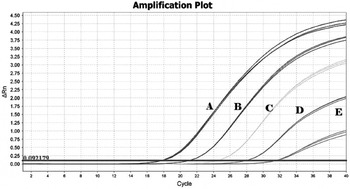
The accuracy of the Real-Time PCR is highly dependent on the PCR efficiency. In the developed method, it was calculated based on the slope of the standard curve obtained using DNA serial dilutions with a template of known concentration (from 250 ng to 25 pg) as templates for Real-Time PCR (Fig. 1). The efficiency (E) of the reaction was calculated according to the equation E = (10(−1/slope) − 1) × 100 (Bustin, Reference Bustin2004). The amplification plot of the experiment with the primer/probe set T. brevifilum and S. maximus generated a slope of −3·34 and −3·37 and an efficiency of 99% and 98%, respectively, with a correlation coefficient of 0·999 in both primer/probe sets. These values of Ct and efficiency have demonstrated the utility of the Real-Time PCR system to detect T. brevifilum and S. maximus, which is used as control of the methodology developed, being the efficiency near to 100%. This confirms that real-Time PCR is a robust methodology to detect the presence of T. brevifilum in cultured turbot. The limit of detection of the developed Real-Time PCR assay reveals that at least 15 and 0·01 pg of the target DNA of T. brevifilum and S. maximus, respectively, are necessary for positive results. This difference in the limit of detection is due to the failure to isolate the parasite from fish. The DNA extraction from Tetramicra includes parasite and S. maximus DNA.
Efficiency of the Real-Time PCR assay: (A) 250 ng, (B) 25 ng, (C) 2·5 ng, (D) 250 pg, and (E) 25 pg of total DNA extracted from Tetramicra brevifilum as template in the PCR.

The sensitivity obtained is very important at the moment of the detection because sensitivity allows detection of the presence of T. brevifilum at early stages of infection, when the infection intensity is low, and regardless of the life-cycle stage of the parasite. The method permits early control measures and consequently avoids a systematic propagation of the pathogen.
Application of the developed Real-Time PCR in cultured turbot
The extracted DNA showed a good yield with optimal purity in all the products analysed (data not shown) and both molecular and classical histological techniques showed concordant results for the detection of T. brevifilum in the analysed samples.
The developed methodology allowed detection of T. brevifilum despite the life-cycle stage of the parasite, and the fact that the infection intensity was low. In addition, it provides an effective tool for the control and prevention of spreading of this pathogen in cultured turbot. The early control of pathologies improves the health and welfare of cultured fish. It also may lead to a reduction of the use of disinfecting chemicals and antibiotics in aquaculture and, as a result, it could minimize the environmental impact of the culture at the same time as increasing the profitability of the aquaculture sector. The methodology developed in this study for the detection of T. brevifilum can be applied to other cultures affected by this parasite, and as a sanitary control of fisheries such as in the control of Lophius budegassa (Maíllo et al. Reference Maíllo, Amigó, Baena, Salvadó and Gracia1998). For its application to other species it will be necessary to check the specificity of the inhibitor control developed with the new host species. If the control does not obtain amplification for this host it will be necessary to design a new specific inhibitor control for the species under study. This character extends the application of this detection methodology, and provides a widespread tool of control for infections for this parasite.
Additional research is necessary to use the developed methodology in the water of the turbot farm. Future research should focus on aspects such as evaluating what is the best filtration system, the adequate volume of infected water, the influence of infection intensity, and other aspects relevant for the recovery of the parasite. The identification of parasites in the water of the turbot cultures could amplify the capacity of detection of this parasite and avoid the sacrifice or stress of the fish.
ACKNOWLEDGeMENTS
This work was funded by the 10MMA006E grant from the Consellería de Innovación e Industria de la Xunta de Galicia. We thank Jacobo Docal and Martín Gómez from INSUIÑA S.L. for their helpful assistance and for kindly supplying the fish and parasites samples.