



Benzodiazepines and Z-drugs are commonly prescribed for the treatment of anxiety and insomnia in women of reproductive age, including during pregnancy. Reference Chan, Gao, Howard, Simonoff, Coghill and Ip1 Despite clinical guidelines recommending caution, prenatal exposure to these medications remains prevalent, raising concerns about their potential long-term impact on child neurodevelopment. Reference Grigoriadis, Graves, Peer, Mamisashvili, Ruthirakuhan and Chan2,Reference Wang, Zhang, Ekheden, Chang, Hellner and Jan3 Although both classes act as benzodiazepine receptor agonists at the γ-aminobutyric acid (GABA)-A receptor, their clinical indications differ: benzodiazepines are typically prescribed for anxiety disorders Reference Griffin, Kaye, Bueno and Kaye4 whereas Z-drugs are primarily indicated for insomnia. Reference Dietmaier, Riederer, Laux, Nagatsu, Le and Riederer5 These differences in maternal clinical context and pharmacology suggest that their neurodevelopmental risk profiles may not be identical, warranting separate evaluation. The underlying mechanisms by which benzodiazepines may affect fetal brain development include modulation of GABA neurotransmission during critical periods of neurogenesis and synaptogenesis. Reference Warm, Schroer and Sinning6
Several cohort studies have examined prenatal exposure to benzodiazepines or Z-drugs and the risk of neurodevelopmental disorders, but findings remain inconsistent. While some have reported increased risks of autism spectrum disorder and attention-deficit hyperactivity disorder (ADHD), Reference Chen, Wu, Lin, Lu, Chen and Stewart7 others have found no significant associations after controlling for maternal psychiatric conditions and polypharmacy. Reference Lupattelli, Chambers, Bandoli, Handal, Skurtveit and Nordeng8 Moreover, most prior studies were limited by small sample size or inadequate follow-up duration, making it difficult to detect long-term effects.
To address these limitations, we conducted a nationwide, population-based cohort study using 13 years of follow-up data in South Korea. We aimed to investigate whether prenatal exposure to benzodiazepines and Z-drugs is associated with an increased risk of long-term neurodevelopmental disorders (LNDDs) in offspring.
Method
Study design and ethical considerations
This retrospective, population-based cohort study was conducted using administrative health data and is reported in accordance with the Strengthening the Reporting of Observational Studies in Epidemiology guidelines. Reference von Elm, Altman, Egger, Pocock, Gøtzsche and Vandenbroucke9 The protocol was approved by the Institutional Review Board of Seoul National University Bundang Hospital (no. X-2407-910-902) and by the National Health Insurance Service (NHIS, no. NHIS-2025-02-1-010), which also granted database access. Because all data were deidentified and collected for routine health service purposes, informed consent was waived under applicable Korean regulations and the principles of the Declaration of Helsinki (1975, revised 2008).
Data source
Data were obtained from NHIS, South Korea’s national single-payer health insurance programme, which provides mandatory coverage for all citizens and long-term residents. The database includes detailed longitudinal information on prescriptions, procedures, diagnoses, mortality and sociodemographic factors. Diagnoses are coded using ICD-10. Although most physicians in Korea work in the private sector, their clinical activities, including reporting and billing, are closely regulated by the government, ensuring uniform data quality across healthcare providers. Reference Lee, Lee, Park, Shin and Kim10
Study population
We identified all live births in South Korea between 1 January 2011 and 31 December 2014, using the NHIS database. Maternal records were subsequently linked to each infant. Deliveries with incomplete or missing information were excluded to ensure data integrity and analytical validity.
Perinatal BZRA exposure
Offspring were classified into the BZRA group if their mothers had received any prescription for benzodiazepines (e.g. alprazolam, clonazepam, diazepam) or Z-drugs (e.g. zolpidem) at any point during pregnancy. Those with no such prescriptions formed the non-BZRA group. The estimated date of the last menstrual period (LMP) was calculated by subtracting from the delivery date 245 days (35 weeks) for preterm births and 273 days (39 weeks) for term birth, following validated algorithms. Reference Margulis, Setoguchi, Mittleman, Glynn, Dormuth and Hernandez-Diaz11,Reference Sujan, Rickert, Oberg, Quinn, Hernandez-Diaz and Almqvist12 To minimise exposure misclassification, mothers who were prescribed BZRAs within 90 days prior to the estimated LMP were excluded from the non-BZRA group.
Within the BZRA group, exposure was further categorised by trimester: first (1–12 weeks post-LMP), second (13–27 weeks) and third (28–40 weeks). Exposure intensity was defined by cumulative days supplied during pregnancy after merging overlapping fills with a 14-day grace period, and categorised as 0, 1–6, 7–29 and ≥30 days. For drug class–specific analyses we created mutually exclusive categories: benzodiazepines only, Z-drugs only and concurrent exposure; class-specific models compared each ‘only category with the unexposed, excluding concurrent exposure.
Study outcome (LNDDs)
The primary end-point was the identification of LNDDs in children, assessed to 31 December 2023. LNDD cases were defined based on ICD-10 diagnostic codes F70–98, as documented in the NHIS database. In South Korea, these codes are required before patients can receive government-funded assistance for neurodevelopmental conditions, supporting the reliability of coding practices in this context. This definition is consistent with prior literature, which includes intellectual disabilities (F70–9), developmental disorders such as speech and language or motor impairments (F80–9) and behavioural/emotional disorders typically presenting in childhood and adolescence (F90–8) as part of the LNDDs classification spectrum. Reference Blotière, Miranda, Weill, Mikaeloff, Peyre and Ramus13,Reference Kuroda and Tamiya14
Maternal and neonatal covariates
Maternal and infant covariates were obtained separately. Maternal demographic characteristics included age at delivery, grouped as ≤20, 21–25, 26–30, 31–35, 36–40 and ≥41 years. Household income at the time of delivery was categorised into quartiles based on health insurance premium levels, with an additional category for recipients of the medical aid programme, a government-supported scheme that provides zero-cost medical coverage to individuals with low income. Information on maternal employment (including self-employment) and place of residence was also included; residential areas were classified as either urban (Seoul and other major metropolitan cities) or rural (all other regions).
Maternal health status at baseline was evaluated using the Charlson comorbidity index, based on the presence of 17 established comorbid conditions. Additionally, psychiatric diagnoses commonly associated with BZRA prescriptions – namely depression, anxiety disorders, insomnia and alcohol use disorders – were included as covariates. We also adjusted for pregnancy-related maternal conditions such as placental disorders, complications of labour and delivery and other medical or surgical comorbidities (diagnostic codes listed in Supplementary Table 1 available at https://doi.org/10.1192/bjp.2025.10481). For neonatal variables, we included gender and 14 specific perinatal disorders identified using ICD-10 codes (Supplementary Table 2).
Statistical analysis
Categorical variables were expressed as counts and percentages, while continuous variables were reported as means with standard deviations. To minimise baseline differences between BZRA-exposed and -unexposed groups, we applied propensity score matching. Reference Rosenbaum and Rubin15 Propensity scores were estimated using logistic regression models incorporating all covariates of interest. A 1:10 nearest-neighbour-matching algorithm without replacement was implemented, using a caliper of 0.2, to maximise retention of participants from the larger, non-BZRA group. Covariate balance between the groups before and after matching was evaluated using absolute standardised mean differences (ASDs), with a threshold of <0.1 indicating adequate balance. Standard univariable logistic regression analyses were then conducted in both the propensity score-matched cohort and full (unmatched) cohort to estimate odds ratios and 95% confidence intervals for the overall risk of LNDDs, as well as for each diagnostic subgroup (intellectual disabilities, disorders of psychological development and behavioural or emotional disorders with onset typically in childhood or adolescence).
We also conducted a series of sensitivity analyses using multivariable logistic regression in the full, unmatched sample. These analyses (a) assessed robustness relative to the matched analysis, (b) evaluated exposure intensity (0, 1–6, 7–29, ≥30 days) and (c) examined trimester-specific effects. We further ran drug class–specific models (benzodiazepines only and Z-drugs only, excluding concurrent exposure). All models included adjustment for potential confounders, with multicollinearity assessed using variance inflation factors (all <2.0). To address unmeasured familial and genetic confounding, we constructed a discordant sibling cohort by linking births to the same mother and restricting to families with two or more singleton births in which exposure status differed across pregnancies. We employed mother-stratified conditional logistic regression (fixed-effects model), which inherently controls for stable maternal characteristics, and further adjusted for time-varying pregnancy-specific covariates (maternal age at delivery, calendar year/quarter, obstetric complications and depression/insomnia/anxiety diagnoses). Additional sensitivity tests included exclusion of offspring who died during follow-up, to address potential survivorship bias, and stratified analyses by follow-up intervals (0–4, 5–9 and 10–13 years) to evaluate time-specific patterns in risk. All statistical analyses were performed using R software (version 4.3.2; R Foundation for Statistical Computing, Vienna, Austria), with two-sided P-values <0.05 considered statistically significant.
Results
Cohort selection and matching
Between 1 January 2011 and 31 December 2014, we identified 1 821 452 live births associated with 1 231 523 mothers in the NHIS database. We excluded 267 947 births and 10 637 mothers due to missing or incomplete delivery-related data, yielding an eligible study population of 1 553 505 births from 1 220 886 mothers. Of these, 5967 offspring were assigned to the BZRA-exposed group based on maternal prescriptions for benzodiazepines or Z-drugs during pregnancy. Among the remaining 1 547 538 births, 4788 were excluded due to maternal BZRA use within 90 days prior to the estimated conception date, resulting in 1 547 413 unexposed births eligible for inclusion in the non-BZRA group.
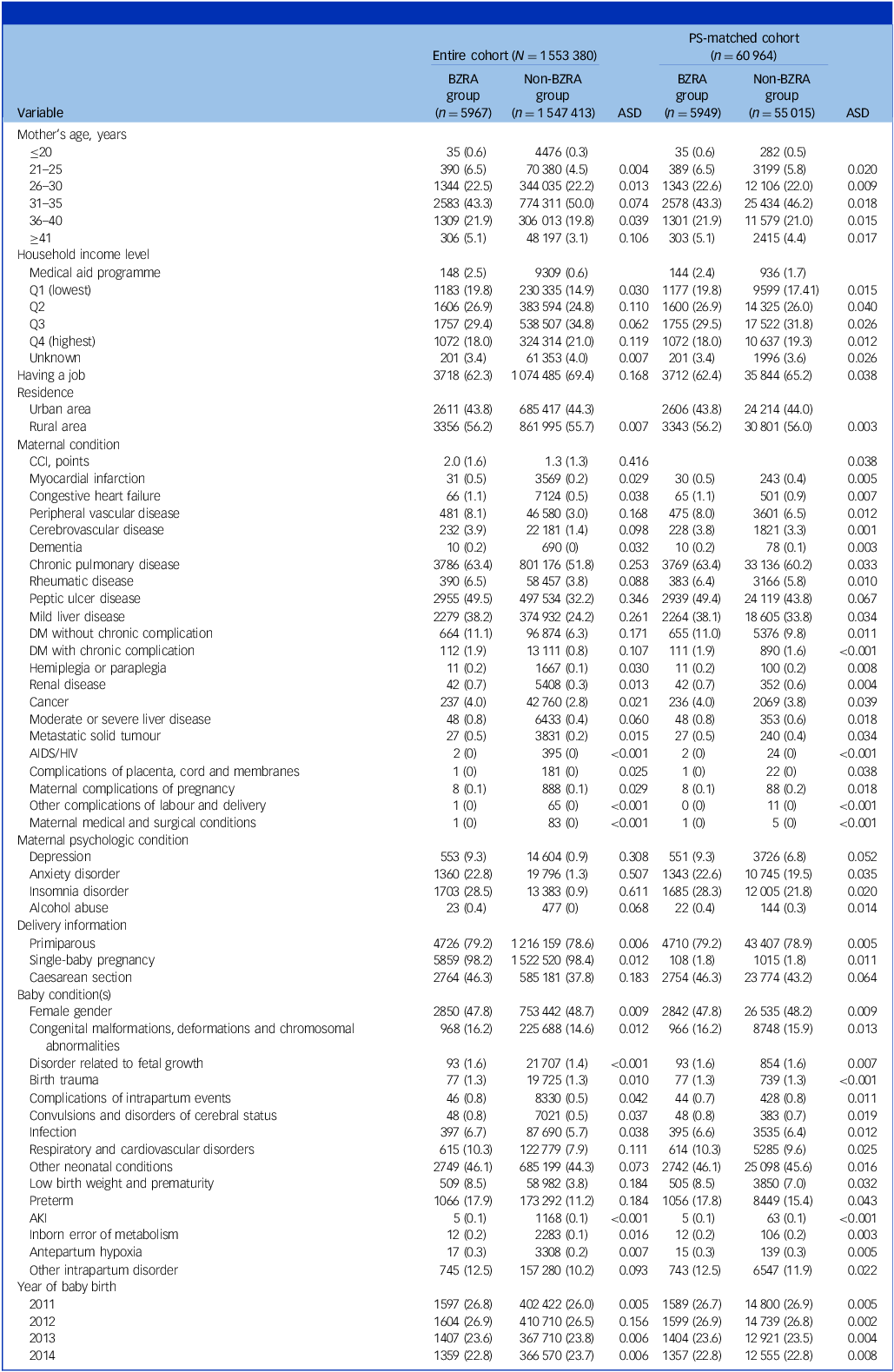
Propensity score matching was then performed using a 1:10 nearest-neighbour algorithm, resulting in a final matched cohort comprising 60 964 births – 5949 in the BZRA group and 55 015 in the non-BZRA group. Figure 1 presents a flowchart of the study population selection process. Table 1 summarises baseline characteristics before and after matching. Following propensity score matching, all covariates achieved adequate balance with absolute standardised differences below 0.1. The largest residual imbalance was observed for peptic ulcer disease (ASD = 0.067). The average follow-up duration for neurodevelopmental outcome assessment was 12.0 years (s.d. 1.15 years).
Flowchart of the study population selection process. PS, propensity score; LMP, last menstrual period; BZRA, benzodiazepine receptor agonist.

Comparison of baseline characteristics between BZRA and non-BZRA groups before and after PS matching

BZRA, benzodiazepine receptor agonist; PS, propensity score; ASD, absolute standardised mean difference; CCI, Charlson comorbidity index; DM, diabetes mellitus; AKI, acute kidney injury.
Analyses in the propensity score-matched cohort
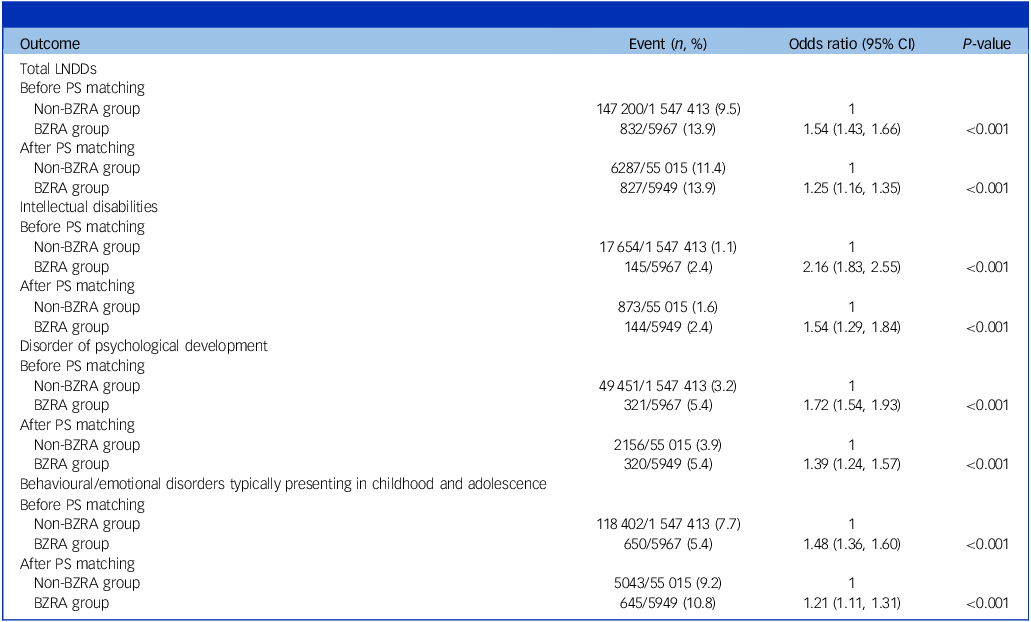
Table 2 summarises the results before and after propensity score matching. In the matched cohort, the incidence of total LNDDs was 13.9% (827/5949) in the BZRA group and 11.4% (6287/55 015) in the non-BZRA group. Logistic regression analysis showed that the BZRA group had a 25% higher risk of LNDDs compared with the non-BZRA group (odds ratio 1.25, 95% CI: 1.16–1.35, P < 0.001). When stratified by LNDD subtype, the BZRA group had significantly higher risk of intellectual disabilities (odds ratio 1.54, 95% CI: 1.29–1.84, P < 0.001), psychological development disorders (odds ratio 1.39, 95% CI: 1.24–1.57, P < 0.001) and behavioural/emotional disorders (odds ratio 1.21, 95% CI: 1.11–1.31, P < 0.001).
Analyses before and after PS matching

PS, propensity score; LNDDs, long-term neurodevelopmental disorders; BZRA, benzodiazepine receptor agonist.
Analyses in the entire cohort
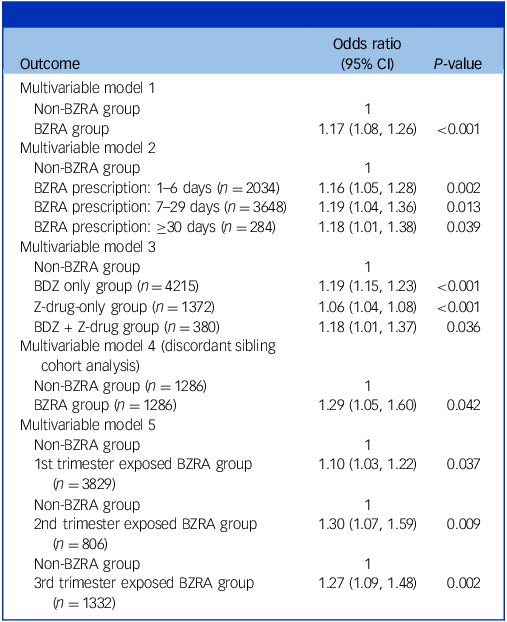
In multivariable analyses of the entire cohort (Table 3), prenatal BZRA exposure was associated with a 17% increased risk of LNDD compared with no exposure (model 1: odds ratio 1.17, 95% CI: 1.08–1.26, P < 0.001). When exposure intensity was categorised by cumulative prescription days (model 2), risks rose consistently with longer duration: 1–6 days (odds ratio 1.16, 95% CI: 1.05–1.28. P = 0.002), 7–29 days (odds ratio 1.19, 95% CI: 1.04–1.36, P = 0.013) and ≥30 days (odds ratio 1.18, 95% CI: 1.01–1.38, P = 0.039). Drug class-specific analyses (model 3) showed a stronger effect of benzodiazepines-only exposure (odds ratio 1.19, 95% CI: 1.15–1.23, P < 0.001) compared with Z-drugs-only exposure (odds ratio 1.06, 95% CI: 1.04–1.08. P < 0.001), while concurrent exposure to both drug classes also increased risk (odds ratio 1.18, 95% CI: 1.01–1.37, P = 0.036).
Multivariable logistic regression analyses in the entire cohort

BZRA, benzodiazepine receptor agonist; BDZ, benzodiazepine.
To construct the discordant sibling cohort, we first identified 388 336 children born to mothers with at least two singleton pregnancies. We excluded 40 twin births to avoid correlated outcomes within the same pregnancy. Among the remaining children, we restricted to families in which maternal BZRA exposure status differed across pregnancies, yielding a final sample of 2572 offspring (1286 exposed and 1286 unexposed). The discordant sibling analysis (model 4) confirmed the association, with BZRA exposure remaining significantly linked to elevated LNDD risk (odds ratio 1.29, 95% CI: 1.05–1.60, P = 0.042), suggesting that familial and genetic confounding alone could not fully explain the observed effect.
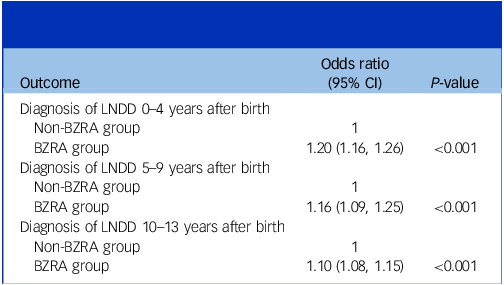
Finally, trimester-specific analyses (model 5) indicated increased risks with exposure during the first trimester (odds ratio 1.10, 95% CI: 1.03–1.22, P = 0.037), second trimester (odds ratio 1.30, 95% CI: 1.07–1.59, P = 0.009) and third trimester (odds ratio 1.27, 95% CI: 1.09–1.48, P = 0.002). Adjusted odds ratios with 95% confidence intervals for all covariates in model 1 are provided in Supplementary Table 3. Sensitivity analyses, excluding 4,113 children who died during follow-up (Supplementary Table 4), produced consistent results, and stratified analyses by follow-up duration (Table 4) demonstrated persistently increased risks across all periods: 0–4 years (odds ratio 1.20, 95% CI: 1.16–1.26, P < 0.001), 5–9 years (odds ratio 1.16, 95% CI: 1.09–1.25, P < 0.001) and 10–13 years (odds ratio 1.10, 95% CI: 1.08–1.15, P < 0.001).
Multivariable logistic regression analysis stratified by follow-up interval (0–4, 5–9 and 10–13 years after birth)

LNDD, long-term neurodevelopmental disorder; BZRA, benzodiazepine receptor agonist.
Discussion
In this nationwide cohort study of over 1.5 million births with 13 years of follow-up, prenatal exposure to BZRAs was associated with a significantly increased risk of LNDDs in offspring. The associations remained robust after adjusting for a comprehensive set of maternal, perinatal and psychiatric factors and were consistent across multiple analytic strategies, including propensity score-matched, full-cohort and discordant sibling analyses. Importantly, unlike previous large population-based studies Reference Chan, Gao, Howard, Simonoff, Coghill and Ip1,Reference Chen, Wu, Lin, Lu, Chen and Stewart7 in which associations observed in conventional analyses disappeared once discordant sibling designs were applied – indicating that those findings were probably explained by shared familial or genetic confounding – our discordant sibling analysis continued to demonstrate a significant association. This persistence suggests that familial and genetic factors cannot fully account for the observed effect, strengthening the possibility of a pharmacological contribution. Furthermore, risk estimates increased with greater cumulative prescription days, and associations were stronger for benzodiazepines than for Z-drugs, supporting potential dose- and class-specific effects.
The biological plausibility of these findings is supported by the role of GABAergic signalling in fetal brain development. During early neurodevelopment, GABA functions as an excitatory rather than an inhibitory neurotransmitter, regulating neuronal proliferation, migration and synaptogenesis, before switching to its inhibitory role at delivery. Reference Ben-Ari, Khalilov, Kahle and Cherubini16 Pharmacologic potentiation of GABA-A receptor activity by BZRAs during this excitatory phase could disrupt normal maturation processes, particularly when exposure occurs in the second and third trimesters when neural circuitry becomes increasingly refined. Evidence from experimental animal studies also supports structural and functional alterations following intrauterine benzodiazepine exposure. Reference da Silva Junior, Marques, Patrone, Biancardi, Bicego and Gargaglioni17,Reference Wadhwa, Sall and Chinn18
Prior epidemiological evidence has been inconsistent. Some population-based studies reported increased risks of autism spectrum disorder or ADHD following prenatal BZRA exposure Reference Chan, Gao, Howard, Simonoff, Coghill and Ip1,Reference Chen, Wu, Lin, Lu, Chen and Stewart7 whereas others observed no significant associations after accounting for maternal psychiatric conditions and polypharmacy. Reference Lupattelli, Chambers, Bandoli, Handal, Skurtveit and Nordeng8 Systematic reviews emphasise the heterogeneity of findings and suggest that residual confounding, methodological differences and variations in exposure definitions probably contribute to these discrepancies. Reference Wang, Zhang, Ekheden, Chang, Hellner and Jan3 In contrast, large-scale studies of other psychotropic medications, particularly antipsychotics, have generally found no increased risks of neurodevelopmental disorders, Reference Wang, Chan, Coghill, Ip, Lau and Simonoff19 and this conclusion has been consolidated in a recent systematic review. Reference Kaplan, Poels, van den Heuvel, Bijma, Bergink and Rommel20 In addition, antidepressants – particularly selective serotonin reuptake inhibitors – have been more extensively studied than antipsychotics, and consistent evidence shows no contribution to adverse neurodevelopmental outcomes from antenatal exposure. A systematic review found no association between intrauterine antidepressant exposure and long-term physical, neurodevelopmental or psychiatric disorders in offspring. Reference Rommel, Bergink, Liu, Munk-Olsen and Molenaar21 This further supports the notion that not all psychotropic medications carry similar risk profiles, underscoring the need for specific evaluation of BZRAs.
Importantly, our results extend this literature in several ways. The persistence of the association in sibling comparison analyses indicates that the increased risks are unlikely to be explained solely by shared familial or genetic confounders. We also observed a dose–response relationship, with higher risks accompanying longer cumulative exposure durations, which strengthens the argument for a potential pharmacological effect. Moreover, analyses separating benzodiazepines and Z-drugs have suggested that the former are associated with a stronger increase in risk than the latter, consistent with prior reviews indicating that the two drug classes may carry distinct neurodevelopmental risk profiles. Reference Wang, Zhang, Ekheden, Chang, Hellner and Jan3 Together, these findings provide novel evidence that complements and extends previous research by demonstrating associations that are robust across analytic approaches and sensitive to both duration and drug class.
The observed associations between prenatal BZRA exposure and LNDDs underscore the importance of cautious prescribing during pregnancy. Because BZRAs are often used for transient symptoms such as anxiety or insomnia, clinicians should carefully weigh the potential long-term risks to offspring against short-term maternal benefits. Non-pharmacologic interventions, when feasible, should be prioritised. If pharmacologic treatment is necessary, minimisation of exposure duration and avoidance of use during mid- to late pregnancy – when fetal neurocircuitry becomes increasingly refined – may mitigate potential harm. Our class-specific analyses also suggest that benzodiazepines may confer greater risk than Z-drugs, a distinction that has practical implications for clinical decision-making.
Several limitations should be acknowledged. First, although our use of propensity score matching and discordant sibling analyses substantially reduced the likelihood of bias, residual confounding cannot be fully excluded. Important unmeasured factors – such as maternal genetic vulnerability, severity of underlying psychiatric illness or the use of non-prescribed substances – may have influenced both medication exposure and child outcomes. Second, BZRA exposure was inferred from prescription records rather than confirmed ingestion, and detailed information on dosage, treatment adherence or indication was unavailable. Third, although we adjusted for a broad range of maternal and perinatal factors, we could not account for all potential teratogens, including anti-epileptic medications, intrauterine infections or environmental exposures. Fourth, our study period was limited to births between 2011 and 2014 to ensure complete and uniform follow-up for up to 13 years, which may have restricted generalisability to more recent birth cohorts. Fifth, outcome ascertainment relied on administrative diagnostic codes, which may not capture subclinical or milder forms of neurodevelopmental impairment. Sixth, we excluded women with BZRA prescriptions within 90 days of the estimated LMP to avoid misclassification of early pregnancy exposure. However, such discontinuers may resemble the exposed group more closely than the unexposed, and their exclusion could introduce residual confounding by disorder severity. Finally, detailed dosage information (e.g. diazepam-equivalent milligrams) was not available in the NHIS claims database, precluding analyses by dose equivalent. Instead, we used cumulative prescription days as a proxy for exposure intensity, which revealed consistent dose–response patterns. While this approach cannot fully substitute for precise dose quantification, it provides a pragmatic estimate within the constraints of claims data.
In conclusion, in this large nationwide cohort with up to 13 years of follow-up, prenatal exposure to BZRAs was associated with increased long-term risks of neurodevelopmental disorders in offspring. The associations were consistent across multiple analytic approaches, including sibling comparisons, and showed dose–response and class-specific patterns. These findings support the need for cautious prescribing of BZRAs during pregnancy, and highlight the importance of further research to both clarify underlying mechanisms and guide safer therapeutic alternatives.
Supplementary material
The supplementary material is available online at https://doi.org/10.1192/bjp.2025.10481
Data availability
The data that support the findings of this study are available from the corresponding author, I.-A.S., upon reasonable request.
Author contributions
T.K.O. and I.-A.S. contributed to the study design, analysed the data and drafted the first manuscript. Both authors read and approved the final version of the manuscript.
Funding
None.
Declaration of interest
None.
Transparency declaration
I.-A.S. affirms that the manuscript is an honest, accurate and transparent account of the study being reported; that no important aspects of the study have been omitted; and that any discrepancies from the study as planned (and, if relevant, registered) have been explained.





eLetters
No eLetters have been published for this article.