Introduction
Restless legs syndrome (RLS) is a neurological movement disorder characterized by unpleasant sensations in the legs and an uncontrollable urge to move at rest to relieve these feelings. The sensations are described as creeping, tingling, pulling, painful, or crawling in the legs, and these sensations are exacerbated when seated or lying down. The term RLS (also known as Willis–Ekbom disease) was introduced in 1945 by Karl-Axel Ekbom, a Swedish neurologist, but was first described by Thomas Willis in 1685.Reference Ekbom and Ulfberg 1 Sensations are mostly located deep inside the legs between the knee and ankle, bilaterally. RLS can also occur in the feet, thighs, arms, or hands. Symptoms of RLS such as unpleasant feelings are less prevalent during the day and exacerbated at night. For this reason, sleep disturbance is a common and serious problem in RLS patients, causing a reduction in quality of life, impaired mood, fatigue, cognitive difficulties, and inability to participate in activities during the daytime. Furthermore, above 80% of people with RLS experience a common condition called periodic limb movement disorder (PLMD), which is characterized by involuntary leg twitching during sleep.
RLS can be more problematic in dialysis patients due to spending several hours and several days/week with physical inactivity. Winkelman et al Reference Winkelman, Chertow and Lazarus 2 studied the association between sleep disorders and premature discontinuation of dialysis among RLS patients. The study reported a significant difference in RLS among end-stage renal disease (ESRD) patients compared with cardiac patients (20% vs 6% respectively). A significant delay in sleep onset and a reduction in total sleep time was noted among the 204 RLS patients with ESRD compared with 129 RLS patients with heart disease, according to self-administered questionnaires. This study noted that premature discontinuation of dialysis was associated with symptoms of RLS, low transferrin saturation levels due to iron deficiency, and sleep onset latency. A 2.5-year follow-up showed that dialysis patients had a greater risk of mortality than those without dialysis.Reference Winkelman, Chertow and Lazarus 2
Other clinical studies have found the increased risk for mortality among ESRD patients. The CHOICE study (Choices for Healthy Outcomes in Care for End-Stage Renal Disease) from 1995–1998 included 894 patients on either hemodialysis or peritoneal dialysis from 80 dialysis centers. It reported that severe symptoms of RLS were associated with lower quality of life and increased risk of death with an annual mortality rate exceeding 20%.Reference Benz, Pressman, Hovick and Peterson 3 One explanation is an increased likelihood of cardio/cerebrovascular events among this patient population.Reference Lin, Sy and Chang 4 Moreover, patients with RLS were more likely to receive benzodiazepines, antidepressants, and anticonvulsants than dialysis patients without RLS. The degree of periodic limb movement and arousals per hour during sleep in patients undergoing dialysis was strongly associated with a higher risk of mortality.Reference Benz, Pressman, Hovick and Peterson 3 Patients with severe periodic limb movements showed a median survival of only 6 months.
Epidemiology
A 2003 RLS prevalence study among 2099 patients reported a 15.3% incidence of RLS in the general population.Reference Nichols, Allen and Grauke 5 A 2004 cross-sectional survey reported an overall prevalence of 10.6%, increasing with age, and women were twice as often affected as men.Reference Berger, Luedemann, Trenkwalder, John and Kessler 6 Varying estimates of RLS prevalence in dialysis patients ranging from 6.6% to 84% have been reported.Reference Al-Jahdali, Al-Qadhi, Khogeer, Al-Hejaili, Al-Ghamdi and Al Sayyari 7 A 2013 study of 500 patients stratified according to estimated glomerular filtration rate showed no difference in the prevalence of RLS among the three groups with 18.9% in patients with estimated glomerular filtration rate (eGFR)≥60, 26% in chronic kidney disease patients, and 26% in ESRD patients.Reference Lee, Nicholl and Ahmed 8 Discrepancies in using unified RLS diagnostic criteria and challenges in collecting epidemiological data across different geographic locations have contributed to the wide range in estimating the correct prevalence of RLS in ESRD patients.
Diagnosis
A clinical study conducted in Germany investigated the prevalence of RLS in patients suffering from unpleasant sensations in the legs. From the 16,543 participating patients, 10.6% were diagnosed with RLS. Of those diagnosed with RLS, 53.4% had discussed with their physicians their leg sensation problems before, and only 20.1% had received a correct diagnosis.Reference Möller, Wetter, Köster and Stiasny-Kolster 9 Physicians commonly may misdiagnose patients’ complaints as akathisia, peripheral neuropathy, arthritis, muscle cramps, stress, insomnia, nervousness, or nocturnal leg cramps.
Akathisia mostly results as an adverse event from treatment with antipsychotic drugs. It is considered a movement disorder and typically is characterized by an inner general feeling of restlessness, although this sensation is not localized to the legs.Reference Lohr, Eidt, Alfaraj and Soliman 10 Akathisia occurs during the daytime and therefore does not disturb sleep.Reference Sachdev 11 Peripheral neuropathy mostly occurs during the daytime, causes no sleep disturbance at night, and does not cause periodic limb movement during sleep.Reference Sachdev 11 Nocturnal leg cramps or unilateral movement is not usually associated with an urge to move the legs. Akathisia can worsen medication adherence and has been linked, in severe cases, to suicidal ideation, aggression, and violent behavior.Reference Lohr, Eidt, Alfaraj and Soliman 10
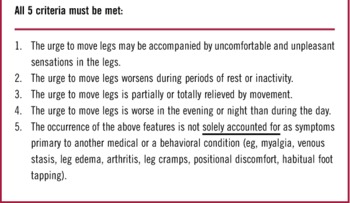
Clinical diagnostic criteria of for RLS established in 2003 by the international RLS Study Group underwent revision in 2012 (Table 1). According to these diagnostic guidelines, the sensation must be rest-induced, worsen during the night, be accompanied by the urge to move the legs usually with dysesthesias, and improve with activity.Reference Allen, Picchietti and Garcia-Borreguero 12 Prior to establishing a diagnosis of RLS, a patient’s past medical history, family history, and current medications should be collected. Laboratory tests could be performed to rule out secondary causes such as iron deficiency, diabetes, and renal dysfunction. Electromyography and Doppler sonography may be performed to evaluate electrical activity in the muscles and nerves of legs to rule out peripheral neuropathy and radiculopathy.
Essential diagnostic criteria for RLSReference Allen, Picchietti and Garcia-Borreguero 12

Pathophysiology of RLS
Genetic contribution
The pathophysiology of RLS remains unclear. However, a positive family history of RLS has accounted for 40–60% of RLS patients, which may indicate that genetics plays a significant factor in RLS. Five loci (12q, 14q, 9p, 2q, 20p) have been describedReference Pichler, Hicks and Pramstaller 13 , Reference Young, Vilariño-Güell, Lin, Wszolek and Farrer 14 from clinical studies involving twins. Genome-wide association studies,Reference Scheller, Ullmer, Berkels, Gwarek and Lübbert 15 based on the cases involving a total number of 2,045 people, identified polymorphisms in 3 gene regions:
-
1. MEISI (myeloid ecotropic viral integration site homeobox 1) on chromosome 2p
-
2. BTBD9 (BTB/POZ domain containing protein 9) on chromosome 6p
-
3. MAP2K5 (mitogen activated protein kinase 5) on chromosome 15q and LBXCOR1 (ladybird homeobox co-repressor 1), which seemed not to be related to dopamine in the brain area.Reference Winkelmann, Schormair and Lichtner 16
Recently, a study of 3 European populations confirmed these data, that three loci (2p, 6p, 15q) had significant associations with RLS in patients of European descent, especially the region of BTBD9.Reference Kemlink, Polo and Frauscher 17
Abnormalities in dopaminergic neurotransmission
A number of clinical trials have discussed the association between iron deficiency, abnormal levels of dopamine, and RLS. However, dopaminergic imaging agents using single proton emission computerized tomography (SPECT) and positron emission tomography (PET) have not demonstrated consistent findings between dopamine function and RLS.Reference Michaud, Soucy, Chabli, Lavigne and Montplaisir 18 A 2009 clinical study showed that a significant decrease in dopamine D2 receptors (and not D1 receptors) in the putamen of RLS patients is related to the severity of the disorder.Reference Connor, Wang and Allen 19 A significant increase in both tyrosine hydroxylase (TH) and phosphorylated (active) TH in the substantia nigra and putamen from RLS population was also observed. TH is the enzyme that catalyzes the conversion of the L-tyrosine to DOPA, a dopamine precursor. This increase in TH and active TH were shown in iron deficiency models supporting the hypothesis that iron deficiency causes dopamine dysfunction in the brain, which can result in RLS.Reference Connor, Wang and Allen 19 In contrast, an earlier multicenter cross-sectional study among 127 RLS patients on dialysis found no association between the disorder and iron status, hemoglobin, or serum phosphate.Reference Siddiqui, Kavanagh, Traynor, Mak, Deighan and Geddes 20
Risk Factors
Several risk factors have been associated with RLS in the general population, including iron deficiency, pregnancy, kidney disease, rheumatic disease, and medication (antihistamines, dopamine antagonists, anti-nausea, mirtazapine, selective serotonin reuptake inhibitors, and tricyclic antidepressants).Reference Ekbom and Ulfberg 1 Uremic factors such as fluid, electrolyte, and hormone imbalances and metabolic abnormalities are associated with RLS in ESRD.Reference Benz, Pressman, Hovick and Peterson 3 This is supported by clinical improvement of RLS symptoms after successful kidney transplantation.Reference Azar, Hatefi and Talebi 21
A controversial association between RLS and dialysis or iron deficiency remains unclear. A 2008 study by Kim et al,Reference Kim, Kwon, Lim, Kim, Lee and Nam 22 which included 46 dialysis patients, found no significant risk factor for RLS in dialysis patients, including duration of dialysis, age, body mass index, hemoglobin, creatinine, iron, ferritin, parathyroid hormone (PTH), folate, phosphate, alanine aminotransferase, and total bilirubin. Interestingly, pre-dialysis blood urea nitrogen level was correlated with RLS symptom severity. A 2005 multicenter cross-sectional study with 295 patients in 5 different dialysis centers found that female gender, increased duration of dialysis, and increasing body weight were risk factors for RLS in dialysis patients.Reference Siddiqui, Kavanagh, Traynor, Mak, Deighan and Geddes 20 Both studies were analyzed by univariate and multivariate logistic regression using the same criteria of diagnosis. A lack of direct association observed in the second study may be explained by a relatively low number of participants. Another study enrolled 228 hemodialysis patients and found significantly high serum calcium levels in patients diagnosed with RLS, and exhibited impaired sleep and health-related quality of life.Reference Kawauchi, Inoue and Hashimoto 23
Treatment of RLS in ESRD Patients
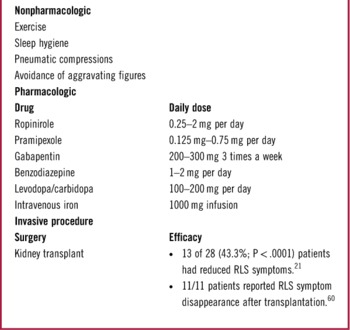
Based on symptom severity and frequency, the management of RLS in ESRD patients can range from nonpharmacological, pharmacological, to invasive interventions (Table 2). RLS symptoms are described as intermittent, daily, or refractory. Intermittent RLS is defined as symptoms arising less than 5 times/month. Daily RLS occurs 2–7 times/week, and refractory RLS is defined as daily RLS treated with dopamine agent with an inadequate initial response, intolerable side effects, or development of augmentation.Reference Silber, Becker and Earley 24 Limited clinical trials and data are available for ESRD patients with RLS, despite its well-described treatment among healthy patients. Most clinical trials studying RLS patients on maintenance dialysis have a short duration design and a small number of participants. Clinical studies that compare the efficacy and side effects among drugs of different classes are still lacking.
Nonpharmacological treatments
Nonpharmacological therapy of RLS includes a good practice of sleep hygiene, leg massage including pneumatic compression, and avoidance of aggravating factors.Reference Lettieri and Eliasson 25 Aerobic exercise has been found to be safe and effective in reducing RLS symptoms and improving functional ability and sleep quality in patients on hemodialysis. A 6-month exercise-training program was reported to be as effective as a 6-month low dosage dopamine agonist treatment, with both groups showing significant improvements in depression score, but only the dopamine agonist treatment was able to significantly improve sleep quality, compared to placebo.Reference Giannaki, Sakkas and Karatzaferi 26 Aggravating factors of RLS symptoms include sleep deprivation and drugs such as antidepressants, lithium, dopamine antagonists, selective antihistamines, and caffeine, and should be avoided. Mental activities such as video games and crossword puzzles can reduce RLS-related symptoms.Reference Silber, Becker and Earley 24
Pharmacological treatments
Dopamine agonists
The non-ergot–derived dopamine agonists (ergot is a group of fungi of the genus Claviceps), ropinirole, pramipexole, and rotigotine, are the only United States Food and Drug Administration (FDA)-approved medications for the treatment of RLS. Ropinirole acts by binding to D2, D3, and D4 dopamine receptors, with a higher specificity for D3 receptors. It is metabolized by liver enzyme P450 CYP1A2 and excreted in the urine.Reference Kaye and Nicholls 27 Ropinirole improved symptoms in RLS patients without ESRD, in short- and long-term management, including improvement of total sleeping time, quality of life, anxiety, and reduction in periodic limb movement.Reference Montplaisir, Karrasch, Haan and Volc 28 Common adverse events were mild and included nausea, dizziness, headache, and skin rash. In a 2004 14-week open, randomized, cross-over study of ropinirole vs levodopa sustained release (SR) in ESRD patients with RLS, all of the participating patients received levodopa (mean dose=119 mg/day) for 6 weeks, followed by ropinirole (mean dose=1.45 mg/day) for 6 weeks with a washout period. The study involved 11 RLS patients with chronic hemodialysis and showed that ropinirole was more effective than levodopa SR in managing the symptoms of RLS in ESRD patients.Reference Pellecchia, Vitale and Sabatini 29
Pramipexole is another dopamine agonist, which shows high specificity for D2-like dopamine receptor family in the brain and in particular D3 receptors.Reference Antonini and Calandrella 30 Through binding to these dopamine receptors, pramipexole can activate the nerves of the striatum and substantia nigra. The half-life of pramipexole is about 8 hours for young healthy people and 12 hours for the elderly, and is renally excreted.Reference Antonini and Calandrella 30 Several clinical trials described pramipexole’s efficacy and safety in the general population and found no significant renal impairment associated with an improvement of sleep quality, periodic limb movement, depression, nocturnal leg restlessness, and involuntary leg movements. The treatment was also effective with prolonged use of pramipexole. Common adverse events reported include fatigue, nausea, dizziness, headache, and stiffness.Reference Montplaisir, Karrasch, Haan and Volc 28
Rotigotine is a non-ergot dopamine agonist administered as a once-daily transdermal patch. It acts by binding to D1, D2, and D3 receptors.Reference Scheller, Ullmer, Berkels, Gwarek and Lübbert 15 A recent double-blind, placebo-controlled study of 30 ESRD patients requiring hemodialysis reported improved periodic limb movements (PLM) and RLS symptoms with rotigotine.Reference Dauvilliers, Benes and Partinen 31 Nausea and vomiting were the most common side effects reported. No rotigotine dose adjustments were necessary among patients undergoing hemodialysis.
Augmentation is worsening of RLS symptom severity after initiating pharmacologic treatment for at least 1 week over a period of at least 5 days. Augmentation of RLS is characterized by symptom occurrence at least 2 hours before initiation of treatment, an increased overall intensity of the urge to move or sensations are temporally related to an increase in the daily medication dosage, the urge to move or sensations are extended to previously unaffected limbs or body parts, and a shorter latency to RLS symptoms at rest than the latency either during initial therapeutic response or before treatment was instituted.Reference Williams and Garcia-Borreguero 32 Augmentation is caused by a significant increase in brain dopamine levels. The overstimulation of D1 receptors, compared with D2 receptors in the spinal cord, could result in pain and generate PLMD. Iron deficiency may be a risk factor for augmentation.Reference Paulus and Trenkwalder 33
Augmentation was reported in 5 out of 60 RLS patients who received 0.25 mg pramipexole/day for at least 6 months, in an open label clinical study. It was found that augmentation was unrelated to either severity of RLS or doses of pramipexole.Reference Ferini-Strambi 34 Pramipexole-induced augmentation can be managed by earlier than usual schedule dosing before augmentation occurrence, small dose increases, and, rarely, discontinuation of pramipexole.Reference Winkelman and Johnston 35 A meta-analysis comparing the efficacy and tolerability of ropinirole and pramipexole in the management of RLS showed significant improvement of RLS symptoms with both drugs compared to placebo.Reference Quilici, Abrams and Nicolas 36 Compared with placebo, ropinirole led to significantly higher incidences of nausea, vomiting, dizziness, and somnolence, while pramipexole’s side effects were limited to a higher incidence of nausea. This study suggested that pramipexole was superior to ropinirole in efficacy and tolerability.Reference Quilici, Abrams and Nicolas 36
A study evaluated pramipexole in 10 uremic patients who received 0.125–0.75 mg/day. During the study period, RLS symptoms and periodic limb movement significantly improved, while there was no significant change in total sleeping time, number of awakenings, and sleep latency. Sleep quality was not assessed.Reference Miranda, Kagi and Fabres 37 There are a limited number of clinical studies assessing ropinirole and pramipexole treatment in ESRD patients with RLS. Those published have a small number of participants and a short trial of treatment. Further studies are needed with a larger population to evaluate the effects of these drugs during acute and long-term phase, determine the appropriate dosing in ESRD patients, evaluate the augmentation and tolerance, and compare the effectiveness between these 2 drugs.
Cabergoline, a third non-ergot dopamine agonist, was reported to improve sensorimotor symptoms and sleep disturbances in RLS patients and was well-tolerated.Reference Oertel, Beneš and Bodenschatz 38 However, no clinical trials have evaluated cabergoline in ESRD population who experience RLS.
Levodopa
Levodopa is a psychoactive drug used in the treatment of Parkinson’s disease by replenishing dopamine levels in the brain. Levodopa is metabolized in the liver to dopamine, an active metabolite. The plasma half-life of levodopa is 50 minutes without carbidopa to 1.5 hours with carbidopa.Reference Nutt, Woodward and Anderson 39 Levodopa is used in combination with carbidopa or benserazide to block the activity of aromatic-L-amino-acid decarboxylase, the enzyme responsible for the peripheral decarboxylation of levodopa. Carbidopa cannot cross the blood–brain barrier, and thus it reduces the side effects caused by dopamine on the periphery as well as increases the levels of levodopa and consequently dopamine in the brain.Reference Nutt, Woodward and Anderson 39
Clinical trials evaluating the efficacy of levodopa for RLS symptoms in patients without ESRD reported that levodopa decreased waking-up time and staying-awake periods.Reference Akpinar 40 The drug improved nocturnal RLS and PLMD symptoms, improved subjective sleep and awakening quality, and was associated with minimal side effects during long-term use.Reference Saletu, Anderer and Högl 41
Augmentation is also a significant side effect of levodopa. Augmentation was reported in 31% of PLMD patients and 82% of all RLS patients and was correlated with higher doses of levodopa treatment (equal or above 50/200 mg of carbidopa/levodopa).Reference Allen and Earley 42 The European RLS Study Group conducted a multi-center study to evaluate RLS augmentation during a 6-month period of L-dopa treatment. Augmentation occurred in 36 of 60 (60%) patients. The mean maximum dose of levodopa was 311 mg/day. Patients with higher doses of levodopa (over 300 mg/day) were more likely to experience augmentation and less improvement of RLS symptoms.Reference Högl, García-Borreguero and Kohnen 43
The use of L-dopa has had varying effects on sleep disturbance in uremic patients. A randomized placebo-controlled double-blind cross-over trial evaluated the effects of L-dopa vs. placebo for 4 weeks on the quality of sleep and frequency of PLM in 11 patients with uremic and 17 patients with idiopathic RLS for 4 weeks. Patients were initiated on 100 mg/25 mg to 200 mg/25 mg levodopa/benserazide depending on improvement of symptoms. Improvement was assessed using polysomnography, actigraphy, patient’s subjective ratings for quality of life and physician’s clinical global impressions scale. Levodopa significantly reduced the frequency of PLM/hour of sleep and the awakening associated with this movement and significantly improved sleep quality.Reference Trenkwalder, Stiasny and Pollmächer 44 However, in another double-blind, placebo-controlled, cross-over study, all 5 participating patients undergoing chronic hemodialysis still experienced sleep disturbance with the administration of levodopa/carbidopa (100/25 mg) at bed time, despite an improvement in leg movements/hour of sleep, the percentage of leg movement time while asleep, and arousals associated with leg movements.Reference Walker, Fine and Kryger 45 The study did not evaluate if the increase dose or frequency of levodopa is effective in sleep quality for uremic patients with RLS. There is limited clinical data for the efficacy and safety of levodopa in ESRD patients with RLS. Furthermore, the duration of the clinical trials was also not long enough to see the effectiveness of levodopa in dialysis patients.
Gabapentin
Gabapentin is an anticonvulsant approved for partial seizure and post-therapeutic neuralgia; however, it is not approved for RLS treatment. It acts as an alpha-2-delta calcium channel ligand.Reference Bockbrader, Wesche, Miller, Chapel, Janiczek and Burger 46 The half-life of gabapentin is 5–7 hours, and is eliminated by renal excretion.Reference Bockbrader, Wesche, Miller, Chapel, Janiczek and Burger 46 Gabapentin has been shown to be effective in reducing periodic limb movement, and improving sensory and motor symptoms, sleep quality, and pain in non-ESRD patients.Reference Happe, Sauter, Klösch, Saletu and Zeitlhofer 47
Among ESRD patients, gabapentin’s half-life is approximately 132 hours during periods of non-hemodialysis.Reference Hassan, Brennan, Collett, Josland and Brown 48 However, during hemodialysis, the half-life of gabapentin was decreased to about 4 hours, similar to that of the general population. The recommended dosing regimen for dialysis patients is an initial dose of 300–400 mg of gabapentin followed by a maintenance dose of 200–300 mg after 4 hours of hemodialysis.
Recent evidence suggests gabapentin treatment alleviates RLS symptoms as well as pruritis in ESRD patients.Reference Hassan, Brennan, Collett, Josland and Brown 48 A 2001 randomized, double-blind, placebo-cross-over study of gabapentin was done that included 16 hemodialysis patients with RLS. Patients received either gabapentin 200–300 mg or placebo 3 times a week at the end of hemodialysis for 6 weeks followed by a 1-week washout period. Significant improvement of RLS symptoms was reported in response to gabapentin, compared with placebo. A serious side effect of gabapentin was lethargy, which caused 2 patients to withdraw from the study.Reference Thorp, Morris and Bagby 49 Another study comparing the efficacy of gabapentin with levodopa in 15 hemodialysis patients in Turkey found that gabapentin was superior to levodopa in improving overall RLS symptoms, sleep quality, general health, body pain, and social function.Reference Micozkadıoglu, Ozdemir, Kut, Sezer, Saatci and Haberal 50
Benzodiazepines
Benzodiazepines, namely clonazepam, have been also used to manage RLS symptoms in non-ESRD patients. Clonazepam is FDA approved for the treatment of panic disorder and seizure.Reference Joy 51 The half-life of clonazepam is 30–40 hours; it is metabolized by the liver enzyme P450 CYP3A and renally excreted. The efficacy of clonazepam has been supported in reducing sleep disturbance due to RLS more so than movement disorder itself.Reference Saletu, Anderer and Saletu-Zyhlarz 52 The long-term effects of clonazepam in the treatment of RLS patients still require further investigation.
Studies with clonazepam are lacking in ESRD patients with RLS symptoms. An earlier study found that sleep disturbances improved in 14 out of 15 uremic patients with RLS treated with clonazepam (1–2 mg/day).Reference Read, Feest and Nassim 53 Adverse events of benzodiazepine therapy include ataxia, somnolence, diplopia, respiratory depression, confusion, paradox reaction, dysarthria, and drug dependence. It may also facilitate obstructive sleep apnea. For this reason, the benefits and risks of benzodiazepine treatment of RLS should be weighted carefully before its initiation.
Opioids
Opioids are not currently approved for the treatment of RLS. A trial studying opioid receptor availability in RLS patients suggested that the severity of RLS was negatively correlated with opioid binding in areas of the brain responsible for nociception including medial thalamus, amygdala, caudate nucleus, anterior cingulate gyrus, insular cortex, and orbitofrontal cortex.Reference Von Spiczak, Whone and Hammers 54 Opioids, such as codeine and propoxyphene, produced symptomatic relief from dyskinesia, dysesthesia, and motor symptom in RLS.Reference Kaplan, Allen, Buchholz and Walters 55 Opioid therapy was also shown to have long-term efficacy in the management of RLS and PLMS. Patients on long-term opioid therapy should be carefully monitored for the development of sleep apnea.Reference Walters, Winkelmann and Trenkwalder 56 No current data are available for the efficacy of opioids in the management of RLS in patients on dialysis. For those undergoing dialysis, the use of propoxyphene might not be recommended because of potential accumulation of metabolites, which can lead to significant adverse effects.
Iron supplementation
The association between RLS and serum ferritin concentration lower than 45–50 mcg/L has been supported in the general population.Reference Silber, Becker and Earley 24 This is due to iron being a necessary cofactor for TH in the dopamine synthesis and the regulation of dopamine receptors.
In an open-label study for RLS patients without ESRD, infusion of 1000 mg iron dextran significantly improved RLS symptom severity, total sleeping time, periodic limb movement disorder, and duration of RLS symptoms.Reference Earley, Heckler and Allen 57 Iron supplementation after the infusion of the single iron dextran achieved symptom improvement.Reference Earley, Heckler and Allen 57 A randomized placebo-controlled, double-blind, multicenter study of IV iron sucrose reported a lack of superiority of iron sucrose treatment at 11 weeks but observed a reduction in RLS symptoms acutely at 7 weeks and during long-term follow-up in patients with a variable degree of iron deficiency.Reference Grote, Leissner, Hedner and Ulfberg 58
As discussed earlier, iron deficiency with or without anemia is a potential risk factor for RLS in ESRD patients. Further studies with larger population samples are needed to evaluate the effects of iron therapy and its effect on RLS symptoms. Treatment using iron supplementation is currently recommended in patients with a serum ferritin level lower than 75 mcg/L either orally or intravenously.Reference Silber, Becker and Earley 24
Conclusions
Restless legs syndrome is a common neurological disorder that is underdiagnosed and undertreated in both the general population and patients with ESRD. Due to the lack of current guidelines published for the management of uremic RLS symptoms, treatment is based on the published instructions for the treatment of patients with idiopathic RLS.Reference Giannaki, Hadjigeorgiou, Karatzaferi, Pantzaris, Stefanidis and Sakkas 59 RLS significantly affects quality of life by inducing severe sleep disturbance during nighttime and lowering quality of life.
Current guidelines for the management of intermittent RLS in the general population, by the Medical Advisory Board of the RLS foundation, include levodopa, dopamine agonists, opioids, and benzodiazepines.Reference Silber, Becker and Earley 24 Intermittent RLS is described as RLS that is troublesome enough to need treatment. But, intermittent RLS does not occur frequently enough to require daily treatment. From clinical experience, the treatment of intermittent symptoms is nonpharmacologic or with dopamine agonists as needed.
Despite the high prevalence of RLS in ESRD patients, few clinical studies have been conducted in order to evaluate the effects of pharmacotherapies in this patient population. Medication dosing and scheduling should be different in patients on dialysis from the general population. Many ESRD patients also experience other significant problems, such as anemia, low levels of calcium, high PTH, high phosphate levels, high blood pressure, metabolic acidosis, and bone disease due to the loss of kidney function. For this reason, medication response might differ between the general population with RLS and ESRD patients with RLS.
Dopamine agonists such as ropinirole or pramipexole are the primary treatment options for RLS. Both medications are FDA-approved drugs for the treatment of RLS. There is no dosing guideline for dopamine agonists among ESRD patients. For this reason, the lowest dose of each medication should be initiated first and the patient should be monitored for serious adverse effect such as augmentation. Further studies are needed to evaluate the safety of each dopaminergic agent, and to determine effective dose of each medications and long-term effects with larger numbers of ESRD patients. Finally, the effect of switching from one treatment to another should be assessed.
Based on the clinical evidence, gabapentin could be used as an alternative therapy because of improvement of symptoms and pain related to RLS. Benzodiazepines such as clonazepam can be used carefully if patients experience severe insomnia. Caution should be used because use of neither gabapentin nor benzodiazepine in treating RLS has been well studied in dialysis patients in regard to efficacy, safety, and appropriate doses. Due to the lack of clinical evidence for opioids, they should be the last treatment option when other therapies have failed.
Disclosures
The authors do not have anything to disclose.
Overview of RLS treatment in ESRD patients