Introduction
For thousands of years, cellulose paper has been a major medium for displaying and transmitting information in many parts of the world. Its chemical and mechanical stability under atmospheric conditions and ability to absorb ink readily remain unmatched by other materials used in large abundance. Cellulose, the major component of paper, can be obtained from plants and represents one of the most abundant organic materials on earth.
In the past decade, research on nanostructures of cellulose has increased dramatically due to the potential applications in electronics, biosensors, and energy storage devices.Reference Klemm, Kramer, Moritz, Lindström, Ankerfors, Gray and Dorris 1 – Reference Nyholm, Nyström, Mihranyan and Strømme 4 Large-scale, energy-efficient production of nanofibrillated cellulose (NFC) has recently become possible by employing various physical, chemical, and enzymatic pretreatment methods before the homogenization step.Reference Klemm, Kramer, Moritz, Lindström, Ankerfors, Gray and Dorris 1 In parallel, the development of nanostructured inorganic materials in the form of nanocrystals, nanowires, and nanotubes provides a list of functional inks for integration into paper.Reference Russo, Ahn, Adams, Duoss, Bernhard and Lewis 5 – Reference Tai and Yang 9
Cellulose by itself is usually limited in functionalities. However, the three-dimensional (3D) hierarchical structures formed by cellulose fibers at different length scales, combined with the ability to accommodate other functional materials, open up many opportunities for applications in electrical, electrochemical, and optical devices.
The focus of this article is to present recent progress in the development of energy and electronics devices fabricated using wood fiber cellulose as the building block in conjunction with other nanomaterials. The first part of this article will focus on the hierarchical structure of wood cellulose, as well as the fabrication and properties of paper. In particular, regular cellulose fibers with a diameter of ∼20 μm and nanocellulose fibers with a diameter of ∼20 nm will be discussed in detail. The second part will focus on the recent development of conductive paper for energy devices, particularly for ultracapacitors and batteries. The last part will focus on the development of transparent nanocellulose paper and its potential applications in electronics and optoelectronic devices.
Cellulose: The building block
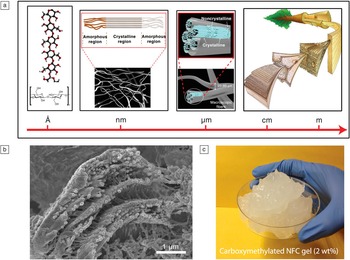
The cell wall of wood has a fascinating 3D hierarchical structure designed to maximize the stability and durability of the trees. The wood fiber is made up of crystalline cellulose nanofibrils (around 40 wt% of the wood), random amorphous hemicellulose (around 25 wt% of the wood), and organic “glue” lignin (around 30 wt% of the wood) that cross-link different polysaccharide in wood to form a strong and durable structure.Reference Sjostrom 10 At the molecular scale, the cellulose polymer molecules have a linear chain structure consisting of glucose repeating units with many hydroxyl groups. They pack into cellulose crystals with dimensions of a few Å, which in turn are organized into nanofibrils with a diameter of around 4 nm and a length over 1 μm.Reference Annergren, Wågberg and Baker 11 These nanofibrils aggregate into bundles with cross-sectional dimensions of around 20 nm × 20 nm2, which further combine to form a large cylindrical wood fiber with a length of 1∼3 mm, a diameter of 20∼50 μm, and a fiber wall thickness of about 4 μm ( Figure 1 a). In its natural state, the delignified fiber wall has a specific surface area of around 100 m2/g. The fiber wall collapses during drying, and the specific surface area decreases to around 1 m2/g. The rich structural motifs of wood fiber cellulose at different scales make them attractive for 3D structural manipulation.
Structure of cellulose fiber. (a) Schematic to show the hierarchical structure of cellulose from the wood cell wall to microfibrillated fiber to nanofibrillated fiber to a cellulose molecule. Image courtesy of Mark Harrington. © 1996 University of Canterbury. (b) Nanocellulose fibrils (with a square cross-section of around 20 × 20 nm2) within the open wet fiber wall, where the lamellar organization of fibrils in the fiber wall is obvious.Reference Klemm, Kramer, Moritz, Lindström, Ankerfors, Gray and Dorris 1 Reprinted with permission from Reference 1. © 2011 Wiley-VCH Verlag GmbH & Co. KGaA, Weinheim. (c) Photograph of nanofibrillated cellulose (NFC) gel at 2 wt% in water.

To design the next-generation high-performance fibril-based paper, regular fibers with ∼20 μm diameter need to be disintegrated into NFC (Figure 1b). Turbak et al. first reported the production of NFC, with a diameter of 2–3 nm and a length of 1–2 μm, by using high-pressure mechanical disintegration of wood pulp.Reference Turbak, Snyder and Sandberg 12 Excess energy consumption in the homogenization process was one of the major drawbacks that limited practical applications of this material. It was later shown that the introduction of charged functional groups by carboxymethylation prior to mechanical disintegration enhanced the swelling of the fiber wall, and hence decreased the energy consumption of the fiber disintegration process.Reference Wågberg, Winter, Ödberg and Lindström 13 The new approach can decrease energy consumption by approximately ten times when comparing to the traditional methods that do not employ the pretreatment.Reference Klemm, Kramer, Moritz, Lindström, Ankerfors, Gray and Dorris 1 , Reference Wågberg, Winter, Ödberg and Lindström 13
The final product after the delamination process is a gel-like NFC dispersion in water (Figure 1c). Depending on the charge density and the concentration, the transparency of the gel can be controlled. The viscous NFC gel can be diluted further, and the remaining fibril aggregates removed by sonication and centrifugation. It has been shown that the colloidal stability of the charged nanofibril dispersion is significantly dependent on the pH and salt concentration. The fibrils form gels at low pH and high salt concentration, provided that they are above a critical concentration (∼1g/L).Reference Fall, Lindström, Sundman, Ödberg and Wågberg 14 Isogai and co-workers have reported another way of introducing negative charges to the cellulose nanofibrils, where the primary hydroxy groups on the C6 carbons of the cellulose molecules are converted to their carboxylic form by TEMPO (2,2,6,6-tetramethylpiperidine-1-oxyl)-mediated oxidation.Reference Saito, Kimura, Nishiyama and Isogai 15 , Reference Saito, Nishiyama, Putaux, Vignon and Isogai 16 This modification is a site-specific method in which the oxidation mostly involves C6 carbon atoms.
Energy storage with conductive paper
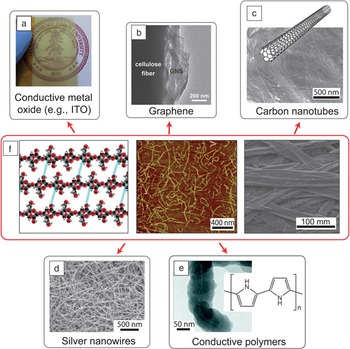
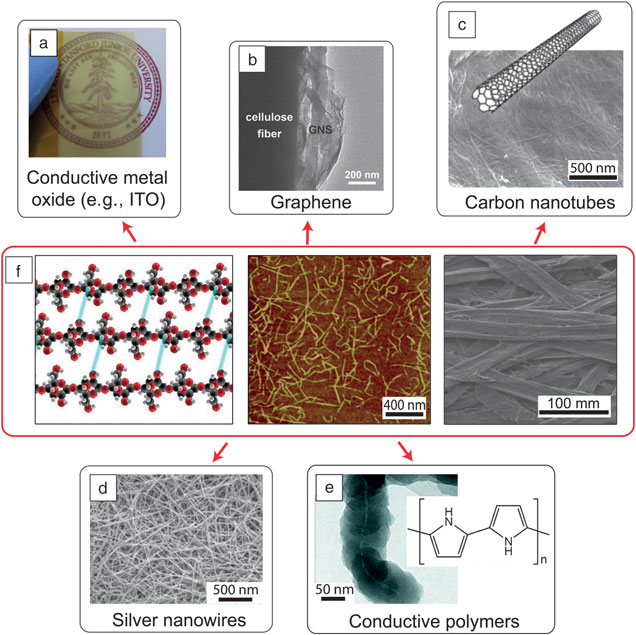
The 3D hierarchical structure of cellulose paper is very interesting for an energy storage system that involves liquid electrolytes, since the interconnected porosity allows fast access of ionic species to the electrode surfaces. In order to render electrical conductivity in cellulose paper, conducting materials such as conductive metal oxide,Reference Hu, Zheng, Yao, Liu, Weil, Cui, Eskilsson, Karabulut, Wågberg, Ruan, Fan, Bloking and McGehee 17 graphene,Reference Weng, Su, Wang, Li, Du and Cheng 8 carbon nanotubes (CNTs),Reference Hu, Choi, Yang, Jeong, La Mantia, Cui and Cui 6 metal nanowires,Reference Hu, Choi, Yang, Jeong, La Mantia, Cui and Cui 6 and conductive polymersReference Nystrom, Razaq, Strømme, Nyholm and Mihranyan 18 can be integrated ( Figure 2 ). The conductive materials can be introduced into paper at different length scales, from molecular mixing with a cellulose polymer to surface coating on photocopy paper.
Diagram showing conductive materials, such as (a) tin doped indium oxide (ITO). Reprinted with permission from Reference 17. © 2013 Royal Society of Chemistry. (b) Graphene. Reprinted with permission from Reference 8. © 2011 Wiley-VCH Verlag GmbH & Co. KGaA, Weinheim. (c) Carbon nanotubes and (d) silver nanowires. Reprinted with permission from Reference 6. © 2009 National Academy of Sciences. (e) Conductive polymers, reprinted with permission from Reference 18. © 2009 American Chemical Society, can be integrated into cellulose at different scales (f), ranging from the molecular level to nanofibrils, and the microfiber level.
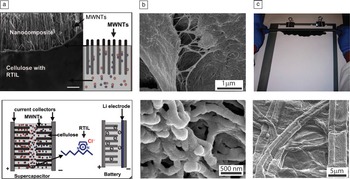
CNTs are particularly versatile in binding with cellulose. Ajayan and co-workers developed a method to dissolve unmodified cellulose fibers in a room-temperature ionic liquid, 1-buty1,3-methylimidazolium chloride ([bmIm][Cl]). The cellulose solution was then coated onto vertically grown CNTs to form the conductive paper, which can be used as an electrode for supercapacitors and lithium-ion batteries ( Figure 3 a).Reference Pushparaj, Shaijumon, Kumar, Murugesan, Ci, Vajtai, Linhardt, Nalamasu and Ajayan 19
Fabrication of the nanocomposite paper for supercapacitor and battery applications. (a) Room-temperature ionic liquid (RTIL) derived cellulose/carbon nanotubes (CNTs) composite with the cross-sectional SEM image showing multi-walled nanotubes (MWNTs) protruding from the thin films. (Scale bar is 2 μm.) The schematic displays the partial exposure of MWNT (top) and the structures of the ultracapacitor and lithium-ion batteries fabricated using the conductive paper (bottom). (Reprinted with permission from Reference 19. © 2007 National Academy of Sciences.) (b) Nanofibrils cellulose/CNT thin film derived from filtration of the solution mixture (top) and after coating of silicon by chemical vapor deposition (bottom). (Reprinted with permission from Reference 20. © 2013 Elsevier.) (c) Meyer-rod coating of CNTs solution onto photocopy paper and the corresponding SEM image showing the micron-sized fibers (bottom). (Reprinted with permission from Reference 6. © 2009 National Academy of Sciences.)

At the nanofibrils scale, the similarity in dimensions of the nanocellulose fibers and CNTs allows uniform mixing of the two materials, resulting in a highly conductive porous composite suitable for high surface area electrodes (Figure 3b).Reference Hu, Liu, Eskilsson, Zheng, McDonough, Wågberg and Cui 20 Conductive polymers are also widely used to coat nanocellulose fibers. Polypyrrole has been found to wet cellulose very well, and polymerization of pyrroles on the surface of cellulose results in conformal coatings of polypyrrole on the nanocellulose fibers.Reference Carlsson, Nystrom, Zhou, Berglund, Nyholm and Stromme 21 Coating of cellulose fibers aerogel was demonstrated by using a polyaniline-dodecyl benzene sulfonic acid doped solution in toluene.Reference Paakko, Vapaavuori, Silvennoinen, Kosonen, Ankerfors, Lindstrom, Berglund and Ikkala 22 The use of an organic solvent allows the high porosity of the aerogel to be preserved.
Alternatively, simple Meyer-rod coating of CNT ink onto commercially available photocopy paper was shown to be highly effective in producing conductive paper with a sheet resistance of around 10 ohm/sq (Figure 3c).Reference Hu, Choi, Yang, Jeong, La Mantia, Cui and Cui 6 (The Meyer-rod is a stainless steel rod that is wound tightly with wires of a certain diameter. The rod is usually used for conformal coating of solution-based materials on a flat substrate.) The high conductivity was attributed to the strong solvent absorption properties of the porous paper structure and the conformal coating of flexible CNTs on the cellulose fibers to form continuous electrical conduction pathways. This fabrication method is also applicable to coating nanowires such as silver ink onto cellulose paper. Filtration methods were used to deposit graphene on filter paper to produce conductive paper for ultracapacitors.Reference Weng, Su, Wang, Li, Du and Cheng 8
Conductive paper made from cellulose fibers and CNTs demonstrates excellent mechanical properties. In the case of CNT-coated photocopy paper, the sheet resistance increased only slightly (<5%) after the conductive paper was bent to a 2 mm radius 100 times. In contrast, conductive paper fabricated with a metal evaporation coating does not withstand bending very well, and the sheet resistance in this case increased by 50% after three bending cycles to a radius of 2 mm.Reference Hu, Choi, Yang, Jeong, La Mantia, Cui and Cui 6 The graphene cellulose paper was shown to withstand high tensile stress up to 8.67 MPa.Reference Weng, Su, Wang, Li, Du and Cheng 8 The increase in resistance was relatively small (<5%) when the change in strain was around 2%.
Due to the hydrophilicity of cellulose fibers, conductive paper has been widely used as electrodes for ultracapacitors with aqueous electrolytes. Unmodified CNTs and graphene are hydrophobic, and their applications in ultracapacitors have been hindered by poor electrolyte wetting. By using cellulose as a substrate for the carbon matrix, aqueous electrolyte can be readily absorbed into the electrode, providing intimate contact between the carbon electrode and electrolyte.Reference Zheng, Hu, Wu, Xie and Cui 23 For lithium-ion battery applications, the use of conductive cellulose paper offers new opportunities in fabricating highly flexible electrodes and battery systems.
The unique structure of conductive cellulose paper made from ionic liquid and CNTs (Figure 3a) allows the working electrode (CNTs) and separator (excess cellulose) to be combined in a single sheet of paper. A simple symmetrical ultracapacitor was built by combining two such electrodes and using KOH as an electrolyte. For fabricating lithium-ion batteries, lithium metal is evaporated onto the excess cellulose side, and the CNTs are used as the working electrode. The as-fabricated flexible lithium-ion battery exhibited a specific capacity of around 110 mAh/g.
Mixing CNTs directly with NFC allows for better tuning of the 3D structure of the composite. Upon freeze-drying the mixture, a highly conductive cellulose aerogel can be fabricated (Figure 3b). Further deposition of silicon onto the nanofibril cellulose using plasma-enhanced chemical vapor deposition can produce a highly flexible silicon electrode, which has stable cycling at around 1500 mAh/g for more than 100 cycles. NaCl-based ion exchange batteries were demonstrated using polypyrrole coated nanocellulose fibers as electrodes. Since polypyrrole can absorb and expel chloride ions during the oxidation/reduction process, the reversible process is utilized to store energy. The batteries have a reasonable capacity of around 25–33 mAh/g.Reference Nystrom, Razaq, Strømme, Nyholm and Mihranyan 18
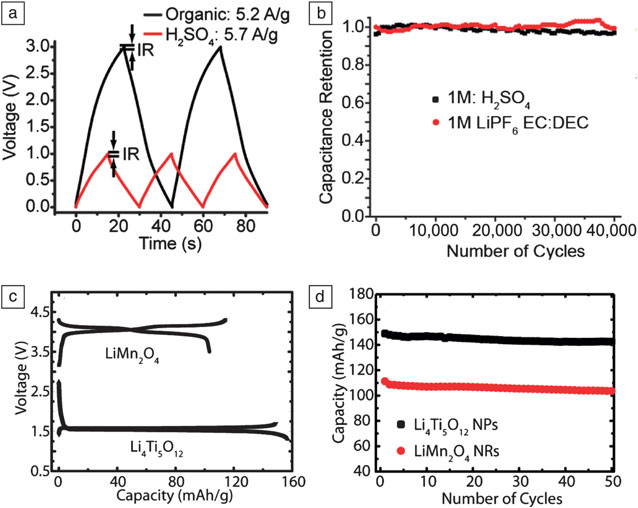
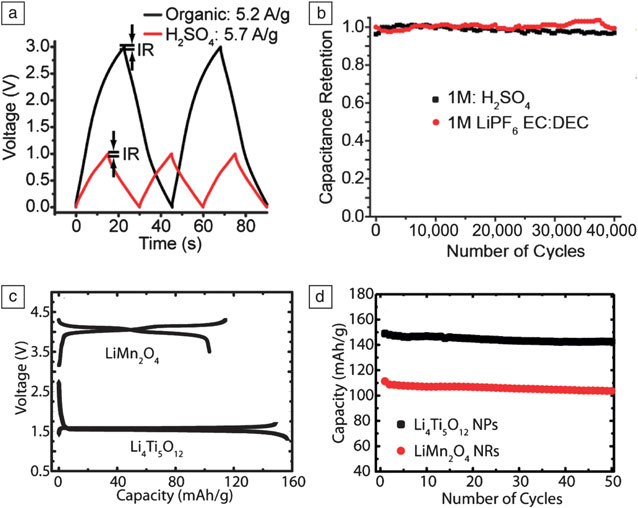
Coating CNTs directly on commercial photocopy paper offers a simpler approach for producing a highly conductive paper substrate. The high porosity of the paper allows rapid absorption of the conductive inks. Conductive paper coated with Li4Ti5O12 and LiMn2O4 demonstrated stable performance for more than 50 cycles. Although full cell performance still needs to be improved, the paper-based electrodes provide a unique approach for fabricating energy storage devices with high mechanical flexibility. The CNT coated photocopy paper also showed excellent performance as an ultracapacitor electrode ( Figure 4 a), with a specific capacitance of 200 F/g and stable cycling of over 40,000 cycles (Figure 4b). The graphene-cellulose paper electrode also demonstrated a high specific capacitance of 120 F/g, and retained >99% capacitance over 5000 cycles.Reference Weng, Su, Wang, Li, Du and Cheng 8 In another simple approach, ultracapacitors were fabricated by a simple pencil drawing of graphite onto both sides of cellulose paper. In an aqueous electrolyte, the device showed good areal capacitance of around 2.3 mF cm–2 and up to 15,000 cycles of charge/discharge, with more than 90% capacitance retention.Reference Zheng, Hu, Wu, Xie and Cui 23 The relatively good electrochemical stability of paper, combined with the low cost and good compatibility with other nanomaterials, provide new opportunities in applying this renewable material to advanced energy storage systems.
(a) Galvanostatic charging/discharging curves of carbon nanotube (CNT)/paper ultracapacitor with organic electrolytes and sulfuric acid. (b) Capacitance retention of the ultracapacitor in different electrolytes. (c) Galvanostatic charging/discharging of LiMn2O4 and Li4Ti5O12 electrodes using the photocopy paper/CNT composite as a current collector. (d) Cycling performance of the LiMn2O4 and Li4Ti5O12 electrodes. (Reprinted with permission from Reference 6. © 2009 National Academy of Sciences.)
Transparent nanocellulose paper for electronic and optoelectronic devices
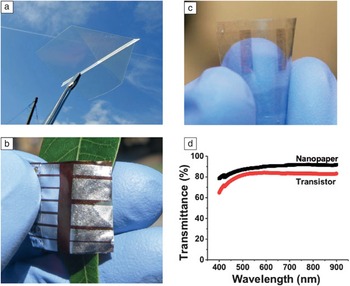
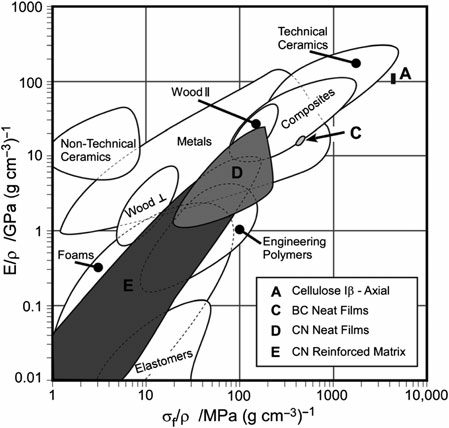
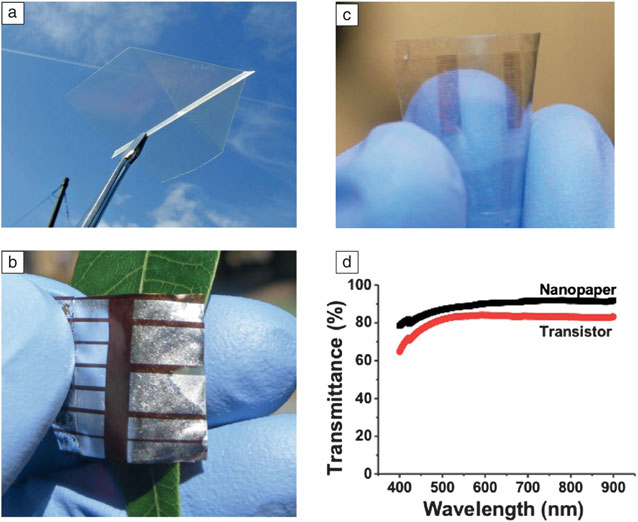
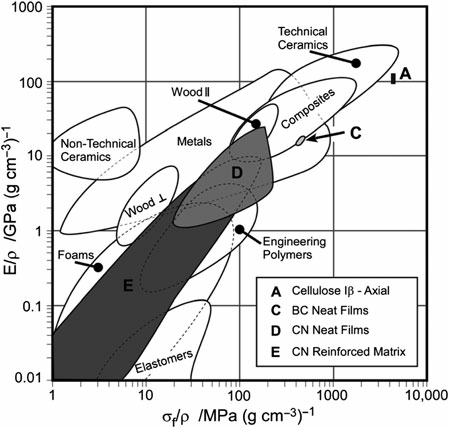
The use of nanocellulose paper as a “green” substrate for electronic and optoelectronic devices has attracted broad attention.Reference Nogi, Iwamoto, Nakagaito and Yano 24 – Reference Olsson, Azizi Samir, Salazar Alvarez, Belova, Strom, Berglund, Ikkala, Nogues and Gedde 26 Commercial paper has a relatively rough surface and weak mechanical properties, which can be problematic for electronic device fabrication. The porosity and thus the refractive index variation inside paper will cause significant light scattering, rendering the paper substrate opaque. Re-engineering paper substrates using NFC as the building blocks can address the previously mentioned problems. To prepare nanocellulose paper from NFC, a simple vacuum filtration method can be used, followed by oven drying, pressing, or freeze-drying.Reference Sehaqui, Liu, Zhou and Berglund 27 The nanocellulose paper fabricated is smooth, flexible, transparent, mechanically strong, and has an extremely low coefficient of thermal expansion.Reference Klemm, Kramer, Moritz, Lindström, Ankerfors, Gray and Dorris 1 , Reference Nogi, Iwamoto, Nakagaito and Yano 24 Yano et al. demonstrated the fabrication of transparent nanocellulose paper, which showed optical transmittance up to 70% ( Figure 5 a).Reference Nogi, Iwamoto, Nakagaito and Yano 24 Using TEMPO oxidized NFC, nanopaper with higher transmittance (84–89%) can be obtained (Figure 5d).Reference Huang, Zhu, Chen, Preston, Rohrbach, Cumings and Hu 29 The optical transmittance of nanopaper can be tailored by varying the diameters of the NFC nanofibers.Reference Zhu, Parvinian, Preston, Vaaland, Ruan, Hu and Hu 30 Meanwhile, nanocellulose paper is generally as lightweight as regular paper but with a much higher Young’s modulus. Figure 6 shows an Ashby plot of specific modulus and strength.Reference Moon, Martini, Nairn, Simonsen and Youngblood 2 Since nanocellulose paper has no binder or any other additives, it belongs to the “D” zone of the CN neat film, where the specific stiffness and strength can go up to 20 GPa (g cm–3)–1 and 300 MPa (g cm–3)–1, respectively. Sehaqui et al. showed that the elastic modulus of nanocellulose paper can reach 33 GPa after fiber alignment.Reference Sehaqui, Ezekiel Mushi, Morimune, Salajkova, Nishino and Berglund 28
(a) Transparent nanocellulose paper made of cellulose nanofibers. (Reprinted with permission from Reference 24. © 2009 Wiley-VCH Verlag GmbH & Co. KGaA, Weinheim.) (b) An organic photovoltaics device on transparent nanocellulose paper. (Reprinted with permission from Reference 17. © 2013 Royal Society of Chemistry.) (c) A picture of a transparent and flexible nanocellulose paper transistor. (d) Comparison of the optical transmittance of nanopaper and a nanopaper transistor. (Reprinted with permission from Reference 29. © 2013 American Chemical Society.)
Ashby plot of specific modulus (E/ρ) versus specific strength (σf/ρ). (Reprinted with permission from Reference 2. © 2011 Royal Society of Chemistry.)
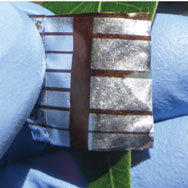
The excellent optical transmittance and mechanical strength of nanopaper, together with the roll-to-roll printing processes, will allow the next-generation flexible electronics and optoelectronics devices to be integrated on the renewable material. Electronic and optoelectronic devices based on transparent nanocellulose paper and printing techniques have been recently demonstrated. Figure 5c shows a picture of a fully transparent organic field-effect transistor fabricated on nanocellulose paper.Reference Huang, Zhu, Chen, Preston, Rohrbach, Cumings and Hu 29 The transmittance of the device is 83.5% at 550 nm (Figure 5d). The transistor also shows excellent mechanical properties, with only around a 10% decrease in mobility when the device was bent in directions parallel or vertical to the conduction channel. Organic photovoltaics on transparent nanocellulose paper has also been demonstrated (Figure 5b).Reference Hu, Zheng, Yao, Liu, Weil, Cui, Eskilsson, Karabulut, Wågberg, Ruan, Fan, Bloking and McGehee 17 Other important devices, such as integrated transparent sensors and 3D microfluidic devices, may also be fabricated on nanocellulose paper. As a potential replacement for plastic substrates, nanocellulose paper holds great promise for fabricating fully integrated flexible electronics and displays with unique properties, and at the same time is compatible with high throughput processes such as roll-to-roll printing.Reference Tobjörk and Österbacka 3
Conclusion
In this article, we have reviewed recent progress in the application of nanocellulose paper for flexible energy storage and electronic devices. Broadly speaking, there are three major building blocks that can be derived from cellulose: regular fiber with an average diameter of 20 μm, nanocellulose fibers with a diameter of ∼20 nm, and molecular scales of cellulose molecules.
Conductive paper made from cellulose fibers of 20 μm in diameter can function as a new type of current collector that enables high-performance paper ultracapacitors and Li-ion batteries. Another emerging area is the development of nanocellulose paper, which is made of nanofibrillated cellulose with diameters of around tens of nanometers. Such nanocellulose paper is highly transparent, smooth, and mechanically strong, allowing applications in a range of flexible energy and electronics devices. Proof-of-concept devices such as transistors and organic photovoltaics have been demonstrated. The combination of cellulose fibers and nanofabrication techniques heralds a new era of green electronics that can be manufactured using high throughput printing technology.