Introduction
Patients with rare diseases, their caregivers and families, are an important group in society that need more support due to significant disease burden and unmet clinical need (Reference Nicod and Kanavos1;Reference Kole and Faurisson2–Reference Chim, Salkeld, Kelly, Lipworth, Hughes and Stockler4). Approximately eighty percent of rare diseases have a genetic origin, and seventy-five percent affect children (Reference Goswami, Subramanian, Silayeva, Newkirk, Doctor and Chawla5). Rare genetic conditions are lifelong, posing substantial challenges due to the complexity and ongoing nature of health service needs and lack of treatment options (Reference Wu, Al-Janabi, Mallett, Quinlan, Scheffer and Howell6). Gene therapies (GTs) represent a breakthrough in therapy and offer the potential to address this unmet need.
While quality-adjusted life-years (QALYs) and costs often form the basis of value assessments in cost-effectiveness analyses, economic evaluations (EEs) of GT involve significant assumptions that cannot be validated, including around the durability of effect which will not be known for some time and the impact on future costs (Reference Whittal, Nicod, Drummond and Facey7;Reference Lakdawalla, Doshi, Garrison, Phelps, Basu and Danzon8). Furthermore, experts claim there are possible “other benefits” or “broader elements of value,” not captured by the QALY which are considered relevant to GT that could be considered in cost-effectiveness analysis (Reference Drummond, Neumann, Sullivan, Fricke, Tunis and Dabbous9). Evaluation of GT thus poses challenges for current EE methods.
Countries differ in their approach to appraising treatments for rare disease such as GT (Reference Whittal, Nicod, Drummond and Facey7). Some have adapted their reimbursement processes to deal with common challenges, such as being accepting of lower levels of evidence, gaining greater disease-specific insights from patient and clinical experts, and consideration of other benefits offered by therapy in their decision making (Reference Whittal, Nicod, Drummond and Facey7).
The purpose of this review is two-fold: first to illustrate the methodological challenges encountered in the EEs of voretigene neparvovec (VN), a GT to treat RPE65-mediated inherited retinal disease (IRD), a rare disease present from early childhood that progresses inexorably to complete blindness (Reference Chung, Bertelsen, Lorenz, Pennesi, Leroy and Hamel10). Subsequently, the broader sources of value possibly created from the development of VN considered by reimbursement decision-makers will be explored.
While similar reviews have been conducted, this review includes EEs from three countries (Australia, Canada, and Ireland) that have not previously been considered (Reference Huygens, Versteegh, Vegter, Schouten and Kanters11). This review also considers the general methodological challenges related to general value assessment and broader value elements specifically. More GTs will be forthcoming, so it is important to gain a deeper understanding of how the methodological challenges were managed and whether broader value was considered by the reimbursement agencies.
Methods
Search strategy
A systematic search according to a prespecified search terms for published EEs and health technology assessment (HTA) agency reports for VN using the following databases: MEDLINE and EMBASE (via the Ovid platform) and EconLit (via the EBSCO platform) was conducted between April 2021 and August 2021 (Supplementary Table 1). The search strategy was not limited by language or year of publication. A subsequent manual search was conducted of well-established HTA agencies to ensure all relevant EEs were captured. Reference lists of the included studies were reviewed for additional eligible studies.
Selection criteria and data extraction
The primary author reviewed reports against eligibility criteria and extracted data from each EE using the Consolidated Health Economic Evaluation Reporting Standards checklist (Supplementary Table 1). Reports not in English, conference abstracts, and systematic reviews were excluded, and only studies reporting the full EE were included.
Assessment of the decision-making process and broader value considered followed an existing methodological framework that included the interpretation of the evidence, “other considerations,” and stakeholder input (Reference Nicod and Kanavos1). Information specific to HTA consideration was extracted from public summary documents as well as agency reports and reflects the base case analysis after any adjustments had been made during the review process (which may differ from the base case results put forward by the applicant/sponsor) (Reference Nicod and Kanavos1).
All cost data were adjusted to May 2021 prices and converted into USD using the relevant exchange rate (www.xe.com).
Results
Search results
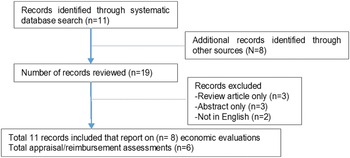
A total of nineteen records were identified, of which eleven met the inclusion criteria (Figure 1). Two reports represent a US evaluation conducted by ICER (Reference Zimmermann, Lubinga, Banken, Rind, Cramer and Synnott12;13), three reports were considered by NICE (Reference Farmer, Bullement, Packman, Long, Robinson and Nikram14–17), and one report each of an Australian MSAC (18), Scottish SMC (19), Irish NCPE (20), German (Reference Uhrmann, Lorenz and Gissel21), the United States (Reference Johnson, Buessing, O’Connell, Pitluck and Ciulla22), and Canadian CADTH (23) evaluation. The eleven reports represent eight unique evaluations. Appraisal/reimbursement decisions were identified from six HTA agencies (CADTH, ICER, NICE, MSAC, NCPE, and SMC).
PRISMA flowchart of the number of records included in this review.

Clinical evidence
All of the EEs relied on two clinical trials of VN: a phase I single arm safety and dose escalation study (Study 101/102, N = 12) and an open label phase III randomized controlled trial (Study 301, N = 29) in which participants were randomized 2:1 to VN or best supportive care (BSC), with crossover allowed after 12 months (Reference Bennett, Wellman, Marshall, McCague, Ashtari and DiStefano-Pappas24;Reference Russell, Bennett, Wellman, Chung, Yu and Tillman25). Participants had a mean age of 15 years, confirmed biallelic RPE65 mutation, visual acuity (VA) equal to or worse than 20/60, or visual field (VF) less than 20 degrees (Reference Russell, Bennett, Wellman, Chung, Yu and Tillman25). The phase III trial was considered the main source of clinical effectiveness data.
Efficacy was assessed using functional vision (i.e., how a person functions in vision-related activities) and visual function (i.e., how the eyes perform, including VA, VF, and light sensitivity) (26). A novel primary endpoint, change in bilateral multiluminance mobility test (MLMT), was developed by the manufacturer (Spark Therapeutics, Inc. US) in collaboration with the US Food and Drug Administration (FDA) to support registration (26;Reference Chung, McCague, Yu, Thill, DiStefano-Pappas and Bennett27). The MLMT is a composite of VA, VF, and light sensitivity and measures the performance of daily living activities that are vision dependent (Reference Russell, Bennett, Wellman, Chung, Yu and Tillman25;Reference Chung, McCague, Yu, Thill, DiStefano-Pappas and Bennett27). The change in bilateral MLMT score at 12 months was the primary endpoint in the trial.
At 1 year, a clinically meaningful increase in mean bilateral MLMT change score was reported in Study 301 (1.8 in the intervention group and 0.2 in the control group, a difference of 1.6 (p = 0.001) (Reference Russell, Bennett, Wellman, Chung, Yu and Tillman25). There were statistically significant improvements in full-field light sensitivity (FST) and VF (Reference Russell, Bennett, Wellman, Chung, Yu and Tillman25).
Both trials supported a durable long-term improvement in functional vision, through to 7.5 years in Study 101 and 4 years in Study 301 (17; 18;Reference Maguire, Russell, Wellman, Chung, Yu and Tillman28).
All evaluations considered BSC the appropriate comparator. BSC was informed by a retrospective chart review that described the long-term natural history of biallelic RPE65-mediated IRD (N = 70) (Reference Chung, Bertelsen, Lorenz, Pennesi, Leroy and Hamel10).
Characteristics of economic evaluation analyses
The characteristics of the eight evaluations (reflecting base case evaluations put forward by the sponsor) are provided in Supplementary Table 2. Six EEs were conducted from a healthcare payer perspective and two from a societal perspective.
A two state Markov model was used by two evaluations (13;Reference Uhrmann, Lorenz and Gissel21). In this model, patients transitioned from “alive with biallelic RPE65- mediated retinal disease” to “dead,” with the transition probability a function of age- and sex-specific mortality rate. Within the alive state, VA and VF were modeled using an exponential and linear form from the natural history study, respectively.
The remaining six evaluations were based on the same industry sponsored model, adapted for each country. Consequently, these evaluations have the same structure but use different inputs (16–20;Reference Johnson, Buessing, O’Connell, Pitluck and Ciulla22;23). The model used a more complex parametric multistate survival model containing six health states (HS1–HS6) representing deteriorating vision based on the course of VA and VF observed in the clinical trial (Study 301) and the natural history study and included mortality. Surrogate outcomes, VF and VA, defined the health states due to a lack of natural history of progression, costs, or impact on quality of life (QOL) data on the MLMT. Data from Study 301 informed the transition probabilities in each of the BSC and VN arms in the initial phase during which individuals moved to either better or worse health states. During the maintenance phase, the initial distributions across HSs was retained for a period followed by a long-term decline consistent with disease progression from less to more severe health states and no regression to less visually impaired states.
The assumed duration of treatment effect varied from 10 years to a lifetime. All EEs were based on a lifetime horizon with a 1-year cycle length. Discounting of costs and benefits was at standard discount rates for each jurisdiction, varying from 1.5 percent (CADTH) to 5 percent (MSAC). NICE considered a scenario analysis applying a 1.5 percent rate (from the base case 3.5 percent) given the likelihood of long-term benefits.
The industry-sponsored evaluations used a bespoke utility study to indirectly elicit utility weights (17–19;23;Reference Lloyd, Piglowska, Ciulla, Pitluck, Johnson and Buessing29). In this study, vignettes describing the health states were valued by six clinical IRD experts using the EuroQol-5D (EQ-5D) and Health Utilities Index Mark 3 (HUI3). Justification for this approach was that there was a lack of IRD-specific values available, and that utility values available in the literature for comparable disorders of vision loss primarily assessed visual impairment only through VA and focused on older patients with age-related macular degeneration (AMD), diabetic retinopathy (DR), or glaucoma (Reference Brown30–Reference Sharma, Oliver-Fernandez, Bakal, Hollands, Brown and Brown33). Those available studies excluded patients with no light perception suggesting that the resulting utility data may be of limited relevance in the younger population with RPE65-mediated IRD (Reference Brown GaB34). Utility values based on the HUI-3 were used in most of the industry-sponsored models because, unlike the EQ-5D, the HUI-3 contains a visual domain (16–20). Because normal vision was included in the moderate visual impairment health state (i.e., HS1) the model submitted to MSAC in Australia increased the utility value in line with utility values reported for normal vision (18;Reference Brown30). The two independent evaluations relied on health utility values from a community-based sample that used the standard gamble (SG) to value health states based on declining VA in people with DR (13;Reference Uhrmann, Lorenz and Gissel21).
In recognition of caregiver and broader family burden associated with IRD, a caregiver disutility was applied in the four worst health states (HS 2–HS 5) in the base case in three evaluations (NICE, SMC, MSAC) and included in a scenario analysis from a societal perspective by CADTH (16;18;19;23). Caregiver disutilities incorporated in the NICE evaluation were sourced from a publication reporting spillover disutility of illness on family members or caregivers and used disutility estimates from parents of children with activity limitations (Reference Wittenberg and Prosser35).
Results of economic evaluations
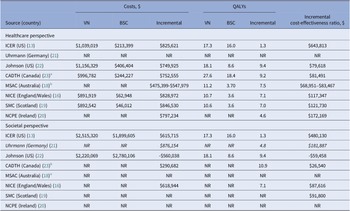
The EE results are summarized in Table 1. Incremental cost-effectiveness ratios (ICERs) are presented from a healthcare and societal perspective separately. All ICERs reflect the published price of VN submitted for evaluation by the sponsor and do not take into account any confidential price discounts.
Results of economic evaluations

Note: The cost-effectiveness results from the two state Markov model (as opposed to the six-state Markov model) are presented in italics. All prices have been converted into USD using the relevant exchange rate in May 2021 (www.xe.com).
Abbreviations: BSC, best supportive care; CADTH, Canadian Agency for Drugs and Technologies in Health; ICER, Institute for Clinical and Economic Review; MSAC, Medical Services Advisory Committee; NICE, National Institute for Health and Care Excellence; NCPE, National Centre for Pharmacoeconomics; NR, not reported; QALY, quality-adjusted life-year; SMC, Scottish Medicines Consortium; VN, voretigene neparvovec.
a The final ICER was not reported in the MSAC Public Summary Document (PSD); however, data were sourced from Novartis Pharmaceuticals Australia and included as a range, reflecting the approach to reporting of ICERs in Pharmaceutical Benefits Advisory Committee (PBAC) PSDs.
b The sponsor submitted scenario analyses, able 12 of the CADTH pharmacoeconomic report, includes societal perspective which is represented here.
From a healthcare perspective, apart from MSAC, the incremental costs were fairly consistent across evaluations, ranging from $749,925 to $846,530. The lower incremental costs ($475,399 to $547,979) reported in the MSAC evaluation may reflect the broader healthcare costs (incl. pensions and government subsidies) attributed to the BSC arm (18;Reference Wright, Keeffe and Thies36).
With the exception of ICER, QALY gains ranged from 4.6 to 9.4, reflecting the differences in duration of treatment effect, discount rates, and caregiver disutility applied in three evaluations (MSAC, NICE, and SMC). ICER reported a 1.3 QALY gain, which is derived from a utility function whereby vision-related disability is linearly proportional to VA or VF. Clinical experts criticized the approach for failing to adequately reflect the substantial utility reduction associated with IRD at the point of severe vision loss with experts quoting a utility of 0.26 associated with the blind state (no light perception) (Reference Lloyd, Nafees, Gavriel, Rousculp, Boye and Ahmad37). Acknowledging the limitation of the extrapolation, a scenario analysis applying a non-linear utility function adjusted the QALY gain to 5.2 which is similar to the other EEs.
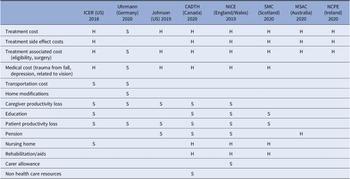
There was much wider variability in the incremental costs from a societal perspective, ranging from cost saving (−$59,458) to $876,154 (13;19;Reference Uhrmann, Lorenz and Gissel21–23). The variability was attributed to subjective estimates of the resource use, variation in indirect costs between different countries, and extrapolation methods. Table 2 presents a summary of the indirect and direct costs included in the EEs. While the source for indirect caregiver and patient productivity loss was based on IRD in the model published by Johnson (Reference Johnson, Buessing, O’Connell, Pitluck and Ciulla22), the indirect costs used by ICER were sourced from AMD (13). Despite both reflecting the US context, the indirect costs attributed to blind patients were double in the model by Johnson compared with ICER, which illustrates the range of costs from different sources.
Summary of healthcare and societal costs incorporated in voretigene neparvovec economic models

Note: “H” reflects costs included in healthcare perspective, “S” reflects costs included in the societal perspective.
Abbreviations: CADTH, Canadian Agency for Drugs and Technologies in Health; ICER, Institute for Clinical and Economic Review; MSAC, Medical Services Advisory Committee; NICE, National Institute for Health and Care Excellence; NCPE, National Centre for Pharmacoeconomics; SMC, Scottish Medicines Consortium.
While all evaluations considered societal costs, only evaluations by NICE, CADTH, and SMC included a societal benefit in terms of a caregiver disutility avoided. The incremental QALY gains reported from a societal perspective had a similar range to that reported from the healthcare perspective.
The resulting ICERs from a healthcare perspective ranged from $68,951 per QALY gained reported by MSAC driven by the comparatively low incremental cost to $643,813 per QALY gained reported by ICER driven by the comparatively low incremental benefit. In comparison, when applying a societal perspective the ICERs ranged from dominant to $480,130 reflecting the broader benefits considered (indirect costs of treatment rather than QOL impact).
HTA decisions
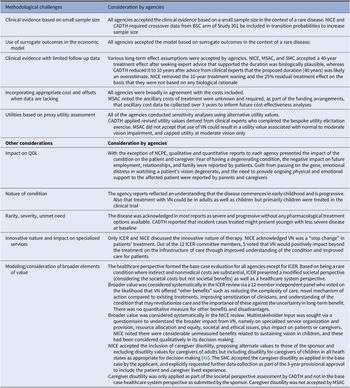
Six evaluations were assessed by HTA agencies, five by government reimbursement agencies (CADTH, MSAC, NICE, SMC, NCPE), and one by an independent research institute (ICER). The methodological challenges and consideration by HTA agencies, including considerations of broader value, are presented in Table 3.
Summary of voretigene neparvovec economic modeling challenges and management by reimbursement agency

Abbreviations: BSC, best supportive care; CADTH, Canadian Agency for Drugs and Technologies in Health; ICER, Institute for Clinical and Economic Review; IRD, inherited retinal disease; MSAC, Medical Services Advisory Committee; NICE, National Institute for Health and Care Excellence; NCPE, National Centre for Pharmacoeconomics; QOL, quality of life; SMC, Scottish Medicines Consortium; VN, voretigene neparvovec.
The agencies accepted the shortcomings in the evidence presented and modeling assumptions, noting the absence of evidence often associated with rare diseases, particularly genetic diseases that are heterogenous in presentation. All agencies thus relied heavily on expert opinion to validate model assumptions.
Two different methods to elicit stakeholder feedback, an in-depth questionnaire (using a systematic approach on a range of specific considerations) or routinely gathered generic insights (as part of a standard process), were used to support the broader considerations associated with VN in all evaluations except for NCPE. Common broad elements of value such as patient productivity and caregiver costs, as well as transport costs and blindness pension, were considered through a societal perspective scenario analysis by all decision-makers except for MSAC and NCPE. ICER considered a modified societal and healthcare perspective in their decision making, although they only included societal cost, not benefit. CADTH’s scenario analysis of the societal perspective considered both cost and caregiver disutility. The caregiver disutility was considered in the healthcare perspective analysis considered by NICE and SMC but not the costs to the caregiver. A number of novel considerations of value beyond clinical and cost-effectiveness, such as an impact on the “infrastructure” of care through increased disease screening and awareness that may revolutionize care or “improved specialized service provision,” were taken into account explicitly by NICE and ICER (13;16).
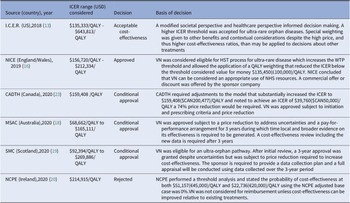
The timing of the appraisal, ICER range, and decisions are presented in Table 4.
Details of reimbursement decisions for voretigene neparvovec

Abbreviations: BSC, best supportive care; CADTH, Canadian Agency for Drugs and Technologies in Health; HST, highly specialized therapy; ICER, Institute for Clinical and Economic Review; IRD, inherited retinal disease; MSAC, Medical Services Advisory Committee; NICE, National Institute for Health and Care Excellence; NCPE, National Centre for Pharmacoeconomics; NHS, national health service; QALY, quality-adjusted life-year; SMC, Scottish Medicines Consortium; VN, voretigene neparvovec; WTP, willingness to pay.
The range of ICERs accepted by agencies was broad ($68,662/QALY to $643,813/QALY). The rationale for accepting what would otherwise be considered above standard thresholds appeared to be the nature and rarity of the condition, although it was difficult to judge from most HTA reports which considerations impacted the decision the most. The report by ICER however refers to raising the willingness to pay threshold in response to “special weighting… given to other benefits” as part of an appraisal framework established for ultra-rare disease treatments, and the report by NICE states, “there were considerable uncaptured benefits related to sustaining vision in children, and that these had been considered qualitatively in its decision making” (13;16).
Despite these concessions, a price reduction was uniformly suggested or requested by agencies to improve cost-effectiveness. Conditional approval, via ongoing data collection to inform re-evaluation and pay-for-performance agreements, was also implemented to address uncertainty by MSAC and SMC (18; 19). These agencies required collection of clinical and patient outcomes (plus caregiver experience and ancillary costs of treatment) as a means of addressing uncertain clinical benefit, patient and caregiver benefit, and costs.
Discussion
A range of economic modeling challenges were identified across the evaluations of VN. Such economic challenges are common to other innovative interventions for rare diseases and managed using standard methods, such as expert opinion to validate assumptions and scenario analyses testing different assumptions (Reference Huygens, Versteegh, Vegter, Schouten and Kanters11;Reference Garrison, Pezalla, Towse, Yang, Faust and Wu38). The distinguishing feature, common to GTs for rare disease, is the concentration and magnitude of these challenges and the lack of a biological analogue on which to assess the plausibility of model assumptions (Reference Drummond, Neumann, Sullivan, Fricke, Tunis and Dabbous9). Broader sources of value were considered by all reimbursement decision-makers and the review revealed challenges in modeling these broader elements of value that are considered relevant to assessing GT but are not typically captured in standard QALY estimates.
Various novel elements of value such as insurance value, severity of disease, value to caregivers, lack of alternatives, substantial improvement in life expectancy, and scientific spillovers are proposed as being particularly relevant to GT (Reference Lakdawalla, Doshi, Garrison, Phelps, Basu and Danzon8;Reference Drummond, Neumann, Sullivan, Fricke, Tunis and Dabbous9). While most agencies discussed severity of disease, value to caregivers, and lack of alternatives, only NICE and ICER systematically considered a wider range of “other benefits” possibly offered by VN (Reference Drummond, Neumann, Sullivan, Fricke, Tunis and Dabbous9;13;16). Of particular relevance to a novel GT such as VN, the improvement in disease management through advancing infrastructure and knowledge, and “scientific spillover” through advancement in the broader field of GT were considered (13;16). Whether such broader elements factored into the final approval across the other agencies is unclear. Three agencies however accepted the inclusion of caregiver disutility in the QALY (reducing the ICER by 9 percent), albeit subject to different approaches (16;19;23). Evaluations considered by NICE and SMC included caregiver disutility within a healthcare perspective for which a recommendation was made without considering broader societal costs (in terms of productivity loss). NICE challenged the disutility value including how many caregivers per patient it should apply to and whether to apply it to caregivers of adult patients (17). In contrast, CADTH included the costs and disutility to the caregiver within the societal perspective only, but these were not an explicit consideration in their decision making. While the ICER, the conventional measure of “value for money,” was reflected in the decision making by all agencies, the wide range of ICERs approved ($68,662/QALY to $643,813/QALY) for this novel therapy was striking and implies that perhaps the broader benefits beyond the QALY were considered in the decision making, or at a minimum that agencies exercise pragmatism in their decision-making that does not rely solely on estimates of cost-effectiveness (Reference Garrison, Jackson, Paul and Kenston39).
Two EEs included in the review did not have an external sponsor (the US Institute for Clinical and Economic Review and academic institute from Germany (Reference Uhrmann, Lorenz and Gissel21) and as such provide unique insights into the broader elements of value that might be considered in an EE of a GT given they are less likely to follow HTA guidelines and not be as influenced by commercial incentives to demonstrate value compared with industry sponsored CEAs (Reference Xie and Zhou40). Decision-makers are constrained by their own HTA guidelines reflecting their values, preferences, and constraints, for example, the healthcare perspective guiding NICE included the carer disutility whereas the healthcare perspective evaluated by MSAC did not (41;42). It is important to note that HTA guidelines are a “guide” and it is the responsibility of sponsor companies to argue for the inclusion of broader elements of value in their application. The complexities in considering such value in EEs may be one reason that sponsor companies have not included broader elements. For instance, there is limited evidence to support the informal care for patients with IRD and there are ongoing challenges in incorporating them into an EE (Reference Oliva-Moreno, Trapero-Bertran, Pena-Longobardo and Del Pozo-Rubio43). There is an ongoing need for reimbursement agencies to review the latest best practice. The Australian government for example is currently undertaking a Health Technology Assessment Policy and Methods Review to keep pace with rapid advances in health technology (44).
A common method of considering broader value via a societal perspective that includes non-related healthcare costs and consequences on caregivers and social services, and economic productivity can profoundly affect whether a therapy is deemed cost-effective (Reference Lakdawalla, Doshi, Garrison, Phelps, Basu and Danzon8;Reference Drummond, Neumann, Sullivan, Fricke, Tunis and Dabbous9). A comparison of the ICER ranges reported from a healthcare perspective ($68,951 to $643,813, Table 2) with a societal perspective (dominant to $480,130) illustrates this point. While the final recommendation by ICER was explicitly based on a side-by-side analysis of the healthcare perspective and “modified societal perspective” (including the societal cost but no benefit), it is not clear whether the societal perspective influenced the reimbursement decisions across the other agencies (Reference Garrison, Pezalla, Towse, Yang, Faust and Wu38;Reference Qiu, Pochopien, Hanna, Liang, Wang and Han45). A review of the societal perspective was evident in most evaluation reports so despite the study perspective being specified by the relevant decision-maker, conducting the cost-effectiveness analysis from both a societal and a healthcare perspective is one way of demonstrating the broader consequences of a GT that sponsor companies should consider.
The extrapolation assumptions applied to ongoing treatment effects and costs had a significant impact on the ICER for VN in all evaluations and were challenged by all agencies. Expert advice from clinicians was sought by all agencies, and despite the same clinical evidence being considered by all agencies, a different interpretation resulted from seeking opinions from different experts. For example, experts consulted by CADTH thought a 40-year treatment effect were optimistic and thus the base case was updated to reflect a shorter, 10-year treatment effect (23). This change resulted in a 200 percent increase in the ICER estimate (23). Other agencies however accepted the proposed 40-year treatment effect. Similarly, experts consulted by NICE objected to the assumed treatment waning period as not being supported by any biological rationale, but this was not a concern for other agencies such as MSAC. Immature evidence and lack of treatment analogue to support the long-term treatment effect for a once in a lifetime therapy will be an ongoing challenge for any GT, like VN (Reference Huygens, Versteegh, Vegter, Schouten and Kanters11;Reference Coyle, Durand-Zaleski, Farrington, Garrison, Graf von der Schulenburg and Greiner46). The novel nature of the treatment means there will inevitably be variation in international opinion regarding the durability of effect. Each jurisdiction differs in their approach to validating such uncertainty for their respective HTA agency and is limited by financial constraints such that the proposal by Huygens et al. to conduct a formal expert elicitation study to generate plausible treatment effect duration assumptions may not always be possible (Reference Huygens, Versteegh, Vegter, Schouten and Kanters11). Alternative approaches to collecting expert input, such as clinical advisory meetings or surveys, might be considered albeit recognizing the potential limitations arising from the number of respondents and their representativeness (41;47).
The lack of IRD-specific utility values was a substantial modeling challenge that is not uncommon in rare diseases. The benefit estimated in the model is driven by QOL; thus, the results are sensitive to the choice of utility weights. Utility values related to vision loss available in the literature focused on older patients with vision loss from conditions of limited relevance in the younger population with RPE65-mediated IRD. Hence, the industry-sponsored models incorporated utilities based on proxy assessments (Reference Brown GaB34). All agencies were critical of the proxy utility estimates and undertook QOL sensitivity using utility data evaluated in different sight disorders that substantially impacted the ICER (+38 percent to +308 percent) (13;17;Reference Lloyd, Piglowska, Ciulla, Pitluck, Johnson and Buessing29). While agencies prefer measurement of health by patients, indirect elicitation of utility weights is considered acceptable for rare diseases (41;47). Rather than sourcing proxy utility estimates, the use of direct elicitation methods such as the SG, time trade-off, or discrete choice experiments from the general population might be a better alternative for utility values for IRD (41;47;Reference Al-Janabi, van Exel, Brouwer and Coast48).
Limitations
Only EEs available in English were included. Most evaluations were sponsor funded therefore reflecting the same underlying clinical data and methods; variations in agencies’ considerations of those evaluations may thus reflect differences in parameter inputs and in underlying decision-making frameworks. A wider understanding of how broader aspects of value feature in decision-making could be gained from looking at the evaluations from more countries and agencies. This analysis was based on public information available in HTA reports, and as such it was subject to the varying transparency with which HTA agencies report their decision-making processes.
Conclusions
This review provides a deeper understanding of the assumptions accepted and the consideration of other benefits in HTA in GT that may assist in developing EEs in this setting. The analysis highlights that evaluations from a societal perspective do not always reflect both cost and benefit, and that societal benefits in terms of caregiver value are considered acceptable by some agencies in the healthcare perspective. Of specific relevance to the challenge in modeling GT are the extrapolation assumptions and broader elements of value considered acceptable by reimbursement agencies. This (study) illustrates the importance of quantifying the broader aspects of value to include in EEs of GT and underscores the need for greater guidance (and consistency) across jurisdictions in relation to consideration of broader element of value, and the need for reimbursement agencies to constantly review their guidelines and processes against the latest best practice. Thus, there is a need to expand on the understanding of the broader benefits that VN offers to patients with IRD and how to deal with those benefits within an EE given that VN, and other GTs with similar benefit profiles, will be the subject of future cost-effectiveness analyses.
Supplementary material
The supplementary material for this article can be found at http://doi.org/10.1017/S0266462323000326.
Acknowledgements
This research was conducted as part of an industry Doctorate at the Centre for Health Economic Research and Evaluation (CHERE), University of Technology Sydney, Sydney, Australia, in partnership with Novartis Pharmaceuticals Australia. Novartis Australia provides a Research Support Fee. Mrs Farris received a salary from Novartis at the time of conducting this review.
Competing interest
Mrs Farris was employed by Novartis Pharmaceuticals Australia at the time of conducting this review. No other disclosures were reported.