1. INTRODUCTION
With advances in laser technology, pulses of very high intensity ( ) and short (femtosecond) duration have become available (Perry & Mourou, Reference Perry and Mourou1994; Umstadter, Reference Umstadter2003). Such ultrashort, ultraintense (USUI) laser pulses make possible exploration of intriguing phenomena related to laser interaction with solid-density plasmas, such as the acceleration of electrons and ions to high energies (Zhuo et al., Reference Zhuo, Chen, Yu, Sheng, Yu, Jin and Kodama2010; Yu et al., Reference Yu, Pukhov, Shvets and Chen2010; Macchi et al., Reference Macchi, Cattani, Liseykina and Cornolti2005; Hatchett et al., Reference Hatchett, Brown, Cowan, Henry, Johnson, Key, Koch, Langdon, Lasinski, Lee, Mackinnon, Pennington, Perry, Phillips, Roth, Sangster, Singh, Snavely, Stoyer, Wilks and Yasuike2000; Koyama et al., Reference Koyama, Adachi, Miura, Kato, Masuda, Watanabe, Ogata and Tanimoto2006; Limpouch et al., Reference Limpouch, Psikal, Andreev, Platonov and Kawata2008; Liu et al., Reference Liu, Xie, Huang, Liu and Yu2009; Malka & Fritzler, Reference Malka and Fritzler2004; Mckenna et al., Reference Mckenna, Carroll, Lundh, Nurnberg, Markey, Bandyopadhyay, Batani, Evans, Jafer, Kar, Neely, Pepler, Quinn, Redaelli, Roth, Wahlstrom, Yuan and Zepf2008; Nickles et al., Reference Nickles, Ter-Avetisyan, Schnuerer, Sokollik, Sandner, Schreiber, Hilscher, Jahnke, Andreev and Tikhonchuk2007; Schwoerer et al., Reference Schwoerer, Pfotenhauer, Jackel, Amthor, Liesfeld, Ziegler, Sauerbrey, Ledingham and Esirkepov2006; Snavely et al., Reference Snavely, Key, Hatchett, Cowan, Roth, Phillips, Stoyer, Henry, Sangster, Singh, Wilks, Mackinnon, Offenberger, Pennington, Yasuike, Langdon, Lasinski, Johnson, Perry and Campbell2000; Wang et al., Reference Wang, Yu, Yu, Senecha, Xu, Wang, Yuan and Sheng2009; Yu et al., Reference Yu, Xu, He, Yu, Ishiguro, Zhang and Wong2005), generation of relativistic positrons (Chen et al., Reference Chen, Wilks, Bonlie, Liang, Myatt, Price, Meyerhofer and Beiersdorfer2009), production of intense quasi-static self-magnetic fields (Humphries & Petillo, Reference Humphries and Petillo2000; Obenschain & Luhmann, Reference Obenschain and Luhmann1979; Cai et al., Reference Cai, Zhu, Chen, Wu, He and Mima2011), etc. These phenomena are not only important to basic physics but also pivotal to many novel applications such as laser-driven particle accelerators, ion lithography schemes (Alves et al., Reference Alves, Reichart, Siegele, Johnston and Jamieson2006), hadron therapy (Bulanov & Khoroshkov, Reference Bulanov and Khoroshkov2002; Salamin et al., Reference Salamin, Harman and Keitel2008), X-ray lasers (Tabak et al., Reference Tabak, Hammer, Glinsky, Kruer, Wilks, Woodworth, Campbell, Perry and Mason1994), compact neutron sources (Disdier et al., Reference Disdier, Garçonnet, Malka and Miquel1999), etc.
Because of the high nonlinearity involved, the interaction of USUI lasers with solid-density plasmas is traditionally investigated using particle-in-cell (PIC) numerical simulation. However, as pointed out by Berezhiani et al. (Reference Berezhiani, Garuchava, Mikeladze, Sigua, Tsintsadze, Mahajan, Kishimoto and Nishikawa2005), multi-dimensional PIC simulation results are often difficult to interpret in terms of the basic underlying physics, since dimensional, kinetic, and other effects can mask and complicate the problem. To better visualize the basic interaction physics, it was proposed that the one-dimensional (1D) relativistic fluid-Maxwell equations be solved numerically. Indeed, Tushentsov et al. (Reference Tushentsov, Kim, Cattani, Anderson and Lisak2001) studied the evolution of the electrons and ions as a relativistic laser pulse penetrates overdense plasma with a 1D fluid-Maxwell code successfully. The Maxwell equations were solved under the slowly-varying-envelope paraxial approximation. Berezhiani et al. (Reference Berezhiani, Garuchava, Mikeladze, Sigua, Tsintsadze, Mahajan, Kishimoto and Nishikawa2005) relaxed the latter approximation, but ignored the effects of ion motion.
Theories of laser-plasma interaction usually start from the same equations as that of the fluid-Maxwell simulation. With suitable simplifications and standard derivation methods, relatively simple evolution equations are derived. In earlier theoretical works, valid for lasers of longer duration and lower intensity, the relativistic effect and ponderomotive effect are usually not included. Recently, 1D and two-dimensional (2D) relativistic theoretical models for the interactions of USUI lasers with solid-density plasmas have been developed (Yu et al., Reference Yu, Yu, Sheng and Zhang1998; Luan et al., Reference Luan, Yu, Yu, Ma, Zhang, Sheng and Murakami2011), whose steady-state solutions describe short-time balance among the plasma electron response, the resulting charge separation fields, the ponderomotive force of the laser pulse, etc. The plasma ions are usually treated as immobile during the interaction.
Here we propose a 2D theoretical model for the time evolution of solid-density plasma during and after the irradiation by an USUI laser pulse normally incident on the solid-density plasma. Ion motion, which can become important after the laser action, is taken into account. Earlier theoretical works and computer simulations (Mishra et al., Reference Mishra, Sentoku and Kemp2009; Kemp et al., Reference Kemp, Sentoku and Tabak2008) on this topic consider lasers of semi-infinite duration, and the investigation is therefore confined to laser-plasma interaction. For USUI laser pulses, however, it is highly desirable to take into account the plasma behavior after laser action as well. In this model, we consider an axis-symmetric laser pulse of finite duration, such that the plasma evolution during and after the laser action can be investigated.
Section 2 contains a description of our theoretical model, which enables us to study the time-dependent behavior of laser and plasma. Section 3 focuses on the reflected laser pulse. With energy dissipation and frequency red-shift after interaction with the plasma, the reflected pulse can provide valuable information on laser absorption rate and electron recession speed. Section 4 considers the plasma response during and after laser action. As the laser pulse irradiates the solid target, the electrons near the target surface are pushed inward and piled up by the radiation pressure, leading to a receding electron density jump where the laser light is reflected. The positively charged massive ions respond to the laser action slowly and are left behind. The strong electrostatic field of charge separation balances with radiation pressure at the laser peak, which agrees well with the steady-state model proposed by Luan et al. (Reference Luan, Yu, Yu, Ma, Zhang, Sheng and Murakami2011). After laser peak, the charge separation field becomes dominant. It accelerates and compresses the target ions. This process continues until the energetic ions join the laser-compressed electrons and results in a high-density plasma peak, which will keep moving inward inertially, even when the charge-separation field vanishes. Section 5 considers the electron oscillations across the compressed density jump. During laser action the u × B oscillation at twice laser frequency occurs for a linearly polarized laser. After laser action, a low-frequency electron oscillation is driven by the combined effect of space-charge field and electron inertia.
2. GOVERNING EQUATIONS
The starting equations for relativistic laser interaction with plasma can be written as (Luan et al., Reference Luan, Yu, Yu, Ma, Zhang, Sheng and Murakami2011)




where ![$< is the ponderomotive force (Esarey et al., Reference Esarey, Sprangle, Krall and Ting1996), p = γu and pi = γui are the electron and ion momentum normalized by mc, u and ui are the electron and ion velocities normalized by the speed of light c, γ and γi are the electron and ion relativistic factors, −e and m are the electron charge and mass, n and n i are the electron and ion densities normalized by the critical density n c, Z is the ion charge number,
 and E is the electric field normalized by mcω0/e. The time is normalized by
 and the space coordinates by
 where ω 0 and k 0 are the laser frequency and wave number, respectively. The electron and ion continuity equations are


It is convenient to write the electric field as E = Et + Eℓ, where Et = −∂ta and  are the transverse and longitudinal components satisfying
 and
 , respectively, and the vector and scalar potentials a and ϕ have been normalized by mc 2∕e. The two vector components can be used to describe the two modes appearing in plasma: the electromagnetic mode induced by laser penetration and the electrostatic (ES) mode induced by charge separation. Since the penetration depth is extremely small, one can assume that the vector potential a in the plasma remains in the same direction as that in the vacuum, i.e., perpendicular to the laser propagation direction. In fact, the overall laser penetration into the plasma is confined to a very small region on the order of the laser spot size in the transverse direction and the laser penetration depth in the axial, or propagation, direction. In solid-density plasma, the former is typically several tens laser wavelengths and the latter is far less than the laser wavelength. Accordingly, for electron momentum driven by laser fields we have
 , and the wave equation becomes

In this way, we can treat the fast varying electron motion driven by electromagnetic mode without invoking the slowly varying envelope (parabolic) approximation.
The light pressure pushes the plasma electrons inward at target surface, forming a moving jump in the electron density. The massive ions can respond only slowly, so that an electrostatic field is induced by charge separation. Since the laser spot size is much larger than the penetration depth, the longitudinal field Eℓ evolves mainly in the axial direction, i.e.,  . The relativistic factor (Esarey et al., Reference Esarey, Sprangle, Krall and Ting1996; Wang et al. Reference Wang, Yu, Yu, Xu, Wang and Yuan2009), is then given by

From Eqs. (1)–(3) we obtain for the ES components



where for simplicity the subscript  has been replaced by z. Eq. (11) can also be written as

We write the incident laser pulse in vacuum in the form


where η = z − t,  represents the radial profile of laser,
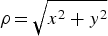 is the radial coordinate, τ is the pulse duration, b is the spot size, σ = 0 and 1 denote linear and circular polarizations, respectively. Since the laser-plasma interaction region is extremely small, we can assume that the radial profile of the overall (both the transverse and longitudinal components) profile of the electric field in this region remains the same as that of the laser in vacuum. That is, the electric field in plasma can be expressed as
 , and we can write
 and
 , where as and E zs are the amplitudes on the laser axis (ρ → 0). One can then rewrite the wave equation (Eq. (7)) as

For the ES parameters, we obtain from (9)–(12)




The continuity Eqs. (5) and (6) become


Eqs. (15)–(21) are solved using a second-order finite difference algorithm similar with the method used by Berezhiani et al. (Reference Berezhiani, Garuchava, Mikeladze, Sigua, Tsintsadze, Mahajan, Kishimoto and Nishikawa2005). A grid is set up in both space coordinate z and time coordinate t. All physical quantities are defined on the grid nodes. The spatial step of the grid ∆z is chosen to be 100 times shorter than the vacuum wavelength λ of the incident pulse. The temporal step ∆t is dictated by the stability criterion of the scheme  . The wave equation was approximated by an implicit second-order discrete equation and solved by the modified Gauss method. For Eqs. (16)–(17) and (20)–(21), the first-order, explicit scheme was employed. To prevent density “overshooting,” the Lax scheme was applied (Berezhiani et al., Reference Berezhiani, Garuchava, Mikeladze, Sigua, Tsintsadze, Mahajan, Kishimoto and Nishikawa2005). Initial distribution of the laser field is localized in vacuum region sufficiently far from the solid plasma boundary. In this region, the scalar potential vanishes and the solution of Eq. (9) is
 . The boundary conditions is
 , where
 .
The above equations are solved to determine the laser and plasma parameters along the laser axis. From Eq. (11), we get for the density difference

The radial variations of the electron and ion densities are then given by


where  is the initial plasma density. Furthermore, for ρ ≫ b, we have
 . With
 , one can determine the radial profile of the vector potential, the relativistic factors, as well as the electron and ion velocities.
3. LASER DEPOSITION
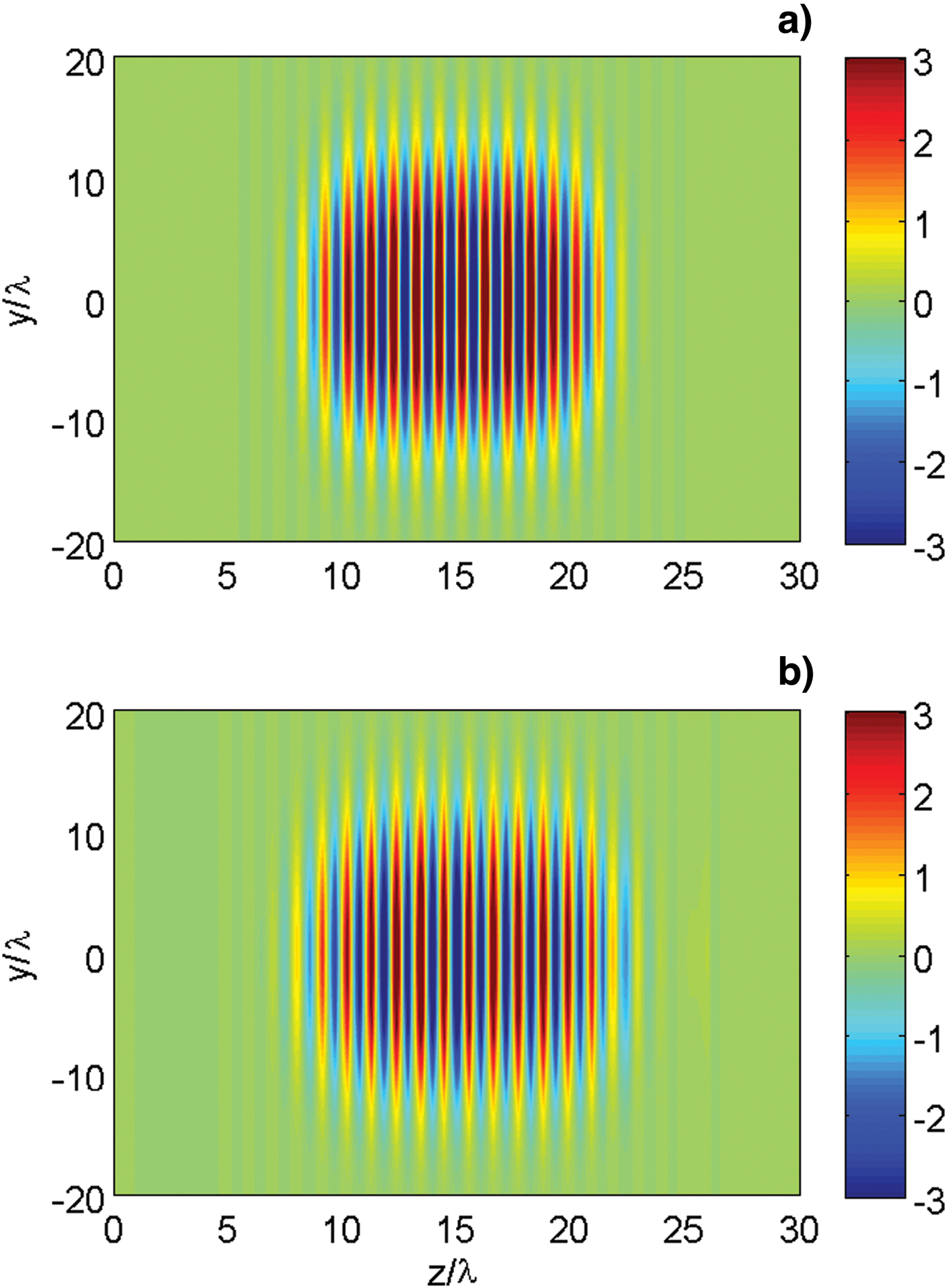
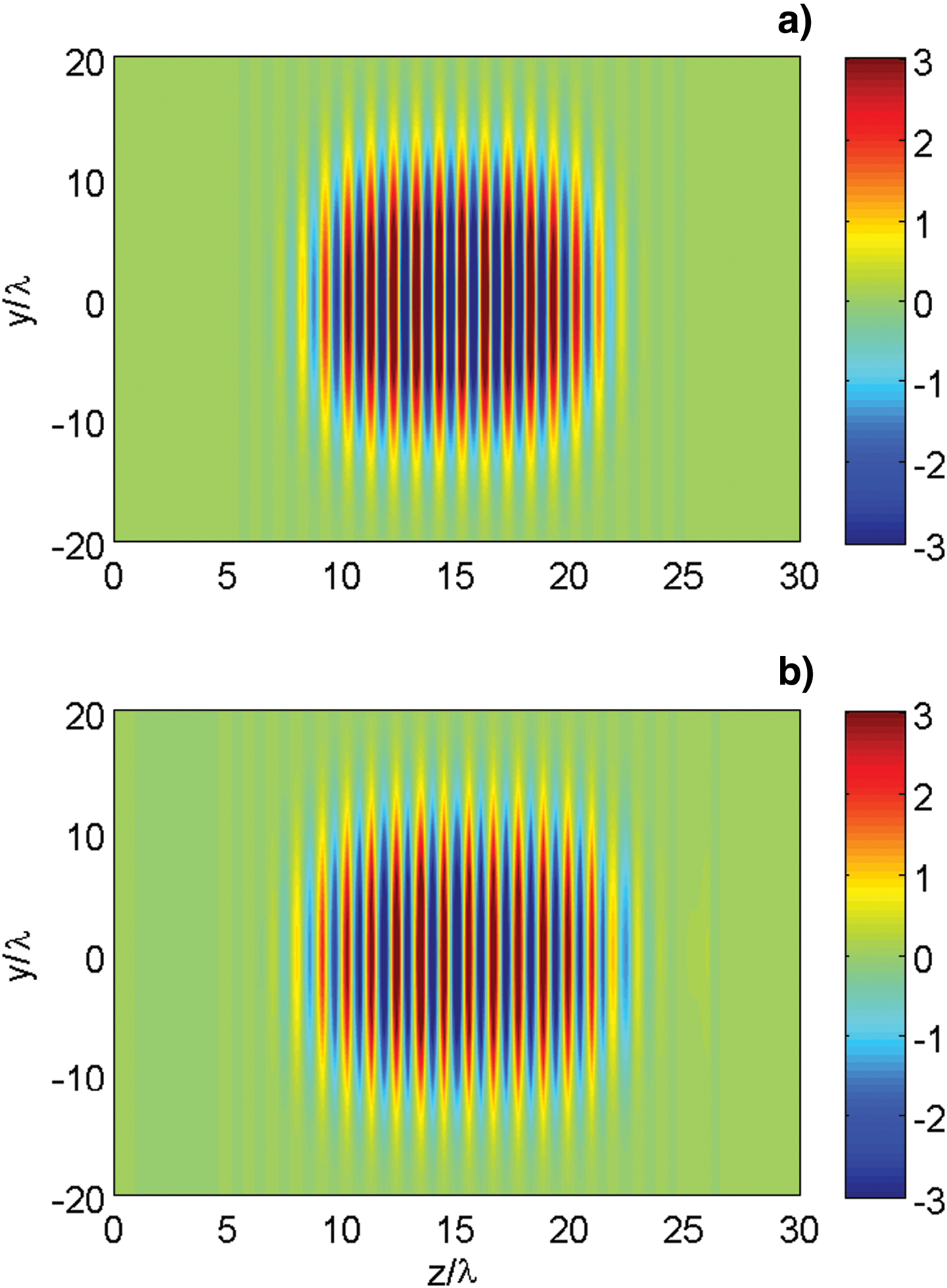
We now consider the evolution of the laser pulse. Figure 1 shows the spatial profile of the vector potential at t = 0 and 30T 0, where T 0 is the laser period, for normal incidence of a linearly polarized laser pulse on a semi-infinite overdense plasma. The initial plasma density is  for z > 30, and n(0) = 0 for z < 30. The incident laser strength is a L = 5, the pulse duration is τ = 10T 0, and the spot size is b = 10λ. At t = 0 the incident laser pulse is centered at z = 15. It propagates in vacuum to the right and interacts with the plasma at z > 30. At t = 30T 0 the laser pulse is reflected from the plasma and propagates again in vacuum to the left. As a result of the nonlinear interaction the reflected pulse is somewhat weaker and longer than the incident pulse.
(Color online) The laser amplitude a normalized by mc 2/e at (a) t = 0, and (b) t = 30T 0, for a L = 5, b = 10λ, τ = 10T 0, and Zn i = 10.
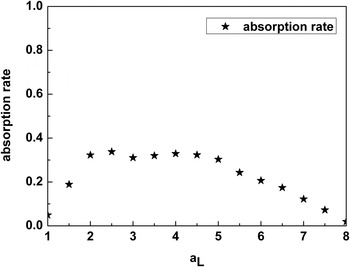
Laser energy deposition in plasma is one of the key issues in laser plasma physics (Wilks et al., Reference Wilks, Kruer, Tabak and Langdon1992; Wilks & Kruer, Reference Wilks and Kruer1997). The absorption rate can be defined as  , where W in and W out are the energy of the incident and reflected laser pulses, respectively. Figure 2 shows the dependence of the absorption rate on the laser strength aL, with the other parameters the same as in Figure 1. Our calculations show that the absorption rate first increases with the laser amplitude, reaches a maximum (about 39%) at aL = 2.5, and decreases as the amplitude further increases.
The effect of initial laser intensity on laser absorption for b = 10λ, τ = 10T 0, and Zn i = 10.

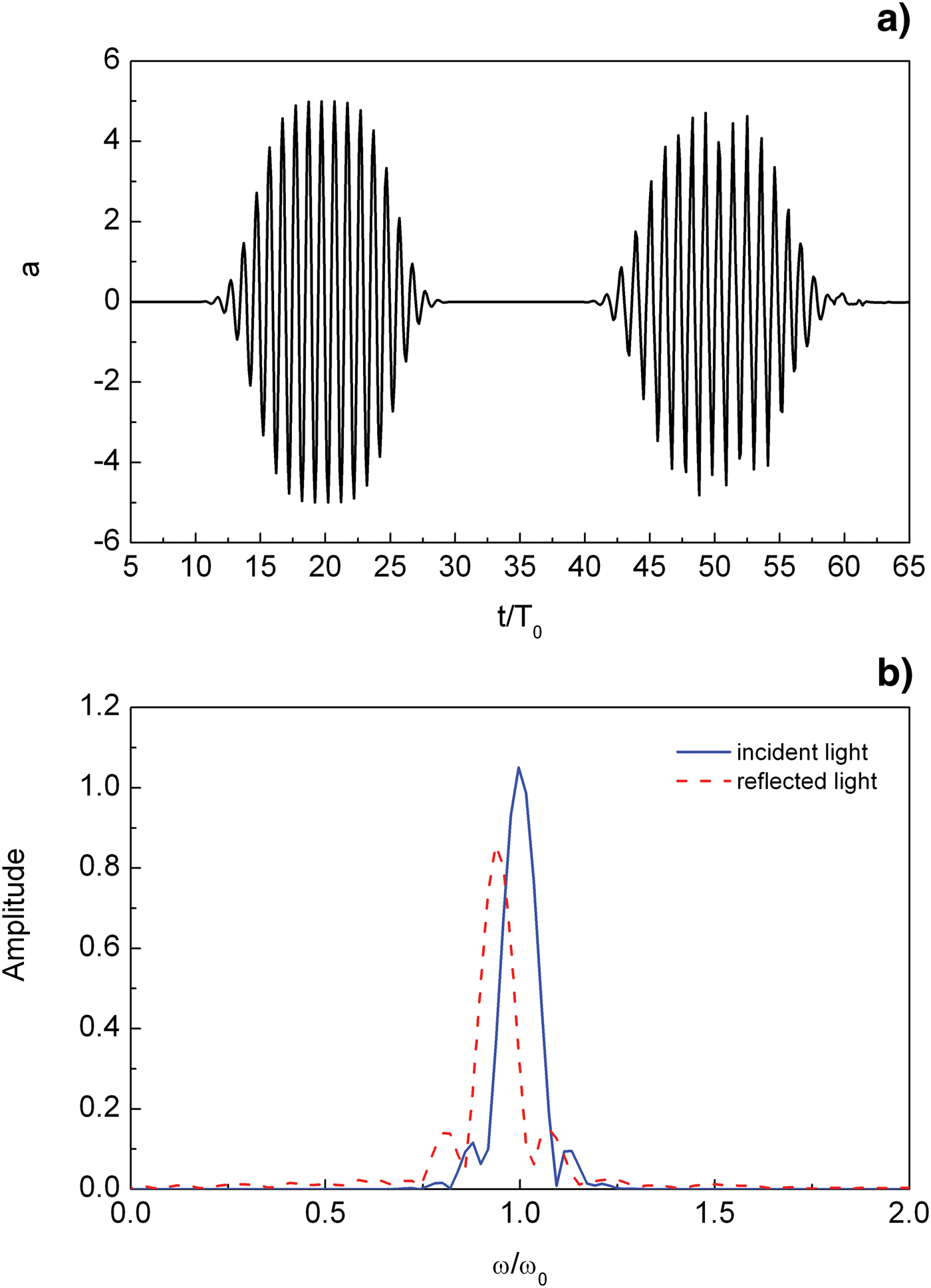
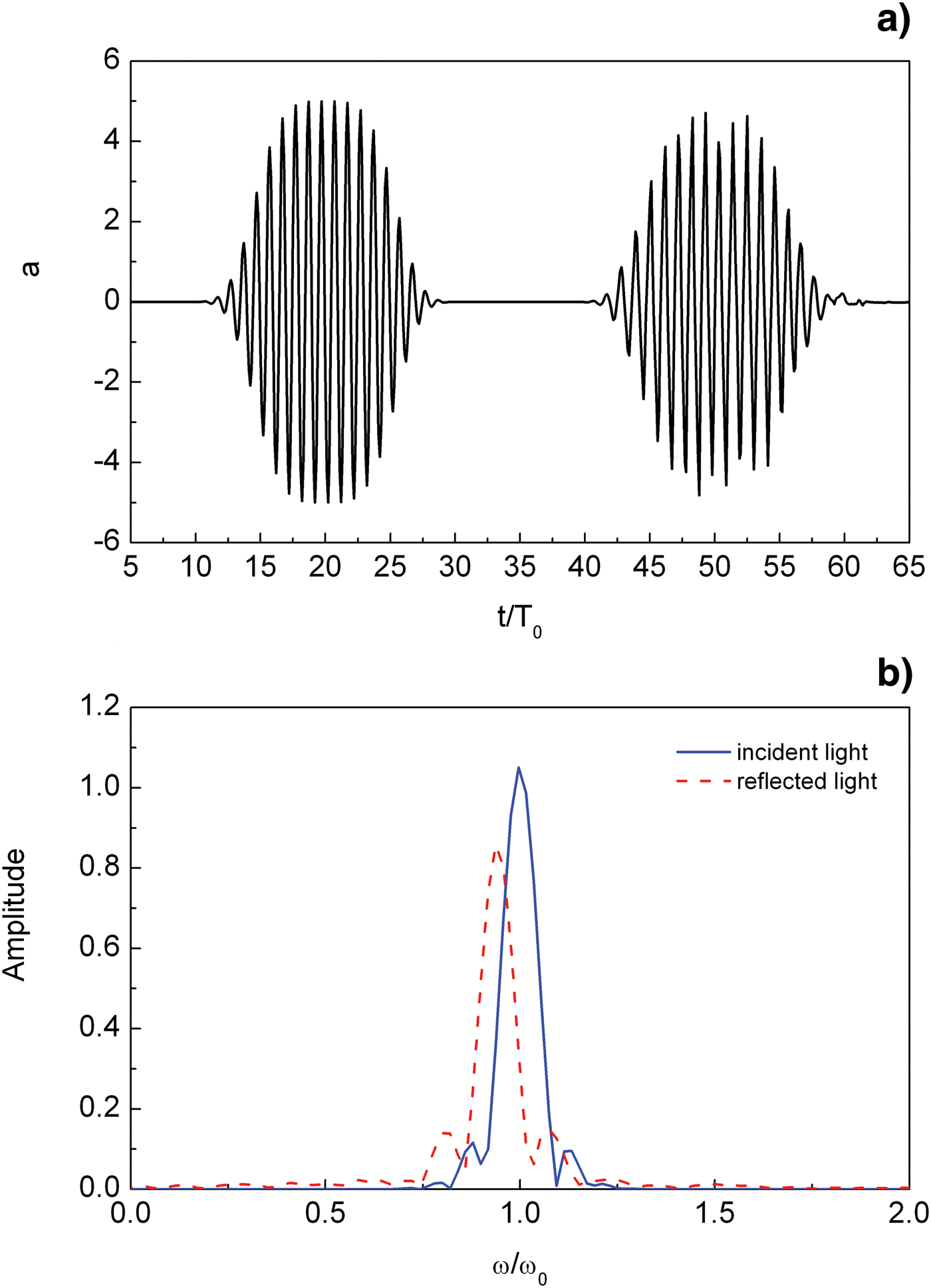
Valuable information can be obtained by analyzing the reflected radiation. Figure 3a shows the time evolution of the laser pulse along the laser axis at z = 15. The parameters of the interaction are the same as in Figure 1. Figure 3b shows the corresponding frequency spectrum, where the blue solid peak centered at ω/ω0 = 1 is for the incident pulse, and the red dashed peak centered at ω/ω0 = 0.91 is for the reflected pulse. The frequency of the reflected pulse is Doppler red-shifted since the laser pulse is reflected from a receding electron layer, acting like a moving mirror. From the Doppler frequency shift relation

where ωr and ωi are the frequencies of the reflected and incident light, we obtain a speed v ~ 0.047c for the receding electron density jump.
(Color online) Time evolution (a) and frequency spectrum (b) of the incident (blue solid line) and reflected (red dashed line) laser pulses at z = 15. The parameters are the same as in Figure 1.
4. PLASMA RESPONSE
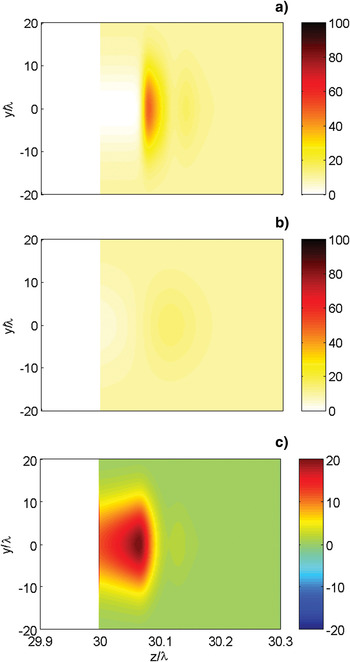
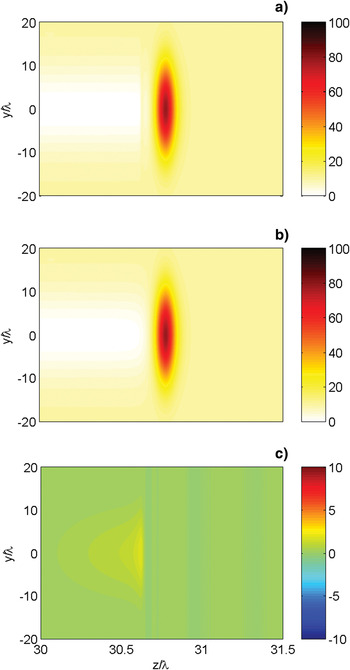
We next examine the plasma response to the laser action. Figure 4 shows the 2D distributions of the (a) electron and (b) ion densities at t = 14T 0, when the laser interacts with plasma. The parameters are the same as for Figure 1. One can see from (a) that the radiation pressure, or the dc component of the ponderomotive force (Mishre et al., 2009), pushes the electrons inward at the target surface and piles them up in front of the laser pulse, leading to a receding electron density jump. The density of the compressed electrons can be several times the initial target density. As shown in Figures 4b and 4c, the massive ions remain almost unmoved, so that an intense positive electrostatic charge-separation field E z appears. The latter tends to accelerate the ions and decelerate the electrons. As the laser action continues, the charge separation field continues to increase until the peak of the laser pulse arrives at the compressed electron layer. A quasi-stationary state can then be established in the region, in which the space charge field balances the radiation pressure. Figure 4 shows the plasma response in such a state, which agrees well with that obtained from earlier steady-state modeling.
(Color online) The electron density n (a), ion density n i (b), normalized by the critical density n c, and electrostatic charge-separation field (c) at t = 14T 0. The parameters are the same as in Figure 1.

After the laser pulse is reflected and leaves the interaction region, the radiation pressure disappears and the space-charge field becomes dominant. It continues to accelerate the ions and decelerate the electrons. As time progresses the ion motion becomes more and more significant, so that the space-charge field becomes weaker and weaker. Figure 5 shows the distributions of the (a) electron density, (b) ion density, and (c) electrostatic field E z at t = 30T 0. At the moment the former ion layer disappears, the ions there are accelerated by the space-charge field, until they join the electrons and move together inertially as a quasi-neutral fluid, as shown in Figures 5a and 5b. As a result, the space-charge field is greatly reduced. The resulting nearly-neutral high-density plasma peak continues to move forward inertially, even when the electrostatic field has vanished.
(Color online) The electron density n (a), ion density n i (b), normalized by the critical density n c, and electrostatic charge-separation field (c) at t = 30T 0. The parameters are the same as in Figure 1.

In the present model, collisions among the charged particles and plasma thermal effects are not included. During the time of laser interaction, these effects are safely negligible in the laser-driven short-timescale electron dynamics. However, in the later stages of the electron and ion evolution, collisions and thermal motion can be significant and even dominant. In particular, collisions can thermalize the dense plasma bunch, which will then expand as it propagates forward.
5. ELECTRON OSCILLATIONS
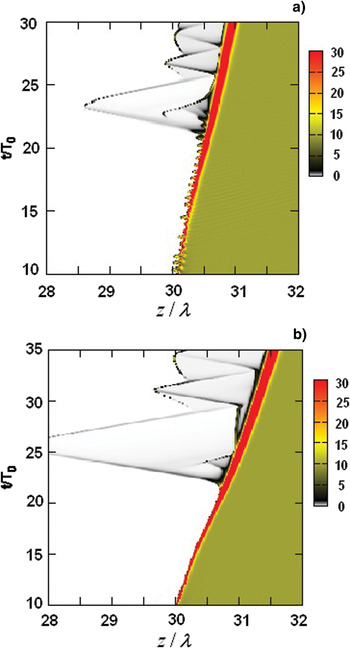
Electron oscillation can appear across the density jump. Figure 6 shows the temporal and spatial profiles of the electron density along the laser axis, where the electron motion is strongest, for irradiation by (a) linearly and (b) circularly polarized laser pulses. The other parameters are the same as in Figure 1. In Figure 6a, one can see the receding electron density-jump (the red region). With  representing the position of density jump, the recession speed can be deduced from the density-jump trajectory
 , which is in good agreement with that deduced from the Doppler frequency shift Eq. (25) and Figure 3b.
(Color online) Evolution of the electron density along the laser axis for linearly (a) and circularly (b) polarized laser pulses for a L = 5, b = 10λ, τ = 10T 0, and Zn i = 10. In (a) one can clearly see the u × B oscillations at the layer surface. Very low frequency and density space charge oscillations appear for both cases after the laser action.

Two different types of electron oscillations can appear across the density jump. For the linearly polarized laser, u × B oscillation at twice the laser frequency (Luan et al., Reference Luan, Yu, Yu, Ma, Zhang, Sheng and Murakami2011; Kruer & Estabrook, Reference Kruer and Estabrook1985) is dominant during (t < 20T 0) the laser action. Electrons near the density jump are pulled out twice a laser period and sent back by the oscillating component of the ponderomotive force, as shown in Figure 6a. Since the returning electrons have gained energy from the laser, they can easily propagate through the region of laser penetration and deposit their energy deep inside the target. This feature has invoked considerable research interest and should be useful for fast ignition in inertial confined fusion. For a circularly polarized laser pulse, however, the u × B oscillations do not occur during the laser action, as shown in Figure 6b for t < 20T 0. On the other hand, it is found that for both linearly and circularly polarized lasers, low-frequency-low-density electron bunch oscillations can occur at the layer surface after the laser action has ended. As mentioned, at the initial stage of the interaction, the radiation pressure pushes plasma electrons inward and establishes a strong space-charge field. After the laser peak, the space-charge field becomes dominant and pulls the electrons backward. These electrons will not stop at the target surface (their initial position before laser action). Instead, they will keep moving outward inertially. A space-charge field pointing the opposite direction is thus established, and decelerates the outgoing electrons and then accelerates them inward. Such an action can start a lower (compared to the laser frequency) frequency space-charge oscillation with decreasing period and amplitude, as shown in Figure 6 for t > 20T 0. Figure 6 also shows that with the circularly polarized laser the post-pulse electron oscillations are more intense. This can be expected, since for the same a Lthe ponderomotive force of a circularly polarized laser is stronger than that of a linearly polarized one, so that a stronger space charge field is established. For the same reason, the forward speed of the compressed layer is also higher for the circularly polarized laser, as can be seen in Figure 6.
6. SUMMARY
In this paper, a 2D theoretical model of the evolution of solid-density plasma during and after irradiation by a normally incident USUI laser pulse is proposed. As the laser pulse irradiates the target, the electrons at the surface are pushed inward by radiation pressure while the massive ions are left behind, leading to a receding electron density jump and a positively charged ion layer. As the peak radiation intensity interacts with the compressed electron layer, the strong electrostatic charge separation field is balanced by the radiation pressure, and a quasi-stationary state is established. After the laser light reflects, the charge separation field accelerates and compresses the ions in the region and decelerates the inertially forward propagating electron layer until the energetic ions merge with the compressed electrons. The resulting high-density neutral plasma peak will keep propagating forward inertially, even after the charge-separation field vanishes. During the interaction the laser pulse loses energy in the plasma and is reflected. The reflected pulse is frequency red-shifted because of the receding electron layer. The laser energy absorption rate and the speed of the electron layer are obtained. Moreover for a linearly polarized laser, during the laser action u × B oscillations at twice laser frequency appear on the surface of the electron layer. For both linearly and circularly polarized lasers, low-frequency oscillations appear after laser action due to the joint effect of space-charge field and electron inertia. In future work we intend to extend our model to thin foil targets and to study the mechanisms of doubly charged ion acceleration (Yu et al., Reference Yu, Pukhov, Shvets and Chen2010).
ACKNOWLEDGMENTS
This work was supported by the Natural Science Foundation of China under Grant Nos. 11174303, 10975185, 11175253; the Science and Technology Commission of Shanghai Municipality under Grant No. 08PJ14102, the 973 Program under Grant Nos. 2008CB717806 and 2011CB808104, and the Ministry of Science and Technology of China ITER Project under Grant No. 2009GB105005.