INTRODUCTION
True crabs (infraorder Brachyura) represent one of the most conspicuous groups among crustaceans by their size, shape and colour. This group is charismatic, with numerous species being of economic importance (v.g. Callinectes) (Hendrickx, Reference Hendrickx, Fisher, Krupp, Schneider, Sommer, Carpenter and Niem1995a). The brachyurans of both American coasts were originally studied within the framework of oceanographic expeditions carried out during the 19th and 20th Centuries, e.g. by the US Fishery Commission (1885–1913), the Allan Hancock Foundation (1933–1938) and the Zoological Society of New York (1936–1938). The results of these expeditions were published by Rathbun (Reference Rathbun1914, Reference Rathbun1918, Reference Rathbun1925), Glassell (Reference Glassell1936), Crane (Reference Crane1937, Reference Crane1941, Reference Crane1947) and Garth (Reference Garth1958, Reference Garth1959, Reference Garth1961). These publications are still considered fundamental contributions on the decapod fauna of the tropical eastern Pacific to the present.
In recent years, significant research efforts have further increased our knowledge about brachyuran richness in this region, including contributions published by Villalobos-Hiriart et al. (Reference Villalobos-Hiriart, Nates-Rodríguez, Díaz-Barriga, Valle-Martínez, Flores-Hernández, Lira-Fernández and Schmidtsorf-Valencia1989), Hendrickx (Reference Hendrickx1999), García-Madrigal (Reference García-Madrigal2000) and Hernández-Aguilera (Reference Hernández-Aguilera and Hendrickx2002). However, our knowledge about this group of crustaceans remains incomplete, without in-depth studies of large sections of the Pacific coast of Mexico especially in the south. For instance, current knowledge about crustaceans in the southern Pacific of Mexico is based on 29 published papers documenting 133 brachyuran species (García-Madrigal et al., Reference García-Madrigal, Jarquín-González, Morales-Domínguez, Sánchez, Chiappa-Carrara and Brito Pérez2012). Also, this lack of study on brachyuran fauna of South Mexico according to Bastida-Zavala et al. (Reference Bastida-Zavala, García-Madrigal, Rosas-Alquicira, López-Pérez, Benítez-Villalobos, Meraz-Hernando, Torres-Huerta, Montoya-Márquez and Barrientos-Luján2013) becomes evident when it is compared with the number of species in relation to the Gulf of California and Gulf of Mexico that represent 25.9% and 13.4%, respectively. Therefore, it is necessary to increase research on crustaceans of this region. In the present study, we provide the first detailed new records of three species, Eucinetops lucasii Stimpson, Reference Stimpson1860, E. rubellulus Rathbun, Reference Rathbun1923 and Uca musica Rathbun, Reference Rathbun1914, for the southern Pacific region of Mexico.
MATERIALS AND METHODS
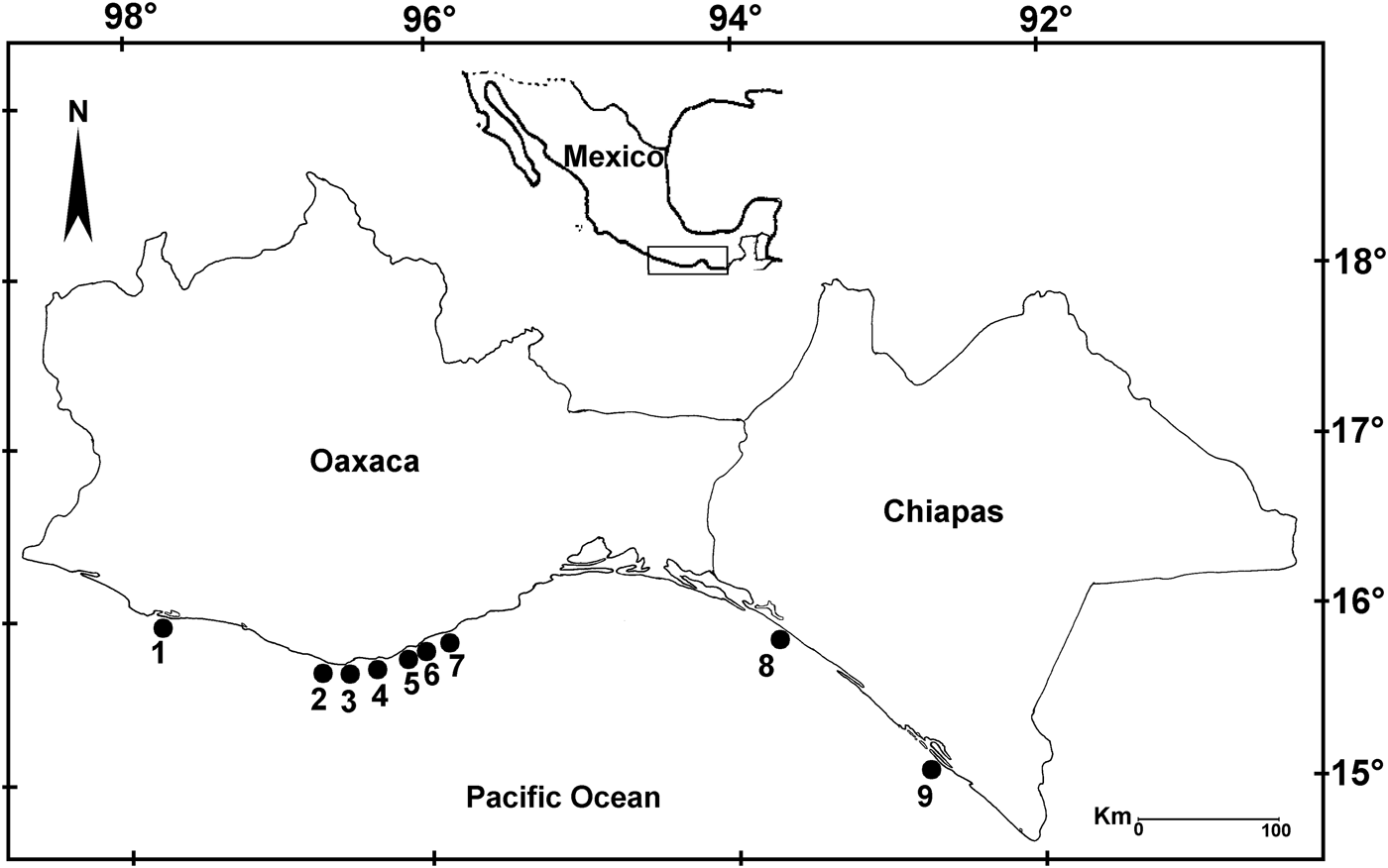
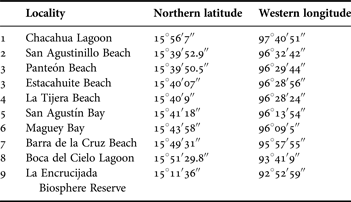
The specimens were collected from several sites along the coast of Oaxaca and Chiapas (Figure 1; Table 1), and were preserved in alcohol 96%, labelled with field data, changed to 70% alcohol for long-term storage and deposited in the Decapod Section (UMAR–DECA) of the Scientific Collection of Marine Invertebrates of the Universidad del Mar, Puerto Angel, Oaxaca, Mexico.
Collection sites from southern Pacific of México. Oaxaca: (1) Chacahua Lagoon; (2) San Agustinillo Beach; (3) Panteón and Estacahuite Beaches; (4) La Tijera Beach; (5) San Agustín Bay; (6) Maguey Bay; (7) Barra de la Cruz Beach. Chiapas: (8) Boca del Cielo Lagoon; (9) La Encrucijada Biosphere Reserve.

Localities and coordinates for collection of specimens along the coast of Oaxaca and Chiapas.

The species were determined using the keys of Rathbun (Reference Rathbun1918, Reference Rathbun1925), Garth (Reference Garth1958) and Crane (Reference Crane1975). In addition, the original descriptions of Uca musica Rathbun, Reference Rathbun1914, Eucinetops lucasii Stimpson, Reference Stimpson1860, and E. rubellulus Rathbun, Reference Rathbun1923 were also used to confirm the identities of the three new records.
The most critical synonyms were used for each species, which included the complete descriptions, figures, and updated list of synonyms and/or relevant records. The systematic arrangement and nomenclatural status follows Ng et al. (Reference Ng, Guinot and Davie2008). The crabs were measured along the widest (carapace width (CW)) and longest axis (carapace length (CL)) of the carapace. The propodus length (PL) and dactyl length (DL) of the major claw were also measured for the male specimens of Uca species. For the genus Eucinetops the length of carapace included the tip of horns.
RESULTS
SYSTEMATICS
Order DECAPODA Latreille, 1802
Infraorder BRACHYURA Linnaeus, 1758
Subsection HETEROTREMATA Guinot, 1977
Family INACHIDAE MacLeay, 1838
Genus Eucinetops Stimpson, Reference Stimpson1860
Eucinetops lucasii Stimpson, Reference Stimpson1860
(Figures 2A & 3A, B)
Eucinetops lucasii Stimpson, Reference Stimpson1860: 191, only female description (type locality: Cabo San Lucas, Baja California Sur); Crane, Reference Crane1937: 54–55, plate II, figures 5 & 6 (Santa Ines Bay, west coast of Baja California Sur); Ng et al., Reference Ng, Guinot and Davie2008: 111 (checklist of brachyuran crabs of the world).
Eucinetops lucasi—Garth, Reference Garth1958: 52–56, figure 3, plate A figure 7, plate B figure 4, plate 3 figure 1 (Gulf of California: Choya Bay, Choya Point, Angel de la Guarda Island, Pond Island, Agua Dulce Bay, Tiburón Island, Puerto San Carlos, Bocochibampo Bay, Catalina Bay, Concepción Bay, Agua Verde Bay, Espíritu Santo Island, La Paz Bay and north-east of Cabeza Ballena); Luke, Reference Luke1977: 58 (25°31.2′N 111°04.8′W 25°18′N 110°57.5′W, west coast of Baja California Sur); Villalobos-Hiriart et al., Reference Villalobos-Hiriart, Nates-Rodríguez, Díaz-Barriga, Valle-Martínez, Flores-Hernández, Lira-Fernández and Schmidtsorf-Valencia1989: 54–55 (Gulf of California: Las Animas Island, Tortuga Island, San Marcos Island, Carmen Island, Montserrat Island, San José Island); Hendrickx, Reference Hendrickx1999: 16–18, figure 7 (Guaymas, Sonora and Puerto Viejo, Mazatlán, Sinaloa); Hernández-Aguilera, Reference Hernández-Aguilera and Hendrickx2002: 313 (Socorro Island, Revillagigedo Archipelago).
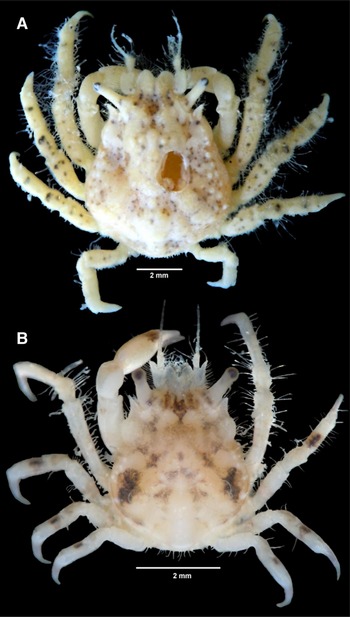
General morphology of the largest male: (A) Eucinetops lucasii from San Agustinillo, carapace length (CL) = 9 mm, carapace width (CW) = 6.75 mm; (B) Eucinetops rubellulus from Panteón Beach, CL = 4 mm, CW = 3 mm.

Eucinetops lucasii from San Agustinillo, carapace length (CL) = 9 mm, carapace width (CW) = 6.75 mm: (A) gonopod of the male; (B) chela, outer view. Eucinetops rubellulus from Panteón Beach, CL = 4 mm, CW = 3 mm: (C) gonopod of the male; (D) chela, outer view.

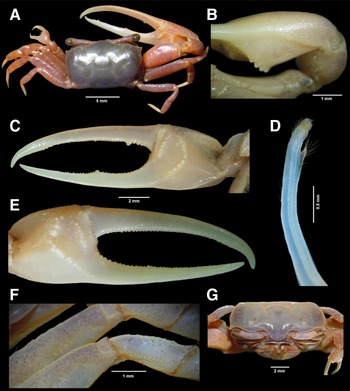
Largest male of Uca (Leptuca) musica from Chacahua Lagoon, Oaxaca, carapace length (CL) = 6.2 mm, carapace width (CW) = 10.3 mm: (A) morphology of dorsal view of carapace; (B) stridulating ridge of the major palm; (C) major chela, inner view; (D) gonopod of the male. Largest male of Uca (Leptuca) musica from La Encrucijada Biosphere Reserve, CL = 6.7 mm, CW = 10.5 mm: (E) major chela, inner view; (D) tubercles on anterior merus and carpus of the first ambulatory leg; (E) morphology of anterior aspect of carapace.

MATERIAL EXAMINED
4 specimens: UMAR–DECA 25, 1 male, San Agustinillo Beach, 7 January 2006, coral rock, intertidal, coll. P. Carrasco-Bautista. UMAR–DECA 26, 1 male, 1 female, 1 ovigerous female, San Agustín Bay, 4 July 2007, rock with algae, 3 m, coll. B. Martínez Guerrero et al.
SIZE RANGE
Males: CL = 5–9.5 mm, CW = 4–7.5 mm. Females: CL = 2–10 mm, CW = 1.5–8.5 mm.
DISTRIBUTION
From San Telmo Point, west coast of Baja California Sur to Mazatlán, Sinaloa; Gulf of California; Socorro Island, Revillagigedo Archipelago. In this work, their distribution is extended from Mazatlán, Sinaloa to San Agustín Bay, Oaxaca, Mexico; approximately 1488 km southward.
HABITAT
Littoral, from intertidal to 3 m deep (Villalobos-Hiriart et al., Reference Villalobos-Hiriart, Nates-Rodríguez, Díaz-Barriga, Valle-Martínez, Flores-Hernández, Lira-Fernández and Schmidtsorf-Valencia1989 recorded to 1.8 m deep). Sandy bottom with algae; consolidated rocks, associated with Pinna shells and coral Pocillopora (Garth, Reference Garth1958).
TAXONOMIC REMARKS
See taxonomic remarks on Eucinetops rubellulus.
Eucinetops rubellulus Rathbun, Reference Rathbun1923
(Figures 2B & 3C, D)
Eucinetops lucasii Stimpson, Reference Stimpson1860 (partim): 192, plate II, figure 3, male description (according to Rathbun, Reference Rathbun1923: 73).
Eucinetops rubella—Luke, Reference Luke1977: 58 (26°04′N 111°05′W, Gulf of California).
Eucinetops rubellula Rathbun, Reference Rathbun1923: 73 (type locality: Cabo San Lucas, Baja California Sur); Rathbun, Reference Rathbun1925: 86–87: plate 219, figure 6; Garth, Reference Garth1958: 56–58, plate A, figures 1–6, plate B, figure 6 (neotype from Mazatlán, Sinaloa); Villalobos-Hiriart et al., Reference Villalobos-Hiriart, Nates-Rodríguez, Díaz-Barriga, Valle-Martínez, Flores-Hernández, Lira-Fernández and Schmidtsorf-Valencia1989: 54–55 (Gulf of California: Tortuga Island, Carmen Island, San José Island, Cerralvo Island); Hendrickx, Reference Hendrickx1999: 19, 22–24, figures 11 & 12 (Mazatlán and Piaxtla Point, Sinaloa); García-Madrigal, Reference García-Madrigal2000 (Maruata Bay, Michoacán); Hernández-Aguilera, Reference Hernández-Aguilera and Hendrickx2002: 313 (Socorro and Clarion Islands, Revillagigedo Archipelago).
Eucinetops rubellulus—Ng et al., Reference Ng, Guinot and Davie2008: 111 (checklist of brachyuran crabs of the world).
MATERIAL EXAMINED
10 specimens: UMAR–DECA 27, 2 males, 1 female, Panteón Beach, 23 March 2007, coral rock, 3 m, coll. S. Rodríguez Hernández and V. Mata de los Santos. UMAR–DECA 28, 2 males, Estacahuite Beach, 9 April 2005, coral rock, 5 m, coll. R. Bastida-Zavala et al. UMAR–DECA 29, 1 female, Estacahuite Beach, 18 April 2005, coral rock, 1–1.5 m, coll. S. García-Madrigal et al. UMAR–DECA 30, 1 male, Estacahuite Beach, 10 September 2005, coral rock, 3–4 m, coll. R. Bastida-Zavala et al. UMAR–DECA 31, 1 male, Estacahuite Beach, 25 November 2005, coral rock, coll. P. Carrasco-Bautista et al. UMAR–DECA 32, 1 ovigerous female, Estacahuite Beach, 25 November 2006, coral rock, 4 m, coll. R. Bastida-Zavala et al. UMAR–DECA 33, 1 male, 1 ovigerous female, La Tijera Beach, 30 April 2005, coral rock, 4 m, coll. R. Bastida-Zavala et al. UMAR–DECA 34, 1 juvenile, La Tijera Beach, 12 September 2006, coral rock, 4 m, coll. R. Bastida-Zavala et al.
SIZE RANGE
Males: CL = 1–5 mm, CW = 1.5–4 mm. Females: CL = 4–5 mm, CW = 3–4 mm.
DISTRIBUTION
Gulf of California: from Tortuga Island to Cabo San Lucas, Baja California Sur; Mazatlán, Sinaloa. Maruata Bay, Michoacán. Socorro Island, Revillagigedo Archipelago. In this work, their distribution is extended from Maruata Bay to La Tijera Beach, Oaxaca, Mexico; approximately 800 km southward.
HABITAT
Sublittoral, 1–5 m on coral rocks. Hendrickx (Reference Hendrickx1999) recorded this species on intertidal rocks, and García-Madrigal (Reference García-Madrigal2000) at 3 m on oyster banks.
TAXONOMIC REMARKS
The diagnostic characters according to Stimpson (Reference Stimpson1860) and Garth (Reference Garth1958) observed from the southern Pacific of Mexico specimens are: the first movable antennal article of Eucinetops rubellulus with outer angle strongly produced externally while E. lucasii is not produced; E. lucasii has rostral horns bluntly rounded at the extremities and cleft close to half way to bases, while E. rubellulus has rostral horns small, wide and deeply separated and cleft than half way to bases. Eucinetops rubellulus has a postorbital spine attenuated and forward, while E. lucasii has the postorbital spine acute and curved outward (Figure 2A, B). The male's pleopod of E. lucasii has a large triangular lateral projection while in E. rubellulus this is a minute, rounded lateral projection (Figure 3A, C). Maybe, E. rubellulus from the southern Pacific of Mexico is a young male, because according to Rathbun (Reference Rathbun1923) the size of male holotype estimated from the figure of Stimpson (Reference Stimpson1860) is CL = 8 mm and CW = 6.2 mm, while the largest male of our examined material is CL = 4 mm and CW = 3 mm.
A diagnostic character for E. lucasii is a tooth in the gape of the adult's finger, but in the specimens examined, this was not observed. Specimens from Oaxaca present the palm of male's chela as longer than wide, the dorsal surface of the palm is continuous with respect to the general line of the chela, fingers close in a narrow gape (Figure 3B) and movable finger has a sinuous cutting edge, as illustrated by Hendrickx (Reference Hendrickx1999, figure 7B); while Garth (Reference Garth1958, figure 3) illustrated the palm of the same length and width, dorsal surface of the palm crested, fingers with a wide gape and cutting edge of movable finger with a broad proximal tooth.
Subsection THORACOTREMATA Guinot, 1977
Family OCYPODIDAE Rafinesque, 1815
Genus Uca Leach, 1814
Uca (Leptuca) musica Rathbun, Reference Rathbun1914
(Figure 4A–G)
Gelasimus gibbosus (not Smith, Reference Smith1870) Streets, Reference Streets1877: 113 (La Paz Bay, Baja California Sur); Lockington, Reference Lockington1877: 150 (Tortugas Bay, west coast of Baja California Sur, previously named Bartolome Bay).
Uca stenodactyla Ortmann, Reference Ortmann1897: 356 (San Diego, partim sensu Rathbun, Reference Rathbun1918).
Uca musica Rathbun, Reference Rathbun1914: 127–128, text—figure 5, plate 10, figures 1–4 (type locality: Pichilingue Bay, Baja California Sur); Rathbun, Reference Rathbun1918: 417–419, text—figure 171a, b, plate 154 (Gulf of California: Guaymas Bay, La Paz, and Mazatlán); Rathbun, Reference Rathbun1924: 377 (Tepoca Bay, Sonora, Gulf of California); Garth, Reference Garth1960: 118 (Santa Maria Bay, Baja California Sur); Rodríguez de la Cruz, Reference Rodríguez de la Cruz1987: 197 (Bahía de los Angeles, Gulf of California).
Uca (Celuca) musica musica—Crane, Reference Crane1975: 314–318, appendix A: 614, plate 43A–D, figures 49A, B 69H & 101, map 17, table 9 (Margarita Island, Magdalena Bay, west coast of Baja California Sur; San Felipe and near to Puertecito, Gulf of California; San Blas, Nayarit; revision of the species); Villalobos-Hiriart et al., Reference Villalobos-Hiriart, Nates-Rodríguez, Díaz-Barriga, Valle-Martínez, Flores-Hernández, Lira-Fernández and Schmidtsorf-Valencia1989: 97–98 (Carmen Island, Gulf of California).
Uca (Leptuca) musica—Ng et al., Reference Ng, Guinot and Davie2008: 241 (checklist of brachyuran crabs of the world).
MATERIAL EXAMINED
24 specimens: UMAR–DECA 321, 1 male, Chacahua Lagoon, 19 February 2008, intertidal mud, coll. J. Trujano. UMAR–DECA 322, 1 male, La Encrucijada Biosphere Reserve, 9 January 2006, intertidal mangrove mud, coll. J. Jarquín-González & P. Hernández-Moreno. UMAR–DECA 1078, 1 female, Chacahua Lagoon, 23 November 2011, intertidal mud, coll. G. Oviedo & R. Vázquez. UMAR–DECA 1079, 3 juvenile males, Boca del Cielo Lagoon, Chiapas, 23 September 2011, intertidal mud, coll. S. García-Madrigal & V. Jiménez-Hernández. UMAR–DECA 1080, 1 juvenile male, 2 juvenile females, La Encrucijada Biosphere Reserve, 21 September 2011, intertidal mud, coll. S. García-Madrigal & V. Jiménez-Hernández. UMAR–DECA 1081, 14 males, 3 females, Barra de la Cruz, Oaxaca, 18 October 2012, intertidal mud, coll. S. García-Madrigal et al.
SIZE RANGE
Males: CL = 4.8–6.7 mm, CW = 8.1–10.5 mm, PL = 11.8–16.9 mm, DW = 8.8–12.4 mm. Females: CL = 4–4.5 mm, CW = 6.9–8.2 mm. Juvenile males: CL = 2.5–4.2 mm, CW = 4.4–8.0 mm, PL = 3.5–7.2 mm, DW = 1.8–4.3 mm.
DISTRIBUTION
San Diego, California to Gulf of California and San Blas, Nayarit, Mexico. In this work, their distribution is extended from San Blas, Nayarit to Chacahua Lagoon, Oaxaca and La Encrucijada Biosphere Reserve, Mexico; approximately 1763 km southward.
HABITAT
Intertidal. Mud and fine sediments from salt marsh and mangroves (Crane, Reference Crane1975).
TAXONOMIC REMARKS
The two species, Uca musica and U. terpsichores, are very similar in their overall morphologies. According to Crane (Reference Crane1975), U. musica and U. terpsichores are distinctly different by the major chela ornamentation, the morphology of male first pleopods, the colour and the number and proximity of tubercles on anterior merus and carpus of the first ambulatory leg. Uca musica has the major palm with an oblique stridulating ridge composed of 14 to 16 parallel striae (Figure 4B), while U. terpsichores has 8 to 12 striae. The first ambulatory leg of U. musica has tubercles on anterior merus and carpus of major cheliped side, slightly more numerous, and more closely placed (Figure 4F), while U. terpsichores are less numerous on carpus and more widely spaced. The inner process of the gonopod of U. musica male is slightly narrower and arising more distally (Figure 4D), while U. terpsichores is broader and arising more proximally. The minor cheliped and ambulatory legs of U. musica, in living and fixed material, have dark spots in both sexes (Figure 4A, F), while in U. terpsichores those are grey in male and completely white in females, never spotted.
The major chela of the largest male from Oaxaca has a conspicuous proximal tooth on the dactylus cutting edge, a conspicuous middle tooth on the immovable finger cutting edge and uniform tubercles on the transverse ridge across the inner surface of the palm (Figure 4C). In comparison, the largest male from Chiapas has unarmed cutting edges (perhaps eroded through time and use), and an irregular oblique ridge across the inner surface of the palm, this is with tubercles of different size (Figure 4D).
We follow Rosenberg (Reference Rosenberg2001) and Ng et al. (Reference Ng, Guinot and Davie2008), who consider Uca musica and U. terpsichores Crane (Reference Crane1975) as two valid species. Thus, the taxon that we recorded here is undoubtedly Uca musica. Previous records by several authors (Crane, Reference Crane1941; Garth, Reference Garth1960; Hendrickx, Reference Hendrickx1984, Reference Hendrickx1995b; Villalobos-Hiriart et al., Reference Villalobos-Hiriart, Nates-Rodríguez, Díaz-Barriga, Valle-Martínez, Flores-Hernández, Lira-Fernández and Schmidtsorf-Valencia1989) pointed out that this species is endemic to north-western Mexico; however, with this new record the endemic status of this species has been invalidated.
ACKNOWLEDGEMENTS
We thank Rolando Bastida-Zavala (UMAR, Puerto Ángel) for his comments and observations to improve the different versions of the manuscript. We thank Edmundo Aguilar-Lopez, Teófilo Gonzalez and Candelario Girón (CONANP, Chiapas), for access to facilities during the visit to La Encrucijada Biosphere Reserve. The comments and corrections of two anonymous referees helped to amend this manuscript. This work was supported by the project Semarnat-Conacyt FOSEMARNAT-2004-01-92 and PROMEP /103-5/09/1353.