Introduction
This article was born out of my curiosity about the way some fringe groups appropriate archaeological findings. Latvian archaeology locally is a branch of history studies, and archaeologists are mainly Latvians, so they mostly study their own past, as in many parts of Europe (Arnold Reference Arnold1999, 2). Archaeological heritage is perceived as a source of collective historical memory, while the importance of archaeology as a science lies in the amplification of this historical memory (Vasks Reference Vasks, Zariņa and Vasks2021, 7). The unwritten theoretical consensus of Latvian archaeology is that we assemble theoretical inspirations that are useful, without necessarily seeing a need to change our paradigm to a processual or postprocessual approach by inevitably following consequential phases of disciplinary development. According to Bruce Trigger’s terminology (Reference Trigger2010, 484–528), ‘pragmatic synthesis’ is closer to the Latvian approach, which is dominated mainly by culture history.
As the archaeological discipline in Latvia is maturing, the gap between public and academic views widens (cf. Meskell Reference Meskell, Gazin-Schwartz and Holtorf2005, 81). Some misunderstandings involve religious arguments. These are sensitive issues, often not taught in university. What could be the possible ways for archaeologist to think about religion? Here I present some problematic cases from Latvia and try to reflect on how to approach the issue.
I will deal with modern religious movements in Latvia. They can be contextualized in relation to organized and unorganized efforts to restore or reconstruct autochthonous pre-Christian and prehistoric Baltic religion, with prehistory in a Latvian context understood as the era that ends around the beginning of 13th century A.D. and the term ‘Baltic’ understood as denoting related ethno-linguistic groups. Such efforts are often accompanied by a ‘fusion of these religions with esoteric, metaphysical, theosophical, astrological, or environmentalist teachings and practices’ (Muktupāvels Reference Muktupāvels2005, 762).
Assuming that an international audience is not so well acquainted with the Latvian situation, I will start with a prolonged introduction to the historical context and outline of the main problems. In the first part, I will summarize common archaeological knowledge about prehistoric religion. To broaden the view, I will offer a very brief introduction to the perspective of folklore studies on the possibility of reconstructing ancient religion. The believer’s part is represented by a discussion of both the neopagan religion known as Dievturība and the Pokaiņi Forest pseudo-sanctuary.Footnote 1 In the end, I present further debate on the causes which divide opinions between science and practitoners of these religious movements.
Religion is a fascinating phenomenon in both present and past societies. Despite the academic impression that religion belongs to ancient history and many scholarly attempts to debunk religion as an ‘opium’, ‘memetic virus’, mental illness or cultural backwardness, the statistics show that more than 80 per cent of the world’s population consider themselves religious (Sherwood Reference Sherwood2018). The number seems too big to ignore: such a step would dehumanize a large part of global society just because European archaeologists come from an environment where organized religion in the form of Christianity has been receding for several generations. It is always good to acknowledge one’s scientific limitations. This prompts one to recognize the inevitably subjective and contingent nature of the paradigms conceived by the modern, Western, secularized individual: ‘As archaeologists, our hermeneutic as regards ontology is flawed epistemologically when it comes to considering religion’ (Insoll Reference Insoll2004, 15). Nevertheless, archaeologists should not ignore religion, since it seems to be an almost universal, crucial element of human behaviour.
There are quite polarizing attitudes towards the archaeology of religion within academia. As Lars Fogelin (Reference Fogelin, Whitley and Hays-Gilpin2008, 140) has put it, ‘Within the discipline of archaeology, religion has been treated as some special domain, a particularly impenetrable black-box’. Among scholars who do invest their time and energy in deciphering the ‘black box’ of religion, we find the consensus that religion is a rather under-represented, perhaps even purposely neglected, topic in general research. It is argued that studies of economy, ideology, identity and many aspects of agency sweep the archaeology of religion away (Insoll Reference Insoll2004, 2). Perhaps the Marxist influence on the discipline (Renfrew Reference Renfrew1994, 49–50) can be blamed for prioritizing the economy, technological achievements and other more materialistic elements as most important for the development and daily existence of past societies. By studying the available publications devoted to the archaeology of religion, one must acknowledge that the lack of theory and methodology in this field is alarming, thus leading to a question: how much of past realities actually remains unrepresented in our research?
Timothy Insoll suggests that ‘the relevance of the archaeological study of religion within our discipline is profound’, since the traits of ‘spiritual’ or religious actions can be archaeologically detected at least from the Upper Palaeolithic, though instead of ‘religion’ archaeologists often choose to use ‘cult’ or ‘ritual’ as an explanatory framework for finds that seem otherwise inexplicable (Insoll Reference Insoll2004, 9). Yet some insist that the concept of religion should not be equated with ritual, as ritual is not always connected to religious action and probably was just one of many aspects within religious experience. Archaeologists should instead ask what can be recovered by using the existing methodology. Is it religion or just traces of separate ritual actions (Barrett Reference Barrett2016; Marcus and Flannery Reference Marcus and Flannery1994)? Renfrew’s schematic method for identification of religious sites (Renfrew Reference Renfrew1994) might be useful but is surely not enough to provide the full picture (Barrett Reference Barrett2016).
For example, there is an academic consensus that Baltic languages have preserved some pre-Christian sacral terms related to offerings and idols; however, no word to signify religion itself seems to be used. This supports the argument that religious expression permeated the daily life of the Balts and that the environment around them was filled with spiritual meaning (Vaitkevičius Reference Vaitkevičius, Iršėnas and Račiūnaitė2015, 27); thus there was no need to separate the sacred from the profane.
Religion in Latvian archaeological research is a topic that is discussed little or not at all. The reasons could be lack of knowledge, lack of interest or generally the lack of an academic tradition of delving into this field. Nonetheless, public demand for knowledge about the religious notions of ancestors is indicated by the revival of Latvian ‘paganism’ in the 20th century. To understand the reasoning behind the rise of new religious movements (which claim to be inheritors of prehistoric religion), one must consider the historical and geopolitical context.
The question about prehistoric Latvian religion gained newly heightened attention after the First World War (Muktupāvels Reference Muktupāvels2005, 763). Ever since the independent Republic of Latvia was declared (on 18 November 1918), there has been a clearly perceptible need to legitimize the rights of the Latvian nation as the true owners of the land. The geopolitical situation was always challenging, and without the national pride and strong will of Latvians to have their own state, it would be unimaginable for the Latvian language and culture to have been maintained in the face of disadvantageous fights and overwhelming pressure from surrounding neighbours. Consistently outnumberered, Latvians always rather relied more on the power of spirit than on weapons. The possibility of Latvian ethnic extinction became very pronounced during the 20th century collisions.Footnote 2 After centuries under German, Russian, Polish and Swedish rule and patronage, Latvians wanted to regain their spiritual autonomy.
The acquired statehood also demanded consolidation of a lasting national identity and cultural self-sufficiency in relation to older competing nations. Baltic people had to prove that they were not lagging behind – neither today, nor centuries ago. Among many intellectuals Christianity was perceived as an alien, German tradition, so the idea about genuine local religion gained support (Muktupāvels Reference Muktupāvels2005, 762). According to national ideology, Christianization and the German takeover in the 13th century were the starting point for all disasters and problems that Latvians subsequently had to endure. Latvian historiography recounts the myth of 700 years of slavery (Lipša Reference Lipša, Fleishman and Weiner2018); in opposition to this long period of hardship, intellectuals, including archaeologists, described how there had been a fight lasting several hundred years for Latvian freedom and beliefs.
At the time, the majority of Latvians nominally belonged to the Lutheran Church and even if some kind of paganism was practised, it was in syncretistic form and mainly in the countryside, whereas political ideas were more common among the urban intelligentsia. Thus, besides the drive towards political self-determination, the need for premodern and ‘natural’ religion can be easily associated with urban alienation that causes yearning for something pure, pastoral and unspoiled by modernity. A leaning towards a romanticized past can be linked to the transition to modern society and the abolishment of serfdom in the 19th century (Muktupāvels Reference Muktupāvels2005, 762).
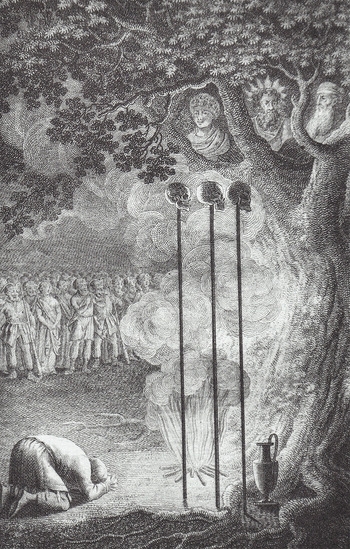
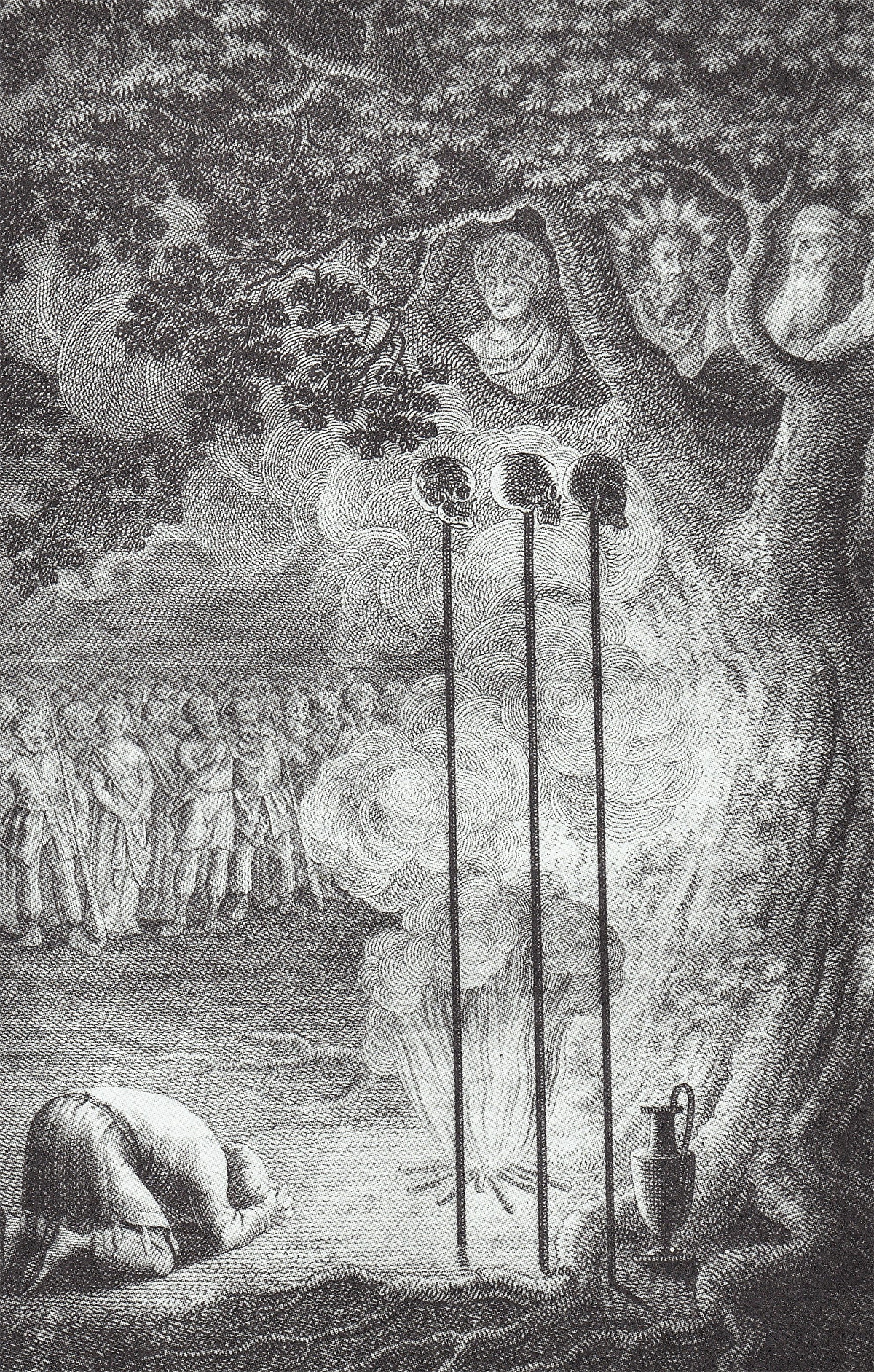
Baltic German intellectuals were the first to study Latvian mythology and folklore as a curiosity. Latvians themselves later got involved in scientific circles and started to collect folklore material from the as yet unmodernized parts of Latvian ethnic territory. Prior to serious studies of folklore, dominant views about Latvian religious practice were based on sources regarding ancient Prussian religion. Since medieval authors produced the majority of sources about the religion of Baltic tribes – and there was a consensus that all Baltic peoples are related – it is no surprise that descriptions of the activities at Romuva or Romowe (figure 1) (a pagan sanctuary in Prussia described as the religious centre of all Baltic tribes) were uncritically assumed to characterize Latvian and Lithuanian religious practice too. This was repeated so often that it gained the appearance of a well-known fact. Still, the latest studies call this into question and the common scientific opinion is that medieval sources do not permit generalizations about common Baltic religious traditions (Pūtelis Reference Pūtelis2019).
Romuva sanctuary in Prussia as imagined during the late 18th century (Merkel Reference Merkel1798, 154).
In the early 20th century, there were several ideas about how the revived ‘pagan’ religion should be constituted, but one in particular made a lasting impact on Latvian contemporary culture until this day. In 1925, the Latvian intellectual Ernests Brastiņš, who was also one of the most notable hillfort researchers in Latvia, and who (despite the lack of academic qualification) should be called an archaeologist, together with his followers (mostly intellectuals including students, artists, academics and teachers, Muktupāvels Reference Muktupāvels2005, 764), created a religion that claimed to be the renewed pre-Christian historical Latvian religion. They called themselves Dievturi.Footnote 3 According to them, ‘Dievturi prefer using Letticism dievestība for Dievturība over loanword reliģija “religion”, due to the allochthonous connotation of the latter; [latviskā] dzīvesziņa n.sg.f “[Latvian-like] folk wisdom of life, life-wisdom” (dzīve “life” + ziņa “wisdom”) the basis of Dievturība’ (Nastevics Reference Nastevics2018, 85–86). Since, for Dievturi, ‘faith’ as an act is not so important, they tend to avoid terms like ‘religion’ and ‘faith’ (ticība), because those are commonly associated with Christianity (Kalnietis Reference Kalnietis2017, 206).
Brastiņš insisted he was not creating something new but renewing – according to him – already existing traditions, while claiming that every surviving Latvian traditional feature can be associated with the one ancient religion (ibid., 207–10). This religious movement is based on the folklore sources of Latvian mythology (mainly folk songs known as dainas, which are usually four-liners). Their congregational activities include calendar and life-cycle celebrations, meetings and services accompanied by ritualized actions and folk songs (Muktupāvels Reference Muktupāvels2005, 764). One of the fundamental texts for Dievturi is an essay about the ancient Latvian creed (also called a ‘catechism’) by Ernests Brastiņš (Reference Brastiņš1932). Their belief is that Dievturība can be described as the
traditional folk (national) religion of Latvian territory, that non-interruptedly has existed and evolved since prehistoric times to the present day, as evidenced by archaeological finds, the testimonies from ancient chronicles and countless later descriptions by representatives of the Christian Church (Rubīns Reference Rubīns2019).
In this statement, archaeology is treated as a legitimate source of information about prehistoric religion. Devout adepts regard Dievturība as a renewal of the ancient Balt religion, while in academia it is considered a newly created tradition, a new religious movement, being a sub-branch of neopaganism (Misāne Reference Misāne2016, 149–68).
The strategic aim of the Dievturi was to gain recognition as the official religion of the Latvian state. The national faith was ‘intended to support national statehood and lay a new, firm spiritual foundation for it’ (Muktupāvels Reference Muktupāvels2005, 764). Nevertheless, their ideas were not well received in society and were strongly opposed by the Christian Church (Ozoliņš Reference Ozoliņš2019). Dievturi exist until this day and still claim direct descent from 13th-century Latvian paganism. This choice of chronology is significant, since it is viewed as the key traumatic period in Latvian history.
Baltic tribes were the last Europeans to resist Christianization. Lithuania adopted Christianity only in 1387 (Eidints et al. Reference Eidints, Bumblausks, Kulakausks and Tamošaitis2013). The geopolitical situation of this pagan enclave between Eastern and Western Christianity was extraordinary. While historians explain it as the result of particular economic and political circumstances, Dievturi see it as a reflection of the special virtues and exceptional role of Balts and Latvians in world history.
Today there seems to be a revival of such groups who claim to practise ancient Latvian religion. They often accuse archaeologists of misinterpreting the all-pervasive evidence of Latvian past superiority. ‘The problem seems to be that, while (academic) archaeology can avoid nationalism, nationalism cannot do without archaeology in its myth-creation and search for identity, and that can mean a lot of pressure’ (Slapšak and Novaković Reference Slapšak, Novaković, Diaz-Andreu and Champion1996, 290).
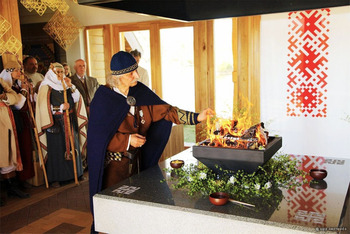
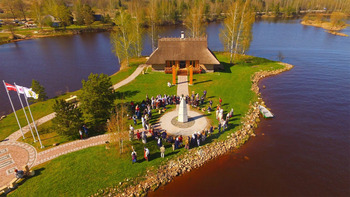
From the point of view of archaeologists, a passing look at Dievturi thought shows the clear misuse of archaeological data, thus indicating that one should not delve too deeply into it. However, the influence of Dievturi in modern Latvian culture is bigger than it seems at first glance. Thanks to the influential personality of Valdis Celms, an artist and spiritual leader of Dievturi (figure 2), their ideas have influenced such a huge national event as the Latvian Song and Dance Festival (on UNESCO’s Masterpieces of the Oral and Intangible Heritage of Humanity list since 2008), where Celms supervises the design solutions and huge environmental objects in the style of Latvian symbolic art (Celms Reference Celms2008, 264–65).
Valdis Celms performing a ritual at a fire altar in Lokstene shrine (Nastevičs Reference Nastevičs2020).

If the ideas of Latvian national religion were acceptable in the 1920s and 1930s as a part of a wider national movement among Latvian intellectuals, then it is interesting to see their revival in contemporary Latvia. Postwar exiles, faithful to an interwar mindset, played a crucial role in preserving this national religion by appealing to national feelings in opposition to Soviet occupation. The fact that communists persecuted Dievturi and other nationalists as ‘reactionary chauvinists’ (Muktupāvels Reference Muktupāvels2005, 764) made them more eager to remain nonconformist and keep their creed. Among Western scholars, many think that the dissolution of the Soviet Union is connected with nationalist movements, conflicts and racism (Kohl Reference Kohl1998, 224; Suny Reference Suny1993), but from a Latvian perspective such insinuations only indicate a follow-up to bygone Soviet propaganda. After the Dievturi organization was officially restored in 1990, the Latvian parliament recognized it as one of the state’s traditional religions in 1995 (Muktupāvels Reference Muktupāvels2005, 765). The members of Dievturi uphold their claim to represent the authentic Latvian world view, as they have effectively tried to introduce their interpretion of Latvian ethics in the school curriculum (ibid., 766).
The culmination of their political influence became obvious a few years ago. In 2014, a Preamble was added to the Constitution of Latvia, including the term ‘Latvian folk wisdom’, previously widely used by Dievturi, which can be differently translated in other languages, but essentially denotes a special world view with no clear definition, and rather demands one to be Latvian in order to really understand this wisdom. It is something you have to know by heart; however, the inclusion of such romantic notions in a legally binding document might seem strange to a scientist.
Ever since the idea of a special Latvian-like life-wisdom was incorporated in the text of the Preamble of the Constitution of Latvia, there has been a tendency to pretend that this notion is so obvious that it is known by every Latvian since birth. However, the term first appears in literature and periodicals from the 1930s. After the Second World War, this word combination mostly was not used in Soviet-occupied Latvia, and was newly introduced only during the National Awakening movement in the late 1980s and the beginning of the 1990s, while in the literature of Latvian exile the term continued to spread and evolve mainly within the religious group of Dievturi.
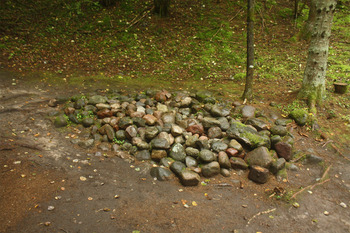
However, Dievturi are not the only ones who believe they are practising the ancient Latvian religion. Some people see the stone constructions (figure 3) of Pokaiņi Forest as the true religious or spiritual centre of Latvia. Pokaiņi is considered a place where Latvian traditions that are thousands of years old are still held in esteem. Many seers, healers and psychics view the place as an undoubtedly ancient sanctuary. Tourist brochures claim that ‘Pokaiņi Forest is the most mysterious place in Latvia, also called “the X-files” of Latvia. Pokaiņi Forest even boasts the name – “Latvian Stonehenge”’ (Latvijas valsts meži 2016; Pokaiņi Forest). It is claimed to be a doorway to Shambhala (a concept borrowed from Buddhist thought), providing intense radiation of cosmic energy (Muktupāvels Reference Muktupāvels2005, 766).
One of the many stone piles in Pokaiņi Forest. Photograph by Zenta Broka-Lāce, 2019.

Similarly to Dievturi, the umbrella term ‘new religious movement’ can also be applied to the Pokaiņi phenomenon, with strong influences from New Age narratives. Although many people with different presuppositions, including pan-Baltic supporters, visit the site, their practices and beliefs have much in common with religious movements elsewhere around the world that emerged in the wake of the global cultural changes of the 1960s. Their common feature is an ecclectic, undogmatic, pacifistic and culturally open world view along with environmentalist interests, the promotion of personal freedom and individual spiritual development, often combining Hindu, Agni Yoga, Buddhist and other influences with Baltic components (Muktupāvels Reference Muktupāvels2005, 764, 766). It is unclear at what point exactly the Latvian archaeological and folkloristic intellectual heritage got entangled in this amalgam of knowledge production (Meskell Reference Meskell, Gazin-Schwartz and Holtorf2005, 83–85).
What does archaeology tell us about prehistoric religion in the territory of Latvia?
Latvian archaeologists are very reluctant to talk about religious questions. Research on this topic is quite scarce. At most, it is possible to identify only a small number of articles or chapters and sometimes just a few sentences about the relationship between archaeological sites or artefacts and prehistoric religion. Vladislavs Urtāns tried to reflect on the sacred meaning of deposits (Urtāns Reference Urtāns1977, 76–84). Guntis Zemītis provides some thoughts on the symbolic and religious world view of hunter–gatherer and agrarian societies in the territory of Latvia (Zemītis Reference Zemītis2004). Vitolds Muižnieks writes about funeral rites and traditions after Christianization (Muižnieks 2015; Reference Muižnieks2016a; 2016b). A more reliable but still little-investigated phenomenon is ancient cult sites. The extensive scholarly work by Juris Urtāns must be mentioned in this category. For example, his work on ancient cult sites of the Semigallia region (Urtāns Reference Urtāns2008) collects information about 239 cult sites, such as sacred hills, bodies of water, stones and many others. The historian Andris Grīnbergs (Reference Grīnbergs2012) has also joined the search for cult sites.
So far, researchers are not ready to make general assumptions about the earliest religion in Latvia. The conceptions about the spiritual world of the Stone Age (10500–1800 B.C.) are fragmentary. Archaeological material supports the idea that Palaeolithic traditions have been persistent and played a significant role even in the mythological notions of Neolithic communities. More drastic changes began with the development of animal husbandry and agriculture, but even then part of the ancient world view remained (Vasks, Vaska and Grāvere Reference Vasks, Vaska and Grāvere1997, 69).
Describing the Late Palaeolithic nomadic reindeer-hunter groups, the very first inhabitants of the Latvian territory, Ilga Zagorska (Reference Zagorska2001b, 39) says,
all were equal, the only criteria for the division of labour were age and gender. The skills and experience of an individual were of great importance … there is unity in the production of tools, a certain uniformity in the organization of society and a common mythology … The reindeer was also worshipped: various rituals were dedicated to it, harpoons were often made of reindeer horn and decorated with magical signs.
Some scholars have suggested that reindeer hunters could have worshipped a deity, the Great Mother (Lielā Māte), ‘creator and protector of all living beings’ (Vasks, Vaska and Grāvere Reference Vasks, Vaska and Grāvere1997, 57).
Speculations about Mesolithic hunter–gatherer societies are based on funeral practices. Archaeologists have written about the choice of gravesite, orientation of the body and grave goods, explaining these as reflections of a ‘mythical perception of the world’ (Zagorska Reference Zagorska2001a, 64). Notions about the afterlife suggested by archaeologists are based mostly on analogies with global cultural practices rather than on local case studies. For example, rivers, based on almost generally accepted knowledge, are seen as a barrier one had to overcome to reach the land of the dead (ibid., 66). Some thoughts have been expressed that the deposition of ochre in graves could be related to ancient beliefs that viewed the colour red as symbolizing the fireplace, warmth, life and blood, thus giving strength to the deceased to start a new life in the world beyond (ibid., 67). Some graves raise suspicions regarding deviations: as if the deceased could have been a bad person or a magician, so in order to stop their rising from the dead, the bodies have been mutilated or treated differently (ibid., 68). There are some finds that prompt one to classify them as sacred, ritualistic or totemic. For example, depictions of elk are common, suggesting to some researchers that they may have been a totemic animal (ibid., 68–69). Although the use of the term ‘totem’ is widespread among archaeologists, the word derives from Native American culture, which, hypothetically, could not be used to describe our research subjects. As Insoll (Reference Insoll2004, 30) would reprove,
it is unsophisticated to suggest there was one universal form of primal religion, as erroneous as to suggest ‘animism’ or ‘totemism’ might likewise be the ancestral religious form. It removes complexity, a precondition of religion now, in all its variants, and, it is suggested, similarly for the past.
In general, the reconstruction of Latvian Mesolithic societies should be more source- and research-based along the lines of regional particularity. For example, a conclusion that ‘[m]en seemed to be excellent fishermen, hunters or warriors, while women were knowledgeable and intelligent mothers, maintainers of traditions’ (Zagorska Reference Zagorska2001a, 73), could be true, but also could derive from some kind of historiographical tradition.
Reconstructions that are more detailed appear in relation to the Neolithic inhabitants of Latvia. Ilze Loze writes about their ‘rituals’ and ‘ideology’, describing some specific artefacts as figurines/sculptures and wands (Loze Reference Loze2001, 107). She has expressed some thoughts on the symbolism of Neolithic art (Loze Reference Loze1983) and its possible relation to the cosmological beliefs of the people who made the artefacts. The suggested explanations are based on analogies with similar archaeological cultures, but Loze does not attempt to expand her conclusions towards religion as a system. She speculates that women may have played an important role in the socio-familial structures of the period as some finds indicate that Early Neolithic societies in the region were matrilineal (Loze Reference Loze2001, 108; Reference Loze2006, 164–68).
Ideas that are more specific have been expressed about the Pit-Comb Ware culture: water birds supposedly played a crucial role in their ‘ideology’. Loze explains this with examples of Finno-Ugric mythology and the rebirth of human souls. Other artefacts suggest that elk, bear and fish also played an important role in the mythological notions of Neolithic peoples (Loze Reference Loze2001, 110–11).
One group of artefacts thought to have formed part of an unknown ritual is small human figurines. Loze argues that ‘these small clay figurines, which do not have accentuated gender features, represented a part of the world view of the ancient inhabitants of Latvia – by materializing humans as deities in general’ (ibid., 111).
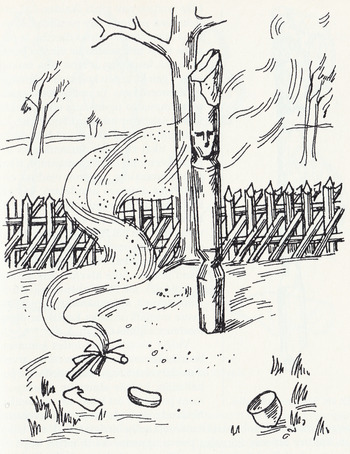
The finding of a wooden idol (Latvian elks) – a robust figure with a human face – at a Neolithic settlement in Sārnate bog and a reconstruction (figure 4) of a sanctuary or shrine there by Lūcija Vankina opened the way to talk about an ‘ancestral cult’ or ‘home spirit’ worship (Vankina Reference Vankina1970; Loze Reference Loze2001, 112; Vasks, Vaska and Grāvere Reference Vasks, Vaska and Grāvere1997, 63–64).
A sanctuary with anthropomorphic wooden idol (Latvian elks) in Sārnate bog, 3rd millennium B.C. A reconstruction by Lūcija Vankina (Vasks, Vaska and Grāvere Reference Vasks, Vaska and Grāvere1997, figure 22, 63).

It has been suggested that finds of the Corded Ware culture indicate a society where men held positions of status and patrilineal organization was dominant. Agrarian symbols were introduced, as reflected in the production and use of solar and lunar symbols such as discs and lunulas (Loze Reference Loze2001, 114). Archaeologists studying this period hint that something changes in religious practice, but offer no further conclusions.
During the Early Metal period (1800–1 B.C.), society had obviously changed even more. We have more archaeological finds, but it is hard to say that they give us better knowledge of the religion practised at the time. Jānis Graudonis consistently uses the term ‘cult actions’ and ‘cult constructions’ to describe the manifestations of spiritual culture in sites of this period (Graudonis Reference Graudonis2001, 145). We can see the same speculations as in the Mesolithic period, for example the idea that burials are designed following some idea of water as a link between life and death. In addition, the ‘cult of the sun’ emerges as a characteristic element of this period (ibid., 146–48). It is believed that the cults and rituals were the same as in most European farmer societies (Vasks, Vaska and Grāvere Reference Vasks, Vaska and Grāvere1997, 111).
The Iron Age (1200 B.C.–A.D. 1200) arrives with differentiated traditions among regional and ethnic groups. The most obvious signs are the variations of burial traditions along with different ornaments and symbols in garments and jewellery (Graudonis Reference Graudonis2001, 180; Vasks Reference Vasks2001, 229). In relation to this period, there are more interpretions using analogies from folklore and ethnography. Of course, archaeologists do not deny that Latvian folklore is a rich repository of ancient mythological views, but the use of it has always been treated with suspicion, because particular events and notions have arisen in different periods, so only in rare cases can folklore be directly linked to an actual timescale (ibid.).
Andrejs Vasks (ibid., 230) has written,
In addition to the cult of the sun and the moon, also wind, thunder, earth and other cults were probably important to the farmers of the early Iron Age, but there is still no concrete evidence about them. Among the deities found in folklore materials, the appearance of the Sky forger (Debesu kalējs) may be related to the early Iron Age, because metalworking was already sufficiently sacralized at that time.
Vasks suggests that since Tacitus wrote about Aesti worshipping the mother of gods (Germania. On the origin and situation of the Germans; Latin: De origine et situ Germanorum, written around A.D. 98), we can assume that Latvian mother deities like the Earth Mother (Zemes māte), Water Mother (Ūdens māte), Wind Mother (Vēja māte) and other mothers familiar from Latvian folklore could also have been worshipped during the Early Iron Age (ibid., 230).
One specific artefact has caught the attention of researchers, a 4th-century A.D. necklace with a triangular pendant where the sun, a wolf and a goat can be recognized. Interestingly, there is an ethnographic game preserved which is played on the winter solstice: the wolf represents the darkness, catching the symbol of light, a goat. The most surprising is the archaeological interpretation of this piece of jewellery. Since the ornament was found in a woman’s grave and is undoubtedly a unique object, the deceased was considered a ‘priestess of the sun’, thus implying that during the Early Iron Age a special societal class served the religious cult. Since also many lunulas – symbols of the moon – were attached to that necklace, archaeologists think that the cult of the sun coexisted with the cult of the moon. They also speculated that the Great Mother, who was worshipped by hunters, could have been replaced by the devil (Velns) of Latvian folklore, a chthonic deity who protects animals (Vasks, Vaska and Grāvere Reference Vasks, Vaska and Grāvere1997, 138).
Written sources from the Late Iron Age also suggest that Latvian tribes had many cult sites and objects, as well as special personnel serving holy places (Apals and Mugurēvičs Reference Apals and Mugurēvičs2001, 362). Around the 9th to 10th centuries A.D. some inhabitants of the Latvian territory had already become acquainted with the Christian faith arriving from ancient Rus. The beliefs probably were still quite syncretic and old traditions remained adjacent to the new ones. According to sources, in some parts of Latvia cremation was practised as late as 15th century despite the strong condemnations of the Christian church (ibid., 362). Obviously, the continuity of ‘pagan’ cultic actions around the deceased should be investigated archaeologically.
The most significant sources regarding ancient Latvian religion, according to historians and archaeologists, can be found in 13th- to 18th-century texts written by non-Latvians. Christian chronicles, travel descriptions and church visitation documents portray Latvians as pagans who worshipped natural spirits near trees and water. However, the religious beliefs that can be reconstructed from these sources demand a serious source critique before using them. For example, the reference about trees and places where idols were worshipped could also be a rhetorical figure of speech, a quotation from the Bible, where it is a common way of referring to paganism in general. Furthermore, talking about Latvians as such before the 17th to 18th centuries is problematic (Muižnieks Reference Muižnieks2016a; 2016b). There was no homogeneous material culture in the territory of Latvia before Christianization. Archaeology indicates significant changes in material culture around the 13th to 14th centuries, thus implying corresponding changes in mental culture. For example, traditional use of ornaments and forms of jewellery differed quite noticeably among Latvian tribes before Christianization, which was followed by the homogenization of material culture (Vaska Reference Vaska2016).
To sum up, there are things that archaeologists feel comfortable discussing, and then there are questions that have hardly been asked, let alone answered. So far, there are disparate hints about ‘ritual’, ‘cult’ or the ‘ideological’ behaviour of prehistoric Latvian communities, but something closer to religion can be glimpsed only in relation to the Late Iron Age. Although much of the available material can be related to the ancient Latvian religion, archaeology remains cautious. At most it admits that something has ‘a deep symbolic meaning that cannot always be deciphered’, and if we do not want to ‘enter a world of unproven statements and imagination’, we must accept that our knowledge of the religion and cult of the time is still very fragmented and incomplete (Vasks Reference Vasks2001, 230). Archaeologists are convinced of the possibility that religious rituals took place near stones, sacred trees, springs, special groves or forests and other places that sometimes have remained in the collective memory of the people until recent times. In addition, burial grounds could have played a role as a place for ritual actions. However, until more precise dated material is found in cult sites, the question remains open (ibid., 231).
Archaeology would agree that the Baltic peoples, like other Indo-Europeans, probably imagined the afterlife according to their model of daily life, and the status obtained during a person’s lifetime was not much different after death (ibid., 361). Nonetheless, it is hard to link archaeological evidence with religious actions. In many cases archaeology has only assumptions about ancient sacred places (Vaitkevičius Reference Vaitkevičius2011).
The folkloristic viewpoint
Linking archaeological research with folklore in a European context is sometimes discouraged as reminiscent of National Socialist Germany (Arnold Reference Arnold2006, 10–11). However, archaeology as a discipline is historically related to folklore and the connections between them are self-evident. Archaeology and folklore can be seen as ‘two of the many lenses through which the past is given meaning’: both ‘create, and are created through, ideas about the past’ (Gazin-Schwartz and Holtorf Reference Gazin-Schwartz, Holtorf, Gazin-Schwartz and Holtorf2005, 2). In many cases, engaging in a dialogue between different systems of meaning can contribute to archaeological interpretations (ibid.). Modern folkloristics argue that folklore is not a historically accurate source about the ‘actual past’, but rather the ‘past as perceived, remembered, and made significant by both past and present people’ (ibid., 3). In this respect, there are few differences between the two disciplines. The contribution of folklore to archeology can also work as follows:
folklore is valuable to archaeologists because it offers us alternative ideas about the past that counter our tendency to portray everyone in all time as versions of ourselves, and because it provides knowledge about the continued importance and therefore the later history of archaeological monuments (ibid., 4).
Folklore studies and archaeology in many regions of Europe emerged from antiquarian interests (ibid., 7; Burström et al., Reference Burström, Gazin-Schwartz and Holtorf2005, 34); the development of both disciplines went hand in hand also in Latvia. Large archives were created during the 19th and early 20th centuries as locals were repeatedly asked to share their tales about hillforts and other interesting sites or monuments in the landscape (e.g. Bielenstein Reference Bielenstein1865). Locals were considered valuable research partners. It is a pity that this dialogue between scholars and public was somewhere lost in our urge to educate rather than to listen (Burström et al., Reference Burström, Gazin-Schwartz and Holtorf2005, 41).
The most notable folklore source in Latvia is oral folklore. Its late systematization and recording in writing (only from the second half of the 19th century) raise some problems (Reidzāne and Laime Reference Reidzāne and Laime2018, 82–113). Furthermore, source critique does not allow full trust in folklore, since the recorders (such as Christian priests) allegedly have censored or rewritten some parts that were not acceptable to them. Over time, folklore research schools have also changed (Bula and Laime Reference Bula and Laime2017).
Regarding religious notions in folklore, 19th-century romantics have heavily shaped the discipline by creating Latvian mythical pseudo-pantheons of gods/deities (Biezais Reference Biezais1961; Pūtelis Reference Pūtelis2019). From those 19th-century authors’ point of view, ancient Greece was seen as a model for the re-creation of Latvian mythology (Muktupāvels Reference Muktupāvels2005, 762).
Many deities and natural forces, which can be traced from folklore sources, are grouped in different subdivisions and categories (Reidzāne and Laime Reference Reidzāne and Laime2018, 82–113). It is now clear that lists of gods were made by uncritically combining Latvian folklore with data from the mythologies of neighbouring regions. Some deities were allegedly invented (Muktupāvels Reference Muktupāvels2005, 762). Early authors also rewrote each other’s texts without listing the sources used (Ķencis Reference Ķencis2011, 146). Folklorists consider the overall Latvian mythological world view as ‘a tripartite division of the world, the Heavenly Mountain, the World Sea, the Sun’s orbit, and passages to other worlds’ (ibid., 154).
Unjustified and erroneous explanations of ancient religious beliefs and world views in Latvia often occur due to inadequate use of folklore. Aleksandrs Gavriļins (Reference Gavriļins2017, 94) has pointed out a serious problem with folklore materials as historical sources:
finding the accuracy of historical evidence in folklore texts is made difficult by the multi-layered nature of folklore, accumulating new evidence from each historical period, thus raising the issue for researchers – how to assess which evidence and features of folklore are really ancient and which were accumulated later?
One way to overcome this problem is to acknowledge that folklore cannot have a chronological frame, as it belongs to all the periods through which it has passed (Gazin-Schwartz and Holtorf Reference Gazin-Schwartz, Holtorf, Gazin-Schwartz and Holtorf2005, 15; Jonuks Reference Jonuks2011; Layton Reference Layton, Gazin-Schwartz and Holtorf2005, 24). Researchers nevertheless should be especially critical when investigating religious issues. There are many borrowings from Christianity in Latvian folklore. Over time, its performers and storytellers have mixed such borrowings with local traditions. In addition, for various reasons, the influences of Christianity on Latvian folklore have not been studied enough. Today it is sometimes hard to ascertain what belongs to the basic substance and what are the layers of Christian faith (ibid., 100–1; Ķencis Reference Ķencis2011, 151). However, folklorists are sure that at some historical point there indeed was an actual Baltic religion as a part of the ancient Indo-European religion, the practice of which varied through the centuries (Vaitkevičius Reference Vaitkevičius, Iršėnas and Račiūnaitė2015, 33). The question is, can we consider the tradition continuous with prehistoric times (Gazin-Schwartz and Holtorf Reference Gazin-Schwartz, Holtorf, Gazin-Schwartz and Holtorf2005, 11)? The fact that until the Soviet occupation Latvia was not much industrialized has helped to preserve a large amount of folklore.
Since the folklore material is exceptionally rich and diverse in genre, it is hard to ignore especially when the archaeologist is a part of this culture and is familiar with the legends and myths without even realizing it. Lacking any political or chauvinistic connotations, Latvian archaeologists will see the connections and the first on-field interpretations often are ‘folkloristic’.
For example, in one folk song (Daina no. 6354), a girl is singing of her fingers full of golden rings that could warn the horserider with the golden saddle from afar. The scene does not make sense in the 19th century (when it was published) as no peasant would have so many gold rings or such a saddle, but it perfectly illustrates the burial inventories of the 11th to 12th centuries, when bronze spiral rings with jingling pendants which could have been worn on every single finger were quite common (Vilcāne Reference Vilcāne, Zariņa and Vasks2021, 468–69). In addition, the saddlery at that particular time apparently was richly decorated with bronze and resembled gold (Tereško Reference Tereško2021, 452–55).
Besides questions about the authentic ‘pagan’ content of folklore, the ethnic problematic is often disregarded. Tribal groups who inhabited the Latvian territory in the past differed from one another in material culture, so their religious notions may also have been different. Folklore studies have not highlighted the distinctive mythological notions of Livs (Balto-Finnic people), giving the impression that before Christianization the beliefs of Baltic tribes were homogeneous (Ķencis Reference Ķencis2011, 145).
The believers’ viewpoint: Dievturība as the true Latvian religion
Neopagan interest in folk tradition and folklore is sometimes related to the extremist wing of folklore movements (Muktupāvels Reference Muktupāvels2005, 764). While archaeologists and folklorists today show scientific reluctance towards the reconstruction of prehistoric religious beliefs, there is a separate historiographical tradition with its own authorities, sources and literature. A greater confidence in conclusions differentiates it from the usual scholarly approach. There is no source critique as we know it. Every single favourable assumption by archaeologists or folklorists turns into a credible statement. For example, in relation to Latvian religion, there have been long discussions about the description of the Aesti and their devotion to the mother goddess in Tacitus’ Germania. Archaeologists refer to this as unproven information and the majority of scholars tend to agree that Aesti are more related to Estonians, not to the Baltic tribes. Folklorists are also not sure about the credibility of this source (Pūtelis Reference Pūtelis2019, 151–52), but devotees of Dievturi and similar groups refer to this specific passage as an undoubted truth about ancient Latvians.
The most important source of information for the Dievturi community is the writings of Ernests Brastiņš (1929; 1932; 1936; 1966; 1980; 1993; Reference Brastiņš1996) and his brother Arvīds Brastiņš. Extensive studies of history, folklore material and semiotics can be found in the Latvian State History Archive among E. Brastiņš’s documents (LVVA, 5459. f., 1. apr.). Brastiņš undoubtedly made a huge contribution to Latvian archaeology by visiting, counting, measuring and describing almost every hillfort in the territory of Latvia (Brastiņš 1923; 1926; 1928; Reference Brastiņš1930). Today it is hard to distinguish his scientific work from what more likely fits under the term ‘pseudoscience’.
Dievturi ground their theories in the comparative method. Besides folksongs, they use archaeological and ethnographic material and semiotic research. In Dievturi religion, geometric symbols that are not easily datable are used as instruments in magical rituals, healing and divination. However, even among Dievturi there are disagreements as to how to interpret these symbols, and many hierarchical systems are created to explain the ancient religion.
Brastiņš tried to reconstruct ancient Latvian religion from folksongs, but Valdis Celms has focused on material culture, with its use of symbols and signs. He has written about Latvian semiotics (Celms Reference Celms2008) and beliefs (Celms Reference Celms2017). He uses archaeological and folkloric sources to create a wholesome Latvian/Balt religious system with alleged continuity from the Stone Age until this day. The same idea of continuum comes from Brastiņš (Reference Brastiņš1936), while Celms’s convincing use of the comparative method makes almost every sceptic believe in Dievturība. Positive reviews by historians and other prominent scientists can be found on the cover of his Latvju raksts un zīmes (Celms Reference Celms2008). Many tables and references in this book give the impression of being scientific. The same was seen in the huge travelling exhibition Signs of the Latvian Soul (Latviskās dvēseles raksti) (LNKC 2015), made by Celms and supported by the government as a part of the 100th anniversary of the Latvian state. Many publications and information about Dievturi views of Latvian history can now be easily learned through different media (Latvijas Dievturu sadraudze).
Even today, Dievturi maintain a defensive position towards scientists who disagree with their world view, arguing that the globalists and neoliberals are trying to destroy the national culture and ideology (Kalnietis Reference Kalnietis2016). Dievturi do not see themselves as a part of the modern world, strongly yearning for something primordial and authentic in their efforts to re-create religion ‘before everything went wrong’. Knowing that the rest of society see them as a farce or a religious sect makes them try twice as hard at proving that the ancient Latvian religion has never actually disappeared (Brastiņš, Reference Brastiņš1936), and the continuity of it can be demonstrated with every archaeological, ethnographical or folklore artefact, even including knitted gloves (Celms Reference Celms2008, 100).
In Latvian neopagan thought, it is important to mythologize time itself. The periodizations and systematizations of history seem undesirable because they are contradictory to the opinion that Latvians have been the same for thousands of years. Dievturi perceive time from the perspective of eternity. In this context, we can notice that Dievturi love to cite Mircea Eliade (ibid.) and are influenced by his works about ahistorical time (Eliade Reference Eliade1969, 25; Insoll Reference Insoll2004, 25). It has clearly left marks on the essence of Latvian ‘paganism’. Overall, it seems that many arguments of Dievturi are created by exploiting inductive reasoning as the main source of knowledge. Respectively, if Latvians are x in the 20th century, they were x in the 13th century A.D., as well as in 11th millennium B.C., so the formula ‘once upon a time’ fits this frame. In Dievturi circles, everyone can freely use and interpret folklore and semiotic material according to their taste, while the authority of the elders (usually men) in these matters is undeniable. The reasoning and methodological framework that Celms has created for modern ‘pagans’ seems to be philosophically justified. His idea is that a huge part of inquiry can be made following the subconscious, intuitive approach where anticipatory feelings and imagination fill in the blanks. Scientific rationality leaves us unequipped when confronting such an opinion. If we try to look at it with an open mind, we must admit that it can also be a legitimate way of perceiving the world.
Their alternative perception of archaeological material can be seen by comparing what archaeologist Ilze Loze has written about a small bone artefact with a possible human image (Loze Reference Loze1983, 27–29), and the audaciously generalized narrative that Dievturi have built around it (Celms Reference Celms2008, 100). The artefact found by Ilze Loze now lives its own life as a cult object for Dievturi in their Lokstene shrine (figure 5) (Nastevičs and Celms Reference Nastevičs and Celms2019; Radošā apvienība DZĪVOTPRIEKS 2017).
Dievturi gathering around the stela depicting the Late Mesolithic bone artefact from Lubāna, Lokstene shrine (Nastevičs Reference Nastevičs2017).

Dievturi have also created a solar calendar, which is based on agrarian seasons and folklore material. The problem is that this calendar clearly can be attributed only to agrarian culture, and could not have been used many thousands of years ago by the first nomadic inhabitants of the territory.
Similar problems have occurred with the interpretation of an archaeological artefact known as the ‘eternal calendar’ (Heinrihsone Reference Heinrihsone2019), when an architect from Dievturi circles declared that she had uncovered the true meaning of a commonly found piece of bronze jewellery, supposing it to be an ancient astronomical device. Valdis Celms incorporated this story into his exhibition Signs of the Latvian Soul (Latviskās dvēseles raksti) (LNKC 2015) without any reservations of probability. Therefore every attendee in prominent museums and art centres in Latvia and abroad would come to believe in it as truly scientific information along with every other glossy picture of Celms’s own interpretations of archaeological material in this expensive exhibition.
The visual identity of Dievturi is also susceptible to analysis. They tend to use naive or pseudo-naive art, making people perceive it as a natural part of folk art. Until this day, pictures from the 1920s and 1930s that were created as a part of a wider folkish or national romantic tradition are very popular in their circles. This trend took inspiration from folklore and gloriously depicted the happy traditional way of life in ancient times. This form of art wanted to distance itself from German and thus wider Western artistic traditions as something foreign.
Folk decorative arts are also honoured among Dievturi, with a specific role given to clothing. Dievturi ways of dressing show that they are clearly aware of archaeological discoveries. Brastiņš argued that one has to dress nationally, which at the time meant ethnographically. The newest generation of Dievturi use archaeological reconstructions as their ritual clothes. The syncretism and postmodern way of thinking can be well observed, since the use of these reconstructions is not fixed at all: you can wear the costumes of Livs (even though they were not Balts, but Finno-Ugric) as it is not considered wrong to assemble things according to your own taste without concern for anachronistic inconsequence. Some artefacts in their circles have gained new meanings and can be worn only by elders.
In Dievturi literature one can find the most surprising things, such as different systems for reckoning time, and different periodizations of history. Some believe that Balts are actually the mythical Hyperboreans described in Greek mythology (Celms Reference Celms2008, 47; Dzenis Reference Dzenis2002).
As we can see from the earliest writings of Dievturi, uncritical thinking sometimes leads to politically awkward situations. According to their belief, ‘the Latvian religion is inherited from the Aryans themselves’, with Latvians being the ‘direct descendants of the Aryan people in language, lifestyle and divine cult’ (Brastiņš Reference Brastiņš1932, 10). Aryan religious beliefs have supposedly been well preserved among Latvians and they can teach them ‘again to those Aryan peoples who long for their ancient deities’ (ibid.). Brastiņš believed that the oldest parts of the Indo-European ancient religion are preserved in the religion of Latvian folksongs, while other Indo-European or ‘Aryan’ people have mostly forgotten their ancient ‘creed’ (Brastiņš Reference Brastiņš1936, 5). Furthermore, for him Latvia was part of a territory where the ancient Aryan people originated, and from which the later Indians and Greeks emigrated. All of this was written before racial theories became scientifically unacceptable, but one can easily find the same expressions in Dievturi proceedings from the 21st century. There, the exceptional role and higher moral status of Latvians or Balts in general is still stressed.
Curiously, Dievturi try to avoid associations with polytheism, in this way opposing the official scientific view on Latvian mythology. Some texts confusingly claim to talk even of one universal god (Celms Reference Celms2008). Contrary to folklorists, Brastiņš insisted that there is one Latvian god, not many (Kalnietis Reference Kalnietis2017, 214). Such a conclusion is made because folksongs exclusively address this single god with the word ‘pray’. The suggested criterion does not really hold up to criticism as it is probably a later layer of folklore influenced by Christianity. Agita Misāne aptly points out that Dievturība is a syncretistic doctrine that combines active denial of Christianity with borrowings from it. For example, the centre of their teaching consists of a kind of trinity, the triad of God (Dievs, Dieviņš), Māra and Laima, who together are recognized as manifestations of a single divine reality (Misāne Reference Misāne2016, 194).
The problem was that Dievturi wanted to become the national religion, replacing the Lutheran Church. However, this desire required the institutionalization and regulation of paganism. They introduced such notions as the triad of gods, catechism and liturgy consisting of folksongs. Eventually it resulted in an odd type of eclecticism, but it failed to reconstruct ancient pagan beliefs. It certainly lacks the violent and patriarchal side of that world view, which archaeologists recognize from grave goods and other Late Iron Age artefacts. The archaeological perspective must ask why people claiming to be pagans do not practise an actual paganism. Historical sources, chronicles and remarks by foreign travellers suggest a different kind of religiosity than the one taught by present-day Dievturi communities. Latvian and Baltic religion most likely consisted of fetishism; totemism; fire, sun, moon and thunder cults; and various types of magic. Such aspects as divination and animal and human sacrifice to propitiate gods and ensure success also played a significant role (Vasks, Vaska and Grāvere Reference Vasks, Vaska and Grāvere1997, 69; Vaitkevičius Reference Vaitkevičius2011), but these are downplayed in modern reconstructions.
Pokaiņi Forest as a centre of the world
Pokaiņi enthusiasts believe that this forest is a Latvian sacred healing and ritual site that is thousands or even millions of years old, thus dating it back before the Holocene. This obviously does not fit with scientific data about the geology and prehistory of the territory. There are many stories and modern legends about the place, often including information about unbelievably ancient civilizations and claims about it being the intellectual centre of the world. Ivars Vīks, who created the Pokaiņi phenomenon, believed that archaeologists do not tell the truth to society. He claimed to have found more than 10 ‘typical Palaeolithic’ heart-shaped cult artefacts, which were ‘similar to South European examples, dating back 20–35 centuries’ (Vīks Reference Vīks1995). Official archaeology certainly knows nothing about these ‘artefacts’, since Vīks has not shown them to professionals.
Archaeologist Juris Urtāns in his monograph about the cult sites of Semigallia places Pokaiņi under the category of ‘new cult sites’, which are arbitrarily proclaimed with no possible way to verify them scientifically. Archaeologists do not approve of Pokaiņi as the most important cult site of Semigallia, Latvia or the world (as it is often claimed). Urtāns describes Zebrene Idol Hill as the central cult site of Semigallia. Since Urtāns is a specialist in applying folklore sources to archaeological sites, he has debunked the idea that the ancient cult status of the site can be directly supported by folklore sources (Urtāns Reference Urtāns2008, 129–33).
Archaeologist Māris Atgāzis undertook an excavation in 1996 at Pokaiņi forest (Atgāzis Reference Atgāzis and Apala1998), financially supported by the local municipality. He researched several stone piles. During the month-long excavation some coal and ash residues, pollen from crops and two low-quality flint flakes were found. A single potsherd was found in one of the piles. This small piece was identified as handmade smoothed pottery that was used in the territory of Latvia during the first millennium A.D. Today researchers have concluded that the entire complex probably was formed during a longer period by removing stones from the surrounding arable land. For now, scientific data about the researched stone piles suggest that Pokaiņi was first used around the 2nd to 6th centuries A.D., along with burial mounds that are situated nearby (ibid., 9–13).
Geologists have joined the discussion about Pokaiņi as well. They admit that the stone piles are human-made but the stones definitely do not come from ‘all around the world’ as some would like to think. The mystical sensations that some people claim to experience in this forest could be caused by natural radiation coming from a large concentration of granite in the area. Besides, geologists were able to count approximately 150 stone piles, not 2,000 to 5,000 as others have claimed (Lase Reference Lase2004). Nevertheless, the official scientific opinion on Pokaiņi is not considered relevant and the place keeps attracting new visitors. Agita Misāne (Reference Misāne2016, 182) writes, ‘distancing from the judgements of academic researchers is a common occurrence whenever they come into conflict with the ambitious efforts of amateurs’.
It is difficult to answer what went particularly wrong in the Pokaiņi case. Are we saying that it is not a valid place for worship because we do not perceive the sacred features that its advocates are talking about, or should we stress that this place has not been used for such purposes historically? Archaeologists have no evidence of the cultic significance of Pokaiņi, but for several decades now this place has been intensively used for cult activities by people from all over the world. Maybe from a perspective of experimental archaeology, we could use this place as a research object – an archaeological ‘cult site’ in the making. Perhaps we should archaeologically inquire about the exact traces left by all the ritualistic actions, offerings and experiences of healing that can be observed today. Such research could lead us to some reconsiderations about the limitations of our methodology and the possibility of interpretation (Gazin-Schwartz and Holtorf Reference Gazin-Schwartz, Holtorf, Gazin-Schwartz and Holtorf2005, 15).
The materiality of archaeological monuments and artefacts can provide us only with vague interpretations about the reality of prehistory. Spontaneous spiritual connections with nature and its elements in uncodified religious practices can easily remain unnoticed without recognizing such possibilities from modern examples. Perhaps archaeologists should try to focus on the capacity of the site for larger or smaller ceremonies, the acoustic features and other smaller nuances of the landscape that so far have been given little attention. Different kinds of meaning are before our eyes; we just need to methodically ask ourselves whether we are ready to listen in and step down from our interpretive supremacy (Burström et al., Reference Burström, Gazin-Schwartz and Holtorf2005, 43).
Research by Vykintas Vaitkevičius suggests that ancient sacred places are rarely associated with archaeological finds, while they do possess specific names and folklore around them (Vaitkevičius Reference Vaitkevičius2011, 46). Such symbolically pregnant places for religious rituals can retain their traces as a multi-layered tradition in collective memory. From a folklorist perspective, eliciting local interest in preserving archaeological sites is something that archaeologists and folklorists should work towards ‘by incorporating local folk tales into public interpretation of archaeological sites’ (Gazin-Schwartz and Holtorf Reference Gazin-Schwartz, Holtorf, Gazin-Schwartz and Holtorf2005, 9). Ancient monuments have in many cases led to the emergence of folk tales and legends (ibid., 15) as interpretations and explanations for the existence of certain objects (Burström et al., Reference Burström, Gazin-Schwartz and Holtorf2005, 41). Maybe something like that is happening in Pokaiņi, proving that modern people are also capable of creating and distributing folklore through encounters with oddities in the landscape.
Concluding discussion: the search for a common ground
As noted above, archaeological data reveal scarce material for succinct descriptions of ancient Latvian religion. Other views are formed by using folklore and ethnography as sources. Beyond scientific discussions, general public opinion tends to be based on and influenced by scientific discoveries. When society is confronted with new facts or interpretations, there surely can be misunderstandings, since conclusions drawn by science in the 1930s and considered legitimate at the time can differ much from approved science today. The public is sometimes not as adaptive in its opinions as scientists are. Among private or religious groups, some scientifically outdated ideas can be perceived as more relevant and genuine than those provided by contemporary science – even after a long period. Furthermore, the memories of freedom and ideology from the 1920s and 1930s made a huge impact on people during and after the long years of occupation.
The misuse of archaeology (from the subjective perspective of an archaeologist) forms only part of a bigger concern dealing with public engagement in archaeology, for example such ethical problems as competing claims about the ownership of the past and differing collective narratives about it, leading into discussion about the paternalistic relationship between experts and the general public.
Why does the picture of prehistoric religion differ between archaeology and believers? Some answers probably can be sought in the history of archaeology as a discipline. While archaeology became immersed in the science of typology and the chronology of artefacts, ancient monuments were neglected:
Interest in the latter was often restricted to the artefacts they might contain. This increased the distance between archaeologists and the general public. While the monuments and the stories told about them continued to attract common people’s interest, archaeologists focused on the dating of artefacts and considered the stories told about monuments to be superstition without scientific value (Burström et al., Reference Burström, Gazin-Schwartz and Holtorf2005, 34–35).
Archaeologists are not interested in Pokaiņi because an unsatisfying expedition was already undertaken there with almost no artefacts found, so even if it was a site with alternative meaning, scientists would not be in a hurry to explore it. For archaeologists to consider the place meaningful, the lack of cultural layers and significant artefacts cannot be replaced with just unusual landscape features. In the meantime, those landscape features and scientifically unprovable energies are more important for Pokaiņi visitors.
The problem that can be ascertained so far is that public opinion often does not correspond to science, and that science does not meet people’s needs, so it must be understood that there are other forms of constructing knowledge besides academic practice (Meskell Reference Meskell, Gazin-Schwartz and Holtorf2005, 80–81). If we are denouncing someone in order to maintain our own academic position or gain funding, then something is not right. Do we really need to deconstruct all national narratives in the past and present, as Hamilakis suggests (Reference Hamilakis1999, 73)?
It is a tricky question whether academic archaeology should respond to public interpretations at all and point out errors in people’s beliefs. What would be the motivation to do that? Only to display a better education? What is the point of winning an unequal battle? The reason why archaeologists discuss the non-academic sphere often is related to a sense of fear that their monopoly on the interpretation of the past is in some way threatened (Gazin-Schwartz and Holtorf Reference Gazin-Schwartz, Holtorf, Gazin-Schwartz and Holtorf2005, 16). Ignoring it would mean validation. However, the idea that we can educate (Arnold Reference Arnold1999, 4; González-Ruibal, González and Criado-Boado Reference González-Ruibal, González and Criado-Boado2018) those people whom we call followers of ‘pseudo-archaeology’, and that then something will change, seems rather naive. The public knows what archaeologists have to say, but it chooses to take from science only what suits its own beliefs and values, in the same way scientists select their sources, but ‘archaeology does not function independently of the societies in which it is practised’ (Trigger Reference Trigger1984, 368).
Our self-assigned scientific and ethical responsibilities towards the public are not necessarily expected of us by the actual public. The paternalistic approach of disseminating knowledge, employed for decades within the discipline, is not particularly successful. If we are being honest, ‘it cannot be justifiably claimed that academic knowledge is necessarily superior to all other forms of knowledge’ (Gazin-Schwartz and Holtorf Reference Gazin-Schwartz, Holtorf, Gazin-Schwartz and Holtorf2005, 16).
It is not easy for modern Western scientists to accept that science and the Enlightenment are not universal and that other possible ways of knowing deserve as much respect (ibid., 17). There are self-sufficient groups of people with their inner expertise, and even if our semantic fields may sometimes overlap, we should not assume that our scientific approach is applicable when one needs to provide answers to spiritual questions. The historical self-understanding of such religious groups as Dievturi for now cannot be our field of research, since at least in Latvia we are neither anthropologists nor social scientists, but simply historians.
Considering that cultural traditions, including religion, cannot be totally fabricated out of thin air (Kohl Reference Kohl1998, 233), one must admit that all of the interest groups in relation to prehistoric Latvian religion have some grain of truth, and there are indeed some indigenous cultural values preserved in the Baltic region (Vaitkevičius and Vaitkevičienė Reference Vaitkevičius and Vaitkevičienė2011).
Archaeologists should not dismiss folklore, as it can provide us with the missing element in our interpretations – both past and present human experiences following interaction with sacred places (Vaitkevičius Reference Vaitkevičius2011, 51). The study of folklore-minded groups makes one realize that there is ‘more than one way to think of time … some of our monuments are the exact places where time is different’, as ‘they belong to the period in which they were constructed and used’ (Gazin-Schwartz and Holtorf Reference Gazin-Schwartz, Holtorf, Gazin-Schwartz and Holtorf2005, 14).
It has been argued that, despite different interpretations and different forms of truth, the common ground on which academic and non-academic people can meet might be the act of ‘making the past meaningful in the present’ (ibid., 16).
There are probably several things to learn from the different perspectives discussed in this paper. Archaeologists make an artificial distinction between monuments, artefacts and natural objects, while folklore and other alternative world views do not make such a distinction (Burström et al., Reference Burström, Gazin-Schwartz and Holtorf2005, 34–35). This could be a path to deeper understanding of the prehistoric past, if only archaeologists could appropriate such thinking.
Contemporary research topics chosen for grant projects seek to provide in-depth knowledge about a particular site, material or method, but rarely touch upon those ‘big’ questions that society desperately wants to hear about. Being realistic, our ability to provide answers about the religion and spiritual culture of non-literate societies is very low. From the market perspective, the fact that people feel the need to create their own ‘scientific’ institutions and publishing companies shows that supply does not match demand. That should make us concerned. Perhaps it would be reasonable to be more ‘populistic’ when choosing the topic for our next monograph. Unless we intend to part ways with the public, academics should put more effort into providing comprehensible knowledge to the people instead of contemptuous laughter and disapproval.
Whether or not there are ethical standards for accepting or rejecting nationalist or any political uses of archaeology (Kohl Reference Kohl1998, 243), scientists probably have to learn how to coexist with such groups and individuals as Dievturi. After all, they are the ones who actually care for archaeological heritage on the civil society level and devote themselves to it as much as, and sometimes even more than, archaeologists themselves. At the end of the day, maybe practical actions (even if sometimes clumsy) rather than pure intentions are what really matter.
Considering the legitimacy of Dievturi as an authentic Latvian religion, the scientific viewpoint would detect many flaws, errors and reasons for debunking. Modern attempts to codify, explain and rationalize ‘paganism’ as such feel out of tune. On the other hand, we must consider that religion does not consist only of visible, tangible and scientifically measurable stuff. Quite the contrary. Religious studies do not justify the legitimacy of one social-cultural system over another. As Fiona Bowie (Reference Bowie2006, 25) has written, ‘religion as a category is fluid and contextual … any attempt to define the subject matter too narrowly risks giving a positivist stamp to what in fact is an interpretive process’.
Our resistance towards new religious movements is not separate from cultural context: we use Christian terms such as ‘pagan’, ‘sect’ and ‘pseudo-religion’ to denounce other forms of religious experiences as invalid. Regarding newer religious movements, one should think about the problem of religious discrimination.
Furthermore, a strict demarcation between traditional and new religious elements in the Dievturi case is difficult. Indeed, there is a specific founding date and a person who signed the founding documents, but even if my beliefs and professional position indicate a slightly different picture of the past, I have no right to declare that Dievturi have not inherited their beliefs and way of life from their grandmothers. It is hard to condemn their will to interpret archaeological artefacts according to their spiritual convictions, when science can provide so little insight into the intangible past. Even if we assume that the religion practised by Dievturi is not as prehistoric as they claim, we cannot deny that every religion in the world has a life of its own with changing emphasis over time, and different branches and ‘sects’ within their teachings. Even the big ‘world religions’ struggle at adapting to modern spiritual needs. ‘Paganism’, though, is more fluid in its teachings, as showed by the first highly syncretic years of Livonian Christianization. Celms (Reference Celms2008, 14) has written,
the task is not to prove how exactly the ancient signs were understood or could have been understood by our ancestors during different stages of history. The author [Celms] focuses on the essence of the ornament and its symbols, their universal functions and meaning as something ongoing, the foundations of which, however, were laid down in ancient times.
If today we could learn a more empathetic way (maybe from feminist archaeology?) to perceive the past, we might also learn how to accept different world views and interpretations of archaeological material, even if they contradict expert knowledge and reasoning.
Acknowledgement
This work is supported by the Institute of Latvian History at the University of Latvia under Grant ZD2015/AZ85.