INTRODUCTION
There is continued interest in the use of woodchip pads (P. French & M. Hickey, Teagasc, unpublished data) as an over-wintering animal housing alternative to conventional, straw-bedded housing and concrete yards, or out-wintering on grassland or forage crops. Their use may provide a cheaper alternative to conventional housing, while reducing potential for gaseous emissions of ammonia and greenhouse gases. Among the claimed benefits of woodchip pads are relatively low installation costs, reduced labour requirements, avoidance of pasture damage in wet conditions, improved animal health and welfare and increased productivity (Hickey et al. Reference Hickey, French and Grant2002).
The pads are made up of a layer of woodchip, chip size ranging from 10 to 100 mm, obtained from various sources including timber and waste construction materials, typically 0·5 m deep, over an impermeable subsoil or lining, with a piped drainage system directing effluent to a store. An early assumption that the woodchip bed works as a biological treatment unit, reducing pollutant load from the dung and urine, allowing a relatively uncontaminated effluent to then enter the subsoil, is now considered implausible. Edwards et al. (Reference Edwards, Campbell and Paterson2003) considered that uncontained drainage from unlined woodchip pads (corrals) is likely to pose a significant pollution risk to groundwater, a view that has been substantiated by several recent studies, with no evidence of effective effluent treatment (P. French & M. Hickey, Teagasc, unpublished data; CREH 2005; Vinten et al. Reference Vinten, Donnelly, Ball, Crawford, Ritchie and Parker2006). Consequently, it seems likely that, without careful design and effluent management, woodchip pads could present a significant pollution risk. The consequences of poor pad construction and management include not only serious risks of groundwater contamination with nutrients and pathogens but also of total pad failure, the latter with negative consequences for animal health and welfare and farm income.
Research was undertaken within a LINK funded (industry partnership) Research Project in the UK in order to assess the impact of important elements of the design and management of woodchip pads on pad and animal performance and consequential risks of environmental emissions to air and water. The studies included monitoring ammonia emissions (results to be reported elsewhere – Dumont et al., forthcoming), effects of animal stocking rate, woodchip size and woodchip depth on pad performance and nutrient fluxes. The results could be used to inform farmers, researchers and policy-makers on best practice for the construction and management of woodchip pads (EBLEX 2011). Together with a review and analysis of installation costs, it is hoped that the current research will improve the knowledge of the potential of woodchip pads, against a background of increasing environmental regulations.
Current UK regulations (Anon 2011) classify effluent produced from woodchip pads as slurry, with significant implications regarding storage requirement (minimum of 5 months capacity) and associated closed period for spreading on land, both of these imposing a significantly increased investment cost for woodchip pads. In order to establish the hydrological and nutrient balance, and therefore the pollutant load associated with woodchip pad effluent, an important component of the current research concerned detailed studies on farm-based woodchip pads. The studies required accurate flow measurement and flow proportional sampling for chemical analysis.
MATERIALS AND METHODS
Site details
The current paper focuses on hydrological monitoring undertaken on two UK farms with beef cattle wintered on woodchip pads during winter 2009/10. One site was at Lower Porthamel Farm, Talgarth, near Brecon, Powys (52° 0′ N, 3° 13′ W, 130 m asl); the other at High Tor Farm, Coalville, Leicestershire (52°44′N, 1°19′W, 201 m asl).
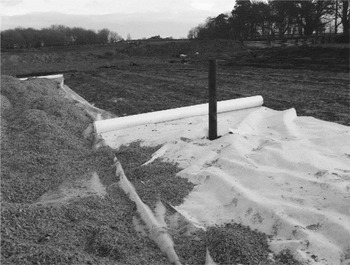
The Coalville pad was completed in January 2009 and used for out-wintering up to 100 beef cattle. The pad was 38×36 m, divided into three equal, independently drained sections. Permeability tests undertaken across the site by the farm, in collaboration with the UK Environment Agency, in order to establish the infiltration capacity of the underlying clay soil were compared with CIRIA (Construction Industry Research and Information Association) standards (Mason Reference Mason1992) and were considered acceptable. An impervious barrier below the pad drainage system was therefore considered unnecessary due to the impermeable clay subsoil. Four surface drains were installed in each pad section, running longitudinally at 3 m spacing. Each drain consisted of perforated plastic pipe 100 mm in diameter, c. 0·3 m deep and backfilled with gravel. A coarse, geotextile membrane (Terram 1000, Terram, Maldon, UK) was laid above the drainage stone to minimize the ingress of solids and help prevent admixture of soil and woodchip, particularly over the drain lines (Fig. 1).
Woodchip being laid onto the impervious membrane at Coalville. Clay soil with gravel drains leading into slurry lagoon can be seen top right.

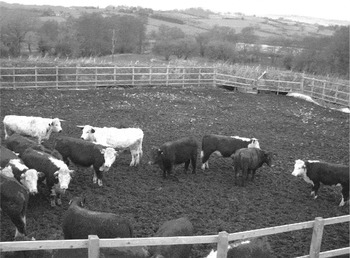
At Brecon, the pad was installed on an exposed, south-facing, sloping site (Fig. 2). The 35×35 m pad was bounded by raised banks on three sides to provide shelter for the animals. On the fourth side, a raised feed race adjacent to concrete yards allowed mechanized feeding of forage during winter. An impervious, plastic barrier (Excelastic 0·75 mm geomembrane, Geosynthetic Technology Ltd., Colchester, Essex, UK) laid over the site was covered by a 300 gauge geotextile overlay, for protection from sharp edges on woodchip, and covered with 200–300 mm depth of mainly conifer woodchip. The 7° slope was considered sufficient to allow gravity flow within the woodchip, across the pad to a single slotted pipe positioned in an arc of c. 10 m radius at the lower corner. This drainage collector pipe was connected to a 1 m diameter access chamber, from which the effluent was channelled to a below-ground collection tank located outside the woodchip pad.
Beef steers on the Brecon pad, with the monitoring station at the far right corner.

System design criteria
An important aim of the flow monitoring equipment was to generate a reliable hydrograph of effluent flow, to allow comparison with winter precipitation, including periods prior to animals first accessing the pad in autumn and after removal of the animals in spring. Total flow was to be monitored and flow proportional samples taken at intervals reflecting major precipitation and drainage events. Daily records of animal stocking rates, coupled with ‘standard’ estimates for outputs of dung and urine input (Anon 2009) enabled coarse nutrient balances to be calculated.
A range of options were considered to achieve accurate measurement of flow volume and flow proportional sampling. Flow monitors (using turbine, ultrasonic, Doppler and electromagnetic principles) are readily available, but do not usually include sampling options. Combinations of flume-based flow monitors with suction sampling (e.g. ISCO, Teledyne Isco Inc., Lincoln, Nebraska 68504, USA) appear to be more applicable to liquids with relatively low solids contents, in a less hostile environment, or to high-volume flow, in open channels. None of these options combined flow monitoring and sampling in a single unit, and several of them were also discounted on cost grounds. A more likely alternative for application with woodchip pads was a high-capacity tipping bucket developed in the previous research on surface run-off from agricultural fields (D. R. Jackson & M. Silgram, personal communication). Although this was considered suitable for the smaller of the two pads (Coalville), the extent of calibration distortion at high flow rates was uncertain, and so design criteria were identified for a novel monitoring system, better suited to the anticipated flow rates from the larger pad at the Brecon site.
Anticipated flow rates
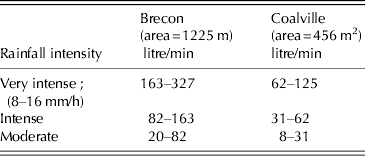
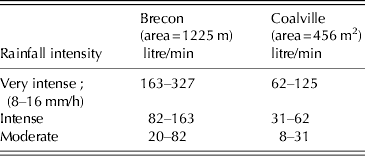
Sub-pad drainage on woodchip pads is limited by compacted low-permeability subsoil or a suitable artificial liner, and so the pad represents a defined precipitation catchment area. However, as the extent of liquid retention within the woodchip was uncertain, a return of 1·00 of precipitation as drainage provided an upper initial estimate of the potential maximum flow rates that needed to be monitored. Estimates of precipitation intensity were required in order to derive potential maximum flow rates. Meteorological predictions of precipitation intensity vary considerably and are based on event frequencies for specific areas. It was therefore considered sufficient to apply broad definitions used by the UK Meteorological Office (Meteorological Office 1982) when describing rainfall statistics on contour maps (Table 1) and relate these to the relevant geographic areas. Long-term average precipitation for the two areas, with seasonal variations, along with estimates of animal excretal output and stocking rates, were proposed as a means of refining the estimates of potential maximum flow rates. These took into account theoretical allowances for surface evaporation and absorption by the woodchip.
Baseline potential flow rates (litre/min) assuming total return of rainfall as effluent flow, with no allowance for evaporative losses or animal excretal inputs (source: Meteorological Office 1982)
Flow proportional sampling
Cattle slurries normally contain 0·02–0·10 solids. Allowing for dilution by precipitation on the pad and some filtration of solids through the woodchip matrix, drainage effluent containing animal excreta and precipitation water of <0·02 solids was expected. The use of narrow, perforated plastic pipe in the drainage system on the Coalville pad would also exclude any larger particles from contaminating pad drainage. A representative sample of this effluent, in proportion to flow, was required.
Sensor and data-logging
At these remote farm-based sites it was necessary to record drainage flow and precipitation automatically and to facilitate the collection and retention of samples for submission to the laboratory for subsequent analysis.
Woodchip pad outfall
The pad drainage outlet represents a hostile environment for scientific equipment due to exposure to the weather, the potentially corrosive nature of the effluent and close proximity to animals. Thus, equipment needed to be strong, durable, water and corrosion resistant and capable of maintaining stable operation over at least one winter season, with minimal maintenance. Optional materials for construction included plastics, stainless steel and aluminium.
Physical constraints of sites
At the Brecon site pad outfall, a 150 mm diameter pipe fed drainage into a sub-surface cylindrical concrete access chamber. The chamber also received effluent from a silage pit and weeping wall manure store and channelled the combined flow into a remote storage tank, some 400 m away. Below the drainage outfall, a depth (fall) of c. 1 m was available within the chamber in which to install the flow-monitoring equipment. At the Coalville site, four 100 mm diameter drainage pipes fed effluent from the monitored pad section to an adjacent lagoon. A maximum vertical fall of c. 1 m was available for monitoring equipment within a 2 m headland between the pad outlets and the effluent level in the lagoon when full.
Brecon: water wheel
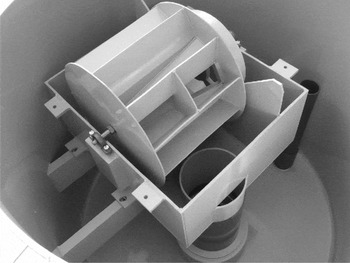
At the Brecon site, a novel design consisting of a small overshot water wheel mounted over the sample collection tank was used, and designed to be capable of monitoring the assumed maximum flow rate of 327 litre/min (Table 1). The sample tank measured 1 m in diameter and height and was fitted with a flange at the upper lip to allow it to sit above the access chamber. There were two outlets in the base of the tank. The first, 200 mm in diameter, was fitted with a plastic pipe, which was connected to the wheel box via a flexible plastic sleeve and directed the effluent to waste after it has passed through the wheel. A 600 mm long tube, 50 mm in diameter, screwed into the second outlet. When screwed in place, this tube acted as an overflow for the sample tank, and when withdrawn, allowed the tank to be emptied completely, to waste. The operation of the wheel itself was based on the principles of an overshot water wheel, except in this application it was designed to measure flow rate rather than its original function of generating power from a moving water stream. The wheel was 400 mm wide and 300 mm in diameter with eight vanes angled back at 45° to the tangent (Fig. 3). A gap between two of these vanes allowed a sample of effluent from each revolution to pass into the conical central core, from which it drained into the sample collection tank beneath, via a separate compartment to the main flow. A water brake, necessary to control the rotational speed developed by the momentum of the wheel, was created by a 50 mm high-raised weir formed by the upper lip of the outlet pipe. Flow from the pad passed through a specially designed flume in the lid and was thus directed onto the wheel 15–50° past top dead centre. The transmitting element of a reed switch (59135-502 sensor, RS Components, Northamptonshire, UK) was attached to the outside of the wheel and a magnetic sender was secured to the side of the mounting assembly. The proximity of the two components as they passed generated an electronic pulse, which was sent to a solid state data-logger (Newlog 3, Technolog Ltd., Wirksworth, UK) and was recorded against time. The dimensions of inter-vane compartments and their geometry were designed to optimize performance within the range of anticipated flow rates. Other flow rates, both greater and smaller, could be accommodated by modifying the wheel design. Unplasticized polyvinyl chloride (UPVC) was chosen for ease of fabrication, light weight and corrosion resistance and was used for all components, except for a metal axle and sealed bearings. The total cost (including some engineering development time) of the completed unit was c. £1000 GBP in 2009 (Edwards Plastic Fabrication Ltd., Tipton, West Midlands, UK).
Water wheel assembly installed in the sample tank (diameter of access chamber 1000 mm), showing main drainage outlet and water brake weir at centre and overflow and sample tank drainage pipe (top right).

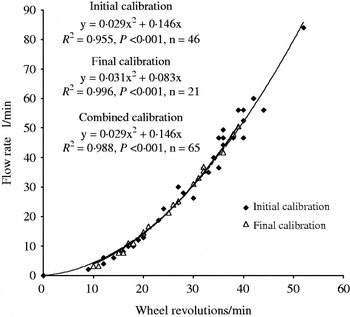
Calibration with water was carried out in summer 2009 prior to installation, and again after the animals had been taken off the pad, in spring 2010. Wheel revolutions were recorded at a range of flow rates ⩽84 litre/min, the maximum attainable with the available calibration equipment. In the field, the maximum flow rate attained was 90·5 litre/min. Second-order polynomial functions were fitted to the calibration data to predict flow rate (litre/min) from the wheel revolution speed (rpm, rev/min) and the two calibration functions were deemed to be from the same population, indicating that no significant functional changes had occurred over the winter monitoring period (Fig. 4). The precision of fit of the function applied to the combined data for both calibrations (R 2=0·99, n=65, P<0·001) suggests that extension of the calibration to higher flow rates for different applications might be acceptable, with the upper limits remaining uncertain. The complete unit was installed on the newly constructed woodchip pad at Lower Porthamel Farm, Talgarth, in August 2009. The sample tank was set below ground in the access chamber and surmounted by a raised plastic flange to prevent the ingress of effluent other than through the pad drainage system. An area around the monitoring equipment was fenced to exclude livestock.
Water wheel calibration data prior to installation and after the monitoring period, showing second-order polynomial functions.

Coalville (Leicestershire): tipping bucket
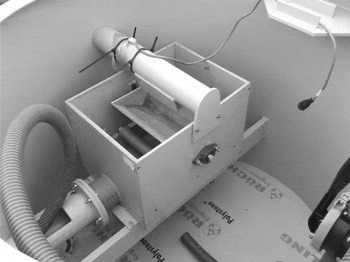
A high-capacity tipping bucket (D. R. Jackson & M. Silgram, personal communication) capable of delivering >1 litre/tip was used to monitor and sample effluent flow at the Coalville site. The tipping bucket was mounted in a box, 500 mm long, 360 mm wide and 360 mm high (Fig. 5), which was positioned over a 400 litre sample tank sunk into the earth bank on the headland between the pad and effluent lagoon. One half of the box drained through a 110 mm spigot directly to waste. The other was divided to include a small outlet open to the sample tank below, allowing c. 0·06 of the total flow to be retained for laboratory analysis. As with the Brecon water wheel, an electronic pulse, generated by a reed switch with one side attached to the tipping bucket and the other to the side of the box, was transmitted to a solid state data-logger to enable remote recording of tip frequency. The four slotted drainage pipes from the pad were joined and fed into a large diameter, sealed pipe, outside the pad area and the combined drain flow from the one-pad section (38×12 m) was thus channelled into the tipping bucket. Waste effluent was pumped from the sample tank with a hand-operated diaphragm pump and directed through a 110 mm pipe to the adjacent lagoon. All parts, except the axle bearings and fixings, were made from polypropylene for strength and durability and the total cost of the completed unit was c. £700 GBP in 2008 (Edwards Plastic Fabrication Ltd., Tipton, West Midlands, UK).
The tipping bucket mounted in the sample tank, showing the drainage outlet with sample tank overflow (bottom left) and manual evacuation pump (bottom right).

Calibration with water was carried out using a calibrated flow meter, at increments of 1 litre/min up to 10 litre/min. The volume of water from each tip was calculated from the tipping frequency at each increment of flow rate, resulting in a mean value across 10 flow rates of 1·33 litre/tip (SD 0·014, CV 1·05%). It was considered reasonable to project the calibration function to greater flow rates. This was due to the stability of the initial calibration, taking into account the predictable, mechanical operation of the tipping bucket, and the assumption, from the manufacturer's technical information that the reed switch could operate successfully at up to one tip/s, which equates to 80 litre/min. In practice, the maximum flow rate reached in the field was 10·4 litre/min, well within the stable calibration range of the high-capacity tipping bucket.
Data recording and effluent sampling strategy
At both sites, effluent flow rates were recorded at 15 min intervals via the data-logging systems, in contrast to sample acquisition, which was more randomly distributed over the duration of the experiments, based on precipitation. The main criterion determining sampling frequency was the need to avoid the sample tank over-topping, which would have resulted in consequentially increased sediment retention within the sample tank and associated chemical concentrations through decanting of more dilute material from the sample. Samples were taken by dipping a container into the sample tank after agitation of the contents, sufficient to ensure a representative sample of the solids and nutrients in suspension. Total flow volumes delineated by sampling occasions were then combined with associated nutrient concentrations to derive cumulative and total pad off-takes.
Equipment performance and results
Lower Porthamel, Brecon (water wheel monitoring device)
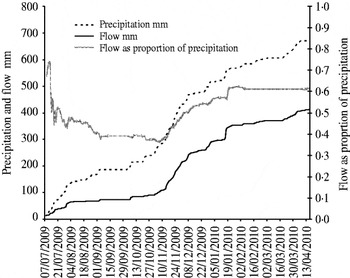
Construction of the Brecon pad was completed in November 2008 and animals were introduced onto the pad in late August 2009 (Fig. 2). The pad is 35×35 m and used for ⩽90 organic beef finishers. Following a relatively dry summer and early autumn, a wetter than average November was followed by an exceptionally cold period lasting well into January, during which time the animals remained on the pad. The waterwheel flow monitoring and sampling equipment performed well throughout the study period, apart from one short period when algal growth on the water wheel caused problems with signals to the data-logger. Recurrence of the problem was avoided by periodic removal of algal accumulation on the tank inlet channel and waterwheel vanes and regular data checking to ensure realistic reflection of drain flow rate in relation to precipitation. Cumulative precipitation, effluent flow and effluent volume estimated as a proportion of precipitation are shown in Fig. 6.
Cumulative precipitation and effluent flow for monitoring period at Brecon, July 2009–May 2010 (monitored using water wheel device) and proportion of precipitation as flow based on cumulative values.

High Tor Farm, Coalville (tipping bucket monitoring device)
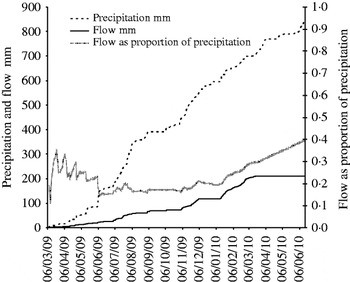
At Coalville, effluent monitoring was carried out from March 2009 to June 2010. Cumulative precipitation, effluent flow and effluent volume estimated as a proportion of rainfall are shown in Fig. 7. Extra sealing around the drain outlets was undertaken to avoid the loss of any effluent drainage via by-pass around the monitored outlet. Periodic cleaning of the tipping bucket was necessary to prevent distortion of flow calibration due to algal growth. The same recording protocols were adopted as at the Brecon site, including effluent flow and precipitation volumes.
Cumulative precipitation and effluent flow for monitoring period at Coalville, March 2009–April 2010 (monitored using tipping bucket device) and proportion of precipitation as flow based on cumulative values.

At both sites, additional analyses were conducted and are reported elsewhere (D. R. Jackson et al. unpublished data). These included sampling and analysis of both effluent (total solids, total nitrogen, total phosphorus, potassium, ammonium (NH4-N) and chemical oxygen demand) and the surface layer of soiled woodchip; animal numbers; ammonia emissions; health and physical condition of stock; feeding practices and estimates about time spent on the pad (any time at pasture or on concrete feed areas). Animal movements on the Coalville pad were recorded by automatic digital camera during one period of several days. These data were used to refine the approximate nutrient balance estimates between the slurry collected on the concrete feed passage, the dirty surface chip layers and effluent drainage from the pad.
DISCUSSION
Successful, coincident flow monitoring and flow-weighted sample acquisition of effluent flow from commercial or experimental woodchip pads was achieved in the current research using novel monitoring equipment and techniques.
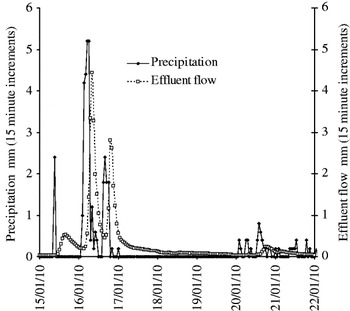
The combination of relatively low nutrient content, with often large and highly variable flow volume, highlights the significant contribution of effluent flow volume, through dilution, to effluent quality and nutrient export. In the hydrograph example from the Brecon pad (Fig. 8), periods of little or no effluent flow coinciding with low precipitation are evident, followed by a wetting-up phase and the re-establishment of flow in response to precipitation with the woodchip nearly reaching its maximum moisture-holding capacity. The lag in flow is a reflection both of the capacity of the woodchip matrix to absorb water and of surface evaporative losses, the latter impacted by weather (including precipitation, solar radiation, ambient temperature and wind speed). This pattern was consistent in the hydrological data from both sites and helps explain differences between total precipitation on the pad area and the recorded effluent volume, the latter representing levels of just over 0.60 and 0·30 of precipitation, respectively, at the Brecon (Fig. 6) and Coalville (Fig. 7) sites, based on the cumulative values at the end of the monitoring periods.
Example hydrograph from a 10 day winter period at the Brecon site, showing daily precipitation (left axis) and effluent flow volumes (right axis).

Evaporative losses
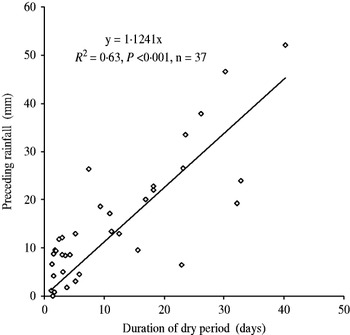
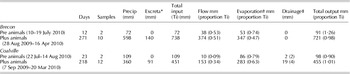
From the periods when effluent flow ceased, it could be assumed that the precipitation amount required to later reinstate flow broadly equated to evaporative loss during these periods. Evaporative loss could therefore be estimated by totalling precipitation received over a period of no/low flow until the initial restoration of effluent flow, using the duration of the no-flow period to calculate the daily rate. These estimates ranged from zero, during periods of high precipitation, to 5·9 mm/day at Brecon and ⩽5·3 mm/day at Coalville. When taken together and excluding extended wet periods, the results from the two sites indicated a mean evaporative loss of 1·12 mm/day (Fig. 9). On initial inspection, these estimates appear similar to estimates produced by the Meteorological Office Rainfall and Evaporation Calculation System MORECS (Hough et al. Reference Hough, Palmer, Weir, Lee and Barrie1995) for appropriate regions of the UK. Current guidelines on design, siting and operation of out-wintering pads in Ireland (Anon 2007) assume a comparable 1·86 mm/day for the combined effects of evaporative loss and absorption in the woodchip in estimating effluent volumes from woodchip pads. The Scottish guidelines, however, appear to make no allowance for evaporative losses or woodchip absorption (Merrilees & Donnelly Reference Merrilees and Donnelly2007). For the purpose of summarizing the experimental results, which have uneven distribution between summer and winter time periods (Brecon, summer mean 4·4 mm/day (s.d. ±0·57, n=2), winter mean 1·28 mm/day (s.d. ±0·7, n=10); Coalville, summer mean 3·74 mm/day (s.d. ±1·54, n=2), winter mean 1·3 mm/day (s.d. ±0·68, n=9)), seasonally weighted means have been applied to the calculation of hydrological balance at the two sites. The hydrological balance calculations show the importance of evaporative losses as a component of total liquid losses (Table 2).
Relationship between evaporative loss from woodchip pad surface and duration of low/no flow periods (combined data from the Brecon and Coalville woodchip pads).

Breakdown of component factors of total water import and export estimates from the Brecon and Coalville pads, showing approximate water balance, based on the assumptions shown

* Water from animal excreta estimated at 17·2 litre/day/animal; 26 litre/day/animal (RB209)×0·66 (time on pads).
† Evaporation estimates: 4·4 and 1·28 mm/day at Brecon, 3·74 and 1·3 mm/day at Coalville.
‡ Drainage estimate: 0·086 mm/day (Mason Reference Mason1992).
Total input=precipitation+excreta.
Total output=flow+evaporation+drainage.
Additions from animal excreta
Excretal input to the pad was estimated considering a daily production of excreta per steer of 26 litres (Anon 2009, 2010). However, remote digital imaging at the Coalville site showed animals spending only 0·62 of time on the pad during daylight hours, the remainder being spent on the separate feed race. This proportion was similar to the 0·66 described in Irish guidelines for over-winter pads (Anon 2007). The c. 0·33 of excretal deposition on the concrete feed race would normally be scraped into separate slurry or solid manure storage, thus not contributing to the hydrological or nutrient loading on the woodchip pad area. For the purpose of arriving at a rough effluent volume and nutrient balance for both pads, the overall contribution from animal excreta was taken as 17·2 litre/animal/day (26 litres×0·66).
Losses to sub-surface drainage
The impervious membrane separating the woodchip from the soil at the Brecon site was assumed to prevent sub-pad drainage, thus channelling all effluent by gravity, through the monitoring equipment via the collector drain. At Coalville, however, the woodchip was laid directly above the clay subsoil which, despite the low permeability test results, over an extended period could allow some drainages of effluent into the subsoil beneath. For slurry storage construction, the minimum standard for water infiltration in a clay soil, for a lagoon base is <1×10⁻⁹ m/s (0·086 mm/day) (Mason Reference Mason1992). This low infiltration rate could be assumed to reduce further over time, as the soil surface becomes increasingly sealed by solids from the woodchip pad effluent drainage.
Absorption by the woodchip
Studies have shown that 10–20 mm woodchip can absorb nearly three times its dry weight (Tegan Darch, University of Reading, personal communication) and wood-shavings (30–70 g/kg moisture) nearly four times (Ward et al. Reference Ward, Wohlt, Zajac and Cooper2000). After the initial wetting up of the woodchip following construction of the pad, or long, dry periods in summer, absorption by the mixture of chip and excreta, in response to precipitation, can be expected to occur in a more transient fashion following periods of surface evaporative moisture loss. Studies in small columns s have been carried out to test the water retention capacity of different grades of woodchip following initial wetting up. These results show ⩽0·06–0·16 retention by weight of the wet chips, even in winter, helping to explain the periods of relatively low drainage from the pad.
Hydrological balance
Table 2 demonstrates an approximate balance between water volume import and export for monitoring restricted to comparable time periods at the two pads (i.e. a short period in summer 2009, prior to the introduction of animals, followed by the winter period (2009/10)), using the assumptions for excretal additions, drainage and evaporative losses detailed above.
With animals present on the pads, 0·98 and 1·01 of the input volumes were accounted for in the calculated balance at Brecon and Coalville, respectively, while outputs represented 1·26 and 0·90 of total inputs prior to the introduction of animals. It is clear that evaporative losses can form a major pathway for water flux from the pads, in the current data comparable with effluent flow (0·47–0·79 of input volumes, with and without animals present), while sub-pad drainage might be ⩽0·05 on the clay soil at Coalville. Input and output volumes within the hydrological balance combine measured precipitation and flow, with estimates of excretal input, evaporative and sub-surface drainage losses. The overall balance achieved gives confidence in the precision of measurements and in the validity of the estimates used in the calculations. More detailed analysis of the data from both pads, along with research data from a replicated research facility at North Wyke Research, Devon (UK), have been drawn together in detailed nutrient balance studies, which will be reported elsewhere.
CONCLUSIONS
The tipping bucket device, proven in over 16 site years of monitoring surface run-off in erosion studies on arable crops, was successfully adapted to provide robust flow data in the difficult field conditions encountered in a woodchip pad drainage system. The tipping bucket itself cost c. £400 GBP to manufacture in 2008 and the total cost of the completed installation, including mounting in the sample tank (c. £700 GBP), could easily be justified by the importance of the scientific information obtained and the associated potential economic benefit to the livestock industry.
A water wheel device used on the Brecon site was developed specifically to meet the estimated flow likely to be observed at the site and under the difficult conditions encountered. This approach was essential to the objectives of the research, given that no suitable equipment was immediately available elsewhere and anticipated flows were well beyond the reliable working range of the tipping bucket device. Its success in terms of reliability and precision opens opportunities for further development, principally aimed at increasing flexibility in flow capacity and its ability to handle different effluent types. Further developments could include automatic sequential sampling and energy generation to provide power for peripheral electronic devices, such as data-loggers.
Critical examination of the hydrological balance in woodchip pads is necessary to support robust interpretation of nutrient fluxes. By combining effluent flow volumes, obtained using these novel equipment and experimental procedures, with assumptions of evaporative losses and potential water absorption and release characteristics of woodchip, much of the volume inputs from precipitation and animal excreta could be accounted for in the recorded output effluent volumes from the woodchip pads. It is suggested that the overall estimate of 1·1 mm/day evaporative loss observed in the results of the current research could be applied to refine estimates of effluent volume that must be collected and stored. Alternatively the MORECS (Hough et al. Reference Hough, Palmer, Weir, Lee and Barrie1995) estimates of evaporative loss (according to meteorological observations in the appropriate region of the UK) could be used. A reliable means of estimating the likely effluent production volume from woodchip pads is an important aid to the development of woodchip pads as a sustainable system for out-wintering of livestock.
Data from the current studies have contributed towards the drafting of new guidelines for farmers on the design, construction and management of woodchip pads and for recommendations to policy advisers and regulators in relation to the existing rules concerning the classification, storage and management of effluent from woodchip pads within Nitrate Vulnerable Zones in the UK (Anon 2009).
The research was funded under the Department for Environment, Food and Rural Affairs (DEFRA) Sustainable Livestock LINK Programme (Project LK0676), and the support of the following industry sponsors is gratefully acknowledged: DairyCo Ltd., EBLEX Ltd., Hybu Cig Cymru (HCC), SW Forest, British Grassland Society (BGS), Alan Cottle (Woodcott Chips, Barnstaple) and Dave Simmons Contracting (North Tawton); also with Environment Agency (EA) support, Rothamsted Research, North Wyke and Richard Hill, Jacobs.
The considerable help and co-operation of the two host farmers at the commercial farm sites is also gratefully acknowledged: Joel Durrell, Lower Porthamel, Brecon; Andrew Danvers, High Tor, Coalville (and landlords, Leicester and Rutland Wildlife Trust).