Introduction
Parasitoids use various types of host-related plant volatiles for foraging and host location (Dicke & Sabelis, Reference Dicke and Sabelis1988; Turlings et al., Reference Turlings, Tumlinson and Lewis1990, Reference Turlings, Tumlinson, Eller and Lewis1991; De Moraes et al., Reference De Moraes, Lewis, Pare, Alborn and Tumlinson1998). Host-related plant volatiles can be sub-divided into two major groups: constitutive compounds, and inducible or herbivore-induced plant volatiles. Constitutive compounds are present constantly in plants and released immediately in response to mechanical damage or at the beginning of herbivore feeding. These include green leaf volatiles (GLVs), such as (Z)-3-hexenal, hexanal and (Z)-3-hexen-1-ol (Turlings et al., Reference Turlings, Tumlinson and Lewis1990; Dicke et al., Reference Dicke, Van Baarlen, Wessels and Dijkman1993; Loughrin et al., Reference Loughrin, Manukian, Heath and Tumlinson1994; McCall et al., Reference McCall, Turlings, Loughrin, Proveaux and Tumlinson1994; Cortesero et al., Reference Cortesero, De Moraes, Stapel, Tumlinson and Lewis1997; Smid et al., Reference Smid, Van Loon, Posthumus and Vet2002; Gouinguené et al., Reference Gouinguené, Pickett, Wadhams, Birkett and Turlings2005). Herbivore-induced plant volatiles (HIPVs) are emitted as a delayed response to herbivore feeding damage. HIPVs in cotton (Gossypium hirsutum L) and similar plants include (Z)-3-hexenyl butyrate, (E,E)-α-farnesene, (E)-β-farnesene, (E)-β-ocimene and linalool (Dicke, Reference Dicke1994; Loughrin et al., Reference Loughrin, Manukian, Heath and Tumlinson1994; McCall et al., Reference McCall, Turlings, Loughrin, Proveaux and Tumlinson1994; Cortesero et al., Reference Cortesero, De Moraes, Stapel, Tumlinson and Lewis1997; Röse et al., Reference Röse, Lewis and Tumlinson1998; Ngumbi et al., Reference Ngumbi, Chen and Fadamiro2009).
The relationship between the degree of specialization of parasitoids and their responses to different suites of host-related volatiles is an important and current evolutionary question (Vet et al., Reference Vet, Sokolowski, Macdonald and Snellen1993; Geervliet et al., Reference Geervliet, Vet and Dicke1996; Cortesero et al., Reference Cortesero, De Moraes, Stapel, Tumlinson and Lewis1997; Bernays, Reference Bernays2001; Chen & Fadamiro, Reference Chen and Fadamiro2007; Ngumbi et al., Reference Ngumbi, Chen and Fadamiro2009, Reference Ngumbi, Chen and Fadamiro2010). Specialist parasitoids which attack fewer host species are predicted to utilize as host location cues host specific volatile signals (e.g. certain HIPVs) (Cortesero et al., Reference Cortesero, De Moraes, Stapel, Tumlinson and Lewis1997). In contrast, since information on host identity is relatively unimportant to natural enemies which attack a wide variety of host species (Vet & Dicke, Reference Vet and Dicke1992), generalist parasitoids may have evolved to use general host-related volatiles (such as GLVs and common HIPVs) as host location cues.
Recent and ongoing studies by our group have employed a comparative approach to test the above predictions by investigating the electrophysiological responses of two parasitoid species (Hymenoptera: Braconidae) with different degrees of host specificity, Microplitis croceipes (Cresson) and Cotesia marginiventris (Cresson), to different suites of host-related plant volatiles. Microplitis croceipes is a relatively specialist parasitoid specific to Heliothis and Helicoverpa larvae (Eller, Reference Eller1990), whereas, C. marginiventris is a generalist parasitoid of caterpillars of a wide range of lepidopteran species, including Spodoptera exigua (Hübner), Helicoverpa zea (Boddie) and Heliothis virescens (Fab) (Lepidoptera: Noctuidae) (Jalali et al., Reference Jalali, Singh and Ballal1987; Turlings et al., Reference Turlings, Tumlinson and Lewis1990; Röse et al., Reference Röse, Lewis and Tumlinson1998). For the most part, the results of our studies which utilized electroantennogram (EAG) and coupled gas chromatography electroantennogram detection (GC-EAD) techniques (Chen & Fadamiro, Reference Chen and Fadamiro2007; Ngumbi et al., Reference Ngumbi, Chen and Fadamiro2009, 2010) support the prediction that specialist parasitoids are relatively more responsive to some HIPVs, whereas generalist parasitoids are more responsive to GLVs. However, electrophysiological results may not always correlate with behaviour, making it important to conduct comparative behavioural tests with our parasitoid models.
Female parasitoids have remained the focus of majority of studies on olfactory response of parasitoids to host-related compounds (Cortesero et al., Reference Cortesero, De Moraes, Stapel, Tumlinson and Lewis1997) with only few studies paying attention to male response (Whitman & Eller, Reference Whitman and Eller1992; Park et al., Reference Park, Zhu, Harris, Ochieng and Baker2001). This is expected since females are the primary sex involved in host location and thus are predicted to be more responsive to host-related volatiles (Jyothi et al., Reference Jyothi, Prasuna, Sighamony, Kumari, Prasad and Yadav2002; Whitman & Eller, Reference Whitman and Eller1990; Chen & Fadamiro, Reference Chen and Fadamiro2007). Furthermore, since host-related volatiles may play different roles in the ecology of female (host location) and male (mate location) parasitoids, it is possible that each sex may show differential responses to different types of host-related volatiles (Li et al., 1992; Park et al., Reference Park, Zhu, Harris, Ochieng and Baker2001).
In this study, we compared the behavioural responses of both sexes of our specialist (M. croceipes) and generalist (C. marginiventris) parasitoid models to host-related plant volatiles. Y-tube olfactometer bioassays were conducted to test for innate differences in the behavioural responses of naïve females and males of both parasitoid species to select synthetic compounds representing two categories of host-related volatiles: (i) GLVs (hexanal and (Z)-3-hexen-1-ol); and (ii) HIPVs ((Z)-3-hexenyl acetate, linalool, (Z)-3-hexenyl butyrate and (E,E)-α-farnesene). Based on the results of our foundational electrophysiological studies summarized above (Chen & Fadamiro, Reference Chen and Fadamiro2007; Ngumbi et al., Reference Ngumbi, Chen and Fadamiro2009, Reference Ngumbi, Chen and Fadamiro2010), we hypothesized that (i) M. croceipes (specialist) would show greater behavioural responses to HIPVs, whereas C. marginiventris (generalist) would show greater behavioural responses to GLVs, and (ii) that females of both parasitoid species would show greater behavioural responses than conspecific males to host-related volatiles.
Methods and materials
Insects
The parent cultures of M. croceipes and C. marginiventris were provided by the USDA-ARS, Insect Biology and Population Management Research Laboratory (Tifton, Georgia, USA) and the University of Georgia (Tifton Campus, contact: John Ruberson), respectively. Microplitis croceipes was reared on caterpillars of H. virescens, its preferred host (Stadelbacher et al., Reference Stadelbacher, Powell and King1984; King et al., Reference King, Powell and Coleman1985), whereas C. marginiventris was reared on caterpillars of its main host S. exigua (Jalali et al., Reference Jalali, Singh and Ballal1987). The rearing procedures of both parasitoids were similar to those of Lewis & Burton (Reference Lewis and Burton1970). Eggs purchased from Benzone Research (Carlisle, PA, USA) were used to start laboratory colonies of the two lepidopteran host species, H. virescens and S. exigua. Caterpillars of both species were reared on a laboratory-prepared pinto bean diet (Shorey & Hale, Reference Shorey and Hale1965) at 25 ± 1 °C, 75 ± 5% RH and under a L14:D10 photoperiod. For each parasitoid species, newly emerged adults were collected prior to mating, sexed and placed in groups of two individuals of opposite sex (mated individuals) in a 6-cm diameter plastic Petri dish supplied with water and sugar sources. Water was provided by filling a 0.5-ml microcentrifuge tube with distilled water and threading a cotton string through a hole in the cap of the tube. About five drops (2μl per drop) of 10% sugar solution were smeared on the inside of the Petri dish cover with a cotton-tipped applicator. Mated parasitoids (aged 3–5 days) were used for the bioassays.
Test compounds
Six compounds were tested in this study: hexanal, (Z)-3-hexen-1-ol, (Z)-3-hexenyl acetate, linalool, (Z)-3-hexenyl butyrate and (E,E)-α-farnesene. Compounds were purchased from Sigma® Chemical Co. (St Louis, MO, USA) with purity >97%. Solutions of synthetic volatile compounds were formulated in hexane. Each compound was tested at two doses (1 and 100μg).
Behavioural bioassays
A Y-tube olfactometer (Analytical Research Systems, Inc, Gainesville, FL, USA) was used to test the attraction of 3–5-days-old naïve female and male M. croceipes and C. marginiventris to the six selected synthetic plant volatiles. The system consists of a central tube (13.5cm long, 24mm diameter) and two lateral arms (5.75cm long, 24mm diameter). A sieve inlay in the lateral arms and extending glass tube 5.25cm away from the connection prevents escape of insects and serves as an end point of each lateral arm. Humidified and purified air was passed into the extending glass tube through a Teflon® connection at 150mlmin−1. The Y-tube olfactometer was inverted following preliminary experiments which showed that the parasitoids preferred to walk vertically up the glass tube than horizontally (unpublished data). Illumination was provided by vertically hanging an office lamp (20W, 250Lux) above (∼50cm high) the olfactometer tube. Parasitoids were introduced individually into the central arm of the Y-tube. The initial choice of a parasitoid that responded by walking into one of the two arms and remaining there at least 15s was recorded. If a parasitoid did not make a choice within 5min of being released, it was removed and discarded. Parasitoids that did not walk into any of the arms were not counted. After four individual parasitoids had been tested, the olfactometer arms were flipped around (180°) to minimize positional effect. After eight individuals had been bioassayed, the olfactometer set-up was rinsed with soap water and acetone, and then air-dried. Each compound was delivered as 10-μl sample placed on No. 1 filter paper strips (7 × 40mm, Whatman® no. 1). After allowing for solvent evaporation (∼15s), the filter paper strip was inserted into a designated arm of the olfactometer. A similar filter paper strip with solvent (hexane) was inserted into the second arm and served as control. We compared for (i) effect of parasitoid species (same sex) on behavioural response and (ii) effect of sex on behavioural response. For each species, 30 naïve individuals per sex were bioassayed to each test compound/dose. The two species, sexes and doses were tested daily in separate experiments using a random order. Olfactometer data (30 replicates per sex) were analyzed by the use of a chi-square (χ2) test (P < 0.05; JMP® 7.0.1: SAS Institute 2007).
Results
Microplitis croceipes
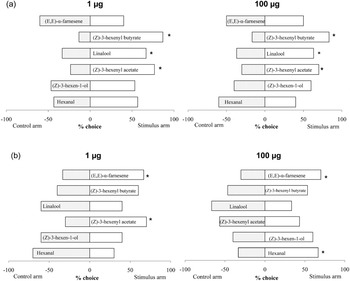
Female M. croceipes showed significant attraction in a Y-tube olfactometer to most of the tested HIPVs (i.e. (Z)-3-hexenyl acetate, linalool and (Z)-3-hexenyl butyrate) at the two doses but not to (E,E)-α-farnesene or the two GLVs (hexanal and (Z)-3-hexen-1-ol (table 1, fig. 1a). Males also showed significant attraction to two HIPVs (i.e. (Z)-3-hexenyl acetate and (E,E)-α-farnesene) and to hexanal (a GLV) at the high dose (table 1, fig. 1b).
Response of Microplitis croceipes (a) females and (b) males in a Y-tube olfactometer when given a choice between hexane (control) and host-related plant volatiles. In this and other figures, volatile compounds were tested at two doses (1 and 100μg). Asterik (*) indicates significant differences between stimulus and control (χ2 tests, P<0.05).

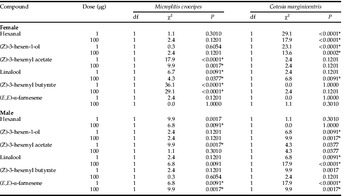
Chi-square analysis of behavioural responses of M. croceipes and C. marginiventris to six host-related volatiles.

Asterik (*) indicates significant difference between test compound and hexane (control) (χ2 test, P < 0.05).
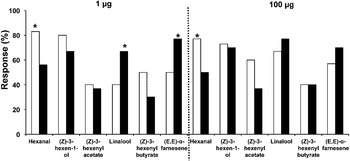
Comparing the two sexes, sex exerted a significant effect on behavioural response of M. croceipes, but this was dose-dependent in many cases. Females showed significantly greater responses than males to hexanal at the low dose (1μg: χ2 = 4.4, df = 1, P = 0.0359), (Z)-3-hexenyl acetate at the high dose (100μg: χ2 = 4.4, df = 1, P = 0.0359), linalool at both doses (1μg: χ2 = 4.3, df = 1, P = 0.0372; 100μg: χ2 = 5.5, df = 1, P = 0.0191) and (Z)-3-hexenyl butyrate at both doses (1μg: χ2 = 5.6, df = 1, P = 0.0175; 100μg: χ2 = 6.4, df = 1, P = 0.0112) (fig. 2). In contrast, males showed significantly higher response than females to hexanal at the high dose (100μg: χ2 = 4.3, df = 1, P = 0.0372) and (E,E)-α-farnesene at the low dose (1μg: χ2 = 4.3, df = 1, P = 0.0372) (fig. 2).
Sexual differences in the response of Microplitis croceipes to host-related plant volatiles in a Y-tube olfactometer. Asterik (*) indicates significant differences between the sexes (χ2 tests, P < 0.05) (□, Female; ■, Male).

Cotesia marginiventris
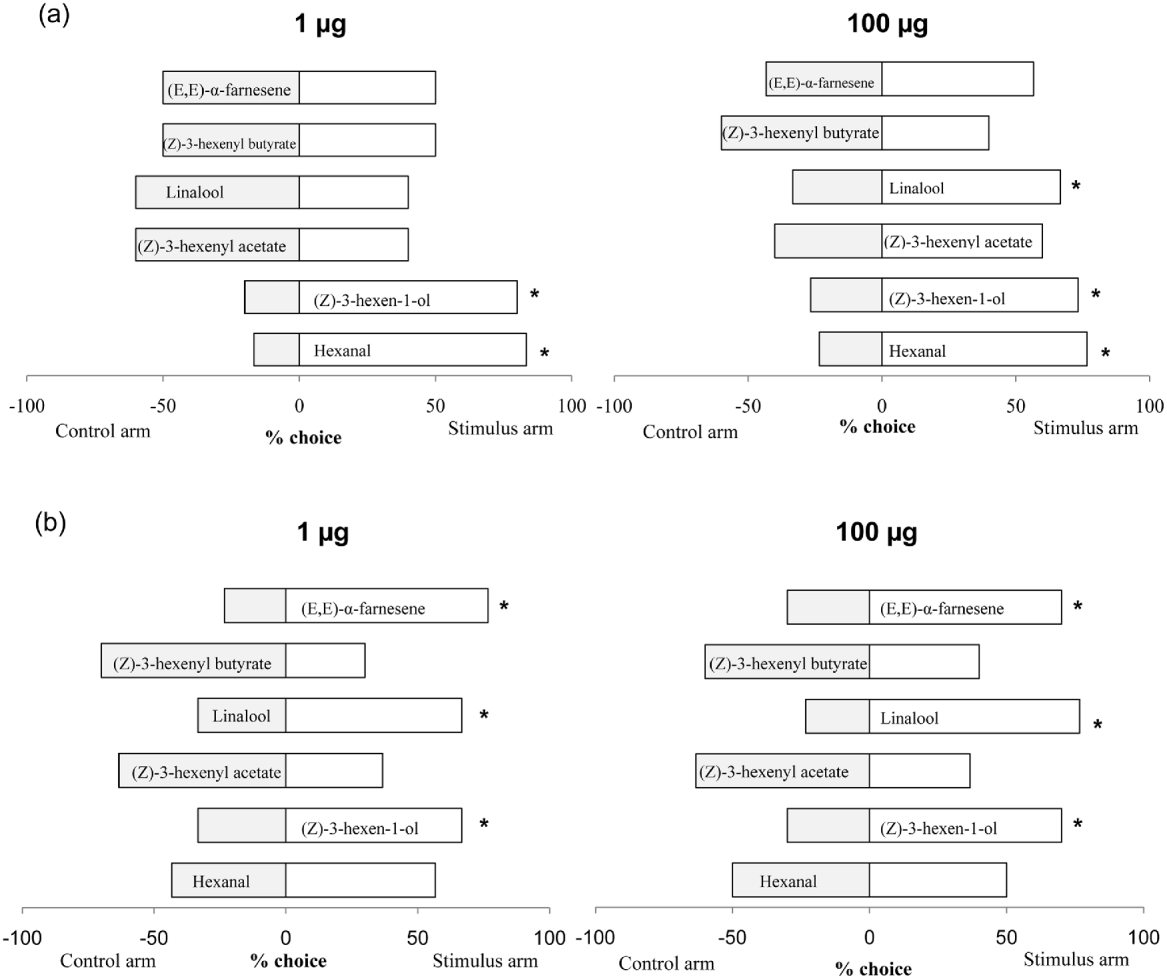
Female C. marginiventris showed significant attraction to both doses of the two tested GLVs (hexanal and (Z)-3-hexen-1-ol) and to linalool at low dose. However, no significant attraction was recorded to the remaining three HIPVs (i.e. (Z)-3-hexenyl acetate, (Z)-3-hexenyl butyrate and (E,E)-α-farnesene) (table 1, fig. 3a). Males, on the other hand, showed significant attraction to both doses of (Z)-3-hexen-1-ol, linalool and (E,E)-α-farnesene) (table 1, fig. 3b).
Response of Cotesia marginiventris (a) females and (b) males in a Y-tube olfactometer when given a choice between hexane (control) and host-related plant volatiles. Asterik (*) indicates significant differences between stimulus and control (χ2 tests, P < 0.05).

Comparing both sexes of C. marginiventris, females showed significantly greater attraction than males only to hexanal at both doses (1μg: χ2 = 5.2, df = 1, P = 0.0224; 100μg: χ2 = 4.6, df = 1, P = 0.0306). In contrast, males showed significantly greater attraction than females to linalool at the low dose (1μg: χ2 = 4.3, df = 1, P = 0.0372) and (E,E)-α-farnesene at the low dose (1μg: χ2 = 4.6, df = 1, P = 0.0306) (fig. 4).
Sexual differences in the response of Cotesia marginiventris to host-related plant volatiles in a Y-tube olfactometer. Asterik (*) indicates significant differences between the sexes (χ2 tests, P < 0.05) (□, Female; ■, Male).

Comparing both parasitoid species
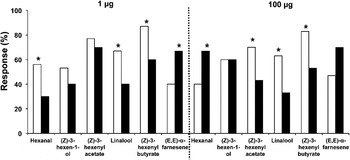
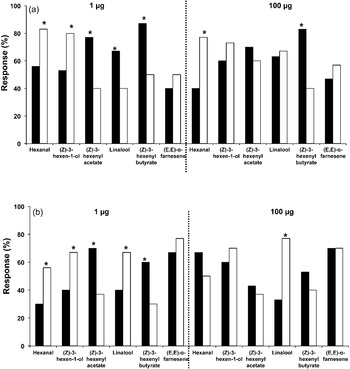
Significant differences were recorded in the responses of both parasitoid species to the tested compounds. At the low dose (1μg), female M. croceipes (specialist) showed significantly greater responses than female C. marginiventris (generalist) to three of the four tested HIPVs, (Z)-3-hexenyl acetate (χ2 = 8.5, df = 1, P = 0.0035), linalool (χ2 = 4.3, df = 1, P = 0.0372) and (Z)-3-hexenyl butyrate (χ2 = 9.8, df = 1, P = 0.0018). In contrast, female C. marginivetris showed significantly greater attraction than female M. croceipes to the two GLVs, hexanal (χ2 = 5.2, df = 1, P = 0.0224) and (Z)-3-hexen-1-ol (χ2 = 4.9, df = 1, P = 0.0268) (fig. 5a). Similar results were recorded at the high dose (100μg) but fewer significant differences were detected. At the 100μg dose, female M. croceipes showed significantly greater response than female C. marginiventris only to one HIPV, (Z)-3-hexenyl butyrate (χ2 = 12.5, df = 1, P = 0.0004). Also, female C. marginiventris showed significantly greater response than female M. croceipes only to the GLV, hexanal (χ2 = 8.5, df = 1, P = 0.0035). No significant differences were recorded in the responses of both species to (E,E)-α-farnesene (an HIPV) at both doses (fig. 5a).
Comparing behavioural responses of Microplitis croceipes versus Cotesia marginiventris (a) females and (b) males to host-related volatiles in a Y-tube olfactometer. Asterik (*) indicates significant differences between the species (χ2 tests, P < 0.05) (■, M. croceipes; □, C. marginiventris).

In general, similar results were recorded for the males with one key exception (fig. 5b). At the low dose, male M. croceipes showed significantly greater responses than male C. marginiventris to two HIPVs, (Z)-3-hexenyl acetate (χ2 = 6.8, df = 1, P = 0.0090) and (Z)-3-hexenyl butyrate (χ2 = 5.5, df = 1, P = 0.0185), whereas male C. marginiventris showed relatively greater attraction than male M. croceipes to the two GLVs, hexanal (χ2 = 4.4, df = 1, P = 0.0359) and (Z)-3-hexen-1-ol (χ2 = 4.3, df = 1, P = 0.0372). Although similar trends were recorded at the high dose, the results were not as conclusive. Contrary to the results recorded for the females, male C. marginiventris showed significantly greater responses than male M. croceipes to linalool (an HIPV) at both doses (1μg: χ2 = 4.3, df = 1, P = 0.0372; 100μg: χ2 = 11.8, df = 1, P = 0.0006) (fig. 5b).
Discussion
The results revealed key sexual and species differences in behavioural responses of our parasitoid models to host-related volatiles and may have important ecological ramifications. As predicted, the specialist parasitoid, M. croceipes, was more responsive (in particular at the low dose) to three of the four tested herbivore-induced plant volatiles (HIPVs), whereas the generalist (C. marginiventris) showed relatively greater behavioural responses to the green leaf volatiles (GLVs). Females of both species also showed greater responses than conspecific males to most of the tested volatiles. These findings are in agreement with the results of previous studies by our group, which showed differential electrophysiological responses of both parasitoid species to host-related volatiles (Chen & Fadamiro, Reference Chen and Fadamiro2007; Ngumbi et al., Reference Ngumbi, Chen and Fadamiro2009, Reference Ngumbi, Chen and Fadamiro2010). In the above studies which utilized EAG and GC-EAD techniques, M. croceipes consistently showed greater electrophysiological responses to the HIPVs such as (Z)-3-hexenyl acetate and (Z)-3-hexenyl butyrate, whereas C. marginiventris showed greater responses to the GLVs such as (Z)-3-hexenal, trans-2-hexenal and (Z)-3-hexenol.
Few studies have systematically compared behavioural responses of specialist and generalist parasitoids to host-related volatiles (Elzen et al., Reference Elzen, Williams, Vinson and Powell1987; Vet et al., Reference Vet, Sokolowski, Macdonald and Snellen1993; Geervliet et al., Reference Geervliet, Vet and Dicke1996; Cortesero et al., Reference Cortesero, De Moraes, Stapel, Tumlinson and Lewis1997; Röse et al., Reference Röse, Lewis and Tumlinson1998). In general, the specialist parasitoid typically showed greater response than the generalist to host-related odour (Elzen et al., Reference Elzen, Williams, Vinson and Powell1987; Vet et al., Reference Vet, Sokolowski, Macdonald and Snellen1993). However, we are not aware of any studies which reported differential responses of specialist and generalist parasitoids to GLVs and HIPVs, as recorded in the present study. Thus, our results show that the specialist parasitoid is more responsive to some HIPVs, especially at the low dose, while the generalist is more responsive to GLVs provide evidence of differential response of specialist and generalists to host-related volatiles. Specialist parasitoids like M. croceipes are likely to have evolved the ability to respond more to the HIPVs, which are specifically linked to their hosts (Cortesero et al., Reference Cortesero, De Moraes, Stapel, Tumlinson and Lewis1997). (Z)-3-hexenyl acetate and (Z)-3-hexenyl butyrate are major HIPVs emitted by cotton plants damaged by cotton caterpillars (Loughrin et al., Reference Loughrin, Manukian, Heath and Tumlinson1994; McCall et al., Reference McCall, Turlings, Loughrin, Proveaux and Tumlinson1994; Ngumbi et al., Reference Ngumbi, Chen and Fadamiro2009) and have been reported to elicit behavioural responses in M. croceipes (Whitman & Eller, Reference Whitman and Eller1992). Recently, we showed that both compounds are emitted in greater quantities by plants damaged by H. virescens, a key host of M. croceipes, compared to plants damaged by S. exigua, a non-host (Ngumbi et al., Reference Ngumbi, Chen and Fadamiro2009), suggesting that these compounds could play an important role in host location behaviour of M. croceipes in natural settings. Similarly, the results which showed that the generalist C. marginiventris was more attracted to the GLVs appear to be in correlation with the behavioural ecology and foraging behaviour of this species. GLVs are ubiquitous volatiles commonly emitted by various plants (Cortesero et al., Reference Cortesero, De Moraes, Stapel, Tumlinson and Lewis1997; Hoballah et al., Reference Hoballah, Tamo and Turlings2002; D‘Alessandro & Turlings, Reference D'Alessandro and Turlings2005; Hoballah & Turlings, Reference Hoballah and Turlings2005). Thus, it would seem adaptive for generalist parasitoids, which attack numerous hosts on numerous plants, to be more responsive to GLVs. Our results suggest that GLVs are important host location cues for C. marginiventris, and possibly similar generalist parasitoids.
In general, our data showed that the specialist was more responsive than the generalist to some HIPVs. One key exception is linalool (an HIPV), which (at the two doses tested) elicited significantly greater responses in male C. marginiventris compared to male M. croceipes. In this study, we used racemic linalool, which comprises of (+) and (–) enantiomers. Previous studies have reported that the two enantiomers of linalool were perceived in different parts of the brain of Manduca sexta (L.) (Lepidoptera: Sphingidae) (Reisenman et al., Reference Reisenman, Christensen, Francke and Hildebrand2004). It is, therefore, possible that the observed differential responses of C. marginiventris and M. croceipes to racemic linalool may be related to how the different enantiomers are perceived in the brain of both species. Alternatively, linalool may be a component of volatiles that serve as mating signals for C. marginiventris. However, little is known about the mating cues or the existence and identity of sex pheromones in C. marginiventis. Also, our results, showing no significant differences between both species in their responses to (E,E)-α-farnesene, may suggest that this HIPV is not an important host specificity cue.
The important sexual differences recorded in this study are consistent with the results of a previous study in which females of M. croceipes and Netelia heroica Townes (Hymenoptera: Ichneumonidae) showed greater behavioural responses to host-related volatiles than males (Whitman & Eller, Reference Whitman and Eller1990) and are in agreement with our current knowledge of parasitoid host location behaviour. The female is the primary sex involved in host location. It is logical to expect females to show greater responses than males to host-related volatiles (in particular GLVs), especially at low doses, since evolution would favour females that were able to arrive immediately at the site of host plant attack (Chen & Fadamiro, Reference Chen and Fadamiro2007). On the other hand, male parasitoids are probably exploiting host-related volatiles for mating and may have evolved greater responsiveness to HIPVs, in particular at high doses, since selection pressure would favour males that were best able to locate sites where females are likely to be found, as signaled by the production of HIPVs (Chen & Fadamiro, Reference Chen and Fadamiro2007). This may explain the results in which males of both parasitoid species showed greater behavioural responses than females to linalool and (E,E)-α-farnesene.
The compounds tested in this study are constituents of blends of volatiles emitted by caterpillar-damaged cotton plants (Loughrin et al., Reference Loughrin, Manukian, Heath and Tumlinson1994; Cortesero et al., Reference Cortesero, De Moraes, Stapel, Tumlinson and Lewis1997; Ngumbi et al., Reference Ngumbi, Chen and Fadamiro2009). In nature, parasitoids typically exploit the whole blend of volatiles for host location. However, attraction of many parasitoid species to certain individual components of the blend, including some of the compounds tested in the present study, has also been documented (Du et al., 1998; Powell et al., Reference Powell, Pennacchio, Poppy and Tremblay1998; de Boer & Dicke, Reference De Boer and Dicke2004). Based on our recent EAG and GC-EAG studies (Chen & Fadamiro, Reference Chen and Fadamiro2007; Ngumbi et al., Reference Ngumbi, Chen and Fadamiro2009), we selected a subset of compounds that are key components of the blend of volatiles produced by caterpillar-damaged plants in order to carry out extensive and detailed behavioural responses of both parasitoid species to these compounds. Our results, therefore, form a foundation for future studies that would be designed to investigate the behavioural responses of both parasitoid species to complex odor blends mimicking the natural blends emitted by cotton plants damaged by different caterpillar species.
In summary, our results showed that the specialist parasitoid (M. croceipes) was more responsive (in particular at the low dose) to most HIPVs, whereas the generalist (C. marginiventris) showed relatively greater behavioural responses to GLVs. The data supports the prediction that specialist parasitoids that utilize fewer numbers of host species are likely to possess olfactory detection systems which are more highly sensitive and narrowly tuned (selective) to host-related volatiles than generalist parasitoids (Vet & Dicke, Reference Vet and Dicke1992; Cortesero et al., Reference Cortesero, De Moraes, Stapel, Tumlinson and Lewis1997; Smid et al., Reference Smid, Van Loon, Posthumus and Vet2002; Chen & Fadamiro, Reference Chen and Fadamiro2007; Ngumbi et al., Reference Ngumbi, Chen and Fadamiro2009, Reference Ngumbi, Chen and Fadamiro2010). Future studies with other parasitoid models and a wider range of host-related volatiles models are needed to further test this prediction and the ecological significance of our findings. Increased knowledge of parasitoid host specificity and host location strategies and identification of attractive volatile compounds should enhance the performance of parasitoids as biological control agents.
Acknowledgements
We thank Prith Wiraj Das and Erica Williams for help with parasitoid rearing and Paul Conner for designing the Y-tube stand. This research was funded by a National Science Foundation (NSF) Grant (Award Number: 0641621) to HYF.