




No CrossRef data available.
Article contents
The effect of postnatal depression on mother–infant interaction, infant response to the Still-face perturbation, and performance on an Instrumental Learning task
Published online by Cambridge University Press: 13 April 2004
Abstract
A representative community sample of primiparous depressed women and a nondepressed control group were assessed while in interaction with their infants at 2 months postpartum. At 3 months, infants were assessed on the Still-face perturbation of face to face interaction, and a subsample completed an Instrumental Learning paradigm. Compared to nondepressed women, depressed mothers' interactions were both less contingent and less affectively attuned to infant behavior. Postnatal depression did not adversely affect the infant's performance in either the Still-face perturbation or the Instrumental Learning assessment. Maternal responsiveness in interactions at 2 months predicted the infant's performance in the Instrumental Learning assessment but not in the Still-face perturbation. The implications of these findings for theories of infant cognitive and emotional development are discussed.This research was supported by the award of a Medical Research Council Training Fellowship to Charles Stanley. Lynne Murray was supported by a Medical Research Council Senior Research Fellowship. Alan Stein was supported by the Tedworth Trust and the Wellcome Trust. The authors would like to thank Anji West and Agnese Fiori\NCowley for their help with the coding of the assessments, Robbie Paterson for administrative assistance, Richard Hooper for assistance with the statistical analyses and Peter Cooper for collaboration in the planning of the study.
Information
- Type
- Research Article
- Information
- Copyright
- © 2004 Cambridge University Press
Associations between maternal depression and adverse childhood developmental outcome have been consistently reported (see reviews by Cummings & Davies, 1994; Downey & Coyne, 1990; Goodman & Gotlib, 1999; Rutter, 1966, 1997): infants exposed to maternal depression in the postpartum period may be at particular risk, given their almost complete dependency on the quality of others' care and emotional responsiveness (Murray, 1980; Trevarthen, Murray, & Hubley, 1981). Indeed, studies of the development of children exposed to postnatal depression suggest adverse outcome in a number of areas, including poor cognitive functioning, insecure attachment, and difficulties in behavioral and emotional adjustment (see review by Murray & Cooper, 2003).
Although it is generally assumed that the underlying processes mediating the link between the maternal mood disorder and adverse child functioning are at least partly environmental in nature (Rutter, 1997), it should be recognized that postpartum depression acts as a marker for developmental risk; it is not, of itself, a risk mechanism (Rutter, 1966, 1997). Indeed, studies attempting to identify the specific risk mechanisms have increasingly turned to the quality of early mother–child relationships.
Marked impairments in depressed mothers' communication and associated infant disturbance were first observed in studies of mother–infant dyads drawn from populations of mothers and infants at high psychosocial risk (Cohn, Matias, Tronick, Connell, & Lyons–Ruth, 1986; Cohn & Tronick, 1989; Field, 1984; Field, Healy, Goldstein, & Guthertz, 1990; Field, Healy, Goldstein, Perry, Bendell, Schanberg, Zimmermain, & Kuhn, 1988; Lyons–Ruth, Zoll, Connell, & Grunebaum, 1986). Subsequent research with representative, low-risk samples has, in general, identified similar difficulties in depressed mothers' responsiveness to their infants, albeit in less extreme forms (see reviews by Lovejoy, 2000; Murray & Cooper, 2003).
A number of aspects of the mother–infant interaction have been hypothesized to have effects on child developmental outcome in the context of postnatal depression (Murray & Cooper, 2003). Moreover, of these, the contingent nature of maternal responsiveness has been viewed as a particularly strong candidate for consideration as a risk mechanism (Cohn et al., 1986, 1990; Field, 1984; Hay, 1997; Hay, Pawlby, Sharpe, Asten, Mills, & Kumar, 2001; Murray, Hipwell, Hooper, Stein, & Cooper, 1996; Murray, Kempton, Woogar, & Hooper, 1993).
Indeed, in normal samples, maternal contingent responsiveness to infant behavior has been shown to predict a wide range of infant social, emotional, and cognitive competencies (see Lewis, 1993; Stern, 1985; Watson, 1979, 1985). Individual differences in maternal contingent responsiveness have been associated with infant developmental outcome in areas as diverse as emotional self-regulation and control (Kochanska, 1994; Kopp, 1982; Tronick, 1989); means–ends differentiation (Lewis & Goldberg, 1969), self-efficacy and expectation of environmental control (Gunnar, 1980; Lewis & Brooks–Gunn, 1979; Maccoby & Martin, 1983; Maccoby, 1992), language development (Bornstein & Tamis–LeMonda, 1997), and cognitive skills and academic achievement (Bornstein & Tamis–LeMonda, 1989; Coates & Lewis, 1984; Lewis, 1993).
To date, however, the role of maternal contingent responsiveness in mediating adverse infant outcome in the context of postnatal depression has received relatively little direct examination using rigorously defined measures of contingency such as those used by Watson (1975). Nevertheless, there has been some work that has attempted to address this issue. For example, the study of Murray and colleagues (1993) found that a reduction in the proportion of maternal speech that was focused on infant experience, a measure likely to be closely related to poor contingent responsiveness, was characteristic of depressed mothers and also accounted for the association between depression and poor cognitive outcome in infants. However, it did not predict attachment outcome in this sample (Murray, Hipwell, Hooper, Stein, & Cooper, 1996), nor did a similar measure of responsiveness predict attachment in the study of Campbell and colleagues (1995).
It is also of note that the study of Murray and colleagues broadly defined cognitive outcome (as success or failure on object concept tasks and scores on the Mental Development Index of the Bayley scales). Thus, cognitive functioning with closer theoretical links to maternal contingent responsiveness, such as the capacity to detect environmental contingencies in operant learning tasks, was not assessed.
Finally, while the infant outcome most commonly assessed in relation to postnatal depression has typically been the quality of infant attachment, there are reasons to suppose that the impact of maternal contingent responsiveness may be more clearly evident when more direct measures of the infants' capacity for emotional and behavioral regulation are employed. The degree to which the mother is able to respond contingently to the infant at times when their behaviors had become miscoordinated during the interactions has been hypothesized to play a key role in the development of the infant's capacity to regulate their own state and affect in the face of environmental disruptions (Tronick & Gianino, 1989).
The current study sought to address these issues in a sample of postnatally depressed and well mothers, testing the role of a rigorously defined measure of maternal contingency in promoting two aspects of infant development with specific, theoretically driven links to parental contingent responsiveness. The first aspect is, within the realm of cognitive functioning, the capacity for operant learning (Lewis, Alessandri, & Sullivan, 1990); the second aspect is, within the realm of emotional and behavioral regulation, the infant's response to the perturbation of the mother's behavior constituted by the “Still-face” presentation (Tronick et al., 1978).
The Instrumental Learning assessment measures both cognitive and motivational aspects of the infant's relationship with his or her physical environment. It tests the infant's ability to generate a motor response to a contingent environmental event, recording responses over baseline, learning and extinction phases. There is abundant evidence that 3-month-old infants can learn simple instrumental contingencies (Rovee–Collier, 1995) and that they respond to subsequent loss of control over such contingencies by trying to reinstate the prior relationship between their behavior and the environmental response (Alessandri et al., 1990; Alessandri, Sullivan, Imaizumi, & Lewis, 1993; Lewis et al., 1990). Thus, it can be hypothesized that the infant's prior experience of contingent relationships between his or her own activity and the environmental events constituted by maternal responsiveness will both foster more rapid learning during Instrumental Learning tasks and, given the expectation for contingency in the environment, delay the course of extinction of responses.
The Still-face assessment examines the infant's behavioral adaptation to a reduction in caregiver responsiveness, when a mother is asked to keep a still or blank face, thus interrupting the normal flow of mother–infant communication. Notably, with respect to the issue of the impact of postnatal depression on infant functioning, Cohn and Tronick (1983) suggest that this type of manipulation may mimic the blunted affect that is characteristic of a depressive illness. Previous studies using the paradigm have reported somewhat different types of infant response to the perturbation (Field, Vega–Lahr, Scafidi, & Goldstein, 1986; Gusella, Muir, & Tronick, 1988; Mayes & Carter, 1990; Murray & Trevarthen, 1985; Toda & Fogel, 1993; Tronick et al., 1978; Weinberg & Tronick, 1996). Nevertheless, a consensus view is that overall levels of infant positive engagement and monitoring of the mother tend to decrease from baseline rates. As the Still-face phase proceeds, any positive acts of engagement tend to be replaced by protest, or by monitoring of the environment rather than the mother. Some infants may eventually become completely disengaged, or, alternatively, frankly disorganized in their behaviors. Typically, once the mothers start to interact with the infant again, the levels of protest abate and rates of engagement increase, although there may be some spill-over of infant behavioral disturbance into the reunion phase. Rather than attempt to describe a universal infant response to reduced maternal responsivity, some studies have specifically commented on the marked individual differences between infants in their response to the perturbation, with some infants attempting to reengage their mothers for prolonged periods during the Still-face period (Mayes & Carter, 1990; Segel, Oster, Cohn, Capsi, Myers, & Brown, 1996). Although there may, in part, be an underlying constitutional basis to differences in infant responsiveness, it is also possible that the behavioral response to the Still-face perturbation reflects, to a significant degree, the infant's expectations of the communicative process based on their prior experience of interactions with primary caregivers. In particular, it can be hypothesized that infants whose mothers have, in general, not provided contingently responsive interactions, would be less likely to regard their mothers as potentially available to them. As a result, these infants would not have developed either the expectation that their own efforts at interactional repair would be successful in reengaging their mothers or the ability to remain behaviorally organized when the scaffold of adult communication is removed. Thus, they would be unable to sustain persistently high levels of active engagement with the mother throughout the Still-face perturbation. Rather, as the perturbation proceeded, they would display increasing levels of either behavioral dysregulation or disengagement.
In summary, we hypothesized, first, that depressed mothers would be less contingently responsive to their infants during face to face interactions than well mothers, and second, that the degree of maternal contingent responsiveness would both predict infant performance during the operant learning and Still-face conditions, and mediate any impact of postnatal depression on these infant outcomes. In essence, we propose that a social process, the evolving quality of mother–infant interactions during the early months, affects the way in which the infant subsequently processes information pertaining to both the social and physical environment. Difficulties in processing such information may predict, and ultimately partly explain, the socioemotional and cognitive deficits noted in the infants of depressed mothers at the end of the first year.
Two further considerations informed the design of the current study. First, given that several previous studies of the effects of postnatal depression have used high risk samples, with the consequence that it has not always been possible to disentangle the relative contribution of the maternal mood disorder from that of socioeconomic adversity, we felt it important to recruit a representative, relatively low risk, community sample. This has the effect of minimizing the influence of potential confounding variables, thus allowing specific focus on the role of mood disorder in relation to developmental outcome. Second, we were interested to examine the possible impact of the timing of the depressive episode on infant outcome. Campbell and colleagues (1995), for example, found effects of depression on maternal and infant behavior only in cases where the depression was chronic (i.e., of more than 6 months' duration). In the study by Murray and colleagues, by contrast, there was no additional adverse effect on infant functioning at 18 months of any maternal depression occurring beyond the first 3 months postpartum (Murray, 1992). In the current study, therefore, further follow-up was conducted to assess maternal psychiatric state at 6 months postpartum, thus allowing maternal and infant outcomes at 3 months postpartum to be analyzed according to the chronicity of maternal episodes.
Design
A community sample of depressed and well mothers was recruited between 6 and 8 weeks postpartum. At 2 months, observations were recorded of mother–infant interactions, and at 3 months, infants were assessed during an Instrumental Learning task and the Still-face perturbation. Follow-up assessments of maternal mental state were made at 3 and 6 months postpartum.
Sample
Primiparous women presenting on the postnatal ward of an East Anglian district general hospital during a 12-month period were approached and invited to participate in a study of the experience of motherhood and infant development. The selection criteria were that the infant be a singleton, have a gestation longer than 36 weeks, have a birth weight of >2.5 kg, have no gross congenital abnormality, and not require admission to the special care baby unit. A total of 725 mothers and infants fulfilled these criteria, of whom only six women (0.8%) refused to take part. At 6 weeks postpartum the mothers were sent the Edinburgh Postnatal Depression Scale (EPDS; Cox et al., 1987). This is a 10-item self-report questionnaire of established validity that has been widely used in research to detect postnatal depression (Murray & Carothers, 1990). Questionnaires were returned by 676 women (92%), and all those with an EPDS score at or over the established threshold of 13 (in addition to some of those who scored 12) were interviewed at 2–3 months postpartum using the Affective Disorder Subsection of the SCID (Structured Clinical Interview for DSM-III-R). This is a widely used standardized structured interview for depression, which has good reliability and validity (Spitzer, Williams, Gibbon, & First, 1990). In addition, of the 43 women who did not return an EPDS Questionnaire, contact was successfully made with 25 who were similarly interviewed. Evidence as to the potential presence of a depressive illness was thus available for 701 (97%) of the original sample. These procedures identified 77 women (10.6%) who either had experienced, or who were currently suffering from, a depressive illness meeting DSM-III-R criteria for Major Depressive disorder following delivery. Of these, 72 (94%) agreed to participate in the study. A nondepressed yoked control group of mothers was recruited from the same postnatal population for the last 9 months of the study. After every index mother was identified, the mother of the next same gender infant that was delivered was invited to join the study when the mother was confirmed by interview as not being depressed. As the recruitment of the control group mothers commenced at a slightly later stage of the study than was the case for the index group mothers, only 54 potential control group mothers were available for recruitment, of whom 50 (93%) agreed to participate.
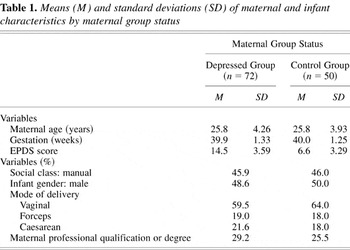
The characteristics of the full experimental cohort of 122 mothers and infants are described in Table 1. Social class was defined according to the UK Registrar General's Office of Population Census and Surveys (OPCS) 1980 classification of partner's occupation; for the purpose of data analysis the sample was divided into two groups: nonmanual and manual/unemployed. Of the sample, 44% had a nonmanual occupation, and 10% of had partners who were unemployed; 6% had no current partner, and 26% were unmarried at the time of entry into the study; and 62.9% had an uncomplicated vaginal delivery, 17.8% had a forceps delivery, and 19.3% had a caesarean section. Neither the depressed nor the control samples differed significantly from each other, or from the population sample from which they were drawn, on any of these variables.
Means (M) and standard deviations (SD) of maternal and infant characteristics by maternal group status

The EPDS and the Affective Disorders Subsection of the SCID were administered again at 3 and 6 months to examine the chronicity of the depressive episode. Women were categorized in two ways: first, as either having been depressed or not (index women, n = 72; and control women, n = 50) and second, in terms of the timing of the episode of depression.
Procedures
Two-month assessment
Face to face interaction
At 2 months, the mothers were visited at home, at which time a face to face interaction was recorded. When the infant was in a quiet and relaxed state he or she was placed in reclining seat, with the mother taking a position opposite. The mother was asked to play with the infant, without using toys, for 5 min. The interaction was videorecorded in such a way as to obtain facial and body profiles of both mother and infant.
Three-month assessments
At 3 months, mothers and infants came in to the laboratory, and the assessments of Instrumental Learning and infant response to the Still-face perturbation were conducted. The assessment of Instrumental Learning was always conducted prior to the Still-face procedure.
Instrumental Learning procedure
This procedure was adapted from that described by Lewis and colleagues (1990). The infant was placed in a position to view a 3-s audiovisual stimulus on a video screen. This consisted of an animated computer generated image of a chipmunk accompanied by a musical recording. It was activated in a contingent fashion by infant arm movements exceeding a predetermined amplitude, recorded using a ribbon connected at the infant's wrist. Three phases of the procedure ran sequentially: (a) a 2-min baseline phase that establishes the operant level of responding; (b) a 3-min learning phase, during which the infants received the contingent audiovisual stimulus after each arm-pull; and (c) a 3-min extinction phase during which contingent reinforcement was discontinued.
Still-face perturbation
The infant was placed opposite the mother in a seat mounted in front of a videocamera. A mirror was placed alongside the infant so that a reflection of the mother's face appeared next to that of the infant. After approximately 3 min of normal face to face interaction, the mother was requested to adopt a still or neutral face and refrain from talking to or touching the infant for 90 s, before carrying on with normal interaction for a further 90 s. The initial phase of the assessment was abandoned if a minimum level of engagement could not be reached, and the infants were retested when their level of arousal was appropriate. This was designed to maximize the likelihood that subsequent deviations from baseline values during the Still-face and reunion phases would reflect a true test of the infant's motivation and ability to negotiate the perturbation, rather than representing the spill-over of state dependent effects, such as level of arousal, into the subsequent phases.
Measures
Maternal contingent responsiveness in face to face interaction
Watson (1978) identified two temporal parameters of adult responsiveness that are central to the definition of contingency: (a) response contingency: the conditional probability that a particular maternal response will occur within a predetermined time after the infant has emitted a given behavior; (b) base-rate contingency: the probability that a maternal behavior will occur at times unrelated to infant behaviors. The critical measure predicting operant learning, and the one used in this study, is the relationship between these two parameters, expressed as a ratio. This effectively captures the overall salience of contingent maternal behavior.
However, a purely temporally based definition of contingency is unlikely to be powerfully predictive of later developmental outcome, unless these basic contingency parameters are also combined with higher order, qualitative features of the maternal response, such as the quality of affective attunement (Fonagy, Steele, Steele, Higgitt, & Target, 1994; Murray, Fiori–Cowley, Hooper, & Cooper, 1996; Murray & Trevarthen, 1986; Stern, 1985). Accordingly, in this study the definition of maternal responsiveness was based on both the lower (quantitative) and higher (qualitative) order aspects of contingency.
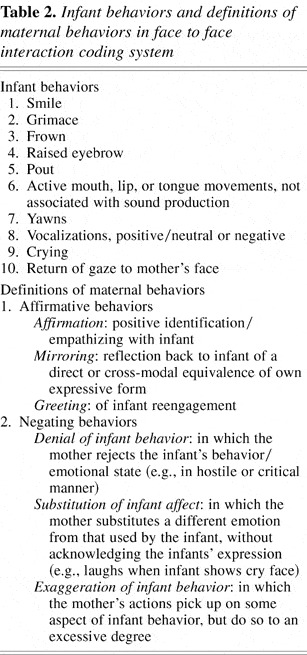
The videorecording was subjected to microanalytical observational techniques using frame by frame analyses of dyadic behavior, in which discrete infant behaviors (see Table 2), or their combinations, were scored on a 1-s time base. Having identified all such events, the videotape was then reviewed for relevant maternal behaviors. These were scored using the scheme described by Murray and colleagues (see Murray et al., 1996, for further details). The degree of contingent maternal affirmation of infant behavior was calculated as the rate at which a predefined infant behavior was followed by an “affirmative” maternal response within a 2-s period. Such responses either mirrored or complemented the infants' behavior in a sympathetic or supportive fashion, and include responses to negative, as well as positive, infant behaviors. For example, if the infant frowned or pouted, the mother might show a concerned expression and make a soothing vocalization. A similar procedure was followed to calculate the degree of contingent maternal negation of infant behavior (see Table 2 for maternal behaviors). In this instance, an infant frown or pout might be followed by a display of maternal annoyance and a critical comment. The degree of baseline maternal behavior at times unconnected to infant behaviors was calculated using a separate measure of the rate at which maternal behaviors (e.g., vocalizations or facial expressions) occurred during the 1-s time interval, 5 s prior to a predefined infant behavioral event, provided that such a maternal behavior was not itself a response to a previous predefined infant behavioral event.
Infant behaviors and definitions of maternal behaviors in face to face interaction coding system

The procedures outlined above provided the two measures of maternal response for use in later analyses, which are calculated in the following manner:
- Contingent positive maternal responsiveness: the ratio of contingent maternal affirmation of infant behavior/baseline maternal behavior. This measure reflects the overall salience of affirmative maternal contingent response, correcting for high baseline rates of maternal behavior occurring at times unconnected to infant behavior.
- Contingent negative maternal responsiveness: the total number of negating maternal responses/the total number of infant behaviors scored. As the frequency of this type of maternal response was low, this latter measure was not corrected for baseline rates of maternal behavior.
Interobserver reliability
Two observers scored all interactions, the principal coder being blind to the hypotheses of the study and maternal psychiatric state. The Cohen's kappa coefficients measuring interrater reliability were .75 for identification of infant behaviors, .70 for maternal affirmative responses, .67 for maternal negating responses and .72 for baseline maternal responses.
Infant response to Instrumental Learning
Two summary measures were calculated to provide estimates of the overall learning and initial extinction effects: (a) rates of arm-pulling during the third minute of the learning phase relative to the baseline phase (L3–BL), and (b) rates of arm-pulling during the first minute of the extinction phase relative to the third minute of the learning phase (E1–L3).
Infant response to Still-face
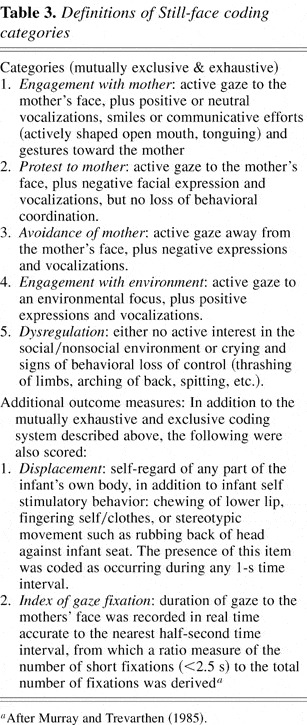
The last 60 s of the initial baseline phase, the whole 90 s of the Still-face phase and the last 60 s of the reunion phase were coded using a 2.5-s interval based scheme that identified five mutually exclusive and exhaustive behavioral states: engagement with mother, protest to mother, avoidance of mother, engagement with environment, and dysregulation (see Table 3 for infant behaviors). In addition, these infant behaviors were further rated on a three-point scale of intensity of expression: 1 = low, 2 = moderate, and 3 = high. The final index of behavioral response was the product of the time spent in any specific behavioral category and the intensity with which that behavior was exhibited, during any given time in each phase of the experiment.
Definitions of Still-face coding categories

In addition, two other infant behaviors were scored: Displacement behavior and Index of Gaze fixation (see Table 3 for definitions).
Interobserver reliability
A researcher who was unaware of maternal psychiatric state, and the nature of previous mother–infant interactions, scored all the videorecords. Twenty percent were selected at random and recoded independently by a second coder. Interrater reliability for infant behaviors was calculated by using Cohen's kappas for each of the Still-face perturbation codes: engagement with mother, .61; protest toward mother, .73; avoidance of mother, .74; engagement with environment, .73; and dysregulation .66. The kappas for infant gaze toward the mother's face and infant displacement behaviors were 0.85 and .81, respectively.
Results
Data analytic strategy
Repeated measures analysis of variance (ANOVA; in the case of the Still-face assessment) and ANOVA (in the case of the Instrumental Learning and face to face interaction assessments) were conducted to investigate the effects of the hypothesized predictor measures of maternal depression and maternal responsiveness on infant developmental outcome, together with the moderating effects of infant gender and social class. In the event that linkages were found between maternal depression and maternal responsiveness, and between both of these predictor variables and subsequent infant developmental outcome, further analyses were planned to test the mediational role of maternal responsiveness in postnatal depression (Baron & Kenny, 1986; Holmbeck, 1997).
Course and duration of maternal depression
Using DSM-III-R criteria for Major Depressive disorder, four groups of woman were defined: control women who did not experience any depression (n = 50), index women who remitted by 3 months (past cases; n = 11), index women who were depressed at 3 months, but remitted by 6 months (current cases; n = 39), and index women who were still depressed at 6 months (chronic cases; n = 21). One woman was not available for 3- and 6-month mental state assessments. The primary health care teams were usually unaware of the mother's psychological difficulties, and early therapeutic intervention was uncommon.
Mother–infant interactions at 2 months
Characteristics of the variables
The measure of contingent positive maternal responsiveness and the original measures from which this variable was derived (frequency of contingent maternal affirmation of infant behavior and baseline frequency of maternal behavior) at 2 months postpartum were normally distributed. However, the measure of contingent maternal negative responsiveness was positively skewed. The distribution was normalized by means of a logistic transformation, following the addition of a small (0.01) constant.
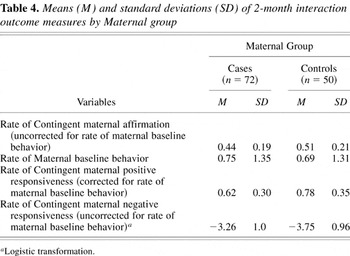
Data analysis proceeded as follows: main effects of postnatal depression (2), infant gender (2), and social class (2) on the measures of contingent positive and negative maternal responsiveness were examined in an ANOVA and the interactions of infant gender and social class with maternal depression were subsequently added to test for moderating effects (see Table 4 for means and standard deviations of face to face interaction outcome measures by maternal group). These analyses revealed significant main effects for maternal depression status: compared to control women, mothers who experienced postnatal depressive illness showed lower rates of positive contingent responsiveness to their infants, F (1, 121) = 7.14, p < .01, and more contingent negating of their infants' behavior, F (1, 121) = 7.35, = p < .01. There were no significant main effects of social class or infant gender, or significant interactions between maternal group status and social class or infant gender. In order to examine the basis for the first of these maternal group effects, the original, uncorrected measures of contingent positive maternal responsiveness to infant behavior and baseline maternal behavior were analyzed in separate ANOVAs using the same independent measures as above. These analyses revealed significant main effects of maternal group status for both uncorrected contingent positive maternal responsiveness to infant behavior (contingent maternal affirmation of infant behavior), F (1, 121) = 3.92, p < .05, and the degree of baseline maternal behavior, F (1, 121) = 5.59, p < .05. Thus, compared to control women, mothers who had experienced postnatal depressive illness showed both lower uncorrected rates of contingent positive responsiveness and higher rates of maternal behaviors that were unrelated to infant behaviors. When the measures of maternal responsiveness were reexamined using a (three-level) measure of the chronicity of maternal depression, there were no significant effects, with mothers who remitted by 3 months, mothers who were depressed at 3 months but remitted by 6 months, and mothers who were still depressed at 6 months all showing similar rates of contingent positive and negative maternal responsiveness.
Means (M) and standard deviations (SD) of 2-month interaction outcome measures by Maternal group

Infant response to Still-face perturbation
Analysis
Infants were assessed at a mean age of 93 days (SD = 7.1 days); the timing of the procedure did not differ significantly between index and control groups. A small number of infants were either unavailable for assessment (two cases and one control) or remained too irritable or underaroused (three cases and one control), despite attempts to complete the assessment.
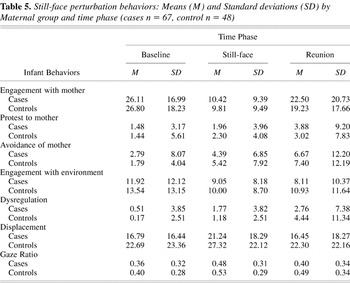
Many of the infants in the study showed the following characteristic pattern: a diminution in initial high baseline levels of engagement with mother over the period of the Still-face, associated with increasing levels of protest to, and avoidance of, the mother as the perturbation proceeded. In the reunion phase there was only a partial resumption of these behaviors to their baseline levels (see Table 5 for means and standard deviations of Still-face outcome measures by maternal group).
Still-face perturbation behaviors: Means (M) and Standard deviations (SD) by Maternal group and time phase (cases n = 67, control n = 48)

Initial exploration of the data revealed that all behaviors were normally distributed, with the exception of behavioral dysregulation. The latter was relatively infrequent and negatively skewed. Its distribution was normalized by means of the addition of a small constant (0.1) and subsequent logistic transformation. The data were analyzed over the three time points, reflecting baseline, and subsequent Still-face and reunion phases.
The data analysis proceeded as follows. First, main effects of postnatal depression, infant gender, and social class were examined, and the interactions of infant gender and social class with postnatal depression were subsequently added to test for moderating effects. Second, main effects of measures of contingent positive and negative maternal responsiveness, infant gender and social class were examined, and the interactions of infant gender and social class with measures of contingent positive and negative maternal responsiveness were subsequently added to test for moderating effects.
Both models were tested using repeated measures ANOVA with the following categorical measures: maternal depression status (4), infant gender (2), social class (2), and continuous covariates: contingent positive and negative maternal responsiveness as independent variables, and time phase as the repeated measure. Deviations of infant behavior from baseline values served as dependent measures.
There were no effects of maternal depression, infant gender, or social class on any of the Still-face infant behavioral outcome measures, nor were there any interactions. Similarly, there were no effects of contingent positive or negative maternal responsiveness for any of the Still-face infant behavioral outcome measures, nor were there any interactions.
Instrumental Learning assessment
Analysis
Due to technical difficulties, the equipment was not available for two periods during the project. Accordingly, 21 of the 74 depressed (28%) and 8 of the 50 control group infants (16%) were not assessed on this measure. Although the procedure was attempted in the remainder, the infant was either too irritable or too underaroused to complete the assessment adequately in 26 of the 53 depressed (49%) and 21 of the 42 control group infants (50%). Thus, the data analysis was restricted to the remaining 27 cases and 21 controls. This level of task noncompletion is not atypical of many experimental studies involving young infants (Oates, 1998). Those infants who failed to complete the assessment did not differ from those who did on the variables of maternal group, infant sex, social class, age at time of assessment, or degree of maternal responsiveness at 2 months.
Infants were assessed at a mean age of 93 days (SD = 6.4); the timing of the procedure did not differ significantly between index and control groups.
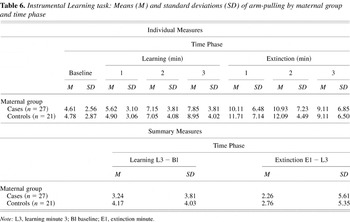
The dependent measure, rate of arm-pulling, conformed to a normal distribution and thus did not require transformation (means and standard deviations of instrumental outcome measures by maternal group status at each individual time point are shown in Table 6).
Instrumental Learning task: Means (M) and standard deviations (SD) of arm-pulling by maternal group and time phase

Two summary measures were examined: the overall learning effect and the extinction effect. The analyses followed the same plan as that outlined for the Still-face assessment (see above). First, main effects of postnatal depression, infant gender, and social class were examined, and the interactions of infant gender and social class with postnatal depression were subsequently added to test for moderating effects. Second, main effects of measures of contingent positive and negative maternal responsiveness, infant gender and social class were examined, and the interactions of infant gender and social class with measures of contingent positive and negative maternal responsiveness were subsequently added to test for moderating effects.
Both models were tested using ANOVA with the following categorical measures: maternal depression status (2), infant gender (2), social class (2), and continuous covariates: positive and negative contingent maternal responsiveness as independent variables. The summary measures of learning (L3–Bl) and extinction (E1–L3) served as the dependent variables. Only the binary (case vs. control) categorization of maternal depression status was used in these analyses, in view of the lower numbers of infants available for testing.
There were no effects of maternal depression, infant gender, or social class on either infant learning or extinction, nor were there any interactions. However, there was a significant main effect of contingent positive maternal responsiveness on infant learning, F (1, 47) = 4.63, p < .04. Thus, infants who had a past history of more contingent positive maternal responsiveness learned to recognize the experimental contingency more efficiently than did infants who had experienced less contingent positive maternal responsiveness. However, there was no complementary main effect for the summary extinction measure, nor were there any main effects of contingent negative maternal responsiveness to infant behavior on either of the dependent measures. Finally, there was no maternal responsiveness by infant gender or social class interactions.
Discussion
The current study had a number of important strengths. First, the use of a relatively large, representative, community sample, with maternal depression diagnosed by clinical interview, repeated over three time points, which allows the potential effects of chronicity of depression to be identified. Second, the use of rigorously defined measures of contingency based on both lower order quantitative (temporal) and higher order, qualitative (emotional state matching) variables. Third, the selection of developmentally appropriate outcome measures that allowed a direct examination of whether contingency of maternal responsiveness mediated any potential effects of maternal depression on infant outcome. Fourth, low rates of subject attrition throughout the course of the study.
The key finding of the current study was that maternal postnatal depression was associated with a disturbance of mother–infant interaction in a representative community sample at relatively low risk for psychosocial adversity. There was also evidence that the deficits in maternal responsiveness, characteristic of depressed mothers, were predictive of poor operant learning in the infant. However, direct links between maternal depression and infant learning, and response to the Still-face perturbation at 3 months postpartum were not evident, irrespective of the chronicity of the disorder.
The findings that the depressed group mothers showed less contingent positive responsiveness, and more contingent negative responsiveness, to their infants replicates those of Murray, Fiori–Cowley, et al. (1996). Together, these studies highlight the fact, therefore, that it may be necessary to incorporate higher order, psychological concepts in the conceptualization of contingency, as well as the more basic, temporal aspects. Indeed, while a lack of purely temporal contingent responsiveness in depressed mothers has been reported in one study (Cohn et al., 1986), a later community study of face to face interaction in the context of postnatal depression suggested, as did the current study, that depressed mothers differed from controls in their quality of affective expression, but not in the temporally contingent relationship between the maternal and infant behavior at 2 months (Cohn et al., 1990).
The results of the Instrumental Learning assessment revealed that infants of mothers who exhibited a high degree of contingent maternal positive responsiveness to their behavior showed a more substantial learning increment between the baseline phase and the end of the learning phase, than infants without this history. This indicates that everyday experience of social contingency, at a time when the infant has very little control over goal directed motor movement, facilitates the later learning of contingent relationships in the physical environment. In view of the small numbers of infants tested, this finding should be regarded as preliminary. Nevertheless, it is of significance in that it extends the previous findings of concurrent associations between adult social contingency and both infant efficiency in processing repeated signal information on an experimental task in the study of Lewis and Goldberg (1969) and on an Instrumental Learning task in the study of Dunham et al. (1990).
Unlike the findings for the Instrumental Learning task, the hypothesis that maternal responsiveness to infant behavior at 2 months postpartum would predict the infant's behavior during the Still-face perturbation at 3 months postpartum was not confirmed. Thus, infants with a history of poor contingent maternal positive responsiveness to their behavior did not show a more dysregulated response to the perturbation than infants without this history, and they did not show less evidence of either continuing to try to engage with their mother or engaging with the environment.
Indeed, the majority of the infants of mothers who had postnatal depression, including those who were not positively responsive, were able to negotiate all phases of the Still-face perturbation with impressive behavioral organization, showing a clear motivation to keep in emotional contact with their mother in the early stages of the Still-face phase, without becoming disengaged or disorganized in the later stages of the Still-face perturbation. They were also able to contribute to reestablishing the interaction when their mothers became available again on reunion.
It is of note that the duration of maternal depressive illness did not appear to differentially affect the quality of mother–infant interaction at 2 months or infant outcome in the Still-face assessment at 3 months postpartum. The former finding is at variance with the Pittsburgh study on a similarly low risk community sample (Campbell et al., 1995; Campbell & Cohn, 1997) which suggested that only women with protracted depressions lasting through to 6 months postpartum were less positive in interaction with their infants. Nevertheless, our own results are consistent with the finding of the Pittsburgh group that maternal postnatal depression does not determine infant behavioral response to the Still-face assessment (Moore, Cohn, & Campbell, 2001).
Several possible explanations may exist for the relative absence of significant differences between depressed and control group profiles during the Still-face perturbation.
First, it is possible that the Still-face perturbation, being relatively brief, was not powerful enough to challenge infant expectations. In the present study, the Still-face phase of the experiment lasted only 90 s, while other studies using 3-min perturbations have reported more extreme responses (Mayes & Carter, 1990; Tronick et al., 1978).
Second, it is possible that the differences in infant emotionality, reactivity and self regulation observed in the Still-face perturbation reflect constitutionally determined differences in temperament, rather than being determined by prior relationship history (Braungart–Rieker, Murphy–Garwood, Powers, & Notaro, 1998). Indeed, such dimensions of infant behavior form part of some influential operational definitions of infant temperament (Buss & Plomin, 1984; Rothbart & Derryberry, 1981).
Third, despite its impressive face validity, the Still-face perturbation has been little used as a psychometric instrument. Rather, it has been deployed as a specialized research tool. Thus, although a recent study of Moore et al. (2001) did report stable individual differences in infant gazing away and in rates of negative affect over a 4-month time period, the stability of behavioral reaction style to the perturbation in the same infant over time or conversational partner has not been consistently demonstrated (Braungart–Rieker et al., 1998), and there are only a few reports of its predictive validity in respect of later child developmental outcome (Cohn, Campbell, & Ross, 1993; Kogan & Carter, 1996; Moore, Cohn, & Campbell, 2001). It may, therefore, fail to access reliably the infant's social expectations in the manner ascribed to it.
Fourth, it is possible that behavioral development is primarily determined by the unfolding of a species-specific biological process at 3 months postpartum, with the result that the care-giving environment would need to be particularly disturbed to deflect the infant away from a normal developmental trajectory. In the current study, the characteristics of the population may account for this minimum level rarely being breached because, although the sample contained a number of socially deprived families, the stable social structure of the study region militated against finding the extreme forms of isolation and socioeconomic adversity that occurs in major urban centers (Brown & Harris, 1978). It is of note that the Pittsburgh study of the effect of postnatal depression on infant development, using a study population at similarly low psychosocial risk, found no difference between case and control infants, with the exception of those where the mothers had experienced protracted depressions lasting through to 6 months (Campbell et al., 1995; Campbell & Cohn, 1997). Similarly, in the study by Murray, Fiori–Cowley, and colleagues (1996), also conducted with a low risk population, no overall differences in infant behavior between index and control groups were evident at two months, despite significant differences in maternal responsiveness of a similar nature to those found in the present study. Such findings stand in marked contrast to those reported for dyads drawn either from self-referred, clinical cohorts (Teti & Gelfand, 1991), or populations at high psychosocial risk (Cohn et al., 1986; Field, 1984). A number of other factors have been shown to be associated with insensitive parenting and adverse child outcome, including marital disharmony, lack of social support, and socioeconomic disadvantage (such as housing problems and poverty). These factors are typically much less prevalent in a low risk sample, such as in this study. The absence of disadvantage and the presence of social support, including other caretakers, has the potential to buffer the adverse effects of maternal postnatal depression, and may explain the lack of effects of postnatal depression on the infant Still-face behavior in this sample.
The absence of significant differences between index and control groups on the Instrumental Learning task at 3 months in terms of rates of arm-pulling during baseline, learning and extinction phases is perhaps somewhat surprising, given the consistent reports of poor performance of depressed group infants on cognitive tasks at later ages (Coghill et al., 1986; Hay et al., 2001; Murray, 1992; Sharpe et al., 1995). This was particularly so in the present study, in view of the finding that a reduction of prior maternal responsiveness, clearly more evident among women with postnatal depression, did have a deleterious effect on infant learning. In fact, Murray and colleagues (Murray et al., 1993; Murray, Hipwell, et al., 1996) did find that the quality of maternal communication with the infant measured at 2 months, and particularly the focus of speech, mediated the association between depression and infant cognitive development at 9 and 18 months on object concept tasks and the Bayley scales. Some authors (Hay, 1997; Hay et al., 2001; Murray et al., 1993; Murray, Hipwell, et al., 1996) have explicitly invoked a low contingency of maternal response to infant behavior as a possible causal mechanism in the genesis of later cognitive deficits. However, in contrast to the present study, previous longitudinal studies of postnatal depression have not included an assessment of infant performance on tasks that actually measure the ability to learn and extinguish contingent associations.
Again, there are several possible explanations for the absence of significant differences between depressed and control infants on the Instrumental Learning task. First, although level of subject attrition was not unusual in an experimental study of this type (Oates, 1998), the rate of completed assessments was rather low (approximately 50%), and the number of infants in the two groups may have been too small to identify the critical effects reliably. Furthermore, although the infants who failed to complete the task did not differ systematically from those who were able to complete the assessment on crucial independent variables of maternal group, gender, and social class, it is plausible to suggest that noncompleting infants may have been more likely to fail because behavior in the Instrumental Learning task is associated with other, more subtle dimensions of maternal functioning that discriminate between depressed and control mothers. Thus, Oates (1998) found that infants whose mothers failed to identify with the fetus early in pregnancy, and who showed impoverished attributions of emotion to the infant in the first few postpartum weeks, were significantly more likely to fail to complete habituation tasks than other infants. Social class, by contrast, failed to relate to these measures of infant outcome.
Second, it is possible that in the current study, postnatal depression, and the associated disruption to maternal responsiveness, did not provide a deviant enough caregiving environment to affect infant development adversely at this age. In contrast, a much more extreme disruption of development, infant vulnerability related to maternal cocaine addiction, which has as etiological components both neurobiological risk to the infant, and the likelihood of substandard maternal care, has predicted infant performance on such tasks in a previous study (Alessandri et al., 1993).
In conclusion, the results of this study suggest that depressed mother–infant interactions in a low risk community sample are less optimal than those exhibited by well mother–infant dyads. However, although a prior history of reduced maternal responsiveness does predict aspects of infant performance on a task that might be expected to index early infant cognitive development, maternal depression showed no direct association with adverse infant outcomes on a learning task or on response to the Still-face perturbation.
References
REFERENCES
Ainsworth, M. D.,
Blehar, M. C.,
Waters, E., &
Wall, S.
(1978).
Patterns of attachment: A psychological study of the Strange
Situation.
Hillsdale, NJ:
Erlbaum.
Alessandri, S. M.,
Sullivan, M. W.,
Imaizumi, S., &
Lewis, M.
(1993).
Learning and emotional responsivity in cocaine exposed infants.
Developmental Psychology
29,
989–997.Google Scholar
Alessandri, S. M.,
Sullivan, M. W., &
Lewis, M.
(1990).
Violation expectancy and frustration in early infancy.
Developmental Psychology
26,
738–744.Google Scholar
Bigelow, A. E.,
MacLean, B. K., &
MacDonald, D.
(1996).
Infants' response to live and replay interactions with self
and mother.
Merrill–Palmer Quarterly
42,
596–611.Google Scholar
Bornstein, M. H., &
Tamis–LeMonda, C. E.
(1989).
Maternal responsiveness and cognitive development in children. In
M. H. Bornstein (Ed.),
Maternal responsiveness: Characteristics and consequences.
San Francisco, CA:
Jossey–Bass.
Bornstein, M. H., &
Tamis–LeMonda, C. E.
(1997).
Maternal responsiveness and infant mental abilities: Specific
predictive relations.
Infant Behavior and Development
20,
283–296.Google Scholar
Braungart–Rieker, J.,
Murphy–Garwood, M.,
Powers, B. P., &
Notaro, P. C.
(1998).
Infant affect and affect regulation during the Still-face paradigm
with mothers and fathers: The role of infant characteristics and
parental sensitivity,
Developmental Psychology
34,
1428–1437.Google Scholar
Brown, G. W., &
Harris, T.
(1978).
Social origins of depression: A study of psychiatric disorder in
women.
New York:
Free Press.
Buss, A. M., &
Plomin, R.
(1984).
Temperament: Early developing personality traits.
Hillsdale, NJ:
Erlbaum.
Campbell, S. B., &
Cohn, J. F.
(1997).
The timing and chronicity of postpartum depression: Implications
for infant development. In
L. Murray &
P. J. Cooper (Eds.),
Postpartum depression and child development.
New York:
Guilford Press.
Campbell, S. B.,
Cohn, J. F., &
Meyers, T.
(1995).
Depression in first time mothers: Mother–infant interaction
and depression chronicity.
Developmental Psychology
31,
349–357.Google Scholar
Cicchetti, D., &
Cohen, D. J.
(1995).
Introduction. In
D. Cicchetti &
D. J. Cohen (Eds.),
Developmental psychopathology: Vol. 1. Theory and methods.
New York:
Wiley.
Coates, D. L., &
Lewis, M.
(1984).
Early mother–infant interaction and infant cognitive status
as predictors of school performance and cognitive behavior in
six-year-olds.
Child Development
55,
1219–1230.Google Scholar
Coghill, S. R.,
Caplan, H. L.,
Alexandra, H.,
Robson, K. M., &
Kumar, R.
(1986).
Impact of postnatal depression on cognitive development in young
children.
British Medical Journal
292,
1165–1167.Google Scholar
Cohn, J. F.,
Campbell, S. B., &
Ross, S.
(1993).
Infant response in the Still-face paradigm at 6 months predicts
avoidant and secure attachment at 12 months.
Development and Psychopathology
3,
367–376.Google Scholar
Cohn, J. F.,
Matias, R.,
Campbell, S. B., &
Hopkins, J.
(1990).
Face to face interactions of postpartum depressed
mother–infant pairs at 2 months.
Developmental Psychology
26,
15–23.Google Scholar
Cohn, J. F.,
Matias, R.,
Tronick, E. Z.,
Connell, D., &
Lyons–Ruth, K.
(1986).
Face to face interactions of depressed mothers and their infants.
In
E. Tronick &
T. Field (Eds.),
New directions for child development: No 34. Maternal depression
and infant disturbance (pp.
31–41).
San Francisco, CA:
Jossey–Bass.
Cohn, J. F., &
Tronick, E. Z.
(1983).
Three-month old infants' reaction to simulated maternal
depression.
Child Development
54,
185–193.Google Scholar
Cohn, J. F., &
Tronick, E. Z.
(1987).
Mother–infant face-to-face interaction: The sequence of
dyadic states at 3, 6, and 9 months.
Developmental Psychology
23,
68–77.Google Scholar
Cohn, J. F., &
Tronick, E. Z.
(1989).
Specificity of infants' response to mothers' affective
behaviour.
Journal of the American Academy of Child and Adolescent Psychiatry
28,
242–248.Google Scholar
Cox, J. L.,
Holden, J. M., &
Sagovsky, R.
(1987).
Detection of postnatal depression: Development of the 10-item
Edinburgh Postnatal Depression Scale.
British Journal of Psychiatry
150,
782–786.Google Scholar
Field, T. F.
(1984).
Early interactions between infants and their postpartum depressed
mothers.
Infant Behavior and Development
7,
517–522.Google Scholar
Field, T. F.,
Healy, B.,
Goldstein, S., &
Guthertz, M.
(1990).
Behavior-state matching and synchrony in mother–infant
interactions of nondepressed versus depressed dyads.
Developmental Psychology
26,
7–14.Google Scholar
Field, T. F.,
Healy, B.,
Goldstein, S.,
Perry, S.,
Bendell, D.,
Schanberg, S.,
Zimmerman, E., &
Kuhn, C.
(1988).
Infants of depressed mothers show “depressed” behavior
even with non-depressed adults.
Child Development
59,
1569–1579.Google Scholar
Field, T. F.,
Vega–Lahr, N.,
Scafidi, F., &
Goldstein, S.
(1986).
Effects of maternal unavailability on mother–infant
interactions.
Infant Behavior and Development
9,
473–478.Google Scholar
Fonagy, P.,
Steele, M.,
Steele, H.,
Higgitt, A., &
Target, M.
(1994).
The Emmanual Millar Memorial Lecture, 1992: The theory and practice
of resilience.
Journal of Child Psychology and Psychiatry
35,
231–257.Google Scholar
Goodman, S. H., &
Gotlib, I. H.
(1999).
Risk for psychopathology in the children of depressed mothers: A
developmental model for understanding mechanisms of transmission.
Psychological Review
106,
458–470.Google Scholar
Gunnar, M. R.
(1980).
Control, warning signals, and distress in infancy.
Child Development
16,
281–289.Google Scholar
Gusella, J. L.,
Muir, D. W., &
Tronick, E. Z.
(1988).
The effect of manipulating maternal behaviour during an interaction
on 3 and 6 month olds' affect and attention.
Child Development
59,
1111–1124.Google Scholar
Hains, S. M. J., &
Muir, D. W.
(1996).
Effects of stimulus contingency in infant-adult interactions.
Infant Behavior and Development
19,
49–61.Google Scholar
Hay, D. F.
(1997).
Postpartum depression and cognitive development. In
L. Murray &
P. J. Cooper (Eds.),
Postpartum depression and child development.
New York:
Guilford Press.
Hay, D. F., &
Kumar, R.
(1995).
Interpreting the effects of mothers' postnatal depression on
children's intelligence: A critique and reanalysis.
Child Psychiatry and Human Development
25,
165–181.Google Scholar
Hay, D. F.,
Pawlby, S.,
Sharpe, D.,
Asten, P.,
Mills, A., &
Kumar, R.
(2001).
Intellectual problems shown by 11-year-old children whose mothers
had postnatal depression.
Journal of Child Psychology and Psychiatry
42,
871–889.Google Scholar
Kochanska, G.
(1994).
Beyond cognition: Expanding the search for the early roots of
internalization and conscience.
Developmental Psychology
30,
20–33.Google Scholar
Kogan, N., &
Carter, A. S.
(1996).
Mother–infant re-engagement following the Still-face: The
role of maternal emotional availability in infant affect
regulation.
Infant Behavior and Development
19,
359–370.Google Scholar
Kopp, C. B.
(1982).
Antecedents of self-regulation: A developmental perspective.
Developmental Psychology
18,
199–214.Google Scholar
Lewis, M.
(1993).
Early socioemotional predictors of cognitive competence at 4 years.
Developmental Psychology
29,
1036–1045.Google Scholar
Lewis, M.,
Alessandri, S. M., &
Sullivan, M. W.
(1990).
Violation of expectancy, loss of control and anger expressions in
young infants.
Developmental Psychology
26,
745–751.Google Scholar
Lewis, M., &
Brooks–Gunn, J.
(1979).
Social cognition and the aquisition of self.
New York:
Plenum Press.
Lewis, M., &
Goldberg, S.
(1969).
Perceptual–cognitive development in infancy: A generalized
expectancy model as a function of mother–infant interaction.
Merrill–Palmer Quarterly
3,
307–316.Google Scholar
Lovejoy, C. M.,
Graczyk, P. A.,
O'Hare, E., &
Neuman, G.
(2000).
Maternal depression and parenting behaviour: A meta-analysis
review.
Clinical Psychology Review
20,
561–592.Google Scholar
Lyons–Ruth, K.,
Zoll, D.,
Connell, D., &
Grunebaum, H. U.
(1986).
The depressed mother and her one-year-old infant: Environment,
interaction, attachment and infant development. In
E. Z. Tronick &
T. Field (Eds.),
Maternal depression and infant disturbance.
San Francisco, CA:
Jossey–Bass.
Maccoby, E., &
Martin, J. A.
(1983).
Socialization in the context of the family: Parent–child
interactions. In
P. H. Mussen &
E. M. Hetherington (Eds.),
Handbook of child psychology: Vol. 4. Socialization, personality,
and social development
(4th ed.).
New York:
Wiley.
Mayes, L. C., &
Carter, A. C.
(1990).
Emerging social-regulatory capacities as seen in the still face
situation.
Child Development
61,
754–763.Google Scholar
Moore, G. A.,
Cohn, J. F., &
Campbell, S. B.
(2001).
Infant affective responses to mother's still face at 6 months
differentially predicts externalizing and internalizing behaviors at 18
months.
Developmental Psychology
37,
706–714.Google Scholar
Murray, L.
(1980).
The sensitivities and expressive capacities of young infants in
communication with their mothers.
Unpublished doctoral dissertation,
University of Edinburgh.
Murray, L.
(1992).
The impact of postnatal depression on infant development.
Journal of Child Psychology and Psychiatry
33,
543–561.Google Scholar
Murray, L., &
Carothers, A.
(1990).
The validation of the Edinburgh Post-natal Depression Scale on a
community sample.
British Journal of Psychiatry
157,
288–290.Google Scholar
Murray, L., &
Cooper, P. J.
(2003).
Intergenerational transmission of affective and cognitive
processes associated with depression: Infancy and the pre-school
years. In
I. M. Goodyer (Ed.),
Unipolar depression: A lifetime perspective.
New York:
Oxford University Press.
Murray, L.,
Fiori–Cowley, A.,
Hooper, R., &
Cooper, P. J.
(1996).
The impact of postnatal depression and associated adversity on
early mother–infant interactions and later child outcome.
Child Development
67,
2512–2526.Google Scholar
Murray, L.,
Hipwell, A.,
Hooper, R.,
Stein, A., &
Cooper, P. J.
(1996).
The cognitive development of five year old children of postnatally
depressed mothers.
Journal of Child Psychology and Psychiatry
37,
927–936.Google Scholar
Murray, L.,
Kempton, C.,
Woogar, R., &
Hooper, R.
(1993).
Depressed mothers' speech to their infants and its relation to
infant gender and cognitive development.
Journal of Child Psychology and Psychiatry
34,
1083–1101.Google Scholar
Murray, L., &
Trevarthen, C.
(1985).
Emotional regulation of interactions between 2 month olds and
their mothers. In
T. M. Field &
N. A. Fox (Eds.),
Social perception in infants.
Norwood, NJ:
Ablex.
Oates, J.
(1998).
Risk factors for infant attrition and low engagement in experiments
and free play.
Infant Behavior and Development
21,
555–569.Google Scholar
Rothbart, M. K., &
Derryberry, D.
(1981).
Development of individual differences in temperament. In
M. E. Lamb &
A. L. Brown (Eds.),
Advances in developmental psychology
(Vol. 1).
Hillsdale, NJ:
Erlbaum.
Rovee–Collier, C.
(1995).
Time windows in cognitive development.
Developmental Psychology
31,
147–169.Google Scholar
Rutter, M.
(1966).
Children of sick parents.
Oxford:
Oxford University Press.
Rutter, M.
(1997).
Maternal depression and infant development: Cause and consequence;
sensitivity and specificity. In
L. Murray &
P. J. Cooper (Eds.),
Postpartum depression and child development.
New York:
Guilford Press.
Segel, L. B.,
Oster, H.,
Cohn, M.,
Capsi, B.,
Myers, M., &
Brown, D.
(1996).
Smiling and fussing in seven month old pre-term and full-term black
infants in the Still-face situation.
Child Development
66,
1829–1843.Google Scholar
Sharpe, D.,
Hay, D. F.,
Pawlby, S.,
Schucker, G.,
Allen, H., &
Kumar, R.
(1995).
The impact of postnatal depression on boys' intellectual
development.
Journal of Child Psychology and Psychiatry
36,
1315–1333.Google Scholar
Sinclair, D., &
Murray, L.
(1998).
Teacher reports of adjustment to school of postnatally depressed
and well mothers' children.
British Journal of Psychiatry
172,
1315–1337.Google Scholar
Spitzer, R. L.,
Endicott, J., &
Robbins, E.
(1978).
Research diagnostic criteria: Rationale and reliability.
Archives of General Psychiatry
35,
773–782.Google Scholar
Spitzer, R. L.,
Williams, B. W.,
Gibbon, M., &
First, M. B.
(1990).
Structured clinical interview for DSM-III-R, nonpatient edition.
Arlington, VA:
American Psychiatric Press.
Stein, A.,
Gath, D. H.,
Butcher, J.,
Bond, A.,
Day, A., &
Cooper, P. J.
(1991).
The relationship between postnatal depression and
mother–child interaction.
British Journal of Psychiatry
158,
46–52.Google Scholar
Stern, D. N.
(1985).
The interpersonal world of the infant.
New York:
Basic Books.
Teti, D. M., &
Gelfand, D. M.
(1991).
Behavioural competence among mothers of infants in the first year:
The mediational role of maternal self-efficacy.
Child Development
62,
918–929.Google Scholar
Teti, D. M.,
Gelfand, D. M.,
Messinger, D. S., &
Isabella, R.
(1995).
Maternal depression and the quality of early attachment: An
examination of infants, preschoolers and their mothers.
Developmental Psychology
31,
364–376.Google Scholar
Toda, S., &
Fogel, A.
(1993).
Infant response to the Still-face situation at 3 and 6 months.
Developmental Psychology
29,
532–538.Google Scholar
Trevarthen, C.,
Murray, L., &
Hubley, P. A.
(1981).
Psychology of infants. In
J. A. Davis &
J. Dobbing (Eds.),
Scientific foundations of paediatrics
(2nd ed.).
London:
Heinemann.
Tronick, E. Z.,
Als, H.,
Adamson, L.,
Wise, S., &
Brazelton, T. B.
(1978).
The infants' response to entrapment between contradictory
messages in face to face interaction.
Journal of the American Academy of Child Psychiatry
17,
1–13.Google Scholar
UK Registrar General Office of Population Census and
Surveys. (OPCS).
(1980).
Classification of occupations.
London:
HMSO.
Watson, J. S.
(1979).
Perception of contingency as a determinant of social
responsiveness. In
E. B. Thoman (Ed.),
Origins of the infant's social responsiveness.
Hillsdale, NJ:
Erlbaum.
Weinberg, M. K., &
Tronick, E. Z.
(1996).
Infant affective reactions to the resumption of maternal
interaction after the Still-face.
Child Development
67,
905–914.Google Scholar
Means (M) and standard deviations (SD) of maternal and infant characteristics by maternal group status
Infant behaviors and definitions of maternal behaviors in face to face interaction coding system
Definitions of Still-face coding categories
Means (M) and standard deviations (SD) of 2-month interaction outcome measures by Maternal group
Still-face perturbation behaviors: Means (M) and Standard deviations (SD) by Maternal group and time phase (cases n = 67, control n = 48)
Instrumental Learning task: Means (M) and standard deviations (SD) of arm-pulling by maternal group and time phase
 You have
Access
- 121
- Cited by