Antibiotic resistance is one of the greatest public health concerns of our era, causing at least 2.8 million antibiotic-resistant infections and 35,000 deaths annually in the United States.1 The mortality rate due to infections with antimicrobial-resistant organisms is projected to surpass that of cancer by the year 2050.2 It is estimated that at least 30% of outpatient antibiotic prescriptions in the United States are unnecessary,Reference Fleming-Dutra, Hersh and Shapiro3 and ~50% of the time, non–first-line agents are used for some of the most common conditions.Reference Hersh, Fleming-Dutra, Shapiro, Hyun and Hicks4 Although >60% of antibiotic expenditures occur in the outpatient setting nationallyReference Suda, Hicks, Roberts, Hunkler and Danziger5 and many studies have shown a correlation between outpatient antibiotic use and the emergence of multidrug-resistant organisms,Reference Klepser, Dobson and Pogue6 these data have never been formally summarized in Virginia. Currently there is a paucity of data for outpatient antibiotic prescribing for urinary tract infections (UTIs) in Virginia. Understanding current outpatient prescribing trends will allow us to identify opportunities for improved prescribing and help reduce inappropriate antibiotic use to minimize harm. In this study, we sought to describe outpatient antibiotic prescribing trends for UTIs based on gender, age, geographic region, insurance payer and International Classification of Disease, Tenth Revision (ICD-10) codes in Virginia.
Methods
The Virginia All-Payer Claims Database (APCD), a program run by the Virginia Department of Health which collects paid medical claims for Virginia residents with Medicare, Medicaid, and commercial insurance was used.7 The study cohort included Virginia residents who had a primary diagnosis of UTI, had an antibiotic claim 0–3 days after the date of the diagnosis and were seen in an outpatient facility in Virginia between January 1, 2016, and December 31, 2016. A diagnosis of UTI was defined using ICD-10 codes N30.0, N30.00, N30.01, N30.9, N30.90, N30.91, N39.0, N34.1, N34.2, N10, and was categorized as cystitis, urethritis, or pyelonephritis. Antibiotic claims data included aminoglycosides, sulfamethoxazole/trimethoprim, cephalosporins, fluoroquinolones, macrolides, penicillins, tetracyclines, and nitrofurantoin. Patients were categorized based on gender, age, location, and payer type. Exclusion criteria included patients receiving antibiotics in observation and radiology units in hospitals. In addition, only the first visit of each patient with a diagnosis of UTI was included in the study, and any subsequent repeat visits were excluded.
We used χ2 and Cochran-Mantel-Haenszel testing for statistical analyses. Analyses were performed using SAS version 9.4 software (SAS Institute, Cary, North Carolina).
Results
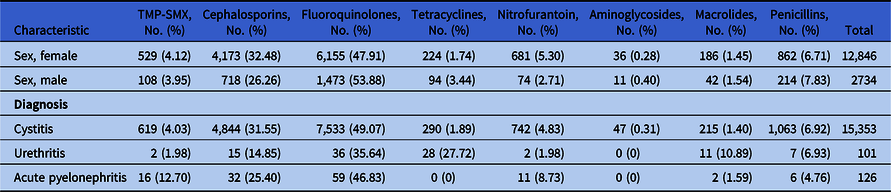
In total, 15,580 patients were included in this study. Antimicrobials prescribed stratified by gender and diagnosis are summarized in Table 1. Prescriptions for antibiotics by drug class differed significantly (P < .0001 for all categories) by gender, age, geographic region, insurance payer, and UTI type. Patients aged ≥65 years were prescribed fluoroquinolones most frequently (5,112 of 8,955, 57.09%), whereas those aged <20 years were prescribed cephalosporins the most (996 of 1,474, 67.57%). In Northern Virginia, cephalosporins were the most frequently prescribed antibiotics (557 of 1,308, 42.58%), but in the Eastern (1,677 of 3,304, 50.76%), Central (1,499 of 3,290, 45.56%), Northwest (1,910 of 3,513, 54.37%) and Southwest (2,081 of 4,165, 49.96%) regions of Virginia, fluoroquinolones were prescribed most often. Patients with commercial health insurance, Medicaid and Medicare were prescribed fluoroquinolones (1,149 of 2,923, 39.31%), cephalosporins (1,326 of 2,354, 56.33%), and fluoroquinolones (5,910 of 10,303, 57.36%) most frequently, respectively.
Antimicrobials Prescribed by Gender and Diagnosis Type

Note. TMP-SMX, sulfamethoxazole/trimethoprim.
Discussion
Antibiotic prescribing trends for UTIs varied by gender, age, geographic region, payer status, and UTI type in the state of Virginia. Based on local antibiotic resistance, we suspected that fluoroquinolones are overprescribed based on our analysis. According to the 2017 Virginia urine cumulative antibiogram,8 the susceptibilities of Escherichia coli, Klebsiella pneumoniae, and Pseudomonas aeruginosa to ciprofloxacin were 77%, 95%, and 80%, respectively, and the susceptibilities to levofloxacin were 76%, 95%, and 78%, respectively. Fluoroquinolones represent an attractive target for statewide stewardship efforts.
This study has several limitations. First, this cohort included only insured patients because we used insurance claims to identify patients who met our inclusion criteria; therefore, the results may not be generalizable to the entire Virginia population. Second, instances that individuals chose to pay out-of-pocket were not included and therefore, our data might underestimate overall outpatient antibiotic prescribing.
In conclusion, this is the first systematic description of outpatient antibiotic prescribing trends for UTIs in the state of Virginia. Our analysis revealed that antibiotic prescribing trends for UTIs varied by gender, age, geographic region, payer status, and UTI type in the state of Virginia. Fluoroquinolone use was high, especially in older adults. These data will inform statewide stewardship efforts.
Acknowledgments
Financial support
No financial support was provided relevant to this article.
Conflicts of interest
All authors report no conflicts of interest relevant to this article.