INTRODUCTION
Diseases in fish are an important issue throughout the world, especially where fishing and aquaculture are better developed (Fonseca, Reference Fonseca2003), because they may cause the loss of natural stocks. According to this, parasitism in fish has been frequently assumed to be an indicator of environmental health, and therefore, an essential complement for the development of aquaculture and the environmental balance in marine ecosystems. A number of parasites use a complex interaction web within their hosts' ecological chains and in that context are vulnerable to any alteration or disturbance noticed on their habitat, even before higher taxa can be affected.
Among marine fish parasites, nearly 25% are crustaceans, mainly represented by copepod, brachiura and isopod (Pavanelli et al., Reference Pavanelli, Eiras and Takemoto1998; Eiras et al., Reference Eiras, Takemoto and Pavanelli2000). Isopod crustaceans are part of the greatest fish ectoparasite group (Eiras et al., Reference Eiras, Takemoto and Pavanelli2000), and are easy to identify due to their size, morphological aspects and because they are easily found on the outer part of fish bodies, such as gill chambers and the mouth cavity (Eiras et al., Reference Eiras, Takemoto and Pavanelli2000; Thatcher, Reference Thatcher, Salgado-Maldonado, Aldrett and Vidal-Martinez2000).
The presence of these ectoparasites may affect these body parts, causing gill filament atrophy, removal of brachial arcs, and obstruction of the mouth cavity and thus destruction of the tongue, compromising the whole of the fish behaviour and leading, sometimes, to the death of the animal (Chavez-Lopez et al., Reference Chavez-Lopez, Rocha-Ramirez, Alvarez and Wetzer2005; Rhode, Reference Rhode2005).
The isopods belonging to the Cymothoidea family are parasitic on a large number of fish families as well as species, and most of these fish species are of considerable commercial importance in the tropical and subtropical regions (Horton & Keymer, Reference Horton and Keymer2003). The effects and infections deriving from these ectoparasites vary according to status and balance on the host–parasite relationships, where they can cause lesions ranging from low impact up to irreversible difficult situations resulting sometimes in the host's death, as above (Leonardos & Trilles, Reference Leonardos and Trilles2003).
These inter-specific interactions among parasites and fish are therefore common. However, studies discussing these associations remain scarce and when found they include a small number of species and localities. This paper aimed to discuss this parasitism association among isopod ectoparasites and some marine fish species, on the Brazilian north-eastern coast within an area of high ecological and commercial importance for the local fish industry.
MATERIALS AND METHODS
This study is part of the Cotegipe Port Terminal aquatic biota long term monitoring programme, and we conducted six ichthyofauna sample campaigns, between 2006 and 2009, covering the dry and wet seasons on four different sample points of the Cotegipe's Bay, on the coast of Bahia, Brazil. The bay located on the north-eastern portion of the Todos os Santos Bay, communicates with the latter one, through the Cotegipe narrow and winding channel.
On the bay's surroundings there are several development sites, such as: chemical industries, automotive and food fabrics and port complexes and transporting in general grains from agricultural production. There are also a considerable number of peninsulas containing areas of dense Atlantic forest vegetation cover, bare sand and pebble beach, sparsely vegetated mangrove and inlets subjected to tidal fluctuations.
The fish were collected using a long line fishing net measuring 150 m long and 2.50 m deep, with upper hoop floating apparatus, and mesh size measuring 20 mm, 30 mm and 35 mm, placed on the different sample points using a 36 feet boat, and harvesting the nets every two hours, through 12 hours of night samples. Four minow traps, were other sample techniques applied, using fresh fish meat as bait; the traps remained on sample points for 12 hours.
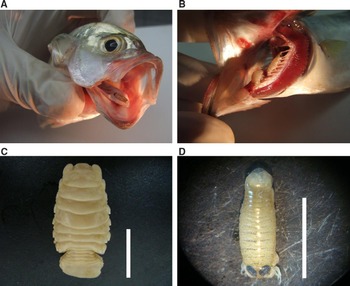
Following the capture of fish specimens, taxonomic identification and biometric registrations were made, using also the popular classification, and anamnesis techniques to search for parasites and other health threats (Figure 1A,B). After these procedures, material was then placed on isothermal containers. Isopods' parasites were removed using clamps and, therefore, placed on fixative solution with 70% ethanol, keeping track with the host identification number, body portion found, and then classified using identification keys (Thatcher, Reference Thatcher, Salgado-Maldonado, Aldrett and Vidal-Martinez2000).
(A) Isopod ectoparasite attached to a fish tongue; (B) gill's chamber showing attached isopods of the same species; (C) parasite Cymothoa spinipalpa appearance (scale 10 mm); (D) parasite Rocinela signata appearance (scale 5 mm) (photographs: G.F.de, Carvalho-Souza and R.C., Santos).

All the material was sent for taxonomic confirmation and deposit in the reference collection at the Ichthyology Laboratory at the State University of Feira de Santana—LIUEFS. The whole of the parasitological indices and calculations followed the equations proposed by Margolis et al. (Reference Margolis, Esch, Holmes, Kuris and Schad1982), with the revision of Bush et al. (Reference Bush, Laffehty, Lotz and Shostak1997). The Spearman correlation (BioEstat 5.0) was applied to test the association between the parasite incidence and the fish size. To test the difference between the number of infected fish among the seasons, and the difference between seasons, the non-parametric Wilcoxon (BioEstat 5.0) was applied.
RESULTS AND DISCUSSION
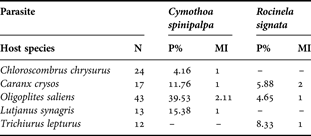
We found associations between five marine fish species' with isopods' ectoparasites as follows: jack, Chloroscombrus chrysurus (Linnaeus, 1766) (N = 24), blue runner, Caranx crysos (Mitchill, 1815) (N = 17), Castin leatherjacket, Oligoplites saliens (Bloch, 1793) (N = 43), lane snapper, Lutjanus synagris (Linnaeus, 1758) (N = 13) and largehead hairtail, Trichiurus lepturus (Linnaeus, 1758) (N = 12). Forty-six isopods' ectoparasites were found in association with these fish species. Isopods belong to two species: Cymothoa spinipalpa (Thatcher, Araújo, Lima & Chellapa, 2007) (Isopoda: Cymothoidea) with 41 specimens (Figure 1C) and Rocinela signata (Schioedte & Meinert, 1879) (Isopoda: Aegidae) with 5 specimens (Figure 1D), where, C. spinipalpa was found in four fish species (C. chrysurus, C. crysos, O. saliens and L. synagris), where, R. signata was found parasitizing C. crysos, O. saliens and T. lepturus (Table 1).
Prevalence (P%) and mean intensity (MI) of isopod Cymothoa spinipalpa and Rocinela signata ectoparasites on marine fish in the Cotegipe's Bay, north-eastern Brazil. N, number of examined fish.

Isopods' species presented fidelity to the attachment site in relation to the fish body portions, where they were found, and they occurred mostly in the mouth cavity and the gills chambers. This may happen because these portions of the fish body are better protected and also demonstrate a higher oxygen level and blood irrigation (Lima, Reference Lima2008). This behaviour occurred in all the marine fish species except for Chloroscombrus chrysurus which had its parasites removed from the head next to the nostril cavities.
The anamnesis showed that the places where parasites infected the individuals, presented a whitish colour and also small lesions in some of the fish specimens. On the gills' chambers, parasites may cause brachial circulation occlusion on blood flow, necrosis and tissue destruction causing pain and other secondary effects, whereas acting on the tegument and the muscles, lesions initially superficial, may trigger other secondary reactions such as other parasites' actions and infestations from other infectious microorganisms (Pavanelli et al., Reference Pavanelli, Eiras and Takemoto1998).
Therefore, the highest-prevalence index for C. spinipalpa was found in Oligoplites saliens with 39.53%, showing average incidence of 2.11 parasites per fish. The species showing the second highest prevalence was Lutjanus synagris with 15.3%, an average incidence of one parasite per fish, followed by Caranx crysos with 11.76% of prevalence, and the overall incidence of one parasite per fish, and with the lowest parasitological prevalence we had Chloroscombrus chrysurus with 4.1%, an average incidence of one parasite per fish. In relation to R. signata the highest prevalence was in Trichiurus lepturus with 8.33%, and average incidence of one parasite per fish, followed by Caranx crysos with prevalence of 5.88% and average incidence of two parasites per fish, and the species Oligoplites saliens with a 4.65% prevalence and average incidence of one parasite per fish (Table 1).
We found no difference between the host fish (Wilcoxon non-parametric—P = 0.250) and sampled seasons (Wilcoxon non-parametric—P = 0.120), and there was no evidence of parasite coexistence on the same individual or species (Oliva & Luque, Reference Oliva and Luque1998; Luque et al., Reference Luque, Muillot and Poulin2004). These results match other findings from the literature, where some studies of isopod parasites in other Brazilian coastal localities, showed that there were 75% prevalence of Livoneca redmanni in December and 44% for Rocinela signata in July for the host Scomberomorus brasiliensis (Lima et al., Reference Lima, Chellapa and Thatcher2005). Other studies found 20% for Cymothoa catarinensis for the host Menticirrhus litoralis and 13% for Cymothoa excisa for the host Micropogonias furnieri (Thatcher et al., Reference Thatcher, Silva and Jost2003a), and also the parasitism of Lironeca redmanni on Cetengraulis edentulus showed the prevalence of 17% (Thatcher et al., Reference Thatcher, Souza-Conceição and Jost2003b).
A significant relationship was found between fish size and isopod parasitism (P < 0.02, r = 0.67). These results suggest that Cymothoa spinipalpa and Rocinela signata showed a higher prevalence in hosts with a longer-body size, especially for individuals between 15 cm and 30 cm length. An ecological research on the metazoan parasites in Pagrus pagrus has also found a positive correlation between the prevalence of Cymothoa sp. and P. pagrus body size (Paraguassu et al., Reference Paraguassú, Luqye and Alves2002). The parasitic relationship among isopods and immature or young adult fish is possibly related to the higher body surface for parasite fixation, higher metabolic rates and more efficient protection against predation. Further studies may lead to hypothesis testing on the relationship of isopods selective behaviour on juvenile fish from species acting in this association.
Through these findings, we demonstrate that there is a high prevalence of the parasitism of C. spinipalpa and R. signata, as well as evidence that according to the size of hosts, these isopods parasitize throughout the life span of adult, young and immature fish.
This paper is the first record of parasitism from crustacean isopods Cymothoa spinipalpa and Rocinela signata as ectoparasites of five marine fish species: Chloroscombrus chrysurus, Caranx crysos, Oligoplites saliens, Lutjanus synagris and Trichiurus lepturus on the Cotegipe's Bay, coast of Bahia, north-eastern Brazil.
ACKNOWLEDGEMENTS
We thank the Lacerta Consultoria Projetos e Assessoria Ambiental Ltda. for the opportunity and logistic support given, the Cotegipe Port Terminal—TPC and M Dias Branco for financial support, Professor MSc Paulo R.D. Lopes and the Ichthyology Laboratory at the State University of Feira de Santana—LIUEFS, and the referees for their contributions to the manuscript.