Introduction
A gap exists between the discoveries generated in health by researchers and their filtration into clinical practice and the community at large. The transfer of research findings into actual clinical practice is a rather random process that may take years (Graham and Tetroe, Reference Graham and Tetroe2007). Around 30–45% of patients do not receive care supported by current scientific evidence and 20–25% of care provided may be unneeded or even harmful (Gaddis et al., Reference Gaddis, Greenwald and Huckson2007). There is no reason to believe that dementia care is any different; for example, in Germany it is estimated that only 20% of dementia patients are adequately treated (Vollmar et al., Reference Vollmar, Butzlaff, Lefering and Rieger2007). This review will examine the broad concept of knowledge translation and its application to the field of dementia.
Knowledge translation or knowledge transfer?
In health there is an increasing focus on the concepts of “knowledge translation” and “knowledge transfer” but the terminology is frequently confused with a long list of terms used (Tetroe et al., Reference Tetroe2008). Knowledge translation involves the dissemination, management and utilization of knowledge. It entails an exchange between researchers and those applying knowledge to reach consensus by blending new with existing knowledge. Knowledge transfer is one aspect of knowledge translation involving the active passing of knowledge from one person to another (Graham et al., Reference Graham2006).
Knowledge translation (KT) represents a shift from the traditional practice of researchers disseminating their findings within academic settings to the new paradigm of wide dissemination of findings ultimately to effect changes in community awareness, clinical practice and health policy. KT is more than providing information; it is transmitting skills and capabilities, and changing mindsets and workplace cultures to bring about change in practice (Graham et al., Reference Graham2006).
KT involves key players who interact with researchers in a large, complex and multidimensional network. These key players provide momentum for the process and communicate within and between groups.
Educators
KT in dementia starts with the education of students as future clinicians and researchers. Aged care suffers from a poor profile and undergraduates in health-related disciplines typically regard the field as low status (Fagerberg et al., Reference Fagerberg, Winblad and Ekman2000). Students on placement in residential care facilities felt poorly supported, found the behavior of residents disturbing, and reported the experience as confronting and frightening (Robinson and Cubit, Reference Robinson and Cubit2007). This can dissuade students away from aged care nursing since positive placement experiences are a key determinant of future attitudes and interests (Henderson et al., Reference Henderson, Happell and Martin2007).
Educators do not recognize their mentoring role in improving attitudes towards aged care nursing and that dementia should be included in curricula and linked to competencies (Xiao et al., Reference Xiao, Paterson, Henderson and Kelton2008). The coverage of dementia in pre-registration and pre-qualifying courses in the U.K. for nurses, occupational therapists and social workers is very variable (Pulsford et al., Reference Pulsford, Hope and Thompson2007). In geriatric nursing, dementia is one of the main areas of knowledge where gaps have been identified (Larson et al., Reference Larson, Chernoff and Sweet-Holp2004). Specific gaps include the management of behavioral disturbances in acute hospital (Henderson et al., Reference Henderson, Winch, Holzhauser and de Vries2006) and residential care settings (Hsu et al., Reference Hsu, Moyle, Creedy and Venturato2005).
Quality placement and experience working with good clinician role models in aged care are key KT educational tools (Xiao et al., Reference Xiao, Paterson, Henderson and Kelton2008). Stakeholders in the aged care sector should work with educational institutions towards the development of dementia programs, which ensure that practical learning, debriefing and mentoring occur during placements (Robinson and Cubit, Reference Robinson and Cubit2007). However, providing students with generic teaching about dementia coupled with placement hours is insufficient; specific tailored information is also needed with strategies for managing communication and behavioral difficulties, and introducing the challenges of residential care (Fruhauf et al., Reference Fruhauf, Jarrott and Lambert-Shute2004).
Service providers
Service providers involved in dementia care work across primary, community, hospital and residential care settings. Information has to be exchanged between service providers to improve competence and quality of care (Kümpers et al., Reference Kümpers, Mur, Hardy, Maarse and van Raak2006).
Primary care as the first point of contact with the medical system is a vital environment for the early detection of dementia. General practitioners (GPs) have difficulties with aspects of the diagnosis and management of dementia (Downs et al., Reference Downs2006; Williams et al., Reference Williams, Byrne and Pond2007). British GPs had sound basic dementia knowledge and were confident in differential diagnosis, but lacked confidence in their ability to communicate the diagnosis and manage behavioral symptoms. They also had poor knowledge of services (Turner et al., Reference Turner2004).
Another barrier is the strong attitudes held by many GPs regarding the negative effects on the doctor–patient relationship that may come from making such a “terrible” diagnosis (Williams et al., Reference Williams, Byrne and Pond2007). Nearly 40% of British GPs reported that managing dementia is more often frustrating than rewarding and one third felt that diagnosis should be made by specialist services (Turner et al., Reference Turner2004).
There is no best KT practice for GPs. Decision-support software built into an electronic medical record system and practice-based workshops both effectively improved the detection of dementia. However, neither approach altered the concordance with guidelines regarding dementia diagnosis or management (Downs et al., Reference Downs2006). Likewise, a randomized controlled trial (RCT) of a dementia care management program only increased knowledge in decision-making capacity and changed the negative perception that dementia patients are difficult to manage (Chodosh et al., Reference Chodosh2006).
Studies of dementia KT to medical specialists are also limited. A RCT to improve the adherence of neurologists to six dementia care practice recommendations led to improvements in the areas where clinicians were not performing well. The endorsement of local opinion leaders and the American Academy of Neurology (AAN) advisory panel, the quality of the supportive evidence, and an AAN-sponsored seminar aided the KT process (Gifford et al., Reference Gifford1999).
Knowledge gaps regarding dementia are similar for non-medical health professionals though the methods for effective KT differ. The personal transmission of information and experiential knowledge has been shown to be a key modality for nurses (Estabrooks et al., Reference Estabrooks2005) and social workers (Gira et al., Reference Gira, Kessler and Poertner2004). Nurses are more comfortable obtaining information from other nursing staff and general internet search engines than from journal articles and medical databases (Pravikoff et al., Reference Pravikoff, Tanner and Pierce2005). Consistent barriers are lack of time to access, read and review materials, lack of resources, and lack of collegial and managerial support (McKenna et al., Reference McKenna, Bennett, Dierselhuis, Hoffmann, Tooth and McCluskey2005; Braun et al., Reference Braun, Cheang and Shigeta2005).
The optimal way to conduct dementia-specific training programs in residential care is not known, with most only providing short-term gains (Grant et al., Reference Grant, Kane, Potthoffa and Ryden1996; Janes et al., Reference Janes, Sidani, Cott and Rappolt2008). One study with care assistants from dementia-specific long-term care units indicated that team discussions, personal experience and resident observation were the knowledge sources most utilized. Institutional policies and information provided by residents and their family members were rarely used and only about half reported making use of formal training, in-services, books and other documentation (Janes et al., Reference Janes, Sidani, Cott and Rappolt2008).
The general public
Dementia is often not recognized by families (Maust et al., Reference Maust2006) and there is a delay of about two years between noticing symptoms and assessment (Wackerbarth and Johnson, Reference Wackerbarth and Johnson2002a). Concerns about developing dementia are usually taken to informal rather than formal networks (Hodgson and Cutler, Reference Hodgson and Cutler2004) but increased knowledge about dementia symptoms increases intent to seek help (Werner, Reference Werner2003).
Public surveys suggest that dementia is commonly perceived as a normal part of aging, that there is poor knowledge of cause or risk reduction strategies, and in some countries a poor understanding of dementia symptoms (Low and Anstey, Reference Low and Anstey2007, Arai et al., Reference Arai, Arai and Zarit2008).
The general public needs information regarding the symptoms of dementia, how to seek professional help, and how to reduce risk. Public misconceptions may form a barrier to the incorporation of new information about symptoms into existing belief systems. There have been no studies of barriers to undertaking risk reduction strategies for dementia. Barriers may be similar to those for reduction of cardiovascular risk which include personal barriers (such as lack of awareness and understanding; reluctance to take life-long medication; and poor adherence to lifestyle changes due to lack of time, money and motivation) and physician barriers (such as lack of awareness, familiarity and agreement with risk reduction; low motivation and/or outcome expectancy; and insufficient time and/or resources) (Erhardt, Reference Erhardt2005).
In preventative public health, multi-component interventions tend to be more effective, and more intensive strategies tend to have the strongest outcomes (Wells et al., Reference Wells, Miranda, Bruce, Alegria and Wallerstein2004). A Cochrane Review found some evidence that mass media can improve the use of health care interventions in the community (Grilli et al., Reference Grilli, Ramsay and Minozzi2002).
The public is increasingly more demanding of health information in order to be in control and make decisions (Coulter et al., Reference Coulter, Entwistle and Gilbert1999). The internet has emerged as a major source of public health knowledge (Hesse et al., Reference Hesse2005); however, limitations include difficulty in assessing the quality of website information, only reaching users actively searching for information, and limited access. Toll-free interactive voice-response telephone systems may be an inexpensive alternative method of providing public education about dementia and information about dementia resources (Mundt et al., Reference Mundt, Kaplan and Greist2001).
Consumers: persons with dementia and their carers
Carers need more information on diagnosis, treatment, legal and financial issues (Wackerbarth and Johnson, Reference Wackerbarth and Johnson2002b). European carers reported that they did not receive information at the time of diagnosis about (i) dementia as a disease (50%), (ii) disease progression (66%), (iii) drug treatments (48%), (iv) their local Alzheimer's Association (59%), and (v) services (82%) (Georges et al., Reference Georges, Jansen, Jackson, Meyrieux, Sadowska and Selmes2008). Many carers do not use services because they are unaware of them (Brodaty et al., Reference Brodaty, Thomson, Thompson and Fine2005).
If persons with dementia have the mental capacity they should be given the opportunity to make decisions about their current and future lives and care (Menne and Whitlatch, Reference Menne and Whitlatch2007). The information presented needs to be appropriate to the person's cognitive ability. An investigation concerning the readability of printed material about dementia for patients and carers found that 25% of brochures were published at unsuitably high levels and 75% used a font size that was too small (Weih et al., Reference Weih, Reinhold, Richter-Schmidinger, Sulimma, Klein and Kornhuber2008). Some information will be more appropriate or salient at certain stages of the dementia and caregiving journey; for example, information on nursing homes gains relevance as the disease progresses. Barriers to KT to consumers include denial, stigma and fear by both the persons with dementia and their carer (Wackerbarth and Johnson, Reference Wackerbarth and Johnson2002a, Vernooij-Dassen et al., Reference Vernooij-Dassen2005) and a perception that they do not require help (Brodaty et al., Reference Brodaty, Thomson, Thompson and Fine2005).
It is not clear what constitutes effective KT strategies for consumers. A review suggested that group-based supportive interventions, including education for carers, impact positively on psychological morbidity, but there was no evidence for the effectiveness of technology or individual-based interventions (Thompson et al., Reference Thompson, Spilsbury, Hall, Birks, Barnes and Adamson2007).
In developed countries there is a lot of information for consumers, but delivery is neither centralized nor coordinated. In developing countries appropriate information needs to be made available (Shaji et al., Reference Shaji, Smitha, Lal and Prince2003). Consumers need to accept some responsibility for KT and make other groups aware when their needs are not met. The focus for consumers should be on providing more information in an accessible and user-friendly way. Consumers should also be encouraged to communicate with service providers and policy-makers.
Policy-makers and health services
Policy-makers are key stakeholders for KT, especially in the areas of population health and delivery of health services. The interaction between researchers and dementia policy changes in Australia over the past 25 years will be used as an exemplar. In this period the Australian government's policies in dementia care evolved from being poorly defined in the early 1980s, with little information available about dementia in Australia to guide policy-makers, to dementia becoming a national health priority in 2005 (Howe, Reference Howe1997). In this context two eminent researchers wrote an influential report on the prevalence, incidence and projections of dementia at the request of the Australian Department of Community Services (Henderson and Jorm, Reference Henderson and Jorm1986). It provided data in a government publication that helped Alzheimer's Australia to lobby effectively for services.
Pivotal research into the difficulties of dementia caregiving (Brodaty and Hadzi-Pavlovic, Reference Brodaty and Hadzi-Pavlovic1990) culminated in a RCT that demonstrated the long-lasting benefits of early interventions with carers (Brodaty et al., Reference Brodaty, Gresham and Luscombe1997). This translated to the Living with Memory Loss Program over a decade later as a federally funded program administered via Alzheimer's Australia. Some of the research was in partnership with Alzheimer's Australia and this involvement of a peak body may have contributed to the impact of the research upon policy-makers.
Australian policy-makers had been challenged to provide programs to address the behavioral and psychological symptoms of dementia (BPSD). A seven-tiered model of service delivery for BPSD that combined data on epidemiology according to BPSD severity along with evidence-based treatments and types of service delivery communicated the research in a format that worked within policy frameworks (Brodaty et al., Reference Brodaty, Draper and Low2003). It has since been adopted by the Federal Government in Australia as the basis for funding and developing services
The Australian experience illustrates the importance of quality evidence-based research that addresses policy requirements and is presented in a format that is understandable and appealing to policy-makers. Opinion leaders from consumers, policy and research also need to be involved.
Challenges in translating dementia research into practice
The volume, accessibility and quality of evidence
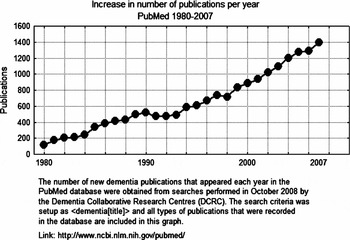
Well over a thousand new journal articles on dementia are available from PubMed each year and this number is increasing steadily (Figure 1). It is a daunting task to sift through the plethora of information, some of which may be outdated and possibly contradictory. Systematic reviews may identify evidence-based best practice; however, to be effective the reviews need to be of high quality, have a clear summary and be regularly updated.
Journal articles on dementia available on PubMed 1980–2007.

In October 2008, the Cochrane Library Dementia and Cognitive Improvement Group had 75 active systematic reviews on the treatment of dementia and cognitive impairment, with around 50% having not been amended for over two years (Cochrane Library, 2008). There are numerous clinical practice guidelines developed for dementia but these lack evaluation (Hogan et al., Reference Hogan2001) and there are inconsistencies (Beck et al., Reference Beck, Cody, Souder, Zhang and Small2000). Dementia service delivery research is often not published in peer-reviewed journals but by the organization itself (Runge et al., in press) or not published at all.
The use of an independent organization to evaluate best practice might overcome these difficulties; however, in the U.K. the National Institute for Health and Clinical Excellence (NICE)'s guidance on the use of cholinesterase inhibitors in Alzheimer's disease for the National Health Service has been controversial and poorly received (National Institute for Health and Clinical Excellence, 2006). Such guidance differs from contemporaneous clinical practice guidelines and may only add to clinician uncertainty (Waldemar et al., Reference Waldemar2007).
Responsibility for KT
Granting bodies may require researchers to have a KT strategy, though there is a lack of clarity between funding agencies about the meaning of KT and how it is operationalized (Tetroe et al., Reference Tetroe2008). It is simplistic to assert that researchers are primarily responsible for KT as this disregards the complex, intensive, iterative two-way process of KT. Successful KT requires a consistent simple message whereas multiple researchers may produce differing messages. The responsibility needs to be shared between those producing the knowledge and those applying it. A shift in the mindset of all key players is required to facilitate regular information flow between all parties. This may require dedicated KT experts.
Premature action
Some restraint is important in bridging the knowledge gap to ensure that treatments are not adopted before their effectiveness is proven (Graham and Tetroe, Reference Graham and Tetroe2007). The scientific community needs to be selective in the content it chooses to translate. Examples of premature KT in dementia are new drug developments, mild cognitive impairment (MCI), and dementia risk factors.
• Numerous drugs are being researched for the treatment of dementia but media coverage of early promising findings unrealistically raises consumers' expectations in much the same fashion as with new cancer “cures”.
• Researchers have been attempting to diagnose dementia as early as possible leading to the conceptualization of MCI, but lack of diagnostic clarity and no effective treatments have led to confusion among clinicians and distress among consumers (Ellison, Reference Ellison2008).
• Risk association findings for dementia are often promoted individually and sometimes in a contradictory and sensationalized manner in the media, leaving the public confused and suspicious of science (Faria, Reference Faria2007).
Lack of KT resources
Effective KT is complex and often resource intensive. Given the time, resource and funding limitations of researchers and service providers, the planning of KT activities needs to be realistic. Operational definitions should be devised so that the KT responsibilities of each group are clearly defined, whether that be the translation or receiving of knowledge (Tetroe et al., Reference Tetroe2008). The cost effectiveness of KT strategies also needs to be considered.
If research studies have some KT component, then the resource cost entailed should be included in the budget. Likewise, continuing education should be regarded favorably by employers of health care workers and funded accordingly.
Lack of research about effective KT strategies
Dementia KT should be evidence-based. Some gaps in knowledge include:
• investigation of the key factors that contribute to the long-term adoption of knowledge and changes in dementia practice;
• evaluation of the effectiveness of current KT practices for consumers;
• the societal outcomes of KT to the public are unknown due to lack of appropriate evaluation.
The characteristics of dementia care workers
The majority of paid carers of older persons have received limited education and minimal training (Richardson and Martin, Reference Richardson and Martin2004). These carers often have poor literacy, come from a minority background and are less competent in the primary language and culture (Kiata et al., Reference Kiata, Kerse and Dixon2005). Also there is high staff turnover (Castle and Engberg, Reference Castle and Engberg2005).
Key features of effective dementia KT
A simple, compelling message
Information must be integrated and simplified, then communicated to different audiences in the most appropriate way without technical jargon (Choi, Reference Choi2005). Each target group requires different strategies and methods for effective KT. A “clear, concise, consistent, continuous and compelling” message that matches the needs of the audience is most likely to be successfully translated (Abernathy et al., Reference Abernathy2001).
Use of interpersonal contact and roles
KT acknowledges the role of human nature. When dementia diagnoses of world figures such as Ronald Reagan and Iris Murdoch entered the public domain, the profile of dementia was raised and its stigma reduced. Quality relationships and trust between those transferring and those using knowledge have to be built, and existing skills and experience have to be recognized (Roberts, Reference Roberts2000).
Interpersonal contact improves the likelihood of behavioral change when introducing new innovations. Five important interpersonal KT roles have been identified:
• opinion leaders (influential persons to whom others go for advice);
• facilitators (who have a formal role in helping implement change processes);
• champions (unsolicited advocates of ideas or projects with overwhelming enthusiasm and strong connections);
• linking agents (problem solvers who identify relevant knowledge and connect it to a need);
• and change agents (who work with people to change their behavior) (Thompson et al., Reference Thompson, Estabrooks and Degner2006).
Persons acting in such roles who realize the need for change and are confident in their ability to implement it can improve the effectiveness of KT (Crookes and Froggatt, Reference Crookes, Froggatt, Crookes and Davies2004). Opinion leaders can promote change but if overzealous they can overpower their audience and effectively distract or inhibit them from the intended message (Thompson et al., Reference Thompson, Estabrooks and Degner2006). Staff at all levels can act as facilitators and change agents. Consumers acting as champions have a powerful influence, particularly with policy-makers.
An emphasis on ‘know-how’
In the domain of business and technology, where KT has had a longer application, there is an emphasis on the importance of skill-based knowledge or “know-how” (Roberts, Reference Roberts2000; Pfeffer and Sutton, Reference Pfeffer and Sutton2003). To know means to understand, to have skills and the ability to act (Roberts, Reference Roberts2000). Efficient KT methods support the acquisition of new skills and experiences that create an impetus for changes in practice (Richards et al., Reference Richards, Toop and Graham2003). Placements for students and interactive workshops for health professionals, consumers and policy-makers emphasize practical applications of knowledge and are useful dementia KT tools. Follow-up after practical interventions will ensure that learnt material crosses the “knowing–doing gap” and is converted into practice (Pfeffer and Sutton, Reference Pfeffer and Sutton2003).
The provision of support and resources for KT
A person who has gained knowledge and wants to change practice will revert to the status quo if not supported by other staff and management. Management needs to support dementia KT by being open to evidence-based practice changes and to innovative suggestions by all staff (Crookes and Froggatt, Reference Crookes, Froggatt, Crookes and Davies2004). It also needs to ensure a stimulating work environment that promotes KT and make time and funding available. Junior staff should be made aware of expectations for them to participate in KT practices. A learning organization model, which encourages group learning, innovation and communication similar to an action research paradigm, has been shown to foster KT in an Australian mental health service (Birleson, Reference Birleson1998).
At a policy level, incentives for undertaking KT should be introduced, which would foster both KT practices within services and consultations across the groups involved in dementia.
Conclusion
Translating dementia research into practice is vital, otherwise research investments are not maximized in improving the quality of life of persons with dementia and their carers. Effective KT requires judiciously selected evidence-based information that has been simplified, adapted and integrated, and these messages can be enhanced by personal delivery. It also requires considerable resources and a supportive environment that embraces evidence-based changes in practice.
Because KT in dementia involves multiple-way communication between researchers, policy-makers, service providers, the general public, consumers and educators, all of these groups need to be engaged in the process for effective KT to occur and all are responsible for ensuring that translation into practice occurs. Facilitation of KT by dedicated experts might be required to make and maintain connections between key players.
Conflict of interest
None.
Description of authors' roles
Brian Draper, Adrienne Withall, Lee-Fay Low and Victor Vickland conceived the paper; Brian Draper, Adrienne Withall, Lee-Fay Low, Victor Vickland and Tanya Ward carried out the literature review and wrote the paper.
Acknowledgments
Dr Vickland, Dr Withall and Ms Ward were funded by the Dementia Collaborative Research Centre (DCRC) at the University of New South Wales. The project was hosted by the DCRC, which is an Australian Government initiative. Dr Low was funded by NHMRC grant no. 455377.