Nomenclature
-
 $\mathcal{G}$
-
the graph of network
-
$\mathcal{V}$
-
the set of interceptors
-
$\mathcal{E}$
-
the set of edges
-
$N$
-
the number of interceptors
-
$A$
-
the weight adjacency matrix
-
$L$
-
Laplacian matrix representing communication among interceptors
-
$h,{t_0},T$
-
power parameter, start time and user-predefined convergence time for prescribed-time
-
scaling function, respectively
-
$b,k$
-
prescribed-time convergence parameters
-
$LOS$
-
line-of-sight
-
${V_M}$
-
the velocity of the interceptor
-
${r_i}$
-
the interceptor-to-target range between the
$i$
-th interceptor and its target -
$\left( {{\theta _{mi}},\;{\psi _{mi}}} \right)$
-
two Euler angles for the LOS coordinate system to the body coordinate system
-
$\left( {{\theta _{Li}},\;{\psi _{Li}}} \right)$
-
$LOS$
angles in azimuth and elevation directions, respectively
-
$\left( {{{{\lambda }}_{yi}},\;{{{\lambda }}_{zi}}} \right)$
-
$LOS$
angle components in the inertial reference frame
-
$({A_{ymi}},{A_{zmi}})$
-
normal accelerations in yaw and pitch directions, respectively
-
${{{\sigma }}_i},{\dot \sigma _i}$
-
heading angle and its rate of the
$i$
-th interceptor’s seeker -
${K_p}$
-
navigation gain
-
$({A_{pymi}},{A_{pzmi}})$
-
pure proportional navigation command in yaw and pitch directions, respectively
-
${\bar{\mathcal{G}}}, {\mathcal{G}_d}$
-
the pinning group network, and pinning network
-
$D$
-
pinning matrix representing the pinning scheme for subgroups
-
$G$
-
the number of subgroups
-
-
the set of the subgroups, wherein
$N$
interceptors are divided into
$G$
subgroups -
${t_f}$
-
the interception time
-
${X_{{g_i}}}$
-
group assigned equilibrium value of a variable
$X$
, wherein the
$i$
-th interceptor belongs to -
the
${g_i}$
-th subgroup -
$({A_{cymi}},{A_{czmi}})$
-
cooperative guidance command in yaw and pitch directions, respectively
-
${k_1},\;{k_2}$
-
cooperative guidance parameters
-
${{\Xi }},{{\;\Gamma }}$
,
$\bar{\xi} ,\;\underline \xi $
-
communication-related matrices and parameters, which are decided by
$L + D$
-
${a_1},{a_4}\;,a$
-
parameters for Lyapunov function
-
${{\tau }}$
-
delayed time
-
$\mathcal{T}$
-
prescribed-time-related convergence time, represents the convergence instant


1.0 Introduction
Advanced guidance law is essential for a flight vehicle to achieve mission objectives during the homing guidance phase. Fully considering complex flight environments, extensive implementations reveal that individual guidance laws can satisfy the requirements of one-to-one interception [Reference An, Guo, Huang and Xu1–Reference Han, Shin, Hu, Tsourdos and Xin4]. In modern warfare, however, with the development of powerful defensive systems, penetration has become increasingly difficult for a single interceptor against modern warfare units, such as the scattered and self-defense equipped targets, manoeuvering targets and hypersonic vehicles [Reference Zhang, Yan, Huang, Che and Wang5–Reference An, Guo, Xu and Huang7]. To effectively cope with such powerful defense systems, cooperative guidance may be a more feasible scheme, which has been a research hotspot [Reference Jeon, Lee and Tahk8–Reference Zhao, Dong, Liang and Ren14]. Relying on the communication network, each single interceptor can share and exchange information with its neighbours to perform a multi-level and all-round attack on the target.
Nevertheless, the complicated battlefield environment makes the guidance scheme challengeable, and brings significant interferences to the communication network. Indeed, in practical engineering scenarios, the scale of cooperation, communication capability and external interferences lead to the time-delay phenomenon as an inevitable problem. However, the convergence of time-delay consensus has not been sufficiently studied. In particular, delayed cooperative information prevents the convergence before impact instant. Without desirable convergence performance, the arrival time difference may result in effectiveness degradation or even failure of cooperative interception. Therefore, for cooperative interception with time delay, it is crucial to comprehensively consider both the network communication capability and convergence performance.
If the real-time cooperative information is absent, the delayed information will strongly affect or even breaks up the stability of the guidance system. Therefore, minimising the influence of time delay is essential. So far, a few cooperative guidance schemes considering time delay have been proposed based on asymptotic consensus [Reference Zhaohui, Yuezu and Jialing15–Reference He, Kim, Song and Lin18]. Based on the linear matrix inequalities (LMI) method, a two-direction cooperative guidance law considering time-delayed network was proposed in Ref. [Reference Zhaohui, Yuezu and Jialing15]. To solve the communication-delayed midcourse cooperation problem, a trajectory shaping cooperative guidance law was proposed in Ref. [Reference Wu, Ren, Luo, Fang and Fu17] and its asymptotic stability was proved with the Lyapunov-Krasovskii function. By using the Nyquist stability criterion, the stability and allowable maximum communication delay of the cooperative guidance scenario among unpowered interceptors was further discussed in Ref. [Reference He, Kim, Song and Lin18].
Notably, the above-mentioned cooperative guidance laws with time delay only focus on asymptotic consensus and the boundary of delay, ignoring the stricter control of convergence time. Indeed, the guidance window is short, and insufficient convergence performance of asymptotic consensus will cause the interceptor miss its target unexpectedly when considering the time delay. Actually, as a potential internal influence factor, limited convergence time has great significance in the effectiveness of cooperative laws. Time delay will bring difficulty to the interceptors for their practical engineering applications. Therefore, in case of cooperative interception, the convergence performance and the stability of the guidance system play the same role in the cooperative guidance. Necessarily, convergence ought to be achieved before the impact instant. In order to improve the convergence performance, the researches on finite-time cooperative guidance law have attracted much more attention [Reference Liu, Yan, Liu, Dai, Yan and Xin19–Reference Ma, Wang, Wang and Chen23]. In Ref. [Reference Liu, Yan, Liu, Dai, Yan and Xin19], utilising acceleration constructed by available information, the finite-time consensus can be achieved in the case of changeable velocity magnitude. Besides, based on the finite-time consensus, two two-stage cooperative guidance laws considering detection blind area were developed in Ref. [Reference Ma, Wang, Wang and Chen23]. It can be noted that earlier convergence can provide better conditions for locking and intercepting the target. Although cooperative guidance laws based on finite-time consensus are more effective than asymptotic consensus, its convergence performance mainly depends on initial engagement conditions. Once the initial states are unavailable, it is unable to determine the convergence time boundary beforehand. Unlike the finite-time cooperative guidance laws, fixed-time consensus theory can be applied for setting convergence bound regardless of initial conditions [Reference Yu, Dai, Li, Zou, Ma, Ma and Zhang24–Reference Zhang and Zhang27]. In Ref. [Reference Yu, Dai, Li, Zou, Ma, Ma and Zhang24], based on proportional navigation guidance law, a fixed-time cooperative guidance law was proposed against input delay. For 3D cooperative guidance laws in Refs. [Reference Lin, Ding, Wang, Liang and Wang25–Reference Zhang and Zhang27], cooperative interception can be ensured by fixed-time consensus-based velocity control in line-of-sight. Since the flight time of dynamic guidance is short, fixed-time parameters need to be tuned repeatedly to ensure the convergence performance, so that the convergence can be achieved before impact. Hence, even if the improved fixed-time cooperative guidance law is not dependent on initial conditions, the convergence time decided by re-tuned parameters is unfavourable for applications of finite/fixed-time theory.
To overcome the aforementioned drawbacks, the prescribed-time consensus has shown its potential in arbitrarily predefined convergence time. In Ref. [Reference Zhang, Tang and Guo28], a two-stage prescribed-time consensus-based unpowered cooperative guidance law was proposed based on optimal control. However, there will be a sudden jump in the guidance command at the switching instant, and the step in the assigned time sequence rapidly narrows, which is unexpected for the cooperative mission. Since specified convergence time is extremely important to some engagements, the prescribed-time consensus-based cooperative guidance law can be further expanded and optimised by considering more realistic influence factors.
Currently, few researches have considered the prescribed-time cooperative guidance problem with time delay. Based on the above analysis, this paper will mainly concern about the practicability of a prescribed-time 3D consensus-based cooperative guidance law with time delay in the following aspects: (1) Owing to the inevitable time-delay phenomenon, only the delayed information can be obtained to generate the cooperative guidance command. (2) Due to the short guidance window and unexpected time delay, the cooperative guidance law needs to ensure the convergence performance within a limited time. (3) Considering the practical requirements, the generalisation of 2D cooperative guidance laws is weakened and existing 3D laws with velocity control are not applicable to most low-cost interceptors.
Motivated by previous studies, to achieve an improved allowance of time delay in the scenario of stage-switching constrain, this paper designs a time-delay prescribed-time consensus-based cooperative guidance law. The main contributions are summarised as follows:
-
(1) A two-stage 3D time-delay prescribed-time cooperative guidance law is proposed based on time-delayed cooperative information and prescribed-time theory, which is more feasible and economical for practical applications.
-
(2) The time-delay prescribed-time stability of the proposed cooperative guidance law is proved by Lyapunov stability theory. Compared with most existing finite/fixed-time consensus-based cooperative guidance law, the time-delay prescribed-time consensus shows better convergence performance. Theoretically, the convergence time can be arbitrarily specified, independent of initial engagement and control parameters.
-
(3) The switching point can be obtained by a clear prescribed-time-related convergence time. The convergence time of the time-delay prescribed-time consensus is deduced by the specified convergence time and delayed time. Contrast to existing two-stage schemes in Refs. [Reference Zhang, Tang and Guo28–Reference He, Wang, Lin and Lei30], a favourable time-delay cooperative performance can be ensured by the switching without real-time judgement.
The remainder of this paper is organised as follows. Necessary background and problem formulation are introduced in the Section 2. Derivations of time-delay prescribed-time cooperative guidance law are presented in Section 3. In Section 4, the numerical simulations are carried out to verify the effectiveness and correctness of the proposed cooperative guidance law. Section 5 concludes the paper.
2.0 Cooperative problem statement
In this section, some preliminaries and prescribed-time relevant lemmas are recalled for preparation; then, to formulate the addressed main problem, necessary backgrounds for cooperative guidance command design are provided briefly.
2.1 Preliminaries
2.1.1 Graph theory
First, review of graph theory is given for conveniently modeling the communication topology among the
 $N$
interceptors. A graph is an order pair
 $\mathcal{G} = \left( {\mathcal{V},\mathcal{E}} \right)$
consisting a finite vertex set
 $\mathcal{V} = \left\{ {1,2, \ldots ,N} \right\}$
representing interceptors and an edge set
 $\mathcal{E} = \left\{ {\left( {i,j} \right) \in \mathcal{V} \times \mathcal{V}} \right\}$
corresponding to the relationship among interceptors in the topology, in which
 $\left( {{v_i},{v_j}} \right) \in \mathcal{E}$
represents the
 $j$
-th interceptor receiving information from
 $i$
-th interceptor. The weight adjacency matrix is defined as
 $A = \left\{ {{a_{ij}}} \right\}$
, where
 ${a_{ii}} = 0,{a_{ij}} \gt 0$
if and only if
 $\left( {{v_i},{v_j}} \right) \in \mathcal{E}$
, otherwise
 ${a_{ij}} = 0$
. Accordingly, the Laplacian matrix is defined with
 $L$
as
 $\mathop \sum \nolimits_{j = 1,j \ne i}^N {a_{ij}}$
if
 $j = i$
, and
 ${l_{ij}} = - {a_{ij}}$
otherwise, in which
 $\mathop \sum \nolimits_{j = 1}^N {l_{ij}} = 0,i = 1,2, \ldots ,N$
is guaranteed.
Additionally, some useful lemmas are introduced for preparation.
Definition 1. [Reference Liao and Ji31] A nonsingular matrix
 $\mathcal{W} = \left\{ {{w_{ij}}} \right\} \in {\mathbb{R}^{N \times N}}$
is called
 $M$
-matrix if elements satisfy
 ${a_{ij}} \le 0\left( {i \ne j} \right)$
and all the elements of
 ${A^{ - 1}}$
are nonnegative.
Lemma 1. [Reference Liao and Ji31] For a nonsingular matrix
 $\mathcal{W} = \left\{ {{w_{ij}}} \right\} \in {\mathbb{R}^{N \times N}}$
, the following statements are equivalent: (1)
 $\mathcal{W}$
is a
 $M$
-matrix; (2) all eigenvalues of
 $\mathcal{W}$
have positive real part, which means
 $Re\left( {{{{\lambda }}_i}\left( \mathcal{W} \right)} \right) \gt 0,i = 1,2, \ldots ,N$
; (3) there existing a positive diagonal matrix
 ${{\Xi }} = {\textrm{diag}}\left\{ {1/{{{\xi }}_1},1/{{{\xi }}_2}, \ldots ,1/{{{\xi }}_{\textrm{N}}}} \right\} \gt 0$
, in which
 ${{\xi }} = {\left[ {{{{\xi }}_1},{{{\xi }}_2}, \ldots ,{{{\xi }}_{\textrm{N}}}} \right]^T} = {\mathcal{W}^{ - 1}}{1_N}$
, such that
 ${{\Xi }}\mathcal{W} + {\mathcal{W}^T}{{\Xi }}$
is positive definite.
Lemma 2. [Reference Golub and Van Loan32] For any given vectors
 $\mathfrak{B} \in {\mathbb{R}^N}$
and
 $\mathfrak{D} \in {\mathbb{R}^N}$
, if there is an arbitrarily positive defined matrix
 $\mathcal{W} \in {\mathbb{R}^{N \times N}}$
, the following inequality holds
 \begin{align} 2{\mathfrak{B}^T}\mathfrak{D} \le {\mathfrak{B}^T}\mathcal{W}\mathfrak{B} + {\mathfrak{D}^T}{\mathcal{W}^{ - 1}}\mathfrak{D}\end{align}
2.1.2 Prescribed-time theory
Some lemmas about prescribed-time are established with a time-varying function in Ref. [Reference Ren, Zhou, Li, Liu and Sun33] as
 \begin{align}a\!\left( t \right) = \left\{ {\begin{array}{l}{{{\left( {\dfrac{T}{{T + {t_0} - t}}} \right)}^h},t \in \left[ {{t_0},{t_0} + T} \right)}\\[12pt]{1,t \in \left[ {{t_0} + T,\infty } \right)}\end{array}} \right.\end{align}
where
 $h \gt 1$
and
 $T$
is the mission-assigned convergence time. The specified convergence time is larger than time period needed for network communication and computing.
In addition, the right-hand derivative is
 \begin{align} \dot a\!\left( t \right) = \left\{ {\begin{array}{l}{\dfrac{h}{T}{{\left( a \right)}^{1 + \frac{1}{h}}},t \in \left[ {{t_0},{t_0} + T} \right)}\\[12pt]{0,t \in \left[ {{t_0} + T,\infty } \right)}\end{array}} \right.\end{align}
Furthermore,
 \begin{align}\psi \!\left( t \right) = \frac{{\dot a\!\left( t \right)}}{{a\!\left( t \right)}} = \left\{ {\begin{array}{l}{\dfrac{h}{{T + {t_0} - t}},t \in \left[ {{t_0},{t_0} + T} \right)}\\[12pt]{0,t \in \left[ {{t_0} + T,\infty } \right)}\end{array}} \right.\end{align}
Lemma 3. [Reference Ren, Zhou, Li, Liu and Sun33] Consider a dynamic system described by
 $\dot x = f\left( {t,x\left( t \right)} \right),x\left( 0 \right) = {x_0}$
, where
 $x \in {\mathbb{R}^N}$
and
 $f$
is a function bounded in time. There exists a continuously differentiable positive function
 $V\left( {t,x\left( t \right)} \right)$
denoted as
 $V\!\left( t \right)$
in short. If there exists
 $\dot V\!\left( t \right) \le - bV\left( t \right) - k\psi \left( t \right)V\left( t \right)$
with constants
 $b \geqslant 0,k \gt 0$
, for
 $t \in \left[ {{t_0},{t_0} + T} \right)$
, it yields
 $\dot V\left( t \right) \le {a^{ - k}}\left( t \right)ex{p^{ - b\left( {t - {t_0}} \right)}}V\left( {{t_0}} \right)$
and for
 $t \in \left[ {{t_0} + T,\infty } \right)$
,
 $V\!\left( t \right) \equiv 0\,$
holds.
2.2 Cooperative interception engagement
For simplification, following standard assumptions are considered.
Assumption 1. Interceptors and targets are treated as mass points in 3D space.
Assumption 2. All the velocities of unpowered interceptors are assumed to be fixed with adjustable perpendicular acceleration throughout the engagement.
Assumption 3. In comparison with the dynamic of autopilot and seeker, guidance loop is fast enough.
A 3D unpowered cooperative engagement scenario is shown in Fig. 1, where multiple interceptors aim to simultaneously capture a stationary target. The differential equations describing the 3D kinematics can be obtained as Ref. [Reference Song and Ha3] and the kinematics is governed by the following equations:
 \begin{align} \left\{ {\begin{array}{l}{{{\dot r}_i} = - {V_M}{\textrm{cos}}{\,\theta _{mi}}{\textrm{cos}}{\,\psi _{mi}}}\\[5pt]{{r_i}{{\dot \lambda }_{yi}} = {V_M}{\textrm{sin}}{\,\theta _{mi}}}\\[5pt]{{r_i}{{\dot \lambda }_{zi}} = - {V_M}{\textrm{cos}}{\,\theta _m}{\textrm{sin}}{\,\psi _m}}\\[8pt]{{{\dot \theta }_{mi}} = \dfrac{{{A_{zmi}}}}{{{V_m}}} - \dfrac{{{V_M}}}{{{r_i}}}{\textrm{tan}}{\,\lambda _{yi}}{\textrm{cos}}{\,\theta _{{m_i}}}{{\textrm{sin}}^2}{\psi _{mi}} + \dfrac{{{V_M}}}{{{r_i}}}{\textrm{sin}}{\,\theta _{mi}}{\textrm{cos}}{\,\psi _{mi}}}\\[12pt]{{{\dot \psi }_{mi}} = \dfrac{{{A_{ymi}}}}{{{V_m}{\textrm{cos}}{\,\theta _{mi}}}} + \dfrac{{{V_M}}}{{{r_i}}}{\textrm{tan}}{\,\lambda _{yi}}{\textrm{sin}}{\,\theta _{mi}}{\textrm{sin}}{\,\psi _{mi}}{\textrm{cos}}{\,\psi _{mi}}}\\[12pt]\qquad\,{ + \dfrac{{{V_M}}}{{{r_i}{\textrm{cos}}{\,\theta _{mi}}}}{{\sin }^2}{\,\theta _{mi}}\sin {\psi _{mi}} + \dfrac{{{V_M}}}{{{r_i}}}{\textrm{cos}}{\,\theta _{mi}}\sin {\psi _{mi}}}\end{array}} \right.\end{align}
such that the heading angle representing the field-of-view of the
 $i$
-th interceptor’s seeker is defined with Euler angle
 ${{{\sigma }}_i}$
as
 \begin{align}{{{{\sigma }}_i} = arccos\!\left( {cos\left( {{{{\theta }}_{mi}}} \right)cos\!\left( {{\psi _{mi}}} \right)} \right),{{{\sigma }}_i} \in \left[ {0,{{\pi }}} \right)}\end{align}
Geometry of 3D cooperative interception.

Hence, the 3D pure proportional navigation guidance (PPNG) is given as
 \begin{align}\left\{ {\begin{array}{l}{{A_{pymi}} = - {K_p}{V_M}{{\dot \lambda }_{yi}}{\textrm{sin}}{\,\theta _{mi}}{\textrm{sin}}{\psi _{mi}} + {K_p}{V_M}{{\dot \lambda }_{zi}}{\textrm{cos}}{\,\theta _{mi}}}\\[5pt]{{A_{pzmi}} = - {K_p}{V_M}{{\dot \lambda }_{yi}}{\textrm{cos}}{\,\psi _{mi}}}\end{array}} \right.\end{align}
Differentiating Equation (6) and substituting Equation (7) into it,
 ${{{\dot \sigma }}_i}$
can be expressed as
 \begin{align}{{\dot \sigma }_i} & = \frac{1}{{\sin {\sigma _i}}}\left( {{\textrm{sin}}{\,\theta _{mi}}\cos {\,\psi _{mi}}{{\dot \theta }_{mi}} + \cos {\,\theta _{mi}}\sin {\,\psi _{mi}}{{\dot \psi }_{mi}}} \right)\nonumber\\[5pt] & = - \frac{{\left( {{K_p} - 1} \right)}}{{\sin {\,\sigma _i}}}\frac{{{V_M}}}{{{r_i}}}\left( {{{\cos }^2}{\,\psi _{mi}} - {{\cos }^2}{\,\theta _{mi}}{{\cos }^2}{\,\psi _{mi}} + {{\sin }^2}{\,\psi _{mi}}} \right)\nonumber\\[5pt] &= - \frac{{\left( {{K_p} - 1} \right){V_M}}}{{{r_i}}}\sin {\,\sigma _i} \end{align}
Dividing Equation (5) by Equation (8) yields
 \begin{align}{\frac{{\partial {r_i}}}{{\partial {\sigma _i}}} = \frac{{{r_i}cot{{{\sigma }}_i}}}{{{K_p} - 1}}}\end{align}
Solving Equation (9) in terms of
 ${{{\sigma }}_i}$
, we can obtain that
 \begin{align}{{r_i} = \frac{{{r_i}\left( 0 \right)}}{{{{\left| {sin{{{\sigma }}_i}\left( 0 \right)} \right|}^{1/\left( {{K_p} - 1} \right)}}}}{{\left| {sin{{{\sigma }}_i}} \right|}^{1/\left( {{K_p} - 1} \right)}}}\end{align}
which reveals that interceptors guided by identical navigation ratio
 ${K_p}$
with the same
 ${r_i}\left( 0 \right)$
and
 $\left| {sin{{{\sigma }}_i}\left( 0 \right)} \right|$
, the shapes of trajectories are the same and the simultaneous interception shall occur. The valuable information is useful to the following cooperative guidance design.
2.3 Cooperative problem statement
In what follows, we focus on the time-delay prescribed-time convergence of the cooperative problem, such that the interceptors communicate through the directed network with time delays can converge to a specified time. Hence, the design objective is transformed to time-delay prescribed-time consensus.
In this paper, a pinning group network
 $\bar{ \mathcal{G}} = \left( {\mathcal{G},{\mathcal{G}_{d}}} \right)$
is considered, wherein
 ${\mathcal{G}_d}$
is the pinning graph and its corresponding pinning matrix is defined as
 $D = \textrm{diag}\left\{ {{d_{i}}} \right\} \in {\mathbb{R}^{N \times N}}$
,
 ${d_{i}} = 1$
if the
 $i$
-th interceptor in
 $\mathcal{G}$
is pinned, otherwise
 ${d_{i}} = 0$
. Then, the
 $N$
interceptors divided into
 $G$
subgroups are denoted as

, where group assigned equilibrium value of the
 $i$
-th interceptor belongs to the
 ${g_i}$
-th subgroup is represented with subscript
 ${g_i}$
.
The group interception mission studied in this work is stated as the following.
Definition 2. For multi-interceptors is said to achieve the group interception if

3.0 Design of time-delay prescribed-time cooperative guidance law
With a pinned directed graph, the time-delay prescribed-time cooperative guidance law is designed with delay cooperative information. At the beginning, with the transformed system, the time-delay prescribed-time consensus is proved. Then, the relationship between the delayed time and prescribed-time is analysed. For application, a two-stage cooperative guidance law is further summarised.
3.1 Design of cooperative guidance law
In practical engineering, through the desired range-to-go
 ${r_i}$
and heading error
 ${{{\sigma }}_i}$
measured by radar and inertial measurement, the cooperation objective can be achieved. One can, then, speculate that how to keep the adversary in the field-of-view is the prerequisite for achieving the simultaneous cooperative interception. To this aim, the cooperative state variables are selected as
 \begin{align}{\left\{ {\begin{array}{l}{{x_{1i}} = \dfrac{{{r_i}}}{{V_M}} + t}\\[12pt]{{x_{2i}} = - cos{{{\sigma }}_i} + 1}\end{array}} \right.}\end{align}
Accordingly, by using Equation (5), the time derivatives of Equation (12) are expressed as
 \begin{align}\left\{ \begin{array}{l} {{{\dot x}_{1i}} = {x_{2i}}} \\[12pt] {{{\dot x}_{2i}} = \dfrac{{{A_{czmi}}}}{{{V_M}}}sin{{{\theta }}_{mi}}cos{\psi _{mi}} + \dfrac{{{A_{cymi}}}}{{{V_M}}}sin{\psi _{mi}} + \dfrac{{{V_M}}}{{{r_i}}}co{s^2}{{{\theta }}_{mi}}si{n^2}{\psi _{mi}} + \dfrac{{{V_M}}}{{{r_i}}}si{n^2}{{{\theta }}_{mi}}} \end{array} \right.\end{align}
Hence, the mission requirement in Definition 2 is transformed to the following consensus problem.
Definition 3. For multi-interceptors pinning group network
 $\bar{\mathcal{G}}$
, the cooperative system Equation (14) reaches time-delay prescribed-time group consensus if

and for
 $\forall t \geqslant \mathcal{T}$

where
 ${x_i} = \left[ {{x_{1i}},{x_{2i}}} \right]$
,
 ${x_{{g_i}}} = \left[ {{x_{1,{g_i}}},{x_{2,{g_i}}}} \right]$
and
 $\mathcal{T} = t\left( {{t_0},T,{{\tau }}} \right)$
is the time-delay prescribed convergence time decided by time delay
 $\tau $
and the prescribed convergence time
 $T$
.
We are now equipped to present the cooperative guidance law that ensures the prescribed-time convergence and simultaneous group interception in case of the time delay. By utilising the measurable delayed time and available delayed information, the inevitable time delay problem is transformed into an input-delay consensus problem. To ensure the prescribed-time consensus, the cooperative guidance law is conducted by prescribed-time function, delayed information and past guidance commands. The cooperative guidance command for the
 $i$
-th interceptor is as follows
 \begin{align}\left\{ {\begin{array}{l}{{A_{cymi}}\left( t \right) = - \dfrac{{V_M^2}}{{{r_i}}}{\textrm{sin}}{\psi _{mi}} + \dfrac{{{U_i}\left( {t - {{\tau }}} \right){V_M}}}{{2\sin {\psi _{Mi}}}}}\\[12pt]{{A_{czmi}}\left( t \right) = - \dfrac{{V_M^2}}{{{r_i}}}{\textrm{sin}}{\theta _{mi}}{\textrm{cos}}{\psi _{mi}} + \dfrac{{{U_i}\left( {t - {{\tau }}} \right){V_M}}}{{2\sin {\theta _{Mi}}co{\textrm{s}}{\psi _{Mi}}}}}\end{array}} \right.\end{align}
where
 \begin{align}U_{i}(t)=-\int^{\tau}_{0}[(\tau - s)p_{0}(t)+p_{1}(t)](d_{i}+l_{ij})U_{i}(t-\tau+s)ds-p_{0}(t)[d_{i}(x_{1i}(t)-x_{1,gi}(t))-\sum_{j\neq i,j=1}^N\end{align}
 \begin{align}a_{ij}(x_{1j}-x_{1i}(t))-\!\sum^{N}_{j=1}l_{ij}x_{1,g_{j}}{(t)}]-[\tau p_{0}(t)+p_{1}(t)][d_{i}(x_{2i}(t)-x_{2,gi}(t))-\!\sum^{N}_{j\neq i,j=1}\! a_{ij}(x_{2j}(t)-x_{2i}(t))-\!\sum^{N}_{j=1}l_{ij}\end{align}
 $x_{2,g_{j}}(t)],$
with
 ${p_0}\!\left( t \right) = {k_1}{k_2}{\psi ^2}\!\left( t \right)$
and
 ${p_1}\!\left( t \right) = \left( {{k_1} + {k_2} - \frac{1}{h}} \right)\psi \!\left( t \right)$
.
Theorem 1. For the multi-interceptors systems Equation (14) with pinning group network
 $\overline{\mathcal{G}}$
, when pinning group matrices
 $L + D$
is a
 $M$
-matrix, if there exist parameters
 $h \gt 1,{k_1} \gt 0,{k_2} \gt 0$
, such that the inequality group Equation (17) is satisfied, then the proposed time-delay prescribed-time cooperative guidance law Equation (16) can ensure the states
 ${x_i}$
converge to group desired states
 ${x_{{g_i}}}$
at
 $\mathcal{T}$
, which is related to the prescribed-time
 $T$
and delayed time
 $\tau $
.
 \begin{align}\begin{array}{l}{\left\{ {\begin{array}{l}{\;{a_1}{a_4} - {a^2} \gt 0}\\[5pt]{{w_1}{k_1}{k_2} + a\bar{\xi} h\left( {{k_1} + {k_2}} \right) + {w_2} \lt 0}\\[5pt]{\bar{\xi} {a_4}h{k_1}{k_2} + {w_3}\left( {{k_1} + {k_2}} \right) + {w_4} \lt 0}\end{array}} \right.}\end{array}\end{align}
where
 $\bar{\xi} = \frac{{{\lambda _{max}}\left( {{\Gamma }} \right)}}{{{\lambda _{min}}\left( {{\Xi }} \right)}},\underline \xi = \frac{{{\lambda _{min}}\left( {{\Gamma }} \right)}}{{{\lambda _{max}}\left( {{\Xi }} \right)}},\;\;{w_1} = \left( { - 2\underline \xi + {a_4}\bar{\xi} } \right)h,{w_2} = \left( {2 + \bar{\xi}h} \right){a_1} + \left( {kh + bT} \right)\left( {{a_1} + a} \right),$
 ${w_3} =$
 $\left( { - 2{a_4}\underline \xi + \bar{\xi}a} \right)h$
and
 ${w_4} = 2{a_4}\underline \xi + 2ah + {a_1}\bar{\xi}h + \left( {kh + bT} \right)\left( {{a_4} + a} \right)$
,
 ${{\Xi }} = {\textrm{diag}}\{ 1/{{{\xi }}_1}, 1/{{{\xi }}_2}, \ldots ,1/{{{\xi }}_{\textrm{N}}} \}$
 $ \gt 0$
, in which
 ${{\xi }} = {\left[ {{{{\xi }}_1},{{{\xi }}_2}, \ldots ,{{{\xi }}_{\textrm{N}}}} \right]^T} = {\left( {L + D} \right)^{ - 1}}{1_N}$
,
 ${{\Gamma }} = \frac{1}{2}\left[ {{{\Xi }}\left( {L + D} \right) + {{\left( {L + D} \right)}^T}{{\Xi }}} \right]$
,
 $b \geqslant 0,k \gt 2/h,$
 ${a_1} \gt 0,{a_4} \gt 0,\;a \gt 0$
.
Proof. Firstly, the system in Equation (13) with delayed state information can be described as
 \begin{align}\begin{array}{l}{\left\{ {\begin{array}{l}{\dfrac{{dE{X_1}}}{{dt}} = E{X_2}}\\[12pt]{\dfrac{{dE{X_2}}}{{dt}} = U\left( {t - {{\tau }}} \right)}\end{array}} \right.}\end{array}\end{align}
where

Hence,
 \begin{align}{\frac{{dEX}}{{dt}} = AEX\!\left( t \right) + BU\!\left( {t - {{\tau }}} \right)}\end{align}
where
 $EX = {\left[ {EX_1^T,EX_2^T} \right]^T},A = \left[ {\begin{array}{c@{\quad}c}{{0_N}} & {{I_N}}\\[5pt]{{0_N}} & {{0_N}}\end{array}} \right],B = \left[ {\begin{array}{l}{{0_N}}\\[5pt]{{1_N}}\end{array}} \right].$
On this basis, the second term of Equation (16) can be rewritten as
 \begin{align}& {d_i}\!\left( {x_{1i}\!\left( t \right) - {x_{1,{g_i}}}\!\left( t \right)} \right) - \mathop \sum \limits_{j \ne i,j = 1}^N {a_{ij}}\!\left( {{x_{1j}}\!\left( t \right) - {x_{1i}}\!\left( t \right)} \right) - \mathop \sum \limits_{j = 1}^N {l_{ij}}{x_{1,{g_j}}}\!\left( t \right) \nonumber \\[5pt] & \quad = {d_i}\!\left( {{x_{1i}}\!\left( t \right) - {x_{1,{g_i}}}\!\left( t \right)} \right) - \mathop \sum \limits_{j \ne i,j = 1}^N {a_{ij}}\!\left( {{x_{1j}}\!\left( t \right) - {x_{1i}}\!\left( t \right)} \right) + \mathop \sum \limits_{j \ne i,j = 1}^N {a_{ij}}{x_{1,{g_j}}}\!\left( t \right) - {l_{ii}}{x_{1,{g_i}}}\!\left( t \right) \nonumber \\[5pt] & \quad = {d_i}\!\left( {{x_{1i}}\!\left( t \right) - {x_{1,{g_i}}}\!\left( t \right)} \right) - \mathop \sum \limits_{j \ne i,j = 1}^N {a_{ij}}\!\left( {{x_{1j}}\!\left( t \right) - {x_{1i}}\!\left( t \right)} \right) + \mathop \sum \limits_{j \ne i,j = 1}^N {a_{ij}}{x_{1,{g_j}}}\!\left( t \right) - \mathop \sum \limits_{j \ne i,j = 1}^N {a_{ij}}{x_{1,{g_i}}}\!\left( t \right) \nonumber \\[5pt] & \quad = {d_i}\!\left( {{x_i}\!\left( t \right) - {x_{{g_i}}}\!\left( t \right)} \right) - \mathop \sum \limits_{j \ne i,j = 1}^N {a_{ij}}\!\left( {\!\left( {{x_j}\!\left( t \right) - {x_{{g_j}}}\!\left( t \right)} \right) - \!\left( {{x_i}\!\left( t \right) - {x_{{g_i}}}\!\left( t \right)} \right)} \right) \nonumber \\[5pt] & \quad = \mathop \sum \limits_{j = 1}^N {l_{ij}}\!\left( {{x_j}\!\left( t \right) - {x_{{g_j}}}\!\left( t \right)} \right) + {d_i}\!\left( {{x_i}\!\left( t \right) - {x_{{g_i}}}\!\left( t \right)} \right) \end{align}
With similarly rewritten third term, Equation (16) can be further simplified in terms of matrix as
 \begin{align}U\!\left( {t - {{\tau }}} \right) & = - {p_0}\!\left( {t - {{\tau }}} \right)\!\left( {L + D} \right)E{X_1}\!\left( {t - {{\tau }}} \right) - {p_1}\!\left( {t - {{\tau }}} \right)\!\left( {L + D} \right)E{X_2}\!\left( {t - {{\tau }}} \right)\nonumber\\[5pt] & \quad- {{\tau }}{p_0}\!\left( {t - {{\tau }}} \right)\!\left( {L + D} \right)E{X_2}\!\left( {t - {{\tau }}} \right) - \int \nolimits_0^{{\tau }} {p_1}\!\left( {t - {{\tau }}} \right)\!\left( {L + D} \right)U\!\left( {t - 2{{\tau }} + s} \right)\!ds\nonumber\\[5pt] &\quad - \mathop \int \nolimits_0^{{\tau }} \!\left( {{{\tau }} - s} \right){p_0}\!\left( {t - {{\tau }}} \right)\!\left( {L + D} \right)U\!\left( {t - 2{{\tau }} + s} \right)ds \end{align}
Here, the integral transformation of delay state variables is given as follows
 \begin{align} EX\!\left( {t - {{\tau }}} \right) = EX\!\left( t \right) - \mathop \int \nolimits_0^{{\tau }} \dot EX\!\left( {t - {{\tau }} + s} \right)ds \end{align}
Hence, Equation (22) allow us to rewrite Equation (21) as
 \begin{align}U\!\left( {t - {{\tau }}} \right) & = - {p_0}\!\left( {t - {{\tau }}} \right)\!\left( {L + D} \right)E{X_1}\!\left( t \right) + {p_0}\!\left( {t - {{\tau }}} \right)\!\left( {L + D} \right)\mathop \int \nolimits_0^{{\tau }} \dot E{X_1}\!\left( {t - {{\tau }} + s} \right)ds\nonumber \\[5pt] & \quad - {p_1}\!\left( {t - {{\tau }}} \right)\!\left( {L + D} \right)E{X_2}\!\left( t \right) + {p_1}\!\left( {t - {{\tau }}} \right)\!\left( {L + D} \right)\mathop \int \nolimits_0^{{\tau }} \dot E{X_2}\!\left( {t - {{\tau }} + s} \right)ds \nonumber\\[5pt] & \quad - {{\tau }}{p_0}\!\left( {t - {{\tau }}} \right)\!\left( {L + D} \right)E{X_2}\!\left( t \right) + {{\tau }}{p_0}\!\left( {t - {{\tau }}} \right)\!\left( {L + D} \right)\mathop \int \nolimits_0^{{\tau }} \dot E{X_2}\!\left( {t - {{\tau }} + s} \right)ds \nonumber\\[5pt] & \quad- \mathop \int \nolimits_0^{{\tau }} \left[ {\!\left( {{{\tau }} - s} \right){p_0}\!\left( {t - {{\tau }}} \right) + {p_1}\!\left( {t - {{\tau }}} \right)} \right]\!\left( {L + D} \right)U\!\left( {t - 2{{\tau }} + s} \right)ds \nonumber\\[5pt] & = - {p_0}\!\left( {t - {{\tau }}} \right)\!\left( {L + D} \right)E{X_1}\!\left( t \right) - \left[ {{p_1}\!\left( {t - {{\tau }}} \right) + {{\tau }}{p_0}\!\left( {t - {{\tau }}} \right)} \right]\!\left( {L + D} \right)E{X_2}\!\left( t \right) \nonumber\\[5pt] & \quad + {p_0}\!\left( {t - {{\tau }}} \right)\!\left( {L + D} \right)\mathop \int \nolimits_0^{{\tau }} \left[ {\dot E{X_1}\!\left( {t - {{\tau }} + s} \right) + sU\!\left( {t - 2{{\tau }} + s} \right)} \right]ds \nonumber\\[5pt] & = - {p_0}\!\left( {t - {{\tau }}} \right)\!\left( {L + D} \right)E{X_1}\!\left( t \right) - {p_1}\!\left( {t - {{\tau }}} \right)\!\left( {L + D} \right)E{X_2}\!\left( t \right) \nonumber\\[5pt] & \quad - {{\tau }}{p_0}\!\left( {t - {{\tau }}} \right)\!\left( {L + D} \right)E{X_2}\!\left( t \right) + {p_0}\!\left( {t - {{\tau }}} \right)\!\left( {L + D} \right)\left[ {sE{X_2}\!\left( {t - {{\tau }} + {{s}}} \right)} \right]\!\left. \right|_0^{{\tau }} \nonumber\\[5pt] & = - {p_0}\!\left( {t - {{\tau }}} \right)\!\left( {L + D} \right)E{X_1}\!\left( t \right) - {p_1}\!\left( {t - {{\tau }}} \right)\!\left( {L + D} \right)E{X_2}\!\left( t \right)\end{align}
Considering the system in Equation (13) and simplified time-delay command in Equation (22), the proof of prescribed-time stability is divided into three parts: (1) prove that the pinning group consensus can be achieve at the convergence time
 $\mathcal{T}$
strongly related to prescribed-time
 $T$
and time-delay
 ${{\tau }}$
; (2) deduce the boundness of control command
 $U$
; (3) derive that the consensus is kept and command input remains zero over
 $\left[ {\mathcal{T}, + \infty } \right)$
.
-
(1) Time-delay consensus in prescribed-time-related convergence time
$\mathcal{T}$

Consider the Lyapunov function candidate as follows,
 \begin{align}\begin{array}{l}{V\!\left( t \right) = E{X^T}\left( t \right)\Omega EX\left( t \right)}\end{array}\end{align}
where
 ${{\Omega }} = \left[ {\begin{array}{c@{\quad}c}{{a_1}} & a\\[5pt]a & {{a_4}}\end{array}} \right] \otimes {{\Xi }} \gt 0$
and
 ${{\Xi }}$
is a positive definite matrix defined as Assumption 1. To ensure that
 $V\left( t \right)$
is a positive function, based on the Schur’s Complement Lemmas, the inequalities
 ${a_4}{{\Xi }} \gt 0$
and
 ${a_1}{{\Xi }} - a{{\Xi }}{\left( {{a_4}{{\Xi }}} \right)^{ - 1}}a{{\Xi }} \gt 0$
must be satisfied. Obviously, the
 $V\left( t \right)$
is positive under the Equation (17) constraint.
Let
 $\overline {E{X_1}} = {{\psi }}\left( {t - {{\tau }}} \right)\;E{X_1},\overline {E{X_2}} = E{X_2}$
such that
 \begin{align}{\mathop {\dot{\overline{EX}} }\limits^ \cdot }_1 = \psi \!\left( {t - {{\tau }}} \right)E{{\dot X}_1} + \dot \psi \!\left( {t - {{\tau }}} \right)E{X_1} = \psi \!\left( {t - {{\tau }}} \right)\overline {E{X_2}} + {1 \over h}\psi \!\left( {t - {{\tau }}} \right)\overline {E{X_1}} \end{align}
The system in Equation (18) can be further expressed as
 \begin{align}\dot{\overline {EX}} \!\left( t \right) = \left[ {\begin{array}{c@{\quad}c}{\dfrac{1}{h}\psi \left( {t - {{\tau }}} \right){I_N}} & {\psi \left( {t - {{\tau }}} \right){I_N}}\\[12pt]{ - {k_1}{k_2}\psi \left( {t - {{\tau }}} \right)\left( {L + D} \right)} & { - \left( {{k_1} + {k_2} - \dfrac{1}{h}} \right)\psi \left( {t - {{\tau }}} \right)\left( {L + D} \right)}\end{array}} \right]\overline {EX}\! \left( t \right)\end{align}
Denote
 $\dot{\overline {EX}}(t) = C(t){\overline {EX}} (t)$
, the time derivative of Equation (23) yields
 \begin{align}\begin{array}{l}{\begin{array}{l}{\dot V\!\left( t \right) = \overline {EX} \!\left( t \right)\Omega C\!\left( t \right)\overline {EX} \!\left( t \right) + + {{\overline {EX} }^T}\!\left( t \right){C^T}\!\left( t \right)\Omega \overline {EX} \!\left( t \right)}\end{array}}\end{array}\end{align}
By Lemma 2, we can further simplify
 $\dot V\!\left( t \right)$
as
 \begin{align} \dot V & = \frac{{2{a_1}}}{h}\psi \!\left( {t - {{\tau }}} \right){\overline {E{X_1}} ^T}{{\Xi }}\overline {E{X_1}} - 2{k_1}{k_2}\psi \!\left( {t - {{\tau }}} \right){\overline {E{X_1}} ^T}{{\Gamma }}\overline {E{X_1}} \nonumber \\[5pt] & \quad + 2a\psi \!\left( {t - {{\tau }}} \right){\overline {E{X_2}} ^T}{{\Xi }}\overline {E{X_2}} - 2{a_4}\!\left( {{k_1} + {k_2} - \frac{1}{h}} \right)\psi \!\left( {t - {{\tau }}} \right){\overline {E{X_2}} ^T}{{\Gamma }}\overline {E{X_2}} \nonumber\\[5pt] & \quad + \!\left( {a_1 + \frac{a}{h}} \right)\psi \!\left( {t - {{\tau }}} \right)\!\left( {{{\overline {E{X_1}} }^T}{{\Xi }}\overline {E{X_2}} + {{\overline {E{X_2}} }^T}{{\Xi }}\overline {E{X_1}} } \right) \nonumber\\[5pt] &\quad - {a_4}{k_1}{k_2}\psi \!\left( {t - {{\tau }}} \right)\!\left( {{{\overline {E{X_1}} }^T}{{\!\left( {{\textrm{L}} + {\textrm{D}}} \right)}^{\textrm{T}}}{{\Xi }}\overline {E{X_2}} + {{\overline {E{X_2}} }^T}{{\Xi }}\!\left( {{\textrm{L}} + {\textrm{D}}} \right)\overline {E{X_1}} } \right)\nonumber\\[5pt] & \quad - a\!\left( {{k_1} + {k_2} - \frac{1}{h}} \right)\psi \!\left( {t - {{\tau }}} \right)\!\left( {{{\overline {E{X_1}} }^T}{{\Xi }}\!\left( {{\textrm{L}} + {\textrm{D}}} \right)\overline {E{X_2}} + {{\overline {E{X_2}} }^T}{{\!\left( {{\textrm{L}} + {\textrm{D}}} \right)}^{\textrm{T}}}{{\Xi }}\overline {E{X_1}} } \right)\nonumber\\[5pt] & \quad \le \frac{{2{a_1}}}{h}\psi \!\left( {t - {{\tau }}} \right){\overline {E{X_1}} ^T}{{\Xi }}\overline {E{X_1}} - 2{k_1}{k_2}\psi \!\left( {t - {{\tau }}} \right){\overline {E{X_1}} ^T}{{\Gamma }}\overline {E{X_1}} \nonumber \\[5pt] & \quad + 2a\psi \!\left( {t - {{\tau }}} \right){\overline {E{X_2}} ^T}{{\Xi }}\overline {E{X_2}} - 2{a_4}\!\left( {{k_1} + {k_2} - \frac{1}{h}} \right)\psi \!\left( {t - {{\tau }}} \right){\overline {E{X_2}} ^T}{{\Gamma }}\overline {E{X_2}} \nonumber\\[5pt] & \quad + \!\left( {{a_1} + \frac{a}{h}} \right)\psi \!\left( {t - {{\tau }}} \right)\!\left( {{{\overline {E{X_1}} }^T}{{\Xi }}\overline {E{X_1}} + {{\overline {E{X_2}} }^T}{{\Xi }}\overline {E{X_2}} } \right)\nonumber\\[5pt] & \quad + \left[ {a\!\left( {{k_1} + {k_2} - \frac{1}{h}} \right){ + a_4}{k_1}{k_2}} \right]\psi \!\left( {t - {{\tau }}} \right)\!\left( {{{\overline {E{X_1}} }^T}{{\Gamma }}\overline {E{X_1}} + {{\overline {E{X_2}} }^T}{{\Gamma }}\overline {E{X_2}} } \right) \end{align}
Scaling parts of terms, we have
 \begin{align}\left\{ {\begin{array}{l}{{{\overline {E{X_1}} }^T}{{\Gamma }}\overline {E{X_1}} \le {{{\lambda }}_{max}}\left( {{\Gamma }} \right)\mathop \sum \limits_{i = 1}^N \|E{X_{1i}}\|^2 \le {{{\lambda }}_{max}}\left( {{\Gamma }} \right){{{\xi }}_{{\textrm{max}}}}\mathop \sum \limits_{i = 1}^N \dfrac{1}{{{{{\xi }}_{\textrm{i}}}}}\|E{X_{1i}}\|^2 \le \bar{\xi} {{\overline {E{X_1}} }^T}{{\Xi }}\overline {E{X_1}} }\\[10pt]{{{\overline {E{X_2}} }^T}{{\Gamma }}\overline {E{X_2}} \le {{{\lambda }}_{max}}\left( {{\Gamma }} \right)\mathop \sum \limits_{i = 1}^N \| E{X_{2i}}\|^2 \le {{{\lambda }}_{max}}\left( {{\Gamma }} \right){{{\xi }}_{{\textrm{max}}}}\mathop \sum \limits_{i = 1}^N \dfrac{1}{{{{{\xi }}_{\textrm{i}}}}}\|E{X_{2i}}\|^2 \le \bar{\xi} {{\overline {E{X_2}} }^T}{{\Xi }}\overline {E{X_2}} }\end{array}} \right.\end{align}
Similarly,
 \begin{align}\left\{ {\begin{array}{l}{{{\overline {E{X_1}} }^T}{{\Gamma }}\overline {E{X_1}} \geqslant {{{\lambda }}_{min}}\left( {{\Gamma }} \right)\mathop \sum \limits_{i = 1}^N \|E{X_{1i}}\|^2 \geqslant {{{\lambda }}_{min}}\left( {{\Gamma }} \right){{{\xi }}_{{\textrm{min}}}}\mathop \sum \limits_{i = 1}^N \dfrac{1}{{{{{\xi }}_{\textrm{i}}}}}\|E{X_{1i}}\|^2 \geqslant \underline \xi {{\overline {E{X_1}} }^T}{{\Xi }}\overline {E{X_1}} }\\[10pt]{{{\overline {E{X_2}} }^T}{{\Gamma }}\overline {E{X_2}} \geqslant {{{\lambda }}_{min}}\left( {{\Gamma }} \right)\mathop \sum \limits_{i = 1}^N \|E{X_{2i}}\|^2 \geqslant {{{\lambda }}_{min}}\left( {{\Gamma }} \right){{{\xi }}_{{\textrm{min}}}}\mathop \sum \limits_{i = 1}^N \dfrac{1}{{{{{\xi }}_{\textrm{i}}}}}\|E{X_{2i}}\|^2 \geqslant \underline \xi {{\overline {E{X_2}} }^T}{{\Xi }}\overline {E{X_2}} }\end{array}} \right.\end{align}
Accordingly, the time derivative is allowed to be scaled as
 \begin{align} & \dot V \le \frac{{2{a_1}}}{h}\psi \!\left( {t - {{\tau }}} \right){\overline {E{X_1}} ^T}{{\Xi }}\overline {E{X_1}} - 2{k_1}{k_2}\underline \xi \psi \!\left( {t - {{\tau }}} \right){\overline {E{X_1}} ^T}{{\Xi }}\overline {E{X_1}} \nonumber \\[5pt] & + 2a\psi \!\left( {t - {{\tau }}} \right){\overline {E{X_2}} ^T}{{\Xi }}\overline {E{X_2}} - 2{a_4}\!\left( {{k_1} + {k_2} - \frac{1}{h}} \right)\underline \xi \psi \!\left( {t - {{\tau }}} \right){\overline {E{X_2}} ^T}{{\Xi }}\overline {E{X_2}} \nonumber \\[5pt] & + \!\left( {{a_1} + \frac{a}{h}} \right)\psi \!\left( {t - {{\tau }}} \right)\bar{\xi} \!\left( {{{\overline {E{X_1}} }^T}{{\Xi }}\overline {E{X_1}} + {{\overline {E{X_2}} }^T}{{\Xi }}\overline {E{X_2}} } \right)\nonumber \\[5pt] & + \left[ {a\!\left( {{k_1} + {k_2} - \frac{1}{h}} \right) + {a_4}{k_1}{k_2}} \right]\psi \!\left( {t - {{\tau }}} \right)\bar{\xi} \!\left( {{{\overline {E{X_1}} }^T}{{\Xi }}\overline {E{X_1}} + {{\overline {E{X_2}} }^T}{{\Xi }}\overline {E{X_2}} } \right) \end{align}
Therefore,
 \begin{align}& {\dot V \le \left[ { - 2{k_1}{k_2}\underline \xi + \frac{{2{a_1}}}{h} + \left( {{a_1} + a\!\left( {{k_1} + {k_2}} \right) + {{\textrm{a}}_4}{k_1}{k_2}} \right)\bar{\xi} } \right]\psi \!\left( {t - {{\tau }}} \right){{\overline {E{X_1}} }^T}\Xi \overline {E{X_1}} }\nonumber \\[8pt]& { + \left[ { - 2{a_4}\!\left( {{k_1} + {k_2} - \frac{1}{h}} \right)\underline \xi + 2a + \left( {{a_1} + a\!\left( {{k_1} + {k_2}} \right) + {{\textit{a}}_4}{k_1}{k_2}} \right)\bar{\xi} } \right]\psi \!\left( {t - {{\tau }}} \right){{\overline {E{X_2}} }^T}\Xi \overline {E{X_2}} } \end{align}
It is clear that, if Equation (17) holds, then
 $\dot V\!\left( t \right) \lt 0$
.
Further, according to Lemma 2, the Lyapunov function readily follows that
 \begin{align} & {V\!\left( t \right) = {a_4}{{\overline {E{X_2}} }^T}\!\left( {\textrm{t}} \right)\Xi \overline {E{X_2}} \!\left( t \right) + {a_1}{{\overline {E{X_1}} }^T}\!\left( {\textrm{t}} \right)\Xi \overline {E{X_1}} \!\left( t \right)}\nonumber \\[5pt]& { + a\!\left( {{{\overline {E{X_2}} }^T}\!\left( {\textrm{t}} \right){{\Xi }}\overline {E{X_1}} \!\left( t \right) + {{\overline {E{X_1}} }^T}\!\left( {\textrm{t}} \right){{\Xi }}\overline {E{X_2}} \!\left( t \right)} \right)}\nonumber \\[5pt]& { \le \!\left( {{a_4} + a} \right){{\overline {E{X_2}} }^T}\!\left( {\textrm{t}} \right)\Xi \overline {E{X_2}} \!\left( t \right) + \left( {{a_1} + a} \right){{\overline {{X_1}} }^T}\!\left( {\textrm{t}} \right)\Xi \overline {E{X_1}} \!\left( t \right)}\end{align}
With conditions in Equation (17), considering the fact
 ${{\psi }}\!\left( {t - {{\tau }}} \right) \geqslant h/T$
, we have
 \begin{align}& \dot V + \left( {b + k\psi \left( {t - {{\tau }}} \right)} \right)V \le \left\{ {\left[ { - 2{k_1}{k_2}\underline \xi + \frac{{2{a_1}}}{h} + \left( {{a_1} + a\left( {{k_1} + {k_2}} \right) + {a_4}{k_1}{k_2}} \right)\bar{\xi} } \right.} \right. \nonumber \\[5pt] & \left. {\left. { +\; k\left( {{a_1} + a} \right)} \right]\frac{{\textrm{h}}}{T} + b\left( {{a_1} + a} \right)} \right\}{\overline {E{X_1}} ^T}\left( {\textrm{t}} \right){{\Xi }}\overline {E{X_1}} \left( t \right) + \left\{ {b\left( {{a_4} + a} \right)} \right. + \frac{{\textrm{h}}}{T}\left[ { - 2{a_4}\left( {{k_1} + {k_2} - \frac{1}{h}} \right)\underline \xi } \right.\nonumber \\[5pt] & \left. {\left. { +\; 2a + k\left( {{a_4} + a} \right) + \left( {{a_1} + a\left( {{k_1} + {k_2}} \right) + {a_4}{k_1}{k_2}} \right)\bar{\xi} } \right]} \right\}{\overline {E{X_2}} ^T}\left( {\textrm{t}} \right){{\Xi }}\overline {E{X_2}} \left( t \right)\end{align}
Therefore,
 \begin{align}{\dot V \le - \left( {b + k\psi \left( {t - {{\tau }}} \right)} \right)V}\end{align}
Obverse the time scaling function, we have
 \begin{align}\tilde a\left( t \right) = a\left( {t - {{\tau }}} \right) = \left\{ {\begin{array}{l}{{{\left( {\dfrac{T}{{T + {t_0} + {{\tau }} - t}}} \right)}^h},t \in \left[ {{t_0} + {{\tau }},{t_0} + T + {{\tau }}} \right)}\\[12pt]{1,t \in \left[ {{t_0} + T + {{\tau }},\infty } \right)}\end{array}} \right.\end{align}
and
 \begin{align}\tilde \psi \left( t \right) = \psi \left( {t - {{\tau }}} \right) = \left\{ {\begin{array}{l}{\dfrac{h}{{T + {t_0} + {{\tau }} - t}},t \in \left[ {{t_0} + {{\tau }},{t_0} + T + {{\tau }}} \right)}\\[10pt]{0,t \in \left[ {{t_0} + T + {{\tau }},\infty } \right)}\end{array}} \right.\end{align}
Then Equation (35) can be written as
 \begin{align}\begin{array}{l}{V\!\left( t \right) \le {{\tilde a}^{ - k}}{e^{ - b\left( {t - {t_0}} \right)}}V\left( {{t_0}} \right)}\end{array}\end{align}
For
 ${\lambda _{min}}\left( {{\Omega }} \right)\!\|\overline {EX} {\left( t \right)\!\|^2} \le V\left( t \right) \le {\lambda _{max}}\left( {{\Omega }} \right)\!\|\overline {EX} {\left( t \right)\!\|^2}$
, we have
 \begin{align}\begin{array}{l}{V\!\left( {{t_0}} \right){ \le _{max}}\left( {{\Omega }} \right)\!\|\overline {EX} {{\left( {{t_0}} \right)}\|^2}}\end{array}\end{align}
Furthermore,
 \begin{align}\begin{array}{l}\|{\overline {EX} {{\left( t \right)}\|^2} \le \dfrac{{{\lambda _{max}}\left( {{\Omega }} \right)}}{{{\lambda _{min}}\left( {{\Omega }} \right)}}{{\tilde a}^{ - k}}{e^{ - b\left( {t - {t_0}} \right)}}\|\overline {EX} {{\left( {{t_0}} \right)}\|^2}}\end{array}\end{align}
The results in Lemma 2 leading to
 $\|\overline {E{X_1}} {\left( t \right)\!\|^2} + \|\overline {E{X_2}} \left( t \right)\!\|^2 \geqslant 2 \|\overline {E{X_1}} \left( t \right)\!\|\,\|\overline {E{X_2}} \left( t \right)\!\|$
help us scale the Equation (39) as
 \begin{align}\begin{array}{l}{\|{\left[ {\overline {E{X_1}} \!\left( t \right)\!\| + \|\overline {E{X_2}} \!\left( t \right)}\| \right]}^2} \le 2\dfrac{{{\lambda _{max}}\!\left( {{\Omega }} \right)}}{{{\lambda _{min}}\!\left( {{\Omega }} \right)}}{{\tilde a}^{ - k}}{e^{ - b\!\left( {t - {t_0}} \right)}}{{\left[ \|{\overline {E{X_1}} \!\left( {{t_0}} \right) \|+\| \overline {E{X_2}} \!\left( {{t_0}} \right)}\| \right]}^2}\end{array}\end{align}
We can further obtain that
 \begin{align}\|{\overline {E{X_1}} \!\left( t \right) \|+ \|\overline {E{X_2}} \!\left( t \right)\!\| \le \sqrt {2\frac{{{\lambda _{max}}\!\left( {{\Omega }} \right)}}{{{\lambda _{min}}\!\left( {{\Omega }} \right)}}} {{\tilde a}^{ - \frac{1}{2}k}}{e^{ - \frac{1}{2}b\!\left( {t - {t_0}} \right)}}\left[ \|{\overline {E{X_1}} \!\left( {{t_0}} \right)\!\| + \|\overline {E{X_2}} \!\left( {{t_0}} \right)} \|\right]}\end{align}
When
 $t \to {\left( {{t_0} + T + {{\tau }}} \right)^ - }$
,
 ${\tilde a^{ - \frac{1}{2}k}} \to 0$
, so we have
 \begin{align}\|{\overline {E{X_1}} \!\left( t \right)\!\| \to 0,\|\overline {E{X_2}} \!\left( t \right)\!\| \to 0,t \to {{\!\left( {{t_0} + T + {{\tau }}} \right)}^ - }}\end{align}
Then, Equation (42) reduces to
 \begin{align}\|{E{X_1}\!\left( t \right)\!\| \to 0,\|E{X_2}\!\left( t \right)\!\| \to 0,t \to {{\left( {{t_0} + T + {{\tau }}} \right)}^ - }}\end{align}
The above results infer that these interceptors achieve the pinning consensus at prescribed-time related convergence time
 $\mathcal{T}$
with time delay.
-
(2) Boundness of control command within the prescribed-related time
$\mathcal{T}$

Note that
 $ L_{\infty} \;:\!=\; \left\{x(t)|x:\; R_{+}\rightarrow {R}, \mathop{Sup}\limits_{t\in R_{+}}|x(t)|< \infty \right\} $
. For
 $ - k + \frac{2}{h} \lt 0$
,
 $0 \lt {\tilde a^{ - \frac{1}{2}k + \frac{1}{h}}} \le 1$
and
 $0 \lt {e^{ - \frac{1}{2}b\left( {t - {t_0}} \right)}} \le 1$
hold. Let
 ${p_{max}} = max\left( {{k_1}{k_2},\left( {{k_1} + {k_2} - \frac{1}{h}} \right)} \right)$
, substituting Equation (41) into Equation (21), one can obtain
 \begin{align} &\| U\!\left( {t - {{\tau }}} \right)\!\| = \|N{p_0}\!\left( {t - {{\tau }}} \right)\!\left( {L + D} \right)E{X_1}\!\left( t \right) + N{p_1}\!\left( {t - {{\tau }}} \right)\!\left( {L + D} \right)E{X_2}\!\left( t \right)\!\| \nonumber \\[5pt] & \quad = \| \left[ {{k_1}{k_2}{\psi ^2}\!\left( {t - {{\tau }}} \right)} \right]\!\left( {L + D} \right)E{X_1}\!\left( t \right) + \left[ {\left( {{k_1} + {k_2} - {1 \over h}} \right)\psi \!\left( {t - {{\tau }}} \right)} \right]\left( {L + D} \right)E{X_2}\!\left( t \right)\!\| \nonumber \\[5pt] & \quad \le {p_{max}}\psi \!\left( {t - {{\tau }}} \right)\!\| L + D\|\left[\| {\overline {E{X_1}} \!\left( t \right)\!\| + \|\overline {E{X_2}} \!\left( t \right)}\!\| \right] \nonumber \\[5pt] & \quad \le {p_{max}}\psi \!\left( {t - {{\tau }}} \right)\|L + D\|\sqrt {2{{{\lambda _{max}}\!\left( {{\Omega }} \right)} \over {{\lambda _{min}}\!\left( {{\Omega }} \right)}}} {{\tilde a}^{ - {1 \over 2}k}}{e^{ - {1 \over 2}b\!\left( {t - {t_0}} \right)}}\left[ \|{\overline {E{X_1}} \!\left( {{t_0}} \right)\!\| + \|\overline {E{X_2}} \!\left( {{t_0}} \right)} \!\|\right] \end{align}
On further simplification with
 $\tilde \psi \!\left( t \right) = \frac{h}{T}{\tilde a^{\frac{1}{h}}}\!\left( t \right)$
, Equation (44) is expressed as
 \begin{align}{\|U\!\left( {t - {{\tau }}} \right) \!\|\le \frac{h}{T}{p_{max}}\sqrt {2\frac{{{\lambda _{max}}\!\left( {{\Omega }} \right)}}{{{\lambda _{min}}\!\left( {{\Omega }} \right)}}} {{\tilde a}^{ - \frac{1}{2}k + \frac{1}{h}}}{e^{ - \frac{1}{2}b\!\left( {t - {t_0}} \right)}}\|L + D\|\left[ \|{\overline {E{X_1}} \!\left( {{t_0}} \right)\! \| + \|\overline {E{X_2}} \!\left( {{t_0}} \right)} \! \|\right]}\end{align}
Therefore,
 \begin{align}\|U\!\left( {t - {{\tau }}} \right) \!\| \in {L_\infty }\end{align}
which means that the control command is bounded over
 $\left[ {{t_0},\mathcal{T}} \right)$
.
-
(3) Over
$\left[ {\mathcal{T},\infty } \right)$
, consensus is kept and the control input remains zero.

Recall the first part of the proof, the time derivative satisfies that
 \begin{align}\begin{array}{l}{\dot V\!\left( t \right) \le - 2\!\left( t \right) \le 0,t \in \left[ {\mathcal{T},\infty } \right)}\end{array}\end{align}
Subsequently,
 \begin{align}\begin{array}{l}{V\!\left( \mathcal{T} \right) = \mathop {\lim }\limits_{t \to {{\!\left( \mathcal{T} \right)}^ - }} V\!\left( t \right) = 0}\end{array}\end{align}
Therefore,
 \begin{align}\begin{array}{l}{0 \le V\!\left( t \right) \le V\!\left( \mathcal{T} \right) = 0,t \in \left[ {{t_0} + {{\tau }},\infty } \right)}\end{array}\end{align}
According to the above proceeding, when
 $t = \mathcal{T}$
,
 $V\!\left( t \right) \equiv 0$
which means
 $E{X_1}\!\left( t \right) = {0_N},E{X_2}\!\left( t \right) = {0_N}$
. Thus, when
 $t \in \left[ {\mathcal{T},\infty } \right)$
, consensus is kept and command remains zero.
Additionally, control input
 $U = {0_N}$
, which means the bounded command is smooth over the whole-time interval.
Consequently, with the control command in Equation (16), the time-delay consensus is achieved at
 $\mathcal{T}$
and the simultaneous arrival can be ensured with the pinned directed group law. This completes the proof.
Remark 1. Theoretically, the convergence time of the prescribed-time cooperative guidance law can be arbitrarily pre-specified, independent of initial conditions and tuning parameters. Meanwhile, with limited available information, the guidance law can ensure convergence performance by compensating for the influence of time delay. Accordingly, the prescribed-time-related convergence not only ensures group cooperation, but also provides a foundation for referable choices, such as the stage transition law. On the other hand, limited by the practical mission, physical actuators and external engagement, the interception can only be achieved with initial conditions within a certain range. Although the convergence time can be pre-specified arbitrarily, its assignment is limited by multiple practical factors (such as mission, engagement, capability, etc).
Corollary 1. Based on the time-delay prescribed-time cooperative guidance law Equation (16), the prescribed-time consensus will be achieved at
 $\mathcal{T} = {t_0} + T + {{\tau }}$
.
Proof. Following from the proofs of Theorem 1, it is worth observing from Equations (35)–(38) that the relationship between the prescribed convergence time and time delay is obtained as
 $\mathcal{T} = {t_0} + T + {{\tau }}$
.
Remark 2. In theory, with prescribed convergence time and measurable delayed time, the time-delay prescribed-time consensus can be achieved before impact instant. However, considering the physical environment, the following potential issues about the prescribed-related convergence time are significant for applications. Although the time delay can be settled by compensation, too long delayed time will result in unideal communication break, and the accumulative cooperative errors challenge the execution of constrained actuators, and may even lead to the failure. Thus, the prescribed convergence is comprehensively decided by the performance of interceptor, network communication capability, task requirements and other external interference.
3.2 Practical implementation of proposed cooperative guidance law
In this section, regarding the cooperative guidance law in Equation (16), we mainly concern about the practical implementation of the cooperative guidance law and its parameters tuning.
Considering the nonnegligible weakness of on-line cooperation, especially the time delay, individual guidance after reaching consensus shows better cost performance and robust without network. Usually, existing two-stage cooperative guidance laws execute judgement by tolerable state errors, such as Refs. [Reference He, Kim, Song and Lin18] and [Reference Zhang, Tang and Guo28]. To get rid of the burden of on-line judgement, the switching condition needs to be improved for stage transition. The proposed cooperative guidance law provided a new switching judgement by the prescribed-time-related convergence time, which is described by the mission-assigned convergence time and the measurable delay. For the transient guidance process, with the satisfactory convergence performance, an implementable version of the proposed cooperative guidance law is summarised as follows.
Step 1. Network establishment. For describing the communication among the interceptors, a pinned directed group topology is given based on M-matrix assumption.
Step 2. Cooperative guidance design. Based on the delayed cooperative information and measurable delayed time, the proposed algorithm defined in Equation (16) is utilised to achieve the consensus of heading error and range-to-go among interceptors.
 \begin{align}{\left\{ {\begin{array}{l}{{A_{cymi}}\left( t \right) = - \dfrac{{V_M^2}}{{{r_i}}}\textrm{sin}{\psi _{mi}} + \dfrac{{{U_i}\left( {t - {{\tau }}} \right){V_M}}}{{{\mathcal{E}_1}}}}\\[12pt]{{A_{czmi}}\left( t \right) = - \dfrac{{V_M^2}}{{{r_i}}}\textrm{sin}{\theta _{mi}}\textrm{cos}{\psi _{mi}} + \dfrac{{{U_i}\left( {t - {{\tau }}} \right){V_M}}}{{{\mathcal{E}_2}}}}\end{array}} \right.}\end{align}
where
 ${\mathcal{E}_1} = max\left( {2\sin {\psi _{Mi}},{\varepsilon _1}sgn\left( {2\sin {\psi _{Mi}}} \right)} \right)$
and
 ${\mathcal{E}_2} = max(2sin{{{\theta }}_{Mi}}cos{{{\psi }}_{Mi}},\;{\varepsilon _2}sgn$
 $\left( {2sin{{{\theta }}_{Mi}}cos{{{\psi }}_{Mi}}} \right)\!)$
.
 ${\varepsilon _1}$
and
 ${\varepsilon _2}$
are two small enough constants related to lower limitations of heading error.
Step 3. Stage switch setting. According to the Corollary 1, at the switching instant
 $\mathcal{T}$
, all the interceptors switch to individual PPN in Equation (7), which leads to the simultaneous target interception.
Remark 3. Usually, most existing asymptotical consensus-based switching law are executed with precision conditions. When all the state variables’ errors decrease to the small precision value, the guidance law is switched to the second stage. Naturally, insufficient convergence or higher switching precision leads to switching later than expected, even causes the miss of interception. Different from the finite/fixed-time laws, the proposed cooperative guidance law can pre-specify the convergence time as switching instant, such that the convergence time is not a boundary decided by tuning parameters. Obviously, the clearly switching time provided by Corollary 1 is applicable for application.
Remark 4. Note that there exists inherent singularity problem in Equation (13) for the trigonometric function of denominator. Though consensus reaches at
 $\mathcal{T}$
with
 ${U_i}\left( {t - {{\tau }}} \right) = 0$
, to address the problem, small terms
 ${\varepsilon _1}$
and
 ${\varepsilon _2}$
are given in Equation (50) to overcome the singularity.
Remark 5. To simplify the tunning of cooperative guidance design, parameters used in Theorem 1 can be divided into three types as follows.
-
(1) Network-related parameter and matrices.
$L$
and
$D$
represent the pining communication network, which satisfies the
$M$
-matrix assumption. Besides, vector
${{\xi }}$
, parameters
$\bar{\xi} $
and
${\underline{\xi }}$
and matrices
${{\Xi }}$
and
${{\Gamma }}$
are calculated by the given topology. -
(2) Prescribed-time parameters
${t_0}\;$
and
$T$
are assigned by user’s or task requirements. -
(3) Control parameters
$h$
,
${k_1}$
and
${k_2}$
are strongly related to system prescribed-time stability, and the
$h$
affects convergence rate.


4.0 Simulations and validations
In this section, numerical examples are conducted to illustrate the effectiveness of the proposed time-delay prescribed-time cooperative guidance law.
4.1 Case 1: Simulation results of the proposed cooperative law
Firstly, Case 1 is given for verifying the effectiveness of the proposed cooperative guidance law. To analyse the influential factors, the scenario is set as follows. In this scenario, five interceptors are divided into two subgroups simultaneous arriving the two stationary targets with velocity of
 $650m/s$
. The initial states are provided in the Table 1, where group A target adversary located at
 $\left( {2km,1km,0km} \right)$
and group B fly towards adversary located at
 $\left( {2km, - 11km,0km} \right)$
.
Scenario for Case 1

Refer to Ref. [Reference Ji, Liu and Liao34], the communication topology is shown in Fig. 2, where interceptor 1 and 4 are pinned.
Communication topology of Case 1 with 2 subgroups.

The control parameters are tuned as
 ${k_1} = 1.4,{k_2} = 2.2,\;h = 2$
and
 ${K_p} = 4$
.
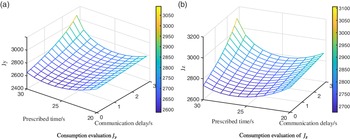
To demonstrate the inherent properties of the proposed cooperative guidance command derived in Theorem 1 and Corollary 1, consumption evaluation indicators are defined as
 \begin{align} \left\{ \begin{array}{c} {{J_{yi}} = \mathop \int \nolimits_0^t \left| {{A_{ymi}}\left( t \right)} \right|dt,{J_y} = \mathop \sum \limits_{i = 1}^N {J_{yi}}} \\[8pt] {{J_{zi}} = \mathop \int \nolimits_0^t \left| {{A_{zmi}}\left( t \right)} \right|dt,{J_z} = \mathop \sum \limits_{i = 1}^N {J_{zi}}} \end{array} \right. \end{align}
By employing the above settings, the simulations are performed with influential factors: pre-specified convergence time
 $T$
and delayed time
 $\tau $
. The consumption indicators, maximum miss distance and impact location are shown in Figs. 3 and 4.
Consumption evaluation of proposed law.

Impact results of proposed law.

It can be noted from Fig. 3 that, with the decrease of the specified time, the energy consumption firstly reduces and then increase. Due to the lack of real-time information, there is a higher demand for control capability when time delay is larger. Though shorter pre-specified convergence time requires larger commands, it also means shorter working hours for consensus. Nevertheless, working with continuously ultimate overload can also complete the task, but the burden of actuators may lead to unexpected consequences. The group interception can be achieved simultaneously, wherein the maximum miss distance is less than
 $1m$
. Besides, the mean value is
 $0.7978m$
.
Simulations show the effectiveness and superiority of the proposed time-delay prescribed-time consensus-based cooperative guidance law. Obviously, if there exists surplus capability, the proposed cooperative guidance law can bear even worse communication or measure situations. Additionally, a relatively longer delayed time challenges the actuators’ execution capability a lot and even prevents the mission from accomplishing. Hence, considering the dead zone of seekers and capability of actuators, converging at a specified time is helpful for simultaneous interception. Especially, with the clear mathematical relationship of
 $\mathcal{T}$
, the switching point can be predetermined to overcome the negative influence of time delay.
To further study the of proposed law, we presented two cases of simultaneous interception arriving stationary targets at
 $33s$
with influential factors
 $T$
and
 $\tau $
in Table 2.
4.1.1 Case 1.1: Simulation results with different delayed time
To evaluate detailed insights on the effect of delayed time, set influential factor
 ${{\tau }}$
as
 $0.01s$
,
 $0.5s$
and
 $1.5s$
with a fixed convergence time of
 $30s$
, respectively. Figure 5 depicts simultaneous interception where interceptors are divided into two subgroups starting from different locations and arriving at the subgroup’s target at the same time. Three numerical simulations show that cooperative missions are accomplished with an arrival time difference of less than
 $0.0025s$
and a maximum miss distance of less than
 $1m$
. Denote
 ${M_i}$
as the
 $i$
-th interceptor and the results, including state variables and guidance commands, are shown in Figs. 6–8.
Trajectory of Case 1.1.

Simultaneous interception of Case 1.1(a) with
 ${{\tau }} = 0.01s.$

Simultaneous interception of Case 1.1(b) with
 ${{\tau }} = 0.5s.$

Simultaneous interception of Case 1.1(c) with
 ${{\tau }} = 1.5s$
.

As revealed from Figs. 6–8, though the initial conditions are different, the range-to-go
 ${r_i}$
and heading error
 ${{{\sigma }}_i}$
could reach the consensus at
 $30.01s,\;30.5s$
and
 $31.5s$
, respectively. Then,
 ${r_i}$
decreases to zero and hits the target as expected. It can be noted that the switching law is well worked and the convergence time satisfies Corollary 1 with the sum of the prescribed time and the delayed time. It is also observed from Figs. 6(c)–8(c) that, when time goes to the predefined convergence time, the demand for adjusting the state errors to zero at the assigned time increases.
4.1.2 Case 1.2: Simulation results with different prescribed convergence time
The results in Case 1.1 were obtained based on assuming different delayed time. In order to validate the prescribed-time consensus, with a constant delay
 ${{\tau }} = 0.5s$
, set influential factor
 $T$
as
 $26s$
,
 $28s$
and
 $30s$
. As rigorously proved earlier, the achievement of prescribed-time consensus leads to a simultaneous interception. All the arrival time difference is less than
 $0.0025s$
and the maximum miss distance is less than
 $1m$
.
Similarly, the results illustrated in Figs. 9–12 can satisfy the relationship among convergence time, prescribed convergence time and delayed time. In addition, we can observe that the range-to-go and heading error reach consensus at
 $22.5s,\;26.5s$
and
 $30.5s$
. In another word, the proposed time-delay prescribed-time consensus-based cooperative guidance law could achieve favourable performance.
Trajectory of Case 1.2.

Simultaneous interception of Case 1.2(a) with
 ${\textrm{T}} = 22s.$

Simultaneous interception of Case 1.2(b) with
 ${\textrm{T}} = 26s.$

Simultaneous interception of Case 1.2(c) with
 ${\textrm{T}} = 30s$
.

Setting parameters for Case 1

4.2 Case 2: Comparison with existing laws
The results in Case 1 show the characters of the proposed time-delay prescribed-time consensus-based cooperative guidance law. In order to highlight the contribution of the proposed law with time-delay cooperation, we now concentrate our focus on comparison cases performed with group consensus cited in Ref. [Reference Liao and Ji31] and with the improved prescribed-time group consensus cited in Ref. [Reference Ma, Liang, Fang, Deng and Fu35].
In this scenario, ten interceptors are divided into four subgroups simultaneously arriving at two stationary targets with a velocity of
 $280m/s$
. The communication topology is shown in Fig. 13, where interceptors 1, 4, 6 and 9 are pinned. The initial states are provided in Table 3, where groups A and C target the adversary located at
 $\left( {2km,1km,0km} \right)$
and groups B and D fly towards an adversary located at
 $\left( {2km, - 11km,0km} \right)$
.
Communication topology among interceptors.

Based on the time-delay consensus-based two-stage law in Ref. [Reference He, Kim, Song and Lin18], combing the consensus proposed in Ref. [Reference Liao and Ji31] with a switching law similar to Ref. [Reference Zhang, Tang and Guo28], the time-delay consensus-based cooperative guidance law is given as follows,
 \begin{align} & {U_i}\left( {t - {{\tau }}} \right) = {\alpha _1}\mathop \sum \limits_{j \ne i,j = 1}^N {a_{ij}}\left( {{x_{2j}}\left( {t - {{\tau }}} \right) - {x_{2i}}\left( {t - {{\tau }}} \right)} \right) + {\alpha _1}\mathop \sum \limits_{j = 1}^N {l_{ij}}{x_{2,{g_j}}} \nonumber \\[5pt] & \quad - {\alpha _1}{d_i}\left( {{x_{2i}}\left( {t - {{\tau }}} \right) - {x_{2,{g_i}}}} \right) - {\beta _1}{d_i}\left( {{x_{1i}}\left( {t - {{\tau }}} \right) - {x_{1,{g_i}}}} \right) \nonumber \\[5pt] & \quad + {\beta _1}\mathop \sum \limits_{j \ne i,j = 1}^N {a_{ij}}\left( {{x_{1j}}\left( {t - {{\tau }}} \right) - {x_{1i}}\left( {t - {{\tau }}} \right)} \right) + {\beta _1}\mathop \sum \limits_{j = 1}^N {l_{ij}}{x_{1,{g_j}}} \end{align}
where control parameters
 ${{{\alpha }}_1} = 0.1$
and
 ${{{\beta }}_1} = 1$
. Besides, the switching conditions requires maximum state variables’ error less than
 $0.1$
and
 $0.01$
, respectively.
With ideal conditions, the law subject to the scenario without time delay is given in Ref. [Reference Ma, Liang, Fang, Deng and Fu35]. In this comparison, assume that the guidance commands are generated based on delay information and switch at the originally prescribed convergence time without knowing the existence of delay, the first-stage prescribed-time cooperative guidance law can be rewritten as
 \begin{align}\left\{ \begin{array}{l} {{A_{cymi}}\left( t \right) = - \dfrac{{V_M^2}}{{{r_i}}}{\textrm{sin}}{\psi _{mi}} + \dfrac{{{U_i}\left( t \right){V_M}}}{{2\sin {\psi _{Mi}}}}} \\[12pt] {{A_{czmi}}\left( t \right) = - \dfrac{{V_M^2}}{{{r_i}}}{\textrm{sin}}{\theta _{mi}}{\textrm{cos}}{\psi _{mi}} + \dfrac{{{U_i}\left( t \right){V_M}}}{{2\sin {\theta _{Mi}}co{\textrm{s}}{\psi _{Mi}}}}} \\[12pt] {{U_i}\left( t \right) = - {\alpha _2}{\psi ^2}\left( t \right)\left[ \begin{array}{c} {{d_i}\left( {{x_{1i}}\left( {t - {{\tau }}} \right) - {x_{1,{g_i}}}\left( {t - {{\tau }}} \right)} \right)} \\[5pt] { - \mathop \sum \limits_{j \ne i,j = 1}^N {a_{ij}}\left( {{x_{1j}}\left( {t - {{\tau }}} \right) - {x_{1i}}\left( {t - {{\tau }}} \right)} \right) - \mathop \sum \limits_{j = 1}^N {l_{ij}}{x_{1,{g_j}}}} \end{array} \right]} \\[20pt] \quad\qquad{ - {\beta _2}\psi \left( t \right)\left[ \begin{array}{c} {{d_i}\left( {{x_{2i}}\left( {t - {{\tau }}} \right) - {x_{2,{g_i}}}\left( {t - {{\tau }}} \right)} \right)} \\[5pt] { - \mathop \sum \limits_{j \ne i,j = 1}^N {a_{ij}}\left( {{x_{2j}}\left( {t - {{\tau }}} \right) - {x_{2i}}\left( {t - {{\tau }}} \right)} \right) - \mathop \sum \limits_{j = 1}^N {l_{ij}}{x_{2,{g_j}}}} \end{array} \right]} \end{array} \right.\end{align}
The common control parameters of Equations (16) and (54) are set as
 $T = 28,$
 ${K_p} = 2.5,\;h = 2,{\alpha _2} = 4.05$
and
 ${\beta _2} = 3.7$
. Referring to Ref. [Reference He, Kim, Song and Lin18], the delayed time is set as
 ${{\tau }} = 0.5s$
. The trajectories of the three laws are shown in Fig. 14 and simulation results are given in Figs. 15–17.
Initial conditions of Case 2

Trajectory of Case 2.

Simultaneous interception based on Equation (16).

As shown in Fig. 15, the proposed law can realise the cooperative interception and time difference is less than 0.015s. Switching at
 $28.5s$
satisfies Corollary 1. Accelerations are less than
 $40m/{s^2}$
within 5s of the switching point, and the changing trend is relatively gentle.
For the consensus-based law in Equation (53), the unexpected system oscillation is obvious in Fig. 16 and cooperative interception is achieved within 0.055s. Not only does real-time judgement consume limited computation resources, but also interception may fail to arrive simultaneously due to insufficient convergence. Additionally, the poor convergence efficacy increases the difficulties of actuator execution. The undesirable control oscillation runs throughout the whole cooperative flight, which means that the time delay threatens system stability and may even lead to the divergence of the system and the failure of the flight. Subject to time-delayed cooperation, compared with the traditional consensus-based law, the proposed one shows better performance with a specified convergence time.
For the prescribed-time consensus-based law in Equation (54), the arrival time difference is less than 0.015s. When it comes to the switching point, the significant command changes have taken place in Fig. 17. Without the integral term, disadvantageous time delay leads to heading errors exceeding the physical restrictions of the seeker, which potentially result in the actuator overloading or the loss of the targets. It is obvious that the proposed law performs better in addressing the unsatisfactory time delay.
Simultaneous interception base on Equation (53).

Simultaneous interception base on Equation (54).

Apparently, the proposed law exhibits better performance even when time delay prescribed-time consensus is taken into account. Besides, with a gentle trajectory, the smaller heading error is more friendly for seekers locking on to a target. Furthermore, delay can be compensated for by integrating previous instructions and robustness can be improved. Theoretically, the convergence time can be arbitrarily specified by mission requirements.
5. Conclusion
In this paper, to address the group cooperative interception with time delay, a time-delay prescribed-time consensus-based cooperative guidance law was proposed. Based on the two-stage cooperative guidance law, the time-delay cooperative interception can be ensured by prescribed-time convergence and switching at prescribed-time-related convergence instant, and the following conclusion are derived.
-
(1) The proposed two-stage prescribed-time cooperative law can ensure the cooperative interception with time delay. Satisfactory performance can be observed that the maximum miss distance is less than
$1m$
and its mean value is
$0.7978m$
. -
(2) Compared with existing cooperative guidance laws, the proposed cooperative guidance law can effectively intercept the target with better performance. Obviously, the guidance commands are smoother without chattering or exceeding. Meanwhile, it shows superiorities in converging within the prescribed time and desired interception time difference.
-
(3) Instead of real-time judgement, the time-delay prescribed-time convergence helps to simplify the stage switching by prescribed-time-related convergence time, which can be obtained by mission-assigned convergence time and measurable delayed time. Simulations show that the mission-assigned convergence time can be arbitrarily specified, regardless of initial conditions and re-tuned control parameters.


The further work will include investigating some typical communication problems, such as time-varying delays, network-induced faults and topology switching.
Data Availability
The data used to support the findings of this study are included within the article.
Conflicts of Interest
The authors declared that they have no conflicts of interest to this work.
Acknowledgements
This study was co-supported by the National Natural Science Foundation of China (No.61973253).