INTRODUCTION
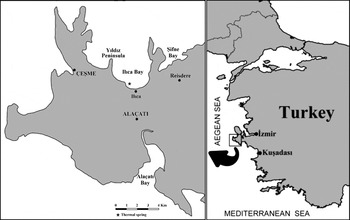
Şifne, located to the west of İzmir and north-east of Çeşme-Ilıca Bay, is a region rich in thermal springs and fountains (Figure 1). The temperature of these springs varies between 42°C and 59°C (Çağlar, Reference Çağlar1946; Başkan & Canik, Reference Başkan and Canik1983). Apart from these, numerous springs have been spotted underwater; and it was suggested that the temperature of these submarine springs varied between 50°C and 62°C and they were classified as salt water springs (Çağlar, Reference Çağlar1946).
Map of Ilıca Bay and the location of the submarine spring (★).

A hot water spring, with a temperature of 28.4°C, is found to the south of the breakwater in the Cape of Yıldız (north-east Ilıca Bay), at a depth of 2.5 m (6 November 2008). In a previous research its temperature has been recorded as 58°C (Çağlar, Reference Çağlar1946; Anon, Reference Anon1974, Reference Anon1999). The spring has been shown to have high radioactivity characteristics.
It is considered that temperature is the major factor limiting the distribution of larger zooxanthellate-bearing foraminifera in tropical and subtropical seas. According to Langer & Hottinger (Reference Langer and Hottinger2000) the occurrence of living amphisteginids are delimited by the 14°C winter isotherm. Laboratory experiments showed that Amphistegina lobifera Larsen ceased all movements at temperatures below 12°C (Zmiri et al., Reference Zmiri, Kahan, Hochstein and Reiss1974). However, Indo-Pacific originated Soritids, Peneroplids and Amphisteginids, such as Sorites orbiculus, Coscinospira hemprichii and Amphistegina lobifera have been recorded in the Aegean Sea (Avşar & Meriç, Reference Avşar and Meriç2001; Koukousioura et al., Reference Koukousioura, Dimiza and Triantaphyllou2010). The average surface temperature of the Aegean Sea is between 9°C and 26°C, suggesting that either the thermophilic alien species are adapted to colder habitats, or they take advantage of the hot submarine springs. High abundance of Amphistegina lobifera Larsen populations around the submarine spring in Pamucak Cove (Kuşadası, Turkey) indicates the effectiveness of the submarine springs in establishing a stable population in colder seas (Meriç et al., Reference Meriç, Yokeş, Avşar and Bircan2010).
The numerous presences of Coscinospira hemprichii Ehrenberg, Laevipeneroplis karreri (Wiesner), Peneroplis pertusus (Forsskål), P. planatus (Fichtel & Moll) and Sorites orbiculus Ehrenberg individuals on the coast of Ilıca Bay and its surroundings, suggests the existence of specific ecological characteristics on this region. The presence of the thermal spring in the bay and the effect of sunshine in the surrounding area due to the fact that the water is not too deep, support the generous phytoplanktonic existence which can in fact be a nutritional source for other organisms. The temperature that the spring creates together with the effect of the sunshine and the chemical composition suggests that there is/can be a rich biotope created around the spring to facilitate the existence of the above mentioned benthic foraminifer genera and species. Apart from this, the fact that temperature alone is a primary reason to facilitate and maintain life in lightless deep environments has been repeatedly indicated by various researchers (Ballard, Reference Ballard1976; Corliss & Ballard, Reference Corliss and Ballard1977; Ballard & Grassie, Reference Ballard and Grassie1979; Enright et al., Reference Enright, Newman, Hessler and McGowan1981; Meriç, Reference Meriç1986; Lutz, Reference Lutz2000; Avşar & Meriç, Reference Avşar and Meriç2001). As another indicator of this fact, a clear difference between the foraminifer assemblages of Ilıca Bay and the coast of Çeşme-Alaçatı was observed. To be more specific, there exists a significant dominance of peneroplids in Ilıca Bay, whereas elphidiids show a significant dominance on the latter area (Sözeri, Reference Sözeri1966; Sellier de Civrieux, Reference Sellier de Civrieux1970; Meriç, Reference Meriç1986; Avşar & Meriç, Reference Avşar and Meriç2001).
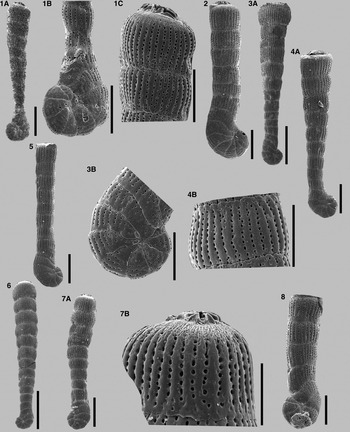
Together with the native species, individuals of West Pacific originated foraminifer Coscinospira acicularis (Batsch) were found in the recent sediments collected around the spring, which constitutes the first observation of this species in the Mediterranean Sea. Scanning electron microscopy photographs of Coscinospira acicularis were taken with a Jeol JSM-6490 LV (Figure 3).
MATERIALS AND METHODS
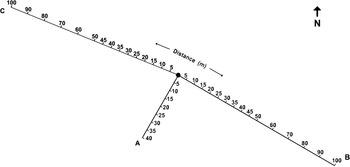
Taking the centre of the spring as the starting point, three transect lines with different angles were set (Line A: 210°, Line B: 120° and Line C: 292°). In the first 50 m from the spring, sediment samples were collected at each 5 m distance and at each 10 m distance between 50 and 100 m (Figure 2). Five grams of wet samples were weighed and kept for 24 hours after adding 10% H2O2. The samples were washed over a 0.063-mm sieve with pressurized water, dried in the incubator at 50°C and separated with 2.00, 1.00, 0.500, 0.250, and 0.125-mm sieves. The foraminifer species were identified under binocular microscope.
Coscinospira acicularis was named by Batsch as Nautilus (Lituus) acicularis in 1791. After then, several names were used by different researchers; Peneroplis pertusus cylindraceus Lamarck (Brady, Reference Brady1884), Spirolina acicularis (Batsch) (Cushman, Reference Cushman1933; Graham & Militante, Reference Graham and Militante1959; Barker, Reference Barker1960; Zheng, Reference Zheng1979), Dendritina acicularis (Batsch) (Hofker, Reference Hofker1951), Peneroplis pertusus (Forsskål) acicularis (Batsch) (Baccaert, Reference Baccaert1987), Spirolina acicularis (Batsch) (Hatta & Ujiie, Reference Hatta and Ujiie1992a, Reference Hatta and Ujiieb), Monalysidium acicularis (Batsch) (Hottinger et al., Reference Hottinger, Halicz and Reiss1993) and Coscinospira acicularis (Batsch) (Loeblich & Tappan, Reference Loeblich and Tappan1994).
Transect lines. The spring was taken as the centre and three lines were set on the sea bottom: A, B and C. The angles of the lines compared with north were A, 210°; B, 120°; C, 292°.

Coscinospira acicularis (Batsch): (1A) side view; (1B) detail view of the first chambers; (1C) detail views of the last chambers and aperture, Çeşme-Ilıca Bay, Aegean Sea, Station Line B5/3.30 m; (2A) side view, Çeşme-Ilıca Bay, Aegean Sea, Station Line C5/2.50 m; (3A) side view; (3B) detail view of the first chambers, Çeşme-Ilıca Bay, Aegean Sea, Station Line C5/2.50 m; (4A) side view and detail view of chamber, Çeşme-Ilıca Bay, Aegean Sea, Station Line A5/3.20 m; (5) side view, Çeşme-Ilıca Bay, Aegean Sea, Station Line A5/3.20 m; (6) side view, Çeşme-Ilıca Bay, Aegean Sea, Station Line A5/3.20 m; (7A) side view; (7B) detail view of the last chamber and aperture, Çeşme-Ilıca Bay, Aegean Sea, Station Line A5/3.20 m; (8) side view, Çeşme-Ilıca Bay, Aegean Sea, Station Line B5/3.30 m. Scale bars: 100 µm.

RESULTS
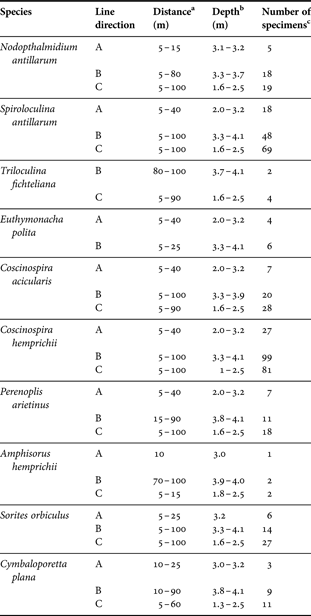
A total of 38 sediment samples were analysed. The foraminiferal assemblages were found to include Vertebralina striata d'Orbigny, Wiesnerella auriculata (Egger), Nodopthalmidium antillarum (Cushman), Nubecularia lucifuga Defrance, Adelosina carinata-striata Wiesner, Spiroloculina ornata d'Orbigny, Triloculina marioni Schlumberger, Euthymonacha polita (Chapman), Coscinospira acicularis (Batsch), C. hemprichii Ehrenberg, Laevipeneroplis karreri (Wiesner), Peneroplis arietinus Batsch, P. pertusus (Forsskål), P. planatus (Fichtel & Moll), Sorites orbiculus Ehrenberg, Lobatula lobatula (Walker & Jacob), Planorbulina mediterranensis d'Orbigny, Asterigerinata mamilla (Williamson), Elphidium aculeatum (d'Orbigny) and E. crispum (Linné). The most important finding is the first observation of Coscinospira acicularis (Batsch) in the Mediterranean Sea. In addition to Peneroplis arietinus Batsch which has previously been recorded from south-west Antalya (Meriç et al., Reference Meriç, Avşar and Yokeş2008), Nodopthalmidium antillarum (Cushman) from the Gulf of Iskenderun (Meriç et al., Reference Meriç, Avşar and Yokeş2008) and the Gulf of Kuşadası (unpublished data), and Euthymonacha polita (Chapman) from the Gulf of Kuşadası (Meriç et al., Reference Meriç, Yokeş, Avşar and Bircan2010) were recorded (Table 1).
The alien species observed in the study area.
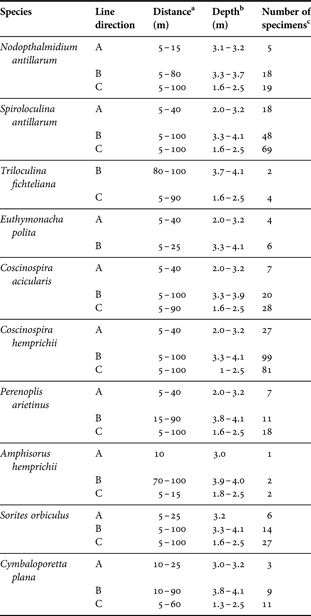
a, distance range of the stations according to the spring; b, depth-range of the stations; c, total number of individuals collected from all stations.
DISCUSSION
In their previous researches, Sözeri (Reference Sözeri1966) and Sellier de Civrieux (Reference Sellier de Civrieux1970) (who studied the same material as Sözeri) have not mentioned the presence of Coscinospira hemprichii Ehrenberg, Coscinospira acicularis (Batsch) and Amphisorus hemprichii Ehrenberg around the study area. This suggests that the above mentioned alien foraminifers have recently arrived at the Aegean coasts. The alien foraminifer Amphistegina lobifera Larsen was found to be dominant around the submarine spring in the Gulf of Kuşadası (Meriç et al., Reference Meriç, Yokeş, Avşar and Bircan2010). But, not a single specimen was observed in Ilıca Bay. However, recently it was shown to be abundant on the northern coasts of the Karaburun Peninsula (İzmir) (unpublished data), which suggests that the range of extension is northward.
Coscinospira acicularis (Batsch) and Euthymonacha polita (Chapman) are only recorded on the Aegean coasts of Turkey and only around submarine springs. Their absence on the eastern Mediterranean coasts suggests that these species might have been introduced via ballast waters and found a chance to survive in the special ecological conditions created by the warm waters of the submarine spring, indicating that thermophilic alien species will enlarge their range of extensions in the Aegean Sea through these thermal submarine springs.
ACKNOWLEDGEMENTS
The authors would like to thank Nihat Bozdoğan and Erhan Yilmaz for their support in the scanning electron microscopy (Jeol JSM-6490 LV) photography, and to physicist Tuğrul Tüzüner for taking the photographs (Turkish Petroleum Corporation Research Center, Ankara).